The graph shows the salvage value of a car over 5 years.
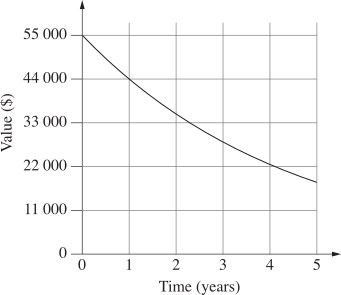
The salvage values are based on the declining-balance method.
By what amount will the car’s value depreciate during the 10th year? (4 marks)
--- 12 WORK AREA LINES (style=lined) ---
Aussie Maths & Science Teachers: Save your time with SmarterEd
The graph shows the salvage value of a car over 5 years.
The salvage values are based on the declining-balance method.
By what amount will the car’s value depreciate during the 10th year? (4 marks)
--- 12 WORK AREA LINES (style=lined) ---
A car is valued at $25 000 when new. Its value depreciates by 25% per annum.
Which of the following best describes the change in value of the car after one year?
The graph shows the decreasing value of an asset.
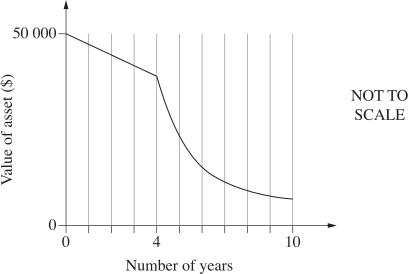
For the first 4 years, the value of the asset depreciated by $1500 per year, using a straight-line method of depreciation.
After the end of the 4th year, the method of depreciation changed to the declining-balance method at the rate of 35% per annum.
What is the total depreciation at the end of 10 years? (4 marks)
--- 10 WORK AREA LINES (style=lined) ---
A plumber leases equipment which is valued at $60 000.
The salvage value of the equipment at any time can be calculated using either of the two methods of depreciation shown in the table.
\begin{array} {|l|c|}
\hline
\rule{0pt}{2.5ex} \textit{Method of depreciation} \rule[-1ex]{0pt}{0pt} & \textit{Rate of depreciation} \\
\hline
\rule{0pt}{2.5ex} \text{Straight-line method} \rule[-1ex]{0pt}{0pt} & \text{\$3500 per annum} \\
\hline
\rule{0pt}{2.5ex} \text{Declining-balance method} \rule[-1ex]{0pt}{0pt} & \text{12% per annum} \\
\hline
\end{array}
Under which method of depreciation would the salvage value of the equipment be lower at the end of 3 years? Justify your answer with appropriate mathematical calculations. (3 marks)
--- 6 WORK AREA LINES (style=lined) ---
A car is purchased for $15 000. The graph shows the value of the car, `$V`, at time `t` years since it was purchased, using the declining-balance method of depreciation.
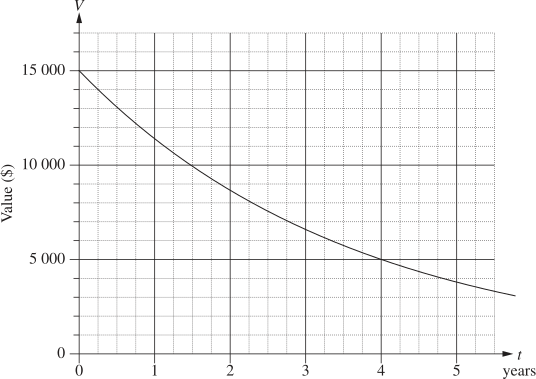
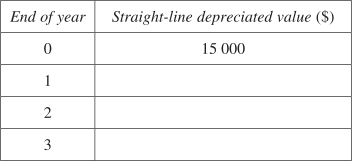
When using the straight-line method of depreciation, the value of the car depreciates at a rate of $2500 per year.
By first completing the table, plot on the grid above the value of the car for the first three years based on the straight-line method of depreciation. (2 marks)
--- 1 WORK AREA LINES (style=lined) ---
a.
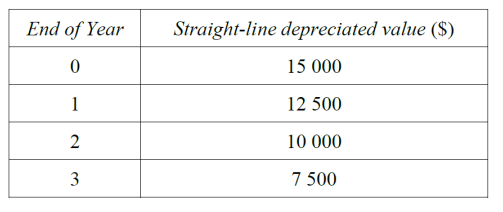
b.
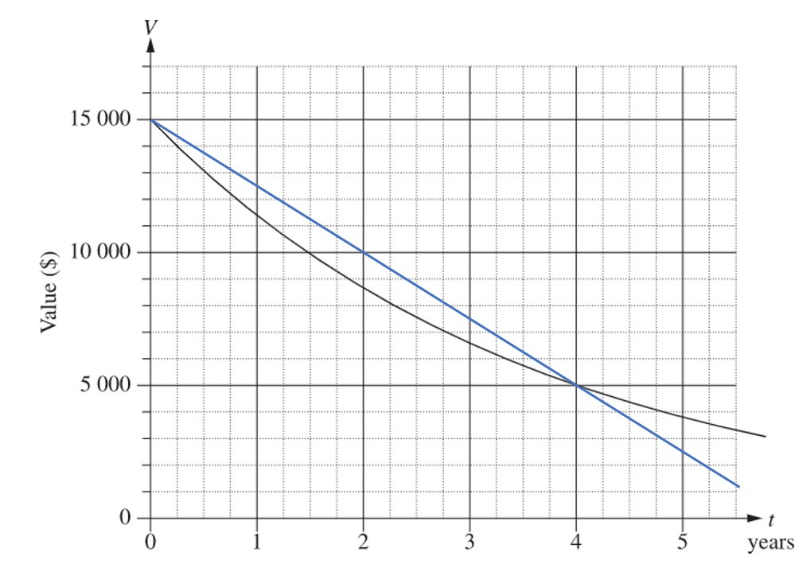
Values are equal when graphs intersect
→ after 4 years
a.
b.
Values are equal when graphs intersect
→ after 4 years
Yin purchased a car for $20 000. The value of the car decreases according to a linear model. The graph shows the value of the car, $\(V\), against the time, \(t\) months, since it was purchased.

--- 2 WORK AREA LINES (style=lined) ---
--- 1 WORK AREA LINES (style=lined) ---
--- 2 WORK AREA LINES (style=lined) ---
Three years ago an appliance was valued at $2467. Its value has depreciated by 15% each year, based on the declining-balance method.
What is the salvage value today, to the nearest dollar?
Adam purchased some office furniture five years ago. It depreciated by $2300 each year based on the straight-line method of depreciation. The salvage value of the furniture is now $7500.
Find the initial value of the office furniture. (2 marks)
--- 4 WORK AREA LINES (style=lined) ---
An asset is depreciated using the declining-balance method with a rate of depreciation of 8% per half year. The asset was bought for $10 000.
What is the salvage value of the asset after 5 years?
A new car is bought for $24 950. Each year the value of the car depreciates by 14%.
Using the declining-balance method, calculate the salvage value of the car at the end of 10 years. (2 marks)
A new car is bought for $24 950. Each year the value of the car is depreciated by the same percentage.
The table shows the value of the car, based on the declining-balance method of depreciation, for the first three years.
\begin{array} {|c|c|}
\hline
\rule{0pt}{2.5ex}\textit{End of year}\rule[-1ex]{0pt}{0pt} & \textit{Value}\\
\hline
\rule{0pt}{2.5ex}1\rule[-1ex]{0pt}{0pt} & \$21\ 457.00 \\
\hline
\rule{0pt}{2.5ex}2\rule[-1ex]{0pt}{0pt} & \$18\ 453.02 \\
\hline
\rule{0pt}{2.5ex}3\rule[-1ex]{0pt}{0pt} & \$15\ 869.60 \\
\hline
\end{array}
What is the value of the car at the end of 10 years? (3 marks)
--- 6 WORK AREA LINES (style=lined) ---
A car is purchased for $23 900.
The value of the car is depreciated by 11.5% each year using the declining-balance method.
What is the value of the car after three years? (2 marks)
--- 4 WORK AREA LINES (style=lined) ---
Michelle intends to keep a car purchased for $17 000 for 15 years. At the end of this time its value will be $3500.
--- 2 WORK AREA LINES (style=lined) ---
--- 2 WORK AREA LINES (style=lined) ---
Khan paid $900 for a printer.
This price includes 10% GST (goods and services tax).
Write your answer correct to the nearest cent. (2 marks)
--- 4 WORK AREA LINES (style=lined) ---
Under flat rate depreciation the printer will be valued at $300 after five years.
Calculate the annual depreciation in dollars. (1 mark)
--- 2 WORK AREA LINES (style=lined) ---
A company purchased a machine for $60 000.
For taxation purposes the machine is depreciated over time using the straight line depreciation method.
The machine is depreciated at a flat rate of 10% of the purchase price each year.
--- 1 WORK AREA LINES (style=lined) ---
--- 2 WORK AREA LINES (style=lined) ---
--- 2 WORK AREA LINES (style=lined) ---
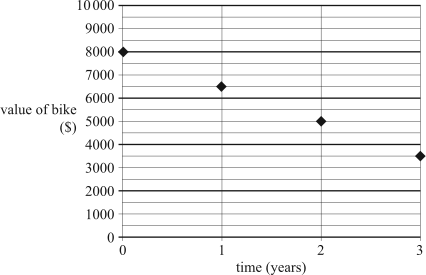
Hugo is a professional bike rider.
The value of his bike will be depreciated over time using the flat rate method of depreciation.
The graph below shows his bike’s initial purchase price and its value at the end of each year for a period of three years.
--- 1 WORK AREA LINES (style=lined) ---
--- 2 WORK AREA LINES (style=lined) ---
--- 2 WORK AREA LINES (style=lined) ---
Rae paid $40 000 for new office equipment at the start of the 2013 financial year.
At the start of each following financial year, she used flat rate depreciation to revalue her equipment.
At the start of the 2016 financial year she revalued her equipment at $22 000.
The annual flat rate of depreciation she used, as a percentage of the purchase price, was
A new car was bought for $19 900 and one year later its value had depreciated to $16 300.
What is the approximate depreciation, expressed as a percentage of the purchase price?
A piece of machinery, initially worth $56 000, depreciates at 8% per annum.
Which graph best shows the salvage value of this piece of machinery over time?


Kai purchased a new car for $30 000. It depreciated in value by $2000 per year for the first three years.
After the end of the third year, Kai changed the method of depreciation to the declining balance method at the rate of 25% per annum.
--- 1 WORK AREA LINES (style=lined) ---
--- 4 WORK AREA LINES (style=lined) ---
Use the horizontal axis to represent time and the vertical axis to represent the value of the car. (3 marks)
--- 8 WORK AREA LINES (style=lined) ---
a. `text(Using)\ \ S = V_0-Dn`
`S= 30\ 000-(2000 xx 3)= $24\ 000`
b. `text(Using)\ \ S = V_0(1-r)^n`
`text(where)\ V_0= 24\ 000,\ r=0.25,\ n=4`
`S= 24\ 000(1-0.25)^4= $7593.75`
`:.\ text(The value of the car after 7 years is $7593.75)`
| c. |
|
A sports car worth $150 000 is bought in December 2005.
In December each year, beginning in 2006, the value of the sports car is depreciated by 10% using the declining balance method of depreciation.
In which year will the depreciated value first fall below $120 000? (2 marks)
--- 5 WORK AREA LINES (style=lined) ---
A car bought for $50 000 is depreciated using the declining balance method.
Which graph best represents the salvage value of the car over time?


Tai uses the declining balance method of depreciation to calculate tax deductions for her business. Tai’s computer is valued at $6500 at the start of the 2003 financial year. The rate of depreciation is 40% per annum.
--- 1 WORK AREA LINES (style=lined) ---
--- 3 WORK AREA LINES (style=lined) ---
The value of a car is depreciated using the declining balance method.
Which graph best illustrates the value of the car over time?


A plasma TV depreciated in value by 15% per annum. Two years after it was purchased it had depreciated to a value of $2023, using the declining balance method.
What was the purchase price of the plasma TV? (2 marks)
--- 4 WORK AREA LINES (style=lined) ---
A car is bought for $19 990. It will depreciate at 18% per annum.
Using the declining balance method, what will be the salvage value of the car after 3 years, to the nearest dollar?
Norman and Pat each bought the same type of tractor for $60 000 at the same time. The value of their tractors depreciated over time.
The salvage value `S`, in dollars, of each tractor, is its depreciated value after `n` years.
Norman drew a graph to represent the salvage value of his tractor.

--- 2 WORK AREA LINES (style=lined) ---
--- 2 WORK AREA LINES (style=lined) ---
--- 3 WORK AREA LINES (style=lined) ---
--- 4 WORK AREA LINES (style=lined) ---
Pat used the declining balance formula for calculating the salvage value of her tractor. The depreciation rate that she used was 20% per annum.
--- 4 WORK AREA LINES (style=lined) ---
--- 2 WORK AREA LINES (style=lined) ---
Zheng has purchased a computer for $5000 for his company. He wants to compare two different methods of depreciation over two years for the computer.
Method 1: Straight-line with $1250 depreciation per annum.
Method 2: Declining balance with 35% depreciation per annum.
Which method gives the greatest depreciation over the two years? Justify your answer with suitable calculations. (3 marks)
--- 6 WORK AREA LINES (style=lined) ---
Jay bought a computer for $3600. His friend Julie said that all computers are worth nothing (i.e. the value is $0) after 3 years.
--- 3 WORK AREA LINES (style=lined) ---
--- 4 WORK AREA LINES (style=lined) ---
Which of the following graphs shows the lowest rate of depreciation over the given time period?


Jim buys a photocopier for $22 000.
Its value is depreciated using the declining balance method at the rate of 15% per annum.
What is its value at the end of 3 years? (2 marks)
A machine was bought for $25 000.
Which graph best represents the salvage value of the machine over 10 years using the declining balance method of depreciation?
| (A) | 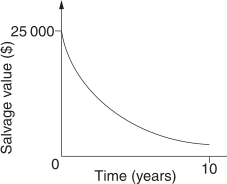 |
(B) | 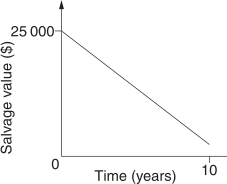 |
|
| (C) | 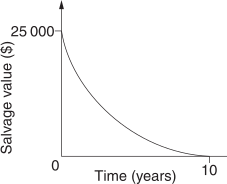 |
(D) | 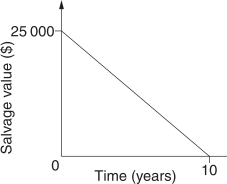 |
