SmarterEd

Aussie Maths & Science Teachers: Save your time with SmarterEd

  • Login
  • Get Help
  • About

Measurement, STD2 M7 2025 HSC 24

The population of snails in a garden is approximately 90.

One night Bobbie collected 18 snails from the garden. He tagged each snail and released it back into the garden.

The next night 20 snails were captured from the garden.

Approximately how many of the snails in the second sample are expected to have a tag?   (2 marks)

--- 8 WORK AREA LINES (style=lined) ---
Show Answers Only

\(\text{4 snails}\)

Show Worked Solution

\(\text{Snail population}=90\)

\(\text{After 1st night tagging:}\)

\(\text{% snails with tag}=\dfrac{18}{90} = 20\% \)

\(\text{Expected snails with tags \((s)\):}\)

\(s=20\% \times 20 = 4\)

Filed Under: Ratio and Scale, Ratios Tagged With: Band 4, smc-1187-30-Capture/Recapture, smc-6931-30-Capture/Recapture

Measurement, STD2 M7 2025 HSC 9 MC

The ratio of the dimensions of a model car to the dimensions of an actual car is \(1:64\). The actual car has a length of 4.9 m.

What is the length of the model car in cm, correct to 1 decimal place?

  1. 3.1
  2. 7.7
  3. 13.1
  4. 59.1
Show Answers Only

\(B\)

Show Worked Solution

\(\text{Actual length}=4.9\ \text{m}\ =490\ \text{cm}\)

\(\therefore\ \text{Model car length}\ =490\times\dfrac{1}{64}=7.65625\approx 7.7\ \text{cm}\)

 \(\Rightarrow B\)

Filed Under: Ratio and Scale, Ratios Tagged With: Band 4, smc-1187-40-Maps and Scale Drawings, smc-6931-40-Maps and Scale Drawings

Measurement, STD2 M7 2024 HSC 38

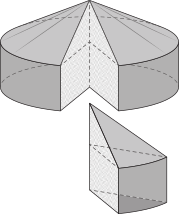
A cake is constructed using a cylinder and a cone-shaped top. The cylinder has diameter 30 cm and height 6 cm.
 

The ratio of the volume of the cylinder to the volume of the cone-shaped top is \(5:1\).

The cake is to be cut into equal slices with volume 212 cm\(^{3}\).

How many equal slices can be cut from the cake?   (3 marks)

--- 8 WORK AREA LINES (style=lined) ---
Show Answers Only

\(24\ \text{slices}\)

Show Worked Solution
\(V_{\text{cylinder}}\) \(=\pi r^{2}h\)  
  \(=\pi \times 15^{2} \times 6\)  
  \(=4241.15\ \text{cm}^{3}\)  

 
\(V_{\text{cylinder}} : V_{\text{cone}} = 5:1\)

\(\Rightarrow V_{\text{cone}} = \dfrac{1}{5} \times 4241.15=848.23\ \text{cm}^{3}\)

\(\text{Volume of cake}\ = 4241.15+848.23=5089.4\ \text{cm}^{3}\)

\(\therefore\ \text{Number of slices}\ \) \(=\dfrac{5089.4}{212}\)  
  \(=24\ \text{slices}\)  
♦♦ Mean mark 36%.

Filed Under: Ratio and Scale, Ratios Tagged With: Band 5, smc-1187-10-Ratio (2 part), smc-1187-70-X-Topic PAV, smc-6931-10-Ratio (2 part), smc-6931-70-X-Topic PAV

Measurement, STD2 M7 2023 HSC 26

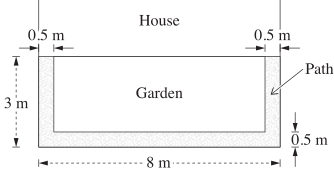
Kim is building a path around a garden at the back of a house, as shown. The path is 0.5 m wide.

  1. Find the area of the path.   (2 marks)

    --- 4 WORK AREA LINES (style=lined) ---

  2. Kim is mixing some concrete for the path. The concrete mix is made up of crushed rock, sand and cement in the ratio of 4 : 2 : 1 by weight.
  3. Kim needs 2.1 tonnes of concrete in the correct ratio.
  4. Calculate how many 15 kg bags of cement Kim needs to buy.   (3 marks)

    --- 6 WORK AREA LINES (style=lined) ---

Show Answers Only

a.   `6.5\ text{m}^2`

b.   `20\ text{bags}`

Show Worked Solution

a.    `text{Area outer rectangle}\ = 3xx8=24\ text{m}^2`

`text{Area garden}\ = 2.5xx7=17.5\ text{m}^2`

`A_text{path}=24-17.5=6.5\ text{m}^2`
  

b.    `text{7 parts = 2.1 tonnes}`

`text{1 part}\ = 2.1/7=0.3\ text{tonnes}\ =300\ text{kgs}`

`text{Rock}:text{Sand}:text{Cement} = 4:2:1 = 1200:600:300`

`=>\ text{300 kgs of cement are required}`

`:.\ text{Bags of cement}=300/15=20\ text{bags}`

Filed Under: Perimeter and Area, Perimeter and Area, Perimeter, Area and Volume, Ratio and Scale, Ratios Tagged With: Band 4, smc-1187-20-Ratio (3 part), smc-6483-20-Composite Areas, smc-6520-20-Composite areas, smc-6931-20-Ratio (3 part), smc-798-10-Perimeter and Area

Measurement, STD2 M7 2023 HSC 11 MC

A bag contains 150 jelly beans. Some of them are red and the rest are blue. The ratio of red to blue jelly beans is `2:3`.

Sophie eats 10 of each colour.

What is the new ratio of red to blue jelly beans?

  1. `2:3`
  2. `4:9`
  3. `5:8`
  4. `11:17`
Show Answers Only

`C`

Show Worked Solution

`text{Original ratio}\ = 2:3`

`text{5 parts = 150}\ \ =>\ \ text{1 part}\ = 150/5=30`

`text{Original ratio (by number)}\ = 2 xx 30:3 xx 30 = 60:90`

`text{After eating 10 of each colour:}`

`text{Ratio}\ = 50:80 = 5:8`

`=>C`

Filed Under: Ratio and Scale, Ratios Tagged With: Band 4, smc-1187-10-Ratio (2 part), smc-6931-10-Ratio (2 part)

Measurement, STD2 M7 2022 HSC 38

A full container has 4.8 L of a mixture of cordial and water in the ratio 1:3.

After removing 1.2 L of the mixture, more water is added to refill the container.

What is the ratio of cordial to water in the final mixture?  (3 marks)

--- 6 WORK AREA LINES (style=lined) ---

Show Answers Only

`3:13`

Show Worked Solution

`text{Original mixture ratio}`

`text{C : W = 1.2 litres : 3.6 litres}`

`text{Removing 1.2 L of mixture, removes}`

`text{→ 300 mL cordial and 900 mL water}`
 

`text{Cordial in mixture after refill}`

`=1200-300`

`=900\ text{mL}`
 

`text{Water in mixture after refill}`

`=3600-900+1200`

`=3900\ text{mL}`
 

`:.\ text{C : W (final mixture)}`

`=900:3900`

`=3:13`


♦♦ Mean mark 33%.

Filed Under: Ratio and Scale, Ratios Tagged With: Band 5, smc-1187-10-Ratio (2 part), smc-6931-10-Ratio (2 part)

Measurement, STD2 M7 2022 HSC 6 MC

What is 20 minutes to one-third of a day, expressed as a ratio in simplest form?

  1. `1: 8`
  2. `1: 24`
  3. `60: 1`
  4. `72: 1`
Show Answers Only

`B`

Show Worked Solution

`text{Minutes in}\ 1/3\ text{day}`

`=1/3 xx 24 xx 60`

`=480`
 

`text{Ratio}\ = 20:480 = 1:24`

`=>B`

Filed Under: Ratio and Scale, Ratios Tagged With: Band 4, smc-1187-10-Ratio (2 part), smc-6931-10-Ratio (2 part)

Measurement, STD2 M7 2022 HSC 4 MC

Lily wanted to estimate the number of fish in a lake.

She randomly captured 30 fish, then tagged and released them.

One week later she randomly captured 40 fish from the same lake. She found that 12 of these 40 fish were tagged.

What is the best estimate for the total number of fish in the lake?

  1. 58
  2. 70
  3. 82
  4. 100
Show Answers Only

`D`

Show Worked Solution

`text{Let}\ \ P=\ text{population of fish in lake}`

`text{Capture}\ = 30/P`

`text{Recapture}\ = 12/40`

`30/P` `=12/40`  
`12P` `=30 xx 40`  
`P` `=1200/12`  
  `=100`  

 
`=>D`


♦♦ Mean mark 37%.

Filed Under: Ratio and Scale, Ratios Tagged With: Band 5, smc-1187-30-Capture/Recapture, smc-6931-30-Capture/Recapture

Measurement, STD2 M7 2021 HSC 25

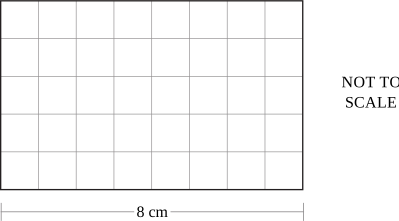
A rectangular sportsground has been drawn to scale on a 1-cm grid as shown. The scale used is `1:3000`.
 

Kerry took 12 minutes to walk around the perimeter of this sportsground.

What was Kerry's average speed in kilometres per hour?  (4 marks)

--- 8 WORK AREA LINES (style=lined) ---
Show Answers Only

`3.9 \ text{km/hr}`

Show Worked Solution
`text{Distance walked on map} \ = \ 2 times  (8 + 5) = 26 \ text{cm}`
Mean mark 54%.


`text{Actual distance}` ` =26 times 3000`  
  `= 78\ 000 \ text{cm}`  
  `=780 \ text{m}`  
  `= 0.78 \ text{km}`  

 
`12 \ text{minutes}\ = 12/60 = 0.2 \ text{hours}`
 

`text{Speed}` `= text{distance}/text{time}`  
  `= 0.78/0.2`  
  `= 3.9 \ text{km/hr}`  

Filed Under: Ratio and Scale, Ratios Tagged With: Band 5, smc-1187-40-Maps and Scale Drawings, smc-6931-40-Maps and Scale Drawings

Measurement, STD2 M7 2021 HSC 15 MC

A total of 11 400 people entered a running race. The ratio of professional runners to amateurs was  `3 : 16`. All the professional runners completed the race while 600 of the amateurs did not complete the race.

For those who completed the race, what is the ratio, in its simplest form, of professional runners to amateurs?

  1. `1 : 2`
  2. `1 : 5`
  3. `1 : 8`
  4. `1 : 19`
Show Answers Only

`B`

Show Worked Solution

`3:16 =>\ text(Total parts = 19)`

♦♦ Mean mark 28%.

`text(Number of professionals) = 3/19 xx 11\ 400 = 1800`

`text(Number of amateurs) = 16/19 xx 11\ 400 = 9600`

`text(Amateurs who finished) = 9600 – 600 = 9000`
 

`:.\ text{Ratio of professionals : amateurs (who finished)}`

`= 1800 : 9000`

`=1:5`

 
`=> B`

Filed Under: Ratio and Scale, Ratios Tagged With: Band 6, smc-1187-10-Ratio (2 part), smc-6931-10-Ratio (2 part)

Measurement, STD2 M7 2020 HSC 23

In a tropical drink, the ratio of pineapple juice to mango juice to orange juice is 15 : 9 : 4 .

  1. How much orange juice is needed if the tropical drink is to contain 3 litres of pineapple juice?  (2 marks)

    --- 4 WORK AREA LINES (style=lined) ---

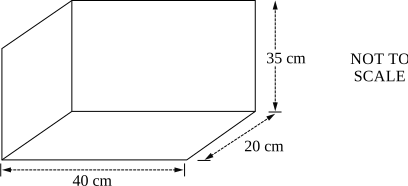
  2. The internal dimensions of a drink container, in the shape of a rectangular prism, are shown.


    To completely fill the container with the tropical drink, how many litres of mango juice are required. (3 marks)

    --- 6 WORK AREA LINES (style=lined) ---
Show Answers Only
  1. `0.8 \ text{L}`
  2. `9\ text{L}`
Show Worked Solution
a.    `text(15 parts)` `= 3\ text(L)`
  `text(1 part)` `=3/15`
    `=0.2\ text(L)`


`:.\ text(4 parts)` `=4 xx 0.2`  
  `=0.8\ text(L)`  


Mean mark 51%.
b.      `text{Volume of container}` `= 40 xx 20 xx 35`
    `= 28 \ 000 \ text{cm}^3`

 
`1 \ text{mL} \ to \ 1 \ text{cm}^3`

`⇒ \ 28 \ 000 \ text{mL of tropical drink}`

`therefore \ text{Mango juice required}` `=text(Mango parts)/text(Total parts) xx 28\ 000`
  `= frac{9}(28} xx 28 \ 000`
  `= 9000 \ text{mL}`
  `=9\ text(L)`

Filed Under: Ratio and Scale, Ratios Tagged With: Band 4, Band 5, smc-1187-20-Ratio (3 part), smc-6931-20-Ratio (3 part)

Measurement, STD2 M7 SM-Bank 1 MC

A dog breeder owns 500 dogs.

150 are Ridgebacks and the rest are Pugs.

What is the ratio of Ridgebacks to Pugs?

  1. 3 : 5
  2. 3 : 7
  3. 3 : 9
  4. 3 : 10
Show Answers Only

`B`

Show Worked Solution

`text(S)text(ince 150 are ridgebacks,)`

`=> 500-150=350\ text(pugs)`

`text(Ridgebacks)` `:\ text(Pugs)`
`150` `: 350`
`3` `: 7`

 
`=> B`

Filed Under: Ratio and Scale, Ratios Tagged With: Band 4, smc-1187-10-Ratio (2 part), smc-6931-10-Ratio (2 part)

Measurement, STD2 M7 SM-Bank 17

There are 48 people in a meeting room.

The ratio of females to males in the room is 13 to 11.

How many females need to leave the room so that the ratio of females to males in the room is 1 to 1?   (2 marks)

--- 4 WORK AREA LINES (style=lined) ---

Show Answers Only

`4\ text(females)`

Show Worked Solution

`text(Females : Males) = 13 : 11`

`text(S)text(ince there are 48 people in the room,)`

`26\ text(females : 22 males.)`


`:. 4\ text(females need to leave for the ratio to become 1 : 1)`

Filed Under: Ratio and Scale, Ratios Tagged With: Band 4, smc-1187-10-Ratio (2 part), smc-6931-10-Ratio (2 part)

Measurement, STD2 M7 EQ-Bank 13

A scalene triangle has angles in the ratio  9 : 2 : 4.

In degrees, what is the size of its largest angle?   (2 marks)

Show Answers Only

`108°`

Show Worked Solution
`text(Largest angle)` `= text(largest part)/text(total parts) xx 180`
  `= 9/(9+2+4) xx 180`
  `= 108°`

Filed Under: M5 Scale Drawings (Y12), Ratio and Scale, Ratios, Ratios Tagged With: Band 4, smc-1105-50-Ratio (3 part), smc-1187-20-Ratio (3 part), smc-6858-50-Ratio (3 part), smc-6931-20-Ratio (3 part)

Measurement, STD2 M7 2019 HSC 41

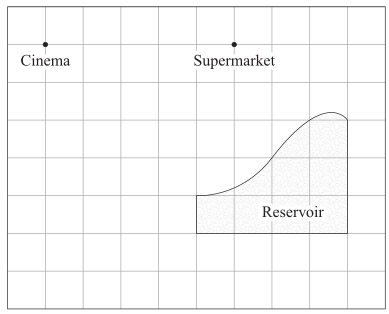
A map is drawn to scale, on 1-cm paper, showing the position of a supermarket and a cinema. A reservoir is also shown.
 

  1. It takes 10 minutes to walk in a straight line from the cinema to the supermarket at a constant speed of 3 km/h. Show that the scale of the map is 1 cm = 100 m.   (3 marks)

    --- 6 WORK AREA LINES (style=lined) ---

  2. The reservoir is initially empty. During a storm 20 mm of rain falls on the reservoir.


    With the aid of one application of the trapezoidal rule, estimate the amount of water in the reservoir immediately after the storm. Assume that all rain which falls over the reservoir is stored. Give your answer in cubic metres.   (3 marks)

    --- 6 WORK AREA LINES (style=lined) ---

Show Answers Only

a.   `text(See Worked Solutions)`

b.   `1600\ text(m)^3`

Show Worked Solution

a.   `text(3 km/h = 3000 metres per 60 minutes)`

♦ Mean mark part (a) 49%.

`text(In 10 minutes:)`

`text(Actual distance) = 3000 xx 10/60 = 500\ text(metres)`

`text(Distance on map = 5 cm)`

`:.\ text(Scale   5 cm)` `: 500\ text(metres)`
`text(1 cm)` `: 100\ text(metres)`


b.   

 
`A~~ h/2(a + b)~~ 400/2(100 + 300)~~ 80\ 000\ text(m)^2`

`text(Converting mm to metres:)`

♦♦ Mean mark part (b) 28%.

`text(20 mm) = 20/1000 text(m = 0.02 metres)`

 
`:.\ text(Volume of water)`

`= A xx h= 80\ 000 xx 0.02= 1600\ text(m)^3`

Filed Under: Ratio and Scale, Ratios, Trapezoidal Rule, Trapezoidal Rule Tagged With: Band 5, smc-1187-40-Maps and Scale Drawings, smc-6328-20-Volume, smc-6328-30-1-3 Approximations, smc-6931-40-Maps and Scale Drawings, smc-941-10-Area, smc-941-30-1-3 Approximations

Measurement, STD2 M7 2019 HSC 18

Andrew, Brandon and Cosmo are the first three batters in the school cricket team. In a recent match, Andrew scored 30 runs, Brandon scored 25 runs and Cosmo scored 40 runs.

  1. What is the ratio of Andrew's to Brandon's to Cosmo's runs scored, in simplest form?  (2 marks)

    --- 4 WORK AREA LINES (style=lined) ---

  2. In this match, the ratio of the total number of runs scored by Andrew, Brandon and Cosmo to the total number of runs scored by the whole team is `19:36`.
  3. How many runs were scored by the whole team?  (2 marks)

    --- 4 WORK AREA LINES (style=lined) ---

Show Answers Only
  1. `6:5:8`
  2. `180\ text(runs)`
Show Worked Solution
a.    `A:B:C` `= 30:25:40`
    `= 6:5:8`


b.    `text(Total runs by)\ A,B,C` `= 30 + 25 + 40`
    `= 95`


`text(Let)\ R` `=\ text(team runs)`
`R/95` `= 36/19`
`:. R` `= (36 xx 95)/19`
  `= 180\ text(runs)`

Filed Under: Ratio and Scale, Ratios Tagged With: Band 3, Band 4, smc-1187-10-Ratio (2 part), smc-1187-20-Ratio (3 part), smc-6931-10-Ratio (2 part), smc-6931-20-Ratio (3 part)

Measurement, STD2 M7 SM-Bank 11

On a map, the distance between two towns is measured at 54 millimetres.

  1. The actual distance between the two towns is 16.2 kilometres. What is the scale of the map?  (1 mark)

    --- 1 WORK AREA LINES (style=lined) ---

  2. If two other towns on the same map are 9.2 centimetres apart, what is the actual distance between the two towns in kilometres?  (1 mark)

    --- 1 WORK AREA LINES (style=lined) ---

Show Answers Only
  1. `1: 300\ 000`
  2. `27.6\ text(km)`
Show Worked Solution

i.   `text{Convert both distance to the same unit (cm).}`

`text(54 mm)` `= 5.4\ text(cm)`
`text(16.2 km)` `= 16\ 200\ text(m)`
  `= 1\ 620\ 000\ text(cm)`


`:.\ text(Scale) \ \ 5.4\ ` `: 1\ 620\ 000`
`1\ ` `: 300\ 000`


ii.    `text(Actual distance)` `= 9.2 xx 300\ 000`
    `= 2\ 760\ 000\ text(cm)`
    `= 27\ 600\ text(m)`
    `= 27.6\ text(km)`

Filed Under: Ratio and Scale, Ratios Tagged With: Band 5, smc-1187-40-Maps and Scale Drawings, smc-6931-40-Maps and Scale Drawings

Measurement, STD2 M7 SM-Bank 10

A potting mix is made up of two ingredients, potting soil and manure, in the ratio 5:2.

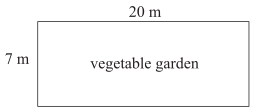
21 kilograms of potting mix are used to fertilise the  rectangular vegetable garden pictured below.


  1. What rate must the whole 21 kilograms of potting mix be applied to be spread evenly over the garden. Give your answer in grams per square metre.  (2 marks)

    --- 4 WORK AREA LINES (style=lined) ---

  2. How much manure is needed to make the required potting mix?  (1 mark)

    --- 1 WORK AREA LINES (style=lined) ---

Show Answers Only
  1. `150\ text(g/m²)`
  2. `text(6 kg)`
Show Worked Solution

i.   `text(Potting mix: 21 kg  ⇒  21, 000 grams)`

`text(Area of garden)` `= 20 xx 7`  
  `= 140\ text(m²)`  


`:.\ text(Rate)` `= (21\ 000)/140`
  `= 150\ text(g/m²)`


ii.
   `text(Ratio  5 : 2)\ \ =>\ \ 5/7 : 2/7`

`:.\ text(Amount of manure)` `= 2/7 xx 21`
  `= 6\ text(kg)`

Filed Under: Ratio and Scale, Ratios Tagged With: Band 4, smc-1187-10-Ratio (2 part), smc-6931-10-Ratio (2 part)

Measurement, STD2 M7 SM-Bank 9

A farmer sells 216 sheep at a livestock auction.

Three buyers purchased all the sheep in the ratio  7:3:2

How many sheep did the buyer of the highest number of sheep purchase?  (2 marks)

--- 4 WORK AREA LINES (style=lined) ---

Show Answers Only

`126\ text(sheep)`

Show Worked Solution

`7:3:2 => 7/12: 3/12:2/12`

`:.\ text(Buyer of the most sheep)`

`= 7/12 xx 216`

`= 126\ text(sheep)`

Filed Under: Ratio and Scale, Ratios Tagged With: Band 5, smc-1187-20-Ratio (3 part), smc-6931-20-Ratio (3 part)

Measurement, STD2 M7 EQ-Bank 7

The scale on a given map is `1:80\ 000`.

If the actual distance between two points is 3.4 kilometres, how far apart on the map would be the two points be, in centimetres?   (2 marks)

--- 4 WORK AREA LINES (style=lined) ---

Show Answers Only

`4.25\ text(cm)`

Show Worked Solution

`text(Actual distance on map)`

`= text(real distance)/text(scale)`

`= text(3.4 km)/(80\ 000)`

`= text(3400 m)/(80\ 000)`

`= 0.0425\ text(m)`

`= 4.25\ text(cm)`

Filed Under: M5 Scale Drawings (Y12), Ratio and Scale, Ratios, Ratios Tagged With: Band 4, smc-1105-20-Maps and Scale Drawings, smc-1187-40-Maps and Scale Drawings, smc-6858-10-Maps and Scale Drawings, smc-6931-40-Maps and Scale Drawings

Measurement, STD2 M7 EQ-Bank 6

In a raffle, the total prize money is shared among the first two tickets drawn in the ratio  6 : 4.

The prize for the second ticket drawn is $360.

What is the total prize money?   (2 marks)

Show Answers Only

`$900`

Show Worked Solution

`4/10 xx text(Total prize money = $360)`

`=> 1/10 xx text(Total prize money = $90)`

`:.\ text(Total prize money)= 90 xx 10= $900`

Filed Under: M5 Scale Drawings (Y12), Ratio and Scale, Ratios, Ratios Tagged With: Band 4, smc-1105-40-Ratio (2 part), smc-1187-10-Ratio (2 part), smc-6858-40-Ratio (2 part), smc-6931-10-Ratio (2 part)

Measurement, STD2 M7 EQ-Bank 3 MC

There are 8 male chimpanzees in a community of 24 chimpanzees.

What is the ratio of males to females in the community?

  1. 1 : 3
  2. 1 : 2
  3. 3 : 1
  4. 2 : 1
Show Answers Only

`B`

Show Worked Solution
`text(Males)` `:\ text(Females)`
`8` `: (24-8)`
`8` `: 16`
`1` `: 2`

 
`=> B`

Filed Under: M5 Scale Drawings (Y12), Ratio and Scale, Ratios, Ratios Tagged With: Band 3, smc-1105-40-Ratio (2 part), smc-1187-10-Ratio (2 part), smc-6858-40-Ratio (2 part), smc-6931-10-Ratio (2 part)

Measurement, STD2 M7 2016 HSC 28a

Jacob has a large jar of silver coins. He adds 20 gold coins into the jar. He then seals the jar and shakes it to ensure that the gold coins are mixed in thoroughly with the silver coins. Jacob then opens the jar and takes a handful of coins. In his hand he has 33 silver coins and 4 gold coins. 

  1. Based on Jacob’s handful, if a coin is selected at random from the jar, what is the probability that it is a gold coin?  (1 mark)

    --- 1 WORK AREA LINES (style=lined) ---

  2. Jacob returns the handful of coins to the jar. Estimate the total number of coins in the jar.  (2 marks)

    --- 4 WORK AREA LINES (style=lined) ---

Show Answers Only
  1. `4/37`
  2. `185`
Show Worked Solution
i.    `P(G)` `= 4/(4 + 33)`
    `= 4/37`
♦ Mean mark part (i) 28%.


ii.  `text(Let)\ \ X =\ text(total coins in jar.)`

`20/X` `=4/37`
`:.X` `=(20 xx 37)/4`
  `=185`

Filed Under: Combinations and Single Stage Events, DS5/6 - Normal Distribution and Sampling, Ratio and Scale, Ratios, Single stage events Tagged With: Band 4, Band 5, smc-1187-30-Capture/Recapture, smc-6931-30-Capture/Recapture, smc-828-10-Simple Probability

Measurement, STD2 M7 2005 HSC 4 MC

The diagram is a scale drawing of a butterfly.
 

2UG-2005-4MC 
 

What is the actual wingspan of the butterfly?

  1. 2.5 cm
  2. 3 cm
  3. 15 cm
  4. 8.75 cm
Show Answers Only

`B`

Show Worked Solution

`text(Wingspan is 3 times the scale distance)`

`text(that equals 1 cm.)`

`:.\ text(Wingspan)` `= 3 × 1`
  `= 3\ text(cm)`

`=> B`

Filed Under: M5 Scale Drawings (Y12), Ratio and Scale, Ratios, Ratios, Similarity and Scale Tagged With: Band 3, smc-1105-20-Maps and Scale Drawings, smc-1187-40-Maps and Scale Drawings, smc-6858-10-Maps and Scale Drawings, smc-6931-40-Maps and Scale Drawings

Measurement, STD2 M7 2007 HSC 23c

A scientific study uses the ‘capture-recapture’ technique.

In the first stage of the study, 24 crocodiles were caught, tagged and released.

Later, in the second stage of the study, some crocodiles were captured from the same area. Eighteen of these were found to be tagged, which was 40% of the total captured during the second stage. 

  1. How many crocodiles were captured in total during the second stage of the study?  (1 mark)

    --- 2 WORK AREA LINES (style=lined) ---

  2. Calculate the estimate for the total population of crocodiles in this area.   (2 marks)

    --- 4 WORK AREA LINES (style=lined) ---

Show Answers Only
  1. `text(45 crocodiles)`
  2. `text(60 crocodiles)`
Show Worked Solution
i.    `text(Let)\ C_1` `=\ text(crocodiles captured in stage 1)`
  `C_2` `=\ text(crocodiles captured in stage 2)`
`C_1` `=\ text(40%)\ xx C_2`
`18` `=\ text(40%)\ xx C_2`
`:.\ C_2` `= 18/0.4 = 45\ text(crocodiles)`

COMMENT: Std2 sample exam questions from NESA included capture/recapture as examinable content within M7 Rates and Ratios.


ii.    `text(Capture) = 24/text(Population)`

`text(Recapture) = 18/45`

`24/text(Population)` `= 18/45`
`:.\ text(Population)` `= (24 xx 45)/18`
  `= 60`

Filed Under: DS5/6 - Normal Distribution and Sampling, Ratio and Scale, Ratios Tagged With: Band 4, Band 5, smc-1187-30-Capture/Recapture, smc-6931-30-Capture/Recapture

Measurement, STD2 M7 2013 HSC 30c

Joel mixes petrol and oil in the ratio  40 : 1  to make fuel for his leaf blower. 

  1. Joel pours 5 litres of petrol into an empty container to make fuel for his leaf blower.


    How much oil should he add to the petrol to ensure that the fuel is in the correct ratio?   (1 mark)

    --- 2 WORK AREA LINES (style=lined) ---

  2. Joel has 4.1 litres of fuel left in his container after filling his leaf blower.


    He wishes to use this fuel in his lawnmower. However, his lawnmower requires the petrol and oil to be mixed in the ratio  25 : 1.


    How much oil should he add to the container so that the fuel is in the correct ratio for his lawnmower?   (3 marks)

    --- 6 WORK AREA LINES (style=lined) ---

Show Answers Only
  1. `text(0.125 L)`
  2. `60\ text(mL)`
Show Worked Solution
♦ Mean mark 50% 
i.    `text(Petrol : Oil) = 40\ :\ 1`
  `5\ text(Litres :)\ X = 40\ :\ 1`
`:. 5/X` `= 40/1`
`40X` `=5`
`X` `= 5/40 = 0.125\ text(L)`


`:.\ text(Joel should add 0.125 L of oil)`


ii.  `text(4.1 L)\ = 4100\ text(mL)`

`text(In ratio  40:1,  there is)`

♦♦♦ Mean mark 8% 
STRATEGY: The critical information required is how much petrol is in the container. Once known, the oil required to satisfy a 25:1 ration can be easily found.

`=>\ text(4000 mL Petrol and 100 mL Oil)`


`text(Lawnmower ratio) = 25:1`

`text(Let Oil required for 4000 mL Petrol)\ = X\ text(mL)`

`X/4000` `=1/25`
`25X` `=4000`
`X` `=4000/25`
  `=160\ text(mL)`

 
`text(4 L of petrol requires 160 mL of oil)`

`text(Container already has 100 mL of oil)`

`:.\ text(Oil to add)\ ` `=160\ -100`
  `=60\ text(mL)`

Filed Under: MM1 - Units of Measurement, Ratio and Scale, Ratios Tagged With: Band 5, Band 6, smc-1187-10-Ratio (2 part), smc-6931-10-Ratio (2 part)

Measurement, STD2 M7 2012 HSC 27c

A map has a scale of  1 : 500 000.

  1. Two mountain peaks are 2 cm apart on the map.


    What is the actual distance between the two mountain peaks, in kilometres?   (1 mark)

    --- 3 WORK AREA LINES (style=lined) ---

  2. Two cities are 75 km apart. How far apart are the two cities on the map, in centimetres?   (1 mark)

    --- 2 WORK AREA LINES (style=lined) ---

Show Answers Only

a.    `text(10 km)`

b.    `text(15 cm)`

Show Worked Solution
♦ Mean mark 37%
MARKER’S COMMENT: Better responses realised that 1 unit on the map represented 1 unit x 500,000 in real life.
a.    `text{Actual distance (2 cm)}` `= 2 xx 500\ 000`
  `= 1\ 000\ 000\ text(cm)`
  `= 10\ 000\ text(m)`
  `=10\ text(km)`

  
`:.\ text(The 2 mountain peaks are 10 km apart.)`


♦ Mean mark 44%

b.    `text(Cities are 75 km apart.)`

`text{From part (i), we know 2 cm = 10 km}`

`=>\ text(1 cm = 5 km)`

`=>\ text(On the map,  75 km)= 75/5=15\ text(cm)` 

`:.\ text(Distance on the map is 15 cm.)`

Filed Under: M5 Scale Drawings (Y12), Ratio and Scale, Ratios, Ratios, Similarity, Similarity and Scale Tagged With: Band 5, num-title-ct-corea, num-title-qs-hsc, smc-1105-20-Maps and Scale Drawings, smc-1187-40-Maps and Scale Drawings, smc-4746-60-Scale drawings, smc-6858-10-Maps and Scale Drawings, smc-6931-40-Maps and Scale Drawings

Measurement, STD2 M7 2012 HSC 26f

The capture-recapture technique was used to estimate a population of seals in 2012.

•   60 seals were caught, tagged and released.

•   Later, 120 seals were caught at random.

•   30 of these 120 seals had been tagged.

The estimated population of seals in 2012 was 11% less than the estimated population for 2008. 

What was the estimated population for 2008?   (2 marks)

--- 4 WORK AREA LINES (style=lined) ---

Show Answers Only

`text{270 seals (nearest whole)}`

Show Worked Solution

`text(Let population in 2012 =)\ P(2012)`

COMMENT: Std2 sample exam questions from NESA included capture/recapture as examinable content within M7 Rates and Ratios.

`text(Capture)`

`⇒ 60/{P(2012)} `

`text(Recapture)`

`=> 30/120 = 1/4`

`60/{P(2012)}` `=1/4`
`:. P(2012)` `= 60 xx 4 =240`


♦♦ Mean mark 26%
MARKER’S COMMENT: The most successful approach was to use the ‘unitary method’ (i.e. calculate what 1% is worth, then multiply it by 89), as shown in the Worked Solution.

`text(We know)\ P(2008)\ text(less 11% = 240)`

`text{(100% – 11%)} xx  P(2008)` `= 240`
`text(89%) xxP(2008)` `=240`
`:. text(1%) xxP(2008)` `=240/89=2.6966…`
`P(2008)` `= 100xx2.6966…`
  `= 269.6629…`
  `=270\ \ text{(nearest whole)}`


`:.\ text{2008 population estimate = 270 seals}`

Filed Under: DS5/6 - Normal Distribution and Sampling, Ratio and Scale, Ratios Tagged With: Band 5, smc-1187-30-Capture/Recapture, smc-6931-30-Capture/Recapture

Copyright © 2014–2026 SmarterEd.com.au · Log in