SmarterEd

Aussie Maths & Science Teachers: Save your time with SmarterEd

  • Login
  • Get Help
  • About

Proof, EXT1 EQ-Bank 16

Consider the following proposition:

\(1+2+3+\ldots+n=\dfrac{1}{2}(n-1)(n+2)\)  for integers  \(n \geqslant 1\).

  1. Show that the proposition does not satisfy the initial case of mathematical induction proof.   (1 mark)

    --- 4 WORK AREA LINES (style=lined) ---

  2. Show that the inductive step of the false proposition can, however, be proven.   (2 marks)

    --- 10 WORK AREA LINES (style=lined) ---
Show Answers Only


Show Worked Solution

a.    \(\text{Initial case:} \ n=1\)

\(\text{LHS}=1\)

\(\text{RHS}=\dfrac{1}{2}(1-1)(1+2)=0 \neq \text{LHS}\)

\(\therefore \ \text{Initial case of} \ \ n=1\ \ \text {is not satisfied.}\)
 

b.    \(\text{if} \ \ n=k:\)

\(1+2+\ldots+k=\dfrac{1}{2}(k-1)(k+2)\)
 

\(\text{Prove true for} \ \ n=k+1:\)

\(\text{i.e.} \ \  1+2+\ldots+k+(k+1)=\dfrac{1}{2} k(k+3)\)

\(\operatorname{LHS}\) \(=1+2+\ldots+k+k+1\)
  \(=\dfrac{1}{2}(k-1)(k+2)+k+1\)
  \(=\dfrac{1}{2}\left(k^2+k-2\right)+\dfrac{1}{2}(2 k+2)\)
  \(=\dfrac{1}{2}\left(k^2+k-2+2 k+2\right)\)
  \(=\dfrac{1}{2}\left(k^2+3 k\right)\)
  \(=\dfrac{1}{2} k(k+3)\)
  \(=\operatorname{LHS}\)


\(\therefore \ \text{The inductive step can be proven.}\)

Filed Under: Induction (Y12) Tagged With: Band 3, Band 4, smc-7281-20-Sum of a Series, smc-7281-60-False Proofs

Proof, EXT1 EQ-Bank 20

Use mathematical induction to prove that  \(3^n+7^n\)  is divisible by 10 for all odd \(n\).   (3 marks)

--- 10 WORK AREA LINES (style=lined) ---

Show Answers Only

\(\text{Proof (See Worked Solutions)}\)

Show Worked Solution

\(\text{Prove \(3^n+7^n\) is divisible by 10 for \(n\) odd.}\)

\(\text{Prove true for}\ \ n=1:\)

\(3^1+7^1=10 \ \ \text {(which is divisible by 10)}\)

\(\therefore \ \text{True for} \ \ n=1\)
 

\(\text{Assume true for} \ \ n=k\) :

\(3^k+7^k=10 P \ \text{(where \(P\) is an integer)}\)

\(\Rightarrow 3^k=10 P-7^k\ \ldots\ (1)\)
 

\(\text{Prove true for}\ \ n=k+2:\)

\(3^{k+2}+7^{k+2}\) \(=9 \times 3^k+49 \times 7^k\)
  \(=9\left(10 P-7^k\right)+49 \times 7^k\)
  \(=90 P-9 \times 7^k+49 \times 7^k\)
  \(=90P+40 \times 7^k\)
  \(=10\left(9 P + 4 \times 7^k\right)\)


\(\Rightarrow \ \text{True for} \ \ n=k+2\)

\(\therefore \ \text{Since true for \(n=1\), by PMI, true for integers \(n\) odd}.\)

Filed Under: Induction (Y12) Tagged With: Band 4, smc-7281-10-Divisibility, smc-7281-60-Proofs where \(\ n \ngeqslant 1\)

Proof, EXT1 P1 2025 SPEC1 7

Use mathematical induction to prove that

\begin{align*}
\displaystyle \sum_{i=1}^n(i+1)^2=\frac{1}{6} n\left(2 n^2+9 n+13\right) \text { for all integers}\ n\geq 1,
\end{align*}

where  \(\displaystyle \sum_{i=1}^n(i+1)^2=2^2+3^2+4^2+\ldots+(n+1)^2\).   (4 marks)

--- 18 WORK AREA LINES (style=lined) ---

Show Answers Only

\(\text{See Worked Solutions}\)

Show Worked Solution

\(\text{Prove} \ \ \displaystyle \sum_{i=1}^n(i+1)^2=\dfrac{1}{6} n\left(2 n^2+9 n+13\right)\)

\(\text{If} \ \ n=1:\)

\(\text{LHS}=(1+1)^2=4\)

\(\text {RHS}=\dfrac{1}{6} \times 1(2+9+13)=4\)

\(\therefore \ \text{True for} \ \ n=1\)
 

\(\text{Assume true for} \ \ n=k:\)

\(\text{i.e.} \ \ \displaystyle \sum_{i=1}^k(i+1)^2=\frac{1}{6} k\left(2 k^2+9 k+13\right)\ \ldots\ (1)\)

\(\text{Prove true for} \ \ n=k+1:\)

\(\text{i.e.} \ \ \displaystyle \sum_{i=1}^{k+1}(i+1)^2\) \(=\dfrac{1}{6}(k+1)\left[2(k+1)^2+9(k+1)+13\right]\)
  \(=\dfrac{1}{6}(k+1)\left(2 k^2+4 k+2+9 k+9+13\right)\)
  \(=\dfrac{1}{6}(k+1)\left(2 k^2+13 k+24\right)\)


\(\operatorname{LHS}\) \(=\dfrac{1}{6} k\left(2 k^2+9 k+13\right)+(k+2)^2\ \ \text{(using (1) above)}\)
  \(=\dfrac{1}{6}\left(2 k^3+9 k^2+13 k\right)+\left(k^2+4 k+4\right)\)
  \(=\dfrac{1}{6}\left(2 k^3+9 k^2+13 k+6 k^2+24 k+24\right)\)
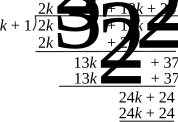
  \(=\dfrac{1}{6}\left(2 k^3+15 k^2+37 k+24\right) \quad \text{(see long division below)}\)
  \(=\dfrac{1}{6}(k+1)\left(2 k^2+13 k+24\right)\)
  \(=\operatorname{RHS}\)


\(\Rightarrow \ \text{True for} \ \ n=k+1\)

\(\therefore \ \text{Since true for \(n=1\), by PMI, true for integers}\ \ n \geq 1.\)

Filed Under: Induction (Y12), Uncategorized Tagged With: Band 4, smc-1019-20-Sum of a Series, smc-7281-20-Sum of a Series

Proof, EXT1 P1 2025 HSC 12c

Prove by mathematical induction that

\(1 \times(1!)+2 \times(2!)+\cdots+n \times(n!)=(n+1)!-1\)

for integers  \(n \geq 1\).   (3 marks)

--- 12 WORK AREA LINES (style=lined) ---

Show Answers Only

\(\text{See Worked Solution}\)

Show Worked Solution

\(1 \times 1!+2 \times 2!+\ldots+n \times n!=(n+1)!-1\)

\(\text{Prove true for}\ \ n=1:\)

\(\text{LHS}=1 \times 1!=1\)

\(\text{RHS}=(2)!-1=1=\text{LHS }\)

\(\therefore\ \text{True for}\ \ n=1.\)
 

\(\text{Assume true for} \ \ n=k:\)

\(1 \times 1!+2 \times 2!+\ldots+k \times k!=(k+1)!-1\)
 

\(\text{Prove true for} \ \ n=k+1:\)

\(\text{i.e.} \ \ 1 \times 1!+2 \times 2!+\ldots +k \times k!+(k+1) \times(k+1)!=(k+2)!-1\)

\(\text{LHS}\) \(=1\times 1!+\ldots+k \times k!+(k+1) \times(k+1)!\)
  \(=(k+1)!-1+(k+1) \times (k+1)!\)
  \(=(k+1)!(1+k+1)-1\)
  \(=(k+1)!(k+2)-1\)
  \(=(k+2)!-1\)
  \(= \operatorname{RHS}\)


\(\Rightarrow \ \text{True for} \ \ n=k+1\)

\(\therefore \ \text{Since true for  \(\ n=1\),  by PMI, true for integers  \(\ n \geqslant 1\).}\)

Filed Under: Induction (Y12), P1 Induction (Y12) Tagged With: Band 3, smc-1019-30-Factorial, smc-7281-30-Factorial

Proof, EXT1 P1 EQ-Bank 32

  1. Show that  \(\cos (A-B)-\cos (A+B)=2 \sin A \sin B\).   (1 mark)

    --- 3 WORK AREA LINES (style=lined) ---

  2. Using the result in part (a), or otherwise, prove by mathematical induction that, for \(n \geqslant 1\)
  3. \(\sin \theta+\sin (3 \theta)+\ldots+\sin ((2 n-1) \theta)=\dfrac{\sin ^2(n \theta)}{\sin \theta}\)   (3 marks)

    --- 15 WORK AREA LINES (style=lined) ---

Show Answers Only
a.     \(\cos (A-B)-\cos (A+B)\) \(=\cos A \cos B+\sin A \sin B-(\cos A \cos B-\sin A \sin B)\)
    \(=2 \sin A \cos B\).

 
b.
   \(\text{Proof (See worked solutions)}\)

Show Worked Solution
a.     \(\cos (A-B)-\cos (A+B)\) \(=\cos A \cos B+\sin A \sin B-(\cos A \cos B-\sin A \sin B)\)
    \(=2 \sin A \cos B\).


b.    \(\text{RTP:} \ \ \sin \theta+\sin (3 \theta)+\ldots+\sin ((2 n-1) \theta)=\dfrac{\sin ^2(n \theta)}{\sin \theta}\)

\(\text{If} \ \ n=1:\)

\(\text{LHS}=\sin \theta\)

\(\text {RHS}=\dfrac{\sin ^2 \theta}{\sin \theta}=\sin \theta=\text{LHS}\)

\(\therefore \text {True for} \ \ n=1\)
 

\(\text{Assume true for} \ \ n=k:\)

\(\sin \theta+\sin (3 \theta)+\ldots+\sin \left((2 k-1) \theta\right)=\dfrac{\sin ^2(k \theta)}{\sin \theta}\ \ …\ \text{(*)}\)
 

\(\text{Prove true for} \ \ n=k+1:\)

\(\sin \theta+\sin (3 \theta)+\cdots+\sin ((2 k-1) \theta)+\sin ((2 k+1) \theta)=\dfrac{\sin ^2((k+1) \theta)}{\sin \theta}\)

\(\text {LHS}\) \(=\dfrac{\sin ^2(k \theta)}{\sin \theta}+\sin ((2 k+1) \theta) \quad \text{(see (*) above)}\)
  \(=\dfrac{\sin ^2(k \theta)+\sin \theta \times \sin ((2 k+1) \theta)}{\sin \theta}\ \ …\ (1)\)

 
\(\text{Using part a:}\)

\(\sin \theta \cdot \sin ((2 k+1) \theta)\) \(=\dfrac{1}{2}[\cos (2 k \theta)-\cos ((2 k+2) \theta)]\)
  \(=\dfrac{1}{2}[\cos (2 k \theta)-\cos (2(k+1) \theta)]\)
  \(=\dfrac{1}{2}\left[1-2 \sin ^2(k \theta)-\left(1-2 \sin ^2((k+1) \theta)\right)\right]\)
  \(=\dfrac{1}{2}\left(2 \sin ^2((k+1) \theta)-2 \sin ^2(k \theta)\right)\)
  \(=\sin ^2((k+1) \theta)-\sin ^2(k \theta)\)

 
\(\text{Substitute into (1):}\)

\(\text {LHS}\) \(=\dfrac{\sin ^2(k \theta)+\sin ^2((k+1) \theta)-\sin ^2(k \theta)}{\sin \theta}\)
  \(=\dfrac{\sin ^2((k+1) \theta)}{\sin \theta}=\text{RHS}\)

 
\(\Rightarrow\ \text{True for}\ \ n=k+1\)

\(\therefore\ \text{Since true for}\ \ n=1, \text{by PMI, true for integers}\ \ n \geq 1.\)

Filed Under: Induction (Y12), P1 Induction (Y12) Tagged With: Band 3, Band 6, smc-1019-40-Trig theme, smc-7281-40-Trig theme

Proof, EXT1 P1 2024 HSC 12d

Use mathematical induction to prove that  \(2^{3 n}+13\)  is divisible by 7 for all integers  \(n \geq 1\).   (3 marks)

--- 12 WORK AREA LINES (style=lined) ---

Show Answers Only

\(\text{Proof (See worked solutions)}\)

Show Worked Solution

\(\text{Prove}\ \ 2^{3 n}+13\ \ \text{is divisible by 7 for}\ \ n \geq 1.\)

\(\text {If}\ \ n=1:\)

\(2^{3 \times 1}+13=21=3 \times 7\)

\(\therefore \text { True for } n=1.\)
 

\(\text {Assume true for } n=k:\)

\(2^{3 k}+13=7P \ \text{(where \(P\) is an integer)}\)

\(\Rightarrow 2^{3k}=7 P-13\ \ldots\ (1)\)

\(\text {Prove true for}\ \ n=k+1:\)

  \(2^{3(k+1)}+13\) \(=2^{3 k} \times 2^3+13\)
    \(=8\left(2^{3 k}\right)+13\)
    \(=8(7P-13)+13\ \ \text{(see (1) above)}\)
    \(=56 P-8 \times 13+13\)
    \(=7(8 P-13)\)

 
\(\Rightarrow \text { True for } n=k+1\)

\(\therefore\ \text{Since true for}\ \ n=1, \text{by PMI, true for integers}\ \ n \geqslant 1.\)

Filed Under: Induction (Y12), P1 Induction (Y12) Tagged With: Band 3, smc-1019-10-Divisibility, smc-7281-10-Divisibility

Proof, EXT1 P1 2023 HSC 12b

Use mathematical induction to prove that

\((1 \times 2)+\left(2 \times 2^2\right)+\left(3 \times 2^3\right)+\cdots+\left(n \times 2^n\right)=2+(n-1) 2^{n+1}\)

for all integers \(n \geq 1\).   (3 marks)

--- 14 WORK AREA LINES (style=lined) ---

Show Answers Only

\(\text{Proof (See Worked Solutions)} \)

Show Worked Solution

\(\text{Prove true for}\ \ n=1: \)

\(\text{LHS}\ = 1 \times 2=2 \)

\(\text{RHS}\ = 2+(1-1)2^2 = 2 = \text{LHS} \)
 

\(\text{Assume true for}\ \ n=k: \)

\((1 \times 2)+\left(2 \times 2^2\right)+\cdots+\left(k \times 2^k\right)=2+(k-1) 2^{k+1}\)
 

\(\text{Prove true for}\ \ n=k+1: \)

\((1 \times 2)+\left(2 \times 2^2\right)+\cdots+\left(k \times 2^k\right) + (k+1)2^{k+1}=2+k \times 2^{k+2}\)

\(\text{LHS}\) \(=2+(k-1)2^{k+1} + (k+1) 2^{k+1} \)  
  \(=2+2^{k+1}(k-1+k+1) \)  
  \(=2+2^{k+1}(2k) \)  
  \(=2+k \times 2^{k+2} \)  
  \(=\ \text{RHS} \)  
 

\(\Rightarrow\ \text{True for}\ \ n=k+1 \)

\(\therefore\ \text{Since true for}\ \ n=1, \text{by PMI, true for integers}\ \ n \geq 1. \)

Filed Under: Induction (Y12), P1 Induction (Y12) Tagged With: Band 3, smc-1019-20-Sum of a Series, smc-7281-20-Sum of a Series

Proof, EXT1 P1 2022 HSC 12f

Use mathematical induction to prove that  `15 ^(n)+6^(2n+1)`  is divisible by 7 for all integers  `n >= 0`.  (3 marks)

--- 14 WORK AREA LINES (style=lined) ---

Show Answers Only

`text{Proof (See Worked Solutions)}`

Show Worked Solution

`text{Prove}\ \ 15 ^(n)+6^(2n+1)\ \ text{is divisible by 7 for}\ \ n>=0`

`text{If}\ \ n=0:`

`15^0+6^1=7`

`:.\ text{True for}\ \ n=0`
 

`text{Assume true for}\ \ n=k`

`text{i.e.}\ \ 15^(k)+6^(2k+1)=7P\ \ text{(where}\ P\ text{is an integer)}`

`=>6^(2k+1)=7P-15^(k)\ \ …\ (1)`
 

`text{Prove true for}\ \ n=k+1`

`15^(k+1)+6^(2k+3)` `=15*15^(k)+6^2*6^(2k+1)`  
  `=15*15^(k)+36(7P-15^(k))\ \ text{(see (1))}`  
  `=15*15^(k)+36*7P-36*15^(k)`  
  `=36*7P-21*15^(k)`  
  `=7(36P-3*15^(k))\ \ text{(which is divisible by 7)}`  

 
`=>\ text{True for}\ \ n=k+1`

`:.\ text{S}text{ince true for}\ \ n=0, text{by PMI, true for integers}\ \ n>=0`

Filed Under: Induction (Y12), P1 Induction (Y12) Tagged With: Band 4, smc-1019-10-Divisibility, smc-7281-10-Divisibility

Proof, EXT1 P1 2021 HSC 12c

Use mathematical induction to prove that

`1/(1 xx 2 xx 3) + 1/(2 xx 3 xx 4) + … + 1/(n(n + 1)(n + 2)) = 1/4 - 1/(2(n + 1)(n + 2))`

 
for all integers `n ≥ 1`.  (3 marks)

--- 14 WORK AREA LINES (style=lined) ---

Show Answers Only

`text(See Worked Solutions)`

Show Worked Solution

`text(Prove for)\ \ n >= 1,`

`1/(1 xx 2 xx 3) + … + 1/(n(n + 1)(n + 2)) = 1/4 – 1/(2(n + 1)(n + 2))`
 

`text(If)\ \ n = 1:`

`text(LHS)\ = 1/(1 xx 2 xx 3) = 1/6`

`text(RHS)\ = 1/4 – 1/(2 xx 2 xx 3) = 1/4 – 1/12 = 1/6`

 
`:.\ text(True for)\ \ n = 1`
 

`text(Assume true for)\ \ n = k:`

`text(i.e.)\ \ 1/(1 xx 2 xx 3) + … + 1/(k(k + 1)(k + 2)) = 1/4 – 1/(2(k + 1)(k + 2))`

 
`text(Prove true for)\ \ n = k + 1:`

`text(i.e.)\ \ 1/(1 xx 2 xx 3) + … + 1/((k + 1)(k + 2)(k + 3)) = 1/4 – 1/(2(k + 2)(k + 3))`

`text(LHS)` `= 1/(1 xx 2 xx 3) + … + 1/(k(k + 1)(k + 2)) + 1/((k + 1)(k + 2)(k + 3))`
  `= 1/4 – 1/(2(k + 1)(k + 2)) + 1/((k + 1)(k + 2)(k + 3))`
  `= 1/4 – ((k + 3 – 2)/(2(k + 1)(k + 2)(k + 3)))`
  `= 1/4 – (k + 1)/(2(k + 1)(k + 2)(k + 3))`
  `= 1/4 – 1/(2(k + 2)(k + 3))`
  `=\ text(RHS)`

 
`=>\ text(True for)\ \ n = k + 1`

`:.\ text(S)text(ince true for)\ \ n = 1, \ text(by PMI, true for integral)\ \ n >= 1.`

Filed Under: Induction (Y12), P1 Induction (Y12) Tagged With: Band 4, smc-1019-20-Sum of a Series, smc-7281-20-Sum of a Series

Proof, EXT1 P1 2020 HSC 12a

Use the principle of mathematical induction to show that for all integers  `n >= 1`,

`1 xx 2 + 2 xx 5 + 3 xx 8 + … + n(3n-1) = n^2(n + 1)`.  (3 marks)

--- 14 WORK AREA LINES (style=lined) ---

Show Answers Only

`text(See Worked Solutions)`

Show Worked Solution

`text(Prove)`

`1 xx 2 + 2 xx 5 + 3 xx 8 + … + n(3n-1) = n^2(n + 1)`
 

`text(Prove true for)\ \ n = 1:`

`text(LHS) = 1(3 xx 1-1) = 2`

`text(RHS) = 1^2(1 + 1) = 2`
 

`text(Assume true for)\ \ n = k:`

`text(i.e.)\ \ 1 xx 2 + 2 xx 5 + 3 xx 8 + … + k(3k-1) = k^2(k + 1)`
 

`text(Prove true for)\ \ n = k + 1:`

`text(i.e.)\ 1 xx 2 + 2 xx 5 + … + k(3k-1) + (k + 1)(3k + 2) = (k + 1)^2(k + 2)`

`text(LHS)` `= 1 xx 2 + … + k(3k-1) + (k + 1)(3k + 2)`
  `= k^2(k + 1) + (k + 1)(3k + 2)`
  `= (k + 1)(k^2 + 3k + 2)`
  `= (k + 1)(k + 1)(k + 2)`
  `= (k + 1)^2(k + 2)`
  `=\ text(RHS)`

 
`=>\ text(True for)\ n = k + 1`

`:. text(S)text(ince true for)\ n = 1,\ text(by PMI, true for integral)\ n >= 1`.

Filed Under: Induction (Y12), P1 Induction (Y12) Tagged With: Band 3, smc-1019-20-Sum of a Series, smc-7281-20-Sum of a Series

Proof, EXT1 P1 2019 HSC 14a

Prove by mathematical induction that, for all integers `n >= 1`,

`1(1!) + 2(2!) + 3(3!) + … + n(n!) = (n + 1)! - 1`.  (3 marks)

--- 14 WORK AREA LINES (style=lined) ---

Show Answers Only

`text(Proof)\ text{(See Worked Solutions)}`

Show Worked Solution

`text(Prove true for)\ n = 1:`

`text(LHS) = 1(1!) = 1`

`text(RHS) = (1 + 1)! – 1 = 2! – 1 = 1 = text(LHS)`

`:.\ text(True for)\ \ n = 1`
 

`text(Assume true for)\ \ n = k:`

`1(1!) + 2(2!) + … + k(k!) = (k + 1)! – 1`
 

`text(Prove true for)\ \ n = k + 1`

`text(i.e.)\ \ underbrace(1(1!) + 2(2!) + … + k(k!))_((k + 1)! – 1) + (k + 1)(k + 1)! = (k + 2)! – 1`

`text(LHS)` `= (k + 1)! – 1 + (k + 1)(k + 1)!`
  `= (k + 1)! [1 + (k + 1)] – 1`
  `= (k + 1)!(k + 2) – 1`
  `= (k + 2)! – 1`

 
`\Rightarrow\ \ text(True for)\ \ n = k + 1`

`:.\ text(S)text(ince true for)\ \ n = 1,\ text(by PMI, true for integral)\ \ n >= 1.`

Filed Under: Induction (Y12), P1 Induction (Y12) Tagged With: Band 3, smc-1019-20-Sum of a Series, smc-1019-30-Factorial, smc-7281-20-Sum of a Series, smc-7281-30-Factorial

Proof, EXT1 P1 2018 HSC 13a

Prove by mathematical induction that, for  `n >= 1,`

`2-6 + 18-54 + … + 2 (-3)^(n-1) = (1-(-3)^n)/2.`  (3 marks)

--- 14 WORK AREA LINES (style=lined) ---

Show Answers Only

`text(Proof)\ \ text{(See Worked Solutions)}`

Show Worked Solution

`text(If)\ \ n = 1,`

`text(LHS)` `= 2 (-3)^0 = 2`
`text(RHS)` `= (1-(-3)^1)/2 = 2`

`:.\ text(True for)\ n = 1`
 

`text(Assume true for)\ n = k`

`2-6 + 18-54 + … + 2 (-3)^(k-1) = (1-(-3)^k)`
 

`text(Prove true for)\ \ n = k + 1`

`text(i.e.)\ \ 2-6 + … + 2 (-3)^(k-1) + 2 (-3)^k = (1-(-3)^(k + 1))/2`

`text(LHS)` `= underbrace{2-6 + … + 2(-3)^(k-1)}_text(Sum of GP, r = –3) + 2 (-3)^k`
  `= (2(1-(-3)^k))/(1+3) + 2 (-3)^k`
  `= (1-(-3)^k + 4 (-3)^k)/2`
  `= (1 + 3(-3)^k)/2`
  `= (1-(-3)(-3)^k)/2`
  `= (1-(-3)^(k + 1))/2`
  `=\ text(RHS)`

 
`=>\ text(True for)\ \ n=k+1`

`:.\ text(S)text(ince true for)\ \ n=1, text(by PMI, true for integral)\ n >= 1.`

Filed Under: 7. Induction and Other Series EXT1, Induction (Y12), P1 Induction (Y12) Tagged With: Band 3, smc-1019-20-Sum of a Series, smc-7281-20-Sum of a Series

Proof, EXT1 P1 2017 HSC 14a

Prove by mathematical induction that  `8^(2n + 1) + 6^(2n − 1)`  is divisible by 7, for any integer  `n ≥ 1`.  (3 marks)

--- 14 WORK AREA LINES (style=lined) ---

Show Answers Only

`text(See Worked Solutions)`

Show Worked Solution

`text(Prove)\ \ 8^(2n + 1) + 6^(2n − 1)\ \ text(is divisible)`

`text(by 7 for integers)\ \ n >= 1`

`text(If)\ n = 1,`

`8^3 + 6^1 = 518 = 74 xx 7`

`:. text(True for)\ n = 1`
 

`text(Assume true for)\ n = k`

`text(i.e.)\ \ 8^(2k + 1) + 6^(2k – 1)` `= 7P\ \ (text(where)\ P\ text(is an integer))`
`8^(2k + 1)` `= 7P – 6^(2k – 1)`

 
`text(Prove true for)\ n = k + 1`

`8^(2k + 3) + 6^(2k − 1)` `= 64 · 8^(2k + 1) + 36*6^(2k – 1)`
  `= 64(7P – 6^(2k – 1)) + 36 · 6^(2k – 1)`
  `= 64 · 7P – 64 · 6^(2k – 1) + 36 · 6^(2k – 1)`
  `= 64 · 7P – 28 · 6^(2k – 1)`
  `= 7(64P – 4 · 6^(2k – 1))`

 
`…\ text(which is divisible by 7.)`
 

`=> text(True for)\ \ n = k + 1`

`:.\ text(S) text(ince true for)\ \ n = 1,\ text(by PMI, true for integral)\ \ n >= 1.`

Filed Under: 7. Induction and Other Series EXT1, Induction (Y12), P1 Induction (Y12) Tagged With: Band 4, smc-1019-10-Divisibility, smc-7281-10-Divisibility

Proof, EXT1 P1 2016 HSC 14a

  1. Show that  `4n^3 + 18n^2 + 23n + 9`  can be written as
  2. `qquad (n + 1)(4n^2 + 14n + 9)`.   (1 marks)

    --- 2 WORK AREA LINES (style=lined) ---

  3. Using the result in part (i), or otherwise, prove by mathematical induction that, for  `n >= 1`,
  4. `qquad 1 × 3 + 3 × 5 + 5 × 7 + … + (2n-1)(2n + 1) = 1/3 n(4n^2 + 6n-1)`.   (3 marks)

    --- 14 WORK AREA LINES (style=lined) ---

Show Answers Only

a.    `text(Proof)\ \ text{(See Worked Solutions)}`

b.   `text(Proof)\ \ text{(See Worked Solutions)}`

Show Worked Solution
a.     `text(RHS)` `= (n + 1) (4n^2 + 14n + 9)`
    `= 4n^3 + 14n^2 + 9n + 4n^2 + 14n + 9`
    `= 4n^3 + 18n^2 + 23n + 9`


b.    `text(Prove)\ \ 1 xx 3 + 3 xx 5 + 5 xx 7 + … + (2n-1) (2n + 1)`

`= 1/3n (4n^2 + 6n-1)`

`text(If)\ \ n = 1,`

`text(LHS) = (1) (3) = 3`

`text(RHS) = 1/3 (1) (4 + 6-1) = 3`

`:.\ text(True for)\ \ n = 1`


`text(Assume true for)\ \ n = k`

`text(i.e.)\ \ 1 xx 3 + 3 xx 5 + … + (2k-1) (2k + 1)`

`= 1/3 k (4k^2 + 6k-1)`

`text(Prove true for)\ \ n = k + 1`

`text(i.e.)\ \ 1 xx 3 + … + (2k + 1) (2k + 3)`

`= 1/3 (k + 1) [4 (k + 1)^2 + 6(k + 1)-1]`

`= 1/3 (k + 1) (4k^2 + 14k + 9)`

`= 1/3 (4k^3 + 18k^2 + 23k + 9)`


`text(LHS)` `= 1 xx 3 + … + (2k-1) (2k + 1) + (2k + 1) (2k + 3)`
  `= 1/3k (4k^2 + 6k-1) + (2k + 1) (2k + 3)`
  `= 1/3 (4k^3 + 6k^2-k) + (4k^2 + 8k + 3)`
  `= 1/3 (4k^3 + 6k^2-k + 12k^2 + 24k + 9)`
  `= 1/3 (4k^3 + 18k^2 + 23k + 9)`
  `=\ text(RHS …)`


`=> text(True for)\ \ n = k + 1`

`:.\ text(S) text(ince true for)\ \ n = 1,\ text(by PMI, true for integral)\ \ n >= 1.`

Filed Under: 7. Induction and Other Series EXT1, Induction (Y12), P1 Induction (Y12) Tagged With: Band 3, Band 4, smc-1019-20-Sum of a Series, smc-7281-20-Sum of a Series

Proof, EXT1 P1 2007 HSC 4b

Use mathematical induction to prove that  `7^(2n – 1) + 5`  is divisible by 12, for all integers  `n ≥ 1`.  (3 marks)

--- 14 WORK AREA LINES (style=lined) ---

Show Answers Only

`text{Proof (See Worked Solutions)}`

Show Worked Solution

`text(Prove)\ \ 7^(2n – 1) + 5\ \ text(is divisible by)\ 12,\ text(for)\ \ n ≥ 1`

`text(If)\ \ n = 1`

`7^(2 – 1) + 5 = 7 + 5 = 12\ \ \ text{(divisible by 12)}`

`:.\ text(True for)\ \ n = 1`


`text(Assume true for)\ \ n = k`

`text(i.e.)\ 7^(2k − 1) + 5` `= 12text{N   (N is an integer)}`
 `7^(2k-1)` `= 12text(N) – 5\ \ …\ (1)`


`text(Prove true for)\ \ n = k + 1`

`7^(2(k + 1) − 1) + 5` `= 7^(2k + 1) + 5`
  `= 7^2 · 7^(2k − 1) + 5`
  `= 49(12text(N) − 5) + 5\ \ \ text{(from (1) above)}`
  `= 49*12text(N) − 245 + 5`
  `= 49*12text(N) − 240`
  `= 12(49text(N) − 20)`

`…text(which is divisible by)\ 12`

 
`=>\ text(True for)\ n = k + 1`

`:.\ text(S)text(ince true for)\ n = 1, text(by PMI, true for integral)\ n ≥ 1.`

Filed Under: 7. Induction and Other Series EXT1, Induction (Y12), P1 Induction (Y12) Tagged With: Band 4, smc-1019-10-Divisibility, smc-7281-10-Divisibility

Proof, EXT1 P1 2015 HSC 13c

Prove by mathematical induction that for all integers `n ≥ 1`,

`1/(2!) + 2/(3!) + 3/(4!) + … + n/((n + 1)!) = 1 − 1/((n + 1)!)`.  (3 marks)

--- 14 WORK AREA LINES (style=lined) ---

Show Answers Only

`text{Proof (See Worked Solutions)}`

Show Worked Solution

`text(Prove for)\ n ≥ 1`

`1/(2!) + 2/(3!) + 3/(4!) + … + n/((n + 1)!) = 1 − 1/((n + 1)!)`

`text(If)\ n = 1`

`text(LHS)` `= 1/(2!) = 1/2`
`text(RHS)` `= 1 − 1/(2!) = 1 − 1/2 = 1/2`

`:.\ text(True for)\ n = 1`

 
`text(Assume true for)\ n = k`

`text(i.e.)\ \ 1/(2!) + 2/(3!) + … + k/((k + 1)!) = 1 − 1/((k + 1)!)`

`text(Prove true for)\ n = k + 1`

`text(i.e.)\ \ 1/(2!) + 2/(3!) + … + k/((k + 1)!) + (k + 1)/((k + 2)!) = 1 − 1/((k + 2)!)`

`text(LHS)` `= 1 − 1/((k + 1)!) + (k + 1)/((k + 2)!)`
  `= 1 − (((k + 2) − (k + 1))/((k + 1)!(k + 2)))`
  `= 1 − 1/((k + 2)!)\ \ …\ text(as required)`

 
`=>\ text(True for)\ n = k + 1`

`:.\ text(S)text(ince true for)\ n = 1,\ text(by PMI, true for integral)\ n ≥ 1.`

Filed Under: 7. Induction and Other Series EXT1, Induction (Y12), P1 Induction (Y12) Tagged With: Band 3, smc-1019-20-Sum of a Series, smc-1019-30-Factorial, smc-7281-20-Sum of a Series, smc-7281-30-Factorial

Proof, EXT1 P1 2008 HSC 3b

Use mathematical induction to prove that, for integers  `n >= 1`,

`1 xx 3 + 2 xx 4 + 3 xx 5 + ... + n(n+2) = n/6 (n + 1)(2n + 7)`.   (3 marks)

--- 14 WORK AREA LINES (style=lined) ---

Show Answers Only

`text(Proof)\ \ text{(See Worked Solutions)}`

Show Worked Solution

`text(Prove)\ \ 1 xx 3 + 2 xx 4 + 3 xx 5 + … + n(n+2)`

`= n/6 (n+1)(2n + 7)\ \ \ text(for)\ n >= 1`

`text(If)\ \ n = 1`

`text(LHS) = 1 xx 3 = 3`

`text(RHS) = 1/6 (2)(9) = 3 = text(LHS)`

`:.\ text(True for)\ \ n = 1`

 
`text(Assume true for)\ \ n = k`

`text(i.e.)\ \ 1 xx 3 + 2 xx 4 + … + k (k + 2)`

`= k/6 (k + 1)(2k + 7)`

 
`text(Prove true for)\ \ n = k + 1`

`text(i.e.)\ \ 1 xx 3 + 2 xx 4 + … + k(k+2) + (k + 1)(k + 3)`

`= ((k+1))/6 (k + 2)(2k + 9)`

`text(LHS)` `= k/6 (k + 1)(2k + 7) + (k + 1)(k + 3)`
  `= 1/6 (k + 1)[k(2k + 7) + 6(k + 3)]`
  `= 1/6 (k + 1)[2k^2 + 7k + 6k + 18]`
  `= 1/6 (k + 1)[2k^2 + 13k + 18]`
  `= 1/6 (k +1)(k + 2)(2k + 9)\ \ \ \ text(… as required)`

 
`=>\ text(True for)\ n = k + 1`

`:.\ text(S) text(ince true for)\ n = 1,\ text(by PMI, true for integral)\ n >= 1.`

Filed Under: 7. Induction and Other Series EXT1, Induction (Y12), P1 Induction (Y12) Tagged With: Band 4, smc-1019-20-Sum of a Series, smc-7281-20-Sum of a Series

Proof, EXT1 P1 EQ-Bank 29

Prove by mathematical induction that  `(3n + 1)7^n -1`  is divisible by 9 for integral  `n >= 1`.   (3 marks)

--- 14 WORK AREA LINES (style=lined) ---

Show Answers Only

`text(Proof)\ \ text{(See Worked Solutions)}`

Show Worked Solution

`text(Prove)\ \ (3n + 1)7^n-1\ \ text(is divisible)`

`text(by 9 for integers)\ n >= 1.`

`text(If)\ \ n = 1`

`(3n + 1)7^n-1` `= (3 xx 1 + 1)7^1-1`
  `= 27`

`=>\ text(Divisible by 9)\ \ (27//9=3)`
 

`text(Assume true for)\ n = k`

IMPORTANT: In cases where substitution doesn’t work, remember that `f(k+1)-f(k)` can be used to illustrate divisibility (Tony Lantry special).

`text(i.e.)\ (3k + 1)7^k-1 = 9P\ \ \ text{(} P\ text(integer) text{)}`

`f(k)` `= (3k + 1)7^k-1`
`f(k + 1)` `= (3 (k + 1) + 1)7^(k+1)-1`
  `= (3k + 4)7^(k+1)-1`

 
`f(k + 1)-f(k)`

`= (3k + 4) 7^(k + 1)-1- [(3k + 1)7^k-1]`
`= 3k * 7^(k + 1) + 4 * 7^(k + 1)-1-[3k*7^k + 7^k-1]`
`= 21k*7^k + 28*7^k-1-3k*7^k-7^k + 1`
`= 18k*7^k + 27*7^k`
`= 9 (2k*7^k + 3*7^k)\ \ text{(divisible)}`
 
`text(S)text(ince)\ \ ` `f(k + 1)-f(k)\ text(is divisible by 9 and)`
  `\ \ \ \ \ \ f(k)\ text(is divisible by 9,)`

 
`=> f(k + 1)\ text(is divisible by 9)`

`:. text(S)text(ince true for)\ n = 1, text(true for integers)\ n >= 1.`

Filed Under: 7. Induction and Other Series EXT1, Induction (Y12), P1 Induction (Y12) Tagged With: Band 5, smc-1019-10-Divisibility, smc-7281-10-Divisibility

Proof, EXT2 P1 EQ-Bank 28

Use mathematical induction to prove that  `7^n + 15^n`  is divisible by 11 where `n` is an odd integer.  (3 marks)

--- 7 WORK AREA LINES (style=lined) ---

Show Answers Only

`text(Proof)\ \ text{(See Worked Solutions)}`

Show Worked Solution

`text(Prove)\ \ 7^n + 15^n\ \ text(is divisible by 11, where)\ n\ text(is odd)`

`text(If)\ \ n = 1:`

`7^n + 15^n` `= 7 + 15 = 22`
`22/11` `= 2\ \ \ text{(Divisible by 11)}`

 
`text(Assume true for)\ \ n = k:`

`text(i.e.)\ 7^k + 15^k` `= 11P\ \ \ \ text{(}P\ text(integer) text{)}`
`7^k` `= 11P\ – 15^k\ \ \ \ \ …\ text{(∗)}`

 
`text(Prove true for)\ \ n = k + 2:`

`7^(k + 2) + 15^(k + 2)` `= 7^2 * 7^k + 15^2 * 15^k`
  `= 49 (11P-15^k) + 225 (15^k)\ \ \ text(… from)\ text{(∗)}`
  `= 49 * 11P-49 * 15^k + 225 (15^k)`
  `= 49 * 11P + 176 * 15^k`
  `= 11 (49P + 16 * 15^k)`

  
`=>text(True for)\ n = k + 2`

`:.\ text(S)text(ince true for)\ n = 1,\ text(by PMI, true for odd integral)\ \ n >= 1`

Filed Under: 7. Induction and Other Series EXT1, Induction, Induction (Y12) Tagged With: Band 5, smc-5115-20-Divisibility, smc-7281-10-Divisibility

Proof, EXT1 P1 2014 HSC 13a

Use mathematical induction to prove that  `2^n + (− 1) ^(n + 1)`  is divisible by 3 for all integers  `n >= 1`.   (3 marks)

--- 14 WORK AREA LINES (style=lined) ---

Show Answers Only

`text(Proof)\ \ text{(See Worked Solutions)}`

Show Worked Solution

`text(Prove)\ \ 2^n + (-1)^(n + 1)`

`text(is divisible by 3 for integers)\ n >= 1`

`text(If)\ n = 1`

`2^1 + (-1)^2` `= 2 + 1`
  `= 3\ \ text{(which is divisible by 3)}`

`:.\ text(True for)\ n = 1`

 
`text(Assume true for)\ \ n = k`

`text(i.e.)\ \ \ 2^k + (-1)^(k + 1)` `= 3P\ text{(} P\ text(integer) text{)}`
`2^k` `= 3P\ – (-1)^(k + 1)\ \ \ \ \ … \ text{(∗)}`

 
`text(Prove true for)\ \ n = k + 1`

`2^(k + 1) + (-1)^(k + 1 + 1)` `= 2*2^k + (-1)^(k + 2)`
  `= 2 (3P\ – (-1)^(k + 1)) + (-1)^(k + 2)\ \ text(… from)\ text{(∗)}`
  `= 6P\ – 2 (-1)^(k + 1)\ – 1 (-1)^(k + 1)`
  `= 6P\ – 3 (-1)^(k + 1)`
  `= 3 (2P\ – (-1)^(k + 1))`
`text(… which is divisible by 3)`

 
`=>\ text(True for)\ n = k + 1`

`:.text(S)text(ince true for)\ n = 1,\ text(by PMI, true for integral)\ n >= 1.`

Filed Under: 7. Induction and Other Series EXT1, Induction (Y12), P1 Induction (Y12) Tagged With: Band 3, smc-1019-10-Divisibility, smc-7281-10-Divisibility

Proof, EXT1 P1 2010 HSC 7a

Prove by induction that 

`47^n + 53 xx 147^(n-1)`

is divisible by  `100`  for all integers  `n >= 1`.    (3 marks)

--- 14 WORK AREA LINES (style=lined) ---

Show Answers Only

 `text(Proof)\ \ text{(See Worked Solutions)}`

Show Worked Solution

`text(Prove)\ \ 47^n + 53 xx 147^(n – 1)\ \ text(is divisible)`

`text(by 100 for)\ n >= 1.`

`text(If)\ n = 1`

`47^1 + 53 xx 147^(1 – 1)` `= 47 + 53`
  `= 100\ \ text{(divisible by 100)}`

`:.\ text(True for)\ n = 1`

♦ Mean mark 51%.
IMPORTANT: Making `47^k` the subject helps the substitution in the proof for `n+1`. Students must state that `P` is an integer. NOTE: using `147^k=147xx147^(k-1)` develops proof for `n=k+1`.

 
`text(Assume true for)\ \ n = k`

`text(i.e.)\ 47^k + 53 xx 147^(k – 1) = 100P\ \ \ text{(} P\ text(integer) text{)}`

`47^k = 100P\ – (53 xx 147^(k – 1))\ \ \ text(…)\ text{(1)}`

`text(Prove true for)\ \ n = k + 1`

`47^(k + 1) + 53 xx 147^(k)`
`= 47 xx 47^k + 53 xx 147^k`
`text{(substitute from (1) above)}`
`= 47 [100P\ – (53 xx 147^(k – 1))] + 53 xx 147 xx 147^(k – 1)`
`= 4700P\ – 2491 xx 147^(k – 1) + 7791 xx 147^(k – 1)`
`= 4700P + 5300 xx 147^(k – 1)`
`= 100 (47P + 53 xx 147^(k – 1))`

 
`=>\ text(True for)\ n = k + 1`

`:.\ text(S)text(ince true for)\ n = 1,\ text(by PMI, true for integral)\ n >= 1`

Filed Under: 7. Induction and Other Series EXT1, Induction (Y12), P1 Induction (Y12) Tagged With: Band 5, smc-1019-10-Divisibility, smc-7281-10-Divisibility

Proof, EXT1 P1 2012 HSC 12a

Use mathematical induction to prove that  `2^(3n)\ – 3^n`  is divisible by  `5`  for  `n >= 1`.   (3 marks)

--- 14 WORK AREA LINES (style=lined) ---

Show Answers Only

 `text(Proof)\ \ text{(See Worked Solutions)}`

Show Worked Solution

`text(Prove by induction)`

`2^(3n)\ – 3^n\ text(is divisible by)\ 5\ text(for)\ n >= 1`

`text(If)\ n = 1`

`2^(3n)\ – 3^n` `= 2^3\ – 3^1`
  `= 5\ \ \ \ text{(divisible by 5)}`

`:.\ text(True for)\ n = 1`

IMPORTANT: Making `3^k` or `2^(3k)` the subject helps for the substitution required in the proof for `n+1`. Important to state that `P` is an integer.

 
`text(Assume true for)\ n = k`

`text(i.e.)\ \ 2^(3k)\ – 3^k` `= 5P\ \ \ \ text{(} P\ text{integer)}`
`3^k` `= 2^(3k)\ – 5P\ \ …\ text{(1)}`

 
`text(Prove true for)\ n = k+1`

`2^(3(k+1))\ – 3^(k+1)` `= 2^(3k + 3)\ – 3 * 3^k`
  `= 2^3 * 2^(3k)\ – 3(2^(3k)\ – 5P)\ \ \ text{(from (1) above)}`
  `= 8 * 2^(3k)\ – 3 * 2 ^(3k) + 15P`
  `= 5 * 2^(3k) + 15P`
  `= 5 (2^(3k) + 3P)`

 
`=>\ text(True for)\ n = k + 1`

`:.\ text(S)text(ince true for)\ n = 1,\ text(by PMI, true for integral)\ n >= 1`

Filed Under: 7. Induction and Other Series EXT1, Induction (Y12), P1 Induction (Y12) Tagged With: Band 4, smc-1019-10-Divisibility, smc-7281-10-Divisibility

Proof, EXT1 P1 2011 HSC 6a

 Use mathematical induction to prove that  for `n>=1`,

`1xx5+2xx6+3xx7+\ …\ +n(n+4)=1/6n(n+1)(2n+13)`.   (3 marks)

--- 14 WORK AREA LINES (style=lined) ---

Show Answer Only

`text{Proof (See Worked Solutions)}`

Show Worked Solution

`text(Prove)\ \ 1xx5+2xx6+3xx7+\ …\ +n(n+4)`

`=1/6n(n+1)(2n+13)\ text(for)\ n>=1`

`text(If)\ n=1`

`text(LHS)=1xx5=5`

`text(RHS)=1/6(1)(2)(15)=30/6=5=text(LHS)`

`:.text(True for)\ \ n=1`

 
`text(Assume true for)\ n=k`

`text(i.e.)\ \ 1xx5+2xx6+3xx7+\ …\ +k(k+4)`

`=1/6k(k+1)(2k+13)`

`text(Prove true for)\ n=k+1`

`text(i.e.)\ 1xx5+2xx6+\ …\ +k(k+4)+(k+1)(k+5)`

`=1/6(k+1)(k+2)(2k+15)`

MARKER’S COMMENT: Write out the statement to be proven. Transcription errors, poor setting out and inefficient algebraic approaches (factorise whenever possible) were common errors.
`text(LHS)` `=1/6k(k+1)(2k+13)+(k+1)(k+5)`
  `=1/6(k+1)[k(2k+13)+6(k+5)]`
  `=1/6(k+1)[2k^2+13k+6k+30]`
  `=1/6k(k+1)(2k^2+19k+30)`
  `=1/6k(k+1)(k+2)(2k+15)`
  `=\ text(RHS … as required)`

 
`=>\ text(True for)\ n=k+1`

`:.\ text{S}text{ince true for}\ \ n=1,\ text{by PMI, true for integral}\  n>=1`.

Filed Under: 7. Induction and Other Series EXT1, Induction (Y12), P1 Induction (Y12) Tagged With: Band 4, smc-1019-20-Sum of a Series, smc-7281-20-Sum of a Series

Copyright © 2014–2026 SmarterEd.com.au · Log in