SmarterEd

Aussie Maths & Science Teachers: Save your time with SmarterEd

  • Login
  • Get Help
  • About

Calculus, EXT1 C3 EQ-Bank 27

A tank contains 5000 litres of fruit juice concentrate solution with an initial concentrate percentage of 5.0%. Another fruit juice solution with a concentrate percentage of 3.0% is pumped into the tank at a rate of 40 litres per minute. The mixture is pumped out at the same rate, keeping the volume constant, and the liquid is kept thoroughly mixed.
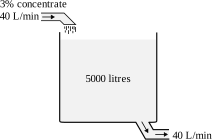
 

Let \(y\) be the volume of fruit concentrate, in litres, present in the tank at time \(t\).

  1. Show that  \(\dfrac{dy}{dt}=\dfrac{150-y}{125} \)   (1 mark)

    --- 4 WORK AREA LINES (style=lined) ---

  2. Show that the amount fruit juice concentrate in the tank at time \(t\) is given by
  3.       \(y=150 + 100e^{-0.008t} \)   (3 marks)

    --- 9 WORK AREA LINES (style=lined) ---

  4. Determine how long will it take for the mixture to reach a fruit juice concentration of 3.5%, giving your answer to the nearest minute?   (2 marks)

    --- 6 WORK AREA LINES (style=lined) ---
Show Answers Only

a.   \(\text{See Worked Solutions}\)

b.  \(\text{See Worked Solutions}\)

c.   \(\text{174 minutes}\)

Show Worked Solution

a.    \(\text{Inflow}=40 \ \text{L/min} \times 0.03=1.2 \ \text{L/min}\)

\(\text{Outflow }=40 \ \text{L/min} \times \dfrac{y}{5000}=\dfrac{y}{125} \ \text{L/min}\)

\(\dfrac{dy}{dt}\) \(=\text{Inflow}-\text{Outflow}\)
  \(=1.2-\dfrac{y}{125}\)
  \(=\dfrac{150-y}{125}\)


b.     \(\dfrac{dy}{dt}\) \(=\dfrac{150-y}{125}\)
  \(\dfrac{dt}{dy}\) \(=\dfrac{125}{150-y}\)
  \(\displaystyle\int dt\) \(=\displaystyle \int \dfrac{125}{150-y} \, dy\)
  \(t\) \(=-125\, \ln \abs{150-y}+c\)
  \(\ln \abs{150-y}\) \(=-\dfrac{t}{125}+c\)
  \(150-y\) \(=e^{-0.008 t+c}\)
  \(150-y\) \(=e^{-0.008 t} \cdot e^c\)
  \(150-y\) \(=A e^{-0.008 t}\)

 
\(\text{At} \ \ t=0, y=5000 \times 0.05=250\ \text{L}\)

\(150-250=Ae^{\circ} \ \  \Rightarrow \ \  A=-100\)

\(150-y\) \(=-100 e^{-0.008 t}\)
\(y\) \(=150+100 e^{0.008 t}\)


c.   \(\text{When fruit concentrate}=3.5 \%\)

\(y=5000 \times 0.035=175 \ \text{L}\)

\(\text{Find} \ t \ \text{when} \ \ y=175:\)

\(175\) \(=150+100 e^{-0.008 t}\)
\(25\) \(=100 e^{-0.008 t}\)
\(e^{-0.008t}\) \(=0.25\)
\(-0.008 t\) \(=\ln (0.25)\)
\(t\) \(=\dfrac{\ln (0.25)}{-0.008}\)
  \(=173.28 \ldots\)


\(\therefore \ \text{After 174 minutes, the fruit concentrate first falls below} \  3.5\%\)

Filed Under: Applications of Differential Equations, Applications of Differential Equations Tagged With: Band 4, Band 5, smc-1198-10-Mixing, smc-7297-10-Mixing

Calculus, EXT1 C3 2024 HSC 13a

In an experiment, the population of insects, \(P(t)\), was modelled by the logistic differential equation

\(\dfrac{d P}{d t}=P(2000-P)\)

where \(t\) is the time in days after the beginning of the experiment.

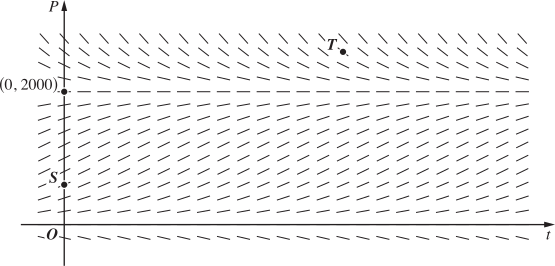
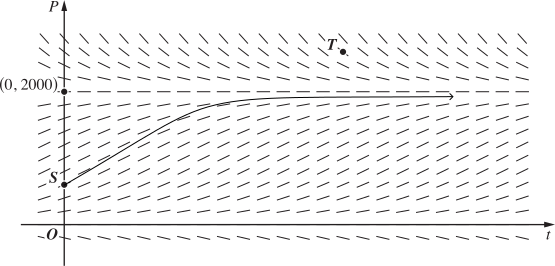
The diagram shows a direction field for this differential equation, with the point \(S\) representing the initial population.
 

  1. Explain why the graph of the solution that passes through the point \(S\) cannot also pass through the point \(T\).   (1 mark)

    --- 2 WORK AREA LINES (style=lined) ---

  2. Clearly sketch the graph of the solution that passes through the point \(S\).   (1 mark)

    --- 5 WORK AREA LINES (style=blank) ---

  3. Find the predicted value of the population, \(P(t)\), at which the rate of growth of the population is largest.   (2 marks)

    --- 4 WORK AREA LINES (style=lined) ---

Show Answers Only

 i.    \(\text{Any solution that passes through}\ S\ \text{will follow the}\)

\(\text{slope field (not crossing any lines) and approach a horizontal}\)

\(\text{asymptote at}\ P=2000\ \text{from the lower side}\ (P<2000).\)

ii.    
       

iii.  \(P= 1000\)

Show Worked Solution

 i.    \(\text{Any solution that passes through}\ S\ \text{will follow the}\)

\(\text{slope field (not crossing any lines) and approach a horizontal}\)

\(\text{asymptote at}\ P=2000\ \text{from the lower side}\ (P<2000).\)

ii.    
       

iii.  \(\dfrac{d P}{d t}=P(2000-P)\)

\(\text {Find \(P\) where  \(\dfrac{d P}{d t}\)  is a maximum.}\)

\(\text{Consider the graph}\ \ y=P(2000-P): \)

\(\Rightarrow \ \text {Graph is a concave down quadratic cutting at}\ \ P=0\ \ \text{and}\ \ P=2000\)

\(\Rightarrow \ \text{Max value of}\ \ P(2000-P)\ \ \Big(\text{i.e.}\ \dfrac{dP}{dt}\Big)\ \ \text{occurs at}\ \ P=1000\ \text{(axis).}\)

♦ Mean mark (iii) 51%.

Filed Under: Applications of Differential Equations, Applications of Differential Equations Tagged With: Band 3, Band 4, Band 5, smc-1198-30-Quantity, smc-7297-30-Quantity

Calculus, EXT1 C3 2023 HSC 13a

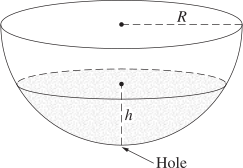
A hemispherical water tank has radius \(R\) cm. The tank has a hole at the bottom which allows water to drain out.

Initially the tank is empty. Water is poured into the tank at a constant rate of  \(2 k R\) cm³ s\(^{-1}\), where \(k\) is a positive constant.

After \(t\) seconds, the height of the water in the tank is \(h\) cm, as shown in the diagram, and the volume of water in the tank is \(V\) cm³.
  

It is known that  \(V= \pi \Big{(} R h^2-\dfrac{h^3}{3}\Big{)}. \)    (Do NOT prove this.)

While water flows into the tank and also drains out of the bottom, the rate of change of the volume of water in the tank is given by  \(\dfrac{d V}{d t}=k(2 R-h)\).

  1. Show that  \(\dfrac{d h}{d t}=\dfrac{k}{\pi h}\).  (2 marks)

    --- 5 WORK AREA LINES (style=lined) ---

  2. Show that the tank is full of water after  \(T=\dfrac{\pi R^2}{2 k}\) seconds.  (2 marks)

    --- 6 WORK AREA LINES (style=lined) ---
  3. The instant the tank is full, water stops flowing into the tank, but it continues to drain out of the hole at the bottom as before.
  4. Show that the tank takes 3 times as long to empty as it did to fill.  (3 marks)

    --- 9 WORK AREA LINES (style=lined) ---

Show Answers Only

i.    \(\text{See Worked Solutions}\)

ii.   \(\text{See Worked Solutions}\)

iii.  \(\text{See Worked Solutions}\)

Show Worked Solution

i.    \(V=\pi \Big{(}Rh^2-\dfrac{h^3}{3} \Big{)} \)

\(\dfrac{dV}{dh} = \pi(2Rh-h^2) \)

\(\dfrac{dV}{dt} = k(2R-h)\ \ \ \text{(given)} \)

\(\dfrac{dh}{dt}\) \(= \dfrac{dV}{dt} \cdot \dfrac{dh}{dV} \)  
  \(=k(2R-h) \cdot \dfrac{1}{\pi} \cdot \dfrac{1}{h(2R-h)} \)  
  \(= \dfrac{k}{\pi h} \)  

 
ii.
    \(\dfrac{dt}{dh} = \dfrac{\pi h}{k} \)

\(t\) \(= \displaystyle \int \dfrac{dt}{dh}\ dh \)  
  \(= \dfrac{\pi}{k} \displaystyle \int h\ dh \)  
  \(= \dfrac{\pi}{k} \Big{[} \dfrac{h^2}{2} \Big{]} +c \)  

 
\(\text{When}\ \ t=0, h=0 \)

\(\Rightarrow c=0 \)

\( t= \dfrac{\pi h^2}{2k} \)

 
\(\text{Tank is full at time}\ T\ \text{when}\ \ h=R: \)

\( T= \dfrac{\pi R^2}{2k}\ \text{seconds} \)

♦ Mean mark (ii) 41%.

iii.   \(\text{Net water flow}\ = k(2R-h)\ \ \text{(given)} \)

\(\text{Flow in}\ =2kR\ \ \text{(given)} \)

\(\text{Flow out}\ = k(2R-h)-2kR=-kh \)
 

\( \dfrac{dh}{dt}= \dfrac{-kh}{\pi h(2R-h)} = \dfrac{-k}{\pi (2R-h)} \)

♦♦♦ Mean mark (iii) 20%.
 

\(\dfrac{dt}{dh}\) \(=\dfrac{- \pi (2R-h)}{k} \)  
\( \displaystyle \int k\ dt\) \(=- \pi \displaystyle \int (2R-h)\ dh \)  
\(kt\) \(=- \pi \Big{(} 2Rh-\dfrac{h^2}{2} \Big{)}+c \)  

 
\(\text{When}\ \ t=0, \ h=R: \)

\(0\) \(=- \pi \Big{(}2R^2-\dfrac{R^2}{2} \Big{)} + c\)  
\(c\) \(= \pi \Big{(} \dfrac{3R^2}{2} \Big{)} \)  

 
\(\text{Find}\ t\ \text{when}\ h=0: \)

\(kt\) \(=- \pi(0) + \pi \dfrac{3R^2}{2} \)  
\(t\) \(= \dfrac{3 \pi R^2}{2k} \)  
  \(= 3 \times \dfrac{\pi R^2}{2k} \)  

 
\(\therefore\ \text{Tank takes 3 times longer to empty than fill.} \)

Filed Under: Applications of Differential Equations, Applications of Differential Equations, Related Rates of Change, Related Rates of Change Tagged With: Band 3, Band 5, Band 6, smc-1079-10-Volume, smc-1198-45-Flow in/out, smc-7297-45-Flow in/out, smc-7351-10-Volume

Calculus, EXT1 C3 EQ-Bank 26

A tank initially contains 300 grams of salt that is dissolved in 50 L of water. A solution containing 15 grams of salt per litre of water is poured into the tank at a rate of 2 litres per minute and the mixture in the tank is kept well stirred.

At the same time, 2 litres of the mixture flows out of the tank per minute.

  1. Find the differential equation, `(dm)/(dt)`, where `m` represents the mass, in grams, of salt in the tank at time `t` minutes.   (2 marks)

    --- 4 WORK AREA LINES (style=lined) ---

  2. Express `m` in terms of `t`.   (3 marks)

    --- 8 WORK AREA LINES (style=lined) ---

  3. Find the concentration of salt in the liquid in the longer term.   (1 mark)

    --- 4 WORK AREA LINES (style=lined) ---

Show Answers Only

a.    `(dm)/(dt) = 30-m/25`

b.    `m=750-450e^(-t/25)`

c.    `15\ text{g/L}`

Show Worked Solution

a.    `V = 50\ text{L}`

`(dm)/(dt) text{(in)} = 15 xx 2 = 30\ text(g/min)`

`(dm)/(dt) text{(out)} = 2 xx m/50 = m/25\ text(g/min)`

`:. (dm)/(dt) = 30-m/25`
 

b.    `(dm)/(dt)=(750-m)/25`

`(dt)/(dm)` `=25/(750-m)`  
`t` `=int 25/(750-m)\ dm=-25ln(750-m)+c`  

 
`text{When}\ \ t=0, m=300:`

`0=-25ln(750-300)+c\ \ =>\ \ c=25ln450`

`t` `=25ln450-25ln(750-m)`  
`t` `=25ln(450/(750-m))`  
`t/25` `=ln(450/(750-m))`  
`e^(t/25)` `=450/(750-m)`  
`750-m` `=450e^(-t/25)`  
`m` `=750-450e^(-t/25)`  


c.    `text{Method 1}`

`text{As}\ t->oo:`

`m->750-450e^(-oo)=750`

`text{Concentration} (m/V)->750/50=15\ text{g/L}`
 

`text{Method 2}`

`text{Concentration}\ -> (dm)/(dt) text{(in)} = 15\ text{g/L}`

Filed Under: Applications of Differential Equations, Applications of Differential Equations Tagged With: Band 4, Band 5, smc-1198-10-Mixing, smc-7297-10-Mixing

Calculus, EXT1 C3 EQ-Bank 24

A researcher estimates the number of brumbies in a National Park after `t` years can be modelled by the equation

`B(t)=(18\ 000)/(1+4e^(-t))`

  1. Sketch the function `B(t)` over the first four years of the research.   (2 marks)

    --- 8 WORK AREA LINES (style=lined) ---

  2. Calculate when the brumby population should reach 13 000, giving your answer to 2 decimal places.   (1 mark)

    --- 6 WORK AREA LINES (style=lined) ---
  3. Show that  `B^(′)(t)=(72\ 000e^t)/(e^t+4)^2`   (2 marks)

    --- 6 WORK AREA LINES (style=lined) ---
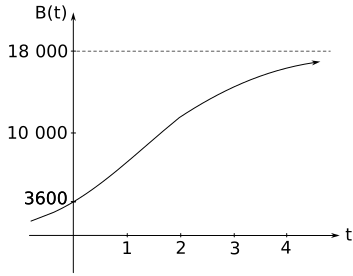
  4. What is the maximum growth rate of the brumby population?   (3 marks)

    --- 10 WORK AREA LINES (style=lined) ---

Show Answers Only

 a.    
       

b.    `2.34\ text{years}`

c.    `text{Proof (See Worked Solutions}`

d.    `4500\ text{brumbies per year}`

Show Worked Solution

a.   

b.    `text {Find}\ t\ text{when}\ \ B(t)=13\ 000`

`13\ 000` `=(18\ 000)/(1+4e^(-t))`  
`13\ 000(1+4e^(-t))` `=18\ 000`  
`1+4e^(-t)` `=18/13`  
`4e^(-t)` `=5/13`  
`e^(-t)` `=5/52`  
`-t` `=ln(5/52)`  
`t` `=2.34\ text{years (2 d.p.)}`  


c.    `text{Show}\ \ B^(′)(t)=(72\ 000e^t)/(e^t+4)^2`

`B(t)=18\ 000(1+4e^(-t))^(-1)`

`B^(′)(t)` `=-1*-1*4e^(-t)*18\ 000(1+4e^(-t))^-2`  
  `=(72\ 000)/(e^t(1+4e^(-t))^2)`  
  `=(72\ 000)/(e^t(1+4/e^t)^2)`  
  `=(72\ 000)/(e^t((e^t+4)/e^t)^2)`  
  `=(72\ 000)/(e^t/(e^t)^2*(e^t+4)^2)`  
  `=(72\ 000e^t)/(e^t+4)^2\ \ text{… as required}`  


d.    `B^(′)(t)=72\ 000e^t(e^t+4)^(-2)`

`text{Using product rule:}`

`B^(″)(t)` `=72\ 000e^t(e^t+4)^(-2)+(-2e^t)(e^t+4)^(-3)72\ 000e^t`  
  `=72\ 000e^t(1/(e^t+4)^2-(2e^t)/(e^t+4)^3)`  
  `=72\ 000e^t((e^t+4-2e^t)/(e^t+4)^3)`  
  `=72\ 000e^t((4-e^t)/(e^t+4)^3)`  

 
`text{Find}\ t\ text{when}\ \ B^(′′)(t)=0:`

`4-e^t` `=0`  
`e^t` `=4`  
`t` `=ln4`  
  `=1.386…\ text{years}`  

 
`text{Checking concavity changes:}`

`text{Since}\ e^t>0, (e^t+4)^3>0\ \ text{for all}\ t:`

`text{At}\ t=1, 4-e^1=1.28>0\ \ =>\ \ B^(″)(1)>0`

`text{At}\ t=2, 4-e^2=-3.4<0\ \ =>\ \ B^(″)(2)<0`

 
`B^(′)(ln4)=\ text{Max growth rate}`

`B^(′)(ln4)` `=(72\ 000e^(ln4))/(e^(ln4)+4)^2`  
  `=(72\ 000xx4)/((4+4)^2)`  
  `=4500\ text{brumbies per year}`  

Filed Under: Applications of Differential Equations, Applications of Differential Equations Tagged With: Band 3, Band 4, Band 5, smc-1198-30-Quantity, smc-7297-30-Quantity

Calculus, EXT1 C3 EQ-Bank 18

The rate of weekly sales of a product that has just been released can be modelled by the following differential equation

`S^(′)(t)=500/(t+1)^3-250/(t+1)^2`

where `S` is the number of sales in thousands and `t` is the number of weeks since launch.

Good quality products will result in increasing sales.

  1. Find the function that describes the weekly sales.   (2 marks)

    --- 4 WORK AREA LINES (style=lined) ---

  2. By calculating the number of sales for the first and fifth week, comment on the results of the launch with respect to the given information.  (2 marks)

    --- 5 WORK AREA LINES (style=lined) ---

Show Answers Only

a.    `S(t)=250/(t+1)-250/((t+1)^2)`

b.    `S(1) = 62\ 500, \ S(5) = 34\ 722`

`text{Sales drop significantly between week 1 and week 5, suggesting}`

`text{the product is of poor quality.}`

Show Worked Solution

a.    `S^(′)(t)=500/(t+1)^3-250/(t+1)^2`

`S(t)` `=int 500/(t+1)^3-250/(t+1)^2\ dt`  
  `=int 500(t+1)^(-3)-250(t+1)^(-2)\ dt`  
  `=(500(t+1)^(-2))/(-2)-(250(t+1)^(-1))/(-1)+c`  
  `=250/(t+1)-250/((t+1)^2)+c`  

 
`text{When}\ \ t=0, S(t)=0:`

`0=250/1-250/(1^2)+c\ \ =>\ \ c=0`

`:.S(t)=250/(t+1)-250/((t+1)^2)`
 

b.    `S(1)=250/(1+1)-250/((1+1)^2)=62.5`

`=>\ text{Sales in week 1 = 62 500}`
 

`S(5)=250/(1+5)-250/((1+5)^2)=34.7222`

`=>\ text{Sales in week 5 = 34 722}`
 

`text{Sales drop significantly between week 1 and week 5, suggesting}`

`text{the product is of poor quality.}`

Filed Under: Applications of Differential Equations, Applications of Differential Equations Tagged With: Band 4, smc-1198-55-Economics, smc-7297-60-Economics

Calculus, EXT1 C3 EQ-Bank 14

The population of Myna birds in a national park is decreasing at a rate proportional to the population at that time.

  1. Write a differential equation that describes the situation.   (1 mark)

    --- 2 WORK AREA LINES (style=lined) ---

  2. If the population was originally 1300 and decreased to 1040 after 5 years, find the expected population after 10 years.  (3 marks)

    --- 8 WORK AREA LINES (style=lined) ---

Show Answers Only

a.    `(dN)/(dt) = -kN`

b.    `832`

Show Worked Solution

i.   `text{Let}\ (dN)/(dt)=\ text{rate of change of bird population at time}\ t\ text{years.}`

`(dN)/(dt) prop N`

`(dN)/(dt) = -kN\ \ (k>0,\ text{decreasing population)}`
 

b.    `(dN)/(dt)` `=-kN`
  `1/N* (dN)/(dt)` `=-k`
  `int1/N\ dN` `=-intk\ dt`
  `ln absN` `=-kt+c`
  `N` `=e^(-kt+c)`
    `=e^(-kt)*e^c`
    `=Ae^(-kt)\ \ \ text{(where}\ A=e^c)`

 
`text{When}\ \ t=0, N=1300:`

`1300=Ae^0\ \ =>\ \ A=1300`

`N=1300e^(-kt)`
 

`text{When}\ \ t=5, N=1040:`

`1040` `=1300e^(-5k)`  
`e^(-5k)` `=1040/1300`  
`-5k` `=ln(0.8)`  
`k` `=-(ln(0.8))/(5)=0.04462…`  

 
`text{Find}\ N\ text{when}\ \ t=10:`

`N` `=1300e^(-0.04462 xx 10)`  
  `=832\ \ text{myna birds}`  

Filed Under: Applications of Differential Equations, Applications of Differential Equations Tagged With: Band 3, Band 4, smc-1198-30-Quantity, smc-7297-30-Quantity

Calculus, EXT1 C3 EQ-Bank 32

The maximum speed that a hammer can reach after falling vertically from the top of a skyscraper is `u\ text{ms}^(-1)`.

The hammer's  speed, `v\ text{ms}^(-1)`, after falling `x` metres, is given by the differential equation 

`(dv)/(dx)=c(u^2-v^2)/v`  where `c` is a positive constant.

Find an expression of `v` in terms of `x`.   (4 marks)

--- 12 WORK AREA LINES (style=lined) ---

Show Answers Only

`v=u(1-e^(-2cx))^(1/2)`

Show Worked Solution
`(dv)/(dx)` `=c((u^2-v^2)/v)`  
`v/(u^2-v^2)\ dv` `=c\ dx`  
`int v/(u^2-v^2)\ dv` `=int c\ dx`  
`-1/2ln(u^2-v^2)` `=cx+C`  

 
`text{When}\ \ x=0, v=0:`

`-1/2ln\ u^2=c xx 0+C\ \ =>\ \ C=-ln\ u`
 

`-1/2ln(u^2-v^2)` `=cx-ln\ u`  
`ln(u^2-v^2)` `=-2cx+2ln\ u`  
`ln(u^2-v^2)` `=-2cx+ln\ u^2`  
`u^2-v^2` `=e^(-2cx+ln\ u^2)`  
`u^2-v^2` `=e^(-2cx)*e^(ln\ u^2)`  
`u^2-v^2` `=u^2e^(-2cx)`  
`v^2` `=u^2-u^2e^(-2cx)`  
  `=u^2(1-e^(-2cx))`  
`v` `=+-u(1-e^(-2cx))^(1/2)`  
  `=u(1-e^(-2cx))^(1/2),\ \ (v>0)`  

Filed Under: Applications of Differential Equations, Applications of Differential Equations Tagged With: Band 5, smc-1198-40-Motion, smc-7297-40-Motion

Calculus, EXT1 C3 EQ-Bank 31

The rate of fuel running out of a leaking tank can be modelled by the following equation

`(dh)/(dt)=-Ae^(-0.2t)`  where `h` is the height of the fuel in the tank after `t` hours?

Initially, the height of the fuel in the tank is  4 metres and after 1.5 hours, it has fallen to 3 metres.

At what height of fuel in the tank will it eventually stabilise, giving your answer to the nearest centimetre?   (4 marks)

--- 12 WORK AREA LINES (style=lined) ---

Show Answers Only

`text{14 centimetres.}`

Show Worked Solution
`(dh)/(dt)` `=-Ae^(-0.2t)`  
`h` `=int-Ae^(-0.2t)\ dt=5Ae^(-0.2t)+C`  

 
`text{As}\ \ t->oo, 5Ae^(-0.2t)->0`

`text{i.e.}\ h\ text{eventually stabilises at}\ C.`

`text{Find}\ A:`

`text{When}\ \ t=0,\ \ h=4`

`4=5Ae^(-0.2t)+C\ \ =>\ \ A=(4-C)/5`
 

`text{When}\ \ t=1.5,\ \ h=3`

`3` `=5xx(4-C)/5 e^(-0.2xx1.5)+C`  
`3` `=4/e^0.3-C/e^0.3+C`  
`(3e^0.3-4)/e^0.3` `=C(1-1/e^0.3)`  
`(3e^0.3-4)/e^0.3` `=C((e^0.3-1)/e^0.3)`  
`C` `=(3e^0.3-4)/e^0.3 xx e^0.3/(e^0.3-1)`  
  `=0.1417…\ text{m}`  
  `=14\ text{cm (nearest cm)`  


`:.\ text{Height of fuel in the tank will stabilise at 14 centimetres.}`

Filed Under: Applications of Differential Equations, Applications of Differential Equations Tagged With: Band 5, smc-1198-45-Flow in/out, smc-7297-45-Flow in/out

Calculus, EXT1 C3 EQ-Bank 17

A varroa virus is infecting commercial beehives in a regional NSW town.

All infected hives detected so far lie within a circular region with radius 16 km and researchers believe that the increase of the radius `r` km can be modelled by a differential equation, where `(dr)/(dt)=2/5sqrtr` where `t` denotes the time in months.

What does this model predict for the radius of the region affected by the pest after `t` months?   (3 marks)

--- 8 WORK AREA LINES (style=lined) ---

Show Answers Only

`r=((t+20)/5)^2`

Show Worked Solution
`(dr)/(dt)` `=2/5sqrtr`  
`5/(2sqrtr)\ dr` `=1\ dt`  
`5/2r^(-1/2)\ dr` `=1\ dt`  
`5/2intr^(-1/2)\ dr` `=int1\ dt`  
`5r^(1/2)` `=t+C`  


`text{When}\ \ t=0, r=16`

`5sqrt16=C\ \ =>\ \ C=20`

`5r^(1/2)` `=t+20`  
`r^(1/2)` `=(t+20)/5`  
`:.r` `=((t+20)/5)^2`  

Filed Under: Applications of Differential Equations, Applications of Differential Equations Tagged With: Band 4, smc-1198-30-Quantity, smc-7297-30-Quantity

Calculus, EXT1 C3 2021 SPEC1 7

The velocity of a particle satisfies the differential equation  `(dx)/(dt) = xsin(t)`,  where  `x`  centimetres is its displacement relative to a fixed point `O` at time `t` seconds.

Initially, the displacement of the particle is 1 cm.

  1. Find an expression for `x` in terms of `t`.  (3 marks)

    --- 6 WORK AREA LINES (style=lined) ---

  2. Find the maximum displacement of the particle and the times at which this occurs.  (2 marks)

    --- 4 WORK AREA LINES (style=lined) ---

Show Answers Only
  1. `x = e^(1 – cos(t))`
  2. `x_text(max) = e^2\ \ text(when)\ \ t = pi, 3pi, 5pi, …`


    `text(or)\ t = (2k + 1)pi\ \ text(for integral)\ \ k =0,1,2,…`

Show Worked Solution
a.    `(dx)/(dt)` `= x sin(t)`
  `int 1/x\ dx` `= int sin(t)\ dt`
  `log_e x` `= -cos(t) + c`


`text(When)\ \ t = 0, x = 1`

`log_e 1` `= -cos0 + c`
`c` `= 1`
`log_e x` `= -cos(t) + 1`
`:. x` `= e^(1 – cos(t))`


b.    `x` `= e^(1 – cos(t))`
  `(dx)/(dt)` `= sin(t) · e^(1 – cos(t))`

`text(Find)\ \ t\ \ text(when)\ \ (dx)/(dt) = 0:`

`e^(1 – cos(t)) != 0`

`sin(t) = 0\ \ text(when)\ \ t = 0, pi, 2pi, …`

`x_text(max) = e^2\ \ text(when)\ \ t = pi, 3pi, 5pi, …`

`text(or)\ \ t = (2k + 1)pi\ \ text(for integral)\ \ k =0,1,2,…`

Filed Under: Applications of Differential Equations, Applications of Differential Equations Tagged With: Band 4, Band 5, smc-1198-40-Motion, smc-7297-40-Motion

Calculus, EXT1 C3 2021 HSC 14b

In a certain country, the population of deer was estimated in 1980 to be 150 000.

The population growth is given by the logistic equation  `(dP)/(dt) = 0.1P((C - P)/C)`  where `t`  is the number of years after 1980 and `C` is the carrying capacity.

In the year 2000, the population of deer was estimated to be 600 000.

Use the fact that  `C/(P(C - P)) = 1/P + 1/(C - P)`  to show that the carrying capacity is approximately 1 130 000.  (4 marks)

Show Answers Only

`text(See Worked Solution)`

Show Worked Solution

`(dP)/(dt) = 0.1P((C – P)/C)`

♦ Mean mark 45%.
`(dt)/(dP)` `= 10/P(C/(C – P))`
  `= 10 xx C/(P(C – P))`
  `= 10(1/P + 1/(C – P))`


`t` `= 10 int 1/P + 1/(C – P)\ dP`
  `= 10[ln P – ln(C – P)] + c`
  `= 10 ln(P/(C – P)) + c`


`text(When)\ \ t= 0, P = 150\ 000:`

`0` `= 10 ln((150\ 000)/(C – 150\ 000)) + c`
`c` `= -10 ln((150\ 000)/(C – 150\ 000))`
  `= 10 ln((C – 150\ 000)/(150\ 000))`


`text(When)\ \ t = 20, P = 600\ 000:`

`20` `= 10 ln((600\ 000)/(C – 600\ 000)) + 10 ln((C – 150\ 000)/(150\ 000))`
`2` `= ln((600\ 000)/(C – 600\ 000) xx (C – 150\ 000)/(150\ 000))`
`2` `= ln((4C – 600\ 000)/(C – 600\ 000))`
`e^2` `= (4C – 600\ 000)/(C – 600\ 000)`
`e^2(C – 600\ 000)` `= 4C – 600\ 000`
`e^2C – 4C` `= e^2* 600\ 000 – 600\ 000`
`C(e^2 – 4)` `= 600\ 000(e^2 – 1)`
`C` `= (600\ 000(e^2 – 1))/(e^2 – 4)`
  `~~ 1\ 131\ 121`

 
`:.\ text(Carrying capacity)\ ~~1\ 130\ 000`

Filed Under: Applications of Differential Equations, Applications of Differential Equations Tagged With: Band 5, smc-1198-30-Quantity, smc-7297-30-Quantity

Calculus, EXT1 C3 2020 SPEC2 10

A tank initially contains 300 grams of salt that is dissolved in 50 L of water. A solution containing 15 grams of salt per litre of water is poured into the tank at a rate of 2 L per minute and the mixture in the tank is kept well stirred. At the same time, 5 L of the mixture flows out of the tank per minute.

Find the differential equation,  `(dm)/(dt)`, where  `m` represents the mass, in grams, of salt in the tank at time `t` minutes, for a non-zero volume of mixture.   (2 marks)

Show Answers Only

`(dm)/(dt) = 30 – (5m)/(50 – 3t)`

Show Worked Solution

`V(t) = 50 + 2t – 5t = 50 – 3t`

`(dm)/(dt)\ text(in) = 15 xx 2 = 30\ text(g/min)`

`(dm)/(dt)\ text(out) = 5 xx m/(50 – 3t) = (5m)/(50 – 3t)`

`:. (dm)/(dt) = 30 – (5m)/(50 – 3t)`

Filed Under: Applications of Differential Equations, Uncategorized Tagged With: Band 4, smc-1198-10-Mixing, smc-7297-10-Mixing

Calculus, EXT1 C3 EQ-Bank 16

Bacteria are spreading over a Petri dish at a rate modelled by the differential equation

`(dP)/(dt) = P/2 (1-P),\ 0 < P < 1`

where  `P`  is the proportion of the dish covered after  `t`  hours.

Given  `2/(P(1-P)) = 2/P + 2/(1-P),`

  1. Show by integration that  `(t-c)/2= log_e(P/(1-P))`, where  `c`  is a constant of integration.  (2 marks)

    --- 5 WORK AREA LINES (style=lined) ---

  2. If half of the Petri dish is covered by the bacteria at  `t = 0`, express  `P`  in terms of  `t`.  (2 marks)

    --- 6 WORK AREA LINES (style=lined) ---

Show Answers Only

a.    `text(Proof)\ text{(See Worked Solutions)}`

b.    `P = e^(t/2)/(1 + e^(t/2))`

Show Worked Solution

a.    `(dt)/(dP) = 2/(P(1-P)) = 2/P + 2/(1-P)`

`t` `= int 2/P + 2/(1-P)\ dP`
  `= 2 log_e |P|-2log_e|1-P| + c`
`(t-c)/2` `=log_e|P|-log_e|1-P|`
  `=log_e |(P)/(1-P)|`
  `= log_e (P/(1-P))`

  
`text(S)text(ince)\ \ 0 < P < 1 :\ |P| = P\ and\ |1-P| = 1-P`


b.
  `text(When)\ \ t=0,\ P=0.5`

`(-c)/2` `= log_e (0.5/0.5)`
`c` `= log_e (1)`
  `=0`


`t/2` `= ln (P/(1-P))`
`e^(t/2)` `= P/(1-P)`
`e^(t/2) (1-P)` `= P`
`e^(t/2)-Pe^(t/2)` `= P`
`e^(t/2)` `= P(1 + e^(t/2))`
`:. P` `= e^(t/2)/(1 + e^(t/2))`

Filed Under: Applications of Differential Equations, Applications of Differential Equations Tagged With: Band 4, smc-1198-30-Quantity, smc-7297-30-Quantity

Calculus, EXT1 C3 2018 SPEC1 8

A tank initially holds 16 L of water in which 0.5 kg of salt has been dissolved. Pure water then flows into the tank at a rate of 5 L per minute. The mixture is stirred continuously and flows out of the tank at a rate of 3 L per minute.

  1.  Show that the differential equation for `Q`, the number of kilograms of salt in the tank after `t` minutes, is given by

    `qquad (dQ)/(dt) = -(3Q)/(16 + 2t)`  (1 mark)
      
  2.  Solve the differential equation given in part a. to find `Q` as a function of `t`.
      
    Express your answer in the form  `Q = a/(16 + 2t)^(b/c)`, where `a, b` and `c` are positive integers.  (3 marks)
Show Answers Only
  1.  `text(Proof)\ \ text{(See Worked Solutions)}`
  2.  `Q = 32/(16 + 2t)^(3/2)`
Show Worked Solution

a. `Q_0 = 0.5, \ V_0 = 16`

♦ Net mean mark of both parts 44%.

`V(t)` `= 16 + (5 – 3) t`
  `= 16 + 2t`

 
`text(Concentration)\ (C)= Q/V= Q/(16 + 2t)\ text(kg/L)`

`(dQ)/(dt)` `= 0 xx 5 – 3C`
  `= -(3Q)/(16 + 2t)`

MARKER’S COMMENT: Many students took the common factor of 2 from  `16+2t`. This wasn’t necessary and complicated the arithmetic in part b.


b.   `-1/(3Q) * (dQ)/(dt) = 1/(16 + 2t)`

`int -1/(3Q)\ dQ` `= int 1/(16 + 2t) dt`
`-1/3 int 1/Q\ dQ` `= 1/2 int 2/(16 + 2t)\ dt`
`-1/3 ln Q` ` = [1/2 ln(16 + 2t)] + c`

 
`text(When)\ \ t=0,\ \ Q=0.5,`

COMMENT: A very challenging test of using exponential and log laws!

`-1/3 ln (1/2)` `= 1/2 ln (16) +c`
`c` `= -1/2 ln (16) -1/3 ln (1/2)`


`-1/3 ln Q` `= 1/2 ln(16 + 2t) -1/2 ln(16) – 1/3 ln (1/2)`
`-1/3 ln Q` `= 1/2 ln ((16 + 2t)/16) – 1/3 ln (1/2)`
`-1/3 ln Q` `= ln (((16 + 2t)^(1/2))/4) – ln (2^(-1/3))`
`ln (Q^(-1/3))` `= ln (((16 + 2t)^(1/2))/(2^2 ⋅ 2^(-1/3)))`
`Q^(-1/3)` `= ((16 + 2t)^(1/2))/(2^(5/3))`
`Q` `= (((16 + 2t)^(1/2))/(2^(5/3)))^-3`
  `= (16 + 2t)^(- 3/2)/(2^(-5))`
`:. Q` `= 32/((16 + 2t)^(3/2))`

Filed Under: Applications of Differential Equations, Uncategorized Tagged With: Band 4, Band 5, smc-1198-10-Mixing, smc-7297-10-Mixing

Calculus, EXT1 C3 2014 VCE 10 MC

A large tank initially holds 1500 L of water in which 100 kg of salt is dissolved. A solution containing 2 kg of salt per litre flows into the tank at a rate of 8 L per minute. The mixture is stirred continuously and flows out of the tank through a hole at a rate of 10 L per minute.

The differential equation for `Q`, the number of kilograms of salt in the tank after `t` minutes, is given by

A.   `(dQ)/(dt) = 16 - (5Q)/(750 - t)`

B.   `(dQ)/(dt) = 16 - (5Q)/(750 + t)`

C.   `(dQ)/(dt) = 16 + (5Q)/(750 - t)`

D.   `(dQ)/(dt) = (100Q)/(750 - t)`

Show Answers Only

`A`

Show Worked Solution

`(dQ_text(in))/(dV)= 2\ text(kg/L),\ (dV_text(in))/(dt) = 8\ text(L/min)`

`V_0 = 1500,\ Q_0 = 100`

`(dV_text(out))/(dt) = 10\ text(L/min)`
  

`V(t)` `= 1500 + (8 – 10)t`
  `= 1500 – 2t`
  `= 2(750 – t)`


`(dQ_text(in))/(dt)` `= 2 xx 8 = 16 text(kg/min)`
`(dQ_text(out))/(dt)` `= Q/(v(t)) xx 10`
  `= (10Q)/(2(750 – t))`
  `= (5Q)/(750 – t)`

 
`:.(dQ)/(dt)= 16 – (5Q)/(150 – t)`

`=> A`

Filed Under: Applications of Differential Equations, Uncategorized Tagged With: Band 4, smc-1198-10-Mixing, smc-7297-10-Mixing

Calculus, EXT1 C3 2013 VCE 13 MC

Water containing 2 grams of salt per litre flows at the rate of 10 litres per minute into a tank that initially contained 50 litres of pure water. The concentration of salt in the tank is kept uniform by stirring and the mixture flows out of the tank at the rate of 6 litres per minute.

If `Q` grams is the amount of salt in the tank `t` minutes after the water begins to flow, the differential equation relating `Q` to `t` is

A.   `(dQ)/(dt) = 20 - (3Q)/(25 + 2t)`

B.   `(dQ)/(dt) = 10 - (3Q)/(25 + 2t)`

C.   `(dQ)/(dt) = 20 - (3Q)/(25 - 2t)`

D.   `(dQ)/(dt) = 10 - (3Q)/(25 - 2t)`

Show Answers Only

`A`

Show Worked Solution
`text(Volume)` `= 50 + (10 – 6)t`
  `= 50 + 4t`

 
`text(Salt in tank at time)\ \ t=Q\ text(grams)`

`:.\ text(Concentration)\ = Q/(50 + 4t)\ text(grams per litre)`
 

`(dQ)/(dt)text(in) = 2 xx 10 = 20\ \ text(g/min)`

`(dQ)/(dt)text(out)` `= 6 xx Q/(50 + 4t)`
  `= (3Q)/(25 + 2t)`

 
`:. (dQ)/(dt) = 20 – (3Q)/(25 + 2t)`

`=> A`

Filed Under: Applications of Differential Equations, Uncategorized Tagged With: Band 4, smc-1198-10-Mixing, smc-7297-10-Mixing

Copyright © 2014–2026 SmarterEd.com.au · Log in