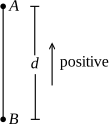
Two particles, \(A\) and \(B\), each have mass 1 kg and are in a medium that exerts a resistance to motion equal to \(k v\), where \(k>0\) and \(v\) is the velocity of any particle. Both particles maintain vertical trajectories. The acceleration due to gravity is \(g\) ms\(^{-2}\), where \(g>0\). The two particles are simultaneously projected towards each other with the same speed, \(v_0\) ms\(^{-1}\), where \(0<v_0<\dfrac{g}{k}\). The particle \(A\) is initially \(d\) metres directly above particle \(B\), where \(d<\dfrac{2 v_0}{k}\). Find the time taken for the particles to meet. (4 marks) --- 16 WORK AREA LINES (style=lined) ---
\(\text{Particle A:}\) \(\ddot{x}=\dfrac{dv_{\small{A}}}{dt}=-g-k v_{\small{A}}\) \(\dfrac{dt}{dv_{\small{A}}}=\dfrac{1}{-g-kv_{\small{A}}}\) \(t=-\displaystyle \int \dfrac{1}{g+k v_{\small{A}}} \, dv_{\small{A}}=-\dfrac{1}{k} \ln \left(g+k v_A\right)+c\) \(\text{At} \ \ t=0, \ v_{\small{A}}=-v_0 \ \Rightarrow \ c=\dfrac{1}{k} \ln \left(g-k v_0\right)\) \(t=\dfrac{1}{k} \ln \left(g-k v_0\right)-\dfrac{1}{k} \ln \left(g+kv_{\small{A}}\right)=\dfrac{1}{k} \ln \left(\dfrac{g-kv_0}{g+kv_{\small{A}}}\right)\) \(\text{Find} \ v_{\small{A}}:\) \(x_{\small{A}}=d-\left(\dfrac{g}{k^2}-\dfrac{v_0}{k}\right) e^{-kt}-gt+\dfrac{g}{k^2}-\dfrac{v_0}{k}\) \(\text{Particle B:}\) \(\ddot{x}=-g-k v_{\small{B}}\) \(t=-\dfrac{1}{k} \ln \left(g+k v_{\small{B}}\right)+c\) \(\text{When} \ \ t=0, v_B=v_0 \ \Rightarrow \ c=\dfrac{1}{k} \ln \left(g+kv_0\right)\) \(\text{When} \ \ t=0, x=0 \ \Rightarrow \ c=\dfrac{g}{k^2}+\dfrac{v_0}{k}\) \(x_{\small{B}}=-\left(\dfrac{g}{k^2}+\dfrac{v_0}{k}\right) e^{-kt}-gt+\dfrac{g}{k^2}+\dfrac{v_0}{k}\) \(\text{Find \(t\) when \(\ x_{\small{A}}=x_{\small{B}}\):}\) \(d-\left(\dfrac{g}{k^2}-\dfrac{v_0}{k}\right) e^{-k t}-g t+\dfrac{g}{k^2}-\dfrac{v_0}{k}=-\left(\dfrac{g}{k^2}+\dfrac{v_0}{k}\right) e^{-k t}-g t+\dfrac{g}{k^2}+\dfrac{v_0}{k}\)
\(\dfrac{g-k v_0}{g+k v_{\small{A}}}\)
\(=e^{kt}\)
\(g-kv_0\)
\(=e^{kt} \cdot g+e^{kt} \cdot kv_{\small{A}}\)
\(kv_{\small{A}}\)
\(=e^{-kt}\left(g-kv_0\right)-g\)
\(v_{\small{A}}\)
\(=\dfrac{1}{k}\left[e^{-kt}\left(g-kv_0\right)-g\right]\)
\(x\)
\(=\displaystyle \frac{1}{k} \int e^{-kt} \cdot g-e^{-kt} \cdot v_0-g \, dt\)
\(=\dfrac{1}{k}\left[-\dfrac{g}{k}e^{-kt}+v_0 e^{-kt}-gt\right]+c\)
\(=-\left(\dfrac{g}{k^2}-\dfrac{v_0}{k}\right) e^{-kt}-gt+c\)
\(\text{When} \ \ t=0, x=0 \ \Rightarrow \ c=\dfrac{g}{k^2}-\dfrac{v_0}{k}\)
\(v_{\small{B}}\)
\(=\dfrac{1}{k}\left[e^{-kt}\left(g+kv_0\right)-g\right]\)
\(x_{\small{B}}\)
\(=-\left(\dfrac{g}{k^2}+\dfrac{v_0}{k}\right) e^{-kt}-gt+c\)
\(\dfrac{2 v_0}{k} \cdot e^{-k t}\)
\(=\dfrac{2 v_0}{k}-d\)
\(e^{-kt}\)
\(=\left(\dfrac{2 v_0-d k}{k}\right) \cdot \dfrac{k}{v_0}\)
\(-kt\)
\(=\ln \left(\dfrac{2 v_0-d k}{v_0}\right)\)
\(t\)
\(=-\dfrac{1}{k} \ln \left(\dfrac{2v_0-dk}{v_0}\right)\)
Mechanics, EXT2 M1 2023 HSC 14c
A projectile of mass \(M\) kg is launched vertically upwards from the origin with an initial speed \(v_0\) m s\(^{-1}\). The acceleration due to gravity is \( {g}\) ms\(^{-2}\).
The projectile experiences a resistive force of magnitude \(kMv^2\) newtons, where \(k\) is a positive constant and \(v\) is the speed of the projectile at time \(t\) seconds.
- The maximum height reached by the particle is \(H\) metres.
- Show that \(H=\dfrac{1}{2 k} \ln \left(\dfrac{k v_0{ }^2+g}{g}\right)\). (3 marks)
--- 8 WORK AREA LINES (style=lined) ---
- When the projectile lands on the ground, its speed is \(v_1 \text{m} \ \text{s}^{-1}\), where \(v_1\) is less than the magnitude of the terminal velocity.
- Show that \(g\left(v_0^2-v_1^2\right)=k v_0^2 v_1^2\). (3 marks)
--- 10 WORK AREA LINES (style=lined) ---
Mechanics, EXT2 M1 2022 HSC 10 MC
A particle is moving vertically in a resistive medium under the influence of gravity. The resistive force is proportional to the velocity of the particle.
The initial speed of the particle is NOT zero.
Which of the following statements about the motion of the particle is always true?
- If the particle is initially moving downwards, then its speed will increase.
- If the particle is initially moving downwards, then its speed will decrease.
- If the particle is initially moving upwards, then its speed will eventually approach a terminal speed.
- If the particle is initially moving upwards, then its speed will not eventually approach a terminal speed.
Mechanics, EXT2 M1 2022 HSC 16b
A projectile of mass `M` kg is launched vertically upwards from a horizontal plane with initial speed `v_0\ text{m s}^(-1)` which is less than 100`\ text{m s}^(-1)`. The projectile experiences a resistive force which has magnitude `0.1 M v` newtons, where `v\ text{m s}^(-1)` is the speed of the projectile. The acceleration due to gravity is 10`\ text{m s}^(-2)`.
The projectile lands on the horizontal plane 7 seconds after launch.
Find the value of `v_0`, correct to 1 decimal place. (4 marks)
--- 15 WORK AREA LINES (style=lined) ---
Mechanics, EXT2 M1 2021 HSC 15c
An object of mass 1 kg is projected vertically upwards with an initial velocity of `u` m/s. It experiences air resistance of magnitude `kv^2` newtons where `v` is the velocity of the object, in m/s, and `k` is a positive constant. The height of the object above its starting point is `x` metres. The time since projection is `t` seconds and acceleration due to gravity is `g` m/s².
- Show that the time for the object to reach its maximum height is `1/sqrt{gk} arctan (u sqrt{k/g})` seconds. (3 marks)
--- 6 WORK AREA LINES (style=lined) ---
- Find an expression for the maximum height reached by the object, in terms of `k`, `g`, and `u`. (3 marks)
--- 8 WORK AREA LINES (style=lined) ---
Mechanics, EXT2 M1 EQ-Bank 28
A canon ball of mass 9 kilograms is dropped from the top of a castle at a height of `h` metres above the ground.
The canon ball experiences a resistance force due to air resistance equivalent to `(v^2)/500`, where `v` is the speed of the canon ball in metres per second. Let `g=9.8\ text(ms)^-2` and the displacement, `x` metres at time `t` seconds, be measured in a downward direction.
- Show the equation of motion is given by
- `ddotx = g-(v^2)/4500` (1 mark)
--- 4 WORK AREA LINES (style=lined) ---
- Show, by integrating using partial fractions, that
- `v = 210((e^(7/75 t)-1)/(e^(7/75 t) + 1))` (5 marks)
--- 14 WORK AREA LINES (style=lined) ---
- If the canon hits the ground after 4 seconds, calculate the height of the castle, to the nearest metre. (3 marks)
--- 10 WORK AREA LINES (style=lined) ---
Mechanics, EXT2 M1 2019 HSC 14b
A parachutist jumps from a plane, falls freely for a short time and then opens the parachute. Let t be the time in seconds after the parachute opens, `x(t)` be the distance in metres travelled after the parachute opens, and `v(t)` be the velocity of the parachutist in `text(ms)^(-1)`.
The acceleration of the parachutist after the parachute opens is given by
`ddot x = g-kv,`
where `g\ text(ms)^(-2)` is the acceleration due to gravity and `k` is a positive constant.
- With an open parachute the parachutist has a terminal velocity of `w\ text(ms)^(-1)`.
- Show that `w = g/k`. (1 mark)
--- 3 WORK AREA LINES (style=lined) ---
- At the time the parachute opens, the speed of descent is `1.6 w\ text(ms)^(-1)`.
- Show that it takes `1/k log_e 6` seconds to slow down to a speed of `1.1w\ text(ms)^(-1)`. (4 marks)
--- 12 WORK AREA LINES (style=lined) ---
- Let `D` be the distance the parachutist travels between opening the parachute and reaching the speed `1.1w\ text(ms)^(-1)`.
- Show that `D = g/k^2 (1/2 + log_e 6)`. (3 marks)
--- 8 WORK AREA LINES (style=lined) ---
Mechanics, EXT2 M1 2018 HSC 14b
A falling particle experiences forces due to gravity and air resistance. The acceleration of the particle is `g-kv^2`, where `g` and `k` are positive constants and `v` is the speed of the particle. (Do NOT prove this.)
Prove that, after falling from rest through a distance, `h`, the speed of the particle will be `sqrt(g/k (1-e^(−2kh)))`. (3 marks)
--- 12 WORK AREA LINES (style=lined) ---
Mechanics, EXT2 M1 2017 HSC 13c
A particle is projected upwards from ground level with initial velocity `1/2 sqrt(g/k)\ text(ms)^(-1)`, where `g` is the acceleration due to gravity and `k` is a positive constant. The particle moves through the air with speed `v\ text(ms)^(-1)` and experiences a resistive force.
The acceleration of the particle is given by `ddot x = -g-kv^2\ text(ms)^(-2)`. Do NOT prove this.
The particle reaches a maximum height, `H`, before returning to the ground.
Using `ddot x = v (dv)/(dx)`, or otherwise, show that `H = 1/(2k) log_e (5/4)` metres. (4 marks)
Mechanics, EXT2 M1 2007 HSC 6b
A raindrop falls vertically from a high cloud. The distance it has fallen is given by
`x = 5 log_e ((e^(1.4 t) + e^(-1.4 t))/2)`
where `x` is in metres and `t` is the time elapsed in seconds.
- Show that the velocity of the raindrop, `v` metres per second, is given by
- `v = 7 ((e^(1.4 t)-e^(-1.4 t))/(e^(1.4 t) + e^(-1.4 t)))` (2 marks)
--- 5 WORK AREA LINES (style=lined) ---
- Hence show that `v^2 = 49 (1-e^(-(2x)/5)).` (2 marks)
--- 7 WORK AREA LINES (style=lined) ---
- Hence, or otherwise, show that `ddot x = 9.8-0.2v^2.` (2 marks)
--- 5 WORK AREA LINES (style=lined) ---
- The physical significance of the 9.8 in part (c) is that it represents the acceleration due to gravity.
- What is the physical significance of the term `–0.2 v^2?` (1 mark)
--- 2 WORK AREA LINES (style=lined) ---
- Estimate the velocity at which the raindrop hits the ground. (1 mark)
--- 3 WORK AREA LINES (style=lined) ---
Mechanics, EXT2 M1 2009 HSC 7a
A bungee jumper of height 2 m falls from a bridge which is 125 m above the surface of the water, as shown in the diagram. The jumper’s feet are tied to an elastic cord of length `L` m. The displacement of the jumper’s feet, measured downwards from the bridge, is `x` m.
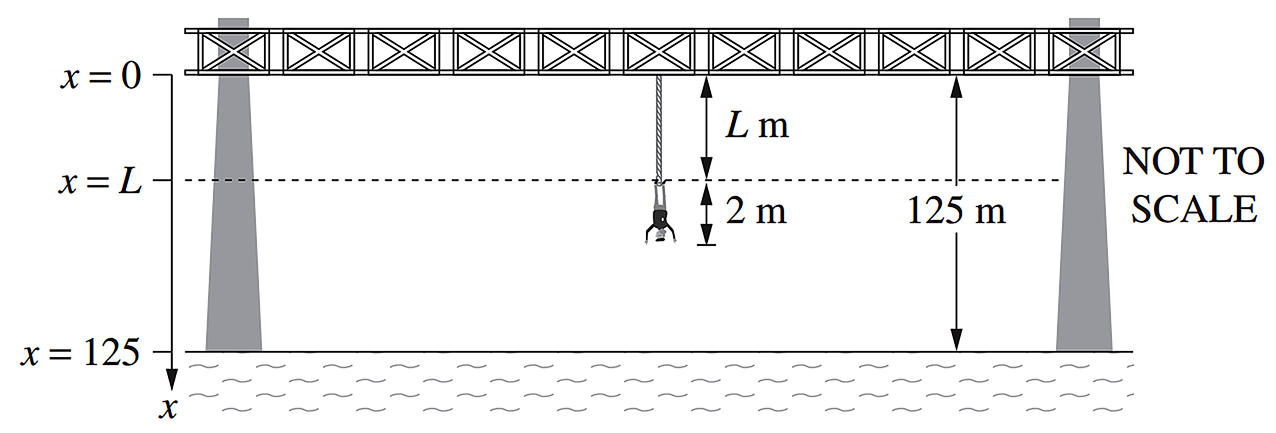
The jumper’s fall can be examined in two stages. In the first stage of the fall, where `0 <= x <= L`, the jumper falls a distance of `L` m subject to air resistance, and the cord does not provide resistance to the motion. In the second stage of the fall, where `x > L`, the cord stretches and provides additional resistance to the downward motion.
- The equation of motion for the jumper in the first stage of the fall is
- `ddot x = g-rv`
- where `g` is the acceleration due to gravity, `r` is a positive constant, and `v` is the velocity of the jumper.
- Given that `x = 0` and `v = 0` initially, show that
- `qquad x = g/r^2 ln (g/(g-rv))-v/r.` (3 marks)
--- 9 WORK AREA LINES (style=lined) ---
-
Given that `g = 9.8\ text(ms)^-2` and `r = 0.2\ text(s)^-1`, find the length, `L`, of the cord such that the jumper’s velocity is `30\ text(ms)^-1` when `x = L`. Give your answer to two significant figures. (1 mark)
--- 4 WORK AREA LINES (style=lined) ---
- In the second stage of the fall, where `x > L`, the displacement `x` is given by
- `x = e^(-t/10)(29 sin t-10 cos t) + 92`
- where `t` is the time in seconds after the jumper’s feet pass `x = L`.
- Determine whether or not the jumper’s head stays out of the water. (4 marks)
--- 10 WORK AREA LINES (style=lined) ---
Mechanics, EXT2 M1 2011 HSC 6a
Jac jumps out of an aeroplane and falls vertically. His velocity at time `t` after his parachute is opened is given by `v(t)`, where `v(0) = v_0` and `v(t)` is positive in the downwards direction. The magnitude of the resistive force provided by the parachute is `kv^2`, where `k` is a positive constant. Let `m` be Jac’s mass and `g` the acceleration due to gravity. Jac’s terminal velocity with the parachute open is `v_T.`
Jac’s equation of motion with the parachute open is
`m (dv)/(dt) = mg-kv^2.` (Do NOT prove this.)
- Explain why Jac’s terminal velocity `v_T` is given by `sqrt ((mg)/k).` (1 mark)
--- 4 WORK AREA LINES (style=lined) ---
- By integrating the equation of motion, show that `t` and `v` are related by the equation
- `t = (v_T)/(2g) ln[((v_T + v)(v_T-v_0))/((v_T-v)(v_T + v_0))].` (3 marks)
--- 12 WORK AREA LINES (style=lined) ---
- Jac’s friend Gil also jumps out of the aeroplane and falls vertically. Jac and Gil have the same mass and identical parachutes.
- Jac opens his parachute when his speed is `1/3 v_T.` Gil opens her parachute when her speed is `3v_T.` Jac’s speed increases and Gil’s speed decreases, both toward `v_T.`
- Show that in the time taken for Jac's speed to double, Gil's speed has halved. (3 marks)
--- 10 WORK AREA LINES (style=lined) ---
Mechanics, EXT2 M1 2013 HSC 15d
A ball of mass `m` is projected vertically into the air from the ground with initial velocity `u`. After reaching the maximum height `H` it falls back to the ground. While in the air, the ball experiences a resistive force `kv^2`, where `v` is the velocity of the ball and `k` is a constant.
The equation of motion when the ball falls can be written as
`m dot v = mg-kv^2.` (Do NOT prove this.)
- Show that the terminal velocity `v_T` of the ball when it falls is `sqrt ((mg)/k).` (1 mark)
--- 4 WORK AREA LINES (style=lined) ---
- Show that when the ball goes up, the maximum height `H` is
- `H = (v_T^2)/(2g) ln (1 + u^2/(v_T^2)).` (3 marks)
--- 10 WORK AREA LINES (style=lined) ---
- When the ball falls from height `H` it hits the ground with velocity `w`.
- Show that `1/w^2 = 1/u^2 + 1/(v_T^2).` (2 marks)
--- 9 WORK AREA LINES (style=lined) ---