SmarterEd

Aussie Maths & Science Teachers: Save your time with SmarterEd

  • Login
  • Get Help
  • About

Mechanics, EXT2 M1 2023 HSC 14c

A projectile of mass \(M\) kg is launched vertically upwards from the origin with an initial speed \(v_0\) m s\(^{-1}\). The acceleration due to gravity is \( {g}\) ms\(^{-2}\).

The projectile experiences a resistive force of magnitude \(kMv^2\) newtons, where \(k\) is a positive constant and \(v\) is the speed of the projectile at time \(t\) seconds.

  1. The maximum height reached by the particle is \(H\) metres.
  2. Show that  \(H=\dfrac{1}{2 k} \ln \left(\dfrac{k v_0{ }^2+g}{g}\right)\).   (3 marks)

    --- 8 WORK AREA LINES (style=lined) ---

  3. When the projectile lands on the ground, its speed is \(v_1 \text{m} \ \text{s}^{-1}\), where \(v_1\) is less than the magnitude of the terminal velocity.
  4. Show that  \(g\left(v_0^2-v_1^2\right)=k v_0^2 v_1^2\).   (3 marks)

    --- 10 WORK AREA LINES (style=lined) ---
Show Answers Only
  1. \(\text{See Worked Solution}\)
  2. \(\text{See Worked Solution}\)
Show Worked Solution

i.    \(\text{Taking up as positive:}\)

\(M\ddot x\) \(=-Mg-kMv^2\)  
\(\ddot x\) \(=-g-kv^2\)  
\(v \cdot \dfrac{dv}{dx}\) \(=-(g+kv^2) \)  
\(\dfrac{dv}{dx}\) \(=-\dfrac{g+kv^2}{v} \)  
\(\dfrac{dx}{dv}\) \(=-\dfrac{v}{g+kv^2} \)  
\(x\) \(=-\dfrac{1}{2k} \displaystyle \int \dfrac{2kv}{g+kv^2}\, dv \)  
  \(=-\dfrac{1}{2k} \ln |g+kv^2|+c \)  

 
\(\text{When}\ \ x=o, \ v=v_0: \)

\(c=\dfrac{1}{2k} \ln |g+kv_0^2| \)

\(x\) \(=\dfrac{1}{2k} \ln |g+kv_0^2|-\dfrac{1}{2k} \ln |g+kv^2| \)  
  \(=\dfrac{1}{2k} \ln \Bigg{|} \dfrac{g+kv_0^2}{g+kv^2} \Bigg{|} \)  

 
\(\text{When}\ \ v=0, x=H: \)

\(H=\dfrac{1}{2k} \ln \Bigg{(} \dfrac{g+kv_0^2}{g} \Bigg{)},\ \ \ \ (k>0) \)
  

ii.   \(\text{When projectile travels downward:} \)

\(M \ddot x\) \(=Mg-kMv^2\)  
\(\ddot x\) \(=g-kv^2\)  
\(v \cdot \dfrac{dv}{dx}\) \(=g-kv^2\)  
\(\dfrac{dx}{dv}\) \(=\dfrac{v}{g-kv^2}\)  
\(x\) \(=-\dfrac{1}{2k} \displaystyle \int \dfrac{-2kv}{g-kv^2}\,dv \)  
  \(=-\dfrac{1}{2k}  \ln|g-kv^2|+c \)  

 
\(\text{When}\ \ x=0, \ v=0: \)

\(c=\dfrac{1}{2k} \ln g \)

\(x=\dfrac{1}{2k} \ln \Bigg{|} \dfrac{g}{g-kv^2} \Bigg{|} \)
 

\(\text{When}\ \ x=H, \ v=v_1: \)

\(\dfrac{1}{2k} \ln \Bigg{(} \dfrac{g+kv_0^2}{g} \Bigg{)}\) \(=\dfrac{1}{2k} \ln \Bigg{|} \dfrac{g}{g-kv_1^2} \Bigg{|} \)  
\(\dfrac{g+kv_0^2}{g} \) \(=\dfrac{g}{g-kv_1^2} \)  
\(g^2\) \(=(g+kv_0^2)(g-kv_1^2) \)  
\(g^2\) \(=g^2-gkv_1^2+gkv_0^2-k^2v_0^2v_1^2 \)  
\(gkv_0^2-gkv_1^2 \) \(=k^2v_0^2v_1^2 \)  
\(gk(v_0^2-v_1^2) \) \(=k^2v_0^2 v_1^2 \)  
\(g(v_0^2-v_1^2) \) \(=kv_0^2v_1^2 \)  
♦♦ Mean mark (ii) 31%.

Filed Under: Resisted Motion, Vertical Resisted Motion Tagged With: Band 3, Band 5, smc-1061-05-Projectile Motion, smc-1061-20-R ~ v^2, smc-1061-50-Max Height, smc-7441-40-\(\large R \propto v^{2}\), smc-7441-50-Max Height

Mechanics, EXT2 M1 2021 HSC 15c

An object of mass 1 kg is projected vertically upwards with an initial velocity of `u` m/s. It experiences air resistance of magnitude `kv^2` newtons where `v` is the velocity of the object, in m/s, and `k` is a positive constant. The height of the object above its starting point is `x` metres. The time since projection is `t` seconds and acceleration due to gravity is `g` m/s².

  1. Show that the time for the object to reach its maximum height is  `1/sqrt{gk} arctan (u sqrt{k/g})`  seconds.   (3 marks)

    --- 6 WORK AREA LINES (style=lined) ---

  2. Find an expression for the maximum height reached by the object, in terms of `k`, `g`, and `u`.   (3 marks)

    --- 8 WORK AREA LINES (style=lined) ---

Show Answers Only
  1. `text{See Worked Solution}`
  2. `x_{text{max}} = {1}/{2k} ln ({g + ku^2}/{g})`
Show Worked Solution
i.    `{dv}/{dt}` `=-g-kv^2`
  `{dt}/{dv}` `= {-1}/{g + kv^2}`
    `= {-1}/{g} * {1}/{1 + k/g v^2}`
    `= {-1}/{g} * sqrt{g/k} * {sqrt{k/g}}/{1 + k/g v^2}`
    `=-1/sqrt{gk} * {sqrt{k/g}}/{1 + k/g v^2}`
  `t` `=-1/sqrt{gk} * int {sqrt{k/g}}/{1 + k/g v^2} dv`
    `= -1/sqrt{gk} tan ^-1 sqrt{k/g} v +c`

 
`text{When} \ t = 0 \ , \ v = u:`

`c = 1/sqrt{gk} tan^-1 sqrt{k/g} u`
  

`v = 0 \ text{at max height}`

`t = 1/sqrt{gk} tan^-1 (u sqrt{k/g})\ text{seconds}`
 

ii.   `text{Find max height:}`

Mean mark part (ii) 54%.
`v * {dv}/{dx}` `= -g-kv^2`
`{dv}/{dx}` `= {-g-kv^2}/{v}`
`{dx}/{dv}` `= {-v}/{g + kv^2}`
`x` `= -{1}/{2k} int {2kv}/{g + kv^2} dv`
  `= -{1}/{2k} ln (g + kv^2) + c`

 
`text{When} \ x = 0 \ , \ v = u:`

`c = {1}/{2k} ln (g + ku^2)`

`x` `= {1}/{2k} ln (g + ku^2)-{1}/{2k} ln (g + kv^2)`
  `= {1}/{2k} ln ({g + ku^2}/{g + kv^2})`
 
`text{Max height occurs when} \ v = 0:`

`:. \ x_{text{max}} = {1}/{2k} ln ({g + ku^2}/{g})`

Filed Under: Resisted Motion, Vertical Resisted Motion Tagged With: Band 4, smc-1061-20-R ~ v^2, smc-1061-50-Max Height, smc-7441-40-\(\large R \propto v^{2}\), smc-7441-50-Max Height

Mechanics, EXT2 M1 2017 HSC 13c

A particle is projected upwards from ground level with initial velocity  `1/2 sqrt(g/k)\ text(ms)^(-1)`, where `g` is the acceleration due to gravity and `k` is a positive constant. The particle moves through the air with speed  `v\ text(ms)^(-1)`  and experiences a resistive force.

The acceleration of the particle is given by  `ddot x = -g-kv^2\ text(ms)^(-2)`. Do NOT prove this.

The particle reaches a maximum height, `H`, before returning to the ground.

Using  `ddot x = v (dv)/(dx)`, or otherwise, show that  `H = 1/(2k) log_e (5/4)`  metres.  (4 marks)

Show Answers Only

`text(Proof)\ \ text{(See Worked Solutions)}`

Show Worked Solution

`ddot x = v · (dv)/(dx) = -g-kv^2`

`(dv)/(dx)` `=-(g + kv^2)/v`
`(dx)/(dv)` `=-v/(g + kv^2)`
`:. x` `=-int v/(g + kv^2)\ dv`
  `= -1/(2k) log_e (g + kv^2) + c`

 
`text(When)\ \ x = 0,\ \ v = 1/2 sqrt(g/k)`

`0` `= -1/(2k) log_e (g + k · g/(4k)) + c`
`:. c` `= 1/(2k) log_e ((5g)/4)`

 
`:. x = 1/(2k) log_e ((5g)/4)-1/(2k) log_e (g + kv^2)`

 
`text{Max height}\ H\ text(occurs when)\ \ v = 0:`

`H` `= 1/(2k) log_e ((5g)/4)-1/(2k) log_e g`
  `= 1/(2k) log_e ((5g)/(4g))`
  `= 1/(2k) log_e (5/4)\ text(… as required.)`

Filed Under: Resisted Motion, Resisted Motion, Vertical Resisted Motion Tagged With: Band 3, smc-1061-05-Projectile Motion, smc-1061-20-R ~ v^2, smc-1061-50-Max Height, smc-7441-40-\(\large R \propto v^{2}\), smc-7441-50-Max Height

Mechanics, EXT2 M1 2009 HSC 7a

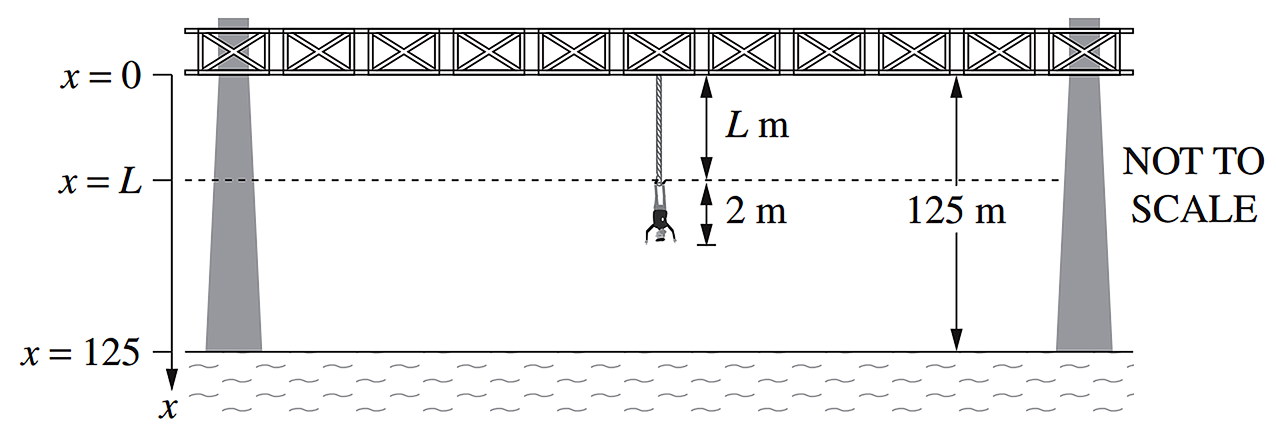
A bungee jumper of height 2 m falls from a bridge which is 125 m above the surface of the water, as shown in the diagram. The jumper’s feet are tied to an elastic cord of length `L` m. The displacement of the jumper’s feet, measured downwards from the bridge, is `x` m.

The jumper’s fall can be examined in two stages. In the first stage of the fall, where  `0 <= x <= L`, the jumper falls a distance of `L` m subject to air resistance, and the cord does not provide resistance to the motion. In the second stage of the fall, where  `x > L`, the cord stretches and provides additional resistance to the downward motion.

  1. The equation of motion for the jumper in the first stage of the fall is
  2.     `ddot x = g-rv`
  3. where `g` is the acceleration due to gravity, `r` is a positive constant, and `v` is the velocity of the jumper.
  4. Given that  `x = 0`  and  `v = 0`  initially, show that
  5. `qquad x = g/r^2 ln (g/(g-rv))-v/r.`   (3 marks)

    --- 9 WORK AREA LINES (style=lined) ---

  6. Given that  `g = 9.8\ text(ms)^-2`  and  `r = 0.2\ text(s)^-1`, find the length, `L`, of the cord such that the jumper’s velocity is `30\ text(ms)^-1`  when  `x = L`. Give your answer to two significant figures.   (1 mark)

    --- 4 WORK AREA LINES (style=lined) ---

  7. In the second stage of the fall, where `x > L`, the displacement `x` is given by
  8.     `x = e^(-t/10)(29 sin t-10 cos t) + 92`
  9. where `t` is the time in seconds after the jumper’s feet pass  `x = L`.
  10. Determine whether or not the jumper’s head stays out of the water.   (4 marks)

    --- 10 WORK AREA LINES (style=lined) ---

Show Answers Only

a.    `text{Proof}\ \ text{(See Worked Solutions)}`

b.    `82\ text(m)`

c.    `text(The jumper’s head will stay out of the water)`

Show Worked Solution

a    `ddot x=g-rv\ \ =>\ \ v (dv)/(dx)= g-rv\ \ =>\ \ (dx)/(dv)=v/(g-rv)`

`:. int dx` `= int v/(g-rv)\ dv`
`x` `=-1/r int ((g-rv-g)/(g-rv))\ dv`
  `=-1/r int (1-g/(g-rv))\ dv`
  `=-1/r (v + g/r ln(g-rv)) +c`

 
`text(When)\ \ x=0,\ \ v=0:`

`c=1/r(g/r lng)=g/r^2 ln g`

`:.x` `=-1/r (v + g/r ln(g-rv))+g/r^2 ln g`
  `=-v/r- g/r^2 ln(g-rv) +g/r^2 ln g`
  `=g/r^2 ln (g/(g-rv))-v/r`


b.    `g = 9.8\ \ text(ms)^-1,\ \ r = 0.2\ \ text(s)^-1`

`text(If)\ \ x = L,\ \ v = 30\ \ text(ms)^-1`

`:.L=9.8/0.2^2 log_e (9.8/(9.8-0.2 xx 30))-30/0.2=82\ text(m)\ \ text{(2 sig.fig.)}`
 

c.     `x` `= e^(-t/10) (29 sin t-10 cos t) + 92`
  `dx/dt` `=e^(-t/10) (29cos t + 10 sin t)`
    `+(-1/10 e^(-t/10) )(29 sin t-10 cos t)`
    `=e^(-t/10)(30 cos t+7.1 sin t)`

 
`text(When)\ \ dx/dt=0\ \ => text(maximum occurs)`

`30 cos t+7.1 sin t` `=0`
`tan t` `=-30/7.1`
`:.t` `=tan^-1 (-30/7.1)=pi-1.338…~~1.8\ \ text(s)`   `

 
`text(When)\ \ t=1.8:`

`x=e^-0.18 (29 sin 1.8-10 cos 1.8) + 92~~117.5\ \ text(m)`

`text(Distance from the bridge to the jumper’s head) = 119.5\ \ text(m)`

`:.\ text(The jumper’s head will not enter the water.)`


Filed Under: Resisted Motion, Resisted Motion, Vertical Resisted Motion Tagged With: Band 4, Band 5, smc-1061-10-R ~ v, smc-1061-50-Max Height, smc-7441-30-\(\large R \propto v\), smc-7441-50-Max Height

Mechanics, EXT2 M1 2013 HSC 15d

A ball of mass `m` is projected vertically into the air from the ground with initial velocity `u`. After reaching the maximum height `H` it falls back to the ground. While in the air, the ball experiences a resistive force `kv^2`, where `v` is the velocity of the ball and `k` is a constant.

The equation of motion when the ball falls can be written as

`m dot v = mg-kv^2.`      (Do NOT prove this.)

  1. Show that the terminal velocity  `v_T` of the ball when it falls is `sqrt ((mg)/k).`   (1 mark)

    --- 4 WORK AREA LINES (style=lined) ---

  2. Show that when the ball goes up, the maximum height  `H`  is
  3.    `H = (v_T^2)/(2g) ln (1 + u^2/(v_T^2)).`   (3 marks)

    --- 10 WORK AREA LINES (style=lined) ---

  4. When the ball falls from height  `H`  it hits the ground with velocity  `w`.
  5. Show that  `1/w^2 = 1/u^2 + 1/(v_T^2).`   (2 marks)

    --- 9 WORK AREA LINES (style=lined) ---

Show Answers Only

a.    `text(Proof)\ \ text{(See Worked Solutions)}`

b.    `text(Proof)\ \ text{(See Worked Solutions)}`

c.    `text(Proof)\ \ text{(See Worked Solutions)}`

Show Worked Solution

a.    `m dot v = mg-kv^2`

`t = 0,\ \ \ v = 0,\ \ \ x = 0\ \ \ text(Ball falling)`

`text{For terminal velocity}\ \(v_T),\ \ \  dot v = 0`

`v_T^2` `= (mg)/k`
`:.v_T` `= sqrt ((mg)/k)`


b.    `text(When the ball rises),\ \ m dot v = -mg-kv^2`

♦ Mean mark (b) 43%.


MARKER’S COMMENT: More than half of students incorrectly wrote the equation to solve as `m dot v=mg-kv^2!`

`text(Using)\ \ dot v= v (dv)/(dx)`

`mv (dv)/(dx)= -mg-kv^2\ \ =>\ \ dx=(-mv)/(mg + kv^2)\ dv`

`int_0^H dx` `= -int_u^0 (mv)/(mg + kv^2) dv`
`[x]_0^H` `= -m/(2k) [log_e (mg + kv^2)]_u^0`
`H` `= -m/(2k) (log_e (mg)-log_e (mg + ku^2))`
  `= m/(2k) log_e ((mg + ku^2)/(mg))`
  `= m/(2k) log_e (1 + (ku^2)/(mg))\ \ \ \ text{(using}\ \ k = (mg)/v_T^2 text{)}`
`:.H` `=(v_T^2)/(2g) log_e (1 + u^2/(v_T^2))`

  
c.
    `text(When the ball falls),\ \ m dot v = mg-kv^2`

♦♦ Mean mark (c) 14%.
`mv (dv)/(dx)` `= mg-kv^2`
`dx` `=(mv)/(mg-kv^2)\ dv` 


`int_0^H dx` `= int_0^w (mv)/(mg-kv^2)dv`
`[x]_0^H` ` =-m/(2k)[log_e (mg-kv^2)]_0^w`
`H` `= -m/(2k) (log_e (mg-kw^2)-log_e (mg))`
  `= -m/(2k) log_e ((mg-kw^2)/(mg))`
  `= -m/(2k) log_e (1-(kw^2)/(mg))\ \ \ \ text{(using}\ \ k = (mg)/v_T^2 text{)}`
`H` `=-(v_T^2)/(2g) log_e (1-w^2/(v_T^2))`
  `=-(v_T^2)/(2g) log_e ((v_T^2-w^2)/(v_T^2))`
  `=(v_T^2)/(2g) log_e ((v_T^2)/(v_T^2-w^2))`


`text{Using part (b):}`

`(v_T^2)/(2g) log_e ((v_T^2)/(v_T^2-w^2))` `=(v_T^2)/(2g) log_e (1 + u^2/(v_T^2))`
`(v_T^2)/(v_T^2-w^2)` `=(v_T^2 + u^2)/(v_T^2)`
`(v_T^2 + u^2)(v_T^2-w^2)` `=v_T^4`
`v_T^4-v_T^2 w^2+v_T^2 u^2-w^2 u^2` `=v_T^4`
`v_T^2 w^2+w^2 u^2` `=v_T^2 u^2`
`(v_T^2 w^2)/(v_T^2w^2u^2)+(w^2 u^2)/(v_T^2w^2u^2)` `=(v_T^2 u^2)/(v_T^2w^2u^2)`
`:.1/u^2 + 1/(v_T^2)` `=1/w^2`

Filed Under: Resisted Motion, Resisted Motion, Vertical Resisted Motion Tagged With: Band 3, Band 5, Band 6, smc-1061-05-Projectile Motion, smc-1061-20-R ~ v^2, smc-1061-50-Max Height, smc-1061-70-Newton's Law, smc-7441-40-\(\large R \propto v^{2}\), smc-7441-50-Max Height

Copyright © 2014–2026 SmarterEd.com.au · Log in