SmarterEd

Aussie Maths & Science Teachers: Save your time with SmarterEd

  • Login
  • Get Help
  • About

Mechanics, EXT2 EQ-Bank 36

An experimental rocket is at a height of 5000 m, ascending at a speed of \(50\sqrt{2}\) m s\(^{-1}\) at an angle of 45° to the horizontal, when its engine stops. The rocket is then subject to gravity and to air resistance proportional to its velocity. Take \(g\) = 10 m s\(^{-2}\).

The velocity vector of the rocket, \(t\) seconds after the engine stops, is

\(\mathbf{v}(t) = 50e^{-0.2t}\,\mathbf{i} + (100e^{-0.2t}-50)\mathbf{j}.\)   (Do NOT prove this.)
 

  1. Show that the rocket reaches its greatest height when  \(t =5\ln 2\)  seconds, and calculate its greatest height.   (3 marks)

    --- 9 WORK AREA LINES (style=lined) ---

  2. The pilot can only operate the ejection seat while the rocket is descending at an angle between 45° and 60° to the horizontal. Find the earliest and latest times at which the pilot can eject.   (3 marks)

    --- 12 WORK AREA LINES (style=lined) ---

  3. As the rocket continues to fall, its speed approaches a limiting value. Find this terminal speed, justifying your answer.   (1 mark)

    --- 4 WORK AREA LINES (style=lined) ---
Show Answers Only

a.    \(\text{See Worked Solutions}\)

b.    \(\text{Pilot can eject between 5.5 and 6.6 seconds.}\)

c.    \(\text{Terminal speed}=50 \ \text{ms}^{-1}\)

Show Worked Solution

a.    \(\mathbf{v}(t)=50 e^{-0.2 t}\,\mathbf{i}+\left(100 e^{-0.2 t}-50\right)\mathbf{j}\)

\(\text{Max height occurs when} \ \ \dot{y}=0:\)

\(100 e^{-0.2 t}-50\) \(=0\)
\(e^{-0.2 t}\) \(=\dfrac{1}{2}\)
\(-0.2 t\) \(=-\ln 2\)
\(t\) \(=5 \ln 2\)

 
\(\text{Find} \ y  \ \text{when}\ \  t=5 \ln 2:\)

\(y(t)=\displaystyle \int 100 e^{-0.2 t}-50\, d t=-500 e^{-0.2 t}-50 t+c\)

\(\text{When} \ \ t=0, y=5000:\)

\(5000=-500 e^{\circ}+c \ \Rightarrow \ c=5500\)

\(y=5500-500 e^{-0.2 t}-50 t\)
 

\(\text{At} \ \ t=5\ln 2:\)

\(y=5500-500 e^{-\ln 2}-50 \times 5 \ln 2=5076.71 \ldots=5077 \ \text{m}\).
 

b.    \(\text {On descent,} \ \ \dot{y}<0.\)

\(\text{Let} \ \ \theta=\text{angle below the horizontal}\)

\(\tan \theta=\dfrac{\abs{\dot{y}}}{\dot{x}}\)

\(\text{Let}\ \  a=e^{-0.2 t}\)

\(\tan \theta=\dfrac{50-100 a}{50 a}=\dfrac{1}{a}-2 \ \Rightarrow \ \theta=\tan ^{-1}\left(\dfrac{1}{a}-2\right)\)
 

\(\text{When} \ 45^{\circ} \ \text {is reached:}\)

\(\dfrac{1}{a}-2=1 \ \Rightarrow \ a=3\)

\(e^{-0.2 t}=\dfrac{1}{3} \ \Rightarrow \ t=\dfrac{\ln 3}{0.2} \approx 5.5 \ \text{s  (1 d.p.)}\)
 

\(\text{When} \ 60^{\circ} \ \text {is reached:}\)

\(\dfrac{1}{a}-2=\sqrt{3} \ \Rightarrow \ a=\dfrac{1}{2+\sqrt{3}}=2-\sqrt{3}\)

\(e^{-0.2 t}\) \(=2-\sqrt{3}\)
\(-0.2 t\) \(=\ln (2-\sqrt{3})\)
\(t\) \(=-5\ln (2-\sqrt{3}) \approx 6.6 \ \text{s  (1 d.p.)}\)

 
\(\therefore \ \text{Pilot can eject between 5.5 and 6.6 seconds.}\)
 

c.    \(\text{As} \ \ t \rightarrow \infty:\)

\(e^{-0.2 t} \rightarrow 0\ \ \Rightarrow\ \ \dot{x} \rightarrow 0, \ \ \dot{y} \rightarrow -50\)

\(\therefore \ \text{Terminal speed}=\sqrt{0^2+50^2}=50 \ \text{ms}^{-1}\)

Filed Under: Projectiles and Resisted Motion Tagged With: Band 4, Band 5, Band 6, smc-7442-20-Max Height, smc-7442-50-Angle of Trajectory/Impact, smc-7442-92-Vectors

Mechanics, EXT2 EQ-Bank 31

A particle is projected from the origin with speed, \(V\), at an angle of \(\alpha\) above the horizontal. It is subject to both gravity and an air resistance proportional to its velocity, so that its horizontal and vertical components of acceleration while it is rising are given by

\(\ddot{x}=-k\dot{x}\)  and  \(\ddot{y} = -g-k\dot{y}\)

  1. Show that  \(\dot{x} = V\cos\,\alpha\ e^{-kt}\)  and  \(\dot{y} = \left( \dfrac{g}{k} + V\sin\,\alpha\right)e^{-kt}-\dfrac{g}{k} \)   (2 marks)

    --- 10 WORK AREA LINES (style=lined) ---

  2. Show that when the particle reaches its greatest height, it has travelled a horizontal distance of
  3.      \(\dfrac{V^2\sin\,2\alpha}{2(g+Vk\,\sin\,\alpha)}\).   (3 marks)

    --- 12 WORK AREA LINES (style=blank) ---

Show Answers Only

a.    \(\text{See Worked Solutions}\)

b.    \(\text{See Worked Solutions}\)

Show Worked Solution

a.    \(\ddot{x}=-k \dot{x} \ \Rightarrow \ \dfrac{d \dot{x}}{d t}=-k \dot{x}\)

\(\text{Solving 1st order differential equation:}\)

\(\dot{x}=A e^{-k t}\)

\(\text{Since}\ \ \dot{x}=V \cos \alpha\ \ \text{when} \ \ t=0\ \ \Rightarrow\ \ A=V \cos \alpha\)

\(\dot{x}=V \cos \alpha e^{-k t}\)
 

\(\ddot{y}=-g-k \dot{y}\ \Rightarrow \ \dfrac{d \dot{y}}{d t}+k \dot{y}=-g\)

\(\text{Solving 1st order differential equation:}\)

\(\dot{y}=B e^{-k t}-\dfrac{g}{k}\)

\(\text{Since} \ \ \dot{y}=V \sin \alpha \ \ \text{when} \ \ t=0:\)

\(V \sin \alpha=B e^{-k t}-\dfrac{g}{k} \ \Rightarrow \ B=\dfrac{g}{k}+V \sin \alpha\)

\(\dot{y}=\left(V \sin \alpha+\dfrac{g}{k}\right) e^{-k t}-\dfrac{g}{k}\)
 

b.    \(\text{At max height,} \ \ \dot{y}=0\)

\(\left(V \sin \alpha+\dfrac{g}{k}\right) e^{-k t}-\dfrac{g}{k}=0 \ \Rightarrow \ e^{-k t}=\dfrac{g}{g+V k \, \sin \alpha}\ \ldots\ (1)\)

\(\text{Find horizontal distance} \ (x):\)

\(x\) \(=\displaystyle \int_0^t V \cos \alpha\, e^{-k t}\, d t\)
  \(=-\dfrac{V \cos \alpha}{k}\big[e^{-k t}\big]_0^t\)
  \(=\dfrac{V \cos \alpha}{k}\left(1-e^{-k t}\right)\)
  \(=\dfrac{V \cos \alpha}{k}\left(1-\dfrac{g}{g+Vk\, \sin \alpha}\right)\ \ \ \text{(using (1) above)}\)
  \(=\dfrac{V \cos \alpha}{k}\left(\dfrac{g+Vk\, \sin \alpha-g}{g+Vk\, \sin \alpha}\right)\)
  \(=\dfrac{V^2 \sin \alpha\, \cos \alpha}{g+Vk\, \sin \alpha}\)
  \(=\dfrac{V^2 \sin 2 \alpha}{2(g+Vk\, \sin \alpha)}\)

Filed Under: Projectiles and Resisted Motion Tagged With: Band 4, Band 5, smc-7442-10-Range/Time of Flight, smc-7442-20-Max Height

Mechanics, EXT2 M1 2022 HSC 8 MC*

As a projectile of mass \(m\) kilograms travels through air, it experiences a frictional force. The magnitude of this force is proportional to the speed \(v\) of the projectile. The constant of proportionality is the positive number \(k\). The position of the particle at time \(t\) is denoted by \(\displaystyle \binom{x}{y}\). The acceleration due to gravity is  \(g \ \text{m s}^{-2}\).

Based on Newton's laws of motion, which equation models the motion of this projectile?

  1. \(\displaystyle\binom{0}{-m g}+k\binom{\dot{x}}{\dot{y}}=m\binom{\ddot{x}}{\ddot{y}}\)
  2. \(\displaystyle\binom{0}{-m g}-k\binom{\dot{x}}{\dot{y}}=m\binom{\ddot{x}}{\ddot{y}}\)
  3. \(\displaystyle\binom{0}{-m g}+k v\binom{\dot{x}}{\dot{y}}=m\binom{\ddot{x}}{\ddot{y}}\)
  4. \(\displaystyle\binom{0}{-m g}-k v\binom{\dot{x}}{\dot{y}}=m\binom{\ddot{x}}{\ddot{y}}\)
Show Answers Only

\(B\)

Show Worked Solution

\(\text{Friction} \ (F) \ \text{works against velocity}\)

\(\Rightarrow \ \text{the resistance term is subtracted (eliminate A and C)}\)
 

\(\text{Force vector has magnitude and direction.}\)

\(\text{Magnitude:} \ \ \abs{F} \propto v \ \Rightarrow \ \abs{F}=kv\ \ \ (k>0)\)

\(\text{Direction is in line with unit vector:} \ \ \dfrac{(\dot{x}, \dot{y})}{\abs{(\dot{x}, \dot{y})}}=\dfrac{(\dot{x}, \dot{y})}{v}\)
 

\(\text{Velocity vector} \ (\dot{x}, \dot{y}) \ \text{has magnitude equal to the speed:}\)

\(\abs{(\dot{x}, \dot{y})}=\sqrt{(\dot{x})^2+(\dot{y})^2}=v\)

\(\abs{-k(\dot{x}, \dot{y})}=k\abs{\dot{x}, \dot{y}}=k v\)
 

\(\text{Magnitude of resistance} \propto \text{speed}\ \  \Rightarrow\ \ -k \displaystyle\binom{\dot{x}}{\dot{y}}\ \text{(no extra}\ v \ \text{needed)}\)

\(\Rightarrow B\)

Filed Under: Projectiles and Resisted Motion Tagged With: Band 6, smc-7442-92-Vectors

Mechanics, EXT2 EQ-Bank 30

In a circus act, an 8 kg cannon ball is projected from the origin into the air with an initial velocity of 26 m s\(^{-1}\) and at an angle of 67.4° to the horizontal. The ball is caught at the top of its trajectory by a performer who is at the position \((A, B)\).

The velocity vector, \(\mathbf{v} (t)\), of the ball at time \(t\) seconds after launch is given by

\(\mathbf{v}(t)=10 e^{-0.8 t} \mathbf{i} +\left[36.5 e^{-0.8 t}-12.5\right] \mathbf{j}\).   (Do NOT Prove this.)

  1. Show that the ball reaches the performer at  \(t=1.339\) (to three decimal places).   (2 marks)

    --- 6 WORK AREA LINES (style=lined) ---

  2. Find the values of \(A\) and \(B\).   (3 marks)

    --- 12 WORK AREA LINES (style=lined) ---

  3. What is the speed of the ball when it reaches the performer?   (1 mark)

    --- 3 WORK AREA LINES (style=lined) ---

  4. What is the magnitude of the force on the ball when it reaches the performer?   (2 marks)

    --- 8 WORK AREA LINES (style=lined) ---

Show Answers Only

a.    \(t=1.339 \ \text{s}\)

b.    \(A=8.217\ \text{m},\ \ B=13.257\ \text{m}\)

c.    \(\text{Speed}\ = 3.426\ \text{m s}^{-1}\)

d.    \(82.951 \ \text{N}\)

Show Worked Solution

a.    \(\text{At top of trajectory:}\)

\(36.5 e^{-0.8 t}-12.5\) \(=0\)
\(36.5 e^{-0.8 t}\) \(=12.5\)
\(e^{-0.8 t}\) \(=\dfrac{12.5}{36.5}\)
\(-0.8 t\) \(=\ln \dfrac{12.5}{36.5}\)
\( t\) \(=\dfrac{\ln\frac{12.5}{36.5}}{-0.8}=1.339 \ \text{s (3 d.p.)}\)


b.     \(\text{Horizontal velocity}\ =10 e^{-0.8 t}\)

\(x=\displaystyle \int 10 e^{-0.8 t}\,d t=\dfrac{10}{-0.8} e^{-0.8 t}+c_1=-12.5 e^{-0.8 t}+c_1\) 

\(\text{When} \ \ t=0, \ x=0:\)

\(0=-12.5 e^0+c_1\ \ \Rightarrow\ \ c_1=12.5\)

\(x=-12.5 e^{-0.8 t}+12.5\)
 

\(\text{When } t=1.339, \ x=A:\)

\(A=-12.5 e^{-0.8 \times 1.339}+12.5=8.217\ \text{m (3 d.p.)}\)
 

\(\text {Vertical velocity}\ =36.5 e^{-0.8 t}-12.5\)

\(y=\displaystyle \int\left(36.5 e^{-0.8 t}-12.5\right)\,d t=\dfrac{36.5}{-0.8} e^{-0.8 t}-12.5 t+c_2=-45.625 e^{-0.8 t}-12.5 t+c_2\)

\(\text{When} \ \ t=0, \ y=0:\)

\(0=-45.625+c_2\ \ \Rightarrow\ \ c_2=45.625\)

\(y=-45.625 e^{-0.8 t}-12.5 t+45.625\)
 

\(\text{When}\ \ t=1.339, \ y=B:\)

\(B=-45.625 e^{-0.8 \times 1.339}-12.5 \times 1.339+45.625=13.257\ \text{m (3 d.p.)}\)
 

c.    \(\text{At top of trajectory,}\ \mathbf{j} \text{-component of velocity = 0.}\)

\(\Rightarrow\ \text{Speed at top is the}\ \mathbf{i} \text{-component of velocity at}\ t=1.339:\)

\(\text{Speed}\ =10e^{-0.8 \times 1.339} = 3.426\ \text{m s}^{-1}\ \text{(3 d.p.)}\)
 

d.    \(\text{Using}\ \ F=m \ddot{x}:\)

\(\mathbf{v}(t)=10 e^{-0.8 t}\mathbf{i} +\left(36.5 e^{-0.8 t}-12.5\right) \mathbf{j}\)

\(\mathbf{a} =\dfrac{d v }{d t}=-8 e^{-0.8 t} \mathbf{i} -29.2 e^{-0.8 t} \mathbf{j}\)

\(\text{When} \ \ t=1.339:\)

\(\mathbf{a}=-8 e^{-0.8 \times 1.339}\mathbf{i}-29.2 e^{-0.8 \times 1.339}\mathbf{j}=-2.74 1\,\mathbf{i} -10\, \mathbf{j}\)
 

\(\text{Magnitude of acceleration}\)

\(=\sqrt{(2.741)^2+(10)^2}=10.36885 \ldots\ \text{ms}^{-2}\)
 

\(\therefore \ \text{Magnitude of force}\)

\(=8 \times 10.36885 \ldots =82.951 \ \text{N (3 d.p.)}\)

Filed Under: Projectiles and Resisted Motion Tagged With: Band 4, Band 5, smc-7442-20-Max Height, smc-7442-92-Vectors

Mechanics, EXT2 M1 2025 HSC 16b

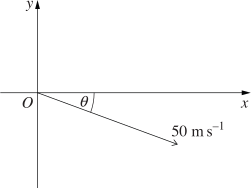
A particle of mass 1 kg is projected from the origin with a speed of 50 ms\(^{-1}\), at an angle of \(\theta\) below the horizontal into a resistive medium.
 

The position of the particle \(t\) seconds after projection is \((x, y)\), and the velocity of the particle at that time is  \(\underset{\sim}{v}=\displaystyle \binom{\dot{x}}{\dot{y}}\).

The resistive force, \(\underset{\sim}{R}\), is proportional to the velocity of the particle, so that  \(\underset{\sim}{R}=-k \underset{\sim}{v}\), where \(k\) is a positive constant.

Taking the acceleration due to gravity to be 10 ms\(^{-2}\), and the upwards vertical direction to be positive, the acceleration of the particle at time \(t\) is given by:

\(\underset{\sim}{a}=\displaystyle \binom{-k \dot{x}}{-k \dot{y}-10}\).    (Do NOT prove this.) 

Derive the Cartesian equation of the motion of the particle, given  \(\sin \theta=\dfrac{3}{5}\).   (5 marks)

--- 20 WORK AREA LINES (style=lined) ---

Show Answers Only

\(y=\left(\dfrac{1-3 k}{4 k}\right) x+\dfrac{10}{k^2} \times \ln \abs{1-\dfrac{k x}{40}}\)

Show Worked Solution

\(\sin \theta=\dfrac{3}{5} \ \Rightarrow \ \cos \theta=\dfrac{4}{5}\)

\(\text{Components of initial velocity:}\)

\(\dot{x}(0)=50\, \cos \theta=50 \times \dfrac{4}{5}=40 \ \text{ms}^{-1}\)

\(\dot{y}(0)=50\, \sin \theta=50 \times \dfrac{3}{5}=-30\ \text{ms}^{-1}\)

♦♦ Mean mark 35%.

\(\text{Horizontal motion:}\)

  \(\dfrac{d \dot{x}}{dt}\) \(=-k \dot{x} \ \ \text{(given)}\)  
\(\dfrac{dt}{d \dot{x}}\) \(=-\dfrac{1}{k \dot{x}}\)  
\(\displaystyle \int dt\) \(=-\dfrac{1}{k} \int \dfrac{1}{\dot{x}}\, d x\)  
\(t\) \(=-\dfrac{1}{k} \ln \dot{x}+c\)  

 
\(\text{When} \ \ t=0, \ \dot{x}=40 \ \Rightarrow \ c=\dfrac{1}{k} \ln 40\)

\(t\) \(=\dfrac{1}{k} \ln 40-\dfrac{1}{k} \ln \abs{\dot{x}}=\dfrac{1}{k} \ln \abs{\dfrac{40}{\dot{x}}}\)
    \(k t\) \(=\ln \abs{\dfrac{40}{\dot{x}}}\)
  \(e^{k t}\) \(=\dfrac{40}{\dot{x}}\)
\(\dot{x}\) \(=40 e^{-k t}\)
\(x\) \(\displaystyle=\int 40 e^{-k t}\, d t=-\dfrac{40}{k} \times e^{-k t}+c\)


\(\text{When} \ \ t=0, x=0 \ \Rightarrow \ c=\dfrac{40}{k}\)

   \(x=\dfrac{40}{k}-\dfrac{40}{k} e^{-k t}=\dfrac{40}{k}\left(1-e^{-k t}\right)\ \ldots\ (1)\)
 

\(\text{Vertical Motion }\)

\(\dfrac{d \dot{y}}{dt}\) \(=-k \dot{y}-10 \quad \text{(given)}\)
\(\dfrac{d t}{d \dot{y}}\) \(=-\dfrac{1}{k} \times \dfrac{1}{\dot{y}+\frac{10}{k}}\)
\(t\) \(=-\dfrac{1}{k} \displaystyle \int \dfrac{1}{\dot{y}+\frac{10}{k}} \, d \dot{y}=-\dfrac{1}{k} \ln \abs{\dot{y}+\frac{10}{k}}+c\)


\(\text{When} \ \ t=0, \, \dot{y}=-30 \ \ \Rightarrow\ \ c=\dfrac{1}{k} \ln \abs{-30+\frac{10}{k}}\)

\(t\) \(=\dfrac{1}{k} \ln \abs{-30+\frac{10}{k}}-\dfrac{1}{k} \ln \abs{\dot{y}+\frac{10}{k}}\)
  \(=\dfrac{1}{k} \ln \abs{\frac{-30+\frac{10}{k}}{\dot{y}+\frac{10}{k}}}\)
  \(e^{k t}\) \(=\abs{\dfrac{-30+\frac{10}{k}}{y+\frac{10}{k}}}\)
\(\dot{y}\) \(=\left(-30+\dfrac{10}{k}\right) e^{-k t}-\dfrac{10}{k}\)
\(y\) \(=\displaystyle \left(-30+\dfrac{10}{k}\right) \int e^{-kt}\, d t-\int \dfrac{10}{k}\, dt\)
  \(=-\dfrac{1}{k}\left(-30+\dfrac{10}{k}\right) e^{-k t}-\dfrac{10 t}{k}+c\)

 \(\text{When} \ \ t=0, y=0 \ \Rightarrow \  c=\dfrac{1}{k}\left(-30+\dfrac{10}{k}\right)\)

  \(y\) \(=\dfrac{1}{k}\left(-30+\dfrac{10}{k}\right)-\dfrac{1}{k}\left(-30+\dfrac{10}{k}\right) e^{-k t}-\dfrac{10t}{k}\)
  \(=\left(\dfrac{10}{k^2}-\dfrac{30}{k}\right)\left(1-e^{-k t}\right)-\dfrac{10 t}{k}\ \ldots\ (2)\)


\(\text {Cartesian equation (using (1) above):}\)

\(x\) \(=\dfrac{40}{k}\left(1-e^{-k t}\right)\)
\(\dfrac{k x}{40}\) \(=1-e^{-k t}\)
\(e^{-k t}\) \(=1-\dfrac{k x}{40}\)
\(-k t\) \(=\ln \abs{1-\dfrac{k x}{40}}\)
\(t\) \(=-\dfrac{1}{k} \ln \abs{1-\dfrac{kx}{40}}\)


\(y\) \(=\left(\dfrac{10}{k^2}-\dfrac{30}{k}\right) \times \dfrac{k x}{40}+\dfrac{10}{k^2} \times \ln \abs{1-\dfrac{k x}{40}}\)
  \(=\left(\dfrac{1-3 k}{4 k}\right) x+\dfrac{10}{k^2} \times \ln \abs{1-\dfrac{k x}{40}}\)

Filed Under: Projectiles and Resisted Motion, Resisted Motion Tagged With: Band 5, Band 6, smc-1061-07-Resistive medium, smc-1061-10-R ~ v, smc-7442-92-Vectors, smc-7442-95-Cartesian Path

Mechanics, EXT2 M1 2023 HSC 13c

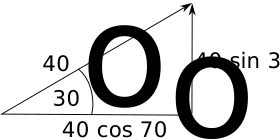
A particle of mass 1 kg is projected from the origin with speed 40 m s\( ^{-1}\) at an angle 30° to the horizontal plane.

  1. Use the information above to show that the initial velocity of the particle is
  2.     \(\mathbf{v}(0)={\displaystyle\left(\begin{array}{cc}20 \sqrt{3} \\ 20\end{array}\right)} \).   (1 mark)

    --- 6 WORK AREA LINES (style=lined) ---

The forces acting on the particle are gravity and air resistance. The air resistance is proportional to the velocity vector with a constant of proportionality 4 . Let the acceleration due to gravity be 10 m s \( ^{-2}\).

The position vector of the particle, at time \(t\) seconds after the particle is projected, is \(\mathbf{r}(t)\) and the velocity vector is \(\mathbf{v}(t)\).
 

  1. Show that  \(\mathbf{v}(t)={\displaystyle \left(\begin{array}{cc}20 \sqrt{3} e^{-4 t} \\ \dfrac{45}{2} e^{-4 t}-\dfrac{5}{2}\end{array}\right)}\)  (3 marks)

    --- 12 WORK AREA LINES (style=lined) ---

  2. Show that  \(\mathbf{r}(t)=\left(\begin{array}{c}5 \sqrt{3}\left(1-e^{-4 t}\right) \\ \dfrac{45}{8}\left(1-e^{-4 t}\right)-\dfrac{5}{2} t\end{array}\right)\)  (2 marks)

    --- 10 WORK AREA LINES (style=lined) ---

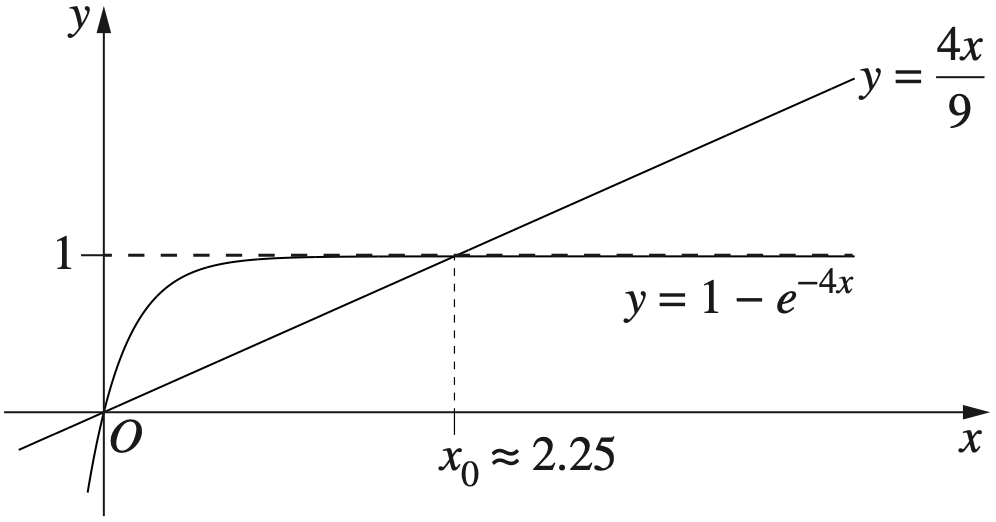
  3. The graphs  \(y=1-e^{-4 x}\)  and  \(y=\dfrac{4 x}{9}\) are given in the diagram below.
     
     
  4. Using the diagram, find the horizontal range of the particle, giving your answer rounded to one decimal place.  (2 marks)

    --- 7 WORK AREA LINES (style=lined) ---

Show Answers Only

  1. \(\text{Proof (See Worked Solutions)}\)
  2. \(\text{Proof (See Worked Solutions)}\)
  3. \(\text{Proof (See Worked Solutions)}\)
  4. \(8.7\ \text{metres}\)

Show Worked Solution

i. 

\(\underset{\sim}{v}(0)={\displaystyle\left(\begin{array}{cc} 40 \cos\ 30° \\ 40 \sin\ 30°\end{array}\right)} = {\displaystyle\left(\begin{array}{cc} 40 \times \frac{\sqrt3}{2} \\ 40 \times \frac{1}{2}\end{array}\right)}  = {\displaystyle\left(\begin{array}{cc}20 \sqrt{3} \\ 20\end{array}\right)} \)
 

ii.   \(\text{Air resistance:} \)

\(\underset{\sim}{F} = -4\underset{\sim}{v} = {\displaystyle\left(\begin{array}{cc} -4\dot{x} \\ -4\dot{y} \end{array}\right)} \)

\(\text{Horizontally:}\)

\(1 \times \ddot{x} \) \(=-4 \dot{x} \)  
\(\dfrac{d\dot{x}}{dt}\) \(=-4\dot{x}\)  
\(\dfrac{dt}{d\dot{x}}\) \(= -\dfrac{1}{4\dot{x}} \)  
\(t\) \(=-\dfrac{1}{4} \displaystyle \int \dfrac{1}{\dot{x}} \ d\dot{x} \)  
\(-4t\) \(=\ln |\dot{x}|+c \)  

 
\(\text{When}\ \ t=0, \ \dot{x}=20\sqrt3 \ \ \Rightarrow\ \ c=-\ln{20\sqrt3} \)

\(-4t\) \(=\ln|\dot{x}|-\ln 20\sqrt3 \)  
\(-4t\) \(=\ln\Bigg{|}\dfrac{\dot{x}}{20\sqrt{3}} \Bigg{|} \)  
\(\dfrac{\dot{x}}{20\sqrt{3}} \) \(=e^{-4t} \)  
\(\dot{x}\) \(=20\sqrt{3}e^{-4t}\)  

 
\(\text{Vertically:} \)

\(1 \times \ddot{y} \) \(=-1 \times 10-4 \dot{y} \)  
\(\dfrac{d\dot{y}}{dt}\) \(=-(10+4\dot{y})\)  
\(\dfrac{dt}{d\dot{y}}\) \(= -\dfrac{1}{10+4\dot{y}} \)  
\(t\) \(=- \displaystyle \int \dfrac{1}{10+4\dot{y}} \ d\dot{y} \)  
\(-4t\) \(=- \displaystyle \int \dfrac{4}{10+4\dot{y}} \ d\dot{y} \)  
\(-4t\) \(=\ln |10+4\dot{y}|+c \)  

 
\(\text{When}\ \ t=0, \ \dot{y}=20 \ \ \Rightarrow\ \ c=-\ln{90} \)

\(-4t\) \(=\ln|10+4\dot{y}|-\ln 90 \)  
\(-4t\) \(=\ln\Bigg{|}\dfrac{10+4\dot{y}}{\ln{90}} \Bigg{|} \)  
\(\dfrac{10+4\dot{y}}{90} \) \(=e^{-4t} \)  
\(4\dot{y}\) \(=90e^{-4t}-10\)  
\(\dot{y}\) \(=\dfrac{45}{2} e^{-4t}-\dfrac{5}{2} \)  

 
\(\therefore \underset{\sim}v={\displaystyle \left(\begin{array}{cc}20 \sqrt{3} e^{-4 t} \\ \dfrac{45}{2} e^{-4 t}-\dfrac{5}{2}\end{array}\right)}\) 

 
iii.
   \(\text{Horizontally:}\)

\(x\) \(= \displaystyle \int \dot{x}\ dx\)  
  \(= \displaystyle \int 20\sqrt3 e^{-4t}\ dt \)  
  \(=-5\sqrt3 e^{-4t}+c \)  

 
\(\text{When}\ \ t=0, \ x=0\ \ \Rightarrow\ \ c=5\sqrt3 \)

\(x\) \(=5\sqrt3-5\sqrt3 e^{-4t} \)  
  \(=5\sqrt3(1-e^{-4t}) \)  

 
\(\text{Vertically:}\)

\(y\) \(= \displaystyle \int \dot{y}\ dx\)  
  \(= \displaystyle \int \dfrac{45}{2} e^{-4t}-\dfrac{5}{2}\ dt \)  
  \(=-\dfrac{45}{8}e^{-4t}-\dfrac{5}{2}t+c \)  

 
\(\text{When}\ \ t=0, \ y=0\ \ \Rightarrow\ \ c= \dfrac{45}{8} \)

\(y\) \(=\dfrac{45}{8}-\dfrac{45}{8} e^{-4t}-\dfrac{5}{2}t \)  
  \(=\dfrac{45}{8}(1-e^{-4t})-\dfrac{5}{2} \)  

 
\(\therefore \underset{\sim}{r}=\left(\begin{array}{c}5 \sqrt{3}\left(1-e^{-4 t}\right) \\ \dfrac{45}{8}\left(1-e^{-4 t}\right)-\dfrac{5}{2} t\end{array}\right)\)
 

iv.   \(\text{Range}\ \Rightarrow\ \text{Find}\ \ t\ \ \text{when}\ \ y=0: \)

\(\dfrac{45}{8}(1-e^{-4t})-\dfrac{5}{2}t \) \(=0\)  
\(\dfrac{45}{8}(1-e^{-4t}) \) \(=\dfrac{5}{2}t \)  
\(1-e^{-4t}\) \(=\dfrac{4}{9}t \)  

 
\(\text{Graph shows intersection of these two graphs.}\)

\(\Rightarrow \text{Solution when}\ \ t\approx 2.25\)

\(\therefore\ \text{Range}\) \(=5\sqrt3(1-e^{(-4 \times 2.25)}) \)  
  \(=8.659…\)  
  \(=8.7\ \text{metres (to 1 d.p.)}\)  

♦ Mean mark (iv) 43%.
 

Filed Under: Projectiles and Resisted Motion, Resisted Motion Tagged With: Band 3, Band 4, Band 5, smc-1061-05-Projectile Motion, smc-1061-10-R ~ v, smc-1061-60-Time of Travel / Distance, smc-1061-95-Vectors, smc-7442-10-Range/Time of Flight

Copyright © 2014–2026 SmarterEd.com.au · Log in