Athletes are filmed executing a skill. They then watch the film and correct their techniques based upon what they observed.
What type of feedback is this?
- Internal and concurrent
- External and concurrent
- Internal and delayed
- External and delayed
Aussie Maths & Science Teachers: Save your time with SmarterEd
Athletes are filmed executing a skill. They then watch the film and correct their techniques based upon what they observed.
What type of feedback is this?
\(D\)
Other Options:
Which of the following is a feature of the associative stage of skill acquisition?
\(D\)
Other Options:
During which stage of skill acquisition is anticipation initially learned?
\(A\)
Other Options:
Which types of feedback are received by a runner who checks her time after crossing the finish line?
\(D\)
Other Options:
Which of the following would be suitable for enhancing the performance of an autonomous athlete?
\(D\)
Other Options:
What type of feedback occurs when an athlete receives a score at the conclusion of a gymnastics routine?
\(C\)
Other Options:
--- 9 WORK AREA LINES (style=lined) --- --- 12 WORK AREA LINES (style=lined) --- a. Stages of skill acquisition b. Types of feedback a. Stages of skill acquisition b. Types of feedback
A learner is practising a complicated serial skill by breaking down the skill into segments. After developing each part, the learner reassembles the skill to get feedback from the coach during skill execution.
Which row in the table shows the practice methods and types of feedback that are described?
| Practice methods | Types of feedback | |
| A. | Part and whole | Concurrent and external |
| B. | Distributed | Concurrent and external |
| C. | Part and whole | Knowledge of performance and delayed |
| D. | Distributed | Knowledge of performance and delayed |
\(A\)
Other Options:
A softball coach asks a player to throw 20 pitches over the plate. At the end of the session, the coach tells the player how many of the 20 pitches went over the plate.
The coach is providing
\(C\)
Other Options:
Immediately after taking a kick at goal, the player turns to the team confident of having made a successful kick.
What type of feedback is the player experiencing?
\(C\)
Other Options:
Analyse how different types of feedback affect a learner’s progress through the stages of skill acquisition. Provide examples to support your answer. (8 marks)
--- 24 WORK AREA LINES (style=lined) ---
Overview Statement:
Component Relationship 1:
Component Relationship 2:
Internal concurrent feedback becomes increasingly important as learners advance through associative to autonomous stages. This occurs because experienced performers develop kinaesthetic awareness during skill execution. A tennis player relies on feel and proprioception during stroke production, enabling immediate self-correction. This interaction allows autonomous performers to maintain consistency without external intervention. Consequently, over-reliance on external feedback at advanced stages can disrupt automatic movement patterns and hinder performance refinement.
Implications and Synthesis:
These relationships demonstrate that feedback effectiveness depends on matching type and timing to learner developmental stage. The significance is that inappropriate feedback can impede skill acquisition progress, while optimal feedback combinations accelerate learning transitions between stages.
Overview Statement:
Component Relationship 1:
Component Relationship 2:
Implications and Synthesis:
At the end of a game, a netball coach gives the goal shooter the following feedback.
'You made a lot of technical errors when shooting today. Next time remember to relax and focus on your wrist action when shooting for goal.'
What type of feedback is being given?
\(D\)
Other Options:
Explain why the performance elements of decision-making and strategic and tactical development should be introduced to athletes at the associative stage of skill acquisition. Provide examples to support your answer. (8 marks)
--- 20 WORK AREA LINES (style=lined) ---
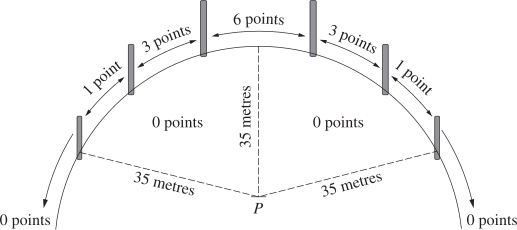
The diagram shows the scoring system that a coach is using to assess the kicking accuracy of players in a team.
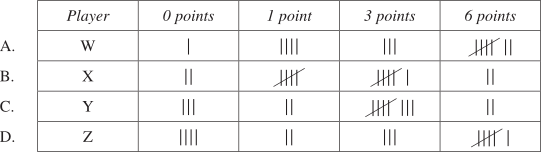
Each player is given 15 kicking attempts to score as many points as possible from the spot marked P, which is located 35 metres away from each post. The coach tallies the number of times each player scores 0,1,3 and 6 points.
Which row in the table represents the player who is most likely to be in the cognitive stage of skill acquisition?
\( B \)
Other Options:
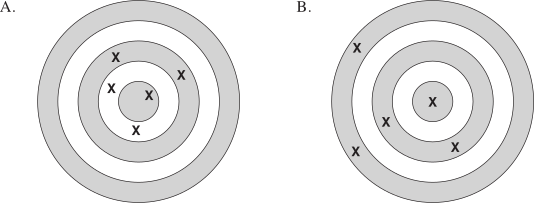
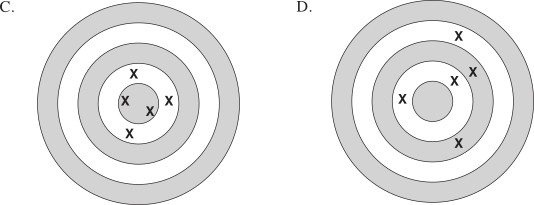
Four Year 7 students on a school camp are participating in archery. Each student had five shots at the target. The centre of the target represents the best possible shot.
The location of each student's five shots are represented by X on the targets shown.
Which student is most likely to be at the associative stage of skill acquisition?
\(A\)
Other Options:
Which of the following best describes an athlete who is a skilled performer?
\(D\)
Other Options:
How can technique be used to appraise an athlete’s performance? Provide an example to support your answer. (5 marks)
--- 15 WORK AREA LINES (style=lined) ---
Sample Answer
Sample Answer
Which of the following traits best represents an athlete in the autonomous stage of skill acquisition?
\(B\)
Other Options:
After training, an elite athlete watches a video recording of their gymnastics routine.
Which TWO types of feedback is the athlete receiving from the video?
\(D\)
Other Options:
An athlete creates the following sequence of images in their mind as part of their training.
Which psychological strategy best describes the process being used by the athlete?
\(C\)
Other Options:
Explain how appropriate feedback types might differ between children learning fundamental movement skills and adults learning a new sport. Provide specific examples. (5 marks)
--- 15 WORK AREA LINES (style=lined) ---
*Language highlighting the cause-effect relationship is bolded in the answer below.
Describe how elite coaches might structure feedback differently for team sports versus individual sports. Support your answer with examples. (5 marks)
--- 18 WORK AREA LINES (style=lined) ---
Sample Answer
Sample Answer
Analyse how technology has enhanced the delivery of different types of feedback for athletes at various stages of learning. Use specific examples from sports to illustrate your answer. (8 marks)
--- 22 WORK AREA LINES (style=lined) ---
Sample Answer
Sample Answer
Describe how a recreational athlete might use different types of feedback during their fitness training. Provide examples. (3 marks)
--- 7 WORK AREA LINES (style=lined) ---
Answers could include any of the following points:
Explain how a swimming coach might modify feedback approaches when working with athletes at different stages of learning the butterfly stroke. Provide specific examples. (4 marks)
--- 12 WORK AREA LINES (style=lined) ---
Sample Answer
Sample Answer
Compare and contrast knowledge of results and knowledge of performance feedback types, explaining which is more appropriate for different stages of learning. Provide examples to support your answer. (5 marks)
--- 15 WORK AREA LINES (style=lined) ---
Sample Answer
Sample Answer
Evaluate the effectiveness of different types of feedback for an elite athlete in the autonomous stage of learning who is attempting to refine a complex gymnastics routine. Justify your response with reference to specific feedback types. (8 marks)
--- 22 WORK AREA LINES (style=lined) ---
*Recommended “Evaluation” language is highlighted in bold throughout the answer below.
Evaluation Statement
Feedback and improvement
Performance disruption
Final Evaluation
*Recommended “Evaluation” language is highlighted in bold throughout the answer below.
Evaluation Statement
Feedback and improvement
Performance disruption
Final Evaluation
Describe TWO ways knowledge of results feedback could benefit a recreational basketball player. Provide specific examples. (3 marks)
--- 8 WORK AREA LINES (style=lined) ---
Discuss how the appropriateness of concurrent versus delayed feedback changes as an athlete progresses from cognitive to autonomous stage in skill acquisition. Use specific sporting examples to support your response. (6 marks)
--- 18 WORK AREA LINES (style=lined) ---
*PEEL – Solution is structured using separate PEEL methods for each side of the argument; [P] Identify the point, [E] expand on the point with a link to question asked, [Ev] apply evidence/examples, [L] linking sentence back to question.
Concurrent feedback becomes more appropriate as skill level increases:
Delayed feedback is more appropriate for beginners:
*PEEL – Solution is structured using separate PEEL methods for each side of the argument; [P] Identify the point, [E] expand on the point with a link to question asked, [Ev] apply evidence/examples, [L] linking sentence back to question.
Concurrent feedback becomes more appropriate as skill level increases:
Delayed feedback is more appropriate for beginners:
Explain the difference between task-intrinsic and augmented feedback, providing an example of how each might be experienced by a volleyball player learning to serve. (4 marks)
--- 10 WORK AREA LINES (style=lined) ---
Sample Answer
Sample Answer
An associative stage soccer player feels the impact of their foot against the ball and instantly recognises they've struck it too far to the left. This demonstrates the player's developing:
\(B\)
Other Options:
A swimming coach films an athlete's technique and reviews it with them after practice, highlighting specific aspects of their stroke that need refinement. This represents:
\(B\)
Other Options:
During a tennis match, a recreational player observes the scoreboard after each point. This represents:
\(A\)
Other Options:
An elite gymnast feels a slight imbalance during a handstand and automatically adjusts their weight distribution to maintain the position. This adjustment demonstrates:
\(D\)
Other Options:
A novice basketball player is learning to shoot free throws. Which type of feedback would be MOST appropriate for this learner at the cognitive stage?
\(C\)
Other Options:
Explain how temporal patterning develops across the three stages of skill acquisition for a gymnast learning a complex floor routine. (5 marks)
--- 15 WORK AREA LINES (style=lined) ---
*Language highlighting the cause-effect relationship is bolded in the answer below.
Analyse how an understanding of the stages of skill acquisition should inform a coach's approach to developing a seasonal training program for a basketball team. (8 marks)
--- 22 WORK AREA LINES (style=lined) ---
*Language that helps to highlight relationships and draw out implications is bolded throughout the answer below.
Overview Statement
Assessment and Training Design
Practice Complexity
Implications and Synthesis
*Language that helps to highlight relationships and draw out implications is bolded throughout the answer below.
Overview Statement
Assessment and Training Design
Practice Complexity
Implications and Synthesis
Evaluate the role of error detection and correction across the three stages of skill acquisition. (8 marks)
--- 22 WORK AREA LINES (style=lined) ---
*Recommended “Evaluation” language is highlighted in bold throughout the answer below.
Evaluation Statement
Learner Capability Development
Correction Strategy Effectiveness
Final Evaluation
*Recommended “Evaluation” language is highlighted in bold throughout the answer below.
Evaluation Statement
Learner Capability Development
Correction Strategy Effectiveness
Final Evaluation
Discuss how the concept of information processing affects progression through the stages of skill acquisition. (6 marks)
--- 18 WORK AREA LINES (style=lined) ---
Sample Answer
Sample Answer
Explain how a coach should modify teaching approaches at each stage of skill acquisition when teaching a volleyball spike. (5 marks)
--- 16 WORK AREA LINES (style=lined) ---
*Language highlighting the cause-effect relationship is bolded in the answer below.
Compare the focus of attention for learners in the cognitive and autonomous stages when learning to serve in tennis. (4 marks)
--- 10 WORK AREA LINES (style=lined) ---
Sample Answer
Sample Answer
Analyse how elite and recreational athletes might progress differently through the stages of skill acquisition when learning a complex movement skill. (8 marks)
--- 22 WORK AREA LINES (style=lined) ---
*Language that helps to highlight relationships and draw out implications is bolded throughout the answer below.
Overview Statement
Learning Capacity and Transfer Relationship
Practice Patterns and Stage Progression
Implications and Synthesis
*Language that helps to highlight relationships and draw out implications is bolded throughout the answer below.
Overview Statement
Learning Capacity and Transfer Relationship
Practice Patterns and Stage Progression
Implications and Synthesis
Describe the role of feedback in the cognitive stage of learning a new swimming stroke. (3 marks)
--- 7 WORK AREA LINES (style=lined) ---
Sample Answer
Sample Answer
Explain how practice methods should differ between the associative and autonomous stages of skill acquisition. (4 marks)
--- 11 WORK AREA LINES (style=lined) ---
*Language highlighting the cause-effect relationship is bolded in the answer below.
Outline the key characteristics of the cognitive stage of skill acquisition. (6 marks)
--- 6 WORK AREA LINES (style=lined) ---
Sample Answer
Sample Answer
Read the following description of a golfer's performance:
"During tournament play, the golfer executes their swing naturally without mentally tracking each movement component. While maintaining consistent swing mechanics, they actively evaluate factors such as wind direction, green contours, and strategic positioning. Their technique remains stable even when facing high-pressure situations in championship rounds."
Which practice approach would be MOST appropriate for this golfer's continued development?
\(C\)
Other Options:
A swimming coach wants to design appropriate practice activities for athletes at different stages of learning the butterfly stroke.
Which practice approach is MOST appropriate for swimmers in the associative stage?
\(A\)
Other Options:
A basketball player demonstrates the following behaviours during practice:
Which skill acquisition stage is the player demonstrating?
\(D\)
Other Options:
The table below shows characteristics of different skill acquisition stages.
| Focus | Error Recognition | Movement Efficiency |
| How to do the skill | Can identify errors | Moderately Efficient |
Which stage of skill acquisition is being described?
\(B\)
Other Options:
A tennis coach observes that a beginner player frequently makes large errors when attempting a forehand stroke, struggles to coordinate the footwork with the arm movement, and requires regular demonstrations to understand the technique.
In which stage of skill acquisition is this tennis player most likely to be?
\(A\)
Other Options:
Analyse how ability as a characteristic of a learner affects movement skill acquisition for both recreational and elite athletes. (8 marks)
--- 24 WORK AREA LINES (style=lined) ---
Sample Answer
Sample Answer
During a game of touch football, a skilled player successfully passes the ball in a high-pressure situation.
Which of the following identifies the types of feedback the player is most likely to have experienced?
\( C \)
Other Options: