The diagram shows a triangle `ABC` where `AC` = 25 cm, `BC` = 16 cm, `angle BAC` = 28° and angle `ABC` is obtuse.
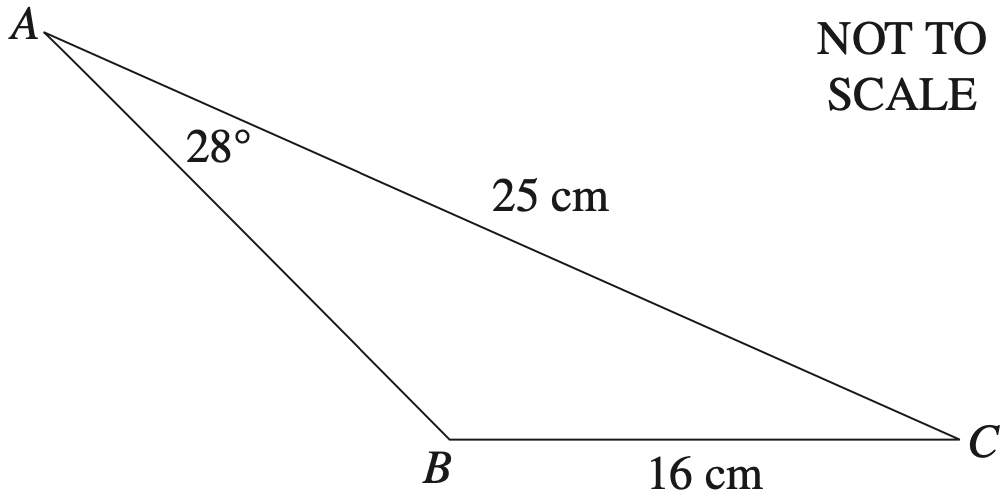
Find the size of the obtuse angle `ABC` correct to the nearest degree. (3 marks)
--- 6 WORK AREA LINES (style=lined) ---
Aussie Maths & Science Teachers: Save your time with SmarterEd
The diagram shows a triangle `ABC` where `AC` = 25 cm, `BC` = 16 cm, `angle BAC` = 28° and angle `ABC` is obtuse.
Find the size of the obtuse angle `ABC` correct to the nearest degree. (3 marks)
--- 6 WORK AREA LINES (style=lined) ---
The diagram shows a triangle `ABC` where `AC` = 25 cm, `BC` = 16 cm, `angle BAC` = 28° and angle `ABC` is obtuse.
Find the size of the obtuse angle `ABC` correct to the nearest degree. (3 marks)
--- 6 WORK AREA LINES (style=lined) ---
A random variable is normally distributed with mean 0 and standard deviation 1. The table gives the probability that this random variable lies between 0 and `z` for different values of `z`.

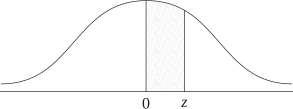
The probability values given in the table for different values of `z` are represented by the shaded area in the following diagram.
--- 1 WORK AREA LINES (style=lined) ---
--- 6 WORK AREA LINES (style=lined) ---
Solve `x+(x-1)/2 = 9`. (2 marks)
There are 8 chocolates in a box. Three have peppermint centres (P) and five have caramel centres (C).
Kim randomly chooses a chocolate from the box and eats it. Sam then randomly chooses and eats one of the remaining chocolates.
A partially completed probability tree is shown.

What is the probability that Kim and Sam choose chocolates with different centres?
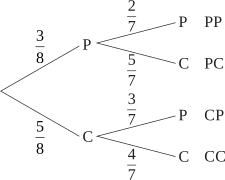
| `Ptext{(different centres)}` | `= P text{(PC)} + P text{(CP)}` |
| `=\frac{3}{8} · \frac{5}{7} + \frac{5}{8} · \frac{3}{7}` | |
| `= \frac{15}{56} + \frac{15}{56}` | |
| `= \frac{15}{28}` |
`=> D`
There are 8 chocolates in a box. Three have peppermint centres (P) and five have caramel centres (C).
Kim randomly chooses a chocolate from the box and eats it. Sam then randomly chooses and eats one of the remaining chocolates.
A partially completed probability tree is shown.
What is the probability that Kim and Sam choose chocolates with different centres?
| `Ptext{(different centres)}` | `= P text{(PC)} + P text{(CP)}` |
| `=\frac{3}{8} · \frac{5}{7} + \frac{5}{8} · \frac{3}{7}` | |
| `= \frac{15}{56} + \frac{15}{56}` | |
| `= \frac{15}{28}` |
`=> D`
Which of the following best represents the graph of `y = 10 (0.8)^x`?
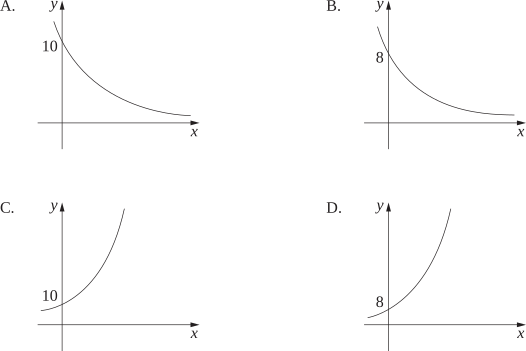
Which of the following best represents the graph of `y = 10 (0.8)^x`?
The number of downloads of a song on each of twenty consecutive days is shown in the following graph.
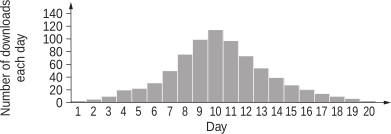
Which of the following graphs best shows the cumulative number of downloads up to and including each day?

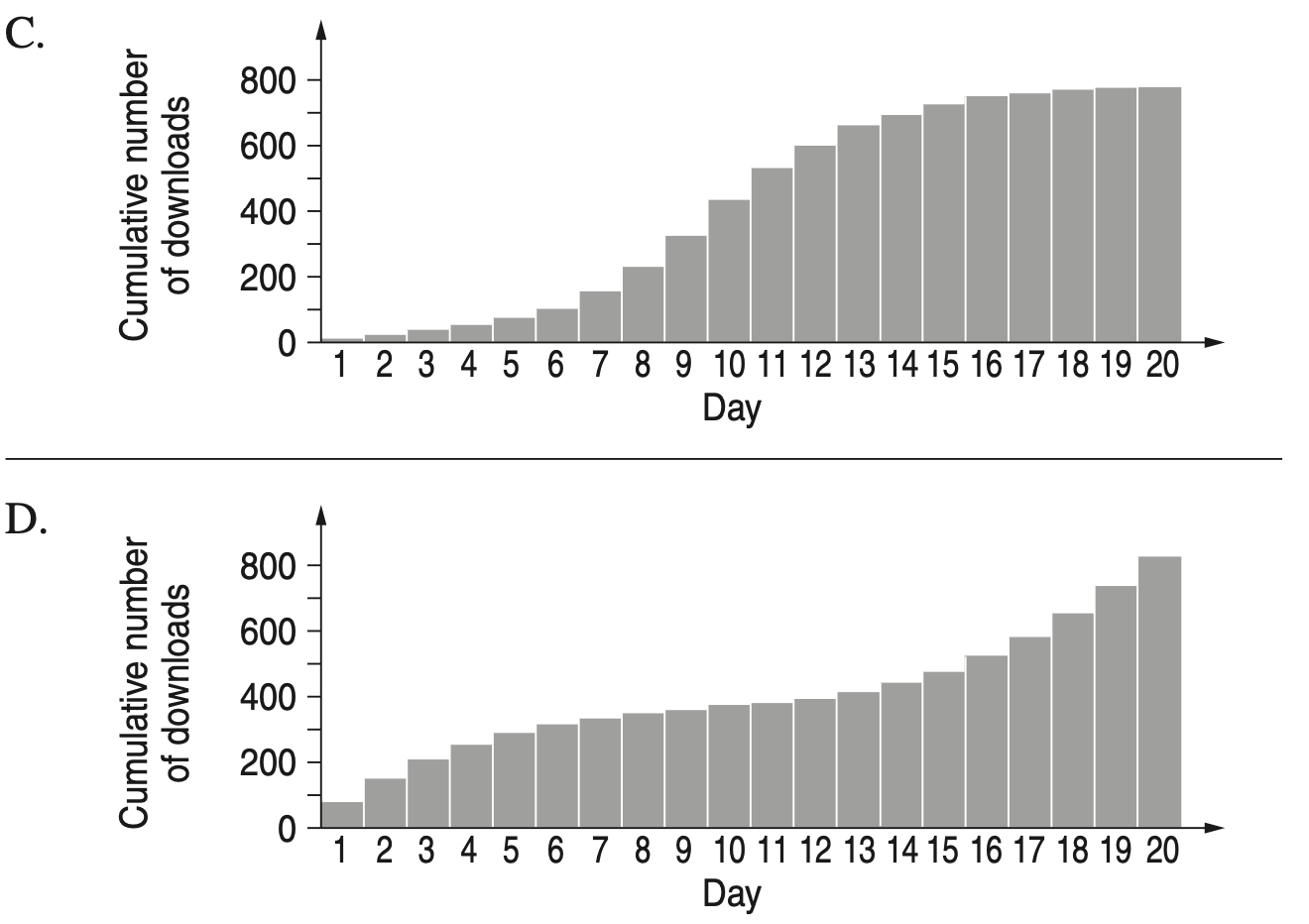
The number of downloads of a song on each of twenty consecutive days is shown in the following graph.
Which of the following graphs best shows the cumulative number of downloads up to and including each day?


Solve `x+(x-1)/2 = 9` (2 marks)
A cricket is an insect. The male cricket produces a chirping sound.
A scientist wants to explore the relationship between the temperature in degrees Celsius and the number of cricket chirps heard in a 15-second time interval.
Once a day for 20 days, the scientist collects data. Based on the 20 data points, the scientist provides the information below.

The scientist fits a least-squares regression line using the data `(x, y)`, where `x` is the temperature in degrees Celsius and `y` is the number of chirps heard in a 15-second time interval. The equation of this line is
`y = −10.6063 + bx`,
where `b` is the slope of the regression line.
The least-squares regression line passes through the point `(barx, bary)`, where `barx` is the sample mean of the temperature data and `bary` is the sample mean of the chirp data.
Calculate the number of chirps expected in a 15-second interval when the temperature is 19° Celsius. Give your answer correct to the nearest whole number. (5 marks)
The diagram shows a regular decagon (ten-sided shape with all sides equal and all interior angles equal). The decagon has centre `O`.
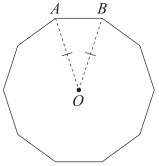
The perimeter of the shape is 80 cm.
By considering triangle `OAB`, calculate the area of the ten-sided shape. Give your answer in square centimetres correct to one decimal place. (4 marks)
--- 8 WORK AREA LINES (style=lined) ---
`angle AOB = 360/10 = 36^@`
`AB = 80/10 = 8\ text(cm)`
`DeltaAOB\ text(is made up of 2 identical right-angled triangles)`
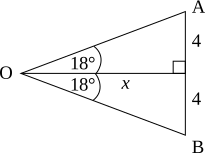
| `tan 18^@` | `= 4/x` |
| `x` | `= 4/(tan 18^@)` |
| `:.\ text(Area of decagon)` | `= 20 xx 1/2 xx 4/(tan 18^@) xx 4` |
| `= 492.429…` | |
| `= 492.4\ text(cm² (to 1 d.p.))` |
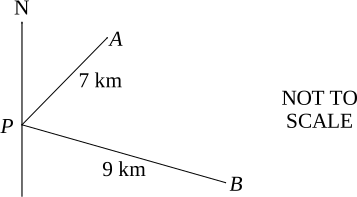
Mr Ali, Ms Brown and a group of students were camping at the site located at `P`. Mr Ali walked with some of the students on a bearing of 035° for 7 km to location `A`. Ms Brown, with the rest of the students, walked on a bearing of 100° for 9 km to location `B`.
--- 2 WORK AREA LINES (style=lined) ---
--- 4 WORK AREA LINES (style=lined) ---
--- 4 WORK AREA LINES (style=lined) ---
| a. | `angle APB` | `= 100 – 35` |
| `= 65^@` |
b. `text(Using cosine rule:)`
| `AB^2` | `= AP^2 + PB^2 – 2 xx AP xx PB cos 65^@` |
| `= 49 + 81 – 2 xx 7 xx 9 cos 65^@` | |
| `= 76.750…` | |
| `:.AB` | `= 8.760…` |
| `= 8.76\ text{km (to 2 d.p.)}` |
c.

`anglePAC = 35^@\ (text(alternate))`
`text(Using cosine rule, find)\ anglePAB:`
| `cos anglePAB` | `= (7^2 + 8.76 – 9^2)/(2 xx 7 xx 8.76)` | |
| `= 0.3647…` | ||
| `:. angle PAB` | `= 68.61…^@` | |
| `= 69^@\ \ (text(nearest degree))` |
`:. text(Bearing of)\ B\ text(from)\ A\ (theta)`
`= 180 – (69 – 35)`
`= 146^@`
There are two tanks on a property, Tank `A` and Tank `B`. Initially, Tank `A` holds 1000 litres of water and Tank B is empty.

By drawing a line on the grid (above), or otherwise, find the value of `t` when the two tanks contain the same volume of water. (2 marks)
--- 2 WORK AREA LINES (style=lined) ---
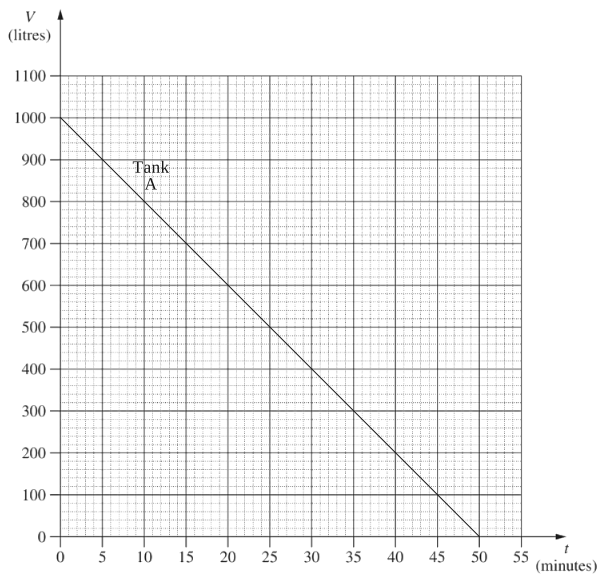
a. `text{T} text{ank} \ A \ text{will pass trough (0, 1000) and (50, 0)}`
b. `text{T} text{ank} \ B \ text{will pass through (15, 0) and (45, 900)}`

`text{By inspection, the two graphs intersect at} \ \ t = 29 \ text{minutes}`
c. `text{Strategy 1}`
`text{By inspection of the graph, consider} \ \ t = 45`
`text{T} text{ank A} = 100 \ text{L} , \ text{T} text{ank B} =900 \ text{L} `
`:.\ text(Total volume = 1000 L when t = 45)`
`text{Strategy 2}`
| `text{Total Volume}` | `=text{T} text{ank A} + text{T} text{ank B}` |
| `1000` | `= 1000 – 20t + (t – 15) xx 30` |
| `1000` | `= 1000 – 20t + 30t – 450 ` |
| `10t` | `= 450` |
| `t` | `= 45 \ text{minutes}` |
There are two tanks on a property, Tank A and Tank B. Initially, Tank A holds 1000 litres of water and Tank B is empty.
The volume of water in Tank A is modelled by `V = 1000 - 20t` where `V` is the volume in litres and `t` is the time in minutes from when the tank begins to lose water.
On the grid below, draw the graph of this model and label it as Tank A. (1 mark)
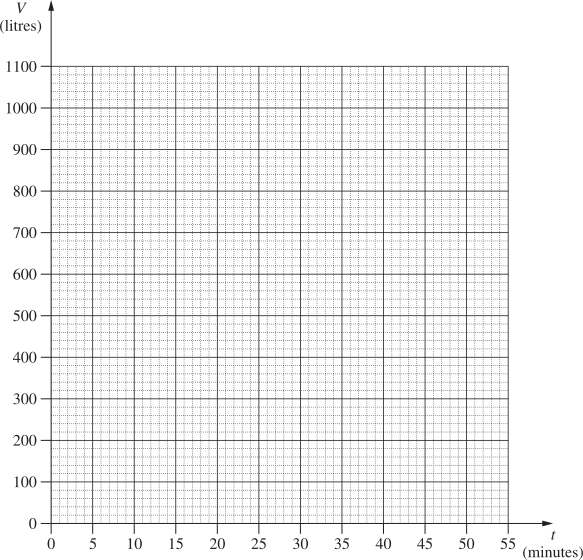
--- 2 WORK AREA LINES (style=lined) ---
--- 1 WORK AREA LINES (style=lined) ---

a. `text{T} text{ank} \ A \ text{will pass trough (0, 1000) and (50, 0)}`
b. `text{T} text{ank} \ B \ text{will pass through (15, 0) and (45, 900)}`
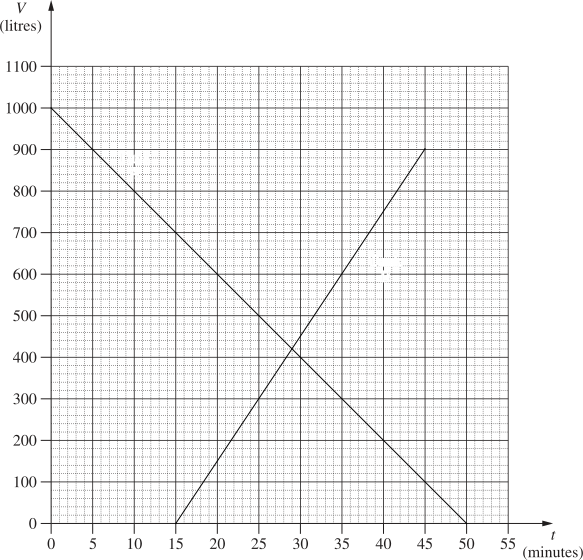
`text{By inspection, the two graphs intersect at} \ \ t = 29 \ text{minutes}`
c. `text{Strategy 1}`
`text{By inspection of the graph, consider} \ \ t = 45`
`text{T} text{ank A} = 100 \ text{L} , \ text{T} text{ank B} =900 \ text{L} `
`:.\ text(Total volume = 1000 L when t = 45)`
`text{Strategy 2}`
| `text{Total Volume}` | `=text{T} text{ank A} + text{T} text{ank B}` |
| `1000` | `= 1000 – 20t + (t – 15) xx 30` |
| `1000` | `= 1000 – 20t + 30t – 450 ` |
| `10t` | `= 450` |
| `t` | `= 45 \ text{minutes}` |
A cricket is an insect. The male cricket produces a chirping sound.
A scientist wants to explore the relationship between the temperature in degrees Celsius and the number of cricket chirps heard in a 15-second time interval.
Once a day for 20 days, the scientist collects data. Based on the 20 data points, the scientist provides the information below.
The scientist fits a least-squares regression line using the data `(x, y)`, where `x` is the temperature in degrees Celsius and `y` is the number of chirps heard in a 15-second time interval. The equation of this line is
`y = −10.6063 + bx`,
where `b` is the slope of the regression,
The least-squares regression line passes through the point `(barx, bary)`, where `barx` is the sample mean of the temperature data and `bary` is the sample mean of the chirp data.
Calculate the number of chirps expected in a 15-second interval when the temperature is 19° Celsius. Give your answer correct to the nearest whole number. (5 marks)
The diagram shows a regular decagon (ten-sided shape with all sides equal and all interior angles equal). The decagon has centre `O`.
The perimeter of the shape is 80 cm.
By considering triangle `OAB`, calculate the area of the ten-sided shape. Give your answer in square centimetres correct to one decimal place. (4 marks)
--- 8 WORK AREA LINES (style=lined) ---
`angle AOB = 360/10 = 36^@`
`AB = 80/10 = 8\ text(cm)`
`DeltaAOB\ text(is made up of 2 identical right-angled triangles)`
| `tan 18^@` | `= 4/x` |
| `x` | `= 4/(tan 18^@)` |
| `:.\ text(Area of decagon)` | `= 20 xx 1/2 xx 4/(tan 18^@) xx 4` |
| `= 492.429…` | |
| `= 492.4\ text(cm² (to 1 d.p.))` |
Tina inherits $60 000 and invests it in an account earning interest at a rate of 0.5% per month. Each month, immediately after the interest has been paid, Tina withdraws $800.
The amount in the account immediately after the `n`th withdrawal can be determined using the recurrence relation
`A_n = A_(n - 1)(1.005) - 800`,
where `n = 1, 2, 3, …` and `A_0 = 60\ 000`
--- 4 WORK AREA LINES (style=lined) ---
--- 4 WORK AREA LINES (style=lined) ---
Mr Ali, Ms Brown and a group of students were camping at the site located at `P`. Mr Ali walked with some of the students on a bearing of 035° for 7 km to location `A`. Ms Brown, with the rest of the students, walked on a bearing of 100° for 9 km to location `B`.
--- 1 WORK AREA LINES (style=lined) ---
--- 5 WORK AREA LINES (style=lined) ---
--- 5 WORK AREA LINES (style=lined) ---
| a. | `angle APB` | `= 100-35` |
| `= 65^@` |
b. `text(Using cosine rule:)`
| `AB^2` | `= AP^2 + PB^2-2 xx AP xx PB cos 65^@` |
| `= 49 + 81-2 xx 7 xx 9 cos 65^@` | |
| `= 76.750…` | |
| `:.AB` | `= 8.760…` |
| `= 8.76\ text{km (to 2 d.p.)}` |
c.
`anglePAC = 35^@\ (text(alternate))`
`text(Using cosine rule, find)\ anglePAB:`
| `cos anglePAB` | `= (7^2 + 8.76-9^2)/(2 xx 7 xx 8.76)` | |
| `= 0.3647…` | ||
| `:. angle PAB` | `= 68.61…^@` | |
| `= 69^@\ \ (text(nearest degree))` |
`:. text(Bearing of)\ B\ text(from)\ A\ (theta)`
`= 180-(69-35)`
`= 146^@`
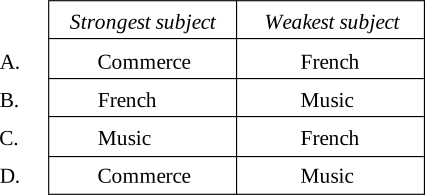
John recently did a class test in each of three subjects. The class scores on each test were normally distributed.
The table shows the subjects and John's scores as well as the mean and standard deviation of the class scores on each test.

Relative to the rest of class, which row of the table below shows John's strongest subject and his weakest subject?
John recently did a class test in each of three subjects. The class scores on each test were normally distributed.
The table shows the subjects and John's scores as well as the mean and standard deviation of the class scores on each test.
Relative to the rest of class, which row of the table below shows John's strongest subject and his weakest subject?