SmarterEd

Aussie Maths & Science Teachers: Save your time with SmarterEd

  • Login
  • Get Help
  • About

Trigonometry, 2ADV T2 SM-Bank 31

Given  `cottheta = −24/7`  for  `−pi/2 < theta < pi/2`, find the exact value of

  1.  `sectheta`   (2 marks)

    --- 4 WORK AREA LINES (style=lined) ---

  2.  `sintheta`   (1 mark)

    --- 1 WORK AREA LINES (style=lined) ---

Show Answers Only
  1. `25/24`
  2. `-7/25`
Show Worked Solution

i.   `cot theta = −24/7\ \ =>\ \ tan theta=– 7/24`

`text(Graphically, given)\ −pi/2 < theta < pi/2:`
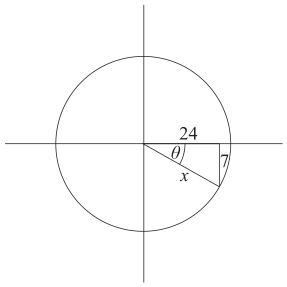
`x= sqrt(24^2 + 7^2)=25`
 

`sectheta` `= 1/(costheta)`
  `= 1/(24/25)`
  `= 25/24`


ii.   `sintheta = −7/25`

Filed Under: Exact Trig Ratios (Adv-2027), Exact Trig Ratios (Y11) Tagged With: Band 3, Band 4, smc-6411-40-cosec/sec/cot, smc-6411-60-Related Trig Ratios, smc-979-40-cosec/sec/cot, smc-979-50-Find ratio given ratio

Functions, 2ADV F1 SM-Bank 25

Damon owns a swim school and purchased a new pool pump for $3250.

He writes down the value of the pool pump by 8% of the original price each year.

  1.  Construct a function to represent the value of the pool pump after `t` years.   (1 mark)

    --- 1 WORK AREA LINES (style=lined) ---

  2.  Draw the graph of the function and state its domain and range.   (2 marks)

    --- 8 WORK AREA LINES (style=lined) ---

Show Answers Only
  1. `text(Value) = 3259 – 260t`
  2. `text(Domain)\ {t: 0 <= t <= 12.5}`
    `text(Range)\ {y: 0 <= y <= 3250}`
Show Worked Solution
i.   `text(Depreciation each year)` `= 8text(%) xx 3250`
  `= $260`

 
`:.\ text(Value) = 3250 – 260t`
 

ii.   

`text(Find)\ \ t\ \ text(when value = 0)`

`3250 – 260t` `= 0`
`t` `= 3250/260`
  `= 12.5\ text(years)`

 
`text(Domain)\ \ {t: 0 <= t <= 12.5}`

`text(Range)\ \ {y: 0 <= y <= 3250}`

Filed Under: Linear Functions (Adv-2027), Linear Functions (Y11) Tagged With: Band 3, Band 4, smc-6214-20-Other Real World Applications, smc-985-20-Other Linear Applications

Functions, 2ADV F1 SM-Bank 24

Ita publishes and sells calendars for $25 each. The cost of producing the calendars is $8 each plus a set up cost of $5950.

How many calendars does Ita need to sell to breakeven?  (2 marks)

--- 5 WORK AREA LINES (style=lined) ---

Show Answers Only

`350`

Show Worked Solution

`text(Let)\ \ x =\ text(number of calendars sold)`

`text(C)text(ost) = 5950 + 8x`

`text(Sales revenue) = 25x`
  

`text(Breakeven occurs when:)`

`25x` `= 5950 + 8x`
`17x` `= 5950`
`:. x` `= 350`

Filed Under: Linear Functions (Adv-2027), Linear Functions (Y11) Tagged With: Band 3, common-content, smc-6214-10-Cost/Revenue, smc-985-10-Cost/Revenue

Functions, 2ADV F1 EQ-Bank 22

Worker A picks a bucket of blueberries in `a` hours. Worker B picks a bucket of blueberries in `b` hours.

  1.  Write an algebraic expression for the fraction of a bucket of blueberries that could be picked in one hour if A and B worked together.  (2 marks)

    --- 3 WORK AREA LINES (style=lined) ---

  2.  What does the reciprocal of this fraction represent?  (1 mark)

    --- 2 WORK AREA LINES (style=lined) ---

Show Answers Only
  1. `(a + b)/(ab)`
  2. `text(The reciprocal represents the number of hours it would)`
  3. `text(take to fill one bucket, with A and B working together.)`
Show Worked Solution

i.    `text(In one hour:)`

COMMENT: Note that the question asks for “a fraction”.

`text(Worker A picks)\ 1/a\ text(bucket.)`

`text(Worker B picks)\ 1/b\ text(bucket.)`
 

`:.\ text(Fraction picked in 1 hour working together)`

`= 1/a + 1/b`

`= (a + b)/(ab)`
 

ii.   `text(The reciprocal represents the number of hours it would)`

`text(take to fill one bucket, with A and B working together.)`

Filed Under: Algebraic Techniques (Adv-2027), Algebraic Techniques (Y11) Tagged With: Band 3, Band 4, common-content, smc-6213-10-Algebraic Fractions, smc-983-40-Algebraic Fractions

Calculus, EXT1 C1 EQ-Bank 12

A tank is initially full. It is drained so that at time `t` seconds the volume of water, `V`, in litres, is given by

`V = 50(1 - t/80)^2`  for  `0 <= t <= 100`

  1.  How much water was initially in the tank?  (1 mark)

    --- 2 WORK AREA LINES (style=lined) ---

  2.  After how many seconds was the tank one-quarter full?  (1 mark)

    --- 4 WORK AREA LINES (style=lined) ---

  3.  At what rate was the water draining out the tank when it was one-quarter full?  (2 marks)

    --- 4 WORK AREA LINES (style=lined) ---

Show Answers Only
  1.  `50\ text(L)`
  2.  `40\ text(seconds)`
  3.  `5/8\ text(litres per second)`
Show Worked Solution

i.   `text(Initially,)\ \ t = 0.`

`V` `= 50(1 – 0)^2`
  `= 50\ text(L)`


ii.   `text(Find)\ t\ text(when tank is)\ \ 1/4\ \ text(full:)`

`50/4` `= 50(1 – t/80)^2`
`(1 – 1/80)^2` `= 1/4`
`1 – t/80` `= 1/2`
`t/80` `= 1/2`
`t` `= 40\ text(seconds)`


iii.   `(dv)/(dt)` `= 2 · 50(1 – t/80)(−1/80)`
  `= −5/4(1 – t/80)`

 
`text(When)\ \ t = 40,`

`(dv)/(dt)` `= −5/4(1 – 40/80)`
  `= −5/8`

 
`:. text(Water is draining out at)\ \ 5/8\ \ text(litres per second.)`

Filed Under: Rates of Change with respect to time (Ext1) Tagged With: Band 2, Band 3, smc-1077-20-Flow and Other Rates

Trigonometry, EXT1 T2 SM-Bank 6

Find the exact value of  `sin\ pi/12`.  (2 marks)

Show Answers Only

`(sqrt6 – sqrt2)/4`

Show Worked Solution
`sin\ pi/12` `= sin(pi/3 – pi/4)`
  `= sin\ pi/3 · cos\ pi/4 – cos\ pi/3 · sin\ pi/4`
  `= sqrt3/2 · 1/sqrt2 – 1/2 · 1/sqrt2`
  `= (sqrt3 – 1)/(2sqrt2) xx sqrt2/sqrt2`
  `= (sqrt6 – sqrt2)/4`

Filed Under: T2 Further Trigonometric Identities (Y11) Tagged With: Band 3, smc-1025-20-Compound Angles

Trigonometry, EXT1 T2 SM-Bank 4

If  `costheta = −3/4`  and  `0 < theta < pi`,

determine the exact value of  `tantheta`.  (2 marks)

--- 5 WORK AREA LINES (style=lined) ---

Show Answers Only

`tan theta = – sqrt7/3`

Show Worked Solution

`text(Consider the angle graphically:)`

 
`text(S)text(ince)\ \ costheta\ \ text(is negative  ⇒  2nd quadrant.)`

`text(Using Pythagoras,)`

`x^2` `= 4^2 – 3^2`
`x` `= sqrt7`

 
`:. tan theta = – sqrt7/3`

Filed Under: T2 Further Trigonometric Identities (Y11) Tagged With: Band 3, smc-1025-30-Other

Trigonometry, EXT1 T2 EQ-Bank 1

Find  `a`  and  `b`  such that

`tan75^@ = a + bsqrt3`   (2 marks)

--- 5 WORK AREA LINES (style=lined) ---

Show Answers Only

`a = 2, b = 1`

Show Worked Solution
`tan75^@` `= tan(45 + 30)^@`
  `= (tan45^@ + tan30^@)/(1 – tan45^@tan30^@)`
  `= (1 + 1/sqrt3)/(1 – 1 · 1/sqrt3) xx sqrt3/sqrt3`
  `= (sqrt3 + 1)/(sqrt3 – 1) xx (sqrt3 + 1)/(sqrt3 + 1)`
  `= (3 + 2sqrt3 + 1)/((sqrt3)^2 – 1^2)`
  `= 2 + sqrt3`

 
`:. a = 2, \ b = 1`

Filed Under: T2 Further Trigonometric Identities (Y11) Tagged With: Band 3, smc-1025-20-Compound Angles

Functions, EXT1 F1 EQ-Bank 7

The parametric equations of a graph are

`x = 1-1/t`

`y = 1 + 1/t`

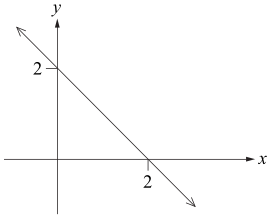
Sketch the graph.   (2 marks)

--- 6 WORK AREA LINES (style=lined) ---

Show Answers Only

Show Worked Solution
`x` `= 1-1/t\ \ …\ (1)`
`tx` `= t-1`
`t(1-x)` `= 1`
`t` `= 1/(1-x)\ \ …\ (1^{′})`
`y` `= 1 + 1/t\ \ …\ (2)`

 
`text(Substitute)\ \ t = 1/(1-x)\ \ text{from}\ (1^{′})\ \text{into (2)}:`

`y` `= 1 + 1/(1/(1-x))`
`y` `= 1 + 1-x`
`y` `= 2-x`


Filed Under: Parametric Functions (Ext1) Tagged With: Band 3, smc-1035-30-Linear and Other

Functions, EXT1 F1 EQ-Bank 6

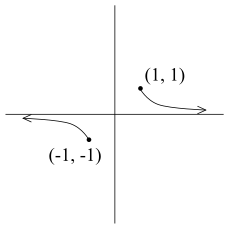
The parametric equations of a graph are

`x = t^2`

`y = 1/t`  for  `t > 0`
 

  1. Find the Cartesian equation for the graph.  (1 mark)

    --- 5 WORK AREA LINES (style=lined) ---

  2. Sketch the graph.  (1 mark)

    --- 6 WORK AREA LINES (style=lined) ---

Show Answers Only

i.   `y = sqrt(1/x)`

ii.

Show Worked Solution

i.     `x = t^2\ …\ (1)`

`y = 1/t\ …\ (2)`
 

`text(Substitute)\ \ t = 1/y\ \ text{from (1) into (1)}`

`x` `= (1/y)^2`
`y^2` `= 1/x`
`y` `= sqrt(1/x)\ \ \ (y > 0\ \ text(as)\ \ t > 0)`


ii.

Filed Under: Parametric Functions (Ext1) Tagged With: Band 3, smc-1035-30-Linear and Other

Functions, EXT1 F1 SM-Bank 5

Find the Cartesian equation for the curve with the parametric equations

`x = 3t`

`y = 2t^2`.  (1 mark)

Show Answers Only

`y = 2/9 x^2`

Show Worked Solution

`x = 3t\ …\ (1)`

`y = 2t^2\ …\ (2)`
 

`text(Substitute)\ \ t = x/3\ \ text{from (1) into (2)}:`

`y = 2(x/3)^2`

`y = 2/9 x^2`

Filed Under: Parametric Functions (Ext1) Tagged With: Band 3, smc-1035-10-Quadratic

Functions, EXT1 F1 SM-Bank 4

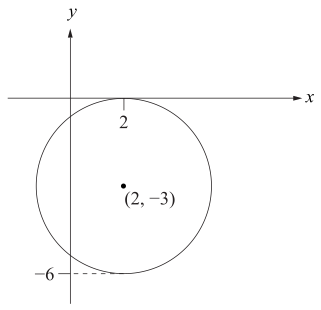
Sketch the curve described by these two parametric equations

`x = 3cost + 2`

`y = 3sint - 3`   for   `0 <= t < 2pi`.  (3 marks)

Show Answers Only

Show Worked Solution

`(x – 2) = 3cost`

`(y + 3) = 3sint`

`(x – 2)^2 + (y + 3)^2` `= (3cost)^2 + (3sint)^2`
  `= 9cos^2t + 9sin^2t`
  `= 9(cos^2t + sin^2t)`
  `= 9`

 
`text(Sketch:) \ (x – 2)^2 + (y + 3)^2 = 3^2`

Filed Under: Parametric Functions (Ext1) Tagged With: Band 3, smc-1035-20-Circles

Functions, EXT1 F1 SM-Bank 2

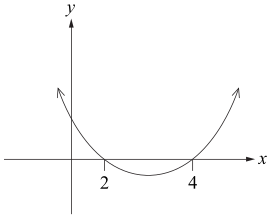
Solve  `3/(|\ x - 3\ |) < 3`.  (3 marks)

--- 6 WORK AREA LINES (style=lined) ---

Show Answers Only

`x < 2\ ∪\ x > 4`

Show Worked Solution

`text(Solution 1)`

`3/(|\ x – 3\ |) < 3`

`|\ x – 3\ |` `> 1`
`(x^2 – 6x + 9)` `> 1^2`
`x^2 – 6x + 8` `> 0`
`(x – 4)(x – 2)` `> 0`


`:. {x: \ x < 2\ ∪\ x > 4}`


`text(Solution 2)`

`|\ x – 3\ | > 1`

`text(If)\ \ (x – 3)` `> 0,\ text(i.e.)\ x >3`
`x – 3` `> 1`
`x` `> 4`

 
`=> x > 4\ (text(satisfies both))`
 

`text(If)\ \ (x – 3)` `< 0,\ text(i.e.)\ x <3`
`−(x – 3)` `> 1`
`−x + 3` `> 1`
`x` `< 2`

 
`=> x < 2\ (text(satisfies both))`

`:. {x: \ x < 2\ ∪\ x > 4}`

Filed Under: Inequalities (Ext1) Tagged With: Band 3, smc-1033-10-Algebraic Fractions, smc-1033-20-Absolute Value

Functions, EXT1 F1 SM-Bank 3

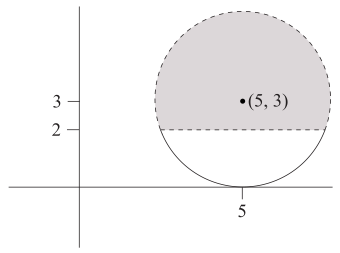
A circle has centre `(5,3)` and radius 3.

  1.  Describe, with inequalities, the region that consists of the interior of the circle and more than 2 units above the `x`-axis.  (2 marks)

    --- 4 WORK AREA LINES (style=lined) ---

  2.  Sketch the region.  (1 mark)

    --- 8 WORK AREA LINES (style=lined) ---

Show Answers Only
  1. `(x-5)^2 + (y-3)^2 < 9\ ∩\ y > 2`
  2.  

Show Worked Solution

i.   `text(Equation of circle:)`

`(x-5)^2 + (y-3)^2 = 3^2`
 

`:.\ text(Region is:)`

`(x-5)^2 + (y- 3)^2 < 9\ ∩\ y > 2`

COMMENT: The broken line on the graph represents an excluded boundary.


ii.   

Filed Under: Inequalities (Ext1) Tagged With: Band 3, Band 4, smc-1033-40-Regions

Functions, EXT1 F1 SM-Bank 1

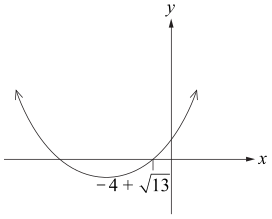
Find the values of `x` that satisfy the equation

  `x^2 + 8x + 3 <= 0`.  (3 marks)

--- 6 WORK AREA LINES (style=lined) ---

Show Answers Only

`{x:\  -4-sqrt{13} <=x <= -4 + sqrt{13}}`

Show Worked Solution
`x` `= (-8 ± sqrt(8^2-4 · 1 · 3))/2`
  `= (-8 ± sqrt(52))/2`
  `= -4 ± sqrt13`


`{x:\  -4-sqrt13 <=x <= -4 + sqrt13}`

Filed Under: Inequalities (Ext1) Tagged With: Band 3, smc-1033-30-Quadratics

Complex Numbers, SPEC2 2017 VCAA 5 MC

 On an Argand diagram, a point that lies on the path defined by  `|\ z - 2 + i\ | = |\ z - 4\ |`  is

  1.  `(3, −1/2)`
  2.  `(−3, −1/2)`
  3.  `(−3, 3/2)`
  4.  `(3, 1/2)`
  5.  `(3, −3/2)`
Show Answers Only

`A`

Show Worked Solution

`text(Equidistant from)\ \ z = 4\ \ text(and)\ \ z= 2 + i`

`text(Midpoint:)\ ((2 + 4)/2, (−1 + 0)/2)`

`= (3, −1/2)`

`=>A`

Filed Under: Geometry and Complex Numbers (SM) Tagged With: Band 3, smc-1173-40-Linear

Graphs, SPEC2 2017 VCAA 1 MC

The implied domain of  `f(x) = 2cos^(−1)(1/x)`  is

  1. `R`
  2. `[−1,1]`
  3. `(−∞,−1] ∪ [1,∞)`
  4. `R\ text(\) {0}`
  5. `[−1,1]\ text(\) {0}`
Show Answers Only

`C`

Show Worked Solution

`1/x ∈ [−1,1]`

`:. x ∈(−∞,−1] ∪ [1,∞)`

`=>C`

Filed Under: Inverse Trig Functions (SM) Tagged With: Band 3, smc-1153-20-arccos

Functions, EXT1 F1 2010 HSC 3b*

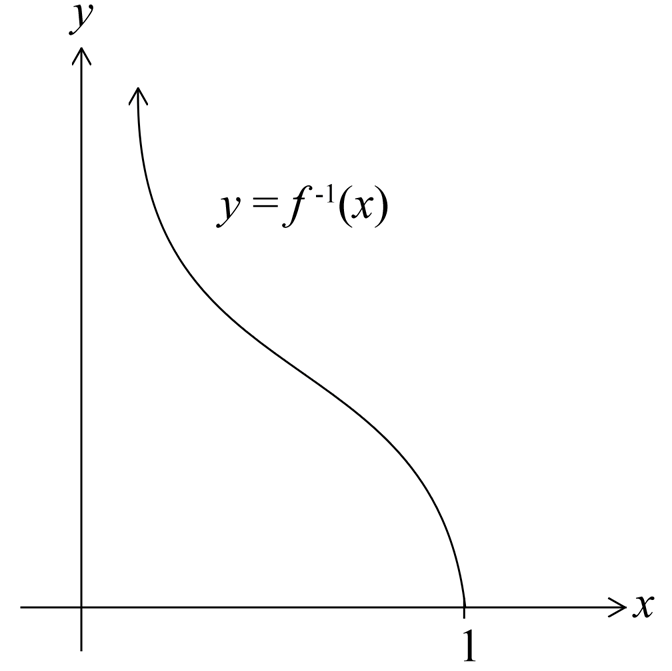
Let  `f(x) = e^(-x^2)`.  The diagram shows the graph  `y = f(x)`.
 

 Inverse Functions, EXT1 2010 HSC 3b

  1. The graph has two points of inflection.  


    Find the  `x`  coordinates of these points.   (3 marks)

    --- 6 WORK AREA LINES (style=lined) ---

  2. Explain why the domain of  `f(x)`  must be restricted if  `f(x)`  is to have an inverse function.    (1 mark)

    --- 3 WORK AREA LINES (style=lined) ---

  3. Find a formula for  `f^(-1) (x)`  if the domain of  `f(x)`  is restricted to  `x ≥ 0`.   (2 marks)

    --- 5 WORK AREA LINES (style=lined) ---

  4. State the domain of  `f^(-1) (x)`.    (1 mark)

    --- 2 WORK AREA LINES (style=lined) ---

  5. Sketch the curve  `y = f^(-1) (x)`.    (1 mark)

    --- 5 WORK AREA LINES (style=lined) ---

Show Answers Only
  1. `x = +- 1/sqrt2` 
  2. `text(There can only be 1 value of)\ y\ text(for each value of)\ x.`
  3. `f^(-1)x = sqrt(ln(1/x))`
  4. `0 <= x <= 1`
  5.  
  6. Inverse Functions, EXT1 2010 HSC 3b Answer
Show Worked Solution
i.    `y` `= e^(-x^2)`
  `dy/dx` `= -2x * e^(-x^2)`
  `(d^2y)/(dx^2)` `= -2x (-2x * e^(-x^2)) + e ^(-x^2) (-2)`
    `= 4x^2 e^(-x^2)\ – 2e^(-x^2)`
    `= 2e^(-x^2) (2x^2\ – 1)`


`text(P.I. when)\ \ (d^2y)/(dx^2) = 0`

`2e^(-x^2) (2x^2\ – 1)` `= 0` 
 `2x^2\ – 1` `= 0` 
 `x^2` `= 1/2`
 `x` `= +- 1/sqrt2` 
COMMENT: It is also valid to show that `f(x)` is an even function and if a P.I. exists at `x=a`, there must be another P.I. at `x=–a`.
`text(When)\ \ ` `x < 1/sqrt2,` `\ (d^2y)/(dx^2) < 0`
  `x > 1/sqrt2,` `\ (d^2y)/(dx^2) > 0`

`=>\ text(Change of concavity)`

`:.\ text(P.I. at)\ \ x = 1/sqrt2`

`text(When)\ \ ` `x < – 1/sqrt2,` `\ (d^2y)/(dx^2) > 0`
  `x > – 1/sqrt2,` `\ (d^2y)/(dx^2) < 0`

`=>\ text(Change of concavity)`

`:.\ text(P.I. at)\ \ x = – 1/sqrt2`


ii.   `text(In)\ f(x), text(there are 2 values of)\ y\ text(for)`
  `text(each value of)\ x.`
  `:.\ text(The domain of)\ f(x)\ text(must be restricted)`
  `text(for)\ \ f^(-1) (x)\ text(to exist).`


iii.   `y = e^(-x^2)`

`text(Inverse function can be written)` 

`x` `= e^(-y^2),\ \ \ x >= 0`
`lnx` `= ln e^(-y^2)`
`-y^2` `= lnx`
`y^2` `= -lnx`
  `=ln(1/x)`
`y` `= +- sqrt(ln (1/x))`


`text(Restricting)\ \ x>=0,\ \ =>y>=0`

`:.  f^(-1) (x)=sqrt(ln (1/x))`
 

♦ Parts (iv) and (v) were poorly answered with mean marks of 39% and 49% respectively.
iv.   `f(0) = e^0 = 1`

`:.\ text(Range of)\ \ f(x)\ \ text(is)\ \ 0 < y <= 1`

`:.\ text(Domain of)\ \ f^(-1) (x)\ \ text(is)\ \ 0 < x <= 1`


v. 

Inverse Functions, EXT1 2010 HSC 3b Answer

Filed Under: Inverse Functions (Ext1) Tagged With: Band 3, Band 4, Band 5, page-break-before-solution, smc-1034-10-Logs and Exponentials

Functions, EXT1 F1 2004 HSC 5b*

The diagram below shows a sketch of the graph of  `y = f(x)`, where  `f(x) = 1/(1 + x^2)`  for  `x ≥ 0`.
 

Inverse Functions, EXT1 2004 HSC 5b

  1. On the same set of axes, sketch the graph of the inverse function,  `y = f^(−1)(x)`.  (1 mark)
  2. State the domain of  `f^(−1)(x)`.  (1 mark)

    --- 1 WORK AREA LINES (style=lined) ---

  3. Find an expression for  `y = f^(−1)(x)`  in terms of  `x`.  (2 marks)

    --- 5 WORK AREA LINES (style=lined) ---

  4. The graphs of  `y = f(x)`  and  `y = f^(−1)(x)`  meet at exactly one point  `P`.


    Let  `α`  be the `x`-coordinate of  `P`. Explain why  `α`  is a root of the equation  `x^3 + x − 1 = 0`.  (1 mark)

    --- 4 WORK AREA LINES (style=lined) ---

Show Answers Only
  1. `text(See Worked Solutions)`
  2. `0 < x ≤ 1`
  3. `y = sqrt((1 − x)/x), \ y > 0`
  4. `text(See Worked Solutions)`
Show Worked Solution
i.  

Inverse Functions, EXT1 2004 HSC 5b Answer

ii.   `text(Domain of)\ \ f^(−1)(x)\ text(is)`

`0 < x ≤ 1`
 

iii.  `f(x) = 1/(1 + x^2)`

`text(Inverse: swap)\ \ x↔y`

`x` `= 1/(1 + y^2)`
`x(1 + y^2)` `= 1`
`1 + y^2` `= 1/x`
`y^2` `= 1/x − 1`
  `= (1 − x)/x`
`y` `= ± sqrt((1 − x)/x)`


`:.y = sqrt((1 − x)/x), \ \ y >= 0`


iv.   `P\ \ text(occurs when)\ \ f(x)\ \ text(cuts)\ \ y = x`

`text(i.e. where)`

`1/(1 + x^2)` `= x`
`1` `= x(1 + x^2)`
`1` `= x + x^3`
`x^3 + x − 1` `= 0`


`=>\ text(S)text(ince)\ α\ text(is the)\ x\ text(-coordinate of)\ P,`

 `text(it is a root of)\ \ \ x^3 + x − 1 = 0`

Filed Under: Inverse Functions (Ext1) Tagged With: Band 3, Band 4, Band 5, smc-1034-20-Other Functions

Functions, 2ADV F1 SM-Bank 11

Given  `f(x) = sqrt (x^2 - 9)`  and  `g(x) = x + 5`

  1.  Find integers `c` and `d` such that  `f(g(x)) = sqrt {(x + c) (x + d)}`   (2 marks)

    --- 4 WORK AREA LINES (style=lined) ---

  2.  State the domain for which  `f(g(x))`  is defined.   (2 marks)

    --- 6 WORK AREA LINES (style=lined) ---

Show Answers Only
  1. `c = 2, d = 8 or c = 8, d = 2`
  2. `x in (– oo, – 8] uu [– 2, oo)`
Show Worked Solution
a.   `f(g(x))` `= sqrt {(x + 5)^2 – 9}`
    `= sqrt (x^2 + 10x + 16)`
    `= sqrt {(x + 2) (x + 8)}`

 
 `:. c = 2, d = 8 or c = 8, d = 2`


b.   `text(Find)\ x\ text(such that:)`

♦♦♦ Mean mark 13%.
MARKER’S COMMENT: “Very poorly answered” with a common response of  `-3 <=x<=3`  that ignored the information from part (a).

`(x+2)(x+8) >= 0`
 

 vcaa-2011-meth-4ii

`(x + 2) (x + 8) >= 0\ \ text(when)`

`x <= -8 or x >= -2`
 

`:.\ text(Domain:)\ \ x<=-8\ \ and\ \  x>=-2`

Filed Under: Composite Functions (Adv-2027), Composite Functions (Y11) Tagged With: Band 3, Band 6, smc-6216-30-Other Functions, smc-6216-40-Domain/Range, smc-986-30-Other, smc-986-40-Domain/Range

Functions, 2ADV F1 SM-Bank 10

Let  `f(x) = x^2 + 1  and  g(x) = 2x + 1.`  Write down the rule of  `f(g(x)).`  (1 mark)

Show Answers Only

`(2x + 1)^2 + 1`

Show Worked Solution
`f (g(x))` `=f(2x+1)`
  `= (2x + 1)^2 + 1`

Filed Under: Composite Functions (Adv-2027), Composite Functions (Y11) Tagged With: Band 3, smc-6216-20-Quadratics, smc-986-20-Quadratic

Functions, 2ADV F1 SM-Bank 9 MC

If  `f(x) = 1/2e^(3x)  and  g(x) = log_e(2x) + 3`  then  `g (f(x))` is equal to
 

A.   `3(x + 1)`

B.   `e^(3x) + 3`

C.   `e^(8x + 9)`

D.   `log_e (3x) + 3`

Show Answers Only

`A`

Show Worked Solution
`g(f(x))` `= log_e(2 xx 1/2e^(3x)) + 3`
  `=log_e e^(3x) + 3`
  `=3x + 3`
  `= 3 (x + 1)`

 
`=> A`

Filed Under: Composite Functions (Adv-2027), Composite Functions (Y11) Tagged With: Band 3, smc-6216-10-Log/Exp, smc-986-10-Log/Exp

Functions, 2ADV F1 SM-Bank 5 MC

Let  `g(x) = x^2 + 2x - 3`  and  `f(x) = e^(2x + 3).`

Then  `f(g(x))`  is given by
 

A.   `e^(4x + 6) + 2 e^(2x + 3) - 3`

B.   `2x^2 + 4x - 6`

C.   `e^(2x^2 + 4x - 3)`

D.   `e^(2x^2 + 4x - 6)`

Show Answers Only

`C`

Show Worked Solution

`text(By trial and error,)`

`text(Consider:)\ \ f(x) = e^(2x^2 + 4x – 3)`

`f(g(x))` `=e^(2 (x^2 + 2x – 3)+3)`
  `= e^(2x^2 + 4x – 3)`

 
`=> C`

Filed Under: Composite Functions (Adv-2027), Composite Functions (Y11) Tagged With: Band 3, smc-6216-10-Log/Exp, smc-6216-20-Quadratics, smc-986-10-Log/Exp, smc-986-20-Quadratic

Functions, 2ADV F1 SM-Bank 2 MC

Let  `f(x)` and `g(x)` be functions such that  `f (2) = 5`,  `f (3) = 4`,  `g(2) = 5`,  `g(3) = 2`  and  `g(4) = 1`.

The value of  `f (g(3))` is

  1.  `1`
  2.  `2`
  3.  `4`
  4.  `5`
Show Answers Only

`D`

Show Worked Solution
`f(g(3))` `=f(2)`
  `=5`

 
`=> D`

Filed Under: Composite Functions (Adv-2027), Composite Functions (Y11) Tagged With: Band 3, smc-6216-30-Other Functions, smc-986-30-Other

Calculus, 2ADV C4 2013* HSC 15a

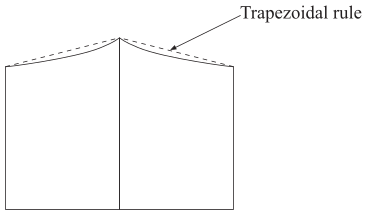
The diagram shows the front of a tent supported by three vertical poles. The poles are 1.2 m apart. The height of each outer pole is 1.5 m, and the height of the middle pole is 1.8 m. The roof hangs between the poles.

2013 15a

The front of the tent has area  `A\ text(m²)`. 

  1. Use the trapezoidal rule to estimate  `A`.    (1 mark)

    --- 2 WORK AREA LINES (style=lined) ---

  2. Does the Trapezoidal rule give a higher or lower estimate of the actual area? Justify your answer.  (1 mark)

    --- 2 WORK AREA LINES (style=lined) ---

Show Answers Only
  1. `3.96\ text(m²)`
  2. `text(See Worked Solutions)`
Show Worked Solution
i.    `A` `~~ h/2 [y_0 + 2y_1 + y_2]`
    `~~ 1.2/2 [1.5 + (2 xx 1.8) + 1.5]`
    `~~ 0.6 [6.6]`
    `~~ 3.96\ text(m²)`


ii.       

`text(S)text(ince the tent roof is concave up, the)`

`text(Trapezoidal rule uses straight lines and)`

`text(will estimate a higher area.)`

Filed Under: Trapezium Rule and Newton, Trapezoidal Rule (Y12) Tagged With: Band 3, Band 6, smc-5145-04-Trapezium rule, smc-5145-20-No table, smc-5145-30-Estimate comparison, smc-976-20-No Table, smc-976-30-Estimate Comparison

Probability, 2ADV S1 2015 MET1 8

For events `A` and `B` from a sample space, `P(A | B) = 3/4`  and  `P(B) = 1/3`.

  1.  Calculate  `P(A ∩ B)`.  (1 mark)

    --- 3 WORK AREA LINES (style=lined) ---

  2.  Calculate  `P(A^{′} ∩ B)`, where `A^{′}` denotes the complement of `A`.  (1 mark)

    --- 3 WORK AREA LINES (style=lined) ---

  3.  If events `A` and `B` are independent, calculate  `P(A ∪ B)`.  (1 mark)

    --- 3 WORK AREA LINES (style=lined) ---

Show Answers Only
  1. `1/4`
  2. `1/12`
  3. `5/6`
Show Worked Solution

i.   `text(Using Conditional Probability:)`

`P(A | B)` `= (P(A ∩ B))/(P(B))`
`3/4` `= (P(A ∩ B))/(1/3)`
`:. P(A ∩ B)` `= 1/4`


ii.    met1-2015-vcaa-q8-answer
`P(A^{′} ∩ B)` `= P(B)-P(A ∩B)`
  `= 1/3-1/4`
  `= 1/12`


iii.   `text(If)\ A, B\ text(independent)`

♦♦ Mean mark 28%.
MARKER’S COMMENT: A lack of understanding of independent events was clearly evident.
`P(A ∩ B)` `= P(A) xx P(B)`
`1/4` `= P(A) xx 1/3`
`:. P(A)` `= 3/4`


`P(A ∪ B)` `= P(A) + P(B)-P(A ∩ B)`
  `= 3/4 + 1/3-1/4`
`:. P(A ∪ B)` `= 5/6`

Filed Under: Conditional Probability and Venn Diagrams (Adv-2027), Conditional Probability and Venn Diagrams (Y11) Tagged With: Band 3, Band 4, Band 5, smc-6470-10-Conditional Prob Formula, smc-6470-20-Venn Diagrams/Intersections, smc-6470-30-Independent Events, smc-991-10-Conditional Prob Formula, smc-991-20-Venn Diagrams/Intersections, smc-991-30-Independent Events

Probability, 2ADV S1 2009 MET1 5

Four identical balls are numbered 1, 2, 3 and 4 and put into a box. A ball is randomly drawn from the box, and not returned to the box. A second ball is then randomly drawn from the box.

  1. What is the probability that the first ball drawn is numbered 4 and the second ball drawn is numbered 1?  (1 mark)

    --- 1 WORK AREA LINES (style=lined) ---

  2. What is the probability that the sum of the numbers on the two balls is 5?  (1 mark)

    --- 2 WORK AREA LINES (style=lined) ---

  3. Given that the sum of the numbers on the two balls is 5, what is the probability that the second ball drawn is numbered 1?  (2 marks)

    --- 4 WORK AREA LINES (style=lined) ---

Show Answers Only
  1. `1/12`
  2. `1/3`
  3. `1/4`
Show Worked Solution
i.    `P (4, 1)` `= 1/4 xx 1/3`
    `= 1/12`


ii.   `P (text(Sum) = 5)`

`= P (1, 4) + P (2, 3) + P (3, 2) + P (4, 1)`

`= 4 xx (1/4 xx 1/3)`

`= 1/3`


iii.   `text(Conditional Probability)`

♦ Mean mark 46%.

`P (2^{text(nd)} = 1\ |\ text(Sum) = 5)`

`= (P (4, 1))/(P (text(Sum) = 5))`

`= (1/12)/(1/3)`

`= 1/4`

Filed Under: Conditional Probability and Venn Diagrams (Adv-2027), Conditional Probability and Venn Diagrams (Y11) Tagged With: Band 3, Band 4, Band 5, smc-6470-10-Conditional Prob Formula, smc-991-10-Conditional Prob Formula

Probability, 2ADV S1 2015 MET2 14 MC

Consider the following discrete probability distribution for the random variable `X.`

\begin{array} {|c|c|c|c|c|c|}
\hline
\rule{0pt}{2.5ex} x \rule[-1ex]{0pt}{0pt} & \ \ \ 1\ \ \  & \ \ \ 2\ \ \  & \ \ \ 3\ \ \ &\ \ \ 4\ \ \ &\ \ \ 5\ \ \ \\
\hline
\rule{0pt}{2.5ex} P(X=x) \rule[-1ex]{0pt}{0pt} & p & 2p & 3p & 4p & 5p \\
\hline
\end{array} 

The mean of this distribution is

  1. `2`
  2. `3`
  3. `7/2`
  4. `11/3`
Show Answers Only

`D`

Show Worked Solution

`text(Find)\ p:`

`p + 2p + 3p + 4p + 5p` `= 1`
`:. p` `= 1/15`


`E(X)` `= 1 xx p + 2(2p) + 3(3p) + 4(4p) + 5(5p)`
  `= 55p`
  `= 55 xx (1/15)`
  `= 11/3`

`=>   D`

Filed Under: Discrete Probability Distributions (Y11) Tagged With: Band 3, smc-992-20-E(X) / Mean

Probability, 2ADV S1 2012 MET1 4

On any given day, the number `X` of telephone calls that Daniel receives is a random variable with probability distribution given by

\begin{array} {|c|c|c|c|c|}
\hline
\rule{0pt}{2.5ex} x \rule[-1ex]{0pt}{0pt} & \ \ \ 0\ \ \  & \ \ \ 1\ \ \  & \ \ \ 2\ \ \  & \ \ \ 3\ \ \  \\
\hline
\rule{0pt}{2.5ex} P(X=x) \rule[-1ex]{0pt}{0pt} & 0.2 & 0.2 & 0.5 & 0.1 \\
\hline
\end{array}

  1. Find the mean of  `X`.   (2 marks)

    --- 3 WORK AREA LINES (style=lined) ---

  2. What is the probability that Daniel receives only one telephone call on each of three consecutive days?   (1 mark)

    --- 2 WORK AREA LINES (style=lined) ---

  3. Daniel receives telephone calls on both Monday and Tuesday.


    What is the probability that Daniel receives a total of four calls over these two days?   (3 marks)

    --- 6 WORK AREA LINES (style=lined) ---

Show Answers Only
  1. `1.5`
  2. `0.008`
  3. `29/64`
Show Worked Solution
i.    `E(X)` `= 0 xx 0.2 + 1 xx 0.2 + 2 xx 0.5 + 3 xx 0.1`
    `= 0 + .2 + 1 + 0.3`
    `= 1.5`


ii.   `P(1, 1, 1)` `= 0.2 xx 0.2 xx 0.2`
    `= 0.008`


iii.   `text(Conditional Probability:)`

♦ Mean mark 36%.

`P(x = 4 | x >= 1\ text{both days})`

`= (P(1, 3) + P(2, 2) + P(3, 1))/(P(x>=1\ text{both days}))`

`= (0.2 xx 0.1 + 0.5 xx 0.5 + 0.1 xx 0.2)/(0.8 xx 0.8)`

`= (0.02 + 0.25 + 0.02)/0.64`

`= 0.29/0.64`

`= 29/64`

Filed Under: Discrete Probability Distributions (Y11) Tagged With: Band 3, Band 4, Band 5, smc-992-20-E(X) / Mean, smc-992-60-Conditional Probability, smc-992-70-Other Probability

Probability, 2ADV S1 2016 MET2 7 MC

The number of pets, `X`, owned by each student in a large school is a random variable with the following discrete probability distribution.

\begin{array} {|c|c|c|c|c|}
\hline
\rule{0pt}{2.5ex} x \rule[-1ex]{0pt}{0pt} & \ \ \ \ 0\ \ \ \  & \ \ \ \ 1\ \ \ \  & \ \ \ \ 2\ \ \ \  & \ \ \ \ 3\ \ \ \  \\
\hline
\rule{0pt}{2.5ex} P(X=x) \rule[-1ex]{0pt}{0pt} & 0.5 & 0.25 & 0.2 & 0.05 \\
\hline
\end{array}

If two students are selected at random, the probability that they own the same number of pets is

  1. `0.3`
  2. `0.305`
  3. `0.355`
  4. `0.405`
Show Answers Only

`C`

Show Worked Solution

`P (0, 0)+ P (1, 1)+ P (2, 2)+ P (3, 3)`

`= 0.5^2+0.25^2+0.2^2+0.05^2`

`=0.355`

 
`=>   C`

Filed Under: Discrete Probability Distributions (Y11) Tagged With: Band 3, smc-992-70-Other Probability

Probability, 2ADV S1 2010 MET2 15 MC

The discrete random variable `X` has the following probability distribution.

\begin{array} {|c|c|c|c|}
\hline
\rule{0pt}{2.5ex} x \rule[-1ex]{0pt}{0pt} & \ \ \ 0\ \ \  & \ \ \ 1\ \ \  & \ \ \ 2\ \ \ \\
\hline
\rule{0pt}{2.5ex} P(X=x) \rule[-1ex]{0pt}{0pt} & a & b & 0.4 \\
\hline
\end{array}

If the mean of `X` is 1 then

  1. `a = 0.3 and b = 0.1`
  2. `a = 0.2 and b = 0.2`
  3. `a = 0.4 and b = 0.2`
  4. `a = 0.1 and b = 0.3`
Show Answers Only

`C`

Show Worked Solution

`E(X) = 1:`

`1 xx b + 2 xx 0.4` `=1`
`b` `=0.2`

 
`text(Sum of probabilities) = 1:`

`a + 0.2 + 0.4` `= 1`
`a` `=0.4`

`=>   C`

Filed Under: Discrete Probability Distributions (Y11) Tagged With: Band 3, smc-992-20-E(X) / Mean

Probability, 2ADV S1 2007 MET2 19 MC

The discrete random variable `X` has probability distribution as given in the table. The mean of `X` is 5.

\begin{array} {|c|c|c|c|c|}
\hline
\rule{0pt}{2.5ex} x \rule[-1ex]{0pt}{0pt} & \ \ \ 0\ \ \  & \ \ \ 2\ \ \  & \ \ \ 4\ \ \  & \ \ \ 6\ \ \ &\ \ \ 8\ \ \ \\
\hline
\rule{0pt}{2.5ex} P(X=x) \rule[-1ex]{0pt}{0pt} & a & 0.2 & 0.2 & 0.3 & b \\
\hline
\end{array}

The values of `a` and `b` are

  1. `{:(a = 0.05,\ and b = 0.25):}`
  2. `{:(a = 0.1­,\ and b = 0.29):}`
  3. `{:(a = 0.2­,\ and b = 0.9):}`
  4. `{:(a = 0.3­,\ and b = 0):}`
Show Answers Only

`A`

Show Worked Solution

`text(Sum of probabilities) = 1`

`a + 0.2 + 0.2 + 0.3 + b = 1`
  

`text(S)text{ince}\ E(X) = 5,`

`5` `=(0 xx a) + (2 xx 0.2) + (4 xx 0.2) + (6 xx 0.3) + 8b`
`8b` `=2`
`:. b` `=0.25`

 
`:. a = 0.05,\ \  b = 0.25`
`=>   A`
Filed Under: Discrete Probability Distributions (Y11) Tagged With: Band 3, smc-992-10-Sum of Probabilities = 1, smc-992-20-E(X) / Mean

Calculus, 2ADV C4 2017* HSC 14b

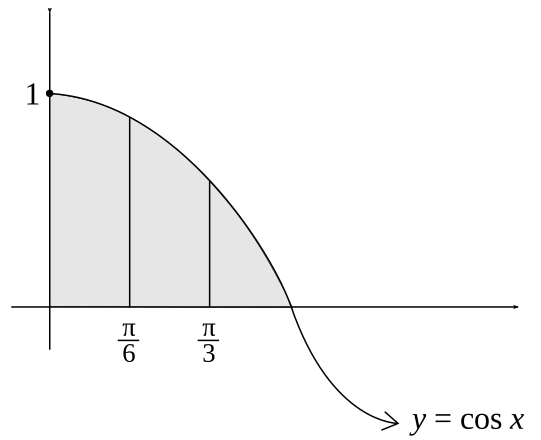
  1. Find the exact value of  `int_0^(pi/3) cos x\ dx`.  (1 mark)

    --- 2 WORK AREA LINES (style=lined) ---

  2. Using the Trapezoidal rule with three function values, find an approximation to the integral  `int_0^(pi/3) cos x\ dx,` leaving your answer in terms of `pi` and `sqrt 3`.  (2 marks)

    --- 4 WORK AREA LINES (style=lined) ---

  3. Using parts (i) and (ii), show that  `pi ~~ (12 sqrt 3)/(3 + 2 sqrt 3)`.  (1 mark)

    --- 2 WORK AREA LINES (style=lined) ---

Show Answers Only
  1. `sqrt 3/2`
  2. `((2sqrt3 + 3)pi)/24`
  3. `text{Proof (See Worked Solutions)}`
Show Worked Solution
i.   `int_0^(pi/3) cos x\ dx` `= [sin x]_0^(pi/3)`
    `= sin\ pi/3-0`
    `= sqrt 3/2`


ii.  

\begin{array} {|l|c|c|c|}\hline
x & \ \ \ 0\ \ \  & \ \ \ \dfrac{\pi}{6}\ \ \  & \ \ \ \dfrac{\pi}{3}\ \ \ \\ \hline
\text{height} & 1 & \dfrac{\sqrt{3}}{2} & \dfrac{1}{2} \\ \hline
\text{weight} & 1 & 2 & 1  \\ \hline \end{array}

`int_0^(pi/3) cos x\ dx` `~~ 1/2 xx pi/6[1 + 2(sqrt3/2) + 1/2]`
  `~~ pi/12((3 + 2sqrt3)/2)`
  `~~ ((3+2sqrt3)pi)/24`


♦ Mean mark part (iii) 49%.

(iii)    `((3+2sqrt3)pi)/24` `~~ sqrt3/2`
  `:. pi` `~~ (24sqrt3)/(2(3+2sqrt3))`
    `~~ (12sqrt3)/(3 + 2sqrt3)`

Filed Under: Trapezium Rule and Newton, Trapezoidal Rule (Y12) Tagged With: Band 3, Band 4, Band 5, smc-5145-04-Trapezium rule, smc-5145-20-No table, smc-5145-30-Estimate comparison, smc-976-20-No Table, smc-976-30-Estimate Comparison

Calculus, 2ADV C4 2012* HSC 12d

At a certain location a river is 12 metres wide. At this location the depth of the river, in metres, has been measured at 3 metre intervals. The cross-section is shown below.
 

2012 12d

  1. Use the Trapezoidal rule with the five depth measurements to calculate the approximate area of the cross-section.   (3 marks)

    --- 6 WORK AREA LINES (style=lined) ---

  2. The river flows at 0.4 metres per second.
  3. Calculate the approximate volume of water flowing through the cross-section in 10 seconds.   (1 mark)

    --- 2 WORK AREA LINES (style=lined) ---

Show Answers Only
  1. `30.9 \ text(m²)`
  2. `123.6 \ text(m³)`  
Show Worked Solution
i.   
`A` `~~ 3/2[0.5 + 2(2.3 + 2.9 + 3.8) + 2.1]`
  `~~ 3/2(20.6)`
  `~~ 30.9\  text(m²)`


♦ Mean mark 49%.

ii.  `text(Distance water flows)`  `= 0.4 xx 10`
  `= 4 \ text(metres)`


`text(Volume flow in 10 seconds)` `~~ 4 xx 30.9`
  `~~ 123.6  text(m³)`

Filed Under: Trapezium Rule and Newton, Trapezoidal Rule (Y12) Tagged With: Band 3, Band 5, smc-5145-04-Trapezium rule, smc-5145-20-No table, smc-976-20-No Table

Calculus, 2ADV C1 2008 HSC 6b

The graph shows the velocity of a particle,  `v`  metres per second, as a function of time,  `t`  seconds.

  1. What is the initial velocity of the particle?   (1 mark)

    --- 1 WORK AREA LINES (style=lined) ---

  2. When is the velocity of the particle equal to zero?    (1 mark)

    --- 1 WORK AREA LINES (style=lined) ---

  3. When is the acceleration of the particle equal to zero?    (1 mark)

    --- 1 WORK AREA LINES (style=lined) ---

Show Answers Only
  1. `20\ text(m/s)`
  2. `t=10\ text(seconds)`
  3. `t=6\ text(seconds)`
Show Worked Solution

i.    `text(Find)\   v  \ text(when)  t=0`

`v=20\ \ text(m/s)`
 

ii.    `text(Particle comes to rest at)\  t=10\ text{seconds  (from graph)}`


iii.  `text(Acceleration is zero when)\ t=6\ text{seconds  (from graph)}`

Filed Under: Rates of Change (Adv-2027), Rates of Change (Y11) Tagged With: Band 2, Band 3, smc-1083-10-Motion Graphs, smc-6438-10-Motion Graphs

Calculus, 2ADV C4 2016* HSC 14a

The diagram shows the cross-section of a tunnel and a proposed enlargement.

hsc-2016-14a

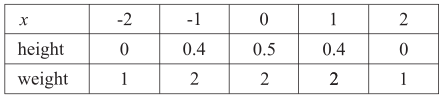
The heights, in metres, of the existing section at 1 metre intervals are shown in Table `A.`

hsc-2016-14ai

The heights, in metres, of the proposed enlargement are shown in Table `B.`

hsc-2016-14aii

Use the Trapezoidal rule with the measurements given to calculate the approximate increase in area.   (3 marks)

--- 6 WORK AREA LINES (style=lined) ---

Show Answers Only

`1.3\ text(m²)`

Show Worked Solution

`text(Consider the shaded area distances:)`

`A` `~~ 1/2[0 + 2(0.4 + 0.5 + 0.4) + 0]`
  `~~ 1/2(2.6)`
  `~~ 1.3\ text(m²)`

Filed Under: Trapezium Rule and Newton, Trapezoidal Rule (Y12) Tagged With: Band 3, smc-5145-04-Trapezium rule, smc-5145-10-Table provided, smc-5145-30-Estimate comparison, smc-976-10-Table provided, smc-976-30-Estimate Comparison

Trigonometry, 2ADV’ T1 2010 HSC 5a

A boat is sailing due north from a point  `A`  towards a point  `P`  on the shore line.

The shore line runs from west to east.

In the diagram,  `T`  represents a tree on a cliff vertically above  `P`, and  `L`  represents a landmark on the shore. The distance  `PL`  is 1 km.

From  `A`  the point  `L`  is on a bearing of 020°, and the angle of elevation to  `T`  is 3°.

After sailing for some time the boat reaches a point  `B`, from which the angle of elevation to  `T`  is 30°.
 

5a
 

  1. Show that  `BP = (sqrt3 tan 3°)/(tan20°)`.   (3 marks) 

    --- 6 WORK AREA LINES (style=lined) ---

  2. Find the distance `AB`. Give your answer to 1 decimal place.   (1 mark)

    --- 3 WORK AREA LINES (style=lined) ---

Show Answers Only
  1. `text(Proof)\ \ text{(See Worked Solutions)}`
  2. `2.5\ text(km)\ \ text{(to 1 d.p.)}`
Show Worked Solution

i.   `text(Show)\ BP = (sqrt3 tan 3°)/(tan 20°)` 

`text(In)\ Delta ATP`
`tan 3°` `= (TP)/(AP)`
`=> AP` `= (TP)/(tan 3)`

 
`text(In)\ Delta APL:`

`tan 20°` `= 1/(AP)`
`=> AP` `= 1/tan 20`


`:. (TP)/(tan3)` `= 1/(tan20)`
`TP` `= (tan3°)/(tan20°)\ \ \ text(…)\ text{(} text(1)text{)}`


`text(In)\ \ Delta BTP:`

`tan 30°` `= (TP)/(BP)`
`1/sqrt3` `= (TP)/(BP)`
`BP` `= sqrt3 xx TP\ \ \ \ \ text{(using (1) above)}`
  `= (sqrt3 tan3°)/(tan20°)\ \ \ text(… as required)`


ii.    `AB` `= AP\ – BP`
  `AP` `= 1/(tan20°)\ \ \ text{(} text(from part)\ text{(i)} text{)}`
`:.\ AB` `= 1/(tan 20°)\ – (sqrt3 tan3°)/(tan20°)`
  `= (1\ – sqrt3 tan 3)/(tan20°)`
  `= 2.4980…`
  `= 2.5\ text(km)\ text{(to 1 d.p.)`

Filed Under: 3D Trigonometry (Y11) Tagged With: Band 3, Band 4, page-break-before-solution

Trigonometry, 2ADV’ T1 2008 HSC 6a

From a point  `A`  due south of a tower, the angle of elevation of the top of the tower  `T`, is 23°. From another point  `B`, on a bearing of 120° from the tower, the angle of elevation of  `T`  is 32°. The distance  `AB`  is 200 metres.
 

Trig Ratios, EXT1 2008 HSC 6a 
 

  1. Copy or trace the diagram into your writing booklet, adding the given information to your diagram.  (1 mark)

    --- 8 WORK AREA LINES (style=lined) ---

  2. Hence find the height of the tower. Give your answer to the nearest metre.  (3 marks)

    --- 6 WORK AREA LINES (style=lined) ---

Show Answers Only
  1.  
    Trig Ratios, EXT1 2008 HSC 6a Answer

  2. `96\ text(m)`
Show Worked Solution

i.

Trig Ratios, EXT1 2008 HSC 6a Answer 


ii.  `text(Find)\ \ OT = h`

`text(Using the cosine rule in)\ Delta AOB :`

`200^2 = OA^2 + OB^2 – 2 * OA * OB * cos 60\ …\ text{(*)}`

 `text(In)\ Delta OAT,\tan 23^@= h/(OA)`

`=> OA= h/(tan 23^@)\  …\ (1)`

 `text(In)\ Delta OBT,\ tan 32^@= h/(OB)`

`=> OB= h/(tan 32^@)\ \ \ …\ (2)`
 

`text(Substitute)\ (1)\ text(and)\ (2)\ text(into)\ text{(*):}`

`200^2` `= (h^2)/(tan^2 23^@) + (h^2)/(tan^2 32^@) – 2 * h/(tan 23^@) * h/(tan 32^@) * 1/2`
  `= h^2 (1/(tan^2 23^@) + 1/(tan^2 32^@) + 1/(tan23^@ * tan32^@) )`
  `= h^2 (4.340…)`
`h^2` `= (40\ 000)/(4.340…)`
  `= 9214.55…`
`:. h` `= 95.99…`
  `= 96\ text(m)\ \ \ text{(to nearest m)}`

Filed Under: 3D Trigonometry (Y11) Tagged With: Band 3, Band 4

Trigonometry, 2ADV’ T1 2015 HSC 12c

A person walks 2000 metres due north along a road from point `A` to point `B`. The point `A` is due east of a mountain `OM`, where `M` is the top of the mountain. The point `O` is directly below point `M` and is on the same horizontal plane as the road. The height of the mountain above point `O` is `h` metres.

From point `A`, the angle of elevation to the top of the mountain is 15°.

From point `B`, the angle of elevation to the top of the mountain is 13°.
 

Trig Ratios, EXT1 2015 HSC 12c
 

  1. Show that  `OA = h\ cot\ 15°`.  (1 mark)

    --- 2 WORK AREA LINES (style=lined) ---

  2. Hence, find the value of  `h`.  (2 marks)

    --- 4 WORK AREA LINES (style=lined) ---

Show Answers Only
  1. `text(See Worked Solutions)`
  2. `910\ text{m  (nearest metre)}`
Show Worked Solution

i.   `text(Show)\ \ OA = h\ cot\ 15^@` 

Trig Ratios, EXT1 2015 HSC 12c Answer1

`text(In)\ \ Delta MOA,`

`tan\ 15^@` `= h/(OA)`
`OA` `= h/(tan\ 15^@)`
  `= h\ cot\ 15^@\ \ …text(as required)`


ii.   `text(In)\ \ ΔMOB`

`tan\ 13^@` `= h/(OB)`
`OB` `= h/(tan\ 13^@)`
  `= h\ cot\ 13^@`


Trig Ratios, EXT1 2015 HSC 12c Answer2 
 

`text(In)\ \ ΔAOB:`

`OA^2 + AB^2` `= OB^2`
`OB^2 − OA^2` `= AB^2`
`(h\ cot\ 13^@)^2 − (h\ cot\ 15^@)^2` `= 2000^2`
`h^2[(cot^2\ 13^@ − cot^2\ 15^@)]` `= 2000^2`
`h^2` `= (2000^2)/(cot^2\ 13^@ − cot^2\ 15^@)`
`:. h` `= sqrt((2000^2)/(cot^2\ 13^@ − cot^2\ 15^@))`
  `= 909.704…`
  `= 910\ text{m  (nearest metre)}`

Filed Under: 3D Trigonometry (Y11) Tagged With: Band 3, Band 4

Measurement, STD2 M1 SM-Bank 16 MC

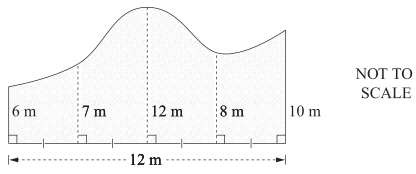
The diagram represents a field.
 

What is the area of the field, using four applications of the Trapezoidal’s rule?

  1. 105 m²
  2. 136 m²
  3. 210 m²
  4. 420 m²
Show Answers Only

`A`

Show Worked Solution

`text(Solution 1)`

`text(Area)` `~~ 3/2(6 + 7) + 3/2(7 + 12) + 3/2(12 + 8) + 3/2(8 + 10)`
  `~~ 3/2(13 + 19 + 20 + 18)`
  `~~ 105\ text(m²)`


`text(Solution 2)`

\begin{array} {|l|c|c|c|c|c|}
\hline
\rule{0pt}{2.5ex} x \rule[-1ex]{0pt}{0pt} & 0 & 3 & 6 & 9 & 12 \\
\hline
\rule{0pt}{2.5ex} \text{height} \rule[-1ex]{0pt}{0pt} & \ \ \ 6\ \ \  & \ \ \ 7\ \ \  & \ \ 12\ \  & \ \ \ 8\ \ \  & \ \ 10\ \  \\
\hline
\rule{0pt}{2.5ex} \text{weight} \rule[-1ex]{0pt}{0pt} & 1 & 2 & 2 & 2 & 1 \\
\hline
\end{array}

`text(Area)` `~~ 3/2(6 + 2 xx 7 + 2 xx 12 + 2 xx 8 + 10)`
  `~~ 3/2(70)`
  `~~ 105\ text(m²)`

 
`=> A`

Filed Under: Trapezoidal Rule (Std 2), Trapezoidal Rule (Std1-2027), Trapezoidal Rule (Std2-2027) Tagged With: Band 3, smc-6328-20-4 Approximations, smc-6523-20-4 Approximations, smc-941-20-4 Approximations

Measurement, STD2 M1 SM-Bank 15 MC

The shaded region represents a block of land bounded on one side by a road.
 

2UG-2005-12MC

 
What is the approximate area of the block of land, using the Trapeziodal rule?

  1.  720 m²
  2.  880 m²
  3.  1140 m²
  4.  1440 m²
Show Answers Only

`A`

Show Worked Solution

`text(Area)` `≈ 20/2(23 + 15) + 20/2(15 + 19)`
  `≈ 10(38) + 10(34)`
  `≈ 720\ text(m²)`

 
`=> A`

Filed Under: Trapezoidal Rule (Std 2), Trapezoidal Rule (Std1-2027), Trapezoidal Rule (Std2-2027) Tagged With: Band 3, smc-6328-10-1-3 Approximations, smc-6523-10-1-3 Approximations, smc-941-10-1-3 Approximations

Complex Numbers, EXT2 N2 2018 HSC 15b

  1. Use De Moivre's theorem and the expansion of `(costheta + isintheta)^8` to show that
     
    `sin8theta = ((8),(1)) cos^7thetasintheta - ((8),(3)) cos^5thetasin^3theta`
     
                        `+ ((8),(5)) cos^3thetasin^5theta - ((8),(7)) costhetasin^7theta`  (2 marks)

    --- 7 WORK AREA LINES (style=lined) ---

  2. Hence, show that
     
    `(sin8theta)/(sin2theta) = 4(1 - 10sin^2theta + 24sin^4theta - 16sin^6theta)`.  (3 marks)

    --- 7 WORK AREA LINES (style=lined) ---

Show Answers Only
  1. `text(See Worked Solutions)`
  2. `text(See Worked Solutions)`
Show Worked Solution

i.   `text(By De Moivre)`

`costheta + isintheta^8 = cos8theta + isin8theta\ \ …\ (text{*})`
 

`text(Using Binomial Expansion)`

`(costheta + isintheta)^8`

`= cos^8theta + ((8),(1))cos^7theta * isintheta + ((8),(2)) cos^6theta *i^2sin^2theta`

`+ ((8),(3)) cos^5theta *i^3sin^3theta + ((8),(4)) cos^4theta *i^4sin^4theta + ((8),(5)) cos^3theta *i^5sin^5theta`

`+ ((8),(6)) cos^2theta *i^6sin^6theta + ((8),(7)) costheta *i^7sin^7theta + i^8sin^8theta`

 
`text(Equating imaginary parts of the expansion equation (*)):`

`isin8theta = ((8),(1)) cos^7theta* isintheta + ((8),(3)) icos^5theta* i^3sin^3theta`

`+ ((8),(5)) cos^3theta* i ^5sintheta + ((8),(7)) costheta *i^7sin^7theta`

`:. sin8theta = ((8),(1)) cos^7theta sintheta – ((8),(3)) cos^5theta sin^3theta`

`+ ((8),(5)) cos^3theta sin^5theta – ((8),(7)) costheta sin^7theta`
 

ii.    `sin8theta` `= 8cos^7theta sintheta – 56cos^5 sin^3theta + 56cos^3theta sin^5theta – 8costheta sin^7theta`
    `= 2sinthetacostheta (4cos^6theta – 28cos^4theta sin^2theta + 28cos^2theta sin^4theta – 4sin^6theta)`

 
`:. (sin8theta)/(sin2theta)`

`= 4cos^6theta – 28cos^4theta sin^2theta + 28cos^2theta sin^4theta – 4sin^6theta`

`= 4(1 – sin^2theta)^3 – 28(1 – sin^2theta)^2 sin^2theta + 28(1 – sin^2theta) sin^4theta – 4sin^6theta`

`= 4(1 – 3sin^2theta + 3sin^4theta + sin^6theta) – 28sin^2theta (1 – 2sin^2theta + sin^4theta)`

`+ 28sin^4theta (1 – sin^2theta) – 4sin^6theta`

`= 4 – 40sin^2theta + 96sin^4theta – 56sin^6theta`

`= 4(1 – 10sin^2theta + 24sin^4theta – 16sin^6theta)`

Filed Under: Powers and Roots, Probability and The Binomial, Solving Equations with Complex Numbers Tagged With: Band 3, Band 4, smc-1050-40-De Moivre and trig identities

Harder Ext1 Topics, EXT2 2018 HSC 14d

Three people, `A`, `B` and `C`, play a series of n games, where  `n ≥ 2`. In each of the games there is one winner and each of the players is equally likely to win.

  1.  What is the probability that player `A` wins every game?  (1 mark)
  2.  Show that the probability that `A` and `B` win at least one game each but `C` never wins, is
     
         `(2/3)^n - 2(1/3)^n`.  (1 mark)
     
  3.  Show that the probability that each player wins at least one game is 
     
         `(3^(n - 1) - 2^n + 1)/(3^(n - 1))`.  (2 marks)
Show Answers Only
  1. `(1/3)^n`
  2. `text(See Worked Solutions)`
  3. `text(See Worked Solutions)`
Show Worked Solution

i.   `text{Pr (A wins every game)} = (1/3)^n`


ii.   `text{Pr (C never wins)} = (2/3)^n`

♦ Mean mark 36%.

`text(If C never wins, only 2 scenarios occur where A or B)`

`text(don’t win at least 1 game)`

`→\ text(A wins all or B wins all.)`
 

`:.\ text{Pr (No C, A and B win at least 1 game)}`

`=\ text{Pr (No C) – Pr (A wins all) – Pr (B wins all)}`

`= (2/3)^n – 2(1/3)^n`


iii.   `=>\ text{A, B or C cannot win all games (part(i)).}`

♦♦♦ Mean mark 19%.

`=>\ text(A cannot lose all games, with B and C winning)`

`text{at least 1 each (part (ii)). Similarly for each player.}`
 

`:.\ text{Pr (each player wins at least 1 game)}`

`= 1 – 3(1/3)^n – 3[(2/3)^n – 2(1/3)^n]`

`= (3^n – 3 – 3 · 2^n + 6)/(3^n)`

`= (3^n – 3 · 2^n + 3)/(3^n)`

`= (3^(n – 1) – 2^n + 1)/(3^(n – 1))\ \ …\ text(as required.)`

Filed Under: Probability and The Binomial Tagged With: Band 3, Band 5, Band 6

Calculus, EXT2 C1 2018 HSC 14c

Let  `I_n = int_(−3)^0 x^n sqrt(x + 3)\ dx`  for  `n = 0, 1, 2…`

  1.  Show that, for  `n >= 1`,
     
         `I_n = (−6n)/(3 + 2n) I_(n - 1)`.   (3 marks)

    --- 8 WORK AREA LINES (style=lined) ---

  2.  Find the value of  `I_2`.  (2 marks)

    --- 5 WORK AREA LINES (style=lined) ---

Show Answers Only
  1. `text(See Worked Solutions)`
  2. `(144sqrt3)/35`
Show Worked Solution

i.   `I_n = int_(−3)^0 x^n sqrt(x + 3)\ dx\ \ text(for)\ \ n = 0, 1, 2…`

`u` `= x^n` `vprime` `= (x + 3)^(1/2)`
`uprime` `= nx^(n – 1)` `v` `= 2/3 (x + 3)^(3/2)`


`I_n` `= [2/3 x^n(x + 3)^(3/2)]_(−3)^0 – 2/3int_(−3)^0  nx^(n – 1)(x + 3)sqrt(x + 3)\ dx`
`I_n` `= 0 – (2n)/3 int_(−3)^0 x^nsqrt(x + 3) + 3x^(n – 1)sqrt(x + 3)\ dx`
`I_n` `= −(2n)/3 (I_n + 3I_(n-1))`
`I_n + (2n)/3 I_n` `= −2nI_(n – 1)`
`I_n(1 + (2n)/3)` `= −2nI_(n – 1)`
`I_n((3 + 2n)/3)` `= −2nI_(n – 1)`
`:. I_n` `= (−6n)/(3 + 2n) I_(n – 1)\ \ \ text(… as required)`


ii.    `I_2` `= −12/7 I_1`
    `= −12/7 xx −6/5 I_0`
    `= 72/35 int_(−3)^0 (x + 3)^(1/2)dx`
    `= 72/35 xx 2/3 [(x + 3)^(3/2)]_(−3)^0`
    `= 48/35 (3^(3/2))`
    `= (144sqrt3)/35`

Filed Under: Recurrence Relations, Recurrence Relations Tagged With: Band 3, Band 4, smc-1054-50-Other Function

Mechanics, EXT2 M1 2018 HSC 14b

A falling particle experiences forces due to gravity and air resistance. The acceleration of the particle is  `g - kv^2`, where `g` and `k` are positive constants and `v` is the speed of the particle. (Do NOT prove this.)

Prove that, after falling from rest through a distance, `h`, the speed of the particle will be  `sqrt(g/k (1 - e^(−2kh)))`.  (3 marks)

--- 8 WORK AREA LINES (style=lined) ---

Show Answers Only

`text(See Worked Solutions)`

Show Worked Solution

`a = v · (dv)/(dx) = g – kv^2`

`(dv)/(dx)` `= (g – kv^2)/v`
`(dx)/(dv)` `= v/(g – kv^2)`
`x` `= int v/(g – kv^2)\ dv`
  `= −1/(2k) log_e(g – kv^2) + c`


`text(When)\ \ x = 0, v = 0`

`=> c = 1/(2k) log_e (g)`

`x` `= −1/(2k)log_e(g – kv^2) + 1/(2k) log_e g`
  `= −1/(2k) log_e ((g – kv^2)/g)`


`text(Find)\ \ v\ \ text(when)\ \ x = h:`

`log_e ((g – kv^2)/g)` `= −2kh`
`(g – kv^2)/g` `= e^(−2kh)`
`kv^2` `= g – g e^(−2kh)`
`v^2` `= g/k (1 – e^(−2kh))`
`:. v` `= sqrt(g/k (1 – e^(−2kh)))`

Filed Under: Resisted Motion, Resisted Motion Tagged With: Band 3, smc-1061-05-Projectile Motion, smc-1061-20-R ~ v^2

Calculus, EXT2 C1 2018 HSC 14a

Using the substitution  `t = tan\ theta/2`  evaluate  `int_0^(pi/2) (d theta)/(2 - costheta)`.  (3 marks)

--- 8 WORK AREA LINES (style=lined) ---

Show Answers Only

`(2sqrt3 pi)/9`

Show Worked Solution

`t = tan\ theta/2, \ costheta = (1 – t^2)/(1 + t^2), \ d theta = 2/(1 + t^2) dt`

`text(When)\ \ theta = pi/2, \ t = 1`

`text(When)\ \ theta = 0, \ t = 0`
 

`int_0^(pi/2) (d theta)/(2 – costheta)` `= int_0^1 1/(2 – (1 – t^2)/(1 + t^2)) · 2/(1 + t^2)\ dt`
  `= int_0^1 2/(2(1 + t^2) – (1 – t^2))\ dt`
  `= int_0^1 2/(1 + 3t^2)\ dt`
  `= [2/sqrt3 tan^(−1)(sqrt3 t)]_0^1`
  `= 2/sqrt3 tan^(−1) sqrt3 – 0`
  `= (2pi)/(3sqrt3)`
  `= (2sqrt3 pi)/9`

Filed Under: Trig Integrals, Trig Integration Tagged With: Band 3, smc-1193-20-t = tan theta/2

Harder Ext1 Topics, EXT2 2018 HSC 13d

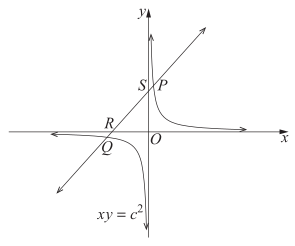
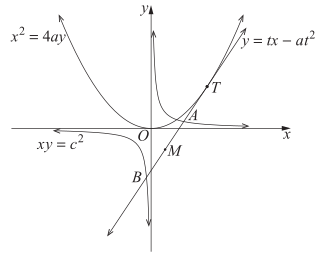
The points  `P(cp, c/p)`  and  `Q(cp, c/q)`  lie on the rectangular hyperbola  `xy = c^2`.

The line `PQ` has equation  `x + pqy = c(p + q)`. (Do NOT prove this.)

The `x` and `y` intercepts of `PQ` are `R` and `S` respectively, as shown in the diagram.


  1. Show that  `PS = QR`.  (3 marks)

The point  `T(2at, at^2)`  lies on the parabola  `x^2 = 4ay`. The tangent to the parabola at `T` intersects the rectangular hyperbola  `xy = c^2`  at `A` and `B` and has equation  `y = tx - at^2`. (Do NOT prove this.) The point `M` is the midpoint of the interval `AB`. One such case is shown in the diagram.
 

  1. Using part (i), or otherwise, show that `M` lies on the parabola  `2x^2 = −ay`.  (2 marks)
Show Answers Only
  1. `text(See Worked Solutions)`
  2. `text(See Worked Solutions)`
Show Worked Solution

i.   `P(cp, c/p)\ text(and)\ Q(cq, c/q)`

`PQ:\ \  x + pqy = c(p + q)`

 
`text(When)\ \ y = 0, x = c(p + q)`

`=> R(c(p + q), 0)`

`text(When)\ x = 0, y = (c(p + q))/(pq)`

`=> S(0, (c(p + q))/(pq))`
 

`text(Using Pythagoras:)`

`(PS)^2` `= (0 – cp)^2 + ((c(p + q))/(pq) – c/p)^2`
  `= c^2p^2 + (c/q + c/p – c/p)^2`
  `= c^2p^2 + (c^2)/(q^2)`


`(QR)^2` `= (cq – c(p + q))^2 + (c^2)/(q^2)`
  `= (cq – cp – cq)^2 + (c^2)/(q^2)`
  `= c^2p^2 + (c^2)/(q^2)`

 
`:. PS = QR\ \ \ text(… as required)`


ii.    `y = tx – at^2`

♦ Mean mark part (ii) 50%.

`=> xtext(-intercept at)\ \ R(at, 0)`

`=> ytext(-intercept at)\ \ S(0,−at^2)`
 

`text(S)text(ince)\ \ AR = BS\ \ \ (text{from part(i)})`

`M_(AB)` `= M_(RS)= ((at)/2, (−at^2)/2)“

 
`text(Find locus of)\ M:`

`x = (at)/2 \ => \ t = (2x)/a`

`y` `= (−at^2)/2`
  `= −a/2 xx ((2x)/a)^2`
  `= (−2x^2)/a`
`:. 2x^2` `= −ay\ \ \ text(… as required)`

Filed Under: Other Ext1 Topics Tagged With: Band 3, Band 5, page-break-before-question

Complex Numbers, EXT2 N1 2018 HSC 13b

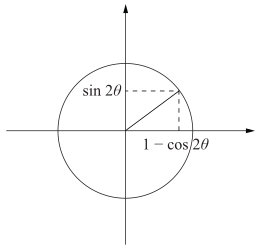
Let   `z = 1 - cos2theta + isin2theta`, where   `0 < theta <= pi`.

  1.  Show that  `|\ z\ | = 2sintheta`.  (2 marks)

    --- 6 WORK AREA LINES (style=lined) ---

  2.  Show that  `text(arg)(z) = pi/2 - theta`.  (2 marks)

    --- 8 WORK AREA LINES (style=lined) ---

Show Answers Only
  1. `text(See Worked Solutions)`
  2. `text(See Worked Solutions)`
Show Worked Solution

i.   `z = 1 – cos2theta + isin2theta`

`|\ z\ |` `= sqrt((1 – cos2theta)^2 + sin^2 2theta)`
  `= sqrt(1 – 2cos2theta + cos^2 2theta + sin^2 2theta)`
  `= sqrt(2 – 2cos2theta)`
  `= sqrt(2(1 – cos2theta))`
  `= sqrt(2(2sin^2theta))`
  `= 2sintheta\ \ \ text(… as required)`


ii.  `z= 1 – cos2theta + isin2theta`

`text(arg)(z)` `= tan^(−1)((sin2theta)/(1 – cos2theta))`
  `= tan^(−1)((2sinthetacostheta)/(2sin^2theta))`
  `= tan^(−1)(cottheta)`
  `= tan^(−1)(tan(pi/2 – theta))`
  `= pi/2 – theta`

 
`(text(S)text(ince)\ \ 0 < theta < pi => \ −pi/2 <= pi/2 – theta < pi/2)`

Filed Under: Argand Diagrams and Mod/Arg form, Geometry and Complex Numbers (vectors) Tagged With: Band 3, Band 4, smc-1049-20-Cartesian to Mod/Arg

Functions, EXT1′ F1 2018 HSC 12d

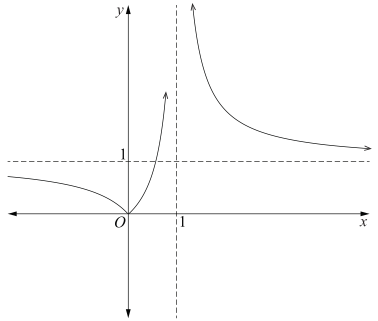
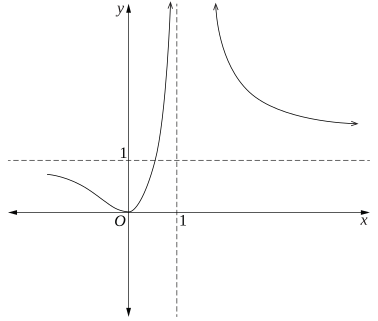
The diagram shows the graph of the function  `f(x) = x/(x - 1)`.


Draw a separate half-page graph for each of the following functions, showing all asymptotes and intercepts.

  1.  `y = |\ f(x)\ |`  (1 mark)

    --- 8 WORK AREA LINES (style=lined) ---

  2.  `y = (f(x))^2`  (2 marks)

    --- 8 WORK AREA LINES (style=lined) ---

Show Answers Only

i.   

ii.

Show Worked Solution
i.   


ii.   

Filed Under: Drawing graphs to powers, Reflections and Harder curves, Reflections and Harder Graphs (Ext1) Tagged With: Band 3, smc-1072-30-y = | f(x) |; y = f( |x| ), smc-1072-40-Other Graphs

Calculus, EXT2 C1 2018 HSC 12c

Find  `int(x^2 + 2x)/(x^2 + 2x + 5)\ dx`.  (3 marks)

Show Answers Only

`x – 5/2 tan^(−1) ((x + 1)/2) + c`

Show Worked Solution
`int(x^2 + 2x)/(x^2 + 2x + 5)\ dx` `= int((x^2 + 2x + 5) – 5)/(x^2 + 2x + 5)\ dx`
  `= int 1 – 5/(x^2 + 2x + 5)\ dx`
  `= int 1 – 5/(2^2 + (x + 1)^2)\ dx`
  `= x – 5/2 tan^(−1) ((x + 1)/2) + c`

Filed Under: Trig Integrals, Trig Integration Tagged With: Band 3, smc-1193-15-tan, smc-1193-50-Completing the square

Graphs, EXT2 2018 HSC 12b

A curve has equation  `x^2 + xy + y^2 = 3`.

  1. Use implicit differentiation to show that  `dy/dx = −(2x + y)/(x + 2y)`.  (2 marks)
  2. Hence, or otherwise, find the coordinates of the points on the curve where  `dy/dx = 0`.  (2 marks)
Show Answers Only
  1. `text(See Worked Solutions)`
  2. `(1,−2)\ \ text(and)\ \ (−1,2).`
Show Worked Solution

i.   `x^2 + xy + y^2 = 3`

♦ Mean mark 98%!

`2x + y + x · dy/dx + 2y · dy/dx=0`

`dy/dx(x + 2y)` `= −2x – y`
`:. dy/dx` `= −(2x + y)/(x + 2y)\ \ \ text(… as required)`


ii.   `text(When)\ \ dy/dx = 0,`

`−(2x + y)/(x + 2y)` `= 0`
`-2x-y` `=0`
`y` `= −2x\ \ \ \ (text(*))`


`text(Substituting into)\ \ x^2 + xy + y^2 = 3`

`x^2 + x(−2x) + (−2x)^2` `= 3`
`x^2 – 2x^2 + 4x^2` `= 3`
`3x^2` `= 3`
`x` `= +-1`
`y` `= +-2\ \ \ \ (text(*))`

 
`:.\ text(Coordinates are)\ \ (1,−2)\ \ text(and)\ \ (−1,2).`

Filed Under: Implicit Differentiation Tagged With: Band 1, Band 3

Complex Numbers, EXT2 N2 2018 HSC 11d

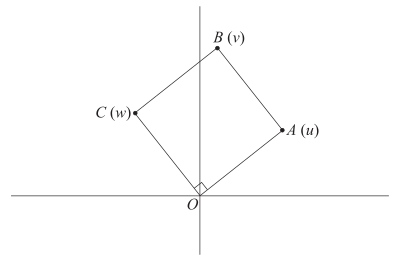
The points `A`, `B` and `C` on the Argand diagram represent the complex numbers `u`, `v` and `w` respectively.

The points `O`, `A`, `B` and `C` form a square as shown on the diagram.


It is given that  `u = 5 + 2i`.

  1.  Find  `w`.  (1 mark)

    --- 2 WORK AREA LINES (style=lined) ---

  2.  Find  `v`.  (1 mark)

    --- 2 WORK AREA LINES (style=lined) ---

  3.  Find  `text(arg)(w/v)`.  (1 mark)

    --- 2 WORK AREA LINES (style=lined) ---

Show Answers Only
  1. `−2 + 5i`
  2. `3 + 7i`
  3. `pi/4`
Show Worked Solution
i.    `w` `= iu`
    `= i(5 + 2i)`
    `= −2 + 5i`


ii.    `v` `= u + w`
    `= 5 + 2i + (−2 + 5i)`
    `= 3 + 7i`


iii.    `text(arg)(w/v)` `= text(arg)(w) – text(arg)(v)`
    `= pi/4\ \ (text(diagonal of square bisects corner))`

Filed Under: Geometrical Implications of Complex Numbers, Geometry and Complex Numbers (vectors) Tagged With: Band 2, Band 3, Band 4, smc-1052-30-Quadrilaterals

Calculus, EXT2 C1 2018 HSC 11c

By writing  `(x^2 - x - 6)/((x + 1)(x^2 - 3))`  in the form  `a/(x + 1) + (bx + c)/(x^2 - 3)`,

find  `int(x^2 - x - 6)/((x + 1)(x^2 - 3))\ dx`.  (4 marks)

--- 8 WORK AREA LINES (style=lined) ---

Show Answers Only

`2 ln |\ x + 1\ | – 1/2 ln |\ x^2 – 3\ | + c`

Show Worked Solution
`(x^2 – x – 6)/((x + 1)(x^2 – 3))` `≡ a/(x + 1) + (bx + c)/(x^2 – 3)`
`x^2 – x – 6` `≡ a(x^2 – 3) + (bx + c)(x + 1)`

 
`text(When)\ x = −1`

`1 + 1 – 6 = −2a\ \ =>\ \ a = 2`
 

`text(Equating co-efficients of)\ x^2`

`1 = (a + b)x^2\ \ =>\ \ b = −1`
 

`text(Equating co-efficients of)\ x`

`−1 = b + c\ \ =>\ \ c = 0`
 

`:. int(x^2 – x – 6)/((x + 1)(x^2 – 3))\ dx` `= int2/(x + 1) – x/(x^2 – 3)\ dx`
  `= 2 ln |\ x + 1\ | – 1/2 ln |\ x^2 – 3\ | + c`

Filed Under: Harder Integration Examples, Partial Fractions, Partial Fractions Tagged With: Band 3, smc-1056-20-Cubic denom, smc-1056-30-PF given

Functions, EXT1′ F2 2018 HSC 11b

The polynomial  `p(x) = x^3 + ax^2 + b`  has a zero at `r` and a double zero at 4.

Find the values of  `a`, `b` and `r`.  (3 marks)

--- 6 WORK AREA LINES (style=lined) ---

Show Answers Only

`a =− 6, b = 32, r = – 2`

Show Worked Solution

`p(x) = x^3 + ax^2 + b`

`pprime(x) = 3x^2 + 2ax`
 

`text(Double root at 4:)`

`pprime(4)` `=0`
`3 xx 16 + 8a` `= 0`
`a` `= −6`


`p(4)` `=0`
`64 + 16a + b` `= 0`
`64 – 96 + b` `= 0`
`b` `= 32`

 
`text(Roots of)\ \ p(x)\ \ text(are)\ \ 4, 4, r`

` 4 + 4 +r` `= −a/1 = 6`
`:. r` `= – 2`

Filed Under: Roots and Coefficients, Sum, Products and Multiplicity of Roots (Ext1) Tagged With: Band 3, smc-1205-20-Multiplicity of Roots

Measurement, NAP-K2-02

Which of these holds about the same amount of water as a bathtub?

 
a teacup
 
a swimming pool
 
a car boot
 
a kettle
Show Answers Only

`text(a car boot)`

Show Worked Solution

`text(A car’s boot would have the closest capacity)`

Filed Under: Units of Measurement, Units of Measurement, Units of Measurement Tagged With: Band 3, smc-3035-40-Best unit/estimate, smc-3089-50-Best unit/estimate, smc-919-50-Best unit/estimate

Number and Algebra, NAP-K2-1

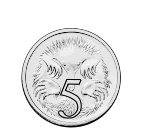
Which of these coins has the greatest value?


Show Answers Only

Show Worked Solution

`text(The $2 coin has the greatest value.)`

Filed Under: Financial Mathematics, Money and Financial Mathematics Tagged With: Band 3, smc-2536-10-Coins, smc-3086-10-Coins

Trigonometry, 2ADV T3 2018 HSC 15a

The length of daylight, `L(t)`, is defined as the number of hours from sunrise to sunset, and can be modelled by the equation

`L(t) = 12 + 2 cos ((2 pi t)/366)`,

where `t` is the number of days after 21 December 2015, for  `0 ≤ t ≤ 366`.

  1. Find the length of daylight on 21 December 2015.   (1 mark)

    --- 1 WORK AREA LINES (style=lined) ---

  2. What is the shortest length of daylight?  (1 mark)

    --- 1 WORK AREA LINES (style=lined) ---

  3. What are the two values of  `t`  for which the length of daylight is 11?  (2 marks)

    --- 4 WORK AREA LINES (style=lined) ---

Show Answers Only
  1. `14\ text(hours)`
  2. `10\ text(hours)`
  3. `t = 122 or 244`
Show Worked Solution

i.   `L(t) = 12 + 2 cos ((2 pi t)/366)`

`text(On 21 Dec 2015) => t = 0`

`:. L(0)` `= 12 + 2 cos 0`
  `= 14\ text(hours)`


ii.   `text(Shortest length of daylight occurs when)`

♦ Mean mark 43%.

`cos ((2 pi t)/366) = -1`
 

`:.\ text(Shortest length)` `= 12 + 2 (-1)`
  `= 10\ text(hours)`


iii.   `text(Find)\ \ t\ \ text(such that)\ \ L(t) = 11:`

`11 = 12 + 2 cos ((2 pi t)/366)`

`cos ((2 pi t)/366) = -1/2`
 

`(2 pi t)/366` `= (2 pi)/3` `qquad\ \ text(or)`     `(2 pi t)/366` `= (4 pi)/3`
`t` `= 366/3`   `t` `= (366 xx 2)/3`
  `= 122`     `= 244`

 
`:. t = 122 or 244`

Filed Under: Exact Trig Ratios and Other Identities, Trig Applications (Y12) Tagged With: Band 3, Band 4, Band 5, smc-1188-30-Other Applications

Functions, EXT1′ 2018 HSC 5 MC

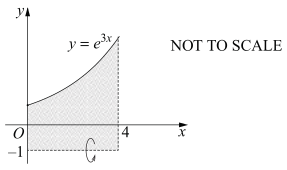
The diagram shows the graph  `y = e^(3x)`  for  `0<= x <= 4`. The region bounded by  `y = −1`,  `y = e^(3x)`,  `x = 0`  and  `x = 4`  is rotated about the line  `y = −1`  to form a solid.


Which integral represents the volume of the solid formed?

  1. `pi int_0^4 (e^(3x) + 1)^2 dx`
  2. `2pi int_0^4 x(e^(3x) + 1)\ dx`
  3. `pi int_0^4 (e^(3x) - 1)^2 dx`
  4. `2pi int_0^4 x(e^(3x) - 1)\ dx`
Show Answers Only

`A`

Show Worked Solution

`text(Rotating)\ \ y = e^(3x)\ \ text(about)\ \ y = −1\ \ text(is equivalent)`

`text(to rotating)\ \ y = e^(3x) + 1\ \ text(about)\ xtext(-axis.)`
 

`V` `= pi int_0^4 y^2 dx`
  `= pi int_0^4 (e^(3x) + 1)^2 dx`

 
`=>A`

Filed Under: Other Ext1 Topics Tagged With: Band 3

Functions, EXT1′ F1 2018 HSC 4 MC

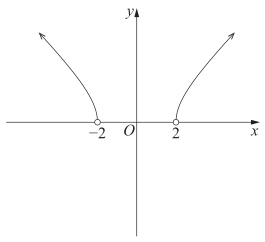
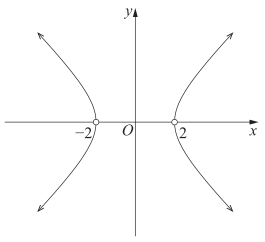
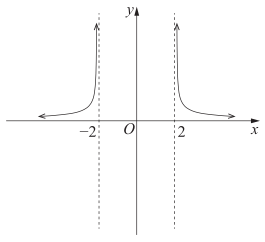
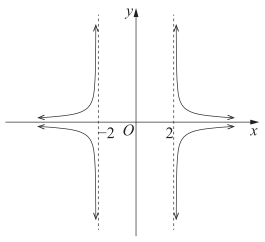
Which graph best represents the curve  `y = 1/sqrt(x^2 - 4)`?
 

A.    B.   
C.    D.   
Show Answers Only

`=>\ text(C)`

Show Worked Solution

`text(S)text(ince)\ \ sqrt(x^2 – 4) > 0`

`=> y > 0\ \ (text(Eliminate B and D))`
 

`text(As)\ x -> 2^+, sqrt(x^2 – 4) -> 0, y -> ∞`

`text(As)\ x -> -2^-, sqrt(x^2 – 4) -> 0, y -> ∞`

`=>\ text(C)`

Filed Under: Reflections and Harder curves, Reflections and Harder Graphs (Ext1) Tagged With: Band 3, smc-1072-40-Other Graphs, smc-1072-50-Even Functions, y^2 = f(x)

Functions, EXT1′ F2 2018 HSC 3 MC

The cubic equation  `x^3 + 2x^2 + 5x - 1 = 0`  has roots, `alpha`, `beta` and `gamma`.

Which cubic equation has roots  `(−1)/alpha, (−1)/beta, (−1)/gamma`?

  1. `x^3 - 5x^2 - 2x + 1 = 0`
  2. `x^3 - 5x^2 - 2x - 1 = 0`
  3. `x^3 + 5x^2 + 2x + 1 = 0`
  4. `x^3 + 5x^2 - 2x + 1 = 0`
Show Answers Only

`text(D)`

Show Worked Solution

`alpha beta gamma = 1`

`alpha beta + beta gamma + gamma alpha = 5`

`alpha + beta + gamma = −2`
 

`text(If roots are)\ \ (−1)/alpha, (−1)/beta, (−1)/gamma :`

`(−1)/alpha · (−1)/beta · (−1)/gamma = (−1)/(alphabetagamma) = −1`

`=> d = 1`
 

`1/(alphabeta) + 1/(betagamma) + 1/(gammaalpha) = ((alpha + beta + gamma))/(alphabetagamma) = −2`

`=>\ c = −2`
 

`(−1)/alpha – (−1)/beta – (−1)/gamma = (−(alphabeta + betagamma + gammaalpha))/(alphabetagamma) = −5`

`=> b = 5`
 

`:.\ text(Equation is)\ \ x^3 + 5x^2 – 2x + 1 = 0`

`=>D`

Filed Under: Roots and Coefficients, Sum, Products and Multiplicity of Roots (Ext1) Tagged With: Band 3, smc-1205-10-Sum and Product

  • « Previous Page
  • 1
  • …
  • 35
  • 36
  • 37
  • 38
  • 39
  • …
  • 57
  • Next Page »

Copyright © 2014–2025 SmarterEd.com.au · Log in