
The graphs of the functions `y = kx^n` and `y = log_e x` have a common tangent at `x = a`, as shown in the diagram.
- By considering gradients, show that
- `a^n = 1/(nk)`. (1 mark)
- Express `k` as a function of `n` by eliminating `a`. (2 marks)
Aussie Maths & Science Teachers: Save your time with SmarterEd
The graphs of the functions `y = kx^n` and `y = log_e x` have a common tangent at `x = a`, as shown in the diagram.
Consider the function `f(x) = e^x − e^(-x)`.
--- 3 WORK AREA LINES (style=lined) ---
--- 7 WORK AREA LINES (style=lined) ---
--- 4 WORK AREA LINES (style=lined) ---
A particle moves in a straight line. Its displacement, `x` metres, after `t` seconds is given by
`x = sqrt3\ sin\ 2t − cos\ 2t + 3`.
--- 6 WORK AREA LINES (style=lined) ---
--- 2 WORK AREA LINES (style=lined) ---
--- 6 WORK AREA LINES (style=lined) ---
--- 8 WORK AREA LINES (style=lined) ---

The diagram shows a point `P(2ap, ap^2)` on the parabola `x^2= 4ay`. The normal to the parabola at `P` intersects the parabola again at `Q(2aq,aq^2)`.
The equation of `PQ` is `x + py − 2ap − ap^3 = 0`. (Do NOT prove this.)
Find the exact values of `x` and `y` which satisfy the simultaneous equations
`sin^(-1)\ x + 1/2\ cos^(-1)\ y = pi/3` and
`3\ sin^(-1)\ x-1/2\ cos^(-1)\ y = (2pi)/3`. (3 marks)
--- 5 WORK AREA LINES (style=lined) ---
Mr and Mrs Roberts and their four children go to the theatre. They are randomly allocated six adjacent seats in a single row.
What is the probability that the four children are allocated seats next to each other? (2 marks)
--- 5 WORK AREA LINES (style=lined) ---
A gutter is to be formed by bending a long rectangular metal strip of width `w` so that the cross-section is an arc of a circle.
Let `r` be the radius of the arc and `2 theta` the angle at the centre, `O`, so that the cross-sectional area, `A`, of the gutter is the area of the shaded region in the diagram on the right.

(i) `text(Show)\ \ A = r^2(theta – sin theta cos theta)`
`text(Area of segment)\ \ OBC`
`= (2 theta)/(2 pi) xx pi r^2`
`= r^2 theta`
| `text(Area of)\ \ Delta OBC` | `= 1/2 ab sin C` |
| `= 1/2 r * r * sin 2 theta` | |
| `= 1/2 r^2 * 2 sin theta cos theta` | |
| `= r^2 sin theta cos theta` |
`:.\ text(Shaded Area (A))`
`= text(Area of segment)\ \ OBC – text(Area of)\ \ Delta OBC`
`= r^2 theta – r^2 sin theta cos theta`
`= r^2 (theta – sin theta cos theta)\ \ text(… as required.)`
(ii) `text(Consider Arc length)\ \ BC`
| `w` | `= (2 theta)/(2 pi) xx 2 pi r` |
| `= 2 theta r` | |
| `:.\ r` | `= w/(2 theta)` |
| `:. A` | `= (w/(2 theta))^2 (theta – sin theta cos theta)` |
| `= w^2/(4 theta) – (w^2 sin theta cos theta)/(4 theta^2)` |
| `:. (dA)/(d theta)` | `= (-w^2)/(4 theta^2) – (w^2/4) [((sin theta xx -sin theta + cos theta * cos theta) theta^2 – 2 theta sin theta cos theta)/theta^4]` |
| `= (-w^2)/(4 theta^2) – (w^2/(4 theta^4))[(cos^2 theta – sin^2 theta) theta^2 – 2 theta sin theta cos theta]` | |
| `= (-w^2)/(4 theta^2) – (w^2/(4 theta^3))[(2 cos^2 theta – 1) theta – 2 sin theta cos theta]` | |
| `= (-w^2)/(4 theta^2) – (w^2/(4 theta^3))[(2 cos^2 theta – 1) theta – 2 sin theta cos theta]` | |
| `= w^2/(4 theta^3) [-theta – 2 theta cos^2 theta + theta + 2 sin theta cos theta]` | |
| `= w^2/(4 theta^3) [2 sin theta cos theta – 2 theta cos^2 theta]` | |
| `= w^2/(2 theta^3) (sin theta cos theta – theta cos^2 theta)` | |
| `= (w^2 cos theta\ (sin theta – theta cos theta))/(2 theta^3)\ \ text(… as required)` |
| (iii) | `g(theta)` | `= sin theta- theta cos theta` |
| `g prime (theta)` | `= cos theta – (theta xx -sin theta + cos theta * 1)` | |
| `= cos theta + theta sin theta – cos theta` | ||
| `= theta sin theta` |
`text(S)text(ince)\ \ 0 < theta < pi,`
`=> sin theta > 0`
`:.\ g prime (theta) > 0`
`g(0) = sin 0 – 0 * cos 0 = 0`
`:.\ text(S)text(ince)\ \ g(0) = 0 and g(theta)\ \ text(is an increasing function)`
`(g prime (theta) > 0)\ \ text(for)\ \ 0 < theta < pi , text(then)\ \ g(theta) > 0.`
(iv) `text(If)\ \ (dA)/(d theta) = 0\ ,\ \ \ 0 < theta < pi`
`(w^2 cos theta\ (sin theta – theta cos theta))/(2 theta^3) = 0`
`text(Consider)`
`(w^2 cos theta)/(2 theta^3) = 0\ ,\ \ theta != 0`
`=>theta = pi/2`
`text(Consider)`
| `sin theta – theta cos theta=` | ` 0` |
| `text(i.e.)\ \ g(theta)=` | ` 0` |
`=>\ text(No solution for)\ \ 0 < theta < pi\ \ text{(using part (iii))}`
`:.\ text(There is only one value of)\ \ theta.`
| (v) `(dA)/(d theta)` | `= (w^2 cos theta\ (sin theta – theta cos theta))/(2 theta^3)` |
| `= (w^2 cos theta * g(theta))/(2 theta^3)` |
`text(If)\ \ theta = pi/4\ ,\ \ g(pi/4) > 0\ ,\ \ cos (pi/4) > 0`
`:.\ (dA)/(d theta) > 0`
`text(If)\ \ theta = (3 pi)/4\ ,\ \ g((3 pi)/4) > 0\ ,\ \ cos ((3 pi)/4) < 0`
`:.\ (dA)/(d theta) < 0`

`:.\ text(Maximum when)\ \ theta = pi/2`
`text(When)\ \ theta = pi/2`
| `A` | `= r^2 (theta – sin theta cos theta)` |
| `= (w/(2 theta))^2 (theta – sin theta cos theta)` | |
| `= w^2/(2^2 xx (pi/2)^2) (pi/2 – sin\ pi/2 cos\ pi/2)` | |
| `= w^2/pi^2 (pi/2)` | |
| `= w^2/(2 pi)\ \ text(u²)` |
In an endurance event, the probability that a competitor will complete the course is `p` and the probability that a competitor will not complete the course is `q = 1 - p.` Teams consist of either two or four competitors. A team scores points if at least half its members complete the course.
--- 2 WORK AREA LINES (style=lined) ---
--- 4 WORK AREA LINES (style=lined) ---
--- 2 WORK AREA LINES (style=lined) ---
--- 6 WORK AREA LINES (style=lined) ---
i. `P text{(at least 3 don’t complete)}`
`= P\ text{(3 don’t complete)} + P\ text{(4 don’t complete)}`
`= \ ^4C_3 q^3 p + \ ^4C_4 q^4`
`= 4pq^3 + q^4`
ii. `P text{(4-member team scores)}`
`= 1 – P\ text{(at least 3 don’t complete)}`
`= 1 – 4pq^3 + q^4`
`= 1 – [4 (1 – q) q^3 + q^4]`
`= 1 – (4q^3 – 4q^4 + q^4)`
`= 1 – 4q^3 + 3q^4`
iii. `P text{(2-member team scores)}`
`= 1 – P\ text{(both don’t complete)}`
`= 1 – q*q`
`= 1 – q^2`
iv. `text(A 2-member team is more likely to score when)`
| `1 – q^2` | `> 1 -4q^3 + 3q^4` |
| `3q^4 – 4q^3 + q^2` | `< 0` |
| `q^2 (3q^2 – 4q + 1)` | `< 0` |
| `q^2 (3q – 1) (q – 1)` | `< 0` |
`text(Consider)\ \ (3q – 1) (q – 1) < 0`

`:.\ text(S)text(ince)\ \ q\ \ text(is positive and)\ != 1`
`q^2 (3q – 1) (q – 1) < 0\ \ text(when)`
`1/3 < q < 1.`
Two particles are fired simultaneously from the ground at time `t = 0.`
Particle 1 is projected from the origin at an angle `theta, \ \ 0 < theta < pi/2`, with an initial velocity `V.`
Particle 2 is projected vertically upward from the point `A`, at a distance `a` to the right of the origin, also with an initial velocity of `V.`

It can be shown that while both particles are in flight, Particle 1 has equations of motion:
`x = Vt cos theta`
`y = Vt sin theta -1/2 g t^2,`
and Particle `2` has equations of motion:
`x = a`
`y = Vt -1/2 g t^2.` Do NOT prove these equations of motion.
Let `L` be the distance between the particles at time `t.`
--- 6 WORK AREA LINES (style=lined) ---
Show that the distance between the particles in flight is smallest when
`t = (a cos theta)/(2V(1 - sin theta))` and that this smallest distance is `a sqrt ((1 - sin theta)/2).` (3 marks)
--- 12 WORK AREA LINES (style=lined) ---
--- 6 WORK AREA LINES (style=lined) ---
| i. |  |
`text(Show)\ \ L^2 = 2V^2t^2 (1 – sin theta) – 2aVt cos theta + a^2`
`text(Consider)\ \ P_1`
`x_1 = Vt cos theta`
`y_1 = Vt sin theta – 1/2 g t^2`
`text(Consider)\ \ P_2`
`x_2 = a`
`y_2 = Vt -1/2 g t^2`
`text(Let)\ \ d=\ text(Vertical distance between particles)`
`d= Vt -1/2 g t^2 – (Vt sin theta – 1/2 g t^2)`
`d= Vt (1 – sin theta)`
`text(Using Pythagoras:)`
| `L^2` | `= (a – x_1)^2 + d^2` |
| `= (a – Vt cos theta)^2 + V^2t^2 (1 – sin theta)^2` | |
| `= a^2 – 2aVt cos theta + V^2t^2 cos ^2 theta + V^2t^2 (1 – 2 sin theta + sin^2 theta)` | |
| `= a^2 – 2aVt cos theta + V^2 t^2 (cos^2 theta + sin^2 theta + 1 – 2 sin theta)` | |
| `= a^2 – 2aVt cos theta + V^2 t^2 (2 – 2 sin theta)` | |
| `= 2 V^2 t^2 (1 – sin theta) – 2aVt cos theta + a^2\ \ text(… as required.)` |
ii. `L^2 = 2V^2 t^2 (1 – sin theta) – 2a Vt cos theta + a^2`
`(d(L^2))/(dt) = 4 V^2 t\ (1 – sin theta) – 2aV cos theta`
`text(Max or min when)\ \ (d(L^2))/(dt) = 0`
| `4V^2t\ (1 – sin theta)` | `= 2aV cos theta` |
| `t` | `= (2a V cos theta)/(4V^2 (1 – sin theta))` |
| `= (a cos theta)/(2V(1 – sin theta)` |
`(d^2(L^2))/(dt^2) = 4V^2(1 – sin theta) > 0\ \ text(for)\ \ V > 0,\ \ 0 < theta < pi/2`
`:.\ L^2\ \ text(is a minimum)`
`:.\ L\ \ text(is a minimum when)\ \ t = (a cos theta)/(2V (1 – sin theta)`
`text(Show minimum distance is)\ \ a sqrt {(1 – sin theta)/2}`
`text(When)\ \ t = (a cos theta)/(2V(1 – sin theta))`
| `L^2` | `= 2V^2 ((a^2 cos ^2 theta)/(4V^2 (1 – sin theta)^2)) (1 – sin theta)` |
| `\ \ – 2aV ((a cos theta)/(2V (1 – sin theta))) cos theta + a^2` | |
| `= (a^2 cos^2 theta)/(2 (1 – sin theta)) – (a^2 cos^2 theta)/((1 – sin theta)) + a^2` | |
| `= a^2[(cos^2 theta – 2 cos^2 theta + 2 (1 – sin theta))/(2(1 – sin theta))]` | |
| `= a^2[(-cos^2 theta + 2 – 2 sin theta)/(2(1 – sin theta))]` | |
| `= a^2[(-(1 – sin^2 theta) + 2 – 2 sin theta)/(2 (1 – sin theta))]` | |
| `= a^2 [(sin^2 theta – 2 sin theta + 1)/(2(1 – sin theta))]` | |
| `= a^2 [(1 – sin theta)^2/(2 (1 – sin theta))]` | |
| `= a^2 [((1 – sin theta))/2]` | |
| `:.\ L` | `= sqrt ((a^2(1 – sin theta))/2)` |
| `= a sqrt ((1 – sin theta)/2)\ \ text(… as required.)` |
iii. `text(Smallest distance occurs when)`
`t = (a cos theta)/(2V (1 – sin theta)`
`text(If)\ \ P_1\ \ text(is ascending,)\ \ dot y_1 > 0`
`y_1 = Vt sin theta – 1/2 g t^2`
`dot y_1 = V sin theta – g t`
| `:.\ V sin theta – g ((a cos theta)/(2V (1 – sin theta)))` | `> 0` |
| `2V^2 sin theta\ (1 – sin theta) – a g cos theta` | `> 0` |
| `2V^2 sin theta\ (1 – sin theta)` | `> ag cos theta` |
| `V^2` | `> (a g cos theta)/(2 sin theta\ (1 – sin theta))` |
| `V` | `> sqrt ((a g cos theta)/(2 sin theta\ (1 – sin theta)))\ \ text(… as required.)` |

The diagram shows points `A`, `B`, `C` and `D` on a circle. The lines `AC` and `BD` are perpendicular and intersect at `X`. The perpendicular to `AD` through `X` meets `AD` at `P` and `BC` at `Q`.
Copy or trace this diagram into your writing booklet.
| (i) |
|
`text(Prove)\ \ ∠QXB =∠QBX`
`∠ADX = ∠ACB = theta`
`text{(angles in the same segment on arc}\ AB)`
`text(In)\ ΔDPX`
| `∠DPX` | `= 90^@\ \ (PQ ⊥ AD)` |
| `∠PXD` | `= (90 – theta)^@\ \ text{(angle sum of}\ Δ DPX)` |
| `∠QXB` | `= (90 – theta)^@\ \ text{(vertically opposite angle)}` |
`text(In)\ Δ BXC`
| `∠BXC` | `= 90^@\ \ (∠AXC\ text{is a straight angle)}` |
| `∠QBX` | `= (90 – theta)^@\ \ text{(angle sum of}\ ΔBXC)` |
| `:.∠QXB` | `= ∠QBX` |
(ii) `text(Prove)\ \ Q\ \ text(bisects)\ \ BC`
| `BQ = QX\ \ ` | `text{(sides opposite equal angles}` |
| `text{of isosceles}\ Delta BXQ text{)}` |
| `∠QXC` | `= 180 − 90 − (90 − theta)\ \ (∠AXC\ text{is a straight angle)}` |
| `= theta` | |
| `∠XCB` | `=theta\ \ \ text{(from part (i))}` |
| `:. ΔXQC\ text(is isosceles)` | |
| `QX = QC\ \ ` | `text{(sides opposite base angles}` |
| `text{of isosceles}\ ΔQXC)` |
`:. BQ = QC`
`:. Q\ text(bisects)\ BC`
Use mathematical induction to prove that `7^(2n – 1) + 5` is divisible by 12, for all integers `n ≥ 1`. (3 marks)
--- 14 WORK AREA LINES (style=lined) ---
In a large city, 10% of the population has green eyes.
--- 1 WORK AREA LINES (style=lined) ---
--- 2 WORK AREA LINES (style=lined) ---
--- 4 WORK AREA LINES (style=lined) ---
A particle is moving in a straight line with its acceleration as a function of `x` given by `ddot x = -e^(-2x)`. It is initially at the origin and is travelling with a velocity of 1 metre per second.
--- 6 WORK AREA LINES (style=lined) ---
--- 6 WORK AREA LINES (style=lined) ---
and hence sketch the graph of `y = (x − 2)/(x − 4)`. (3 marks)
--- 10 WORK AREA LINES (style=lined) ---
--- 5 WORK AREA LINES (style=lined) ---
i. `y = (x − 2)/(x − 4)`
`text(Vertical asymptote at)\ x = 4`
| `lim_(x → ∞) (x − 2)/(x − 4)` | `= lim_(x → ∞) (1 − 2/x)/(1 − 4/x)=1` |
`ytext(–intercept)\ = 1/2`
`xtext(–intercept)\ = 2`

ii. `text(Find)\ \ x\ \ text(so that)\ \ (x − 2)/(x − 4) ≤ 3`
| `text(When)\ \ (x − 2)/(x − 4)` | `= 3` |
| `x − 2` | `= 3x − 12` |
| `2x` | `= 10` |
| `x` | `= 5` |
`=>(5, 3)\ \ text(is the intersection of)\ \ y = 3\ and\ y = (x − 2)/(x − 4)`
`:. (x − 2)/(x − 4) ≤ 3\ \ text(when)\ \ x < 4\ \ text(and)\ \ x ≥ 5.`
Find the volume of the solid of revolution formed when the region bounded by the curve `y = 1/(sqrt(9 + x^2))`, the `x`-axis, the `y`-axis and the line `x = 3`, is rotated about the `x`-axis. (3 marks)
--- 6 WORK AREA LINES (style=lined) ---
A skydiver jumps from a hot air balloon which is 2000 metres above the ground. The velocity, `v` metres per second, at which she is falling `t` seconds after jumping is given by `v =50(1 - e^(-0.2t))`.
--- 6 WORK AREA LINES (style=lined) ---
--- 7 WORK AREA LINES (style=lined) ---
Let `f(x) = 2 cos^(-1)x`.
--- 8 WORK AREA LINES (style=lined) ---
--- 2 WORK AREA LINES (style=lined) ---
i. `y= 2\ cos^(-1)x`
`text(Domain:)\ -1 ≤ x ≤ 1`
| `text{Range:}\ \0 ≤` | `y/2 ≤ pi` | |
| `0 ≤` | `y ≤ 2pi` |

ii. `text(Range:)\ \ 0 ≤ y ≤ 2pi`
By using the substitution `t = tan\ theta/2`, or otherwise, show that `(1 − cos\ theta)/(sin\ theta) = tan\ theta/2`. (2 marks)
--- 8 WORK AREA LINES (style=lined) ---

`=>tan\ theta/2 = t`
| `=>sin theta` | `= 2 · t/(sqrt(1 + t^2)) · 1/(sqrt(1 + t^2)) = (2t)/(1 + t^2)` |
| `=>cos theta` | `= 1/(1 + t^2) − t^2/(1 + t^2) = (1 − t^2)/(1 + t^2)` |
`text(Show)\ \ (1 − cos theta)/(sin theta) = tan\ theta/2 :`
| `(1 − cos\ theta)/(sin theta)` | `= (1 − ((1 − t^2)/(1 + t^2)))/((2t)/(1 + t^2)) xx (1+t^2)/(1+t^2)` |
| `= (1 + t^2 − (1 − t^2))/(2t)` | |
| `= (2t^2)/(2t)` | |
| `= t` | |
| `= tan\ theta/2\ \ …text(as required)` |
Use the substitution `u = 25 - x^2` to evaluate `int_3^4 (2x)/(sqrt(25 - x^2))\ dx`. (3 marks)
--- 8 WORK AREA LINES (style=lined) ---
A fire hose is at ground level on a horizontal plane. Water is projected from the hose. The angle of projection, `theta`, is allowed to vary. The speed of the water as it leaves the hose, `v` metres per second, remains constant. You may assume that if the origin is taken to be the point of projection, the path of the water is given by the parametric equations
`x = vt\ cos\ theta`
`y = vt\ sin\ theta − 1/2 g t^2`
where `g\ text(ms)^(−2)` is the acceleration due to gravity. (Do NOT prove this.)
--- 6 WORK AREA LINES (style=lined) ---
This fire hose is now aimed at a 20 metre high thin wall from a point of projection at ground level 40 metres from the base of the wall. It is known that when the angle `theta` is 15°, the water just reaches the base of the wall.

--- 3 WORK AREA LINES (style=lined) ---
--- 6 WORK AREA LINES (style=lined) ---
--- 6 WORK AREA LINES (style=lined) ---
--- 10 WORK AREA LINES (style=lined) ---
| i. | `x` | `= vt\ cos\ theta` |
| `y` | `= vt\ sin\ theta − 1/2 g t^2` |
`text(Find)\ \ t\ \ text(when)\ \ y = 0`
| `vt\ sin\ theta − 1/2 g t^2` | `= 0` |
| `t(v\ sin\ theta − 1/2 g t)` | `= 0` |
| `v\ sin\ theta − 1/2 g t` | `= 0, \ \ t ≠ 0` |
| `1/2 g t` | `= v\ sin\ theta` |
| `t` | `= (2v\ sin\ theta)/g` |
`text(Find)\ \ x\ \ text(when)\ \ t = (2v\ sin\ theta)/g`
| `x` | `= v · (2v\ sin\ theta)/g\ cos\ theta` |
| `= (v^2 · \ 2\ sin\ theta\ cos\ theta)/g` | |
| `= (v^2\ sin\ 2theta)/g` |
`:.\ text(When)\ \ x = (v^2\ sin\ 2theta)/g,\ \ \text(the water returns)`
`text(to ground level … as required.)`
ii. `text(Show)\ \ v^2 = 80\ text(g)`
`text(When)\ \ theta = 15^@, \ x = 40`
`text{From part (i)}`
| `40` | `= (v^2\ sin\ 30^@)/g` |
| `v^2 xx 1/2` | `= 40g` |
| `v^2` | `= 80g\ \ \ …text(as required)` |
iii. `text(Show)\ \ y = x\ tan\ theta − (x^2\ sec^2\ theta)/160`
| `x` | `= vt\ cos\ theta` |
| `:.t` | `= x/(v\ cos\ theta)` |
`text(Substitute into)`
| `y` | `= vt\ sin\ theta − 1/2 g t^2` |
| `= v · x/(v\ cos\ theta) · sin\ theta −1/2 g (x/(v\ cos\ theta))^2` | |
| `= x\ tan\ theta − 1/2 g (x^2/(v^2\ cos^2\ theta))` | |
| `= x\ tan\ theta − 1/2 g · x^2/(80g\ cos^2\ theta)` | |
| `= x\ tan\ theta − (x^2\ sec^2\ theta)/160\ \ \ …text(as required.)` |
iv. `text(Water clears the top if)\ \ y = 20\ \ text(when)\ \ x = 40`
`text{Substitute into equation from (iii)}`
| `40\ tan\ theta − (40^2\ sec^2\ theta)/160` | `= 20` |
| `40\ tan\ theta − 10\ sec^2\ theta` | `= 20` |
| `40\ tan\ theta − 10(1 + tan^2\ theta)` | `= 20` |
| `40\ tan\ theta − 10 − 10\ tan^2\ theta` | `= 20` |
| `10\ tan^2\ theta − 40\ tan\ theta\ + 30` | `= 0` |
| `tan^2\ theta − 4\ tan\ theta + 3` | `= 0\ \ \ text(… as required)` |
| v. |
|
`text(Water hits the bottom of the wall when)`
`x = 40\ \ text(and)\ \ y = 0`
| `40\ tan\ theta − (40^2\ sec^2\ theta)/160` | `= 0` |
| `40\ tan\ theta − 10\ sec^2\ theta` | `= 0` |
| `4\ tan\ theta − (1 + tan^2\ theta)` | `= 0` |
| `tan^2\ theta − 4\ tan\ theta + 1` | `= 0` |
`text(Using the quadratic formula)`
| `tan\ theta` | `= (+4 ± sqrt(16 − 4 · 1 · 1))/ (2 xx 1)` |
| `= (4 ± sqrt12)/2` | |
| `= 2 ± sqrt3` | |
| `theta` | `= 15^@\ \ text(or)\ \ 75^@` |
`text(Water hits the top of the wall when)`
`x = 40\ text(and)\ \ y = 20`
| `tan^2\ theta − 4\ tan\ theta + 3` | `= 0\ \ \ text{from (iv)}` |
| `(tan\ theta − 1)(tan\ theta − 3)` | `= 0` |
| `tan\ theta` | `= 1` | `text(or)` | `tan\ theta` | `= 3` |
| `theta` | `= 45^@` | `theta` | `= tan^(−1)\ 3` | |
| `= 71.565…` | ||||
| `= 71.6^@\ \ \text{(to 1 d.p.)}` |
`:.\ text(Following the motion of the water as)\ \ theta\ \ text(increases,)`
`text(water hits the wall when)`
| `15^@ ≤ theta ≤ 45^@` | `\ text(and)` |
| `71.6^@ ≤ theta ≤ 75^@` |

The points `A, \ B, \ C` and `D` are placed on a circle of radius `r` such that `AC` and `BD` meet at `E`. The lines `AB` and `DC` are produced to meet at `F`, and `BECF` is a cyclic quadrilateral.
Copy or trace this diagram into your writing booklet.
| (i) |
|
`∠ACD = ∠ABD = theta\ \ \ text{(angles in the same segment on arc}\ AD)`
`text(Consider cyclic quad)\ \ BECF`
| `∠DBF = ∠ECD = theta` | `\ \ \ text{(exterior angle of cycle quad}` |
| `\ \ \ text{equals its interior opposite)}` |
| `2theta` | `= 180^@\ \ \ (∠ABF\ text{is a straight angle)}` |
| `theta` | `= 90^@` |
| `:.∠DBF` | `= 90^@` |
(ii) `text(S)text(ince)\ AD\ text(subtends right angles)\ \ ∠ABD\ \ text(and)\ \ ∠ACD`
`text{(from part (i))}`
`⇒ AD\ \ text(is a diameter)`
`:.AD = 2r`
The diagram below shows a sketch of the graph of `y = f(x)`, where `f(x) = 1/(1 + x^2)` for `x ≥ 0`.

| (i) |
|
(ii) `text(Domain of)\ \ f^(−1)(x)\ text(is)`
`0 < x ≤ 1`
(iii) `f(x) = 1/(1 + x^2)`
`text(Inverse: swap)\ \ x↔y`
| `x` | `= 1/(1 + y^2)` |
| `x(1 + y^2)` | `= 1` |
| `1 + y^2` | `= 1/x` |
| `y^2` | `= 1/x − 1` |
| `= (1 − x)/x` | |
| `y` | `= ± sqrt((1 − x)/x)` |
`:.y = sqrt((1 − x)/x), \ \ y >= 0`
(iv) `P\ \ text(occurs when)\ \ f(x)\ \ text(cuts)\ \ y = x`
`text(i.e. where)`
| `1/(1 + x^2)` | `= x` |
| `1` | `= x(1 + x^2)` |
| `1` | `= x + x^3` |
| `x^3 + x − 1` | `= 0` |
`=>\ text(S)text(ince)\ α\ text(is the)\ x\ text(-coordinate of)\ P,`
`text(it is a root of)\ \ \ x^3 + x − 1 = 0`
| (v) | `f(x)` | `= x^3 + x − 1` |
| `f′(x)` | `= 3x^2 + 1` | |
| `f(0.5)` | `= 0.5^3 + 0.5 − 1` | |
| `= −0.375` | ||
| `f′(0.5)` | `= 3 xx 0.5^2 + 1` | |
| `= 1.75` |
| `α_2` | `= α_1 − (f(0.5))/(f′(0.5))` |
| `= 0.5 − ((−0.375))/1.75` | |
| `= 0.5 − (−0.2142…)` | |
| `= 0.7142…` | |
| `= 0.714\ \ \ text{(to 3 d.p.)}` |
A particle is moving along the `x`-axis, starting from a position `2` metres to the right of the origin (that is, `x = 2` when `t = 0`) with an initial velocity of `5\ text(ms)^(−1)` and an acceleration given by
`ddot x = 2x^3 + 2x`.
--- 8 WORK AREA LINES (style=lined) ---
--- 8 WORK AREA LINES (style=lined) ---
Katie is one of ten members of a social club. Each week one member is selected at random to win a prize.
--- 2 WORK AREA LINES (style=lined) ---
--- 5 WORK AREA LINES (style=lined) ---
--- 8 WORK AREA LINES (style=lined) ---
Use mathematical induction to prove that for all integers `n ≥ 3`,
`(1 − 2/3)(1 − 2/4)(1 − 2/5)…(1 − 2/n) = 2/(n(n − 1))`. (3 marks)

The length of each edge of the cube `ABCDEFGH` is 2 metres. A circle is drawn on the face `ABCD` so that it touches all four edges of the face. The centre of the circle is `O` and the diagonal `AC` meets the circle at `X` and `Y`.
| (i) |
|
`text(S)text(ince)\ \ FA, \ AC\ \ text(and)\ \ FC\ \ text(are all)`
`text(diagonals of sides of a cube,)`
`FA = AC = FC`
`:.ΔFAC\ \ text(is equilateral)`
`:.∠FAC = 60^@`
| (ii) |
|
`text(In)\ \ ΔAEF`
| `AF^2` | `= EF^2 + EA^2` |
| `= 2^2 + 2^2` | |
| `= 8` | |
| `AF` | `= sqrt8` |
| `= 2sqrt2` |
`text(In)\ \ ΔAFO`
| `sin\ 60^@` | `= (FO)/(AF)` |
| `sqrt3/2` | `= (FO)/(2sqrt2)` |
| `FO` | `= sqrt3/2 xx 2sqrt2` |
| `= sqrt6\ text(metres … as required.)` |
| (iii) |
|
`XY\ \ text(is the diameter of a circle AND the width)`
`text(of the cube.)`
| `:.XY` | `= 2` |
| `:.OX` | `= OY = 1` |
| `tan\ ∠OFX` | `=1 /sqrt6` |
| `∠OFX` | `= 22.207…^@` |
| `:.∠XFY` | `= 2 xx 22.407…` |
| `= 44.415…` | |
| `= 44^@\ text{(nearest degree)}` |
A ferry wharf consists of a floating pontoon linked to a jetty by a 4 metre long walkway. Let `h` metres be the difference in height between the top of the pontoon and the top of the jetty and let `x` metres be the horizontal distance between the pontoon and the jetty.

--- 2 WORK AREA LINES (style=lined) ---
When the top of the pontoon is 1 metre lower than the top of the jetty, the tide is rising at a rate of 0.3 metres per hour.
--- 10 WORK AREA LINES (style=lined) ---
Let `P(x) = (x + 1) (x − 3)Q(x) + a(x + 1) + b`, where `Q(x)` is a polynomial and `a` and `b` are real numbers.
When `P(x)` is divided by `(x + 1)` the remainder is `−11`.
When `P(x)` is divided by `(x − 3)` the remainder is `1`.
--- 4 WORK AREA LINES (style=lined) ---
--- 6 WORK AREA LINES (style=lined) ---
Find `int cos^2 4x\ dx.` (2 marks)
A four-person team is to be chosen at random from nine women and seven men.
--- 2 WORK AREA LINES (style=lined) ---
--- 2 WORK AREA LINES (style=lined) ---
--- 8 WORK AREA LINES (style=lined) ---
Give your answers correct to three decimal places. (2 marks)
--- 6 WORK AREA LINES (style=lined) ---
Find `d/(dx)\ cos^(−1)\ (3x^2).` (2 marks)
Evaluate `lim_(x → 0)(sin (x/5))/(2x).` (2 marks)
Let `f(x) = log_e (1 + e^x)` for all `x`.
Show that `f(x)` has an inverse. (2 marks)
--- 5 WORK AREA LINES (style=lined) ---
A particle is moving so that `ddot x = 18x^3 + 27x^2 + 9x.`
Initially `x = – 2` and the velocity, `v`, is `– 6.`
--- 8 WORK AREA LINES (style=lined) ---
--- 6 WORK AREA LINES (style=lined) ---
--- 8 WORK AREA LINES (style=lined) ---
The cubic polynomial `P(x) = x^3 + rx^2 + sx + t`. where `r, \ s` and `t` are real numbers, has three real zeros, `1, alpha` and `-alpha.`
--- 4 WORK AREA LINES (style=lined) ---
--- 4 WORK AREA LINES (style=lined) ---

The points `P, Q` and `T` lie on a circle. The line `MN` is tangent to the circle at `T` with `M` chosen so that `QM` is perpendicular to `MN`. The point `K` on `PQ` is chosen so that `TK` is perpendicular to `PQ` as shown in the diagram.
| (i) |  |
`/_ QMT = 90^@\ \ \ (QM _|_ MN)`
`/_ QKT = 90^@\ \ \ (PQ _|_ TK)`
`:.\ /_ QMT + /_ QKT = 180^@`
`:.\ QKTM\ \ text(is cyclic)\ \ text{(opposite angles are supplementary)}`
`text(… as required.)`
(ii) `text(Show)\ \ /_ KMT = /_ KQT`
`/_ KMQ = /_ KTQ = theta`
`text{(angles in the same segment on arc}\ \ KQ text{)}`
| `/_ KQT` | `= 90 – theta\ \ text{(angle sum of}\ \ Delta KQT text{)}` |
| `/_ KMT` | `= /_ QMT – /_ KMQ` |
| `= 90 – theta` |
`:.\ /_ KMT = /_ KQT\ \ text(… as required.)`
(iii) `text(Show)\ \ MK\ text(||)\ TP`
| `/_ NTP` | `= /_ KQT\ \ text{(angle in alternate segment)` |
| `= 90 – theta` |
`:.\ /_ NTP = /_ KMT\ \ text{(from part (ii))}`
`:.\ MK\ text(||)\ TP\ \ text{(corresponding angles are equal)}`
Sophie has five coloured blocks: one red, one blue, one green, one yellow and one white. She stacks two, three, four or five blocks on top of one another to form a vertical tower.
--- 1 WORK AREA LINES (style=lined) ---
--- 2 WORK AREA LINES (style=lined) ---
Find `int_0^(pi/4) sin^2 x\ dx.` (2 marks)

The points `P(2ap, ap^2), Q(2aq, aq^2)` and `R(2ar, ar^2)` lie on the parabola `x^2 = 4ay`. The chord `QR` is perpendicular to the axis of the parabola. The chord `PR` meets the axis of the parabola at `U`.
The equation of the chord `PR` is `y = 1/2(p + r)x - apr.` (Do NOT prove this.)
The equation of the tangent at `P` is `y = px - ap^2.` (Do NOT prove this.)
Let `f(x) = sin^-1 (x + 5).`
--- 4 WORK AREA LINES (style=lined) ---
--- 4 WORK AREA LINES (style=lined) ---
--- 8 WORK AREA LINES (style=lined) ---

i. `f(x) = sin^-1 (x + 5)`
`text(Domain)`
`-1 <= x + 5 <= 1`
`-6 <= x <= -4`
`text(Range)`
`-pi/2 <= y <= pi/2`
ii. `y = sin^-1 (x + 5)`
`(dy)/(dx) = 1/sqrt(1-(x + 5)^2)`
`text(When)\ \ x = -5`
| `(dy)/(dx)` | `= 1/sqrt(1-(-5 + 5)^2)` |
| `= 1/sqrt(1-0)` | |
| `= 1` |
`:.\ text(Gradient of)\ \ y = f(x)\ \ text(at)\ \ x = -5\ \ text(is)\ \ 1.`
|
iii. |
|
For what values of `b` is the line `y =12x + b` tangent to `y =x^3`? (3 marks)
Evaluate `lim_(x -> 0) (sin 5x)/(3x).` (2 marks)
An experimental rocket is at a height of 5000 m, ascending with a velocity of ` 200 sqrt 2\ text(m s)^-1` at an angle of 45° to the horizontal, when its engine stops.

After this time, the equations of motion of the rocket are:
`x = 200t`
`y = -4.9t^2 + 200t + 5000,`
where `t` is measured in seconds after the engine stops. (Do NOT show this.)
--- 6 WORK AREA LINES (style=lined) ---
--- 10 WORK AREA LINES (style=lined) ---
--- 8 WORK AREA LINES (style=lined) ---
i.

`y = -4.9t^2 + 200t + 5000`
`dot y = -9.8t + 200`
`text(Max height occurs when)\ \ dot y = 0`
| `9.8t` | `= 200` |
| `t` | `= 20.408…` |
| `= 20.4\ text{seconds (to 1 d.p.)}` |
`text(When)\ t = 20.408…`
| `y` | `= -4.9 (20.408…)^2 + 200 (20.408…) + 5000` |
| `= 7040.816…` | |
| `= 7041\ text{m (to nearest metre)}` |
`:.\ text(The rocket will reach a maximum height of)`
`text(7041 metres when)\ \ t = 20.4\ text(seconds.)`
ii. `text(The rocket is descending at 45° at point)\ A\ text(on the graph.)`
`text(The symmetry of the parabolic motion means that)\ \ A`
`text(occurs when)\ \ t = 2 xx text(time to reach max height, or)`
`40.8\ text(seconds.)`
`text(Point)\ B\ text(occurs when the rocket is descending at 60°)`
`text(to the horizontal.)`
`text(At)\ \ B,`

`-tan 60° = (dot y)/(dot x)`
`text{(The gradient of the projectile becomes}`
`text{negative after reaching its max height.)}`
`dot y = -9.8t + 200`
`dot x = d/(dt) (200t) = 200`
| `:.\ – sqrt 3` | `= (-9.8t + 200)/200` |
| `-200 sqrt 3` | `= -9.8t + 200` |
| `9.8t` | `= 200 + 200 sqrt 3` |
| `t` | `= (200 + 200 sqrt 3)/9.8` |
| `= (546.410…)/9.8` | |
| `= 55.756…` | |
| `= 55.8\ text{seconds (nearest second)}` |
`:.\ text(The pilot can operate the ejection seat)`
`text(between)\ \ t = 40.8 and t = 55.8\ text(seconds.)`
|
iii. |
 |
`v^2 = (dot x)^2 + (dot y)^2`
`text(When)\ \ v = 350`
| `350^2` | `= 200^2 + (-9.8t + 200)^2` |
| `122\ 500` | `= 40\ 000 + (-9.8t + 200)^2` |
| `(-9.8t + 200)^2` | `= 82\ 500` |
| `-9.8t + 200` | `= +- sqrt (82\ 500)` |
| `9.8t` | `= 200 +- sqrt (82\ 500)` |
| `t` | `= (200 +- sqrt (82\ 500))/9.8` |
| `= 49.717…\ \ \ (t > 0)` | |
| `= 49.7\ text{seconds (to 1 d.p.)}` |
`:.\ text(The latest time the pilot can eject safely)`
`text(is when)\ \ t = 49.7\ text(seconds.)`
There are five matches on each weekend of a football season. Megan takes part in a competition in which she earns one point if she picks more than half of the winning teams for a weekend, and zero points otherwise. The probability that Megan correctly picks the team that wins any given match is `2/3`.
--- 4 WORK AREA LINES (style=lined) ---
--- 2 WORK AREA LINES (style=lined) ---
--- 5 WORK AREA LINES (style=lined) ---
A particle moves in a straight line and its position at time `t` is given by
`x = 5 + sqrt 3 sin3t - cos 3t.`
--- 6 WORK AREA LINES (style=lined) ---
--- 3 WORK AREA LINES (style=lined) ---
--- 5 WORK AREA LINES (style=lined) ---
Two chords of a circle, `AB` and `CD`, intersect at `E`. The perpendiculars to `AB` at `A` and `CD` at `D` intersect at `P`. The line `PE` meets `BC` at `Q`, as shown in the diagram.

|
(i)
|
 |
`/_ PAE = /_ PDE = 90°\ \ text{(given)}`
`:. DPAE\ \ text(is a cyclic quadrilateral)`
`text{(opposite angles are supplementary)}`
(ii) `text(Prove)\ \ /_ APE = /_ ABC`
`/_ ABC = /_ ADE`
`text{(angles in the same segment on arc}\ AC text{)}`
`text(S) text(ince)\ \ DPAE\ \ text(is a cyclic quad)\ \ text{(from (i))}`
`/_ APE = /_ ADE`
`text{(angles in the same segment on arc}\ AE text{)}`
`:.\ /_ APE = /_ ABC\ \ text(… as required.)`
(iii) `/_ APE = /_ ABC\ \ \ text{(from part (ii))}`
`/_ AEP = /_ BEQ\ \ \ text{(vertically opposite angles)}`
`:.\ Delta APE\ \ text(|||)\ \ Delta QBE\ \ text{(equiangular)}`
`:.\ /_ EQB = /_ EAP = 90°`
`text{(corresponding angles of similar triangles)}`
`:.\ PQ _|_ BC\ \ text(… as required.)`
Find the exact value of the volume of the solid of revolution formed when the region bounded by the curve `y = sin 2x`, the `x`-axis and the line `x = pi/8` is rotated about the `x`-axis. (3 marks)
--- 8 WORK AREA LINES (style=lined) ---
The points `P (2ap, ap^2)` and `Q (2aq, aq^2)` lie on the parabola `x^2 = 4ay`.
The equation of the normal to the parabola at `P` is `x + py = 2ap + ap^3` and the equation of the normal at `Q` is similarly given by `x + qy = 2aq + aq^3.`
(i) `text(Show)\ \ R\ \ text(is)\ \ (–apq [p + q], a [p^2 + pq + q^2 + 2])`

`text(Equations of normals through)\ \ P and Q`
| `x + py` | `= 2ap + ap^3` | `\ \ text{… (1)}` |
| `x + qy` | `= 2aq + aq^3` | `\ \ text{… (2)}` |
`text{Multiply (1)} xx q\ ,\ \ text{(2)} xx p`
| `qx + pqy` | `= 2apq + ap^3q` | `\ \ text{… (3)}` |
| `px + pqy` | `= 2apq + apq^3` | `\ \ text{… (4)}` |
`text{Subtract (4) – (3)}`
| `x (p – q)` | `= apq^3 – ap^3q` |
| `= apq (q^2 – p^2)` | |
| `= apq (q – p) (q + p)` | |
| `= -apq (p -q) (p + q)` | |
| `x` | `= -apq [p + q]` |
`text(Substitute)\ \ x = -apq [p + q]\ \ text{into (1)}`
| `py – apq[p + q]` | `= 2ap + ap^3` |
| `py` | `= 2ap + ap^3 + apq (p + q)` |
| `y` | `= 2a + ap^2 + aq (p + q)` |
| `= 2a + ap^2 + apq + aq^2` | |
| `= a[p^2 + pq + q^2 + 2]` |
`:.\ R\ \ text(is)\ \ (–apq [p + q], a [p^2 + pq + q^2 + 2])`
`text(… as required.)`
(ii) `PQ\ \ text(is)\ \ y = 1/2 (p + q)x – apq`
`text(Passes)\ \ (0, a)`
| `a` | `= 1/2 (p + q)0 – apq` |
| `a` | `= -apq` |
| `:. pq` | `= -1\ \ text(… as required)` |
(iii) `R\ \ text(has coordinates)`
| `x` | `= -apq [p + q]` |
| `x` | `= a(p + q)\ \ \ text{(using part (ii))}` |
| `x/a` | `=(p + q)` |
| `y` | `= a [p^2 + pq + q^2 + 2]` |
| `= a (p^2 – 1 + q^2 + 2)` | |
| `= a (p^2 + q^2 +1)` | |
| `= a [(p + q)^2 – 2pq + 1]` | |
| `= a [(p + q)^2 + 3]` | |
| `= a [(x/a)^2 + 3]` | |
| `= x^2/a + 3a` |
`:.\ text(Locus of)\ \ R\ \ text(is)\ \ y = x^2/a + 3a`
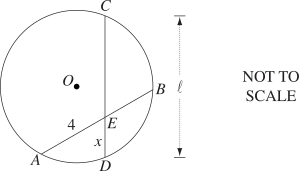
In the circle centred at `O` the chord `AB` has length `7`. The point `E` lies on `AB` and `AE` has length `4`. The chord `CD` passes through `E`.
Let the length of `CD` be `l` and the length of `DE` be `x`.
(i) `text(Show)\ \ x^2 – lx + 12 = 0`
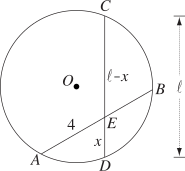
| `AB` | `= 7` |
| `:.\ EB` | `= 7 – 4 = 3` |
`AE xx EB = ED xx CE`
`text{(intercepts of intersecting chords)}`
| `4 xx 3` | `= x (l – x)` |
| `12` | `= xl – x^2` |
`:.\ x^2 – lx + 12 = 0\ \ text(… as required.)`
(ii) `x^2 – lx + 12 = 0\ \ text(has a solution)`
`text(When)\ \ Delta >= 0`
| `b^2 – 4ac` | `>= 0` |
| `(-l)^2 – 4 * 1 * 12` | `>= 0` |
| `l^2 – 48` | `>= 0` |
| `l^2` | `>= 48` |
| `l` | `>= sqrt 48` |
| `>= 4 sqrt 3` |
`:.\ text(The shortest chord that could pass through)`
`E\ \ text(is)\ \ 4 sqrt 3\ text(units.)`
--- 3 WORK AREA LINES (style=lined) ---
--- 6 WORK AREA LINES (style=lined) ---
Find `d/(dx) (2 sin^-1 5x).` (2 marks)
The acute angle between the lines `y = 3x + 5` and `y = mx + 4` is `45°`. Find the two possible values of `m`. (2 marks)
Using the substitution `u = 2x^2 + 1`, or otherwise, find `int x (2x^2 + 1)^(5/4)\ dx.` (3 marks)
--- 8 WORK AREA LINES (style=lined) ---
Sketch the region in the plane defined by `y <= |\ 2x + 3\ |.` (2 marks)


`y <= |2x + 3|`
`text(Consider)\ \ (0, 0)`
`0 <= |\ 0 + 3\ |\ \ =>\ \ text(correct.)`
`:.\ text(Shaded area defines)\ \ y <= |2x + 3|`
The noise level, `N`, at a distance `d` metres from a single sound source of loudness `L` is given by the formula
`N = L/d^2.`
Two sound sources, of loudness `L_1` and `L_2` are placed `m` metres apart.

The point `P` lies on the line between the sound sources and is `x` metres from the sound source with loudness `L_1.`
--- 2 WORK AREA LINES (style=lined) ---
Find an expression for `x` in terms of `m`, `L_1` and `L_2` if `P` is chosen to be this point. (4 marks)
--- 8 WORK AREA LINES (style=lined) ---
| i. |  |
`N = L/d^2`
| `text(Noise from)\ L_1` | `= L_1/x^2` |
| `text(Noise from)\ L_2` | `= L_2/(m-x)^2` |
| `:. N` | `= L_1/x^2 + L_2/(m-x)^2` |
ii. `N = L_1\ x^-2 + L_2 (m – x)^-2`
| `(dN)/(dx)` | `= -2 L_1 x^-3 + -2 L_2 (m – x)^-3 xx d/(dx) (m – x)` |
| `= (-2 L_1)/x^3 + (2 L_2)/(m – x)^3` |
`text(Max or min when)\ (dN)/(dx) = 0`
| `(2 L_1)/x^3` | `= (2 L_2)/(m – x)^3` |
| `2 L_1 (m – x)^3` | `= 2 L_2\ x^3` |
| `L_1 (m – x)^3` | `= L_2\ x^3` |
| `root 3 L_1 (m – x)` | `= root 3 L_2\ x` |
| `root 3 L_1\ m – root 3 L_1\ x` | `= root 3 L_2\ x` |
| `root 3 L_2\ x + root 3 L_1\ x` | `= root 3 L_1\ m` |
| `x (root 3 L_2 + root 3 L_1)` | `= root 3 L_1\ m` |
| `x` | `= (root 3 L_1\ m)/{(root 3 L_2 + root 3 L_1)}` |
| `(dN)/(dx)` | `= -2 L_1\ x^-3 + 2 L_2 (m – x)^-3` |
| `(d^2N)/(dx^2)` | `= 6 L_1\ x^-4 – 6 L_2 (m – x)^-4 xx -1` |
| `= (6 L_1)/x^4 + (6 L_2)/(m – x)^4 > 0` |
`:.\ text(A minimum occurs when)`
`x = (root 3 L_1\ m)/{(root 3 L_2 + root 3 L_1)}`
An object is moving on the `x`-axis. The graph shows the velocity, `(dx)/(dt)`, of the object, as a function of time, `t`. The coordinates of the points shown on the graph are `A (2, 1), B (4, 5), C (5, 0) and D (6, –5)`. The velocity is constant for `t >= 6`.


|
(i) |
 |
`text(Distance travelled)`
`= int_0^4 (dx)/(dt)\ dt`
`~~ h/3 [y_0 + 4y_1 + y_2]`
`~~ 2/3 [0 + 4 (1) + 5]`
`~~ 2/3 [9]`
`~~ 6\ \ text(units)`
(ii) `text(Displacement is reducing when the velocity is negative.)`
`:. t > 5\ \ text(seconds)`
(iii) `text(At)\ B,\ text(the displacement) = 6\ text(units)`
`text(Considering displacement from)\ B\ text(to)\ D.`
`text(S)text(ince the area below the graph from)`
`B\ text(to)\ C\ text(equals the area above the)`
`text(graph from)\ C\ text(to)\ D,\ text(there is no change)`
`text(in displacement from)\ B\ text(to)\ D.`
`text(Considering)\ t >= 6`
`text(Time required to return to origin)`
| `t` | `= d/v` |
| `= 6/5` | |
| `= 1.2\ \ text(seconds)` |
`:.\ text(The particle returns to the origin after 7.2 seconds.)`
|
(iv) |
|


