SmarterEd

Aussie Maths & Science Teachers: Save your time with SmarterEd

  • Login
  • Get Help
  • About

Functions, EXT1 F1 EQ-Bank 18

If  \(f(x)=\dfrac{4-e^{5 x}}{3}\),  find the inverse function  \(f^{-1}(x)\).   (2 marks)

--- 7 WORK AREA LINES (style=lined) ---

Show Answers Only

\(f^{-1}=\dfrac{1}{5} \ln \abs{4-3x}\)

Show Worked Solution

\(f(x) = \dfrac{4-e^{5x}}{3}\)

\(\text{Inverse: swap}\ \ x↔y\)

\(x\) \(=\dfrac{4-e^{5x}}{3} \)  
\(3x\) \(=4-e^{5y}\)  
\(e^{5y}\) \(=4-3x\)  
\(\ln e^{5y}\) \(=\ln \abs{4-3x}\)  
\(5y\) \(=\ln \abs{4-3x}\)  
\(y\) \(=\dfrac{1}{5} \ln \abs{4-3x}\)  

Filed Under: Inverse Functions, Inverse Functions Tagged With: Band 4, smc-1034-10-Logs and Exponentials, smc-6641-10-Logs and Exponentials

Functions, EXT1 F1 2010 HSC 3b*

Let  `f(x) = e^(-x^2)`.  The diagram shows the graph  `y = f(x)`.
 

 Inverse Functions, EXT1 2010 HSC 3b

  1. The graph has two points of inflection.  


    Find the `x` coordinates of these points.   (3 marks)

    --- 6 WORK AREA LINES (style=lined) ---

  2. Explain why the domain of `f(x)` must be restricted if `f(x)` is to have an inverse function.   (1 mark)

    --- 3 WORK AREA LINES (style=lined) ---

  3. Find a formula for `f^(-1) (x)` if the domain of `f(x)` is restricted to  `x ≥ 0`.   (2 marks)

    --- 5 WORK AREA LINES (style=lined) ---

  4. State the domain of `f^(-1) (x)`.   (1 mark)

    --- 2 WORK AREA LINES (style=lined) ---

  5. Sketch the curve  `y = f^(-1) (x)`.   (1 mark)

    --- 5 WORK AREA LINES (style=lined) ---

Show Answers Only
  1. `x = +- 1/sqrt2` 
  2. `text(There can only be 1 value of)\ y\ text(for each value of)\ x.`
  3. `f^(-1)x = sqrt(ln(1/x))`
  4. `0 <= x <= 1`
  5.  
  6. Inverse Functions, EXT1 2010 HSC 3b Answer
Show Worked Solution
i.    `y` `= e^(-x^2)`
  `dy/dx` `= -2x * e^(-x^2)`
  `(d^2y)/(dx^2)` `= -2x (-2x * e^(-x^2)) + e ^(-x^2) (-2)`
    `= 4x^2 e^(-x^2)-2e^(-x^2)`
    `= 2e^(-x^2) (2x^2-1)`


`text(P.I. when)\ \ (d^2y)/(dx^2) = 0:`

`2e^(-x^2) (2x^2-1)` `= 0` 
 `2x^2-1` `= 0` 
 `x^2` `= 1/2`
 `x` `= +- 1/sqrt2` 
COMMENT: It is also valid to show that `f(x)` is an even function and if a P.I. exists at `x=a`, there must be another P.I. at `x=–a`.

 
`text(If)\ x < 1/sqrt2\ =>\ (d^2y)/(dx^2) < 0,\ \ x > 1/sqrt2\ =>\ (d^2y)/(dx^2) > 0`

`=>\ text(Change of concavity)`

`:.\ text(P.I. at)\ \ x = 1/sqrt2`
 

`text(If)\ x < – 1/sqrt2\ =>\ (d^2y)/(dx^2) > 0,\ \ x > – 1/sqrt2\ =>\ (d^2y)/(dx^2) < 0`

`=>\ text(Change of concavity)`

`:.\ text(P.I. at)\ \ x = -1/sqrt2`
 

ii.   `text(In)\ f(x), text(there are 2 values of)\ y\ text(for each value of)\ x.`

`:.\ text(The domain of)\ f(x)\ text(must be restricted for)\ f^(-1) (x)\ text(to exist).`
 

iii.  `y = e^(-x^2)`

`text(Inverse function can be written)` 

`x` `= e^(-y^2),\ \ \ x >= 0`
`lnx` `= ln e^(-y^2)`
`-y^2` `= lnx`
`y^2` `= -lnx`
`y^2` `=ln(1/x)`
`y` `= +- sqrt(ln (1/x))`

 
`text(Restricting)\ \ x>=0\ \ =>\ \ y>=0`

`:.  f^(-1) (x)=sqrt(ln (1/x))`
 

♦ Parts (iv) and (v) were poorly answered with mean marks of 39% and 49% respectively.
iv.   `f(0) = e^0 = 1`

`:.\ text(Range of)\ \ f(x)\ \ text(is)\ \ 0 < y <= 1`

`:.\ text(Domain of)\ \ f^(-1) (x)\ \ text(is)\ \ 0 < x <= 1`
 

v.    
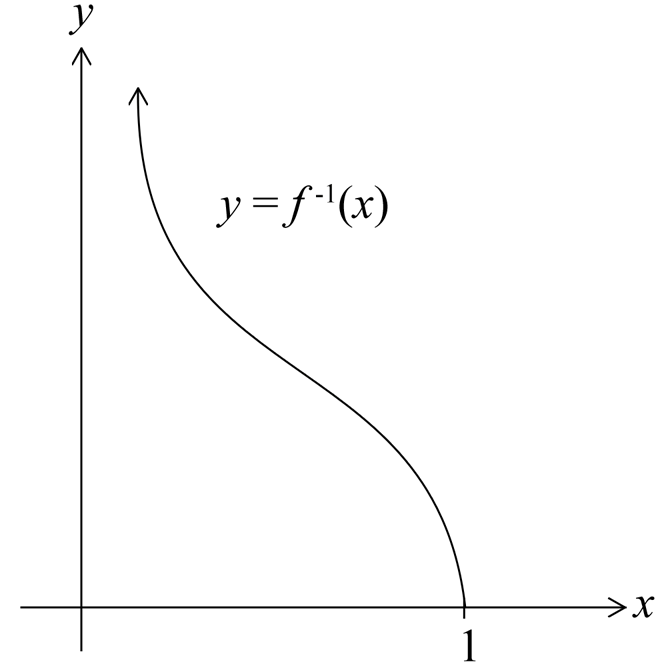
         Inverse Functions, EXT1 2010 HSC 3b Answer

Filed Under: Inverse Functions, Inverse Functions Tagged With: Band 3, Band 4, Band 5, page-break-before-solution, smc-1034-10-Logs and Exponentials, smc-6641-10-Logs and Exponentials

Functions, EXT1 F1 2007 HSC 6b

Consider the function  `f(x) = e^x-e^(-x)`.

  1. Show that `f(x)` is increasing for all values of `x`.   (1 mark)

    --- 4 WORK AREA LINES (style=lined) ---

  2. Show that the inverse function is given by
  3.    `f^(-1)(x) = log_e((x + sqrt(x^2 + 4))/2)`  (3 marks)

    --- 8 WORK AREA LINES (style=lined) ---

  4. Hence, or otherwise, solve  `e^x-e^(-x) = 5`. Give your answer correct to two decimal places.   (1 mark)

    --- 4 WORK AREA LINES (style=lined) ---

Show Answers Only
  1. `text{Proof (See Worked Solutions.)}`
  2. `text{Proof (See Worked Solutions.)}`
  3. `1.65\ \ text{(to 2 d.p.)}`
Show Worked Solution

i.    `f(x)= e^x-e^(-x)\ \ =>\ \ f^{′}(x)= e^x + e^(-x)`

`text(S)text(ince)\ ` `e^x` `> 0\ \ text(for all)\ x`
  `e^(-x)` `> 0\ \ text(for all)\ x`
  `f^{′}(x)` `> 0\ \ text(for all)\ x`

 
`:.f(x)\ text(is an increasing function for all)\ x.`
 

ii.   `y = e^x-e^(-x)`

`text(Inverse function:)`

`x` `= e^y-1/(e^y)`
`xe^y` `= e^(2y)-1`
`e^(2y)-xe^y-1` `= 0`

 
`text(Let)\ \ A = e^y:`

`A^2-xA-1 = 0`

`text(Using the quadratic formula:)`

`A=(x ± sqrt((-x)^2-4 · 1 · (-1)))/(2 · 1)=(x ± sqrt(x^2 + 4))/2`

`text(S)text(ince)\ \ (x -sqrt(x^2 + 4))/2<0\ \ text(and)\ \ e^y>0:`

`e^y` `= (x + sqrt(x^2 + 4))/2`
`log_e e^y` ` = log_e((x + sqrt(x^2 + 4))/2)`
`y` `= log_e((x + sqrt(x^2 + 4))/2)=f^(-1)(x)`


iii.  `e^x-e^(-x)=5\ \ =>\ \ f(x)=5\ \ =>\ \ f^(-1)(5)= x`

`f^(-1)(5)= log_e((5 + sqrt(5^2 + 4))/2)= 1.647…= 1.65\ \ text{(to 2 d.p.)}`

Filed Under: Inverse Functions, Inverse Functions, Other Inverse Functions EXT1 Tagged With: Band 4, Band 5, Band 6, page-break-before-solution, smc-1034-10-Logs and Exponentials, smc-6641-10-Logs and Exponentials

Functions, EXT1 F1 2006 HSC 5b

Let  `f(x) = log_e (1 + e^x)`  for all `x`.

Show that `f(x)` has an inverse.   (2 marks)

--- 5 WORK AREA LINES (style=lined) ---

Show Answers Only

`text(Proof)\ \ text{(See Worked Solutions)}`

Show Worked Solution
`f(x)` `= log_e (1 + e^x)`
`f^{′}(x)` `= e^x/(1 + e^x)`

 
`e^x > 0\ \ text(for all)\ x\ \ => \ \ e^x/(1 + e^x) > 0\ \ text(for all)\ x`

`f(x)\ text(is a monotonic increasing function for all)\ x.`

`:.\ f(x)\ text(has an inverse for all)\ x.`

Filed Under: Inverse Functions, Inverse Functions, Other Inverse Functions EXT1 Tagged With: Band 4, smc-1034-10-Logs and Exponentials, smc-6641-10-Logs and Exponentials

Functions, EXT1 F1 2009 HSC 3a

Let  `f(x) = (3 + e^(2x))/4`. 

  1.  Find the range of `f(x)`.   (1 mark)

    --- 2 WORK AREA LINES (style=lined) ---

  2.  Find the inverse function `f^(-1) (x)`.    (2 marks)

    --- 5 WORK AREA LINES (style=lined) ---

Show Answers Only
  1. `y > 3/4`
  2. `f^(-1) (x) = 1/2 ln(4x-3)`
Show Worked Solution
i.   `f(x) = (3 + e^(2x))/4`

`text(As)\ \ x -> oo, \ e^(2x) ->oo, \ f(x)->oo`

`text(As)\ \ x -> -oo, \ e^(2x) ->0, \ f(x)->3/4`

`:.\ text(Range is)\ \ y > 3/4`
 

ii.   `text(Inverse function: swap)\ \ x↔y` 

`x` `= (3 + e^(2y))/4`
`4x` `= 3 + e^(2y)`
`e^(2y)` `= 4x-3`
`ln e^(2y)` `= ln (4x-3)`
`2y` `= ln (4x-3)`
`y` `= 1/2 ln (4x-3)`


`:.\ f^(-1) (x) = 1/2 ln (4x\ – 3)`

Filed Under: 12. Logs and Exponentials EXT1, Inverse Functions, Inverse Functions, Other Inverse Functions EXT1 Tagged With: Band 4, Band 5, smc-1034-10-Logs and Exponentials, smc-6641-10-Logs and Exponentials

Copyright © 2014–2026 SmarterEd.com.au · Log in