SmarterEd

Aussie Maths & Science Teachers: Save your time with SmarterEd

  • Login
  • Get Help
  • About

v1 Algebra, STD2 A4 2014 HSC 26d

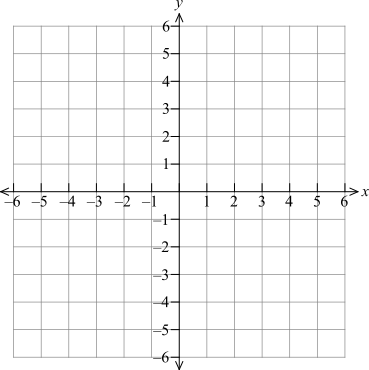
Draw each graph on the grid below and hence solve the simultaneous equations.   (3 marks)

\(y=2x-6\)

\(y-x+2=0\)
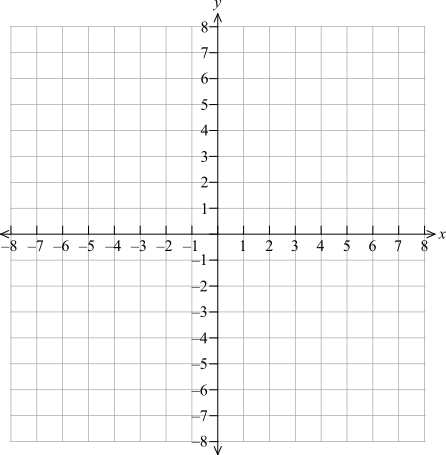
 

--- 6 WORK AREA LINES (style=lined) ---

Show Answers Only
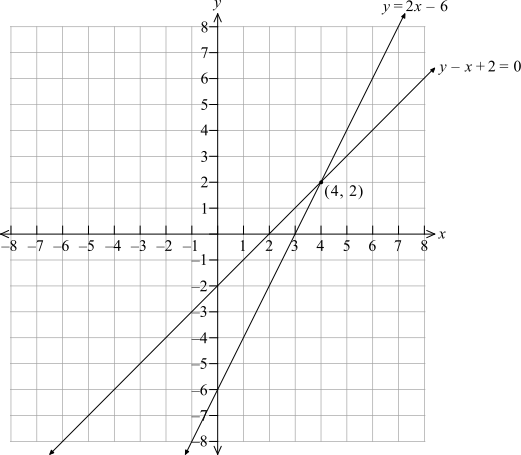
\(x=4,\ y=2\)

Show Worked Solution

\(\text{Solution is at the intersection:}\ \ x=4,\ y=2\)
Filed Under: Simultaneous Equations and Applications (Std 2-X) Tagged With: Band 4, smc-5237-10-Find intersection, smc-5237-40-Sketch Linear Equations

v1 Algebra, STD2 A4 SM-Bank 27

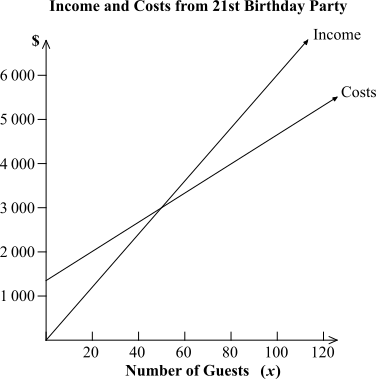
Morgan and Beau are to host a 21st birthday party for their friend's Zac and Peattie. They can hire a function room for $900 and a DJ for $450. Drinks will cost them $33 per person.

  1. Write a formula for the cost (\($C\)) of holding the birthday party for  \(x\)  people.   (1 mark)

    --- 1 WORK AREA LINES (style=lined) ---

  2. The graph below shows the planned income and costs if they charge $60 per person. Estimate the number of friends they need to invite to break even.   (1 mark)


    --- 1 WORK AREA LINES (style=lined) ---

  3. How much money will Morgan and Beau have to purchase a travel voucher as a group gift if 90 people attend the party?   (1 mark)

    --- 2 WORK AREA LINES (style=lined) ---

Show Answers Only
  1. \($C=1350+33x\)
  2. \(50\)
  3. \($1080\)
Show Worked Solution
i.    \(\text{Fixed Costs}\) \(=900+450\)
    \(=$1350\)

 
\(\text{Variable Costs}=$33x\)

\(\therefore\ $C=1350+33x\)


ii.   \(\text{From the graph}\)
  \(\text{Costs = Income when}\ x=50\)
  \(\text{(i.e. where lines intersect)}\)


\(\text{Algebraically}\)  
\(\text{Income }\) \(=\ \text{Costs}\)
\(60x\) \(=1350+33x\)
\(27x\) \(=1350\)
\(x\) \(=50\)


\(\therefore\ \text{Breakeven when }50\ \text{people attend}\)

  
iii. 
\(\text{When}\ \ x=90:\)

\(\text{Income}\) \(=90\times 60\)  
  \(=$5400\)  


\($C\) \(=1350+33\times 90\)
  \(=$4320\)


\(\therefore\ \text{Travel Voucher}\) \(=5400-4320\)
  \(=$1080\)

Filed Under: Simultaneous Equations and Applications (Std 2-X) Tagged With: Band 4, smc-5237-40-Cost/Revenue

v1 Algebra, STD2 A4 2018 HSC 27b

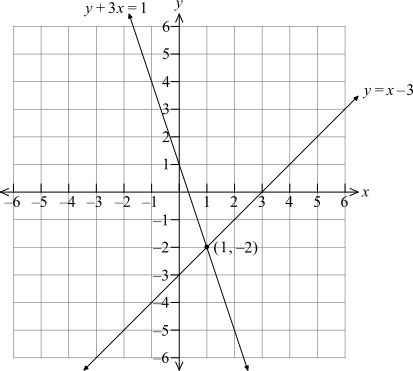
\(y\) \(=x-3\)
\(y+3x\) \(=1\)

 
Draw these two linear graphs on the number plane below and determine their intersection.  (3 marks)


--- 2 WORK AREA LINES (style=lined) ---

 
Show Answers Only

\((1,-2)\)

Show Worked Solution

\(\text{Table of values:}\ \ y=x-3\)

\begin{array} {|c|c|c|c|c|}
\hline x & -2 & -1 & 0 & \colorbox{lightblue}{  1  } \\
\hline \ \ y \ \ & \ \ -5  \ \ & \ \ -4  \ \ & \ \ -3  \ \ & \ \colorbox{lightblue}{ – 2} \\ 
\hline \end{array}

 
\(\text{Table of values:}\ \ y+3x=1 \ \rightarrow \ y=-3x+1\)

\begin{array} {|c|c|c|c|c|}
\hline x & -1 & 0 & \colorbox{lightblue}{ 1 } & 2 \\
\hline \ \ y \ \ & \ \ \ 4\ \ \ & \ \ \ 1\ \ \ & \ \colorbox{lightblue}{ – 2} & \ \ -5 \ \ \\ 
\hline \end{array}


\(\text{From graph (and table), intersection occurs}\)

\(\text{at}\ \ (1, -2).\)

Filed Under: Simultaneous Equations and Applications (Std 2-X) Tagged With: Band 4, smc-5237-10-Find intersection, smc-5237-40-Sketch Linear Equations

v1 Algebra, STD2 A4 2023 HSC 21

Electricity provider \(A\) charges 30 cents per kilowatt hour (kWh) for electricity, plus a fixed monthly charge of $90.

  1. Complete the table showing Provider \(A\)'s monthly charges for different levels of electricity usage.   (1 mark)

    \begin{array} {|l|c|}
    \hline
    \rule{0pt}{2.5ex} \textit{Electricity used in a month (kWh)} \rule[-1ex]{0pt}{0pt} & \ \ 0 \ \ & \ \ 400 \ \ & \ \ 1000 \ \ \\
    \hline
    \rule{0pt}{2.5ex} \textit{Monthly Charge (\$)} \rule[-1ex]{0pt}{0pt} & \ \ 90 \ \ & \ \ 210 \ \ & \ \ 390 \ \ \\
    \hline
    \end{array}

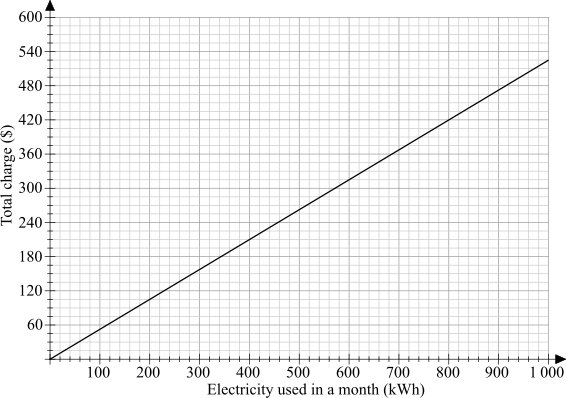
Provider \(B\) charges 52.5 cents per kWh, with no fixed monthly charge. The graph shows how Provider \(B\)'s charges vary with the amount of electricity used in a month.


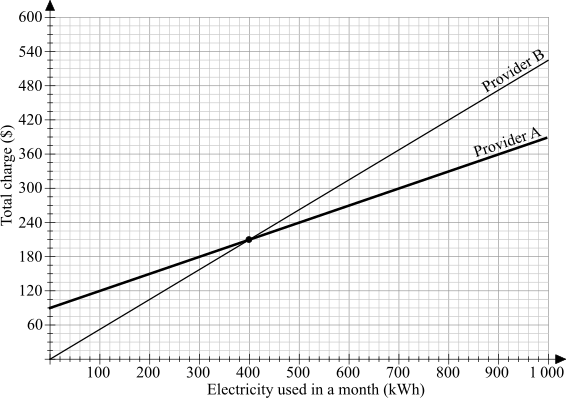
  1. On the grid above, graph Provider \(A\)'s charges from the table in part (a).   (1 mark)
  2. Use the two graphs to determine the number of kilowatt hours per month for which Provider \(A\) and Provider \(B\) charge the same amount.   (1 mark)

    --- 1 WORK AREA LINES (style=lined) ---

  3. A customer uses an average of 600 kWh per month.
  4. Which provider, \(A\) or \(B\), would be the cheaper option and by how much?   (2 marks)

    --- 4 WORK AREA LINES (style=lined) ---

Show Answers Only

a.    \(\text{When kWh} =400\)

\(\text{Monthly charge}\ =$90+0.30\times 400=$210\)

\begin{array} {|l|c|}
\hline
\rule{0pt}{2.5ex} \textit{Electricity used in a month (kWh)} \rule[-1ex]{0pt}{0pt} & \ \ 0 \ \ & \ \ 400 \ \ & \ 1000 \ \\
\hline
\rule{0pt}{2.5ex} \textit{Monthly Charge (\$)} \rule[-1ex]{0pt}{0pt} & \ \ 90 \ \ & \ \ 210 \ \ & \ \ 390 \ \ \\
\hline
\end{array}

b.    
         

c.    \(\text{400 kWh}\)

d.    \(\text{Provider}\ A\ \text{is cheaper by \$45.}\)

Show Worked Solution

a.   \(\text{When kWh} =400\)

\(\text{Monthly charge}\ =$90+0.30\times 400=$210\)

\begin{array} {|l|c|}
\hline
\rule{0pt}{2.5ex} \textit{Electricity used in a month (kWh)} \rule[-1ex]{0pt}{0pt} & \ \ 0 \ \ & \ \ 400 \ \ & \ 1000 \ \\
\hline
\rule{0pt}{2.5ex} \textit{Monthly Charge (\$)} \rule[-1ex]{0pt}{0pt} & \ \ 90 \ \ & \ \ 210 \ \ & \ \ 390 \ \ \\
\hline
\end{array}

b. 


c.    \(A_{\text{charge}} = B_{\text{charge}}\ \text{at intersection.}\)

\(\therefore\ \text{Same charge at 400 kWh}\)
 

d.    \(\text{Cost at 600 kWh:}\)

\(\text{Method 1: Using graph}\rightarrow\ $315-270=$45\)

\(\text{Method 2: Algebraically}:\)

\(\text{Provider}\ A: \ 90 + 0.30 \times 600 = $270\)

\(\text{Provider}\ B: \ 0.525 \times 600 = $315\)

\(\therefore \text{Provider}\ A\ \text{is cheaper by \$45.}\)

Filed Under: Simultaneous Equations and Applications (Std 2-X) Tagged With: Band 3, Band 4, smc-5237-20-Other SE Applications, smc-5237-40-Sketch Linear Equations

v1 Algebra, STD2 A4 2018 HSC 27d

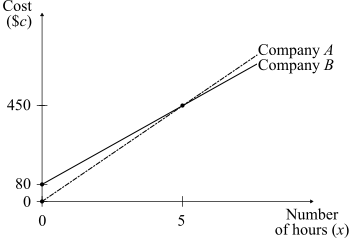
The graph displays the cost (\($c\)) charged by two companies for the hire of a jetski for \(x\) hours.


Both companies charge $450 for the hire of a jetski for 5 hours.

  1. What is the hourly rate charged by Company A?  (1 mark)

    --- 1 WORK AREA LINES (style=lined) ---

  2. Company B charges an initial booking fee of $80.


    Write a formula, in the of  \(c=b+mx\), for the cost of hiring a jetski from Company B for \(x\) hours.  (2 marks)

    --- 4 WORK AREA LINES (style=lined) ---

  3. A jetski is hired for 7 hours from Company B.


    Calculate how much cheaper this is than hiring from Company A.  (2 marks)

    --- 4 WORK AREA LINES (style=lined) ---

Show Answers Only
  1. \($90\)
  2. \(c=80+74x\)
  3. \($32\)
Show Worked Solution
i.    \(\text{Hourly rate}\ (A)\) \(=\dfrac{450}{5}\)
    \(=$90\)


ii.   \(m=\text{hourly rate}\)

\(\text{Find}\ m,\ \text{given}\ c = 450,\ \text{when}\ \ x = 5\ \text{and}\ \ b = 80\)

\(450\) \(=80+m\times 5\)
\(5m\) \(=370\)
\(m\) \(=\dfrac{370}{5}=74\)

\(\therefore\ c=80+74x\)
 

iii.    \(\text{Cost}\ (A)\) \(=90\times 7=$630\)
  \(\text{Cost}\ (B)\) \(=80+74\times 7=$598\)

 
\(\therefore\ \text{Company}\ B’\text{s hiring cost is }$32\ \text{cheaper.}\)

Filed Under: Simultaneous Equations and Applications (Std 2-X) Tagged With: Band 3, Band 4, smc-5237-40-Cost/Revenue

v1 Algebra, STD2 A4 SM-Bank 7 MC

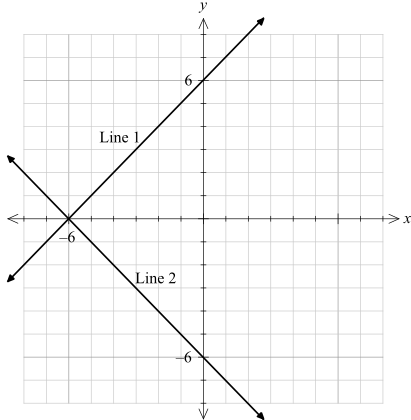
A computer application was used to draw the graphs of the equations

\(x+y=-6\)  and  \(x-y=-6\)

Part of the screen is shown.

Which row of the table correctly matches the equations with the lines drawn and identifies the solution when the equations are solved simultaneously?

\begin{align*}
\begin{array}{c|c}
\text{ } \\
\textbf{ A. } \\
\textbf{ B. } \\
\textbf{ C. } \\
\textbf{ D. }
\end{array}
\begin{array}{|c|c|c|}
\hline
\ x+y=-6 & x-y=-6 & \text{Solution} \\
\hline
\text{Line 1} & \text{Line 2} & x=-6,\ y=0 \\
\hline
\text{Line 1} & \text{Line 2} & x=-6, y=-6 \\
\hline
\text{Line 2} & \text{Line 1} & x=-6,\  y=0 \\
\hline
\text{Line 2} & \text{Line 1} & x=-6, y=-6 \\
\hline
\end{array}
\end{align*}

Show Answers Only

\(C\)

Show Worked Solution

\(\text{Line 1:} \ \ x-y=-6\)

\(\text{Line 2:} \ \ x+y=-6\)

\(\text{Intersection at} \ (-6, 0).\)

\(\Rightarrow C\)

Filed Under: Simultaneous Equations and Applications (Std 2-X) Tagged With: Band 4, smc-5237-10-Find intersection

v1 Networks, STD2 N2 2021 HSC 2 MC

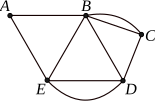
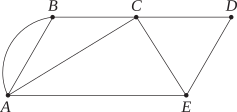
Consider the network diagram.
 

What is the sum of the degrees of all the vertices in this network?

  1.  5
  2.  8
  3.  14
  4.  16
Show Answers Only

`D`

Show Worked Solution

`text(Working from)\ A\ text(to)\ E:`

COMMENT: This simple question caused problems for many with mean mark just 58%.
`text{Sum of degrees}` `= 4 + 3 + 4 + 2 + 3`
  `= 16`

 
`=> D`

Filed Under: Basic Concepts (Std 2-X) Tagged With: Band 4, smc-912-40-Degrees of Vertices

v1 Algebra, STD2 A2 2007 HSC 24c

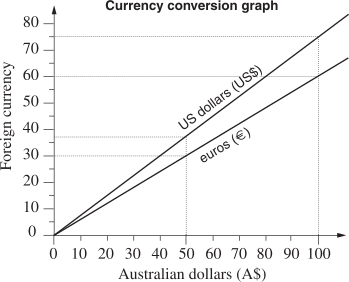
Blythe travels to France via the USA. She uses this graph to calculate her currency conversions.


  1. After leaving the USA she has US$750 to add to the A$2150 that she plans to spend in France.


    She converts all of her money to euros. How many euros does she have to spend in France?    (3 marks)

    --- 6 WORK AREA LINES (style=lined) ---

  2. If the value of the US dollar rises in comparison to the Australian dollar, what will be the effect on the gradient of the line used to convert US dollars to Australian dollars?   (1 mark)

    --- 2 WORK AREA LINES (style=lined) ---

Show Answers Only
  1. \(1890\ \text{€}\)
  2. \(\text{See worked solutions}\)
Show Worked Solution

i.   \(\text{From graph:}\)

\(75\ \text{US}$\) \(=100\ \text{A}$\)
\(\rightarrow\ 750\ \text{US}$\) \(=1000\ \text{A}$\)

 
\(\therefore\ \text{Blythe has a total of }$1000+$2150=\text{A}$3150 \)
 

\(\text{Converting A}$\ \text{to €}:\)

\(100\ \text{A}$\) \(=60\ \text{€}\)
\(\therefore\ 3150\ \text{A}$\) \(=\dfrac{3150}{100}\times 60\)
  \(=1890\ \text{€}\)


ii.    \(\text{If the value of the US}\ $\ \text{rises against the}\)

\(\text{Australian }$\ \text{then 1 A}\ $\ \text{will buy less US}\ $\)

\(\text{than before and the gradient used to convert}\)

\(\text{the currencies will steepen (increase).}\)

Filed Under: Applications: Currency, Fuel and Other Problems (Std 2-X) Tagged With: Band 4, smc-5236-10-Currency conversion

v1 Algebra, STD2 A2 2014 HSC 22 MC

Lisa’s motorbike uses fuel at the rate of 1.8 L per 100 km for long-distance driving and  2.3 L per 100 km for short-distance driving.

She used the motorbike to make a journey of 840 km, which included 108 km of short-distance driving.  

Approximately how much fuel did Lisa’s motorbike use on the journey?

  1. 9 L
  2. 16 L
  3. 18 L
  4. 34 L
Show Answers Only

\(B\)

Show Worked Solution

\(\text{Fuel used in short distance}\)

\(=\dfrac{108}{100}\times 2.3\ \text{L}=2.484\ \text{L}\)

\(\text{Fuel used in long distance}\)

\(=\dfrac{840-108}{100}\times 1.8\ \text{L}=13.176\ \text{L}\)
 

\(\therefore\ \text{Total Fuel}\) \(=2.484+13.176\)
  \(=15.66\ \text{L}\)

\(\Rightarrow B\)

Filed Under: Applications: Currency, Fuel and Other Problems (Std 2-X) Tagged With: Band 4, smc-5236-20-Fuel

v1 Algebra, STD2 A2 2014 HSC 26f

The weight of an object on the moon varies directly with its weight on Earth.  An astronaut who weighs 63 kg on Earth weighs only 9 kg on the moon.

A lunar landing craft weighs 2449 kg when on the moon. Calculate the weight of this landing craft when on Earth.   (2 marks)

--- 4 WORK AREA LINES (style=lined) ---

Show Answers Only

 \(17\ 143\ \text{kg}\)

Show Worked Solution

\(W_{\text{moon}}\propto W_{\text{earth}}\)

\(\rightarrow\  W_{\text{m}}=k\times W_{\text{e}}\)

\(\text{Find}\ k,\ \text{given}\ W_{\text{e}}=63\ \text{when}\ W_{\text{m}}=9\)

\(9\) \(=k\times 63\)
\(k\) \(=\dfrac{9}{63}=\dfrac{1}{7}\)

  
\(\text{If}\ W_{\text{m}}=2449\ \text{kg, find}\ W_{\text{e}}:\)

\(2449\) \(=\dfrac{1}{7}\times W_{\text{e}}\)
\(W_{\text{e}}\) \(=7\times 2449=17\ 143\)

  
\(\text{Landing craft weighs}\ 17\ 143\ \text{kg on earth}\)

Filed Under: Applications: Currency, Fuel and Other Problems (Std 2-X) Tagged With: Band 4, smc-5236-50-Proportion

v1 Algebra, STD2 A2 2007 HSC 27b

A cafe uses eight long-life light globes for 7 hours every day of the year. The purchase price of each light globe is $11.00 and they each cost  \($f\)  per hour to run.

  1. Write an equation for the total cost (\($c\)) of purchasing and running these eight light globes for one year in terms of  \(f\).    (2 marks)

    --- 4 WORK AREA LINES (style=lined) ---

  2. Find the value of  \(f\)  (correct to three decimal places) if the total cost of running these eight light globes for one year is $850.   (1 mark)

    --- 2 WORK AREA LINES (style=lined) ---

  3. If the use of the light globes increases to ten and a half hours per night every night of the year, does the total cost increase by one-and-a-half times? Justify your answer with appropriate calculations.   (1 mark)

    --- 2 WORK AREA LINES (style=lined) ---

Show Answers Only
  1. \($c=88+20\ 440f\)
  2. \(0.037\ $/\text{hr}\ \text{(3 d.p.)}\)
  3. \(\text{Proof:  (See Worked Solutions)}\)
Show Worked Solution

i.  \(\text{Purchase price}=8\times 11=$88\)

\(\text{Running cost}\) \(=\text{No. of  hours}\times \text{Cost per hour}\)
  \(=8\times 7\times 365\times f\)
  \(=20\ 440f\)

  
\(\therefore\ $c=88+20\ 440f\)
  

ii.  \(\text{Given}\ \ $c=$850\)

\(850\) \(=88+20\ 440f\)
\(20\ 440f\) \(=850-88\)
\(f\) \(=\dfrac{762}{20440}\)
  \(= 0.03727\dots\)
  \(=0.037\ $/\text{hr}\ \text{(3 d.p.)}\)


iii.  \(\text{If}\ f\ \text{is multiplied by  }1.5 =\dfrac{10.5}{7}\)

\(f=1.5\times0.037=0.0555\ \ $/\text{hr}\)

\(\therefore\ $c\) \(=88+20\ 440\times 0.0555\)
  \(=$1222.42\)

  
\(\text{Since }$1222.42\ \text{is less than}\ 1.5\times $850 = $1275,\)

\(\text{the total cost increases to less than 1.5 times the}\)

\(\text{the original cost.}\)

Filed Under: Applications: Currency, Fuel and Other Problems (Std 2-X) Tagged With: Band 4, Band 5, smc-5236-30-Other linear applications

v1 Algebra, STD2 A2 SM-Bank 3

The average height, \(L\), in centimetres, of a boy between the ages of 7 years and 10 years can be represented by a line with equation

\(L=7A+85\)

where \(A\) is the age in years. For this line, the gradient is 7.

  1. What does this indicate about the heights of boys aged 7 to 10?   (1 mark)

    --- 2 WORK AREA LINES (style=lined) ---

  2. Give ONE reason why this equation is not suitable for predicting heights of boys older than 10.   (1 mark)

    --- 2 WORK AREA LINES (style=lined) ---

Show Answers Only
  1. \(\text{It indicates that 7-10 year old boys, on average, grow 7 cm per year.}\)
  2. \(\text{Boys eventually stop growing, and the equation doesn’t factor this in.}\)
Show Worked Solution

a.    \(\text{It indicates that 7-10 year old boys, on average, grow}\)

\(\text{7 cm per year.}\)
 

b.   \(\text{Boys eventually stop growing, and the equation doesn’t}\)

\(\text{factor this in.}\)

Filed Under: Applications: Currency, Fuel and Other Problems (Std 2-X) Tagged With: Band 4, Band 5, smc-5236-30-Other linear applications, smc-5236-40-Limitations

v1 Algebra, STD2 A2 2019 HSC 14 MC

Last Friday, Jake had 98 marbles and Jack had 79 Marbles. On average, Jake wins 5 marbles per day and Jack loses 4 marbles per day.

If  \(x\)  represents the number of days since last Friday and  \(y\)  represents the number of marbles, which pair of equations model this situation?

  A.     \(\text{Jake:}\ \ y=98x+5\)


    \(\text{Jack:}\ \ y=79x-4\)

  B.     \(\text{Jake:}\ \ y=5+98x\)


    \(\text{Jack:}\ \ y=4-79x\)

  C.     \(\text{Jake:}\ \ y=5x+98\)


    \(\text{Jack:}\ \ y=4x-79\)

  D.     \(\text{Jake:}\ \ y=98+5x\)


    \(\text{Jack:}\ \ y=79-4x\)

Show Answers Only

\(D\)

Show Worked Solution

\(\text{Jake starts with 98 and adds 5 per day:}\)

\(y=98+5x\)

\(\text{Jack starts with 79 and loses 4 per day:}\)

\(y=79-4x\)

\(\Rightarrow D\)

Filed Under: Applications: Currency, Fuel and Other Problems (Std 2-X) Tagged With: Band 4, smc-5236-30-Other linear applications

v1 Algebra, STD2 A2 2019 HSC 34

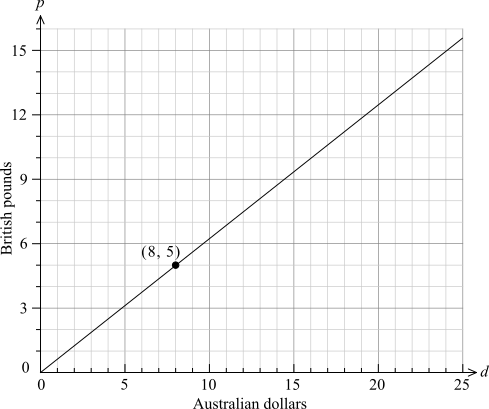
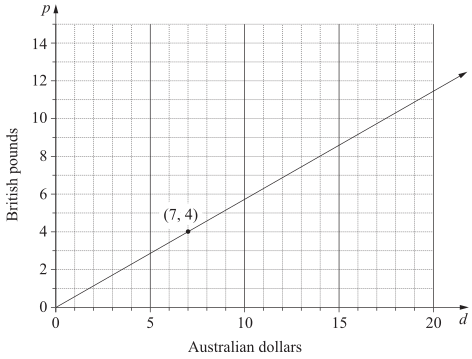
The relationship between British pounds \((p)\) and Australian dollars \((d)\) on a particular day is shown in the graph.
 

  1. Write the direct variation equation relating British pounds to Australian dollars in the form  \(p=md\). Leave \(m\) as a fraction.  (1 mark)

    --- 2 WORK AREA LINES (style=lined) ---

  2. The relationship between Japanese yen \((y)\) and Australian dollars \((d)\) on the same day is given by the equation  \(y=84d\).


    Convert \(107\ 520\) Japanese yen to British pounds.  (2 marks)

    --- 4 WORK AREA LINES (style=lined) ---

Show Answers Only
  1. \(p=\dfrac{5}{8}d\)
  2. \(107\ 520\ \text{yen = 800 pounds}\)
Show Worked Solution

a.   \(m=\dfrac{\text{rise}}{\text{run}}=\dfrac{5}{8}\)

\(p=\dfrac{5}{8}d\)


♦ Mean mark 42%.

b.   \(\text{Yen to Australian dollars:}\)

\(y\) \(=84d\)
\(107\ 520\) \(=84d\)
\(d\) \(=\dfrac{107\ 520}{84}\)
  \(= 1280\ $\text{A}\)

 
\(\text{Australian dollars to pounds:}\)

\(p\) \(=\dfrac{5}{8}\times 1280\)
  \(=800\ \text{pounds}\)

  
\(\therefore\ 107\ 520\ \text{yen = 800 pounds}\)

Filed Under: Applications: Currency, Fuel and Other Problems (Std 2-X) Tagged With: Band 4, Band 5, smc-5236-50-Proportion

v1 Algebra, STD1 A2 2020 HSC 20

The height of a bundle of photographic paper (\(H\) mm) varies directly with the number of sheets (\(N\)) of photographic paper that the bundle contains.

This relationship is modelled by the formula  \(H=kN\), where  \(k\)  is a constant.

The height of a bundle containing 150 sheets of photographic paper is 2.7 centimetres.

  1. Show that the value of  \(k\)  is 0.18.   (1 mark)

    --- 2 WORK AREA LINES (style=lined) ---

  2. A bundle of photographic paper has a height of 36 centimetres. Calculate the number of sheets of photographic paper in the bundle.   (2 marks)

    --- 4 WORK AREA LINES (style=lined) ---

Show Answers Only
  1. \(\text{See Worked Solutions}\)
  2. \(2000\ \text{sheets}\)
Show Worked Solution

a.    \(H=2.7\ \text{cm }=27\ \text{mm, when}\  N=150:\)

\(H\) \(=kN\)
\(2.7\) \(=k\times 150\)
\(\therefore\ k\) \(=\dfrac{2.7}{150}\)
  \(=0.18\)


b.     \(\text{Find}\ \ N \ \text{when} \ \ H=36\ \text{cm}=360\ \text{mm:}\)

\(360\) \(=0.18\times N\)
\(\therefore\ N\) \(=\dfrac{360}{0.18}\)
  \(=2000\ \text{sheets}\)

♦ Mean mark 50%.

Filed Under: Applications: Currency, Fuel and Other Problems (Std 2-X) Tagged With: Band 4, Band 5, smc-5236-50-Proportion

v1 Algebra, STD2 A4 2022 HSC 22

The formula  \(C=80n+b\)  is used to calculate the cost of producing desktop computers, where \(C\) is the cost in dollars, \(n\) is the number of desktop computers produced and \(b\) is the fixed cost in dollars.

  1. Find the cost \(C\) when 2458 desktop computers are produced and the fixed cost is \($18\ 230\).  (1 mark)

    --- 2 WORK AREA LINES (style=lined) ---

  2. Some desktop computers have extra features added. The formula to calculate the production cost for these desktop computers is
  3.     \(C=80n+an+18\ 230\)
  4. where \(a\) is the additional cost in dollars per desktop computer produced.
  5. Find the number of desktop computers produced if the additional cost is $35 per desktop computer and the total production cost is \($103\ 330\).  (2 marks)

    --- 4 WORK AREA LINES (style=lined) ---

Show Answers Only
  1. \($214\ 870\)
  2. \(740\ \text{desktop computers}\)
Show Worked Solution

a.   \(\text{Find}\ C,\ \text{given}\ n=2458\ \text{and}\ b=18\ 230\)

\(C\) \(=80\times 2458+18\ 230\)  
  \(=$214\ 870\)  


b.   \(\text{Find}\ n,\ \text{given}\ C=103\ 330\ \text{and}\ a=35\)

\(C\) \(=80n+an+18\ 230\)
\(103\ 330\) \(=80n+35n+18\ 230\)
\(115n\) \(=85\ 100\)
\(n\) \(=\dfrac{85\ 100}{115}\)
  \(=740\ \text{desktop computers}\)

Filed Under: Applications: Currency, Fuel and Other Problems (Std 2-X) Tagged With: Band 2, Band 4, smc-5236-30-Other linear applications

v1 Algebra, STD2 A2 2012 HSC 8 MC

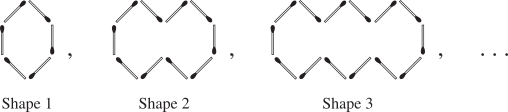
Dots were used to create a pattern. The first three shapes in the pattern are shown. 
 

 The number of dots used in each shape is recorded in the table. 

\begin{array} {|l|c|}
\hline
\rule{0pt}{2.5ex} \text{Shape $(S)$} \rule[-1ex]{0pt}{0pt} &\;\;\;  1 \;\;\; & \;\; \;2  \;\;\; &   \;\;\; 3 \;\;\; \\
\hline
\rule{0pt}{2.5ex} \text{Number of dots $(N)$} \rule[-1ex]{0pt}{0pt} &\;\;\;  8 \;\;\; & \;\; \;10  \;\;\; &   \;\; \;12\; \;\; \\
\hline
\end{array}

How many dots would be required for Shape 182?

  1. 363
  2. 370
  3. 546
  4. 1092
Show Answers Only

\(B\)

Show Worked Solution

\(\text{Linear relationship where}\)

\(N=6+(2\times S)\)

\(\text{When}\ \ S=182\)

\(N\) \(=6+(2\times 182)\)
  \(=370\)

  
\(\Rightarrow B\)

Filed Under: Linear Equations and Basic Graphs (Std 2-X) Tagged With: Band 4, smc-5240-40-Patterns

v1 Algebra, STD2 A2 2011 HSC 23b

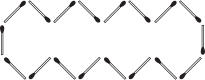
Sticks were used to create the following pattern. 
  

The number of sticks used is recorded in the table.

\begin{array} {|l|c|}
\hline
\rule{0pt}{2.5ex} \text{Shape $(S)$} \rule[-1ex]{0pt}{0pt} & \;\;\; 1 \;\;\; & \;\;\; 2 \;\;\; & \;\;\; 3 \;\;\; \\
\hline
\rule{0pt}{2.5ex} \text{Number of sticks $(N)$}\; \rule[-1ex]{0pt}{0pt} & \;\;\; 6 \;\;\; & \;\;\; 10 \;\;\; & \;\;\; 14 \;\;\; \\
\hline
\end{array}

  1. Draw Shape 4 of this pattern.  (1 mark)

    --- 3 WORK AREA LINES (style=blank) ---

  2. How many sticks would be required for Shape 128?    (1 mark)

    --- 3 WORK AREA LINES (style=lined) ---

  3. Is it possible to create a shape in this pattern using exactly 609 sticks?


    Show suitable calculations to support your answer.    (2 marks)

    --- 5 WORK AREA LINES (style=lined) ---

Show Answers Only
  1. \(\text{See Worked Solutions.}\)
  2. \(514\)
  3. \(\text{No (See worked solution)}\)
Show Worked Solution

  i.    \(\text{Shape 4 is shown below:}\)

ii.    \(\text{Since}\ \ N=2+4S\)

♦ Mean mark 48%.
MARKER’S COMMENT: Students should attempt to find a “rule” in such questions, and use this formula to solve the question, as per the Worked Solution.  
\(\text{If }S\) \(=128\)
\(N\) \(=2+(4\times 128)\)
  \(=514\)


iii.    \(609\) \(=2+4S\)
  \(4S\) \(=607\)
  \(S\) \(=151.75\)

    
\(\text{Since}\ S\ \text{is not a whole number, 609 sticks}\)

\(\text{will not create a shape in this pattern.}\)

Filed Under: Linear Equations and Basic Graphs (Std 2-X) Tagged With: Band 1, Band 4, Band 5, smc-5240-40-Patterns

v1 Algebra, STD2 A2 2006 HSC 7 MC

Which equation represents the relationship between \(x\) and \(y\) in this table?
 

\begin{array} {|c|c|c|}
\hline \ \ x\ \ & \ \ 0\ \ &\ \ 2\ \ & \ \ 4\ \ & \ \ 6\ \ & \ \ 8\ \ \\
\hline y & 3 & 4 & 5 & 6 & 7 \\
\hline \end{array} 

  1. \(y=2x+3\)
  2. \(y=\dfrac{1}{2}x+3\) 
  3. \(y=\dfrac{1}{2}x-3\)
  4. \(y=3x-2\)
Show Answers Only

\(B\)

Show Worked Solution

\(\text{By elimination (using the table)}\)

\((0, 3)\ \text{must satisfy}\)

\(\therefore\ \text{NOT}\ C\ \text{or}\ D\)

\((2, 4)\ \text{must satisfy}\)

\(\therefore\ \text{NOT}\ A\ \text{as}\ 2\times 2+3\neq\ 5\)

\(\Rightarrow B\)

Filed Under: Linear Equations and Basic Graphs (Std 2-X) Tagged With: Band 4, smc-5240-20-Equation of line

v1 Algebra, STD2 A2 2016 HSC 14 MC

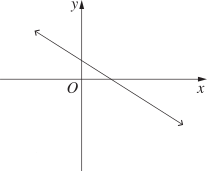
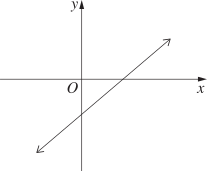
The graph shows a line which has an equation in the form  \(y=mx+c\).
 

Which of the following statements is true?

  1. \(m\) is positive and \(c\) is negative
  2. \(m\) is negative and \(c\) is positive
  3. \(m\) and \(c\) are both positive
  4. \(m\) and \(c\) are both negative
Show Answers Only

\(B\)

Show Worked Solution

\(y\text{-intercept}\ (c)\ \text{is positive}\)

\(\rightarrow\ \text{eliminate A and D}\)

\(\text{gradient}\ (m)\ \text{is negative}\)

\(\rightarrow\ \text{eliminate C}\)

\(\Rightarrow B\)

Filed Under: Linear Equations and Basic Graphs (Std 2-X) Tagged With: Band 4, smc-5240-10-Gradient

v1 Algebra, STD2 A4 2017 HSC 17 MC

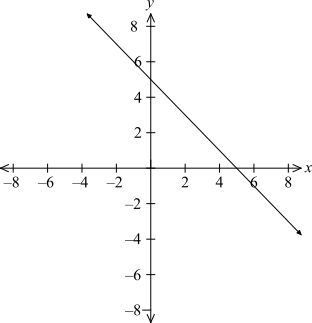
The graph of the line with equation  \(y=5-x\)  is shown.


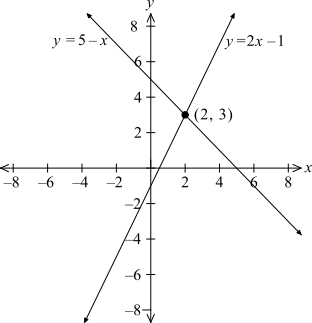
When the graph of the line with equation  \(y=2x-1\)  is also drawn on this number plane, what will be the point of intersection of the two lines?

  1. \((0, 5)\)
  2. \((1, 2)\)
  3. \((2, 3)\)
  4. \((5, 0)\)
Show Answers Only

\(C\)

Show Worked Solution

\(\text{Method 1: Graphically}\)

\(\text{From graph, intersection is at} (2,3)\)


\(\text{Method 2: Algebraically}\)

\(y\) \(=5-x\) \(…\ (1)\)
\(y\) \(=2x-1\) \(…\ (2)\)

 
\(\text{Substitute (2) into (1)}\)

\(2x-1\) \(=5-x\)
\(3x\) \(=6\)
\(x\) \(=2\)

 
\(\text{When}\ \ x=2,\ y=5-2=3\)

\(\Rightarrow C\)

Filed Under: Linear Equations and Basic Graphs (Std 2-X), Simultaneous Equations and Applications (Std 2-X) Tagged With: Band 4, smc-5237-10-Find intersection, smc-5240-30-Sketch line, smc-5240-50-Other

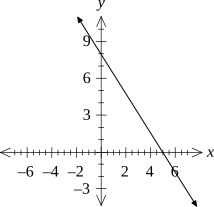
v1 Algebra, STD2 A2 SM-Bank 5 MC

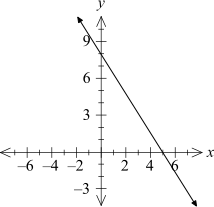
The equation of the line drawn in the diagram below is: 
  

  1. \(5y=8x\)
  2. \(y=-\dfrac{8}{5}x+8\)
  3. \(y=\dfrac{8}{5}x+8\)
  4. \(y=-\dfrac{5}{8}x+8\)
Show Answers Only

\(B\)

Show Worked Solution

\(y\text{-intercept}=+8\)

\(\text{Gradient}\) \(=\dfrac{\text{rise}}{\text{run}}\)
  \(=-\dfrac{8}{5}\)


\(\therefore\ \text{Equation is}:\ y=-\dfrac{8}{5}x+8\)

\(\Rightarrow B\)

Filed Under: Linear Equations and Basic Graphs (Std 2-X) Tagged With: Band 4, smc-5240-20-Equation of line

v1 Algebra, STD2 A2 SM-Bank 5

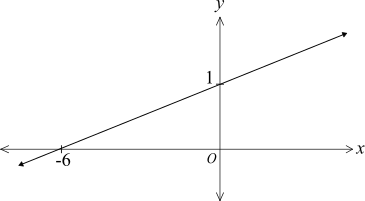
The diagram shows the graph of a line.
 

What is the equation of this line?    (2 marks)

Show Answers Only

\(y=\dfrac{1}{6}x+1\)

Show Worked Solution

\(y\text{-intercept}=1\)

\(\text{Gradient}\) \(=\dfrac{\text{rise}}{\text{run}}\)
  \(=\dfrac{1}{6}\)

 
\(\therefore\ \text{Equation:}\ \ y=\dfrac{1}{6}x+1\)

Filed Under: Linear Equations and Basic Graphs (Std 2-X) Tagged With: Band 4, smc-5240-20-Equation of line

v1 Algebra, STD2 A2 SM-Bank 6 MC

Hannah went paddle boarding on a holiday.

The hiring charges are  listed in the table below:

\begin{array} {|l|c|c|}
\hline \text{Hours hired} \ (h) & 1 & 2 & 3 & 4 & 5 \\
\hline \text{Cost} \ (C) & 15 & 23 & 31 & 39 & 47 \\
\hline \end{array}

Which linear equation shows the relationship between \(C\) and \(h\)?

  1. \(C=8+7h\)
  2. \(C=7+8h\)
  3. \(C=15+8h\)
  4. \(C=8+15h\)
Show Answers Only

\(B\)

Show Worked Solution

\(\text{Consider Option 2:}\)

\(7+8\times 1=7+8=15\)

\(7+8\times 2=7+16=23\)

\(7+8\times 3=7+24=31\ \ \ \ \text{etc …}\)

\(\text{The linear equation is:}\ \ C=7+8h\)

\(\Rightarrow B\)

Filed Under: Linear Equations and Basic Graphs (Std 2-X) Tagged With: Band 4, smc-5240-50-Other

v1 Algebra, STD2 A2 SM-Bank 20

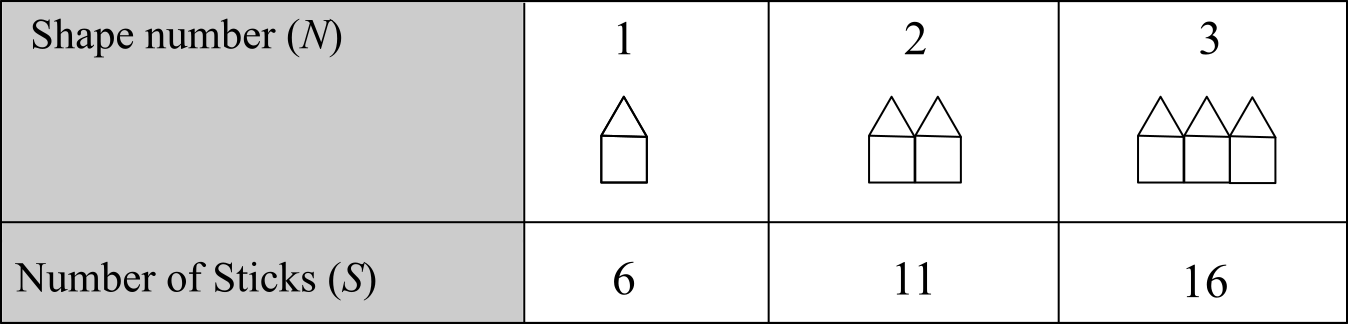
Brett uses matchsticks to make a pattern of shapes, as shown in the table below.
  

   How many sticks (\(S\)) will be needed to make Shape Number 24?  (2 marks)

--- 5 WORK AREA LINES (style=lined) ---

Show Answers Only

\(121\)

Show Worked Solution

\(\text{Shape 1:}\ \ S=5\times 1+1=6\)

\(\text{Shape 2:}\ \ S=5\times 2+1=11\)

\(\vdots\)

\(\text{Shape}\ N:\ \ S=5N+1\)
 

\(\therefore\ \text{Sticks required when}\ \ N=24\)

\(=24\times 5+1\)

\(=121\)

Filed Under: Linear Equations and Basic Graphs (Std 2-X) Tagged With: Band 4, smc-5240-40-Patterns

v1 Algebra, STD2 A2 SM-Bank 10 MC

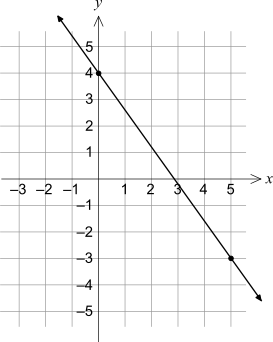
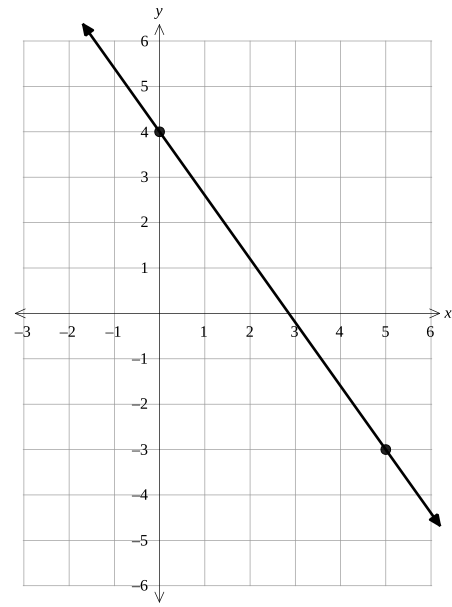
Petra drew a straight line through the points \((0, 4)\) and \((5, -3)\) as shown in the diagram below.
 

What is the gradient of the line that Petra drew?

  1. \(-\dfrac{7}{5}\)
  2. \(-\dfrac{5}{7}\)
  3. \(\dfrac{7}{5}\)
  4. \(\dfrac{5}{7}\)
Show Answers Only

\(A\)

Show Worked Solution

\(\text{Line passes through } (0, 4)\ \text{and } (5, -3)\)

\(\text{Gradient}\) \(=\dfrac{y_2-y_1}{x_2-x_1}\)
  \(=\dfrac{4- -3}{0-5}\)
  \(=-\dfrac{7}{5}\)

 
\(\Rightarrow A\)

Filed Under: Linear Equations and Basic Graphs (Std 2-X) Tagged With: Band 4, smc-5240-10-Gradient

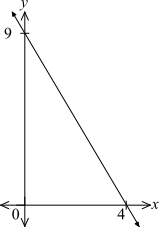
v1 Algebra, STD2 A2 SM-Bank 12 MC

 Which of these equations represents the line in the graph?

  1. \(y=9-4x\)
  2. \(y=9+4x\)
  3. \(y=9-\dfrac{9}{4}x\)
  4. \(y=9+\dfrac{9}{4}x\)
Show Answers Only

\(C\)

Show Worked Solution

\(\text{Graph passes through }(0, 9)\text{ and} (4, 0)\)

\(\text{Gradient}\) \(=\dfrac{y_2-y_1}{x_2-x_1}\)  
  \(=\dfrac{9-0}{0-4}\)  
  \(=-\dfrac{9}{4}\)  

\(\therefore\ \text{Equation is:}\ \ y=9-\dfrac{9}{4}x\)

\(\Rightarrow C\)

Filed Under: Linear Equations and Basic Graphs (Std 2-X) Tagged With: Band 4, smc-5240-20-Equation of line

v1 Algebra, STD2 A2 2020 HSC 6 MC

Suppose  \(y=-2-3x\).

When the value of  \(x\)  increases by 4, the value of  \(y\)  decreases by

  1. \(1\).
  2. \(4\).
  3. \(12\). 
  4. \(14\).
Show Answers Only

\(C\)

Show Worked Solution

\(\text{Strategy 1}\)

\(\text{If}\ \ x\  \ \text{increases by} \ 4\)

\(\rightarrow y\ \text{decreases by} \ \ 3x=3\times 4 = 12\)

 
\(\text{Strategy 2}\)

\(\text{Test}\ 2\ \text{values:}\)

\(\text{If} \ \ x=0 , \ y=-2\)

\(\text{If}\ \ x=4 , \ y =-2-3\times 4=-14\)

\(\therefore\ \ y \ \text{decreases by} \ 12.\)

\(\Rightarrow C\)

Filed Under: Linear Equations and Basic Graphs (Std 2-X) Tagged With: Band 4, smc-5240-50-Other

v1 Algebra, STD2 A2 2021 HSC 9 MC

Marty is thinking of a number. Let the number be \(n\).

When Marty subtracts 4 from this number and multiplies the result by 7, the answer is 8 more than \(n\).

Which equation can be used to find \(n\)?

  1. \(7n-4=8n\)
  2. \(7(n-4)=8n\)
  3. \(7n-4=n+8\)
  4. \(7(n-4)=n+8\)
Show Answers Only

\(D\)

Show Worked Solution

\(\text{The description defines the following equation:}\)

\((n-4)\times 7\) \(=n+8\)
\(7(n-4)\) \(=n+8\)

 
\(\Rightarrow D\)

Filed Under: Linear Equations and Basic Graphs (Std 2-X) Tagged With: Band 4, smc-5240-50-Other

v1 Algebra, STD2 A1 2012 HSC 15 MC

A car takes 5 hours to complete a journey when travelling at 75 km/h.

How long would the same journey take if the car were travelling at 100 km/h?

  1. 37.5 minutes
  2. 1 hour and 20 minutes
  3. 3 hours and 45 minutes
  4. 4 hours and 15 minutes
Show Answers Only

\(C\)

Show Worked Solution

\(T=\dfrac{D}{S}\)

\(\text{Since}\ \ \ T = 5\ \ \text{when}\ \ \ S = 75\)

\(5\) \(=\dfrac{D}{75}\)
\(D\) \(=5\times 75\)
  \(=375\ \text{km}\)


\(\text{Find}\ \ T\ \ \text{when}\ \ \ S = 100\ \ \text{ and}\ \ \ D = 375\)

\(T\) \(=\dfrac{375}{100}\)
  \(=3.75\ \text{hours}\)
  \(=3\ \text{hrs}\ \ 45\ \text{minutes}\)

  
\(\Rightarrow C\)

Filed Under: Applications: BAC, Medication and D=SxT (Std 2-X) Tagged With: Band 4, smc-5234-20-Speed Distance Time

v1 Algebra, STD2 A1 SM-Bank 1 MC

The blood alcohol content (\(BAC\)) of a male's blood is given by the formula;

\(BAC_{\text{male}}=\dfrac{10N - 7.5H}{6.8M}\)  , where

\(N\) is the number of standard drinks consumed,

\(H\) is the number of hours drinking and 

\(M\) is the person's mass in kgs. 

Calculate the  \(BAC\) of a male who consumed 5 standard drinks in 2.5 hours and weighs 72 kgs, correct to 2 decimal places. 

  1.    1.06
  2.    0.06
  3.    0.04
  4.    0.01
Show Answers Only

\(B\)

Show Worked Solution
\(BAC_{\text{male}}\) \(=\dfrac{10\times 5-7.5\times 2.5}{6.8\times 72}\)
  \(=\dfrac{31.25}{489.6}\)
  \(=0.0638\dots\)

\(\Rightarrow B\)

Filed Under: Applications: BAC, Medication and D=SxT (Std 2-X) Tagged With: Band 4, smc-5234-10-BAC

v1 Algebra, STD2 A1 2014 HSC 29b

Blood alcohol content of males can be calculated using the following formula

\(BAC_{\text{Male}} = \dfrac{10N-7.5H}{6.8M}\)

where    \(N\) is the number of standard drinks consumed

\(H\) is the number of hours drinking

\(M\) is the person's mass in kilograms 

What is the maximum number of standard drinks that Jacko, who has a mass of 75 kg, can consume over 5 hours in order to maintain a blood alcohol content (\(BAC\)) of less than 0.05?   (3 marks)

--- 6 WORK AREA LINES (style=lined) ---

Show Answers Only

\(6\)

Show Worked Solution

\(BAC_\text{male}=\dfrac{10N-7.5H}{6.8M}\)

\(\text{Find}\ \ N\ \text{for }BAC<0.05,\ \text{given}\ \ H=5\ \text{and}\ \ M = 75\)
 

\(\dfrac{10N-7.5\times 5}{6.8\times 75}\) \(< 0.05\)
\(10N-37.5\) \(< 0.05\times 6.8\times 75\)
\(10N\) \(< 25.5+37.5\)
\(10N\) \(<63\)
\(\therefore\ N\) \(< 6.3\)


\(\therefore\ \text{Max number of standard drinks is 6.}\)

Filed Under: Applications: BAC, Medication and D=SxT (Std 2-X) Tagged With: Band 4, smc-5234-10-BAC

v1 Algebra, STD2 A1 2015 HSC 23 MC

The number of ‘standard drinks’ in various glasses of wine is shown.
  

Number of standard drinks
White Wine Red Wine
small glass large glass small glass large glass
0.9 1.4 1.0 1.5
 

A woman weighing 58 kg drinks two small glasses of white wine and three small glasses of red wine between 7 pm and 11 pm.

Using the formula for calculating blood alcohol below, what would be her blood alcohol content (\(BAC\)) estimate at 11 pm, correct to three decimal places?
 

\(BAC_{\text{Female}}=\dfrac{10N-7.5H}{5.5M}\)
 

where    \(N\) is the number of standard drinks consumed

\(H\) is the number of hours drinking

\(M\) is the person's mass in kilograms
 

  1. 0.013
  2. 0.023
  3. 0.046
  4. 0.056
Show Answers Only

\(D\)

Show Worked Solution
\(N\) \(=2\times 0.9 + 3\times 1\)
  \(=4.8\ \text{standard drinks}\)
\(H\) \(=4\ \text{hours}\)
\(M\) \(=58\ \text{kg}\)


\(BAC_f\) \(=\dfrac{10\times 4.8-7.5\times 4}{5.5\times 58}\)
  \(=0.05642\dots\)

  
\(\Rightarrow D\)

Filed Under: Applications: BAC, Medication and D=SxT (Std 2-X) Tagged With: Band 4, smc-5234-10-BAC

v1 Algebra, STD2 A1 2005 HSC 24b

The formula  \(D=\dfrac{2A}{15}\)  is used to calculate the dosage of liquid paracetamol to be given to a child.

    • \(D\) is the dosage of liquid paracetamol in millilitres (mL).
    • \(A\) is the age of the child in months.
  1. If Charlotte is six months old, what dosage of liquid paracetamol should she be given?  (1 mark)

    --- 2 WORK AREA LINES (style=lined) ---

The correct dosage of liquid paracetamol for Teddy is 6 mL.

  1. What is the difference in the ages of Teddy and Charlotte, in months?  (3 marks)

    --- 6 WORK AREA LINES (style=lined) ---

Show Answers Only

i.    \(\text{0.8 mL}\)

ii.   \(39\)

Show Worked Solution
i.     \(D\) \(=\dfrac{2A}{15}\)
    \(=\dfrac{2\times 6}{15}\)
    \(=0.8\text{ mL}\)

  
\(\therefore\ \text{Charlotte should be given a dosage of 0.8 mL}\)


ii.   \(\text{Find}\ A\ \text{when}\ D=\text{6 mL}\)

\(6\) \(=\dfrac{2A}{15}\)
 \(2A\) \(=90\)
 \(A\) \(=45\)

  
\(\therefore\ \text{Teddy is 45 months old and is 39 months}\)

\(\text{older than Charlotte.}\)

Filed Under: Applications: BAC, Medication and D=SxT (Std 2-X) Tagged With: Band 4, smc-5234-30-Medication Formulae

v1 Algebra, STD2 A1 2016 HSC 10 MC

Anika drinks two small bottles of wine over a four-hour period. Each of these bottles contains 2.4 standard drinks. Anika weighs 55 kg.

Using the formula below, what is Anika's approximate blood alcohol content (\(BAC\)) at the end of this period?
 

\(BAC_{\text{Female}}=\dfrac{10N - 7.5H}{5.5M}\)
 

where    \(N\) is the number of standard drinks consumed

\(H\) is the number of hours drinking

\(M\) is the person's mass in kilograms
 

  1. 0.013
  2. 0.060
  3. 0.0013
  4. 0.0060
Show Answers Only

\(B\)

Show Worked Solution
\(BAC_f\) \(=\dfrac{10N – 7.5H}{5.5M}\)
  \(=\dfrac{10(2\times 2.4) – 7.5\times 4}{5.5\times 55}\)
  \(= 0.0595\dots\approx 0.060\)

 
\(\Rightarrow B\)

Filed Under: Applications: BAC, Medication and D=SxT (Std 2-X) Tagged With: Band 4, smc-5234-10-BAC

v1 Algebra, STD2 A1 2017 HSC 19 MC

Young’s formula, shown below, is used to calculate the dosage of medication for children aged 1−12 years based on the adult dosage.

\(D=\dfrac{yA}{y + 12}\)

where    \(D\)   = dosage for children aged 1−12 years
\(y\)   = age of child (in years)
\(A\)   = Adult dosage

 
A child’s dosage is calculated to be 15 mg, based on an adult dosage of 30 mg.

How old is the child in years?

  1. 6
  2. 8
  3. 10
  4. 12
Show Answers Only

\(D\)

Show Worked Solution
\(D\) \(=\dfrac{yA}{y+12}\)
\(15\) \(=\dfrac{30y}{y+12}\)
\(15(y+12)\) \(=30y\)
\(15y+180\) \(=30y\)
\(15y\) \(=180\)
\(y\) \(=12\)

  
\(\Rightarrow D\)

Filed Under: Applications: BAC, Medication and D=SxT (Std 2-X) Tagged With: Band 4, smc-5234-30-Medication Formulae

v1 Algebra, STD2 A1 2017 HSC 27e

Bryce is drinking low alcohol beer at a party over a four-hour period. He reads on the label of the low alcohol beer bottle that it is equivalent to 0.8 standard drinks.

Bryce weighs 85 kg.

The formula below  can be used to calculate a male's blood alcohol content.
 

\(BAC_{\text{Male}}=\dfrac{10N-7.5H}{6.8M}\)

where    \(N\) is the number of standard drinks consumed

\(H\) is the number of hours drinking

\(M\) is the person's mass in kilograms
 

What is the maximum number of complete bottles of the low alcohol beer Bryce can drink to remain under a Blood Alcohol Content (\(BAC\)) of 0.05?  (4 marks)

--- 8 WORK AREA LINES (style=lined) ---

Show Answers Only

\(7\)

Show Worked Solution
\(BAC_\text{male}\) \(=\dfrac{10N-7.5H}{6.8M}\)
\(0.05\) \(=\dfrac{10N-7.5\times 4}{6.8\times 85}\)
\(10N\) \(=0.05\times 6.8\times 85+7.5\times 4\)
\(10N\) \(=58.9\)
\(N\) \(=5.89\ \text{standard drinks}\)

  
\(\therefore\ \text{Number of low alcohol bottles}\)

\(=\dfrac{5.89}{0.8}\)

\(=7.3625\)
 

\(\therefore\ \text{Max complete bottles to stay under 0.05}\)

\(=7\)

Filed Under: Applications: BAC, Medication and D=SxT (Std 2-X) Tagged With: Band 4, smc-5234-10-BAC

v1 Algebra, STD2 A1 2019 HSC 28

The formula below is used to calculate an estimate for blood alcohol content \((BAC)\) for females.

\(BAC_{\text{female}}=\dfrac{10N - 7.5H}{5.5M}\)

The number of hours required for a person to reach zero \(BAC\) after they stop consuming alcohol is given by the following formula.

\(\text{Time}=\dfrac{BAC}{0.015}\)

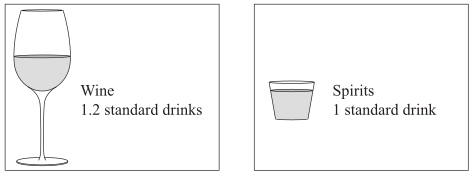
The number of standard drinks in a glass of wine and a glass of spirits is shown.
 

Georgie weighs 58 kg. She consumed 2 glasses of wine and 4 glasses of spirits between 7:45 pm and 12:15 am the following day. She then stopped drinking alcohol.

Using the given formulae, calculate the time in the morning when Georgie's \(BAC\) should reach zero.  (4 marks)

Show Answers Only

\(\text{6:34 am}\)

Show Worked Solution

\(\text{Standard drinks consumed}\ (N)=2\times 1.2+4=6.4\)

\(\text{Hours drinking}\ (H) = \text{4 h 30 min = 4.5 hours}\)

\(BAC_{\text{Georgie}}\) \(=\dfrac{10\times 6.4-7.5\times 4.5}{5.5\times 58}\)
  \(=0.09482\dots\)

COMMENT: Convert a decimal answer into hours and minutes using the calculator degree/minute function.

\(\text{Time (to zero)}\) \(=\dfrac{0.09482\dots}{0.015}\)
  \(=6.3218\dots\ \text{hours}\)
  \(\approx 6\ \text{hours 19 minutes}\)

 
\(\therefore\ \text{Georgie should reach zero}\ BAC\)

\(=12:15+6:19=6:34\ \text{am}\)

Filed Under: Applications: BAC, Medication and D=SxT (Std 2-X) Tagged With: Band 4, smc-5234-10-BAC

v1 Algebra, STD2 A1 SM-Bank 2 MC

Frank lives 45 kilometres from his work.

On Monday, he drove to work and averaged 60 kilometres per hour.

On Wednesday, he took the train which averaged 90 kilometres per hour.

What was the extra time of the car journey on Monday, in minutes, compared to when he caught the train on Wednesday?

  1.  15
  2.  30
  3.  45
  4.  75
Show Answers Only

\(A\)

Show Worked Solution

\(\text{Time}=\dfrac{\text{distance}}{\text{speed}}\)
  

\(\text{Time on Monday}\) \(=\dfrac{45}{60}\)
  \(=0.75\ \text{hour}\)
  \(=45\ \text{minutes}\)


\(\text{Time on Wednesday}\) \(=\dfrac{45}{90}\)
  \(=0.5\ \text{hour}\)
  \(=30\ \text{minutes}\)


\(\therefore\ \text{The extra time driving the car}=45-30=15\ \text{minutes}\)
 

\(\Rightarrow A\)

Filed Under: Applications: BAC, Medication and D=SxT (Std 2-X) Tagged With: Band 4, smc-5234-20-Speed Distance Time

v1 Algebra, STD2 A1 2023 HSC 36

The following formula can be used to calculate an estimate for blood alcohol content (\(BAC\)) for males.
 

\(BAC_{\text{male}}=\dfrac{10N-7.5H}{6.8M}\)

\(N\) is the number of standard drinks consumed

\(M\) is the person's weight in kilograms

\(H\) is the number of hours of drinking
 

Min weighs 70 kg. His \(BAC\) was zero when he began drinking alcohol. At 10:30 pm, after consuming 4 standard drinks, his \(BAC\) was 0.032.

Using the formula, estimate at what time Min began drinking alcohol, to the nearest minute.  (4 marks)

--- 8 WORK AREA LINES (style=lined) ---

Show Answers Only

\(7:12\text{ pm}\)

Show Worked Solution
\(BAC\) \(=\dfrac{10N-7.5H}{6.8M}\)
\(0.032\) \(=\dfrac{10\times 4-7.5\times H}{6.8\times 70}\)
\(0.032\times 476\) \(=40-7.5H\)
\(7.5H\) \(=40-15.232\)
\(H\) \(=\dfrac{24.768}{7.5}\)
  \(=3.3024\ \text{hours}\)
  \(\approx 3\ \text{hours}\ 18\ \text{minutes (nearest minute)}\)

 
\(\text{Time Min began drinking}\)

\(=10:30\text{ pm – 3 h 18 m}\)

\(=7:12\text{ pm}\)

Mean mark 56%.

Filed Under: Applications: BAC, Medication and D=SxT (Std 2-X) Tagged With: Band 4, smc-5234-10-BAC

v1 Algebra, STD2 A1 2010 HSC 24a

Margie tried to solve this equation and made a mistake in Line 2. 

\begin{array}{rl}
3(m+3)-2(m+4)=-5\ &\ \ \ \text{Line 1} \\
3m+9-2m+8=-5\ &\ \ \ \text{Line 2} \\
m+17=-5\ &\ \ \ \text{Line 3} \\
m=-12& \ \ \ \text{Line 4}
\end{array}

  1. Copy the equation in Line 1. Rewrite Line 2 correcting her mistake.   (1 mark)

    --- 2 WORK AREA LINES (style=lined) ---

  2. Continue your solution showing the correct working for Lines 3 and 4 to solve this equation for \(m\).   (1 mark)

    --- 2 WORK AREA LINES (style=lined) ---

Show Answers Only
i.    \(3(m+3)-2(m+4)\) \(=-5\ \ \ \ \ \ \text{Line}\ 1\)
  \(3m+9-2m-8\) \(=-5\ \ \ \ \ \ \text{Line}\ 2\)
ii.    \(m+1\) \(=-5\)
  \(m\) \(=-6\)
Show Worked Solution
i.    \(3(m+3)-2(m+4)\) \(=-5\ \ \ \ \ \ \text{Line}\ 1\)
  \(3m+9-2m-8\) \(=-5\ \ \ \ \ \ \text{Line}\ 2\)


ii.    \(m+1\) \(=-5\ \ \ \ \ \ \text{Line}\ 3\)
  \(m\) \(=-6\ \ \ \ \ \ \text{Line}\ 4\)

Filed Under: Substitution and Other Equations (Std 2-X) Tagged With: Band 4, smc-5233-15-Find the Mistake

v1 Algebra, STD2 A1 2009 HSC 25a

Simplify  \(10-3(x+4)\).    (2 marks)

--- 3 WORK AREA LINES (style=lined) ---

Show Answers Only

 \(-3x-2\)

Show Worked Solution
♦ Mean mark 47%
\(10-3(x+4)\) \(=10-3x-12\)
  \(=-3x-2\)

Filed Under: Substitution and Other Equations (Std 2-X) Tagged With: Band 4, smc-5233-5-Other Equations

v1 Algebra, STD2 A1 2014 HSC 26c

Solve the equation  \(\dfrac{4x-3}{5}-6=7-6x\).   (3 marks)

Show Answers Only

 \(x=2\)

Show Worked Solution
\(\dfrac{4x-3}{5}-6\) \(=7-6x\)
\(4x-3-5\times 6\) \(=5(7-6x)\)
\(4x-3-30\) \(=35-30x\)
\(34x\) \(=68\)
\(\therefore\ x\) \(=2\)

Filed Under: Substitution and Other Equations (Std 2-X) Tagged With: Band 4, smc-5233-30-Algebraic Fractions

v1 Algebra, STD2 A1 2008 HSC 9 MC

What is the value of  \(\sqrt{\dfrac{2x + y}{5x}}\)  if  \(x=5.1\)  and  \(y=3.7\), correct to 2 decimal places? 

  1. \(0.13\)
  2. \(0.74\)
  3. \(3.74\)
  4. \(3.80\)  
Show Answers Only

\(B\)

Show Worked Solution
\(\sqrt{\dfrac{2x+y}{5x}}\) \(=\sqrt{\dfrac{2\times 5.1+3.7}{5\times 5.1}}\)
  \(=\sqrt{\dfrac{13.9}{25.5}}\)
  \(= 0.7383\dots\)

\(\Rightarrow B\)

Filed Under: Substitution and Other Equations (Std 2-X) Tagged With: Band 4, smc-5233-10-Substitute

v1 Algebra, STD2 A1 2005 HSC 14 MC

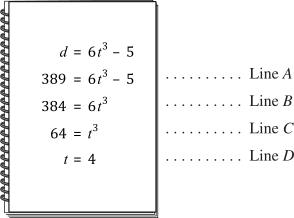
Using the formula  \(d=6t^3-5\), Marcia tried to find the value of  \(t\)  when \(d=389\).

Here is her solution. She has made one mistake.
 

Which line does NOT follow correctly from the previous line?

  1. \(\text{Line}\ A\)
  2. \(\text{Line}\ B\)
  3. \(\text{Line}\ C\)
  4. \(\text{Line}\ D\)
Show Answers Only

\(B\)

Show Worked Solution
\(d\) \(=6t^3-5\)  
\(389\) \(=6t^3-5\ \ \ \) \(\dots\text{ Line A}\)
\(394\) \(=6t^3\) \(\dots\text{ Line B}\)

  
\(\therefore\ \text{Line}\ B\ \text{does not follow on correctly.}\)

\(\Rightarrow B\)

Filed Under: Substitution and Other Equations (Std 2-X) Tagged With: Band 4, smc-5233-15-Find the Mistake

v1 Algebra, STD2 A1 2015 HSC 24 MC

Consider the equation  \(\dfrac{5x}{2}-3=\dfrac{3x}{5}+1\).

Which of the following would be a correct step in solving this equation?

  1. \(\dfrac{5x}{2}-2=\dfrac{3x}{5}\)
  2. \(\dfrac{10x}{4}-4=\dfrac{6x}{5}\)
  3. \(\dfrac{5x}{2}=\dfrac{3x}{5}+4\)
  4. \(5x-3=\dfrac{6x}{5}+2\)
Show Answers Only

\(C\)

Show Worked Solution
\(\dfrac{5x}{2}-3\) \(=\dfrac{3x}{5}+1\)
\(\dfrac{5x}{2}-3+3\) \(=\dfrac{3x}{5}+1+3\)
\(\dfrac{5x}{2}\) \(=\dfrac{3x}{5}+4\)

 
\(\Rightarrow C\)

Filed Under: Substitution and Other Equations (Std 2-X) Tagged With: Band 4, smc-5233-30-Algebraic Fractions

Algebra, STD2 A1 2015 HSC 28d v1

The formula  \(C=\dfrac{5}{9}(F-32)\)  is used to convert temperatures between degrees Fahrenheit \((F)\) and degrees Celsius \((C)\).

Convert 18°C to the equivalent temperature in Fahrenheit.  (2 marks)

--- 5 WORK AREA LINES (style=lined) ---

Show Answers Only

\(64.4\ \text{degrees}\ F\)

Show Worked Solution
\(C\) \(=\dfrac{5}{9}(F-32)\)
\(F-32\) \(=\dfrac{9}{5}C\)
\(F\)  \(=\dfrac{9}{5}C+32\)

 
\(\text{When}\ \ C = 18,\)

\(F\)  \(=\dfrac{9}{5}\times 18+32\)
  \(=64.4\ \text{degrees}\ F\)

Filed Under: Formula Rearrange (Std 2-X), Substitution and Other Equations (Std 2-X) Tagged With: Band 4, eo-derivative (HSC), smc-5232-10-Linear, smc-5233-20-Rearrange and substitute

v1 Algebra, STD2 A1 SM-Bank 8

What is the value of  \(\dfrac{x+y}{xy}\)  if  \(x=-4.3\) and \(y=-2.4\), correct to 1 decimal place?  (2 marks)

Show Answers Only

\(-0.6\ \text{(1 d.p.)}\)

Show Worked Solution
\(\dfrac{x+y}{xy}\) \(=\dfrac{-4.3+(-2.4)}{-4.3\times -2.4}\)
  \(=\dfrac{-6.7}{10.32}\)
  \(=-0.649\dots\)
  \(\approx-0.6\ \text{(1 d.p.)}\)

Filed Under: Substitution and Other Equations (Std 2-X) Tagged With: Band 4, smc-5233-10-Substitute

v1 Algebra, STD2 A1 2016 HSC 5 MC

Which expression is equivalent to  \(2(7x-3)+5\)?

  1. \(14x-1\)
  2. \(14x-8\)
  3. \(14x-11\)
  4. \(14x+2\)
Show Answers Only

\(A\)

Show Worked Solution

\(2(7x-3)+5\)

\(=14x-6+5\)

\(=14x-1\)  
  

\(\Rightarrow A\)

Filed Under: Substitution and Other Equations (Std 2-X) Tagged With: Band 4, smc-5233-5-Other Equations

v1 Algebra, STD2 A1 SM-Bank 10

For adults (18 years and older), the Body Mass Index is given by:
  

\(B=\dfrac{m}{h^2}\),    where  \(m=\) mass in kilograms and  \(h=\) height in metres.
  

The medically accepted healthy range for  \(B\)  is  \(21\leq B\leq 25\).

What is the minimum weight for a 172 cm adult female to be considered healthy, correct to 1 decimal place? (2 marks)

--- 5 WORK AREA LINES (style=lined) ---

Show Answers Only

\(62.1\ \text{kg}\)

Show Worked Solution

\(B=\dfrac{m}{h^2}\)

\(h=172\ \text{cm} =1.72\ \text{m}\)
 

\(\text{Given}\ \ 21\leq B\leq 25,\)

\(\rightarrow\ B = 21\ \text{for minimum healthy weight.}\)

\(21\) \(=\dfrac{m}{1.72^2}\)
\(\therefore\ m\) \(=21\times 1.72^2\)
  \(=62.1264\)
  \(=62.1\ \text{kg}\ \text{(1 d.p.)}\)

Filed Under: Substitution and Other Equations (Std 2-X) Tagged With: Band 4, smc-5233-20-Rearrange and substitute

v1 Algebra, STD1 A1 2020 HSC 18

The distance, \(d\) metres, travelled by a car slowing down from \(u\) km/h to \(v\) km/h can be obtained using the formula

\(v^2=u^2-100 d\)

What distance does a car travel while slowing down from 100 km/h to 70 km/h?   (2 marks)

--- 5 WORK AREA LINES (style=lined) ---

Show Answers Only

\(51\ \text{metres}\)

Show Worked Solution

\(u=100 \ , \ v=70\)

\(v^2\) \(=u^2-100d\)
\(70^2\) \(=100^2-100d\)
\(100d\) \(=100^2-70^2\)
\(\therefore\ d\) \(=\dfrac{100^2-70^2}{100}\)
  \(=51\ \text{metres}\)

Filed Under: Substitution and Other Equations (Std 2-X) Tagged With: Band 4, smc-5233-20-Rearrange and substitute

Algebra, STD2 A1 2012 HSC 21 MC v1

Which of the following correctly expresses \(r\) as the subject of  \(V=\pi r^2+x\) ?

  1. \(r=\pm\sqrt{\dfrac{V}{\pi}}-x\)
  2. \(r=\pm\sqrt{\dfrac{V}{\pi}-x}\)
  3. \(r=\pm\sqrt{\dfrac{V-x}{\pi}}\)
  4. \(r=\pm\dfrac{\sqrt{V-x}}{\pi}\)
Show Answers Only

\(C\)

Show Worked Solution
\(V\) \(=\pi r^2+x\)
\(\pi r^2\) \(=V-x\)
\(r^2\) \(=\dfrac{V-x}{\pi}\)
\(\therefore\ r\) \(=\pm\sqrt{\dfrac{V-x}{\pi}}\)

\(\Rightarrow C\)

Filed Under: Formula Rearrange (Std 2-X) Tagged With: Band 4, eo-derivative (HSC), smc-1200-20-Non-Linear, smc-1201-20-Non-Linear, smc-5232-20-Non-Linear

Algebra, STD2 A1 2010 HSC 18 MC v1

Which of the following correctly express  \(h\)  as the subject of  \(A=\dfrac{bh}{2}\) ?

  1. \(h=\dfrac{A-2}{b}\)
  2. \(h=2A-b\)
  3. \(h=\dfrac{2A}{b}\)
  4. \(h=\dfrac{Ab}{2}\)
Show Answers Only

\(C\)

Show Worked Solution
\(A\) \(=\dfrac{bh}{2}\)
\(bh\) \(=2A\)
\(\therefore\ h\) \(=\dfrac{2A}{b}\)

 
\(\Rightarrow C\)

Filed Under: Formula Rearrange (Std 2-X) Tagged With: Band 4, eo-derivative (HSC), num-title-ct-pathc, num-title-qs-hsc, smc-1200-10-Linear, smc-1201-10-Linear, smc-4362-20-Formula rearrange

Algebra, STD2 A1 2004 HSC 11 MC v1

If  \(m = 8n^2\), what is a possible value of \(n\) when  \(m=7200\)?

  1. \(0.03\)
  2. \(30\)
  3. \(240\)
  4. \(900\)
Show Answers Only

\(B\)

Show Worked Solution
\(m\) \(=8n^2\)
\(n^2\) \(=\dfrac{m}{8}\)
\(n\) \(=\pm\sqrt{\dfrac{m}{8}}\)

 
\(\text{When}\ m=7200:\)

\(n\) \(=\pm\sqrt{\dfrac{7200}{8}}\)
  \(=\pm 30\)

 
\(\Rightarrow B\)

Filed Under: Formula Rearrange (Std 2-X), Substitution and Other Equations (Std 2-X) Tagged With: Band 4, eo-unique, smc-5232-20-Non-Linear, smc-5233-20-Rearrange and substitute

Algebra, STD2 A1 2016 HSC 24 MC v1

Which of the following correctly expresses \(M\) as the subject of  \(y=\dfrac{M}{V}+cX\)?

  1. \(M=Vy-VcX\)
  2. \(M=Vy+VcX\)
  3. \(M=\dfrac{y-cX}{V}\)
  4. \(M=\dfrac{y+cX}{V}\)
Show Answers Only

\(A\)

Show Worked Solution
\(y\) \(=\dfrac{M}{V}+cX\)
\(\dfrac{M}{V}\) \(=y-cX\)
\(\therefore\ M\) \(=V(y-cX)\)
  \(=Vy-VcX\)

 
\(\Rightarrow A\)

Filed Under: Formula Rearrange (Std 2-X) Tagged With: Band 4, eo-derivative (HSC), smc-5232-10-Linear

Algebra, STD2 A1 EO-Bank 6

Make \(r\) the subject of the equation  \(u=\dfrac{5}{4}r+25\).  (2 marks)

Show Answers Only

\(r=\dfrac{4}{5}u-20\)

Show Worked Solution
\(u\) \(=\dfrac{5}{4}r+25\)
\(\dfrac{5}{4}r\) \(=u-25\)
\(r\) \(=\dfrac{4}{5}(u-25)\)
\(r\) \(=\dfrac{4}{5}u-20\)

Filed Under: Formula Rearrange (Std 2-X) Tagged With: Band 4, eo-unique, smc-5232-10-Linear

Algebra, STD2 A1 EO-Bank 11

Make  \(V\)  the subject of the equation  \(E=\dfrac{3}{2}mV^3\).  (3 marks)

--- 6 WORK AREA LINES (style=lined) ---

Show Answers Only

\(v=\sqrt[3]{\dfrac{2E}{3m}}\)

Show Worked Solution
\(E\) \(=\dfrac{3}{2}mV^3\)
\(2E\) \(=3mV^3\)
\(\dfrac{2E}{3}\) \(=mV^3\)
\(V^3\) \(=\dfrac{2E}{3m}\)
\(V\) \(=\sqrt[3]{\dfrac{2E}{3m}}\)

Filed Under: Formula Rearrange (Std 2-X) Tagged With: Band 4, eo-unique, smc-5232-20-Non-Linear

Algebra, STD2 A1 EO-Bank 12

Make  \(x\)  the subject of the equation  \(y=\dfrac{2}{7}(x-25)\).  (2 marks)

Show Answers Only

\(x=\dfrac{7y}{2}+25\)

Show Worked Solution
\(y\) \(=\dfrac{2}{7}(x-25)\)
\(7y\) \(=2(x-25)\)
\(\dfrac{7y}{2}\) \(=x-25\)
\(\therefore\ x\) \(=\dfrac{7y}{2}+25\)

Filed Under: Formula Rearrange (Std 2-X) Tagged With: Band 4, eo-unique, smc-5232-10-Linear

Algebra, STD1 A1 2019 HSC 34 v1

Given the formula  \(D=\dfrac{B(x+1)}{18}\), calculate the value of  \(x\)  when  \(D=90\)  and  \(B=400\).  (3 marks)

--- 6 WORK AREA LINES (style=lined) ---

Show Answers Only

\(3.05\)

Show Worked Solution

\(\text{Make}\ x\ \text{the subject:}\)

\(D\) \(=\dfrac{B(x+1)}{18}\)
\(18D\) \(=B(x+1)\)
\(x+1\) \(=\dfrac{18D}{B}\)
\(x\) \(=\dfrac{18D}{B}-1\)
\(\text{When }\) \(D=90, B=400\)
\(\therefore\ x\) \(=\dfrac{18\times 90}{400}-1=3.05\)

Filed Under: Formula Rearrange (Std 2-X), Substitution and Other Equations (Std 2-X) Tagged With: Band 4, eo-derivative (HSC), smc-5232-10-Linear, smc-5233-20-Rearrange and substitute, std2-std1-common

Algebra, STD2 A1 2022 HSC 14 MC v1

Which of the following correctly expresses \(x\) as the subject of  \(y=\dfrac{mx-c}{3}\) ?

  1. \(x=\dfrac{3y}{m}+c\)
  2. \(x=\dfrac{y}{3m}+c\)
  3. \(x=\dfrac{y+c}{3m}\)
  4. \(x=\dfrac{3y+c}{m}\)
Show Answers Only

\(D\)

Show Worked Solution
\(y\) \(=\dfrac{mx-c}{3}\)
\(3y\) \(=mx-c\)
\(mx\) \(=3y+c\)
\(\therefore\ x\) \(=\dfrac{3y+c}{m}\)

 
\(\Rightarrow D\)

Filed Under: Formula Rearrange (Std 2-X) Tagged With: Band 4, eo-derivative (HSC), smc-5232-10-Linear

  • « Previous Page
  • 1
  • …
  • 35
  • 36
  • 37
  • 38
  • 39
  • …
  • 114
  • Next Page »

Copyright © 2014–2025 SmarterEd.com.au · Log in