SmarterEd

Aussie Maths & Science Teachers: Save your time with SmarterEd

  • Login
  • Get Help
  • About

BIOLOGY, M8 2023 HSC 12 MC

The following diagram shows the regulation of blood calcium \(\ce{(Ca^{2+})}\) levels in the body.
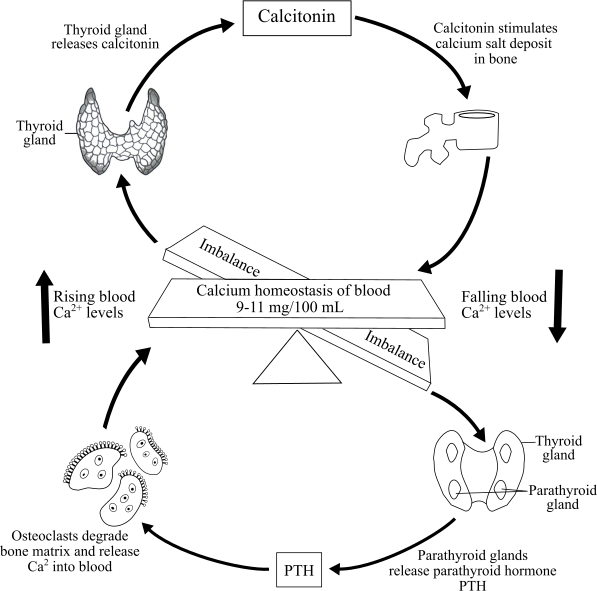


A blood test shows a person has a blood calcium level of 6 mg/100 mL.

What will occur in the body to restore homeostasis?

  1. Calcium will be deposited in the bones.
  2. Calcium will be removed from the bone matrix.
  3. The thyroid gland will release the hormone thyroxine.
  4. The thyroid gland will release the hormone calcitonin.
Show Answers Only

\(B\)

Show Worked Solution
  • 6 mg/100 mL is lower than the homeostasis concentration range.
  • This means that the parathyroid gland will release PTH causing \(\ce{Ca^{2+}}\) ions to be removed from the bone matrix.

\(\Rightarrow B\)

Mean mark 58%.

Filed Under: Homeostasis Tagged With: Band 4, smc-3659-12-Negative Feedback Loops

BIOLOGY, M5 2023 HSC 11 MC

The diagram shows part of a protein molecule.
 

Which row of the table is correct?

\begin{align*}
\begin{array}{l}
\rule{0pt}{2.5ex}\ \rule[-1ex]{0pt}{0pt}& \\
\rule{0pt}{2.5ex} \textbf{A.}\rule[-1ex]{0pt}{0pt}\\
\rule{0pt}{2.5ex} \textbf{B.}\rule[-1ex]{0pt}{0pt}\\
\rule{0pt}{2.5ex} \textbf{C.}\rule[-1ex]{0pt}{0pt}\\
\rule{0pt}{2.5ex} \textbf{D.}\rule[-1ex]{0pt}{0pt}\\
\end{array}
\begin{array}{|c|c|}
\hline \rule{0pt}{2.5ex}X \rule[-1ex]{0pt}{0pt}& \textit{Level of protein structure} \\
\hline \rule{0pt}{2.5ex} \text {Amino Acid} \rule[-1ex]{0pt}{0pt}& \text {Primary} \\
\hline \rule{0pt}{2.5ex} \text {Amino Acid} \rule[-1ex]{0pt}{0pt}& \text {Secondary} \\
\hline \rule{0pt}{2.5ex} \text {Polypeptide} \rule[-1ex]{0pt}{0pt}& \text {Primary} \\
\hline \rule{0pt}{2.5ex} \text {Polypeptide} \rule[-1ex]{0pt}{0pt}& \text {Secondary} \\
\hline
\end{array}
\end{align*}

Show Answers Only

\(A\)

Show Worked Solution
  • The diagram shows that \(X\) is an amino acid which is part of the polypeptide chain, and therefore the level of protein structure is primary.

\(\Rightarrow A\)

Filed Under: DNA and Polypeptide Synthesis Tagged With: Band 4, smc-3650-60-Proteins

BIOLOGY, M6 2023 HSC 10 MC

The diagram shows a bacterial cell that will be used to produce a protein.
 

Which component would be inserted into gap \(X\) ?

  1. A cell
  2. A gene
  3. An amino acid
  4. A chromosome
Show Answers Only

\(B\)

Show Worked Solution
  • A gene will be inserted into the bacteria's DNA so that it can produce the associated protein of interest.

\(\Rightarrow B\)

Filed Under: Genetic Technologies Tagged With: Band 4, smc-3654-80-Gene Cloning

BIOLOGY, M5 2023 HSC 9 MC

Sheep have 54 chromosomes, while goats have 60 chromosomes. The hybrid offspring of a sheep-goat pairing is called a geep.

During fertilisation, an egg from the sheep is fertilised by a sperm from the goat, resulting in a geep.

Which of the following will be correct for the geep?

  1. \(n\) = 29 chromosomes
  2.  \(n\) = 52 chromosomes
  3. \(2n\) = 57 chromosomes
  4. \(2n\) = 114 chromosomes
Show Answers Only

\(C\)

Show Worked Solution
  • \(54 + 60 = 114\)
  • \(114\ ÷\ 2 = 57\)

\(\Rightarrow C\)

Filed Under: Genetic Variation / Inheritance Tagged With: Band 4, smc-3648-60-Karyotypes

BIOLOGY, M7 2023 HSC 8 MC

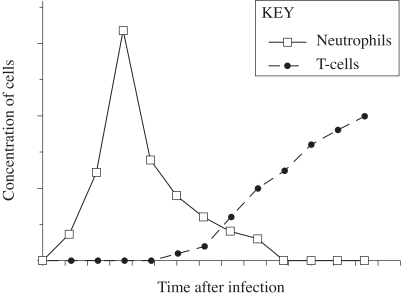
Neutrophils and T-cells are cells of the human immune system. After an infection, the concentration of these types of cells in infected tissue was plotted as a function of time.
 

Based on the data provided, neutrophils are part of which human immune system?

  1. Acquired
  2. Adaptive
  3. Innate
  4. Primary
Show Answers Only

\(C\)

Show Worked Solution
  • The relatively quick spike in neutrophil concentration when compared to the T-cells (which are part of the specific immune response) would indicate they are part of the innate/non-specific immune response.

\(\Rightarrow C\)

Filed Under: Immunity and Responses to Pathogens Tagged With: Band 4, smc-3657-20-Cell Mediated, smc-3657-30-Innate Response (2nd Line)

BIOLOGY, M6 2023 HSC 4 MC

The following diagram shows a summary of the process of artificial pollination.
 

The purpose of Process \(B\) is to

  1. produce seeds.
  2. collect the pollen.
  3. fertilise the flower.
  4. prevent self-pollination.
Show Answers Only

\(D\)

Show Worked Solution
  • Process \(B\) shows removal of the anthers of the plant.
  • The anthers contain the pollen and male gametes of the plant, hence by removing them, self-pollination is prevented.

\(\Rightarrow D\)

Filed Under: Genetic Technologies Tagged With: Band 4, smc-3654-51-Reproductive Technologies

BIOLOGY, M8 2023 HSC 1 MC

A cochlear implant is a device that is used to assist with hearing loss.

What does the cochlear implant electrode array stimulate?

  1. Hairs
  2. Ossicles
  3. Oval window
  4. Auditory nerve
Show Answers Only

\(D\)

Show Worked Solution
  • The cochlear implant is able to bypass a dysfunctional cochlear and directly stimulate the auditory nerve.

\(\Rightarrow D\)

Filed Under: Technologies and Disorders Tagged With: Band 4, smc-3663-30-Ears

Vectors, EXT2 V1 2023 HSC 15b

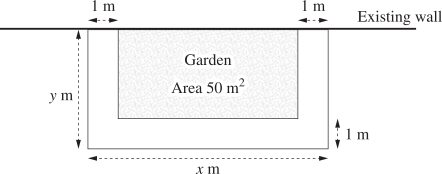
On the triangular pyramid \(A B C D, L\) is the midpoint of \(A B, M\) is the midpoint of \(A C, N\) is the midpoint of \(A D, P\) is the midpoint of \(C D, Q\) is the midpoint of \(B D\) and \(R\) is the midpoint of \(B C\).
 

Let  \(\underset{\sim}{b}=\overrightarrow{A B}, \underset{\sim}{c}=\overrightarrow{A C}\)  and  \(\underset{\sim}{d}=\overrightarrow{A D}\).

  1. Show that \(\overrightarrow{L P}=\dfrac{1}{2}(-\underset{\sim}{b}+\underset{\sim}{c}+\underset{\sim}{d})\).  (1 mark)

    --- 4 WORK AREA LINES (style=lined) ---

  2. It can be shown that

\(\overrightarrow{M Q}=\dfrac{1}{2}(\underset{\sim}{b}-\underset{\sim}{c}+\underset{\sim}{d})\)  and

\(\overrightarrow{N R}=\dfrac{1}{2}(\underset{\sim}{b}+\underset{\sim}{c}-\underset{\sim}{d})\).   (Do NOT prove these.) 

  1. Prove that

  \( \Big{|}\overrightarrow{A B}\Big{|}^2+\Big{|}\overrightarrow{A C}\Big{|}^2+\Big{|}\overrightarrow{A D}\Big{|}^2+\Big{|}\overrightarrow{B C}\Big{|}^2+\Big{|}\overrightarrow{B D}\Big{|}^2+\Big{|}\overrightarrow{C D}\Big{|}^2 \)

\(=4\left(\Big{|}\overrightarrow{L P}\Big{|}^2+\Big{|}\overrightarrow{M Q}\Big{|}^2+\Big{|}\overrightarrow{N R}\Big{|}^2\right)\)  (3 marks)

--- 10 WORK AREA LINES (style=lined) ---

Show Answers Only
  1. \(\text{See Worked Solutions}\)
  2. \(\text{Proof (See Worked Solutions)}\)
Show Worked Solution
i.     \(\overrightarrow{LP}\) \(=\overrightarrow{LA}+\overrightarrow{AC}+\overrightarrow{CP} \)
    \(=\dfrac{1}{2} \overrightarrow{BA}+\overrightarrow{AC}+\dfrac{1}{2}\overrightarrow{CD} \)
    \(=-\dfrac{1}{2} \underset{\sim}b +\underset{\sim}c + \dfrac{1}{2}(\underset{\sim}d-\underset{\sim}c) \)
    \(=-\dfrac{1}{2} \underset{\sim}b +\underset{\sim}c + \dfrac{1}{2}\underset{\sim}d-\dfrac{1}{2}\underset{\sim}c\)
    \(=\dfrac{1}{2} (-\underset{\sim}b+\underset{\sim}c+\underset{\sim}d) \)


ii.   \(\overrightarrow{M Q}=\dfrac{1}{2}(\underset{\sim}{b}-\underset{\sim}{c}+\underset{\sim}{d})\)

\(\overrightarrow{N R}=\dfrac{1}{2}(\underset{\sim}{b}+\underset{\sim}{c}-\underset{\sim}{d})\).

\(\text{RHS}\) \(=4\left(\Big{|}\overrightarrow{L P}\Big{|}^2+\Big{|}\overrightarrow{M Q}\Big{|}^2+\Big{|}\overrightarrow{N R}\Big{|}^2\right)\)  
  \(=4\left(\overrightarrow{L P}\cdot \overrightarrow{L P} +\overrightarrow{MQ}\cdot \overrightarrow{MQ} +\overrightarrow{NR}\cdot \overrightarrow{NR}\right)\)  
  \(=4\Bigg{(}\dfrac{1}{4}(-\underset{\sim}b+\underset{\sim}c+\underset{\sim}d) \cdot(-\underset{\sim}b+\underset{\sim}c+\underset{\sim}d) +  \)  
  \( \dfrac{1}{4}(\underset{\sim}{b}-\underset{\sim}{c}+\underset{\sim}{d}) \cdot(\underset{\sim}{b}-\underset{\sim}{c}+\underset{\sim}{d}) +  \)  
  \( \dfrac{1}{4}(\underset{\sim}{b}+\underset{\sim}{c}-\underset{\sim}{d}) \cdot(\underset{\sim}{b}+\underset{\sim}{c}-\underset{\sim}{d}) \Bigg{)}\)  
  \(=(\underset{\sim}c+(\underset{\sim}d-\underset{\sim}b)) \cdot(\underset{\sim}c+(\underset{\sim}d-\underset{\sim}b))+(\underset{\sim}d+(\underset{\sim}b-\underset{\sim}c))\cdot (\underset{\sim}d+(\underset{\sim}b-\underset{\sim}c)) + \)  
  \( (\underset{\sim}b+(\underset{\sim}c-\underset{\sim}d))\cdot (\underset{\sim}b+(\underset{\sim}c-\underset{\sim}d))  \)  
  \(=|\underset{\sim}c|^2+2\underset{\sim}c(\underset{\sim}d-\underset{\sim}b) + |\underset{\sim}d-\underset{\sim}b|^2 + \)  
  \(|\underset{\sim}d|^2+2\underset{\sim}d(\underset{\sim}b-\underset{\sim}c) + |\underset{\sim}b-\underset{\sim}c|^2 + \)  
  \( |\underset{\sim}b|^2+2\underset{\sim}b(\underset{\sim}c-\underset{\sim}d) + |\underset{\sim}c-\underset{\sim}d|^2 \)  
  \(=|\underset{\sim}b|^2+|\underset{\sim}c|^2+|\underset{\sim}d|^2+|\underset{\sim}b-\underset{\sim}c|^2+|\underset{\sim}d-\underset{\sim}b|^2+|\underset{\sim}c-\underset{\sim}d|^2 + \)  
  \( 2(\underset{\sim}c \cdot\underset{\sim}d-\underset{\sim}c \cdot\underset{\sim}b+\underset{\sim}d \cdot\underset{\sim}b-\underset{\sim}d \cdot\underset{\sim}c+\underset{\sim}b \cdot\underset{\sim}c-\underset{\sim}b \cdot\underset{\sim}d) \)  
  \(=\Big{|}\overrightarrow{A B}\Big{|}^2+\Big{|}\overrightarrow{A C}\Big{|}^2+\Big{|}\overrightarrow{A D}\Big{|}^2+\Big{|}\overrightarrow{B C}\Big{|}^2+\Big{|}\overrightarrow{B D}\Big{|}^2+\Big{|}\overrightarrow{C D}\Big{|}^2 + 0\)  
  \(=\ \text{LHS} \)  

♦♦ Mean mark (ii) 34%.

Filed Under: Vectors and Geometry Tagged With: Band 4, Band 5, smc-1210-20-Pyramid, smc-1210-70-3D problems

BIOLOGY, M3 EQ-Bank 23

Explain how the finches on the Galapagos Islands support Darwin's theory of Natural Selection.   (5 marks)

--- 10 WORK AREA LINES (style=lined) ---

Show Answers Only
  • The diversity between finches that exist on seperate islands in the Galapagos can be explained by Darwin’s theory of evolution and Natural Selection.
  • It is believed that a few million years ago, one species of finch migrated to the rocky Galapagos from Central or South America. This finch species can be considered the common ancestor.
  • As the finch species spread out between the islands, the ecological niches of each island placed different selection pressures that pushed the two finch populations in different directions.
  • Some random variations that provided a breeding or survival advantage became more prevalent after generations because finches with the advantage reproduced more.
  • This process resulted in the development of different finch species between the islands, each with varying beak sizes and shapes which were better suited to the different diets on each island. For example, one species that eat grubs developed longer beaks to poke into holes and extract the grubs.
  • In this way, the varying finch species observed by Darwin provides evidence for his theory of Natural Selection.
Show Worked Solution
  • The diversity between finches that exist on seperate islands in the Galapagos can be explained by Darwin’s theory of evolution and Natural Selection.
  • It is believed that a few million years ago, one species of finch migrated to the rocky Galapagos from Central or South America. This finch species can be considered the common ancestor.
  • As the finch species spread out between the islands, the ecological niches of each island placed different selection pressures that pushed the two finch populations in different directions.
  • Some random variations that provided a breeding or survival advantage became more prevalent after generations because finches with the advantage reproduced more.
  • This process resulted in the development of different finch species between the islands, each with varying beak sizes and shapes which were better suited to the different diets on each island. For example, one species that eat grubs developed longer beaks to poke into holes and extract the grubs.
  • In this way, the varying finch species observed by Darwin provides evidence for his theory of Natural Selection.

Filed Under: Adaptations Tagged With: Band 4, smc-4308-50-Galapagos

BIOLOGY, M3 EQ-Bank 5-6 MC

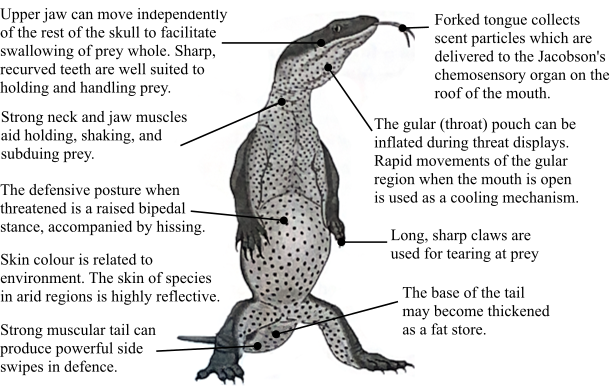
The following diagram shows features which relate to the goanna.
 

Question 5

Which of the following features is a behavioural adaptation?

  1. Skin colour related to the environment.
  2. The base of the tail becoming thick to store fat.
  3. Long, sharp claws that are used for tearing at prey.
  4. Rapid movements of the gular region to cool down.

 
Question 6

Which of the following features is a physiological adaptation?

  1. Skin colour related to the environment.
  2. The base of the tail becoming thick to store fat.
  3. Long, sharp claws that are used for tearing at prey.
  4. Rapid movements of the gular region to cool down.
Show Answers Only

Question 5: \(D\)

Question 6: \(B\)

Show Worked Solution

Question 5

  • A behavioural adaptation is an action that is carried out by the organism. This would be the action of moving the gular region to cool down.

\(\Rightarrow D\)
 

Question 6

  • A physiological adaptation is a process which occurs within the organism. This would be the thickening of the tail to store fat.

\(\Rightarrow B\) 

Filed Under: Adaptations Tagged With: Band 4, smc-4308-15-Physiological adaptations, smc-4308-18-Behavioural adaptations

BIOLOGY, M2 EQ-Bank 21

Describe two key differences between colonial and multicellular organisms.   (2 marks)

Show Answers Only
  • Colonial organisms do not exhibit specialisation. Each cell in the colony is the same but they are connected in such a way to enhance processes such as food gathering and production.
  • Multicellular organisms do consist of specialised cells, each of which will carry out one specific function which will benefit the whole organism.
Show Worked Solution
  • Colonial organisms do not exhibit specialisation. Each cell in the colony is the same but they are connected in such a way to enhance processes such as food gathering and production.
  • Multicellular organisms do consist of specialised cells, each of which will carry out one specific function which will benefit the whole organism.

Filed Under: Organisation of Cells Tagged With: Band 4, smc-4304-20-Multicellular, smc-4304-30-Colonial

BIOLOGY, M2 EQ-Bank 4 MC

What component of a mature red blood cell relates to its function?

  1. Its biconcave shape allows them to move quicker.
  2. Its biconcave shape allows them to more effectively carry antibodies.
  3. The reduction of the nucleus allows for more effective duplication via mitosis.
  4. The reduction of the nucleus allow them to carry more haemoglobin and hence more \( \ce{O_2}\).
Show Answers Only

\(D\)

Show Worked Solution

By Elimination

  • The biconcave shape allows for greater manoeuvrability, especially through tight areas like capillaries (Eliminate A and B).
  • The reduction of a large nucleus allows more space for haemoglobin molecules (Eliminate C).

\(\Rightarrow D\)

Filed Under: Organisation of Cells Tagged With: Band 4, smc-4304-40-Cell Specialisation

BIOLOGY, M2 EQ-Bank 3 MC

Which of the following does NOT occur in the mouth?

  1. Lubrication of food.
  2. Breakdown of starch.
  3. Beginning of protein digestion.
  4. Breakdown of food into smaller fragments.
Show Answers Only

\(C\)

Show Worked Solution

By Elimination

  • Saliva in the mouth lubricates food to help in pass through the oesophagus easier (Eliminate A).
  • The enzyme amylase, found in saliva, is able to breakdown starch into maltose (Eliminate B).
  • Chewing breaks down food into smaller pieces which both allows for easier movement through the rest of the digestive system and increasing surface area to allow enzymes to work more effectively (Eliminate D).
  • The breakdown of proteins begins in the stomach as it contains the adequate enzymes.

\(\Rightarrow C\)

Filed Under: Nutrient and Gas Requirements Tagged With: Band 4, smc-4305-52-Digestive system

BIOLOGY, M1 EQ-Bank 2 MC

Which of the following best describes the fluid-mosaic model of the cell membrane?

  1. Phospholipid bilayer with a protein coating.
  2. Phospholipid bilayer with embedded proteins.
  3. Phospholipid monolayer with protein coating.
  4. Phospholipid monolayer with embedded proteins.
Show Answers Only

\(B\) 

Show Worked Solution

By Elimination

  • The model has it’s phospholipids arranged in a bilayer, with the heads facing outwards and the tails facing each other inward (Eliminate C and D).
  • The model’s proteins do not form a coat around the membrane, but are rather embedded within different locations within the bilayer depending on their function (Eliminate A).

\(\Rightarrow B\)

Filed Under: Cell Structure Tagged With: Band 4, smc-4302-50-Cell membrane

Calculus, EXT2 C1 2023 HSC 15a

  1. Let  \(J_n= {\displaystyle \int_0^{\frac{\pi}{2}}} \sin ^n \theta \ d \theta\)  where \(n \geq 0\) is an integer. 
  2. Show that  \(J_n=\dfrac{n-1}{n} J_{n-2}\)  for all integers \(n \geq 2\).  (3 marks)

    --- 9 WORK AREA LINES (style=lined) ---

  3. Let  \(I_n={\displaystyle \int_0^1 x^n(1-x)^n}\, dx \)  where \( n \)  is a positive integer.
  4. By using the substitution  \(x=\sin ^2 \theta\), or otherwise,
  5. show that  \( I_n=\dfrac{1}{2^{2 n}} {\displaystyle \int_0^{\frac{\pi}{2}}} \sin ^{2 n+1} \theta \ d \theta \).  (4 marks)

    --- 12 WORK AREA LINES (style=lined) ---

  6. Hence, or otherwise, show that  \(I_n=\dfrac{n}{4 n+2} I_{n-1}\), for all integers  \(n \geq 1\).   (2 marks)

    --- 8 WORK AREA LINES (style=lined) ---

Show Answers Only
  1. \(\text{See Worked Solutions}\)
  2. \(\text{See Worked Solutions}\)
  3. \(\text{See Worked Solutions}\)
Show Worked Solution
i.    \(J_n\) \(= \displaystyle \int_0^{\frac{\pi}{2}} \sin^{n}\, \theta\, d\theta \)  
    \(= \displaystyle \int_0^{\frac{\pi}{2}} \sin^{n-1}\, \theta \cdot \sin\,\theta\, d\theta \)  

 
\(\text{Integrating by parts:} \)

\(u\) \(=\sin^{n-1}\, \theta \) \(u^{′}=(n-1) \cos\, \theta \cdot \sin^{n-2}\,\theta \)
\(v\) \(=-\cos\,\theta \) \(v^{′}=\sin \, \theta\)
\(J_n\) \(= \big{[} -\cos\,\theta \cdot \sin^{n-1}\,\theta \big{]}_0^{\frac{\pi}{2}} + (n-1) \displaystyle \int_0^{\frac{\pi}{2}} \cos^{2} \theta \cdot \sin^{n-2}\theta\, d\theta\)  
  \(=(n-1) \displaystyle \int_0^{\frac{\pi}{2}} (1-\sin^{2} \theta) \sin^{n-2}\theta\, d\theta\)  
  \(=(n-1) \displaystyle \int_0^{\frac{\pi}{2}} \sin^{n-2}\theta-\sin^{n}\theta\, d\theta\)  
  \(=(n-1)J_{n-2}-(n-1)J_n \)  
\(J_n+(n-1)J_n \) \(=(n-1)J_{n-2} \)  
\(J_n(1+n-1) \) \(=(n-1) J_{n-2} \)  
\(J_n\) \(= \dfrac{n-1}{n} J_{n-2} \)  


ii.   \(I_n= \displaystyle \int_0^1 x^{n}(1-x)^n\,dx \)

\(\text{Let}\ \ x=\sin^{2}\,\theta \)

\(\dfrac{dx}{d\theta}=2\sin\,\theta\, \cos\,\theta \ \Rightarrow \ dx=2\sin\,\theta \,\cos\,\theta\,d\theta \)

\(\text{When}\ \ x=1, \ \theta=\dfrac{\pi}{2}; \ \ x=0, \ \theta=0 \)

\(I_n\) \(= \displaystyle \int_0^{\frac{\pi}{2}} \sin^{2n}\,\theta(1-\sin^{2}\,\theta)^{n} \cdot 2\sin\,\theta \,\cos\,\theta\,d\theta \)  
  \(= 2 \displaystyle \int_0^{\frac{\pi}{2}} \sin^{2n+1}\,\theta \cdot \cos^{2n+1}\,\theta\,d\theta \)  
  \(=\dfrac{2}{2^{2n+1}} \displaystyle \int_0^{\frac{\pi}{2}} (2\sin\,\theta\,\cos\,\theta)^{2n+1} d\theta \)  
  \(=\dfrac{1}{2^{2n}} \displaystyle \int_0^{\frac{\pi}{2}} \sin^{2n+1}(2\theta)\, d\theta \)  

 
\(\text{Let}\ \ u=2\theta \)

\(\dfrac{du}{d\theta}=2\ \ \Rightarrow\ \ \dfrac{du}{2}=d\theta\)

\(\text{When}\ \ \theta=\dfrac{\pi}{2}, \ u=\pi; \ \theta=0, \ u=0 \)

\(I_n=\dfrac{1}{2^{2n+1}} \displaystyle \int_0^{n} \sin^{2n+1} u\, du\)

 
\(\text{Since}\ \ \sin^{2n+1} u\ \ \text{is symmetrical about}\ \ u=\dfrac{\pi}{2} \)

\(\Rightarrow \displaystyle \int_0^{\pi} \sin^{2n+1} u\,du=2\displaystyle \int_0^{\frac{\pi}{2}} \sin^{2n+1} u\,du \)

\(I_n\) \(= \dfrac{1}{2^{2n+1}} \cdot 2\displaystyle \int_0^{\frac{\pi}{2}} \sin^{2n+1} u\,du \)  
  \(= \dfrac{1}{2^{2n}} \displaystyle \int_0^{\frac{\pi}{2}} \sin^{2n+1} u\,du \)  

 
\(\text{Which can be expressed as:}\)

\(I_n= \dfrac{1}{2^{2n}}  \displaystyle \int_0^{\frac{\pi}{2}} \sin^{2n+1} \theta\, d\theta \)
 

♦♦ Mean mark (ii) 34%.
iii.    \(I_n\) \(=\dfrac{1}{2^{2n}}  \displaystyle \int_0^{\frac{\pi}{2}} \sin^{2n+1} \theta\, d\theta \)
    \(=\dfrac{1}{2^{2n}} J_{2n+1} \ \ \ \text{(by definition)}\)
    \(=\dfrac{1}{2^{2n}} \cdot \underbrace{\dfrac{2n}{2n+1} \cdot J_{2n+1}}_{\text{using part i}}  \)
    \(= \dfrac{n}{2(2n+1)} \cdot \dfrac{2^2}{2^{2n}}\cdot J_{2n-1} \)
    \(= \dfrac{n}{4n+2} \cdot \underbrace{\dfrac{1}{2^{2n-2}}\cdot J_{2n-1}}_{=I_{n-1} \ \ \text{(using part ii)}} \)
    \(=\dfrac{n}{4 n+2} I_{n-1}\)
♦♦ Mean mark (iii) 28%.

Filed Under: Recurrence Relations Tagged With: Band 4, Band 5, smc-1054-10-Trig

Complex Numbers, EXT2 N2 2023 14a

Let \(z\) be the complex number  \(z=e^{\small{\dfrac{i \pi}{6}}} \)  and \(w\) be the complex number  \(w=e^{\small{\dfrac{3 i \pi}{4}}} \).

  1. By first writing \(z\) and \(w\) in Cartesian form, or otherwise, show that
  2.    \(|z+w|^2=\dfrac{4-\sqrt{6}+\sqrt{2}}{2}\).  (3 marks)

    --- 6 WORK AREA LINES (style=lined) ---

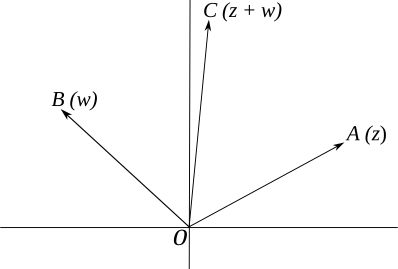
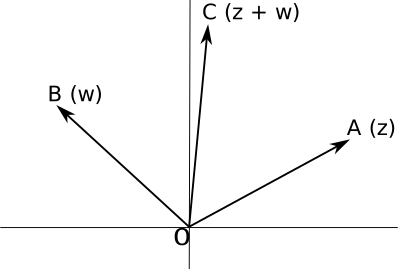
  3. The complex numbers \(z, w\) and \(z+w\) are represented in the complex plane by the vectors \(\overrightarrow{O A},\overrightarrow{O B}\) and \(\overrightarrow{O C}\) respectively, where \(O\) is the origin.
  4. Show that  \(\angle A O C=\dfrac{7 \pi}{24}\).  (2 marks)

    --- 8 WORK AREA LINES (style=lined) ---

  5. Deduce that  \(\cos \dfrac{7 \pi}{24}=\dfrac{\sqrt{8-2 \sqrt{6}+2 \sqrt{2}}}{4}\).  (1 mark)

    --- 5 WORK AREA LINES (style=lined) ---

Show Answers Only
  1. \(\text{See Worked Solutions}\)
  2. \(\text{See Worked Solutions}\)
  3. \(\text{See Worked Solutions}\)
Show Worked Solution

i.    \(z=e^{\small\dfrac{i \pi}{6}} = \cos\,\dfrac{\pi}{6} + i \,\sin\,\dfrac{\pi}{6} = \dfrac{\sqrt3}{2} + \dfrac{1}{2}i \)

\(w=e^{\small\dfrac{3i \pi}{4}} = \cos\,\dfrac{3\pi}{4} + i \,\sin\,\dfrac{3\pi}{4} = -\dfrac{1}{\sqrt2} + \dfrac{i}{\sqrt2} \)

\(|z+w|^2\) \(=\Bigg{|} \dfrac{\sqrt3}{2}+\dfrac{1}{2}i-\dfrac{1}{\sqrt2}+\dfrac{i}{\sqrt2} \Bigg{|}\)  
  \(=\Bigg{|} \Bigg{(}\dfrac{\sqrt3}{2}-\dfrac{1}{\sqrt2} \Bigg{)} +\Bigg{(}\dfrac{1}{2}+\dfrac{1}{\sqrt2}\Bigg{)}\,i \Bigg{|}\)  
  \(=\Bigg{|} \dfrac{\sqrt6-2}{2\sqrt2}+\dfrac{\sqrt2+2}{2\sqrt2}\,i \Bigg{|}\)  
  \(= \dfrac{(\sqrt6-2)^2+(\sqrt2+2)^2}{(2\sqrt2)^2}\)  
  \(= \dfrac{6-4\sqrt6+4+2+4\sqrt2+4}{8}\)  
  \(=\dfrac{16-4\sqrt6+4\sqrt2}{8} \)  
  \(=\dfrac{4-\sqrt6+\sqrt2}{2} \)  

 
ii.   

\(\angle AOB= \arg(w)-\arg(z)=\dfrac{3\pi}{4}-\dfrac{\pi}{6}=\dfrac{7\pi}{12} \)

\( |z|=|w|=1\ \Rightarrow AOBC\ \text{is a rhombus.} \)

\(\overrightarrow{OC}\ \text{is a diagonal of rhombus}\ AOBC \)

\(\Rightarrow \overrightarrow{OC}\ \text{bisects}\ \angle AOB \)

\(\therefore \angle AOC= \dfrac{1}{2} \times \dfrac{7\pi}{12}=\dfrac{7\pi}{24} \)
  

iii.   \(\text{In}\ \triangle AOC: \)

\( \overrightarrow{AC}=\overrightarrow{OC}-\overrightarrow{OA} = \overrightarrow{OB} \)

\(\Rightarrow \overrightarrow{OB}\ \text{is represented by}\ w. \)
 

\(\text{Using the cos rule in}\ \triangle AOC: \)

\(\cos\,\dfrac{7\pi}{24}\) \(=\dfrac{|z|^2+|z+w|^2-|w|^2}{2|z||z+w|}\)  
  \(=\dfrac{ 1+\frac{4-\sqrt6+\sqrt2}{2}-1}{2 \times 1  \sqrt{\frac{4-\sqrt6+\sqrt2}{2}}} \)  
  \(=\dfrac{\sqrt{\frac{4-\sqrt6+\sqrt2}{2}} \times 2} {2 \times 2} \)  
  \(=\dfrac{\sqrt{4( \frac{4-\sqrt6+\sqrt2}{2})}} {4} \)  
  \(=\dfrac{8-2\sqrt6+2\sqrt2}{4} \)  
♦♦ Mean mark (iii) 26%.

Filed Under: Geometrical Implications of Complex Numbers Tagged With: Band 3, Band 4, Band 5, smc-1052-60-Other problems, smc-1052-70-Vectors

Mechanics, EXT2 M1 2023 HSC 13c

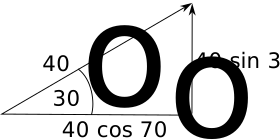
A particle of mass 1 kg is projected from the origin with speed 40 m s\( ^{-1}\) at an angle 30° to the horizontal plane.

  1. Use the information above to show that the initial velocity of the particle is
  2.     \(\mathbf{v}(0)={\displaystyle\left(\begin{array}{cc}20 \sqrt{3} \\ 20\end{array}\right)} \).   (1 mark)

    --- 6 WORK AREA LINES (style=lined) ---

The forces acting on the particle are gravity and air resistance. The air resistance is proportional to the velocity vector with a constant of proportionality 4 . Let the acceleration due to gravity be 10 m s \( ^{-2}\).

The position vector of the particle, at time \(t\) seconds after the particle is projected, is \(\mathbf{r}(t)\) and the velocity vector is \(\mathbf{v}(t)\).
 

  1. Show that  \(\mathbf{v}(t)={\displaystyle \left(\begin{array}{cc}20 \sqrt{3} e^{-4 t} \\ \dfrac{45}{2} e^{-4 t}-\dfrac{5}{2}\end{array}\right)}\)  (3 marks)

    --- 12 WORK AREA LINES (style=lined) ---

  2. Show that  \(\mathbf{r}(t)=\left(\begin{array}{c}5 \sqrt{3}\left(1-e^{-4 t}\right) \\ \dfrac{45}{8}\left(1-e^{-4 t}\right)-\dfrac{5}{2} t\end{array}\right)\)  (2 marks)

    --- 10 WORK AREA LINES (style=lined) ---

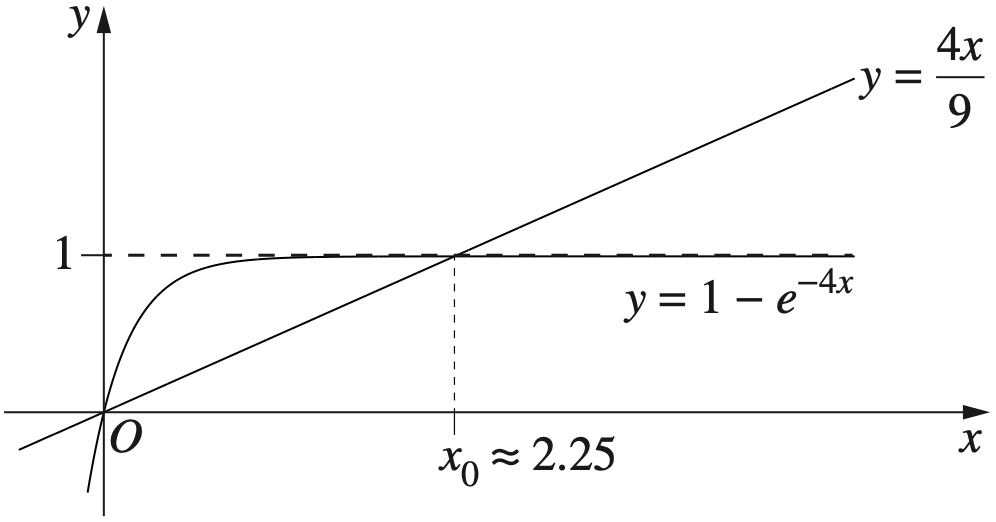
  3. The graphs  \(y=1-e^{-4 x}\)  and  \(y=\dfrac{4 x}{9}\) are given in the diagram below.
     
     
  4. Using the diagram, find the horizontal range of the particle, giving your answer rounded to one decimal place.  (2 marks)

    --- 7 WORK AREA LINES (style=lined) ---

Show Answers Only

  1. \(\text{Proof (See Worked Solutions)}\)
  2. \(\text{Proof (See Worked Solutions)}\)
  3. \(\text{Proof (See Worked Solutions)}\)
  4. \(8.7\ \text{metres}\)

Show Worked Solution

i. 

\(\underset{\sim}{v}(0)={\displaystyle\left(\begin{array}{cc} 40 \cos\ 30° \\ 40 \sin\ 30°\end{array}\right)} = {\displaystyle\left(\begin{array}{cc} 40 \times \frac{\sqrt3}{2} \\ 40 \times \frac{1}{2}\end{array}\right)}  = {\displaystyle\left(\begin{array}{cc}20 \sqrt{3} \\ 20\end{array}\right)} \)
 

ii.   \(\text{Air resistance:} \)

\(\underset{\sim}{F} = -4\underset{\sim}{v} = {\displaystyle\left(\begin{array}{cc} -4\dot{x} \\ -4\dot{y} \end{array}\right)} \)

\(\text{Horizontally:}\)

\(1 \times \ddot{x} \) \(=-4 \dot{x} \)  
\(\dfrac{d\dot{x}}{dt}\) \(=-4\dot{x}\)  
\(\dfrac{dt}{d\dot{x}}\) \(= -\dfrac{1}{4\dot{x}} \)  
\(t\) \(=-\dfrac{1}{4} \displaystyle \int \dfrac{1}{\dot{x}} \ d\dot{x} \)  
\(-4t\) \(=\ln |\dot{x}|+c \)  

 
\(\text{When}\ \ t=0, \ \dot{x}=20\sqrt3 \ \ \Rightarrow\ \ c=-\ln{20\sqrt3} \)

\(-4t\) \(=\ln|\dot{x}|-\ln 20\sqrt3 \)  
\(-4t\) \(=\ln\Bigg{|}\dfrac{\dot{x}}{20\sqrt{3}} \Bigg{|} \)  
\(\dfrac{\dot{x}}{20\sqrt{3}} \) \(=e^{-4t} \)  
\(\dot{x}\) \(=20\sqrt{3}e^{-4t}\)  

 
\(\text{Vertically:} \)

\(1 \times \ddot{y} \) \(=-1 \times 10-4 \dot{y} \)  
\(\dfrac{d\dot{y}}{dt}\) \(=-(10+4\dot{y})\)  
\(\dfrac{dt}{d\dot{y}}\) \(= -\dfrac{1}{10+4\dot{y}} \)  
\(t\) \(=- \displaystyle \int \dfrac{1}{10+4\dot{y}} \ d\dot{y} \)  
\(-4t\) \(=- \displaystyle \int \dfrac{4}{10+4\dot{y}} \ d\dot{y} \)  
\(-4t\) \(=\ln |10+4\dot{y}|+c \)  

 
\(\text{When}\ \ t=0, \ \dot{y}=20 \ \ \Rightarrow\ \ c=-\ln{90} \)

\(-4t\) \(=\ln|10+4\dot{y}|-\ln 90 \)  
\(-4t\) \(=\ln\Bigg{|}\dfrac{10+4\dot{y}}{\ln{90}} \Bigg{|} \)  
\(\dfrac{10+4\dot{y}}{90} \) \(=e^{-4t} \)  
\(4\dot{y}\) \(=90e^{-4t}-10\)  
\(\dot{y}\) \(=\dfrac{45}{2} e^{-4t}-\dfrac{5}{2} \)  

 
\(\therefore \underset{\sim}v={\displaystyle \left(\begin{array}{cc}20 \sqrt{3} e^{-4 t} \\ \dfrac{45}{2} e^{-4 t}-\dfrac{5}{2}\end{array}\right)}\) 

 
iii.
   \(\text{Horizontally:}\)

\(x\) \(= \displaystyle \int \dot{x}\ dx\)  
  \(= \displaystyle \int 20\sqrt3 e^{-4t}\ dt \)  
  \(=-5\sqrt3 e^{-4t}+c \)  

 
\(\text{When}\ \ t=0, \ x=0\ \ \Rightarrow\ \ c=5\sqrt3 \)

\(x\) \(=5\sqrt3-5\sqrt3 e^{-4t} \)  
  \(=5\sqrt3(1-e^{-4t}) \)  

 
\(\text{Vertically:}\)

\(y\) \(= \displaystyle \int \dot{y}\ dx\)  
  \(= \displaystyle \int \dfrac{45}{2} e^{-4t}-\dfrac{5}{2}\ dt \)  
  \(=-\dfrac{45}{8}e^{-4t}-\dfrac{5}{2}t+c \)  

 
\(\text{When}\ \ t=0, \ y=0\ \ \Rightarrow\ \ c= \dfrac{45}{8} \)

\(y\) \(=\dfrac{45}{8}-\dfrac{45}{8} e^{-4t}-\dfrac{5}{2}t \)  
  \(=\dfrac{45}{8}(1-e^{-4t})-\dfrac{5}{2} \)  

 
\(\therefore \underset{\sim}{r}=\left(\begin{array}{c}5 \sqrt{3}\left(1-e^{-4 t}\right) \\ \dfrac{45}{8}\left(1-e^{-4 t}\right)-\dfrac{5}{2} t\end{array}\right)\)
 

iv.   \(\text{Range}\ \Rightarrow\ \text{Find}\ \ t\ \ \text{when}\ \ y=0: \)

\(\dfrac{45}{8}(1-e^{-4t})-\dfrac{5}{2}t \) \(=0\)  
\(\dfrac{45}{8}(1-e^{-4t}) \) \(=\dfrac{5}{2}t \)  
\(1-e^{-4t}\) \(=\dfrac{4}{9}t \)  

 
\(\text{Graph shows intersection of these two graphs.}\)

\(\Rightarrow \text{Solution when}\ \ t\approx 2.25\)

\(\therefore\ \text{Range}\) \(=5\sqrt3(1-e^{(-4 \times 2.25)}) \)  
  \(=8.659…\)  
  \(=8.7\ \text{metres (to 1 d.p.)}\)  

♦ Mean mark (iv) 43%.
 

Filed Under: Resisted Motion Tagged With: Band 3, Band 4, Band 5, smc-1061-05-Projectile Motion, smc-1061-10-R ~ v, smc-1061-60-Time of Travel / Distance, smc-1061-95-Vectors

Proof, EXT2 P2 2023 HSC 13b

  1. Show that  \(k^2-2 k-3 \geq 0\)  for  \(k \geq 3\).  (1 mark)

    --- 3 WORK AREA LINES (style=lined) ---

  2. Hence, or otherwise, use mathematical induction to prove that
  3.   \(2^n \geq n^2-2\), for all integers  \(n \geq 3\).  (3 marks)

    --- 8 WORK AREA LINES (style=lined) ---

Show Answers Only

i.    \(\text{Proof (See Worked Solutions)} \)

ii.   \(\text{Proof (See Worked Solutions)} \)

Show Worked Solution

i.     \(k^2-2k-3\) \(=0\)
  \( (k-3)(k+1) \) \(=0\)

\(\text{Vertex (min) at}\ (1,-4) \)

\(\text{Quadratic is monotonically increasing for}\ \ k \geq1 \)

\(\text{At}\ \ k=3, \ k^2-2k-3=0 \)

\( \therefore\ \ k^2-2 k-3 \geq 0\ \ \text{for}\ \ k \geq 3\)
 

ii.    \(\text{Prove}\ \ 2^n \geq n^2-2 \)

\(\text{If}\ \ n=3: \)

\(\text{LHS}\ = 2^3=8 \)

\(\text{RHS}\ =3^3-2=7 \leq \text{LHS} \)

\(\therefore \ \text{True for}\ \ n=3. \)
 

\(\text{Assume true for}\ \ n=k: \)

\(2^k \geq k^2-2 \ \ \ …\ (*) \)
 

\(\text{Prove true for}\ \ n=k+1: \)

\(\text{i.e.}\ \ 2^{k+1} \geq (k+1)^2-2 \)

\(\text{LHS}\) \(=2^{k+1} \)  
  \(=2 \cdot 2^{k} \)  
  \( \geq 2(k^2-2) \ \ \ \text{(see (*) above)} \)  
  \( \geq 2k^2-4 \)  
  \( \geq k^2 + \underbrace{k^2-2k-3}_{\geq 0\ \  \text{(see part (i))}} +2k-1 \)  
  \(\geq k^2+2k-1 \)  
  \(\geq k^2+2k+1-2 \)  
  \(\geq (k+1)^2-2 \)  

 
\(\Rightarrow \text{True for}\ \ n=k+1 \)

\(\therefore \text{Since true for}\ \ n=3,\ \text{by PMI, true for integers}\ \ n\geq3 \)

Filed Under: Induction, P2 Induction (Ext2) Tagged With: Band 3, Band 4, smc-1044-10-Inequalities, smc-5115-10-Inequalities

Calculus, EXT2 C1 2023 HSC 13a

Find \({\displaystyle \int \frac{1-x}{\sqrt{5-4 x-x^2}}\ dx}\).  (3 marks)

--- 8 WORK AREA LINES (style=lined) ---

Show Answers Only

\(I=\sqrt{5-4x-x^2} + 3 \sin^{-1} \big{(} \dfrac{x+2}{3} \big{)} + c \)

Show Worked Solution

\(I\) \(={\displaystyle \int \frac{1-x}{\sqrt{5-4 x-x^2}}\ dx}\)  
  \(= \dfrac{1}{2} {\displaystyle \int \frac{2-2x}{\sqrt{5-4 x-x^2}}\ dx}\)  
  \(=\dfrac{1}{2} {\displaystyle \int \frac{-4-2x}{\sqrt{5-4 x-x^2}}\ dx} + \dfrac{1}{2} {\displaystyle \int \frac{6}{\sqrt{5-4 x-x^2}}\ dx}\)  

 
\(\text{Let}\ \ u=5-4x-x^2 \)

\( \dfrac{du}{dx}=-4-2x\ \ \Rightarrow\ \ du=-4-2x\ dx \)

\(I\) \(= \dfrac{1}{2} {\displaystyle \int u^{-\frac{1}{2}}\ du} + {\displaystyle 3 \int \frac{1}{\sqrt{9-(x+2)^2}}\ dx}\)  
  \(= u^{\frac{1}{2}} + 3 \sin^{-1} \big{(} \dfrac{x+2}{3} \big{)} + c \)  
  \(=  \sqrt{5-4x-x^2}+ 3 \sin^{-1} \big{(} \dfrac{x+2}{3} \big{)} + c \)  

Filed Under: Substitution and Harder Integration, Trig Integration Tagged With: Band 4, smc-1057-40-Other Functions, smc-1057-60-Substitution not given, smc-1193-10-sin/cos, smc-1193-50-Completing the square

Complex Numbers, EXT2 N2 2023 HSC 12e

The complex number  \(2+i\)  is a zero of the polynomial

\(P(z)=z^4-3 z^3+c z^2+d z-30\)

where \(c\) and \(d\) are real numbers.

  1. Explain why  \(2-i\)  is also a zero of the polynomial \(P(z)\).  (1 marks)

    --- 2 WORK AREA LINES (style=lined) ---

  2. Find the remaining zeros of the polynomial \(P(z)\).  (2 marks)

    --- 6 WORK AREA LINES (style=lined) ---

Show Answers Only

i.    \(\text{Since all coefficients are real and given}\ P(x)\ \text{has a complex root} \)

\((2+i), \ \text{then its conjugate pair}\ (2-i)\ \text{is also a root.} \)

ii.   \(\text{Remaining zeros:}\ \ -3, 2 \)

Show Worked Solution

i.    \(\text{Since all coefficients are real and given}\ P(x)\ \text{has a complex root} \)

\((2+i), \ \text{then its conjugate pair}\ (2-i)\ \text{is also a root.} \)


ii.    \(P(z)=z^4-3 z^3+c z^2+d z-30\)

\(\text{Let roots be:}\ \ 2+i, 2-i, \alpha, \beta \)

\( \sum\ \text{roots:}\)

\(2+i+2-i+\alpha + \beta\) \(=-\dfrac{b}{a} \)  
\(4+\alpha+\beta\) \(=3\)  
\(\alpha + \beta\) \(=-1\ \ \ …\ (1) \)  

 
\(\text{Product of roots:} \)

\((2+i)(2-i)\alpha\beta \) \(= \dfrac{e}{a} \)  
\(5\alpha\beta\) \(=-30\)  
\(\alpha \beta \) \(=-6\ \ \ …\ (2) \)  

 
\(\text{Substitute}\ \ \beta=-\alpha-1\ \ \text{into (2):} \)

\(\alpha(-\alpha-1) \) \(=-6 \)  
\(-\alpha^2-\alpha \) \(=-6\)  
\(\alpha^2+\alpha-6\) \(=0\)  
\( (\alpha+3)(\alpha-2) \) \(=0\)  

 
\(\therefore\ \text{Remaining zeros:}\ \ -3, 2 \)

Filed Under: Solving Equations with Complex Numbers Tagged With: Band 3, Band 4, smc-1050-30-Roots > 3, smc-1050-35-Conjugate roots

Complex Numbers, EXT2 N2 2023 HSC 12d

Find the cube roots of  \(2-2 i\). Give your answer in exponential form.  (3 marks)

--- 8 WORK AREA LINES (style=lined) ---

Show Answers Only

\(\sqrt[3]{2-2i}= \sqrt2 e^{- \frac{i\pi}{12}}, \sqrt2 e^{\frac{i7\pi}{12}}, \sqrt2 e^{- \frac{i3\pi}{4}} \)

Show Worked Solution

\(\text{Express}\ \ 2-2i\ \ \text{in exponential form:}\)
 

\(\big{|}2-2i\big{|}=2\sqrt2 \)

\(\arg(2-2i) = – \dfrac{\pi}{4} \)

\(2-2i=2\sqrt2 e^{-\frac{i\pi}{4}} \)
 

\(\text{Find}\ \ z=re^{i\theta},\ \ \text{where}\ \ z^3=r^3e^{i 3\theta}=2\sqrt2 e^{-\frac{i\pi}{4}} \)

\(r^3=2\sqrt2\ \ \Rightarrow\ \ r=\sqrt2 \)

\( i3\theta\) \(= -\dfrac{i\pi}{4} \)  
\(\theta_1\) \(=-\dfrac{\pi}{12} \)  

 
\(\text{Since roots are found symmetrically around Argand diagram:}\)

\(\theta_2=-\dfrac{\pi}{12}+\dfrac{2\pi}{3}=\dfrac{7\pi}{12} \)

\(\theta_3=-\dfrac{\pi}{12}-\dfrac{2\pi}{3}=-\dfrac{3\pi}{4} \)

\(\therefore \sqrt[3]{2-2i}= \sqrt2 e^{- \frac{i\pi}{12}}, \sqrt2 e^{\frac{i7\pi}{12}}, \sqrt2 e^{- \frac{i3\pi}{4}} \)

Filed Under: Solving Equations with Complex Numbers Tagged With: Band 4, smc-1050-20-Cubic roots, smc-1050-50-Exponential form

Mechanics, EXT2 M1 2023 HSC 12c

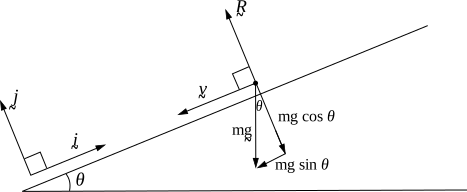
An object with mass \(m\) kilograms slides down a smooth inclined plane with velocity \( \underset{\sim}{v}(t)\), where \(t\) is the time in seconds after the object started sliding down the plane. The inclined plane makes an angle \(\theta\) with the horizontal, as shown in the diagram. The normal reaction force is \(\underset{\sim}{R}\). The acceleration due to gravity is \(\underset{\sim}{g}\) and has magnitude \(g\). No other forces act on the object.

The vectors \(\underset{\sim}{i}\) and \( \underset{\sim}{j} \) are unit vectors parallel and perpendicular, respectively, to the plane, as shown in the diagram.
 

  1. Show that the resultant force on the object is  \(\underset{\sim}{F}=-(m g \ \sin \theta) \underset{\sim}{i}\).  (2 marks)

    --- 5 WORK AREA LINES (style=lined) ---

  2. Given that the object is initially at rest, find its velocity \(\underset{\sim}{v}(t)\) in terms of \(g\), \(\theta, t\) and \(\underset{\sim}{i}\).  (2 marks)

    --- 5 WORK AREA LINES (style=lined) ---

Show Answers Only

i.    \(\text{Proof (See Worked Solution)} \)

ii.   \(\underset{\sim}{v}=-gt\ \sin \theta \ \underset{\sim}{i} \)

Show Worked Solution

i.       
         

\(\text{Resolving forces in}\ \underset{\sim}{j} \ \text{direction:} \)

\( {\underset{\sim}{F}}_\underset{\sim}{j} = \underset{\sim}{R} + m\underset{\sim}{g}\ \cos \theta = 0\ \ \text{(in equilibrium)} \)

\(\text{Resolving forces in}\ \underset{\sim}{i} \ \text{direction:} \)

\( {\underset{\sim}{F}}_\underset{\sim}{i} = -m\underset{\sim}{g} \ \sin \theta \ \ \ \text{(down slope)} \)

\(\therefore \text{Resultant force:}\ \ \underset{\sim}{F}=-(m g \ \sin \theta) \underset{\sim}{i} \)
 

♦ Mean mark (i) 50%.

ii.   \(\text{Using}\ \ \underset{\sim}{F}=m \underset{\sim}{a}: \)

\(m \underset{\sim}{a}\) \(=-mg\ \sin \theta \ \underset{\sim}{i} \)  
\(\underset{\sim}{a}\) \(=-g\ \sin \theta \ \underset{\sim}{i} \)  
\(\underset{\sim}{v}\) \(= \displaystyle \int \underset{\sim}{a}\ dt \)  
  \(=-gt\ \sin \theta +c \)  

 
\(\text{When}\ \ t=0,\ \ \underset{\sim}{v}=0\ \ \Rightarrow \ \ c=0 \)

\(\therefore \underset{\sim}{v}=-gt\ \sin \theta \ \underset{\sim}{i} \)

Filed Under: Motion Without Resistance Tagged With: Band 4, Band 5, smc-1060-04-Motion as f(t), smc-1060-45-Inclined planes, smc-1060-50-Vectors and motion

Proof, EXT2 P1 2023 HSC 12b

Prove that for all real numbers \(x\) and \(y\), where \(x^2+y^2 \neq 0\),

\(\dfrac{(x+y)^2}{x^2+y^2} \leq 2 \text {. }\)  (2 marks)

--- 6 WORK AREA LINES (style=lined) ---

Show Answers Only

\(\text{Proof (See Worked Solutions)}\)

Show Worked Solution
\((x-y)^2 \) \(\geq 0 \)  
\(x^2-2xy+y^2 \) \(\geq 0\)  
\(x^2+y^2\) \(\geq 2xy \)  
\( \dfrac{2xy}{x^2+y^2}\) \( \leq 1\ \text{… (1)}\)  


\(\dfrac{(x+y)^2}{x^2+y^2}\) \(=\dfrac{x^2+2xy+y^2}{x^2+y^2}\)  
  \(=\dfrac{x^2+y^2}{x^2+y^2}+\underbrace{\dfrac{2xy}{x^2+y^2}}_{\text{see (1) above}} \)  
  \(\leq 1+1\)  
  \(\leq 2\)  

Filed Under: Proof and Inequalities Tagged With: Band 4, smc-1208-20-Proofs using Square > 0

Proof, EXT2 P1 2023 HSC 12a

Prove that \(\sqrt{23}\) is irrational.  (3 marks)

--- 8 WORK AREA LINES (style=lined) ---

Show Answers Only

\(\text{Proof (See Worked Solutions)} \)

Show Worked Solution

\(\text{Proof by contradiction:} \)

\(\text{Assume}\ \sqrt{23}\ \text{is rational} \)

\( \sqrt{23} = \dfrac{p}{q}\ \ \text{where}\ p, q \in \mathbb{Z}\ \ \text{with no common factor except 1} \)

\(23\) \(= \dfrac{p^2}{q^2} \)  
\(23q^2\) \(=p^2\)  

 
\(\Rightarrow \text{23 is a factor of}\ p^2 \)

\(\Rightarrow \text{23 is a factor of}\ p \)
 

\( \exists k \in \mathbb{Z}\ \ \text{such that}\ \ p=23k \)

\(23q^2\) \(=(23k)^2 \)  
\(q^2\) \(=23k^2 \)  

 
\(\Rightarrow \text{23 is a factor of}\ q^2 \)

\(\Rightarrow \text{23 is a factor of}\ q \)

\(\therefore \text{HCF}\ \geq 23 \)

\(\therefore \text{By contradiction,}\ \sqrt{23}\ \text{is rational} \)

Filed Under: Contradiction, Contrapositive and Other Proofs, Converse, Contradiction and Contrapositive Proof Tagged With: Band 4, smc-1207-10-Contradiction, smc-1207-30-Irrational, smc-5116-10-Contradiction, smc-5116-30-Irrational

Measurement, STD1 M2 2023 HSC 27

When it is 10 am in Town \(A\), the time in Town \(B\) is 2 pm on the same day.

Joe lives in Town \(A\) and wishes to watch a live soccer game played in Town \(B\). The game commences at 11:30 am, Town \(B\) local time, and lasts for 2 hours.

What time will it be in Town \(A\) when the game finishes?  (2 marks)

Show Answers Only

\(9:30\ \text{am}\)

Show Worked Solution

\(11:30-4+2=9:30\ \text{am}\)

\(\therefore\ \text{The game finishes in Town } A\ \text{at}\ 9:30\ \text{am.}\)

Filed Under: M2 Working with Time (Y11), Time and Time Difference (Std1-2027), Time and Time Difference (Std2-2027) Tagged With: Band 4, smc-1102-10-Time Differences, smc-6306-10-Time Differences, smc-6525-10-Time Differences

Vectors, EXT2 V1 2023 HSC 11d

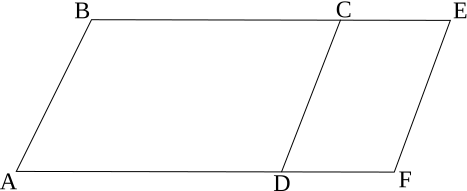
The quadrilaterals \(A B C D\) and \(A B E F\) are parallelograms.

By considering \(\overrightarrow{A B}\), show that \(C D F E\) is also a parallelogram.  (2 marks)

--- 7 WORK AREA LINES (style=lined) ---

Show Answers Only

\(\text{Proof (See Worked Solutions)} \)

Show Worked Solution

\(\text{Parrallelogram}\ \Rightarrow\ \text{Show opposite sides are equal} \)

\( \Big{|}\overrightarrow{A B} \Big{|} = \Big{|}\overrightarrow{CD} \Big{|} \ \ (ABCD\ \text{is a parallelogram}) \)

\( \Big{|}\overrightarrow{A B} \Big{|} = \Big{|}\overrightarrow{EF} \Big{|} \ \ (ABEF\ \text{is a parallelogram}) \)

\( \Rightarrow \Big{|}\overrightarrow{CD} \Big{|} = \Big{|}\overrightarrow{EF} \Big{|} \)
 

\( \Big{|}\overrightarrow{CE} \Big{|} = \Big{|}\overrightarrow{BE} \Big{|}-\Big{|}\overrightarrow{BC} \Big{|} \)

\(\text{Similarly,} \)

\( \Big{|}\overrightarrow{DF} \Big{|} = \Big{|}\overrightarrow{AF} \Big{|}-\Big{|}\overrightarrow{AD} \Big{|} \)

\( \text{Since}\ \ \Big{|}\overrightarrow{BE} \Big{|} = \Big{|}\overrightarrow{AF} \Big{|}\ \ \text{and}\ \ \Big{|}\overrightarrow{BC} \Big{|} = \Big{|}\overrightarrow{AD} \Big{|}\)

\( (ABCD\ \text{and}\ ABEF\ \text{are parallelograms}) \)

\( \Rightarrow\ \Big{|}\overrightarrow{DF} \Big{|} = \Big{|}\overrightarrow{CE} \Big{|} \)

\(\therefore CDFE\ \text{is a parallelogram} \)

Filed Under: Vectors and Geometry Tagged With: Band 4, smc-1210-30-Quadrilateral, smc-1210-60-2D problems

Functions, EXT1 F2 2023 HSC 14b

Consider the hyperbola  \(y=\dfrac{1}{x}\)  and the circle  \((x-c)^2+y^2=c^2\), where \(c\) is a constant.

  1. Show that the \(x\)-coordinates of any points of intersection of the hyperbola and circle are zeros of the polynomial  \(P(x)=x^4-2 c x^3+1\).  (1 mark)

    --- 4 WORK AREA LINES (style=lined) ---

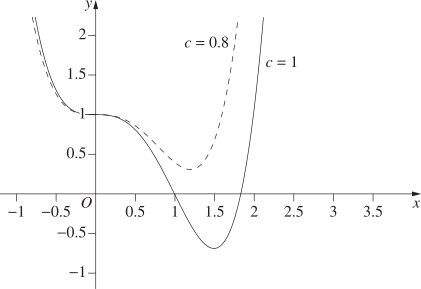
  2. The graphs of  \(y=x^4-2 c x^3+1\)  for  \(c=0.8\)  and  \(c=1\) are shown.
     

  1. By considering the given graphs, or otherwise, find the exact value of  \(c>0\)  such that the hyperbola  \(y=\dfrac{1}{x}\)  and the circle  \((x-c)^2+y^2=c^2\)  intersect at only one point.  (3 marks)

    --- 10 WORK AREA LINES (style=lined) ---

Show Answers Only

  1. \(\text{See Worked Solutions}\)
  2. \(\sqrt[4]{\dfrac{16}{27}}\approx 0.877\)

Show Worked Solution

i.     \(y=\dfrac{1}{x}\ …\ (1) \)

\((x-c)^2+y^2=c^2\ …\ (2) \)

\(\text{Substitute (1) into (2):}\)

\((x-c)^2+\Big{(}\dfrac{1}{x}\Big{)}^2 \) \(=c^2\)  
\(x^2-2cx+c^2+\dfrac{1}{x^2}\) \(=c^2\)  
\(x^4-2cx^3+1\) \(=0\)  
Mean mark (i) 53%.

ii.    \(\text{The two graphs show that for some value of}\ \ 0.8 \leq c \leq 1,\)

\(P(x)\ \text{has a minimum that touches the}\ x\text{-axis once.}\)

\(P(x)\) \(=x^4-2cx^3+1\)  
\(P^{′}(x)\) \(=4x^3-6cx^2\)  

 
\(\text{Find}\ x\ \text{when}\ P^{′}(x)=0: \)

\(4x^3-6cx^2\) \(=0\)  
\(2x^2(2x-3c)\) \(=0\)  
\(x\) \(=\dfrac{3c}{2}\ \ (x \neq 0)\)  

 
\(\text{Find}\ c\ \text{when}\ P(\frac{3c}{2})=0: \)

\(\Big{(} \dfrac{3c}{2} \Big{)}^4-2c\Big{(} \dfrac{3c}{2} \Big{)}^3+1 \) \(=0\)  
\(\dfrac{81c^4}{16}-\dfrac{54c^4}{8}+1\) \(=0\)  
\(\dfrac{(108-81)c^4}{16}\) \(=1\)  
\(\dfrac{27c^4}{16}\) \(=1\)  
\(c^4\) \(=\dfrac{16}{27}\)  
\(c\) \(=\sqrt[4]{\dfrac{16}{27}} \)  
  \(\approx 0.877\)  
Mean mark (ii) 19%.

Filed Under: Sum, Products and Multiplicity of Roots (Ext1) Tagged With: Band 4, Band 6, smc-1205-20-Multiplicity of Roots, smc-1205-30-Other

Calculus, EXT1 C2 2023 HSC 14a

Let  \(f(x)=2 x+\ln x\), for \(x>0\).

  1. Explain why the inverse of \(f(x)\) is a function.  (1 mark)

    --- 4 WORK AREA LINES (style=lined) ---

  2. Let  \(g(x)=f^{-1}(x)\). By considering the value of \(f(1)\), or otherwise, evaluate \(g^{\prime}(2)\).  (2 mark)

    --- 8 WORK AREA LINES (style=lined) ---

Show Answers Only

i.     \(f(x)=2 x+\ln x\)

\(f^{′}(x)=2+\dfrac{1}{x} \)

\(\text{In domain}\ x \gt 0\ \ \Rightarrow f^{-1}(x) \gt 0 \ \ (f(x)\ \text{is monotonically increasing}) \)

\(\text{Since}\ f(x)\ \text{is one-to-one,}\ f^{-1}(x)\ \text{is a function.} \)
 

ii.    \(\dfrac{1}{3}\)

Show Worked Solution

i.     \(f(x)=2 x+\ln x\)

\(f^{′}(x)=2+\dfrac{1}{x} \)

\(\text{In domain}\ x \gt 0\ \ \Rightarrow f^{-1}(x) \gt 0 \ \ (f(x)\ \text{is monotonically increasing}) \)

\(\text{Since}\ f(x)\ \text{is one-to-one,}\ f^{-1}(x)\ \text{is a function.} \)

Mean mark (i) 54%.

 
ii.
    \(g(x)=f^{-1}(x) \)

\(f(g(x))=x\)

\(\text{Differentiate both sides:}\)

\(g^{′}(x)\ f^{′}(g(x))\) \(=1\)  
\(g^{′}(x)\) \(=\dfrac{1}{f^{′}(g(x))}\)  
\(g^{′}(2)\) \(=\dfrac{1}{f^{′}(g(2))}\)  

 
\(f(1)=2 \times 1 + \ln1 = 2 \)

\(\Rightarrow g(2)=1 \ \text{(by inverse definition)}\)

\(\therefore g^{′}(2)\) \(= \dfrac{1}{f^{′}(1)} \)  
  \(=\dfrac{1}{2+\frac{1}{1}}\)  
  \(=\dfrac{1}{3} \)  
♦♦ Mean mark (ii) 32%.

Filed Under: Inverse Functions Calculus (Ext1) Tagged With: Band 4, Band 5, smc-1037-50-Other inverse functions

Vectors, EXT1 V1 2023 HSC 13b

Particle \(A\) is projected from the origin with initial speed \(v\) m s\(^{-1}\) at an angle \(\theta\) with the horizontal plane. At the same time, particle \(B\) is projected horizontally with initial speed \(u\) ms\(^{-1}\) from a point that is \(H\) metres above the origin, as shown in the diagram.
  

The position vector of particle \(A, t\) seconds after it is projected, is given by

\[\textbf{r}_A(t)=\left(\begin{array}{c}v t\ \cos \theta \\vt\ \sin\theta-\dfrac{1}{2} g t^2\end{array}\right) \text{. (Do NOT prove this.)}\]

The position vector of particle \(B, t\) seconds after it is projected, is given by

\[\textbf{r}_B(t)=\left(\begin{array}{c}u t \\H-\dfrac{1}{2} g t^2\end{array}\right) \text{. (Do NOT prove this.)}\]

The angle \(\theta\) is chosen so that  \(\tan \theta=2\).

The two particles collide.

  1. By first showing that  \(\cos \theta=\dfrac{1}{\sqrt{5}}\), verify that  \(v=\sqrt{5} u\).   (2 marks)

    --- 5 WORK AREA LINES (style=lined) ---

  2. Show that the particles collide at time  \(T=\dfrac{H}{2 u}\).   (1 mark)

    --- 4 WORK AREA LINES (style=lined) ---

When the particles collide, their velocity vectors are perpendicular.

  1. Show that  \(H=\dfrac{2 u^2}{g}\).   (3 marks)

    --- 6 WORK AREA LINES (style=lined) ---

  2. Prior to the collision, the trajectory of particle \(A\) was a parabola. (Do NOT prove this.)  
  3. Find the height of the vertex of that parabola above the horizontal plane. Give your answer in terms of \(H\).   (2 marks)

    --- 5 WORK AREA LINES (style=lined) ---

Show Answers Only

  1. \(\text{See Worked Solutions}\)
  2. \(\text{See Worked Solutions}\)
  3. \(\text{See Worked Solutions}\)
  4. \(H\)

Show Worked Solution

i.    \(\text{Given}\ \ \tan \theta =2\)

\(\cos \theta = \dfrac{1}{\sqrt 5} \)

\(\text{Since particles collide, for some}\ t: \)

\(vt\ \cos \theta\) \(=ut\)  
\(v \cdot \dfrac{1}{\sqrt 5} \) \(=u\)  
\(v\) \(=\sqrt5 u\)  


ii.
    \(\text{Equating y-components of}\ \textbf{r}_A\ \text{and}\ \textbf{r}_B : \)

\(vt\ \sin \theta-\dfrac{1}{2}gt^2\) \(=H-\dfrac{1}{2}gt^2\)  
\(vt\ \sin \theta\) \(=H\)  
\(u \sqrt{5} \times t \times \dfrac{2}{\sqrt5} \)  \(=H\)  
\(t\) \(= \dfrac{H}{2u} \)  

 
iii.
  \(\text{Velocity vectors:} \)

\[\textbf{v}_A(t)=\left(\begin{array}{c}v\ \cos \theta \\v\ \sin\theta-gt\end{array}\right)=\left(\begin{array}{c} u \\ 2u-gt \end{array}\right)\]

\[\textbf{v}_B(t)=\left(\begin{array}{c}u \\-gt \end{array}\right)\]

\(\text{Since particles are perpendicular at collision:}\)

\(\textbf{v}_A \cdot \textbf{v}_B=0\)

♦♦ Mean mark (iii) 37%.
\(u^2+(-gt)(2u-gt)\) \(=0\)  
\(u^2-2gtu+g^2t^2\) \(=0\)  
\((u-gt)^2\) \(=0\)  
\(gt\) \(=u\)  
\(t\) \(=\dfrac{u}{g}\)  
\(\dfrac{H}{2u}\) \(=\dfrac{u}{g}\ \ \text{(see part (ii))}\)  
\(\therefore H\) \(=\dfrac{2u^2}{g}\)  

 
iv.
   \(\text{Height of vertex}\ \ \Rightarrow \ \text{Find}\ t\ \text{when y-component of}\ \textbf{v}_A=0 \)

\(v\ \sin \theta-gt\) \(=0\)  
\(t\) \(=\dfrac{v\ \sin \theta}{g} \)  

 
\(\text{Height of vertex}\ =\ \text{y-component of}\ \textbf{r}_A\ \text{when}\ \ t= \dfrac{v\ \sin \theta}{g} \)

\(\text{Height}\) \(=vt\ \sin \theta-\dfrac{1}{2}gt^2 \)  
  \(=\dfrac{v^2\sin^2 \theta}{g}-\dfrac{1}{2}g\Big{(} \dfrac{v^2\sin^2 \theta}{g^2}\Big{)} \)  
  \(=\dfrac{v^2 \sin^2 \theta}{2g} \)  
  \(=\dfrac{(2u)^2}{2g} \)  
  \(=\dfrac{2u^2}{g} \)  
  \(=H\)  
♦♦ Mean mark (iv) 34%.

Filed Under: Vectors and Projectile Motion (Ext1) Tagged With: Band 4, Band 5, smc-1087-20-Maximum Height, smc-1087-85-Collision

Algebra, STD1 A3 2023 HSC 26

Electricity provider \(A\) charges 25 cents per kilowatt hour (kWh) for electricity, plus a fixed monthly charge of $40.

  1. Complete the table showing Provider \(A\) 's monthly charges for different levels of electricity usage.  (1 mark)

\begin{array} {|l|c|}
\hline
\rule{0pt}{2.5ex} \text{Electricity used in a month (kWh)} \rule[-1ex]{0pt}{0pt} & \ \ \ \ \ 0\ \ \ \ \  & \ \ \ 400\ \ \  & \ \ 1000\ \  \\
\hline
\rule{0pt}{2.5ex} \text{Monthly charge (\$)} \rule[-1ex]{0pt}{0pt} & 40 & & 290 \\
\hline
\end{array}

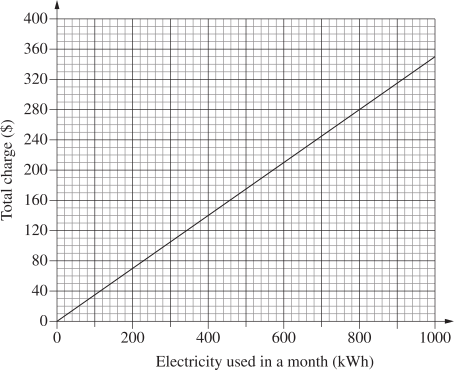
Provider \(B\) charges 35 cents per kWh, with no fixed monthly charge. The graph shows how Provider \(B\) 's charges vary with the amount of electricity used in a month.

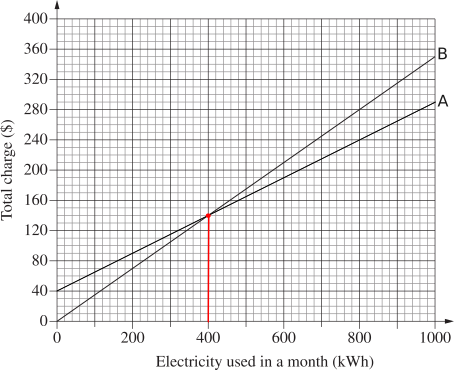
  1. On the grid on above, graph Provider A's charges from the table in part (a).  (1 mark)
  2. Use the two graphs to determine the number of kilowatt hours per month for which Provider \(A\) and Provider \(B\) charge the same amount.  (1 mark)

    --- 2 WORK AREA LINES (style=lined) ---

  3. A customer uses an average of 800 kWh per month.
  4. Which provider, \(A\) or \(B\), would be the cheaper option and by how much?  (2 marks)

    --- 5 WORK AREA LINES (style=lined) ---

Show Answers Only

a.   

\begin{array} {|l|c|}
\hline
\rule{0pt}{2.5ex} \text{Electricity used in a month (kWh)} \rule[-1ex]{0pt}{0pt} & \ \ \ \ \ 0\ \ \ \ \  & \ \ \ 400\ \ \  & \ \ 1000\ \  \\
\hline
\rule{0pt}{2.5ex} \text{Monthly charge (\$)} \rule[-1ex]{0pt}{0pt} & 40 & \textbf{140} & 290 \\
\hline
\end{array}

b.

c.    \(400\text{ kWh}\)

d.    \(A\text{ is cheaper by }$40.\)

Show Worked Solution

a.   

\begin{array} {|l|c|}
\hline
\rule{0pt}{2.5ex} \text{Electricity used in a month (kWh)} \rule[-1ex]{0pt}{0pt} & \ \ \ \ \ 0\ \ \ \ \  & \ \ \ 400\ \ \  & \ \ 1000\ \  \\
\hline
\rule{0pt}{2.5ex} \text{Monthly charge (\$)} \rule[-1ex]{0pt}{0pt} & 40 & \textbf{140} & 290 \\
\hline
\end{array}

b.   


♦♦ Mean mark (b) 40%.

c.    \(\text{Same charge when Provider }A = \text{Provider } B \text{ i.e. where the lines intersect}\)

\(=400\text{ kWh (see graph above)}\)

d.    \(\text{When kWh}= 800, \ \ A=$240 \text{ and } B=$280\)

\(\therefore A\text{ is cheaper by }$40.\)

Filed Under: A3 Types of Relationships (Y12) Tagged With: Band 4, Band 5, smc-1099-20-Other SE applications, std2-std1-common

Financial Maths, STD1 F2 2023 HSC 25

An artwork is currently valued at $ 15000. It appreciates at a rate of 5.3% per annum.

What will the value of the artwork be in 8 years time?  (2 marks)

Show Answers Only

\($22\ 673.48\text{ (2 d.p.)}\)

Show Worked Solution

\(PV=$15\ 000,\ \ r=\dfrac{5.3}{100},\ \ n=8\)

\(FV\) \(=PV(1+r)^n\)
  \(=15\ 000(1+\dfrac{5.3}{100})^8\)
  \(=$22\ 673.48242\)
  \(=$22\ 673.48\text{ (2 d.p.)}\)

Filed Under: F2 Investment (Y12) Tagged With: Band 4, smc-1108-20-FV Formula

Financial Maths, STD1 F2 2023 HSC 24

Bobby invested $5000.

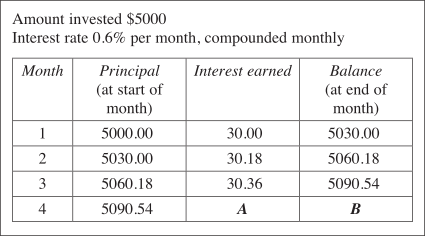
The table shows the progress of his investment over the first 4 months.


  1. What are the values of \(A\) and \(B\)?  (2 marks)

    --- 4 WORK AREA LINES (style=lined) ---

  2. Bobby could have earned simple interest on the investment at 0.62% per month.
  3. How much interest would Bobby have earned over 4 months by choosing this option?  (2 marks)

    --- 4 WORK AREA LINES (style=lined) ---

Show Answers Only

a.    \(A=$30.54,\ \ B=$5121.08\)

b.    \($124\)

Show Worked Solution

a.    \(A\) \(=5090.54\times\dfrac{0.6}{100}\)
    \(=$30.54\text{ (2 d.p.)}\)
     
  \(B\) \(=5090.54+30.54\)
    \(=$5121.08\)

b.    \(P=$5000,\ \ r=\dfrac{0.62}{100},\ \ n=4\)

\(I\) \(=Prn\)
  \(=5000\times \dfrac{0.62}{100}\times 4\)
  \(=$124\)


♦♦ Mean mark (b) 31%.

Filed Under: F2 Investment (Y12) Tagged With: Band 4, Band 5, compound, smc-1124-10-Simple Interest

Financial Maths, STD1 M4 2023 HSC 23

The table compares the fuel costs of a petrol car with an electric car.

\begin{array} {|l|l|l|}
\hline
\rule{0pt}{2.5ex} \rule[-1ex]{0pt}{0pt} & \textit{Petrol car} & \textit{Electric car}\\
\hline
\rule{0pt}{2.5ex}\text{Fuel consumption}\rule[-1ex]{0pt}{0pt} & \text{8.6 L/100 km} & \text{18 kWh/100 km} \\ \hline \rule{0pt}{2.5ex}\text{Cost of fuel}\rule[-1ex]{0pt}{0pt} & \text{\$1.87/L} & \text{\$0.25/kWh} \\ \hline \end{array}

Jun travels on average 35 000 km per year.

How much will he save on fuel costs in a year by using an electric car?  (3 marks)

--- 6 WORK AREA LINES (style=lined) ---

Show Answers Only

\($4053.70\)

Show Worked Solution

\(\text{Petrol car fuel costs}\)

\(\text{Litres used}=\dfrac{8.6\times 35\ 000}{100}=3010\text{ L}\)

\(\text{Cost of fuel}=3010\times $1.87 = $5628.70\)

  
\(\text{Electric car power costs}\)

\(\text{kWh}=\dfrac{18\times 35\ 000}{100}=6300\text{ kWh}\)

\(\text{Cost of power}=6300\times $0.25 = $1575\)

  
\(\text{Saving}=$5628.70-$1575=$4053.70\)

Filed Under: M4 Rates (Y12) Tagged With: Band 4, smc-1104-20-Fuel, smc-1119-20-Fuel

Financial Maths, STD1 F1 2023 HSC 22

The hours worked last week by Rose are shown. Her normal rate of pay per hour is $24.05.

\begin{array} {|l|l|}
\hline
\rule{0pt}{2.5ex} \text{Monday to Friday (normal rate)} \rule[-1ex]{0pt}{0pt} & \text{8:30 am – 12:30 pm} \\
\hline
\rule{0pt}{2.5ex} \text{Saturday (time-and-a-half)} \rule[-1ex]{0pt}{0pt} & \text{9:00 am – 11:30 am} \\
\hline\rule{0pt}{2.5ex} \text{Sunday (double time)} \rule[-1ex]{0pt}{0pt} & \text{9:00 am – noon} \\
\hline
\end{array}

How much did Rose earn last week?  (4 marks)

--- 6 WORK AREA LINES (style=lined) ---

Show Answers Only

\($745.55\)

Show Worked Solution
\(\text{Normal Pay}\) \(=5\times 4\times $24.05\) \(=$481.00\)
\(\text{Time-and-a-half}\) \(=2.5\times 1.5\times $24.05\) \(=$90.19\)
\(\text{Double time}\) \(=2\times 3\times $24.05\) \(=$144.55\)
  \(\text{TOTAL}\) \(=$715.49\)

Filed Under: Earning Money and Budgeting (Std 1), Ways of Earning (Std1-2027) Tagged With: Band 4, smc-1126-10-Wages, smc-6515-10-Wages/Salaries

Algebra, STD1 A1 2023 HSC 17

Consider the equation \(P=\dfrac{10 N-7.5 M}{9}\).

Find the value of \(P\) when \(N=6\) and \(M=2\).  (2 marks)

--- 4 WORK AREA LINES (style=lined) ---

Show Answers Only

\(5\)

Show Worked Solution

\(P\) \(=\dfrac{10N-7.5M}{8}\)
  \(=\dfrac{10\times 6-7.5\times 2}{9}\)
  \(=5\)

Filed Under: Substitution and Other Equations (Std 1), Substitution and Other Equations (Std1-2027) Tagged With: Band 4, smc-1116-10-Substitution, smc-6508-10-Substitution

Networks, STD1 N1 2023 HSC 15

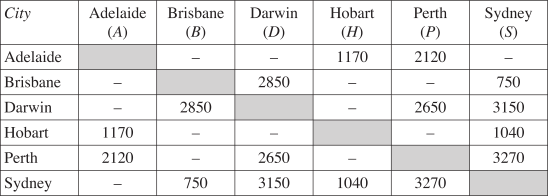
The table shows some of the flight distances (rounded to the nearest 10 km between various Australian cities.

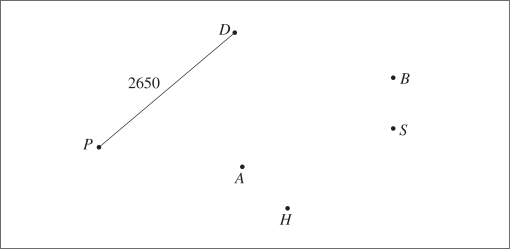
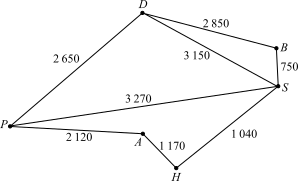
  1. Use the information in the table to complete the network diagram where the edges are labelled with distances.  (2 marks)


  1. Mahsa wants to travel from Hobart to Darwin. She wants to change planes only once.
  2. Using the network diagram, calculate how many kilometres she will travel by plane.  (1 mark)

    --- 1 WORK AREA LINES (style=lined) ---

Show Answers Only

a.  

b.    \(4190\text{ km}\)

Show Worked Solution

a.

b.    \(\text{Changing planes only once}\Rightarrow H\rightarrow S\rightarrow D\)

\(\text{Kilometres travelled}=1040+3150=4190\text{ km}\)

Filed Under: Basic Concepts Tagged With: Band 3, Band 4, smc-1136-10-Table to Network, std2-std1-common

Measurement, STD1 M4 2023 HSC 14

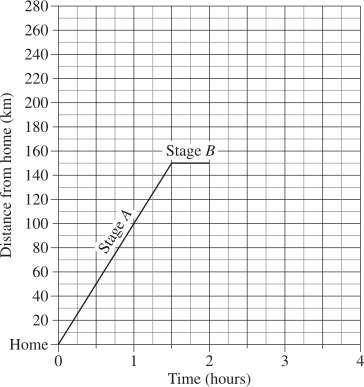
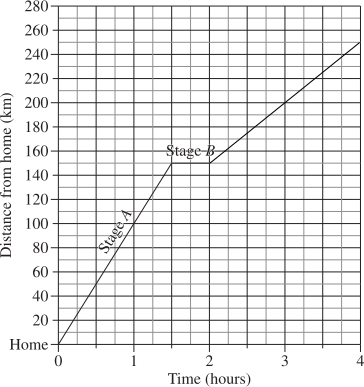
The distance-time graph shows the first two stages of a car journey from home to a holiday house.
  

  1. At what speed, in kilometres per hour, did the car travel during stage \(A\) of the journey?   (1 mark)

    --- 2 WORK AREA LINES (style=lined) ---

  2. For how long did the car stop during stage \(B\) of the journey?   (1 mark)

    --- 2 WORK AREA LINES (style=lined) ---

  3. After stage \(B\), the car continues to travel towards the holiday house at a constant speed of \(50\ \text{km/h}\) for 2 hours. Graph this part of the journey on the grid above.   (2 marks)

    --- 4 WORK AREA LINES (style=lined) ---

Show Answers Only

a.    \(100\text{ km/h}\)

b.    \(30\text{ minutes}\)

c.   

Show Worked Solution

a.   \(S=\dfrac{D}{T}=\dfrac{150}{1.5}=100\ \text{km/h}\)
 

b.    \(\text{Stage}\textit{ B}=1.5\rightarrow 2\text{ hours}=30\text{ minutes}\)
 

c.    \(\text{Position after 2 hours at 50km/h}=(150+2\times 50 , 2 + 2) = (250 , 4)\)


♦ Mean mark (c) 50%.

Filed Under: M4 Rates (Y12) Tagged With: Band 3, Band 4, smc-1104-10-Travel Graphs, smc-1117-20-Distance Speed Time, smc-791-20-Speed Distance Time

Combinatorics, EXT1 A1 2023 HSC 12d

It is known that  \({ }^n C_r={ }^{n-1} C_{r-1}+{ }^{n-1} C_r\)  for all integers such that  \(1 \leq r \leq n-1\). (Do NOT prove this.)

Find ONE possible set of values for \(p\) and \(q\) such that

\({ }^{2022} C_{80}+{ }^{2022} C_{81}+{ }^{2023} C_{1943}={ }^p C_q\)  (2 marks)

--- 6 WORK AREA LINES (style=lined) ---

Show Answers Only

\(p=2024, q=81 \)

Show Worked Solution

\({ }^{2022} C_{80}+{ }^{2022} C_{81}+{ }^{2023} C_{1943}={ }^p C_q\)

\(\text{Using the known relationship:} \)

\({ }^{2022} C_{80}+{ }^{2022} C_{81} = { }^{2023} C_{81}\ \ …\ (1)\)

\(\text{Also, since}\ \ { }^n C_r={ }^n C_{n-r} \)

\({ }^{2023} C_{1943} = { }^{2023} C_{2023-1943} = { }^{2023} C_{80}\ \ …\ (2)\) 

\({ }^{2022} C_{80}+{ }^{2022} C_{81}+{ }^{2023} C_{1943}\) \(={ }^{2023} C_{81}+{ }^{2023} C_{1943}\ \ \text{(see (1) above)}\)  
  \(={ }^{2023} C_{81}+{ }^{2023} C_{80}\ \ \text{(see (2) above)} \)  
  \(={ }^{2024} C_{81} \)  

 
\(\therefore p=2024, q=81 \)

Filed Under: Binomial Expansion (Ext1) Tagged With: Band 4, smc-1088-30-Proofs

Statistics, EXT1 S1 2023 HSC 12c

A gym has 9 pieces of equipment: 5 treadmills and 4 rowing machines.

On average, each treadmill is used 65% of the time and each rowing machine is used 40% of the time.

  1. Find an expression for the probability that, at a particular time, exactly 3 of the 5 treadmills are in use.  (2 marks)

    --- 2 WORK AREA LINES (style=lined) ---

  2. Find an expression for the probability that, at a particular time, exactly 3 of the 5 treadmills are in use and no rowing machines are in use.  (1 mark)

    --- 3 WORK AREA LINES (style=lined) ---

Show Answers Only

  1. \(P\text{(3 of 5 treadmills in use)}\ =\ ^5C_3 (0.65)^3(0.35)^2 \)
  2. \(P\text{(3 treadmills and no rowing)}\ = \ ^5C_3 (0.65)^3(0.35)^2 \times (0.6)^4 \)

Show Worked Solution

i.    \(P(T)=0.65, \ \ P(\overline{T})=1-0.65=0.35 \)

\(P\text{(3 of 5 treadmills in use)}\ =\ ^5C_3 (0.65)^3(0.35)^2 \)
 

ii.  \(P(R)=0.4, \ \ P(\overline{R})=1-0.4=0.6 \)

\(P\text{(no rowing machines in use)}\ =\ ^4C_0 (0.6)^4(0.4)^0=(0.6)^4 \)

\(\text{Since 2 events are independent:} \)

\(P\text{(3 treadmills and no rowing)}\ = \ ^5C_3 (0.65)^3(0.35)^2 \times (0.6)^4 \)

Filed Under: Binomial Probability (Ext1) Tagged With: Band 3, Band 4, smc-1084-10-General Case, smc-1084-25-Compound Events

Statistics, EXT1 S1 2023 HSC 11f

A recent census found that 30% of Australians were born overseas.

A sample of 900 randomly selected Australians was surveyed.

Let \(\hat{p}\) be the sample proportion of surveyed people who were born overseas.

A normal distribution is to be used to approximate \(P(\hat{p} \leq 0.31)\).

  1. Show that the variance of the random variable \(\hat{p}\) is \(\dfrac{7}{30\ 000}\).  (2 marks)

    --- 5 WORK AREA LINES (style=lined) ---

  2. Use the standard normal distribution and the normal distribution table to approximate \(P(\hat{p} \leq 0.31)\), giving your answer correct to two decimal places.  (2 marks)

    --- 4 WORK AREA LINES (style=lined) ---

Show Answers Only

  1. \(\text{See Worked Solutions}\)
  2. \(0.74\)

Show Worked Solution

i.    \(\text{Let}\ X =\ \text{number of people born overseas} \)

\(X\sim \text{Bin}(900,0.3) \)

\(\hat{p} = \dfrac{X}{900}\)

\(\text{Var}(X) = np(1-p)=900 \times 0.3 \times 0.7 \)

\(\text{Var}(\hat{p})\) \(=\dfrac{\text{Var}(X)}{n^2} \)  
  \(=\dfrac{900 \times 0.3 \times 0.7}{900^2}\)  
  \(=\dfrac{7}{30\ 000} \)  


ii.    \(\mu = E(\hat{p}) = 0.3,\ \ \sigma(\hat{p}) = \sqrt{\dfrac{7}{30\ 000}} \)

\(z\text{-score (0.31)} \ = \dfrac{0.31-0.3}{\sqrt{\dfrac{7}{30\ 000}}} = 0.6546… \)

\(P(\hat{p} \leq 0.31) \) \(=P(z \leq 0.6546…) \)  
  \(=0.74\ \ \text{(to 2 d.p.)} \)  

Filed Under: Normal Approximations of Sample Proportions (Ext1) Tagged With: Band 4, smc-1085-10-Single z-score

Trigonometry, EXT1 T3 2023 HSC 11e

Solve  \(\cos \theta+\sin \theta=1\)  for  \(0 \leq \theta \leq 2 \pi\).  (3 marks)

--- 10 WORK AREA LINES (style=lined) ---

Show Answers Only

\(\theta=0, \dfrac{\pi}{2}, 2\pi \)

Show Worked Solution

\(\text{Let}\ \ t=\tan \dfrac{\theta}{2} \)

\(\dfrac{1-t^2}{1+t^2} + \dfrac{2t}{1+t^2} \) \(=1\ \ \text{(see reference sheet)}\)  
\(1-t^2+2t\) \(=1+t^2\)  
\(2t^2-2t\) \(=0\)  
\(2t(t-1) \) \(=0\)  
\(t\) \(= 0 \ \text{or} \ 1\)  

 
\(\text{When}\ \ \tan\dfrac{\theta}{2} = 0: \)

\(\dfrac{\theta}{2} = 0, \pi\ \ \Rightarrow \ \theta=0\ \ \text{or}\ \ 2\pi \)

\(\text{When}\ \ \tan\dfrac{\theta}{2} = 1: \)

\(\dfrac{\theta}{2} = \dfrac{\pi}{4}\ \Rightarrow \ \theta=\dfrac{\pi}{2} \)
 

\(\text{Test}\ \ \theta=\pi: \)

\(\cos\ \pi+\sin\ \pi = -1+0=-1\ \ \text{(not a solution)} \)

\(\therefore \theta=0, \dfrac{\pi}{2}, 2\pi \)

Filed Under: Identities, Equations and 't' formulae (Ext1) Tagged With: Band 4, smc-1076-30-`t` formulae

Probability, STD1 S2 2023 HSC 8 MC

Four cards marked with the numbers 1, 2, 3 and 4 are placed face down on a table.

One card is turned over as shown.

What is the probability that the next card turned over is marked with an odd number?

  1. \(\dfrac{1}{4}\)
  2. \(\dfrac{1}{3}\)
  3. \(\dfrac{2}{4}\)
  4. \(\dfrac{2}{3}\)
Show Answers Only

\(D\)

Show Worked Solution

\(\text{Sample space} =1,3,4\)

\(P(\text{odd})=\dfrac{2}{3}\)

  
\(\Rightarrow D\)

Filed Under: Probability, Single and Multi-Stage Events (Std 1) Tagged With: Band 4, num-title-ct-core, num-title-qs-hsc, smc-1135-05-Simple Probability, smc-4225-15-Single-stage events

Financial Maths, STD1 F1 2023 HSC 6 MC

A delivery truck was valued at \($65 000\) when new. The value of the truck depreciates at a rate of \(22\) cents per kilometre travelled.

What is the value of the truck after it has travelled a total distance of \(132 600\) km?

  1. \($35 828\)
  2. \($29 172\)
  3. \($14 872\)
  4. \($14 300\)
Show Answers Only

\(A\)

Show Worked Solution
\(\text{Value}\) \(=65\ 000-132\ 600\times\frac{22}{100}\)
  \(=$35\ 828\)

\(\Rightarrow A\)

Filed Under: Simple Interest and S/L Depreciation (Std 1) Tagged With: Band 4, smc-1124-20-Straight Line Depreciation, std2-std1-common

Financial Maths, STD1 F3 2023 HSC 5 MC

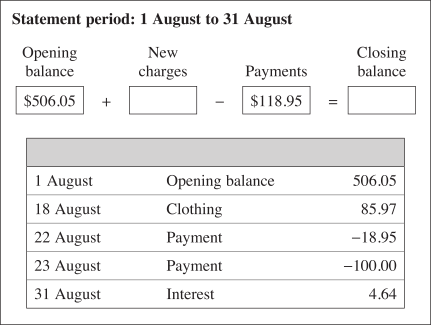
The following is part of a credit card statement for August, with some figures missing.
 

What are the amounts for 'New charges' and 'Closing balance'?
 

  \(\text{New charges}\) \(\text{Closing balance}\)
A.  \($85.97\) \($468.43\)
B.  \($85.97\) \($596.66\)
C.  \($90.61\) \($473.07\)
D.  \($90.61\) \($477.71\)


Show Answers Only

\(D\)

Show Worked Solution
\(\text{New Charges}\) \(=85.97+4.64\)
  \(=$90.61\)


\(\text{Closing Balance}\) \(=506.05+90.61-(18.95+100)\)
  \(=$477.71\)

 
\(\Rightarrow D\)

Filed Under: Credit Cards (Std 1) Tagged With: Band 4, smc-1140-10-Credit Cards

Financial Maths, STD1 F1 2023 HSC 2 MC

An amount of $2500 is invested at a simple interest rate of 3% per annum.

How much interest is earned in the first two years?

  1. $75
  2. $150
  3. $2575
  4. $2652
Show Answers Only

\(B\)

Show Worked Solution
\(I\) \(=Prn\)  
  \(=2500 \times\ \dfrac{3}{100} \times\ 2\)  
  \(=$150\)  

 
\(\Rightarrow B\)

Filed Under: Simple Interest and S/L Depreciation (Std 1) Tagged With: Band 4, smc-1124-10-Simple Interest, std2-std1-common

Measurement, STD1 M1 2023 HSC 1 MC

What is \(4.2681\) when rounded to \(3\) decimal places?

  1. \(4.26\)
  2. \(4.27\)
  3. \(4.268\)
  4. \(4.269\)
Show Answers Only

\(C\)

Show Worked Solution

\(4.2681 \approx\ 4.268 \ (3\ \text{d.p.})\)

\(\Rightarrow C\)

Filed Under: Identify and Convert Between Units (Std1-2027), Units and Measurement Error (Std 1) Tagged With: Band 4, smc-1120-40-Other unit conversion, smc-6519-20-Length/Area

Trigonometry, EXT1 T1 2023 HSC 7 MC

Which statement is always true for real numbers \(a\) and \(b\) where \(-1 \leqslant a<b \leqslant 1\)?

  1. \(\sec a<\sec b\)
  2. \(\sin ^{-1} a<\sin ^{-1} b\)
  3. \(\arccos a<\arccos b\)
  4. \(\cos ^{-1} a+\sin ^{-1} a<\cos ^{-1} b+\sin ^{-1} b\)
Show Answers Only

\(B\)

Show Worked Solution

\(\text{Consider the graph of}\ \ y=\sin^{-1}x \)
 

\( y=\sin^{-1}x\ \ \text{is an increasing function in range}\ \ -1 \leqslant x \leqslant 1 \)

\(\therefore\ \text{Given}\ \ -1 \leqslant a<b \leqslant 1\ \ \Rightarrow \sin ^{-1} a<\sin ^{-1} b \)

\(\Rightarrow B\)

Filed Under: T1 Inverse Trig Functions (Y11) Tagged With: Band 4, smc-1024-10-arcsin Graphs

Functions, EXT1 F1 2023 HSC 8 MC

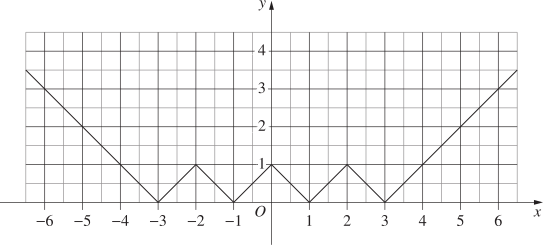
The diagram shows the graph of a function.
 

Which of the following is the equation of the function?

  1. \(y=\Big{|}1-\big{|}|x|-2\big{|}\Big{|}\)
  2. \(y=\Big{|}2-\big{|}|x|-1\big{|}\Big{|}\)
  3. \(y=\Big{|}1-\big{|}x-2\big{|}\Big{|}\)
  4. \(y=\Big{|}2-\big{|}x-1\big{|}\Big{|}\)
Show Answers Only

\(A\)

Show Worked Solution

\(\text{By elimination:}\)

\(\text{Even function}\ \rightarrow\ \text{Eliminate}\ C\ \text{and}\ D \)

\(\text{Graph passes through}\ (1, 0) \)

\(\text{Option}\ A:\ \ y=\Big{|}1-\big{|}1-2\big{|}\Big{|} =\Big{|}1-1\Big{|}=0\ \ \text{(lies on graph)} \)

\(\text{Option}\ B:\ \ y=\Big{|}2-\big{|}|1|-1\big{|}\Big{|} =\Big{|}2-0\Big{|}=2\ \ \text{(not on graph)} \)

\(\therefore\ \text{Eliminate}\ B \)

\(\Rightarrow A\)

Filed Under: Reflections and Harder Graphs (Ext1) Tagged With: Band 4, smc-1072-30-y = | f(x) |; y = f( |x| )

Trigonometry, EXT1 T1 2023 HSC 5 MC

Which of the following is the value of   \(\sin ^{-1}(\sin a)\)  given that  \(\pi<a<\dfrac{3 \pi}{2}\)? 

  1. \(a-\pi\)
  2. \(\pi-a\)
  3. \(a\)
  4. \(-a\)
Show Answers Only

\(B\)

Show Worked Solution

\(\sin(a)\) \(=-\sin(a-\pi)\ \ \text{(see above)}\)  
\(\sin^{-1}(\sin(a))\) \(=\sin^{-1}(-\sin(a-\pi))\)  
  \(=\sin^{-1}(\sin(\pi-a)) \)  
  \(=\pi-a \)  

 
\(\Rightarrow B\)

Mean mark 56%.

Filed Under: T1 Inverse Trig Functions (Y11) Tagged With: Band 4, smc-1024-30-Equations and Exact Values

Calculus, EXT1 C3 2023 HSC 4 MC

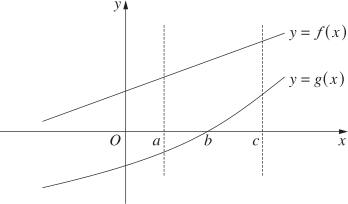
The diagram shows the graphs of the functions \(f(x)\) and \(g(x)\).
 

It is known that

\begin{aligned} & \int_a^c f(x) d x=10 \\ & \int_a^b g(x) d x=-2 \\ & \int_b^c g(x) d x=3 .\end{aligned}

What is the area between the curves  \(y=f(x)\)  and  \(y=g(x)\)  between \(x=a\) and \(x=c\) ?

  1. 5
  2. 7
  3. 9
  4. 11
Show Answers Only

\(C\)

Show Worked Solution
\(A\) \[= \int_a^c f(x)\ dx-\int_b^c g(x)\ dx+\Big{|}\int_a^b g(x)\ dx\Big{|} \]  
  \(= 10-3+|-2| \)  
  \(=9\)  

 
\(\Rightarrow C\)

Filed Under: Further Area and Solids of Revolution (Ext1) Tagged With: Band 4, smc-1039-50-Area

Statistics, EXT1 S1 2023 HSC 2 MC

A standard six-sided die is rolled 12 times.

Let \(\hat{p}\) be the proportion of the rolls with an outcome of 2.

Which of the following expressions is the probability that at least 9 of the rolls have an outcome of 2?

  1. \(P\left(\hat{p} \geq \dfrac{3}{4}\right)\)
  2. \(P\left(\hat{p} \geq \dfrac{1}{6}\right)\)
  3. \(P\left(\hat{p} \leq \dfrac{3}{4}\right)\)
  4. \(P\left(\hat{p} \leq \dfrac{1}{6}\right)\)
Show Answers Only

\(A\)

Show Worked Solution

\(\text{Let}\ X =\ \text{number of rolls}\ \geq 2\)

\(X \sim\ \text{Bin}\Big(12, \dfrac{5}{6}\Big)\)

\(\text{If}\ \ X=9\ \ \Rightarrow\ \ \hat{p} = \dfrac{9}{12}=\dfrac{3}{4} \)

\(\therefore P(X \geq 9) = P\Big(\hat{p} \geq \dfrac{3}{4}\Big) \)

\(\Rightarrow A\)

Filed Under: Normal Approximations of Sample Proportions (Ext1) Tagged With: Band 4, smc-1085-50-Other

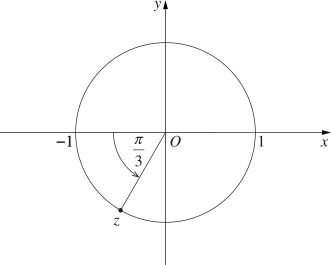
Complex Numbers, EXT2 N1 2023 HSC 3 MC

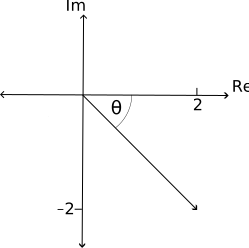
A complex number \(z\) lies on the unit circle in the complex plane, as shown in the diagram.
 

Which of the following complex numbers is equal to \(\bar{z}\) ?

  1. \(-z\)
  2. \(z^2\)
  3. \(-z^3\)
  4. \(z^4\)
Show Answers Only

\(B\)

Show Worked Solution

\(z=e^{-\small{\dfrac{2i \pi}{3}}}, \ \bar z=e^{\small{\dfrac{2i \pi}{3}}} \)
 

\(\text{By trial and error:}\)

\(z^2=e^{-\small{\dfrac{2 \times 2i \pi}{3}}} = e^{-\small{\dfrac{4i \pi}{3}}}=e^{\small{\dfrac{2i \pi}{3}}} =\bar z \)

\(\Rightarrow B\)

Filed Under: Exponential Form Tagged With: Band 4, smc-1191-50-Powers

Calculus, 2ADV C4 2023 HSC 32

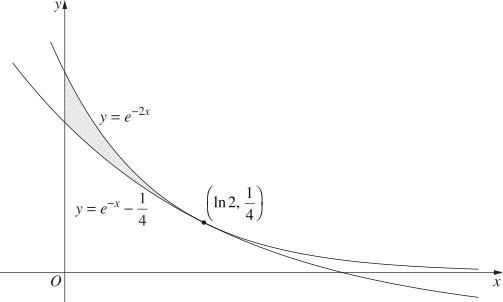
The curves  \(y=e^{-2 x}\)  and  \(y=e^{-x}-\dfrac{1}{4}\)  intersect at exactly one point as shown in the diagram. The point of intersection has coordinates \(\left(\ln 2, \dfrac{1}{4}\right)\). (Do NOT prove this.)
 

  1. Show that the area bounded by the two curves and the \(y\)-axis, as shaded in the diagram, is  \(\dfrac{1}{4} \ln 2-\dfrac{1}{8}\).  (3 marks)

    --- 7 WORK AREA LINES (style=lined) ---

  2. Find the values of \(k\) such that the curves  \(y=e^{-2 x}\)  and  \(y=e^{-x}+k\)  intersect at two points.  (3 marks)

    --- 8 WORK AREA LINES (style=lined) ---

Show Answers Only

a.    \(\text{See Worked Solutions}\)

b.    \( -\dfrac{1}{4} < k < 0 \)

Show Worked Solution

a.     \(A\) \(= \int_0^{\ln2} e^{-2x}-(e^{-x}-\dfrac{1}{4})\ dx\)
    \(=\Big{[}-\dfrac{1}{2} e^{-2x}+e^{-x}+\dfrac{1}{4}x \Big{]}_0^{\ln2} \)
    \(=\Big{[}(-\dfrac{1}{2} e^{-2\ln2}+e^{-\ln2}+\dfrac{1}{4}\ln2)-(-\dfrac{1}{2}e^0+e^0-0)\Big{]} \)
    \(=\Big{[}(-\dfrac{1}{2} e^{\ln{(2^{-2})}}+e^{\ln{(2^{-1})}}+\dfrac{1}{4}\ln2+\dfrac{1}{2}-1)\Big{]} \)
    \(=\Big{[}(-\dfrac{1}{2} e^{\ln \frac{1}{4}}+e^{\ln \frac{1}{2}}+\dfrac{1}{4}\ln2-\dfrac{1}{2}\Big{]} \)
    \(=-\dfrac{1}{2} \times \dfrac{1}{4} +\dfrac{1}{2}+\dfrac{1}{4}\ln2-\dfrac{1}{2} \)
    \(=\dfrac{1}{4}\ln2-\dfrac{1}{8} \)

 
b.
    \(\text{Intersection occurs when}\)

\(e^{-2x}\) \(=e^{-x}+k\)  
\(e^{-2x}-e^{-x}-k\) \(=0\)  

 
\(\text{Let}\ X=e^{-x} \)

\(X^2-X-k=0 \)

\(X\) \(=\dfrac{1\pm \sqrt{1^2-4(1)(-k)}}{2} \)  
  \(=\dfrac{1\pm \sqrt{1+4k}}{2} \)  


\(\text{2 solutions}\ \Rightarrow\ \Delta >0 \)

\(1+4k>0\ \ \Rightarrow \ k>-\dfrac{1}{4} \)
 

\(\text{Since}\ X=e^{-x} >0:\)

\(\Rightarrow\ \text{Both real solutions to the quadratic MUST be positive.}\)

\(\sqrt{1+4k}\) \(<1\)  
\(1+4k\) \(<1\)  
\(k\) \(<0\)  

 
\(\therefore\ -\dfrac{1}{4} < k < 0 \)

♦♦♦ Mean mark (b) 14%.

Filed Under: Areas Under Curves (Y12) Tagged With: Band 4, Band 6, smc-975-40-Exponential

Calculus, 2ADV C3 2023 HSC 30

Let  \(f(x)=e^{-x} \sin x\).

  1. Find the coordinates of the stationary points of \(f(x)\) for  \(0\leq x\leq 2\pi\). You do NOT need to check the nature of the stationary points.  (3 marks)

    --- 6 WORK AREA LINES (style=lined) ---

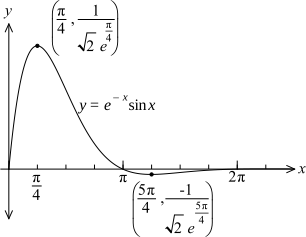
  2. Without using any further calculus, sketch the graph of  \(y=f(x)\), for  \(0\leq x\leq 2\pi\), showing stationary points and intercepts.  (2 marks)


--- 0 WORK AREA LINES (style=lined) ---

Show Answers Only

a.    \( \Big(\dfrac{\pi}{4},\dfrac{1}{\sqrt2 \times e^{\frac{\pi}{4}}}\Big)\ \text{and}\  \Big(\dfrac{5\pi}{4},\dfrac{-1}{\sqrt2 \times e^{\frac{5\pi}{4}}}\Big)\)

b.    
         

Show Worked Solution

a.    \(f(x)=e^{-x} \sin x\)

\(f^{′}(x)=e^{-x} \cos x-e^{-x} \sin x = e^{-x}( \cos x-\sin x) \)

\(\text{SPs when}\ f^{′}(x)=0: \)

\(e^{-x}=0\ \ \rightarrow \ \text{no solution} \)

\(\cos x-\sin x\) \(=0\)  
\(1-\tan x\) \(=0\)  
\(\tan\) \(=1\)  
Mean mark (a) 54%.

\(x=\dfrac{\pi}{4}, \dfrac{5\pi}{4} \)
 

\(f(\dfrac{\pi}{4})=e^{-\frac{\pi}{4}}\sin \frac{\pi}{4}=\dfrac{1}{\sqrt2 \times e^{\frac{\pi}{4}}} \)

\(f(\dfrac{5\pi}{4})=e^{-\frac{5\pi}{4}}\sin \frac{5\pi}{4}=\dfrac{-1}{\sqrt2 \times e^{\frac{5\pi}{4}}} \)
 

\(\therefore\ \text{SPs at}\ \Big(\dfrac{\pi}{4},\dfrac{1}{\sqrt2 \times e^{\frac{\pi}{4}}}\Big)\ \text{and}\  \Big(\dfrac{5\pi}{4},\dfrac{-1}{\sqrt2 \times e^{\frac{5\pi}{4}}}\Big)\)

 
b.
    \(\ x\text{-intercepts at}\ \ x=0, \pi,\ 2\pi \)


♦♦ Mean mark (b) 34%.

Filed Under: Curve Sketching (Y12), Graphs and Applications (Y11) Tagged With: Band 4, Band 5, smc-966-10-Exponential graphs, smc-969-30-Other Graphs

Statistics, 2ADV S3 2023 HSC 29

A continuous random variable \(X\) has probability density function \(f(x)\) given by
 

\(f(x)=\left\{\begin{array}{cl} 12 x^2(1-x), & \text { for } 0 \leq x \leq 1 \\ 0, & \text { for all other values of } x \end{array}\right.\)


  1. Find the mode of \(X\).  (2 marks)

    --- 6 WORK AREA LINES (style=lined) ---

  2. Find the cumulative distribution function for the given probability density function.  (2 marks)

    --- 6 WORK AREA LINES (style=lined) ---

  3. Without calculating the median, show that the mode is greater than the median.  (2 marks)

    --- 5 WORK AREA LINES (style=lined) ---

Show Answers Only

a.   \(x=\dfrac{2}{3} \)

b.   \(F(x)=\left\{\begin{array}{cl} 0, & \text { for } x \lt 0 & \\ 4x^3-3x^4, & \text { for } 0 \leq x \leq 1 \\ 1, & \text { for } x > 1 \end{array}\right.\)

c.    \(\text{See Worked Solutions}\)

Show Worked Solution

a.    \(\text{Mode}\ \rightarrow \ f(x)_\text{max} \)

\(f(x)=12 x^2(1-x)=12x^2-12x^3 \)

\(f^{′}(x)=24x-36x^2=12x(2-3x) \)

\(f^{″}(x)=24-72x \)

♦ Mean mark (a) 45%.

\(\text{Max/min when}\ f^{′}(x)=0 \)

\(2-3x=0\ \ ⇒\ \ x=\dfrac{2}{3} \ \ (x \neq 0) \)

\(\text{At}\ x=\dfrac{2}{3}, \ f^{″}(x)=24-72(\dfrac{2}{3})=-24<0 \)

\(\therefore \ \text{Mode (max) at}\ x=\dfrac{2}{3} \)
  

b.     \(F(x)\) \(= \int 12x^2-12x^3\ dx\)
    \(=4x^3-3x^4+c \)

 
\(\text{At}\ x=0, F(x)=0\ \ ⇒\ \ c=0 \)

\(F(x)=4x^3-3x^4 \)
 

\(F(x)=\left\{\begin{array}{cl} 0, & \text { for } x \lt 0 & \\ 4x^3-3x^4, & \text { for } 0 \leq x \leq 1 \\ 1, & \text { for } x > 1 \end{array}\right.\)

 
c.
    \(\text{Find}\ F\Big{(}\dfrac{2}{3}\Big{)}: \)

\(F\Big{(}\dfrac{2}{3}\Big{)} \) \(=4 \times \Big{(}\dfrac{2}{3}\Big{)}^3-3 \times \Big{(}\dfrac{2}{3}\Big{)}^4 \)  
  \(=\dfrac{16}{27}>0.5 \)  

 
\(\therefore\ \text{Mode > median}\)

♦♦♦ Mean mark (c) 17%.

Filed Under: Probability Density Functions (Y12) Tagged With: Band 4, Band 5, Band 6, smc-994-10-Median, smc-994-20-Mode, smc-994-40-Cumulative Distribution Fn, smc-994-60-Polynomial PDF

Functions, 2ADV F2 2023 HSC 27

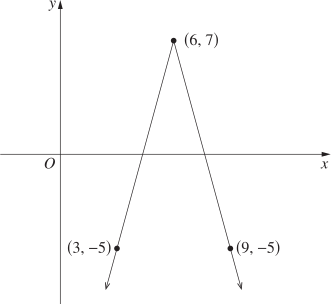
The graph of  \(y=f(x)\), where  \(f(x)=a|x-b|+c\), passes through the points \((3,-5), (6,7)\) and \((9,-5)\) as shown in the diagram.
 

  1. Find the values of  \(a, b\) and \(c\).  (3 marks)

    --- 6 WORK AREA LINES (style=lined) ---

  2. The line  \(y=m x\)  cuts the graph of  \(y=f(x)\)  in two distinct places.
  3. Find all possible values of \(m\).  (2 marks)

    --- 5 WORK AREA LINES (style=lined) ---

Show Answers Only

a.    \(\ a=-4\) , \(\ b=6\) , \(\ c=7\)

b.   \( \text{2 solutions when}\ \ -4<m<7/6 \)

Show Worked Solution

a.    \(\text{Consider the transformation of}\ \ y=-|x|\)

\(\text{Translate 6 units to the right}\)

\(y=-|x|\ \ \rightarrow\ \ y=-|x-6| \)

\(\therefore b=6\)
 

\(\text{Translate 7 units vertically up}\)

\(y=-|x-6|\ \ \rightarrow\ \ y=-|x-6|+7 \)

\(\therefore c=7\)
 

\(f(x)=a|x-6|+7\ \ \text{passes through}\ (3, -5):\)

\(-5\) \(=a|3-6|+7\)  
\(-5\) \(=3a+7\)  
\(3a\) \(=-12\)  
\(\therefore a\) \(=-4\)  

 
b.
    \(y=mx\ \ \text{passes through (0, 0)}\)

\( \text{One solution when}\ \ y=mx\ \ \text{passes through (0, 0) and (6, 7)}\)

\(m=\dfrac{7-0}{6-0}=\dfrac{7}{6}\)

\(\text{As graph gets flatter and turns negative ⇒ 2 solutions}\)
 

\(\text{2 solutions continue until}\ \ y=mx\ \ \text{is parallel to}\)

\(\text{the line joining (6, 7) to}\ (9,-5),\ \text{where}: \)

\(m=\dfrac{7-(-5)}{6-9}=-\dfrac{12}{3}=-4 \)
 

\(\therefore \ \text{2 solutions when}\ \ -4<m< \dfrac{7}{6} \)

♦♦♦ Mean mark (b) 23%.

Filed Under: Graph Transformations (Adv-2027), Transformations (Y12) Tagged With: Band 4, Band 6, smc-1008-20-Absolute Value, smc-1008-70-Combinations, smc-6408-15-Absolute Value, smc-6408-60-Combinations

Calculus, 2ADV C4 2023 HSC 26

A camera films the motion of a swing in a park.

Let \(x(t)\) be the horizontal distance, in metres, from the camera to the seat of the swing at \(t\) seconds.

The seat is released from rest at a horizontal distance of 11.2 m from the camera.
 

  1. The rate of change of \(x\) can be modelled by the equation

\(\dfrac{dx}{dt}=-1.5\pi\ \sin(\dfrac{5\pi}{4}t)\).

  1. Find an expression for \(x(t)\).  (2 marks)

    --- 4 WORK AREA LINES (style=lined) ---

  2. How many times does the swing reach the closest point to the camera during the first 10 seconds?  (2 marks)

    --- 4 WORK AREA LINES (style=lined) ---

Show Answers Only

  1. \(x(t)=\dfrac{6}{5} \cos(\dfrac{5\pi}{4}t) + 10\)
  2. \(\text{6 times}\)

Show Worked Solution

a.    \(\dfrac{dx}{dt}=-1.5\pi\ \sin(\dfrac{5\pi}{4}t)\)

\(x(t)\) \(= -1.5\pi\ \int \sin(\dfrac{5\pi}{4}t)\ dt \)  
  \(= 1.5\pi \times \dfrac{4}{5\pi} \times \cos(\dfrac{5\pi}{4}t) + c\)  
  \(=\dfrac{6}{5} \cos(\dfrac{5\pi}{4}t) + c \)  
Mean mark (a) 51%.

  
\(\text{When}\ t=0, \ x(t)=11.2:\)

\(11.2\) \(=\dfrac{6}{5} \cos(0) + c\)  
\(c\) \(=11.2-\dfrac{6}{5} \)  
  \(=10\)  

 
\(x(t)=\dfrac{6}{5} \cos(\dfrac{5\pi}{4}t) + 10\)


b.    \(\text{Period}\ =\dfrac{2\pi}{n} = \dfrac{2\pi}{\frac{5\pi}{4}} = \dfrac{8}{5} = 1.6\ \text{(seconds)}\)
♦♦ Mean mark (b) 31%.

\(\text{1st time swing reaches closest point to camera = 0.8 seconds}\)

\(\text{Periods in next 9.2 seconds}\) \(=\dfrac{9.2}{1.6}\)  
  \(= 5.75\ \text{times}\)  

 
\(\therefore\ \text{Swing reaches the closest point 6 times in the 1st 10 seconds}\)

Filed Under: Other Integration Applications (Y12) Tagged With: Band 4, Band 5, smc-1213-10-Motion

Financial Maths, 2ADV M1 2023 HSC 25

On the first day of November, Jia deposits $10 000 into a new account which earns 0.4% interest per month, compounded monthly. At the end of each month, after the interest is added to the account, Jia intends to withdraw \($M\) from the account.

Let \(A_n\) be the amount (in dollars) in Jia's account at the end of \(n\) months.

  1. Show that  \(A_2 = 10\ 000(1.004)^2-M(1.004)-M\).  (1 mark)

    --- 2 WORK AREA LINES (style=lined) ---

  2. Show that  \(A_n = (10\ 000-250M)(1.004)^n + 250M\).  (3 marks)

    --- 6 WORK AREA LINES (style=lined) ---

  3. Jia wants to be able to make at least 100 withdrawals.
  4. What is the largest value of \(M\) that will enable Jia to do this?  (2 marks)

    --- 4 WORK AREA LINES (style=lined) ---

Show Answers Only
  1. \(\text{See Worked Solutions}\)
  2. \(\text{See Worked Solutions}\)
  3. \($121.52\)
Show Worked Solution

a.    \(A_1=10\ 000(1.004)-M\)

\(A_2\) \(=A_1(1.004)-M\)  
  \(=[(10\ 000(1.004)-M)](1.004)-M\)  
  \(=10\ 000(1.004)^2-M(1.004)-M\)  

 
b.
    \(A_3=10\ 000(1.004)^3-M(1.004)^2-M(1.004)-M\)

\( \vdots\)

♦ Mean mark (b) 44%.
\(A_n\) \(=10\ 000(1.004)^n-M(1.004)^{n-1}-…-M(1.004)-M\)  
  \(=10\ 000(1.004)^n-M \underbrace{(1+1.004+1.004^2+…+1.004^{n-1})}_{\text{GP where}\ a=1, r=1.004, n=n} \)  
\(A_n\) \(=10\ 000(1.004)^n-M(\dfrac{1.004^n-1}{1.004-1}) \)  
  \(=10\ 000(1.004)^n-M(\dfrac{1.004^n-1}{0.004}) \)  
  \(=10\ 000(1.004)^n-250M(1.004^n-1) \)  
  \(=10\ 000(1.004)^n-250M(1.004)^n+250M \)  
  \(=(10\ 000-250M)(1.004)^n + 250M\)  

 
c. 
  \(\text{Find}\ M\ \text{when}\ A_{100}=0: \)

\(A_{100}\) \(= (10\ 000-250M)(1.004)^{100}+250M\)  
\(0\) \(=10\ 000(1.004)^{100}-250M(1.004)^{100}+250M \)  
\(250M(1.004^{100}-1)\) \(=10\ 000(1.004)^{100} \)  
\(M\) \(=\dfrac{10\ 000(1.004)^{100}}{250(1.004^{100}-1)} \)  
  \(=121.527…\)  

 
\( \therefore M_\text{max} = $121.52\)

Mean mark (c) 53%.

Filed Under: Financial Applications of Series (Y12) Tagged With: Band 4, Band 5, smc-1007-30-Annuity/Deposit - Withdrawal Phase

Calculus, 2ADV C3 2023 HSC 24

A gardener wants to build a rectangular garden of area 50 m² against an existing wall as shown in the diagram. A concrete path of width 1 metre is to be built around the other three sides of the garden.
 

Let \(x\) and \(y\) be the dimensions, in metres, of the outer rectangle as shown.

  1. Show that  \(y\) = \(\dfrac {50}{x - 2}+1 \).  (1 mark)

    --- 2 WORK AREA LINES (style=lined) ---

  2. Find the value of \(x\) such that the area of the concrete path is a minimum. Show that your answer gives a minimum area.  (4 marks)

    --- 8 WORK AREA LINES (style=lined) ---

Show Answers Only

  1. \(\text{See worked solutions}\)
  2. \(x=12\)

Show Worked Solution

a.     \( (y-1)(x-2)\) \(=50\)
  \(yx-2y-x+2\) \(=50\)
  \(y(x-2)\) \(=48+x\)
  \(y\) \(=\dfrac{48+x}{x-2}\)
  \(y\) \(=\dfrac{50+(x-2)}{x-2}\)
  \(y\) \(=\dfrac{50}{x-2}+1\)

 
b.
    \(\text{Let}\ A=\ \text{area of concrete path}\)

\(A\) \(= xy-50\)  
  \(= x(\dfrac{50}{x-2}+1)-50\)  
  \(=\dfrac{50x}{x-2}+x-50\)  


\(\dfrac{dA}{dx}\) \(=\dfrac{50(x-2)-50x}{(x-2)^2}+1\)  
  \(=\dfrac{-100}{(x-2)^2}+1\)  

 
\(\text{Max/min when}\ \dfrac{dA}{dx}=0\)

\(\dfrac{-100}{(x-2)^2}+1\) \(=0\)  
\((x-2)^2\) \(=100\)  
\(x-2\) \(=\pm 10\)  

 
\(x=12\ \ (x>0)\)

♦♦ Mean mark (b) 33%.

\(\text{Check gradients about}\ \ x=12: \)

\begin{array} {|c|c|c|c|}
\hline
\rule{0pt}{2.5ex} x \rule[-1ex]{0pt}{0pt} & 10 & 12 & 14\\
\hline
\rule{0pt}{2.5ex}\dfrac{dA}{dx} \rule[-1ex]{0pt}{0pt} & – \frac{9}{16} & 0 & \frac{11}{36}\\
\rule{0pt}{2.5ex}  \rule[-1ex]{0pt}{0pt} & \text{ \ } & \text{ _ } & \text{ / } \\
\hline
\end{array}

\(\therefore \text{Minimum at}\ x=12.\)

Filed Under: Maxima and Minima (Y12) Tagged With: Band 4, Band 5, smc-970-10-Area

Trigonometry, 2ADV T1 2023 HSC 22

In the rectangular prism shown, \(AD\) = 7 cm, \(AE\) = 8 cm, \(EF\) = 6 cm. Point \(M\) is the midpoint \(CD\).
  

Find \(\angle AEM\) to the nearest degree.  (3 marks)

--- 6 WORK AREA LINES (style=lined) ---

Show Answers Only

\(44°\)

Show Worked Solution

\(DM=MC= \frac{1}{2} \times 6 = 3\)

\(\text{Consider}\ \triangle ADM:\)

\(\text{By Pythagoras,}\)

\(AM^2\) \(= 7^2 + 3^2\)  
  \(=58\)  
\(AM\) \(=\sqrt{58}\)  


\(\text{In}\ \triangle AEM:\)

\(\tan \angle AEM\) \(= \dfrac{AM}{AE}\)  
  \(= \dfrac{\sqrt{58}}{8}\)  
\(\angle AEM\) \(=\tan^{-1}\Big{(}\dfrac{\sqrt{58}}{8}\Big{)}\)  
  \(= 43.59…\)  
  \(= 44°\ \text{(nearest degree)}\)  

Filed Under: 3D Trigonometry (Y11) Tagged With: Band 4

  • « Previous Page
  • 1
  • …
  • 44
  • 45
  • 46
  • 47
  • 48
  • …
  • 114
  • Next Page »

Copyright © 2014–2025 SmarterEd.com.au · Log in