SmarterEd

Aussie Maths & Science Teachers: Save your time with SmarterEd

  • Login
  • Get Help
  • About

Harder Ext1 Topics, EXT2 2017 HSC 14b

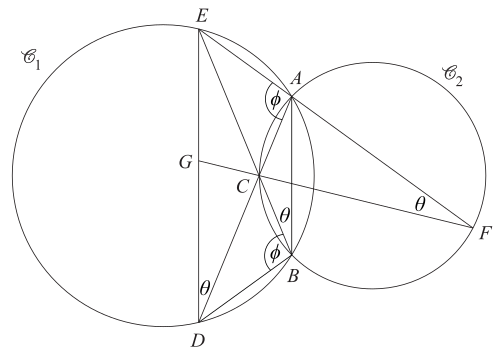
Two circles, `cc"C"_1` and `cc"C"_2`, intersect at the points `A` and `B`. Point `C` is chosen on the arc `AB` of `cc"C"_2` as shown in the diagram.

The line segment `AC` produced meets `cc"C"_1` at `D`.

The line segment `BC` produced meets `cc"C"_1` at `E`.

The line segment `EA` produced meets `cc"C"_2` at `F`.

The line segment `FC` produced meets the line segment `ED` at `G`.

Copy or trace the diagram into your writing booklet.

  1. State why `/_ EAD = /_ EBD`.  (1 mark)
  2. Show that `/_ EDA = /_ AFC`.  (1 mark)
  3. Hence, or otherwise, show that `B, C, G` and `D` are concyclic points.  (3 marks)
Show Answers Only
  1. `text(Proof)\ \ text{(See Worked Solutions)}`
  2. `text(Proof)\ \ text{(See Worked Solutions)}`
  3. `text(Proof)\ \ text{(See Worked Solutions)}`
Show Worked Solution

(i)  `text(Join)\ DB`

`/_ EAD = /_ EBD` `text{(angles at circumference}`
  `text(sitting on same arc)\ ED\ text(of)\ cc”C”_1 text{)}`


(ii)  `text(Join)\ AB`

`/_ EDA = /_ EBA` `text{(angles at circumference}`
  `text(sitting on same arc)\ EA\ text(of)\ cc”C”_1 text{)}`


`text(Consider arc)\ AC\ text(in)\ cc”C”_2`

`/_ EBA = /_ CBA = /_ AFC` `text{(angles at circumference}`
  `text(sitting on same arc)\ AC\ text(of)\ cc”C”_2 text{)}`


`:. /_ EDA = /_ AFC\ text(… as required.)`


(iii)   `text(Let)\ \ ` `/_ EDA = /_ AFC = theta\ \ text{(part (ii))}`
    `/_ EAD = /_ EBD = phi\ \ text{(part (i))}`


`text(Consider)\ Delta EAD:`

♦ Mean mark 47%.

`/_ AED = pi – theta – phi`

`text(Consider)\ Delta EGF:`

`/_ EGF` `= pi – (theta + pi – theta – phi)`
  `= phi`


`text(In)\ BCGD`

`text(External angle)\ EGF = phi`

`text(Interior opposite angle)\ EBD = phi`

`:. BCGD\ text(is a cyclic quadrilateral.)`
Filed Under: Circle/Plane Geometry Tagged With: Band 2, Band 4, Band 5

Algebra, STD2 A4 SM-Bank 4

Penny is a baker and makes meat pies every day.

The cost of making `p` pies, `$C`,  can be calculated using the equation

`C = 675 + 3.5 p`

Penny sells the pies for $5.75 each, and her income is calculated using the equation

`I = 5.75 p`

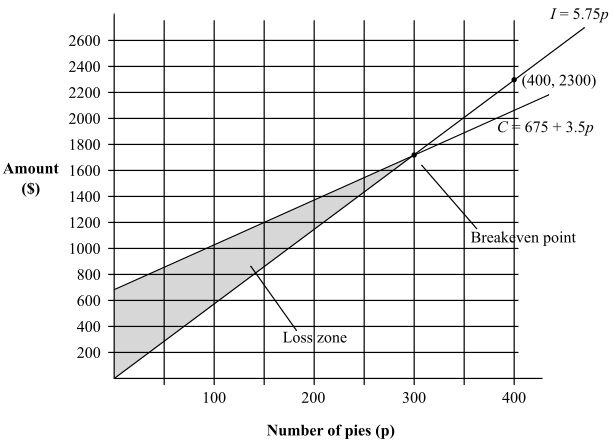
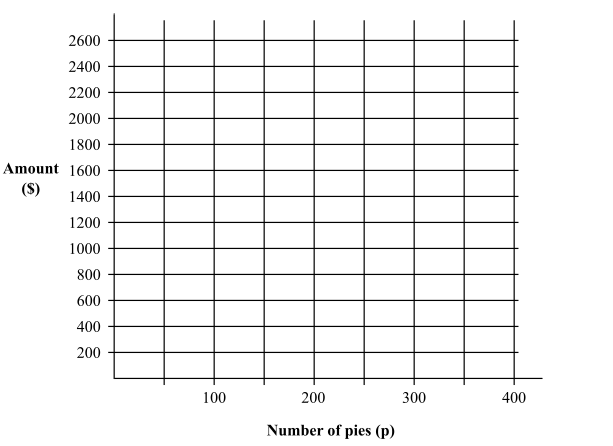
  1. On the graph, draw the graphs of  `C`  and  `I`.  (2 marks)

    --- 0 WORK AREA LINES (style=lined) ---

  2. On the graph, label the breakeven point and the loss zone.  (2 marks)

    --- 0 WORK AREA LINES (style=lined) ---

Show Answers Only

(i) and (ii)

Show Worked Solution
i.   


ii.  `text(Loss zone occurs when)\ C > I,\ text(which is shaded)`

`text(in the diagram above.)`
Filed Under: A3 Types of Relationships (Y12), Simultaneous Equations and Applications (Std 2) Tagged With: Band 4, Band 5, smc-1099-10-Cost/Revenue

Complex Numbers, EXT2 N2 2017 HSC 13e

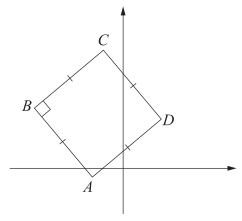
The points  `A, B, C`  and  `D`  on the Argand diagram represent the complex numbers  `a, b, c`  and  `d` respectively. The points form a square as shown on the diagram.


By using vectors, or otherwise, show that  `c = (1 + i) d - ia`.  (2 marks)

--- 4 WORK AREA LINES (style=lined) ---

Show Answers Only

`text(Proof)\ \ text{(See Worked Solutions)}`

Show Worked Solution

♦ Mean mark 49%.
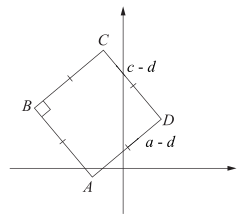
`c – d` `= i (d – a)\ \ \ text{(rotation of}\ pi/2 text{)}`
`:. c ` `= d + id – ia`
  `= (1 + i) d – ia\ text(… as required.)`
Filed Under: Geometrical Implications of Complex Numbers, Geometry and Complex Numbers (vectors) Tagged With: Band 5, smc-1052-30-Quadrilaterals

Proof, EXT2 P1 2017 HSC 10 MC

Suppose  `f(x)`  is a differentiable function such that
`(f(a) + f(b))/2 >= f((a + b)/2)`, for all `a` and `b`.

Which statement is always true?

  1. `int_0^1 f(x)\ dx >= (f(0) + f(1))/2`
  2. `int_0^1 f(x)\ dx <= (f(0) + f(1))/2`
  3. `f′(1/2) >= 0`
  4. `f′(1/2) <= 0`
Show Answers Only

`B`

Show Worked Solution

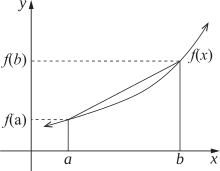
`text(Representing the equation graphically)`

♦ Mean mark 41%.

`text{(one of many possibilities)}`


`f(x)\ text(is an increasing function between)`

`a\ text(and)\ b\ text(such that:)`

`(f(a) + f(b))/2 >= f((a + b)/2)`
 

`text(If)\ \ a = 0\ text(and)\ \ b = 1,`

`int_0^1 f(x)\ dx` `<=\ text(Area of trapezium)`
  `<= 1/2(1) (f(0) + f(1))`
  `<= (f(0) + f(1))/2`

`=> B`

Filed Under: Harder Integration Examples, Inequalities EXT2, Proof and Inequalities Tagged With: Band 5, smc-1208-50-Arithmetic/Geometric Mean

Mechanics, EXT2 2017 HSC 9 MC

A particle is travelling on the circle with equation  `x^2 + y^2 = 16`.

It is given that  `(dx)/(dt) = y`.

Which statement about the motion of the particle is true?

  1. `(dy)/(dt) = x`  and the particle travels clockwise
  2. `(dy)/(dt) = x`  and the particle travels anticlockwise
  3. `(dy)/(dt) = −x`  and the particle travels clockwise
  4. `(dy)/(dt) = −x`  and the particle travels anticlockwise
Show Answers Only

`C`

Show Worked Solution
♦ Mean mark 46%.
`x^2 + y^2` `= 16`
`y^2` `= 16 – x^2`
`y` `= sqrt(16 – x^2)`
`(dy)/(dx)` `= 1/2 · (−2x)/(sqrt(16 – x^2)) = (−x)/(sqrt(16 – x^2))`
`(dy)/(dt)` `= (dy)/(dx) · (dx)/(dt)`
  `= (−x)/(sqrt16 – x^2) · sqrt(16 – x^2)\ \ \ (text(given)\ \ (dx)/(dt) = y)`
  `= −x`


`text{Test (1, 3) on circle:}`

`(dx)/(dt) = 3, (dy)/(dt) = −1`

`text(Interpretation:)\ y↓\ text(as)\ x↑\ text(in 1st quadrant)`

`:.\ text(Travelling in clockwise direction.)`

`=> C`

Filed Under: Circular Motion Tagged With: Band 5

Conics, EXT2 2017 HSC 16b

The hyperbola with equation

`(x^2)/(a^2) - (y^2)/(b^2) = 1`

has eccentricity 2.

The distance from one of the foci to one of the vertices is 1.

What are the possible values of `a`?  (2 marks)

Show Answers Only

`1/3\ \ text(or)\ \ 1`

Show Worked Solution

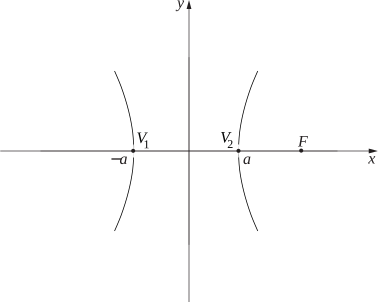
`text(Focus)\ (F)\ text(co-ordinates:)\ (ae,0) = (2a,0)`

♦ Mean mark 45%.

`text(Consider vertex 1)\ (V_1):`

`V_1F = 2a + a` `= 1`
`a` `= 1/3`


`text(Consider vertex 2)\ (V_2):`

`V_2F = 2a – a` `= 1`
`a` `= 1`


`:.a=1/3\ \ text(or)\ \ 1`

Filed Under: Hyperbola Tagged With: Band 5

Harder Ext1 Topics, EXT2 2017 HSC 16a

  Let  `alpha = costheta + i sintheta`, where  `0 < theta < 2pi`.

  1. Show that  `alpha^k + alpha^(−k) = 2 cos ktheta`, for any integer `k`.  (1 mark)
  2. Let  `C = alpha^(−n) + … + alpha^(−1) + 1 + alpha + … + alpha^n`, where `n` is a positive integer.
  3. By summing the series, prove that  

    `C = (alpha^n + alpha^(−n) - (a^(n + 1) + alpha^(−(n + 1))))/((1 - alpha)(1 - baralpha))`.  (3 marks)

  4. Deduce, from parts (i) and (ii), that`1 + 2(costheta + cos2theta + … + cosntheta) = (cosntheta - cos(n + 1)theta)/(1 - costheta)`.  (2 marks)

  5. Show that  
    `cos\ pi/n + cos\ (2pi)/n + …  + cos\ (npi)/n`  is independent of `n`.  (1 mark)


Show Answers Only
  1. `text(See Worked Solutions)`
  2. `text(See Worked Solutions)`
  3. `text(See Worked Solutions)`
  4. `text(See Worked Solutions)`
Show Worked Solution

(i)   `alpha = costheta – isintheta`

`text(Using de Moivre:)`

`alpha^k` `= cos(ktheta) + isin(ktheta)`
`alpha^(−k)` `= cos(−ktheta) + isin(−ktheta)`
  `= cos(ktheta) – isin(ktheta)`
`:. alpha^k + alpha^(−k)` `= cos(ktheta) + isin(ktheta) + cos(ktheta) – isin(ktheta)`
  `= 2cos(ktheta)\ …\ \ text(as required.)`


(ii)   `C = alpha^(−n) + … + alpha^(−1) + 1 + alpha + … + alpha^n`

♦♦ Mean mark 34%.

`=> text(GP where)\ \ a = alpha^(−n), r = alpha`

`=> text(Number of terms) = 2n + 1`

`:. C` `= (a(1 – r^n))/(1 – r)`
  `= (alpha^(−n)(1 – alpha^(2n + 1)))/(1 – alpha)`
  `= (alpha^(−n)(1 – alpha^(2n + 1)))/(1 – alpha) xx (1 – baralpha)/(1 – baralpha)\ \ \ \ text{(where}\ baralpha = alpha^(−1) text{)}`
  `= ((alpha^(−n) – alpha^(n + 1))(1 – alpha^(−1)))/((1 – alpha)(1 – baralpha))`
  `= (alpha^(−n) – alpha^(−n – 1) – alpha^(n + 1) + alpha^n)/((1 – alpha)(1 – baralpha))`
  `= (alpha^n + alpha^(−n) – (alpha^(n + 1) + alpha^(−(n + 1))))/((1 – alpha)(1 – baralpha))\ …\ \ text(as required.)`
♦ Mean mark part (iii) 48%.


(iii)    `C` `= alpha^(−n) + a^(−n + 1) … + alpha^(−1) + 1 + alpha + … + alpha^n `
    `= 1 + (alpha + alpha^(−1)) + (alpha^2 + alpha^(−2)) + … + (alpha^n + alpha^(−n))`
    `= 1 + 2costheta + 2cos2theta + … + 2cosntheta\ \ \ \ (text{using part (i)})`
    `= 1 + 2(costheta + 2cos2theta + … + cosntheta)`


`text{Also, using part (ii)}`

`C` `= (alpha^n + alpha^(−n) – (alpha^(n + 1) + alpha^(−(n + 1))))/((1 – alpha)(1 – baralpha))`
  `= (2cosntheta – 2cos(n + 1)theta)/(1 – baralpha – alpha + 1)\ \ (text{part (i)})`
  `= (2cosntheta – 2cos(n + 1)theta)/(2 – (alpha + alpha^(−1)))`
  `= (2cosntheta – 2cos(n + 1)theta)/(2 – 2costheta)`
  `= (cosntheta – cos(n + 1)theta)/(1 – costheta)`

`:. 1 + 2(costheta, cos2theta + … + cosntheta) = (cosntheta – cos(n + 1)theta)/(1 – costheta)`

♦♦♦ Mean mark part (iv) 28%.


(iv)   `text{Rearrange the result from (iii):}`

`costheta + cos2theta + … + cosntheta = 1/2((cosntheta – cos(n + 1)theta)/(1 – costheta) – 1)`

`text(Let)\ \ theta = pi/n`

`:. cos\ pi/n + cos\ (2pi)/n + … + cos\ (npi)/n`

`= 1/2((cos((npi)/n) – cos(((n + 1)pi)/n))/(1 – cos(pi/n)) – 1)`
`= 1/2((cospi – cos(pi + pi/n))/(1 – cos(pi/n)) – 1)`
`= 1/2((−(1 – cos(pi/n)))/(1 – cos(pi/n)) – 1)`
`= 1/2 (−1 – 1)`
`= −1`


`=> text(which is independent of)\ n.`

Filed Under: Other Ext1 Topics Tagged With: Band 3, Band 5, Band 6

CORE, FUR2 2017 VCAA 1

The number of eggs counted in a sample of 12 clusters of moth eggs is recorded in the table below.
     

  1. From the information given, determine
  2.  i. the range   (1 mark)

    --- 1 WORK AREA LINES (style=lined) ---

  3. ii. the percentage of clusters in this sample that contain more than 170 eggs.   (1 mark)

    --- 2 WORK AREA LINES (style=lined) ---

In a large population of moths, the number of eggs per cluster is approximately normally distributed with a mean of 165 eggs and a standard deviation of 25 eggs.

  1. Using the 68–95–99.7% rule, determine
  2.  i. the percentage of clusters expected to contain more than 140 eggs.   (1 mark)

    --- 3 WORK AREA LINES (style=lined) ---

  3. ii. the number of clusters expected to have less than 215 eggs in a sample of 1000 clusters.   (1 mark)

    --- 3 WORK AREA LINES (style=lined) ---

  4. The standardised number of eggs in one cluster is given by  `z = –2.4`
  5. Determine the actual number of eggs in this cluster.   (1 mark)

    --- 3 WORK AREA LINES (style=lined) ---

Show Answers Only

a.    `72`

b.i.  `25text(%)`

b.ii.  `-1`

c.  `105\ text(eggs)`

Show Worked Solution

a.i.  `text(Range)\ = 197-125= 72`

a.ii.  `text(3 clusters > 170 eggs)`

`:.\ text(Percentage)` `= 3/12 xx 100text(%)`
  `= 25text(%)`


b.i.    `ztext{-score (140)}` `= (140-165)/25`
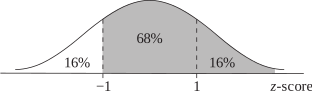
    `= −1`

`:.\ text(Percentage over 140)`

`= 68 + 16`

`= 84text(%)`


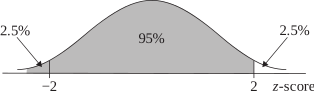
b.ii.    `ztext{-score (215)}` `= (215-165)/25`
    `= 2`


`:.\ text(Percentage less than 215)`

`= 97.5text(%) xx 1000`

`= 975`


c.    `text(Using)\ \ \ z` `= (x-barx)/s`
  `−2.4` `= (x-165)/25`
  `x` `= (−2.4 xx 25) + 165`
    `= 105\ text(eggs)`

Filed Under: Normal Distribution, Summary Statistics Tagged With: Band 3, Band 4, Band 5, smc-468-40-Median Mode and Range, smc-600-10-Single z-score

MATRICES, FUR1 2017 VCAA 6 MC

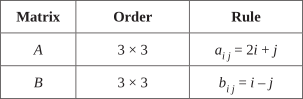
The table below shows information about two matrices, `A` and `B`.


The element in row `i` and column `j` of matrix `A` is `a_(ij)`.

The element in row `i` and column `j` of matrix `B` is `b_(ij)`.

The sum  `A + B`  is

A.

`[(5,7,9),(8,10,12),(11,13,15)]`


B.

`[(5,8,11),(7,10,13),(9,12,15)]`


C.

`[(3,6,9),(3,6,9),(3,6,9)]`


D.

`[(3,3,3),(6,6,6),(9,9,9)]`


E.

`[(3,6,3),(6,3,9),(3,9,3)]`


Show Answers Only

`D`

Show Worked Solution
`a_(ij) + b_(ij)` `= 2i + j + i – j`
  `= 3i`
`A + B` `= [(3xx1,3xx1,3xx1),(3xx2,3xx2,3xx2),(3xx3,3xx3,3xx3)]`
  `= [(3,3,3),(6,6,6),(9,9,9)]`

`=> D`

Filed Under: Matrix Calculations Tagged With: Band 5, smc-616-70-Elements/Rules

MATRICES, FUR1 2017 VCAA 5 MC

Four teams, `A`, `B`, `C` and `D`, competed in a round-robin competition where each team played each of the other teams once. There were no draws.

The results are shown in the matrix below.
 

`{:(),(),(text(winner)\ ):}{:(qquadqquadqquad\ text(loser)),(qquadqquadAquadBquadCquadD),({:(A),(B),(C),(D):}[(0,0,f,1),(1,0,0,0),(1,g,0,1),(0,1,0,h)]):}`
 

A 1 in the matrix shows that the team named in that row defeated the team named in that column.

For example, the 1 in row 2 shows that team `B` defeated team `A`.

In this matrix, the values of  `f`, `g` and `h` are

  1. `f = 0,qquadg = 1,qquadh = 0`
  2. `f = 0,qquadg = 1,qquadh = 1`
  3. `f = 1,qquadg = 0,qquadh = 0`
  4. `f = 1,qquadg = 1,qquadh = 0`
  5. `f = 1,qquadg = 1,qquadh = 1`
Show Answers Only

`A`

Show Worked Solution

`text(Consider column 1:)`

`C\ text(defeated)\ A => f = 0`

`text(Consider column 3:)`

`B\ text(lost to)\ C => g = 1`

`h = 0, text(s)text(ince team)\ D\ text(cannot play itself.)`

`=> A`

Filed Under: Matrix Applications Tagged With: Band 5, smc-619-70-One/Two Step Dominances

GRAPHS, FUR1 2017 VCAA 7 MC

Connor makes 200 meat pies to sell at his local market.

The cost, `$C`, of producing `n` pies can be determined from the rule below.

`C = 0.8n + 250`

Connor sells the first 150 pies at full price and sells the remaining 50 pies at half-price.

To break even, the full price of each pie must be closest to

  1. `$1.85`
  2. `$2.05`
  3. `$2.35`
  4. `$2.50`
  5. `$2.75`
Show Answers Only

`C`

Show Worked Solution
`text(Total cost)` `= 0.8 xx 200 + 250`
  `= $410`


`text(Let)\ \ x =\ text(full price)`

`text(Breakeven occurs when:)`

`150x + 50 xx 1/2x` `= 410`
`175x` `= 410`
`x` `= 410/175`
  `= $2.342…`

`=> C`

Filed Under: Linear relationships Tagged With: Band 5

GRAPHS, FUR1 2017 VCAA 6 MC

The ticket office at a circus sells adult tickets and child tickets:

• The Payne family bought two adult tickets and three child tickets for $69.50
• The Tran family bought one adult ticket and five child tickets for $78.50
• The Saunders family bought three adult tickets and four child tickets.

What is the total amount spent by the Saunders family?

  1.   `$83.40`
  2.   `$87.50`
  3.   `$98.00`
  4. `$101.50`
  5. `$112.00`
Show Answers Only

`C`

Show Worked Solution

`text(Let)\ a\ text(= cost of 1 adult ticket)`

`text(Let)\ c\ text(= cost of 1 child ticket)`

`2a + 3c` `= 69.50\ \ …\ (1)`
`a + 5c` `= 78.50\ \ …\ (2)`


`text(Multiply)\ (2) xx 2`

`2a + 10c = 157.00\ \ …\ (3)`


`text(Subtract)\ (3) – (1)`

`7c` `= 87.50`
`c` `= $12.50`


`text(Substitute)\ \ c=$12.50\ \ text{into (2)}`

`a + 5 xx 12.50` `= 78.50`
`:. a` `= $16`


`:.\ text(Saunders family cost)`

`= 3 xx 16 + 4 xx 12.50`

`= $98`

`=> C`

Filed Under: Linear relationships Tagged With: Band 5

GRAPHS, FUR1 2017 VCAA 5 MC

A childcare centre requires at least one teacher employed for every 15 children enrolled.

Let `x` be the number of teachers employed.

Let `y` be the number of children enrolled.

Which one of the following is the inequality that represents this situation?

  1. `y >= 15x`
  2. `y <= x/15`
  3. `y <= 15/x`
  4. `y <= 15x`
  5. `y >= x/15`
Show Answers Only

`D`

Show Worked Solution
`x` `>= y/15`
`:. y` `<= 15x`

`=> D`

Filed Under: Linear Programming Tagged With: Band 5

NETWORKS, FUR1 2017 VCAA 7 MC

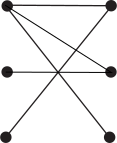
A graph with six vertices has no loops or multiple edges.

Which one of the following statements about this graph is not true?

  1. If the graph is a tree it has five edges.
  2. If the graph is complete it has 15 edges.
  3. If the graph has eight edges it may have an isolated vertex.
  4. If the graph is bipartite it will have a minimum of nine edges.
  5. If the graph has a cycle it will have a minimum of three edges.
Show Answers Only

`D`

Show Worked Solution

`text(Consider option)\ D:`

`text(It is easy to construct a bipartite graph in this)`

`text(example with less than nine edges.)`

`text(For example, the graph below is bipartite with)`

`text(6 vertices and 5 edges.)`
 

`=> D`

Filed Under: Basic Concepts Tagged With: Band 5, smc-626-10-Definitions

NETWORKS, FUR1 2017 VCAA 6 MC

 
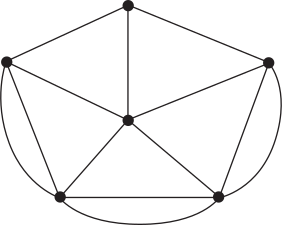
An Eulerian trail for the graph above will be possible if only one edge is removed.

In how many different ways could this be done?

  1. `1`
  2. `2`
  3. `3`
  4. `4`
  5. `5`
Show Answers Only

`E`

Show Worked Solution

`text(An Eulerian trail needs two vertices to have an)`

`text(odd degree.)`

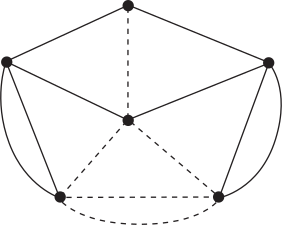
`text(Any of the dashed edges below could be removed.)`

`=> E`

Filed Under: Travelling Problems and Adjacency Matrices Tagged With: Band 5, smc-622-10-Euler

NETWORKS, FUR1 2017 VCAA 4-5 MC

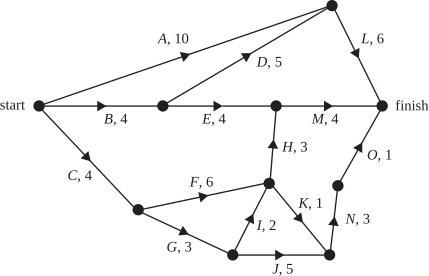
The directed graph below shows the sequence of activities required to complete a project.

The time to complete each activity, in hours, is also shown.


Part 1

The earliest starting time, in hours, for activity `N` is

  1. 3
  2. 10
  3. 11
  4. 12
  5. 13


Part 2

To complete the project in minimum time, some activities cannot be delayed.

The number of activities that cannot be delayed is

  1. 2
  2. 3
  3. 4
  4. 5
  5. 6
Show Answers Only

`text(Part 1:)\ D`

`text(Part 1:)\ C`

Show Worked Solution

`text(Part 1)`

`text(EST of)\ N:\ CGJ`

`:.\ text(EST of)\ N` `= 4 + 3 +5`
  `= 12\ text(hours)`

`=> D`


`text(Part 2)`

`text(Critical path is:)\ CFHM`

`:. 4\ text(activities can’t be delayed.)`

`=> C`

Filed Under: Critical Path Analysis Tagged With: Band 4, Band 5, smc-621-20-Critical Paths/EST

NETWORKS, FUR1 2017 VCAA 3 MC

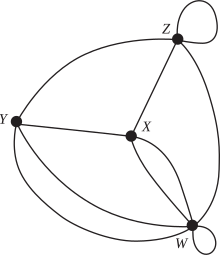
Consider the following graph.


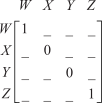
The adjacency matrix for this graph, with some elements missing, is shown below.


This adjacency matrix contains 16 elements when complete.

Of the 12 missing elements

  1. eight are ‘1’ and four are ‘2’.
  2. four are ‘1’ and eight are ‘2’.
  3. six are ‘1’ and six are ‘2’.
  4. two are ‘0’, six are ‘1’ and four are ‘2’.
  5. four are ‘0’, four are ‘1’ and four are ‘2’.
Show Answers Only

`A`

Show Worked Solution

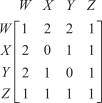
`text(Completing the adjacency matrix:)`
 

`=> A`

Filed Under: Travelling Problems and Adjacency Matrices Tagged With: Band 5, page-break-before-question, smc-622-40-Adjacency Matrix

GEOMETRY, FUR1 2017 VCAA 6 MC

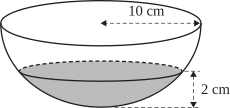
A hemispherical bowl of radius 10 cm is shown in the diagram below.

The bowl contains water with a maximum depth of 2 cm.

The radius of the surface of the water, in centimetres, is

  1.   `2`
  2.   `6`
  3.   `8`
  4.   `9`
  5. `10`
Show Answers Only

`B`

Show Worked Solution

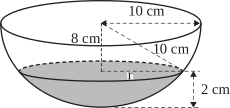
`text(Using Pythagoras,)`

`r^2` `= 10^2 – 8^2`
  `= 36`
`:. r` `= 6\ text(cm)`

`=> B`

Filed Under: Perimeter, Area and Volume Tagged With: Band 5

GEOMETRY, FUR1 2017 VCAA 5 MC

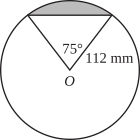
A segment is formed by an angle of 75° in a circle of radius 112 mm.

This segment is shown shaded in the diagram below.
 

Which one of the following calculations will give the area of the shaded segment?

  1. `pi xx 112^2 xx (75/360)`
  2. `pi xx 112^2 xx (285/360)`
  3. `pi xx 112^2 xx (75/360) - 1/2 xx 112^2 xx sin(75°)`
  4. `pi xx 112^2 xx (285/360) - 1/2 xx 112^2 xx sin(75°)`
  5. `pi xx 112^2 xx (75/180) - 1/2 xx 112^2 xx sin(75°)`
Show Answers Only

`C`

Show Worked Solution
`text(Area)` `=\ text(Area small sector − Area of triangle)`
  `= pi xx 112^2 xx 75/360 – 1/2 xx 112^2 xx sin(75°)`

`=> C`

Filed Under: Perimeter, Area and Volume Tagged With: Band 5

Measurement, STD2 M1 2013 HSC 15a*

The diagram shows the front of a tent supported by three vertical poles. The poles are 1.2 m apart. The height of each outer pole is 1.5 m, and the height of the middle pole is 1.8 m. The roof hangs between the poles.

2013 15a

The front of the tent has area `A\ text(m²)`. 

  1. Use the trapezoidal rule to estimate `A`.    (2 marks)

    --- 4 WORK AREA LINES (style=lined) ---

  2. Explain whether the trapezoidal rule give a greater or smaller estimate of  `A`?  (1 mark)

    --- 2 WORK AREA LINES (style=lined) ---

Show Answers Only
  1. `3.96\ text(m²)`
  2. `text(The trapezoidal rule assumes a straight line between)`


    `text(all points and therefore would estimate a greater)`


    `text(area than the actual area of the tent front.)`

Show Worked Solution
i.    `A` `~~ h/2 [y_0 + 2y_1 + y_2]`
    `~~ 1.2/2 [1.5 + (2 xx 1.8) + 1.5]`
    `~~ 0.6 [6.6]`
    `~~ 3.96\ text(m²)`


ii.  `text(The trapezoidal rule assumes a straight line between)`

`text(all points and therefore would estimate a greater)`

`text(area than the actual area of the tent front.)`

Filed Under: Trapezoidal Rule (Std 2), Trapezoidal Rule (Std2-2027) Tagged With: Band 4, Band 5, smc-6328-10-1-3 Approximations, smc-941-10-1-3 Approximations

Algebra, STD2 A2 SM-Bank 2

The weight of a steel beam, `w`, varies directly with its length, `ℓ`.

A 1200 mm steel beam weighs 144 kg.

Calculate the weight of a 750 mm steel beam.  (2 marks)

--- 4 WORK AREA LINES (style=lined) ---

Show Answers Only

`90\ text(kg)`

Show Worked Solution

`w propto ℓ`

`w = kℓ`

`text(When)\ \ w = 144\ text(kg),\ \ ℓ = 1200\ text(mm)`

`144` `= k xx 1200`
`k` `= 144/1200`
  `= 3/25`


`text(When)\ \ ℓ = 750\ text(mm),`

`w` `= 3/25 xx 750`
  `= 90\ text(kg)`

Filed Under: Applications: Currency, Fuel and Other Problems (Std 1), Applications: Currency, Fuel and Other Problems (Std 2), Direct Variation (Std2-2027) Tagged With: Band 5, smc-1119-30-Other Linear Applications, smc-1119-50-Proportional, smc-6249-30-Algebraic Solutions, smc-793-30-Other Linear Applications, smc-793-50-Proportional

Algebra, STD2 A1 SM-Bank 4

Doris is driving in a school zone at a speed of 35 kilometres per hour and needs to stop immediately to avoid an accident.

It takes her 1.25 seconds to react and her breaking distance is 5.3 metres.

Stopping distance can be calculated using the following formula
 

`text(stopping distance = {reaction time distance} + {braking distance})`
 

What is Doris' total stopping distance? Give your answer to 1 decimal place.  (2 marks)

--- 4 WORK AREA LINES (style=lined) ---

Show Answers Only

`17.5\ text{metres  (to 1 d.p.)}`

Show Worked Solution
`35\ text(km/hr)` `= 35\ 000\ text(m/hr)`
  `= (35\ 000)/(60 xx 60)\ text(m/sec)`
  `= 9.722…\ text(m/sec)`


`:.\ text(Total stopping distance)`

`=\ text(Reaction time distance) + text(braking distance)`

`= 1.25 xx 9.722… +5.3`

`= 17.452…`

`= 17.5\ text{metres  (to 1 d.p.)}`

Filed Under: Applications: BAC, Medication and D=SxT (Std 2), Applications: BAC, Medicine and D=SxT (Std2-2027), Applications: D=SxT and Other (Std 1), Safety: D=ST & BAC Tagged With: Band 5, smc-1117-40-Stopping Distance, smc-6235-40-Stopping Distance, smc-791-40-Stopping Distance

CORE, FUR1 2017 VCAA 23 MC

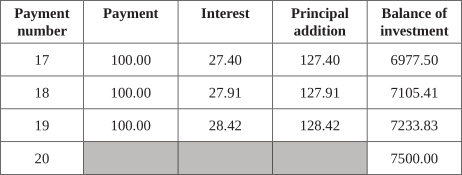
Four lines of an amortisation table for an annuity investment are shown below.

The interest rate for this investment remains constant, but the payment value may vary.


The balance of the investment after payment number 20 is $7500.

The value of payment number 20 is closest to

  1.   `$29`
  2. `$100`
  3. `$135`
  4. `$237`
  5. `$295`
Show Answers Only

`D`

Show Worked Solution

`text(Principal addition)`

`= 7500 – 7233.83`

`= $266.17`


`text(From the table,)`

`text{Interest applicable (expected) ≈ $29}`

`:.\ text(Payment)` `~~ 266.17 – 29`
  `~~ $237.17`

`=> D`

Filed Under: Annuities and Perpetuities Tagged With: Band 5, smc-2512-30-Annuity Amortisation Table

CORE, FUR1 2017 VCAA 22 MC

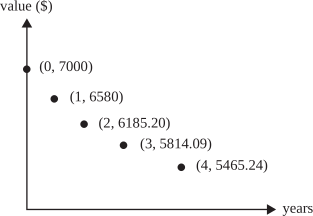
Consider the graph below.


This graph could show the value of

  1. a piano depreciating at a flat rate of 6% per annum.
  2. a car depreciating with a reducing balance rate of 6% per annum.
  3. a compound interest investment earning interest at the rate of 6% per annum.
  4. a perpetuity earning interest at the rate of 6% per annum.
  5. an annuity investment with additional payments of 6% of the initial investment amount per annum.
Show Answers Only

`B`

Show Worked Solution

`text(Consider the change in the)\ y text(-values:)`

`7000 xx 0.94` `= 6580`
`6580 xx 0.94` `= 6185.20`
`…\ \ text(and so on)`


`:.\ text(The asset is depreciating at 6% p. a. on a reducing)`

`text(balance basis.)`

`=> B`

Filed Under: Annuities and Perpetuities, Borrowing and Loans, Depreciation Tagged With: Band 5, smc-2512-60-Graphs, smc-602-60-Depreciation graphs, smc-603-80-Graphs

CORE, FUR1 2017 VCAA 21 MC

A printer was purchased for $680.

After four years the printer has a value of $125.

On average, 1920 pages were printed every year during those four years.

The value of the printer was depreciated using a unit cost method of depreciation.

The depreciation in the value of the printer, per page printed, is closest to

  1.  3 cents.
  2.  4 cents.
  3.  5 cents.
  4.  6 cents.
  5.  7 cents.
Show Answers Only

`E`

Show Worked Solution

`text(Value lost each year)`

`= (680 – 125)/4`

`= $138.75`
 

`:.\ text(Depreciation per page)`

`= 138.75/1920`

`= 0.072…`

`~~ 7\ text(cents per page.)`

`=> E`

Filed Under: Depreciation Tagged With: Band 5, smc-602-30-Unit cost

Algebra, STD2 A4 SM-Bank 3

Temperature can be measured in degrees Celsius (`C`) or degrees Fahrenheit (`F`).

The two temperature scales are related by the equation  `F = (9C)/5 + 32`.

  1. Calculate the temperature in degrees Fahrenheit when it is  −20 degrees Celsius.  (1 mark)

    --- 2 WORK AREA LINES (style=lined) ---

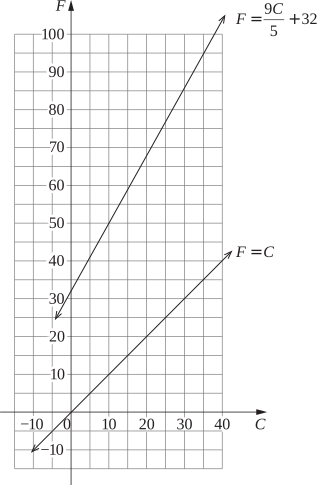
  2. The following two graphs are drawn on the axes below:
     
           `F = (9C)/5 + 32`  and  `F = C`


    Explain what happens at the point where the two graphs intersect.  (1 mark)

    --- 2 WORK AREA LINES (style=lined) ---

Show Answers Only
  1. `−4^@F`
  2. `text(The two graphs intersect at a temperature where)`


    `text(Celcius and Farenheit are the same.)`

Show Worked Solution
i.   `F` `= (9(−20))/5 + 32`
    `= −4^@F`


ii.   `text(The two graphs intersect at a temperature where)`

`text(Celcius and Farenheit are the same.)`

Filed Under: A3 Types of Relationships (Y12), Simultaneous Equations and Applications (Std 2) Tagged With: Band 3, Band 5, smc-1099-20-Other SE applications, smc-794-15-Other SE Applications

CORE, FUR1 2017 VCAA 16 MC

The seasonal index for the sales of cold drinks in a shop in January is 1.6

To correct the January sales of cold drinks for seasonality, the actual sales should be

  1. `text(reduced by 37.5%)`
  2. `text(reduced by 40%)`
  3. `text(reduced by 62.5%)`
  4. `text(increased by 60%)`
  5. `text(increased by 62.5%)`
Show Answers Only

`A`

Show Worked Solution

`text(Deseasonalised sales)`

`= text(Actual)/text(index)`

`= text(Actual) xx 1/1.6`

`=\ text(Actual × 62.5%)`


`:.\ text(Actual sales need to be reduced by 37.5%)`

`=> A`

Filed Under: Time Series Tagged With: Band 5, smc-266-20-(De)Seasonalising Data

CORE, FUR1 2017 VCAA 13-15 MC

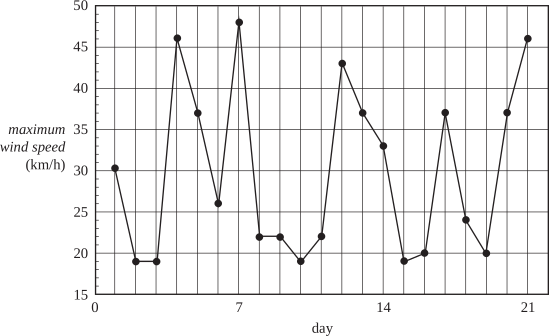
The wind speed at a city location is measured throughout the day.

The time series plot below shows the daily maximum wind speed, in kilometres per hour, over a three-week period.


Part 1

The time series is best described as having

  1. seasonality only.
  2. irregular fluctuations only.
  3. seasonality with irregular fluctuations.
  4. a decreasing trend with irregular fluctuations.
  5. an increasing trend with irregular fluctuations.


Part 2

The seven-median smoothed maximum wind speed, in kilometres per hour, for day 4 is closest to

  1. `22`
  2. `26`
  3. `27`
  4. `30`
  5. `32`


Part 3

The table below shows the daily maximum wind speed, in kilometres per hour, for the days in week 2.

A four-point moving mean with centring is used to smooth the time series data above.

The smoothed maximum wind speed, in kilometres per hour, for day 11 is closest to

  1. `22`
  2. `24`
  3. `26`
  4. `28`
  5. `30`
Show Answers Only

`text(Part 1:)\ B`

`text(Part 2:)\ D`

`text(Part 3:)\ D`

Show Worked Solution

`text(Part 1)`

`text(The time series plot shows no obvious trend and)`

`text(is over too short a period to show seasonality.)`

`=> B`


`text(Part 2)`

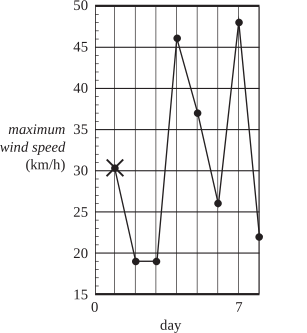
`text(Consider the 7 values where day 4 is the middle)`

`text(data point.)`

`text(By inspection of the graph, the 4th highest point = 30.)`

`=> D`


`text(Part 3)`

`text(Mean for Day 9 – 12)`

`= (22 + 19 + 22 + 43)/4 = 26.5`


`text(Mean for Day 10 – 13)`

`= (19 + 22 + 43 + 37)/4 = 30.25`


`:. 4text(-point moving mean with centring)`

`= (26.5 + 30.25)/2`

`= 28.375`

`=> D`

`

Filed Under: Time Series Tagged With: Band 4, Band 5, smc-266-40-Time Series Trends, smc-266-60-MEAN Smoothing, smc-266-70-MEDIAN Smoothing

CORE, FUR1 2017 VCAA 8-10 MC

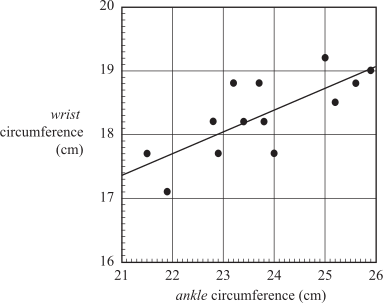
The scatterplot below shows the wrist circumference and ankle circumference, both in centimetres, of 13 people. A least squares line has been fitted to the scatterplot with ankle circumference as the explanatory variable.
 

Part 1

The equation of the least squares line is closest to

  1. ankle = 10.2 + 0.342 × wrist
  2. wrist = 10.2 + 0.342 × ankle
  3. ankle = 17.4 + 0.342 × wrist
  4. wrist = 17.4 + 0.342 × ankle
  5. wrist = 17.4 + 0.731 × ankle


Part 2

When the least squares line on the scatterplot is used to predict the wrist circumference of the person with an ankle circumference of 24 cm, the residual will be closest to

  1. `–0.7`
  2. `–0.4`
  3. `–0.1`
  4.    `0.4`
  5.    `0.7`


Part 3

The residuals for this least squares line have a mean of 0.02 cm and a standard deviation of 0.4 cm.

The value of the residual for one of the data points is found to be  – 0.3 cm.

The standardised value of this residual is

  1. `–0.8`
  2. `–0.7`
  3. `–0.3`
  4.    `0.7`
  5.    `0.8`
Show Answers Only

`text(Part 1:)\ B`

`text(Part 2:)\ A`

`text(Part 3:)\ A`

Show Worked Solution

`text(Part 1)`

`ytext(-intercept = 10.2)`

`(text(note)\ xtext(-axis in graph begins at 21 cm))`

`:. text(wrist) = 10.2 + 0.342 xx text(ankle)`

`=> B`


`text(Part 2)`

`text(Predicted wrist)` `= 10.2 + 0.342 xx 24`
  `= 18.4`


`text(Residual)` `=\ text(actual − predicted)`
  `~~ 17.7 – 18.4`
  `~~ −0.7`

 
`=> A`

 
`text(Part 3)`

`barx = 0.02,qquad s_x = 0.4`

`text(If)\ \ x = −0.3,`

`z` `= (x – barx)/s_x`
  `= (−0.3 – 0.02)/0.4`
  `= −0.8`

 
`=> A`

Filed Under: Correlation and Regression, Normal Distribution Tagged With: Band 4, Band 5, smc-265-20-Find LSRL Equation/Gradient, smc-265-50-Residuals, smc-600-10-Single z-score

CORE, FUR1 2017 VCAA 5-7 MC

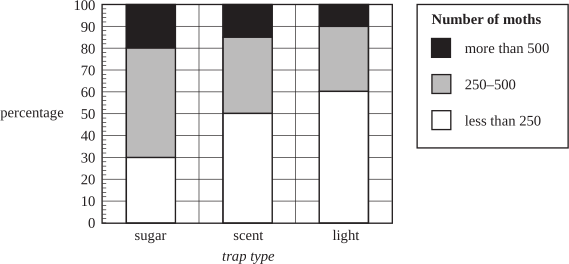
A study was conducted to investigate the association between the number of moths caught in a moth trap (less than 250, 250–500, more than 500) and the trap type (sugar, scent, light). The results are summarised in the percentaged segmented bar chart below.
 

Part 1

There were 300 sugar traps.

The number of sugar traps that caught less than 250 moths is closest to

  1. 30
  2. 90
  3. 250
  4. 300
  5. 500

 
Part 2

The data displayed in the percentaged segmented bar chart supports the contention that there is an association between the number of moths caught in a moth trap and the trap type because

  1. most of the light traps contained less than 250 moths.
  2. 15% of the scent traps contained 500 or more moths.
  3. the percentage of sugar traps containing more than 500 moths is greater than the percentage of scent traps containing less than 500 moths.
  4. 20% of sugar traps contained more than 500 moths while 50% of light traps contained less than 250 moths.
  5. 20% of sugar traps contained more than 500 moths while 10% of light traps contained more than 500 moths.

 
Part 3

The variables number of moths (less than 250, 250–500, more than 500) and trap type (sugar, scent, light) are

  1. both nominal variables.
  2. both ordinal variables.
  3. a numerical variable and a categorical variable respectively.
  4. a nominal variable and an ordinal variable respectively.
  5. an ordinal variable and a nominal variable respectively.
Show Answers Only

`text(Part 1:)\ B`

`text(Part 2:)\ E`

`text(Part 3:)\ E`

Show Worked Solution

`text(Part 1)`

`text(Sugar traps that caught < 250)`

`= 30text(%) xx 300`

`= 90`

`=> B`


`text(Part 2)`

`text(An association should compare different)`

`text(trap types against the same value of)`

`text(number of moths caught.)`

`=> E`


`text(Part 3)`

`text{Number of moths (grouped) – ordinal variable}`

`text(Trap type – nominal variable)`

`=> E`

Filed Under: Graphs - Histograms and Other, Summary Statistics Tagged With: Band 4, Band 5, smc-468-10-Data Classification, smc-644-40-Segmented Bar Charts

Geometry, NAP-G3-CA06

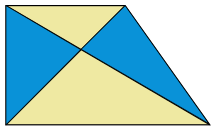
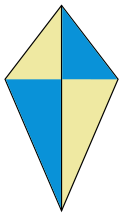
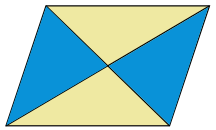
In which of these are the two shaded triangles the same size and shape?


Show Answers Only

Show Worked Solution

Filed Under: Triangles and Other Geometric Properties Tagged With: Band 5, smc-679-25-Quadrilateral properties

Measurement, NAP-H3-CA06

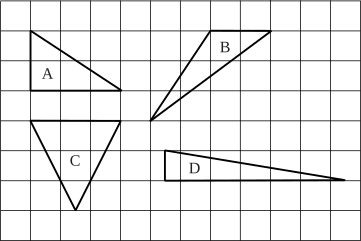
What shape has an area greater than 3 square units


`text(A)` `text(B)` `text(C)` `text(D)`


Show Answers Only

`C`

Show Worked Solution

`text(Consider triangle)\ C:`

`text(Area)` `=1/2 xx b xxh`
  `=1/2 xx 3 xx3`
  `=4.5\ text(square units)`

`=>C`

Filed Under: Perimeter, Area and Volume, Perimeter, Area and Volume Tagged With: Band 5, smc-3153-20-Area, smc-666-20-Area

Geometry, NAP-A3-NC06

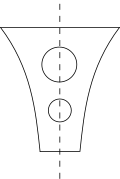
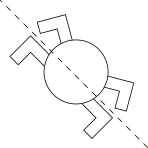
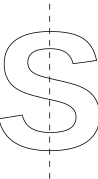
Which dotted line is a line of symmetry?


Show Answers Only

Show Worked Solution

Filed Under: Transformations and Symmetry Tagged With: Band 5, smc-3156-10-Lines of symmetry

Geometry, NAP-A3-NC04

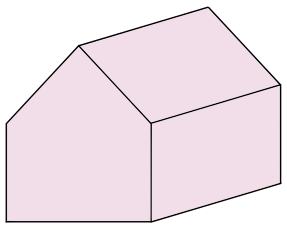
A rectangular prism and a triangular prism are joined together to create the shape below.


How many faces does the new object have?

4 7 8 15


Show Answers Only

`7`

Show Worked Solution

`7`

Filed Under: 2D-3D Shapes, 2D-3D Shapes Tagged With: Band 5, smc-3155-60-Number of faces/edges, smc-673-60-Number of faces/edges

Number, NAP-A3-NC03

Another way of writing  `5^2`  is

`5 xx 2`       `5 xx 5`       `5 + 5` `2 xx 2 xx 2 xx 2 xx 2`


Show Answers Only

`5 xx 5`

Show Worked Solution

`5 xx 5`

Filed Under: Basic Concepts and Calculations, Basic Concepts and Calculations Tagged With: Band 5, smc-3143-40-Integer indices, smc-676-40-Integer indices

Measurement, NAP-A3-NC02

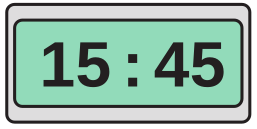
Which time is the same as the time shown on this digital clock?

3:45 am 3:45 pm 5:45 am 5:45 pm


Show Answers Only

`text(3:45 pm)`

Show Worked Solution

`text(Converting from 24-hour time:)`

`text(15:45 is greater than 12:00)`

`=>\ text(Time is p.m.)`

`:.\ text(15:45 less 12 hours = 3:45 pm).` 

Filed Under: Time, Time Tagged With: Band 5, smc-3037-10-Telling the time, smc-903-50-Reading 12/24 hr time

Geometry, NAP-A3-CA07

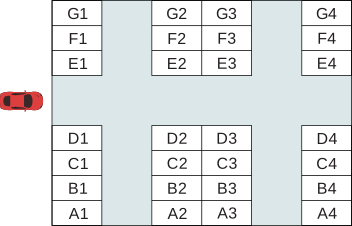
Perry drives into a carpark as shown below.


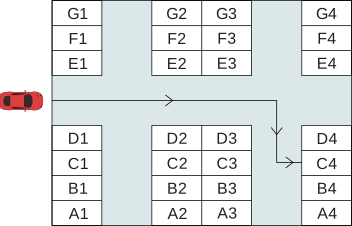
Perry takes his second right and parks in the second parking space on his left.

Which parking space is this?

`text(B4)` `text(C4)` `text(F4)` `text(C3)`


Show Answers Only

`text(C4)`

Show Worked Solution

`text(C4)`

Filed Under: Maps and Directions, Maps and Directions Tagged With: Band 5, smc-3164-30-Grid locations, smc-667-30-Grid locations

Measurement, NAP-A4-NC02

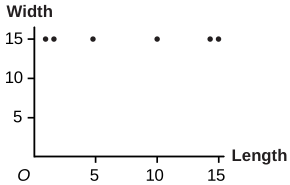
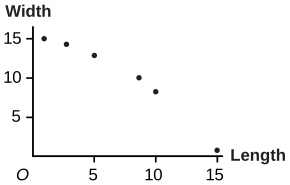
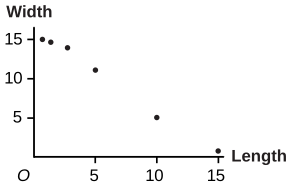
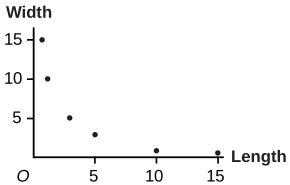
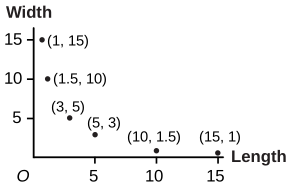
The table shows the lengths and widths of rectangles with an area of 15 cm2.


Which graph shows the information in the table for length against width?


Show Answers Only

`text(See Worked Solutions)`

Show Worked Solution

`text(Mapping the given coordinates:)`

Filed Under: Perimeter, Area and Volume, Perimeter, Area and Volume Tagged With: Band 5, smc-3183-20-Area, smc-669-20-Area

Algebra, NAP-A4-CA02

If   `p = 7`, what is the value of  `2p`?

`14` `27` `49` `98`


Show Answers Only

`14`

Show Worked Solution
`p` `= 7`
`2p` `= 2 xx 7`
  `= 14`

Filed Under: Basic Algebra, Basic Algebra Tagged With: Band 5, smc-3179-20-Substitution, smc-683-20-Substitution

Probability, NAP-B4-NC02

The probability of rolling a 6 on a standard six-sided die is

`2/3` `1/2` `1/6` `1/5`


Show Answers Only

`1/6`

Show Worked Solution
`P` `= text(favorable events)/text(total possible events)`
  `=1/6`

Filed Under: Probability, Probability Tagged With: Band 5, smc-3191-20-One-step events, smc-682-20-One-step events

Geometry, NAP-B4-NC01

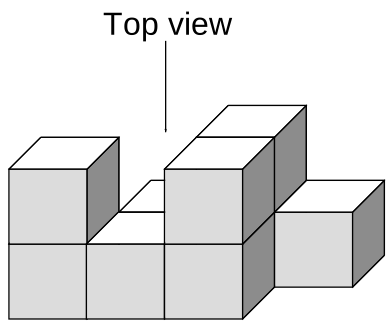
The object below is made from 9 cubes


Which one of these shows the top view?


Show Answers Only

Show Worked Solution

Filed Under: 2D-3D Shapes, 2D-3D Shapes Tagged With: Band 5, smc-3185-40-Different views, smc-672-40-Different views

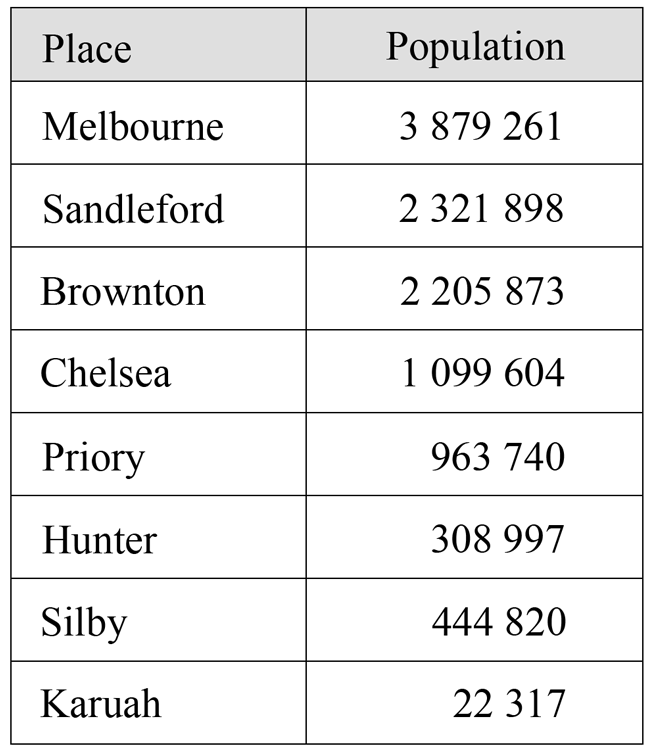
Number, NAP-B4-CA06

How many more people live in Sandleford than Silby and Karuah combined?

`467\ 137` `422\ 503` `1\ 854\ 761` `1\ 899\ 395`


Show Answers Only

`1\ 854\ 761`

Show Worked Solution
`text(Number of people)` `= 2\ 321\ 898 – (444\ 820 + 22\ 317)`
  `= 1\ 854\ 761`

Filed Under: Basic Concepts and Calculations, Basic Concepts and Calculations Tagged With: Band 5, smc-3173-20-Basic Operators, smc-890-20-Basic Operators

Statistics, NAP-B4-CA02

Percy bought 8 packets of cough lollies for $18.00.

The average cost of one packet is

`$0.45` `$2.25` `$2.50` `$10`


Show Answers Only

`$2.25`

Show Worked Solution
`text(Price of 1 packet)` `= ($18.00)/8`
  `= $2.25`

Filed Under: Data and Interpretation, Data and Statistics Tagged With: Band 5, smc-3190-30-Mean/median/mode/range, smc-681-30-Mean/median/mode/range

Geometry, NAP-B4-CA01

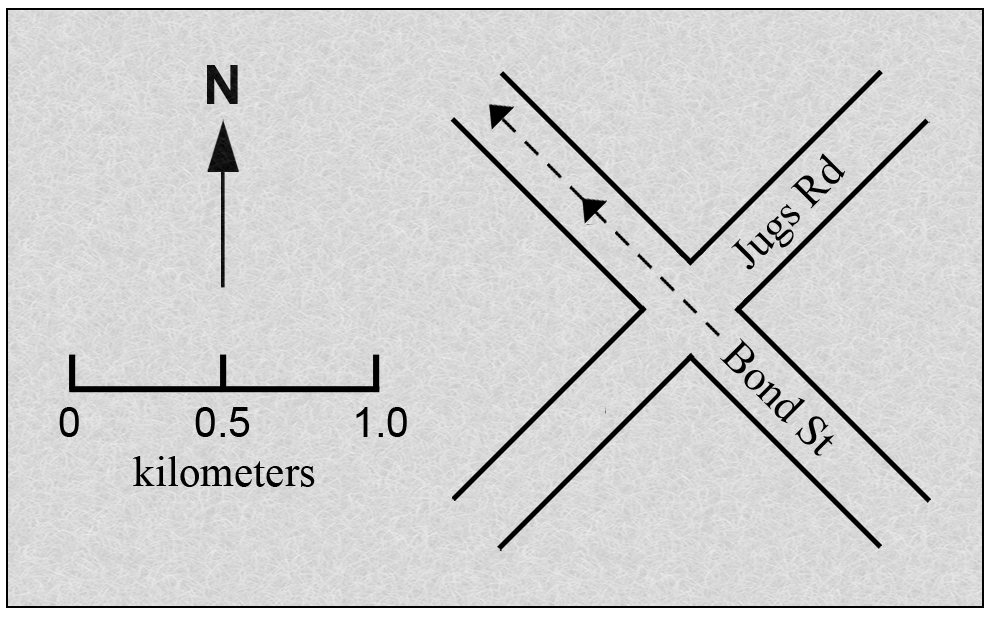
Roger is driving on Bond St in the direction of the arrows in the map below.


In what direction is Roger driving?

 
North-East
 
North-West
 
South-East
 
South-West
Show Answers Only

`text(North-West)`

Show Worked Solution

`text(North-West)`

Filed Under: Maps and Bearings, Maps and Bearings, Maps and Directions Tagged With: Band 5, smc-3164-10-Compass directions, smc-3187-10-Compass directions, smc-670-10-Compass directions

Calculus, EXT1 C1 2017 HSC 14c

The concentration of a drug in a body is  `F(t)`, where `t` is the time in hours after the drug is taken.

Initially the concentration of the drug is zero. The rate of change of concentration of the drug is given by   

`F^{′}(t) = 50e^(−0.5t)-0.4F(t)`.

  1. By differentiating the product  `F(t)e^(0.4t)` show that


    `qquadd/(dt)(F(t)e^(0.4t)) = 50e^(−0.1t)`.  (2 marks)

    --- 4 WORK AREA LINES (style=lined) ---

  2. Hence, or otherwise, show that  `F(t) = 500(e^(−0.4t)-e^(−0.5t))`.  (2 marks)

    --- 8 WORK AREA LINES (style=lined) ---

  3. The concentration of the drug increases to a maximum.


    For what value of `t` does this maximum occur?  (2 marks)

    --- 6 WORK AREA LINES (style=lined) ---

Show Answers Only
  1. `text(Show Worked Solutions)`
  2. `text(Show Worked Solutions)`
  3. `10 ln\ 5/4`
Show Worked Solution

i.  `text(Show)\ \ d/(dt)(F(t)e^(0.4t)) = 50e^(−0.1t)`

`F^{′}(t) = 50e^(−0.5t)-0.4F(t)\ …\ text{(1)  (given)}`

 
`text(Using product rule:)`

`d/(dt)(F(t)e^(0.4t))` `= F^{′}(t)e^(0.4t) + 0.4e^(0.4t)F(t)`
  `= e^(0.4t)(F^{′}(t) + 0.4F(t))`
  `= e^(0.4t) · 50e^(−0.5t)\ \ text{(using (1) above)}`
  `= 50e^(−0.1t)\ \ …\ text(as required)`


ii.   `text(Show)\ \ F(t) = 500(e^(−0.4t)-e^(−0.5t))`

♦♦ Mean mark 37%.
`F(t)e^(0.4t)` `= int 50e^(−0.1t)\ dt`
  `= 50/(−0.1) · e^(−0.1t) + c`
  `= −500 e^(−0.1t) + c`

 
`text(When)\ \ t = 0, \ F(t) = 0`

`0` `= −500 e^0 + c`
`c` `= 500`


`F(t)e^(0.4t)` `= 500-500e^(−0.1t)`
`:. F(t)` `= 500e^(−0.4t)-500e^(−0.5t)`
  `= 500 (e^(−0.4t)-e^(−0.5t))`


iii.    `F(t)` `= 500(e^(−0.4t)-e^(−0.5t))`
  `F^{′}(t)` `= 500(−0.4e^(-0.4t) + 0.5e^(−0.5t))`


`text(Find)\ t\ text(when)\ F^{′}(t) = 0 :`

♦♦ Mean mark 39%.
`0.4e^(−0.4t)` `= 0.5e^(−0.5t)`
`(e^(−0.4t))/(e^(−0.5t))` `= 0.5/0.4`
`e^(0.1t)` `= 5/4`
`0.1t` `= ln (5/4)`
`:. t_text(max)` `= 10 ln (5/4)`

Filed Under: Exponential Growth and Decay EXT1, Modified Growth and Decay Tagged With: Band 5, smc-1080-20-Other

Quadratic, EXT1 2017 HSC 14b

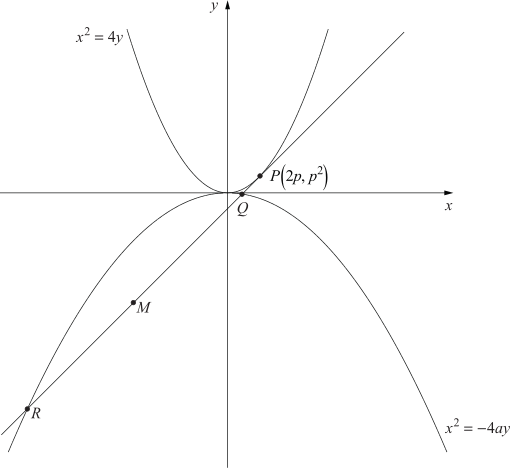
Let  `P(2p, p^2)`  be a point on the parabola  `x^2 = 4y`.

The tangent to the parabola at `P` meets the parabola  `x^2 = −4ay`, `a > 0`, at `Q` and `R`. Let `M` be the midpoint of `QR`.

  1. Show that the `x` coordinates of `R` and `Q` satisfy
  2. `qquadx^2 + 4apx - 4ap^2 = 0`.  (2 marks)

  3. Show that the coordination of `M` are  `(−2ap, −p^2(2a + 1))`.  (2 marks)
  4. Find the value of `a` so that the point `M` always lies on the parabola  `x^2 = −4y`.  (2 marks)


Show Answers Only
  1. `text(See Worked Solution)`
  2. `text(See Worked Solution)`
  3. `1 + sqrt2, a > 0`
Show Worked Solution

(i)   `x^2 = 4y,\ \ =>y = (x^2)/4`

`(dy)/(dx) = x/2`

`text(At)\ P(2p, p^2),`

`(dy)/(dx) = p`

`text(Equation of tangent:)`

`y = px – p^2`


`R and Q\ text(at intersection)`

`y` `= px – p^2\ …\ (1)`
`y` `= −(x^2)/(4a)\ …\ (2)`


`text(Subtract)\ (1) – (2)`

`px – p^2 + (x^2)/(4a)` `= 0`
`x^2 + 4apx – 4ap^2` `= 0\ …\ text(as required)`


(ii)   `x^2 + 4apx – 4ap^2 = 0`

♦♦ Mean mark 30%.
`x=` `\ (−4ap ± sqrt((4ap)^2 – 4 · 1 · (−4ap^2)))/2`
`=`  `\ (−4ap ± sqrt(16ap^2(a + 1)))/2`
`=`  `\ −2ap ± 2psqrt(a(a + 1))`


`=> xtext(-coordinate of)\ M\ text(is)\ −2ap.`


`M\ text(lies on tangent)\ \ y = px – p^2`

`:.y` `= p(−2ap) – p^2`
  `= −2ap^2 – p^2`
  `= −p^2(2a + 1)`

`:. M\ text(has coordinates)\ \ (−2ap, −p^2(2a + 1))`


(iii)   `text(If)\ M\ text(always lies on)\ \ x^2 = −4y`

♦♦ Mean mark 23%.
`(−2ap)^2` `= −4(−p^2(2a + 1))`
`4a^2p^2` `= 4p^2(2a + 1)`
`a^2` `= 2a + 1`
`a^2 – 2a – 1` `= 0`
`:. a` `= (+2 ± sqrt(4 + 4 · 1· 1))/2`
  `= 1 ± sqrt2`
  `= 1 + sqrt2, \ a > 0`

Filed Under: 9. Quadratics and the Parabola EXT1 Tagged With: Band 4, Band 5, Band 6

Mechanics, EXT2* M1 2017 HSC 13c

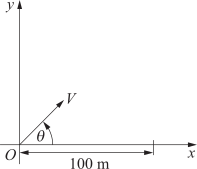
A golfer hits a golf ball with initial speed `V\ text(ms)^(−1)` at an angle `theta` to the horizontal. The golf ball is hit from one side of a lake and must have a horizontal range of 100 m or more to avoid landing in the lake.


Neglecting the effects of air resistance, the equations describing the motion of the ball are

`x = Vt costheta`

`y = Vt sintheta - 1/2 g t^2`,

where `t` is the time in seconds after the ball is hit and `g` is the acceleration due to gravity in `text(ms)^(−2)`. Do NOT prove these equations.

  1. Show that the horizontal range of the golf ball is
     
         `(V^2sin 2theta)/g` metres.  (2 marks)

    --- 5 WORK AREA LINES (style=lined) ---

  2. Show that if  `V^2 < 100 g`  then the horizontal range of the ball is less than 100 m.  (1 mark)

    --- 2 WORK AREA LINES (style=lined) ---

It is now given that  `V^2 = 200 g`  and that the horizontal range of the ball is 100 m or more.

  1. Show that  `pi/12 <= theta <= (5pi)/12`.  (2 marks)

    --- 4 WORK AREA LINES (style=lined) ---

  2. Find the greatest height the ball can achieve.  (2 marks)

    --- 6 WORK AREA LINES (style=lined) ---

Show Answers Only
  1. `text(See Worked Solution)`
  2. `text(See Worked Solution)`
  3. `text(See Worked Solution)`
  4. `25(2 – sqrt 3)\ text(metres)`
Show Worked Solution

i.   `text(Find)\ \ t\ \ text(when)\ \ y = 0:`

`1/2 g t^2` `= Vtsintheta`
`1/2 g t` `= Vsintheta`
`t` `= (2Vsintheta)/g`


`text(Horizontal range)\ (x)\ text(when)\ \ t = (2Vsintheta)/g :`

`x` `= V · (2Vsintheta)/g costheta`
  `= (V^2 2sintheta costheta)/g`
  `= (V^2sin2theta)/g\ … text(as required)`


ii.   `text(If)\ \ V^2 < 100 g`

♦ Mean mark 44%.
`x` `< (100 g sin2theta)/g`
`x` `< 100 sin2theta`


`text(S)text(ince)\ −1 <= 2theta <= 1,`

`x < 100\ text(metres)`


iii.   `V^2 = 200g,\ \ x >= 100`

`(200 g · sin2theta)/g` `>= 100`
`sin2theta` `>= 1/2`

`:. pi/6 <= 2theta <= (5pi)/6`

`:. pi/12 <= theta <= (5pi)/12\ …\ text(as required)`


iv.   `text(Max height occurs when)`

♦♦ Mean mark 35%.
`t` `= 1/2 xx text(time of flight)`
  `= (Vsintheta)/g`

 
`text(Find)\ \ y\ \ text(when)\ \ t = (Vsintheta)/g`

`y` `= V · (Vsintheta)/g · sintheta – 1/2 g ((Vsintheta)/g)^2`
  `= (V^2 sin^2theta)/g – 1/2 · (V^2 sin^2 theta)/g`
  `= (V^2 sin^2theta)/(2g)`


`text(Max height when)\ theta = (5pi)/12\ (text(steepest angle)), V^2 = 200 g\ (text(given))`

`y_text(max)` `= (200 g · sin^2 ((5pi)/12))/(2g)`
  `= 100 sin^2 ((5pi)/12)`
  `= 50(1 – cos((5pi)/6))`
  `= 50(1 + sqrt3/2)`
  `= 25(2 + sqrt 3)\ text(metres)`

Filed Under: Projectile Motion, Projectile Motion EXT1 Tagged With: Band 4, Band 5, Band 6, smc-1062-10-Range/Time of Flight, smc-1062-20-Max Height, smc-1062-40-Initial Angle/Speed

Binomial, EXT1 2017 HSC 13b

Let `n` be a positive EVEN integer.

  1. Show that
  2. `(1 + x)^n + (1 - x)^n = 2[((n),(0)) + ((n),(2))x^2 + … + ((n),(n))x^n]`.  (2 marks)

  3. Hence show that
  4. `n[(1 + n)^(n - 1) - (1 - x)^(n - 1)] = 2[2((n),(2))x + 4((n),(4))x^3 + … + n((n),(n))x^(n - 1)]`.  (1 mark)

  5. Hence show that
  6. `((n),(2)) + 2((n),(4)) + 3((n),(6)) + … + n/2((n),(n)) = n2^(n - 3)`.  (2 marks)


Show Answers Only
  1. `text(See Worked Solution)`
  2. `text(See Worked Solution)`
  3. `text(See Worked Solution)`
Show Worked Solution

(i)   `text(Show)\ (1 + x)^n + (1 – x)^n = 2[\ ^nC_0 + \ ^nC_2x^2 + … + \ ^nC_nx^n]`

`text(Using binomial expansion)`

`(1 + x)^n + (1 – x)^n`

`= \ ^nC_0 + \ ^nC_1x + \ ^nC_2x^2 + … + \ ^nC_nx^n`

`+ \ ^nC_0 – \ ^nC_1x + \ ^nC_2x^2 + … + \ ^nC_nx^n`

`= 2[\ ^nC_0 + \ ^nC_2x^2 + \ ^nC_4x^4 + … + \ ^nC_nx^n]`

`…\ text(as required)`


(ii)   `text{Differentiate both sides of part (i):}`

`n(1 + x)^(n-1) – n(1 – x)^(n-1)`

`= 2[2\ ^nC_2x + 4\ ^nC_4x^3 + … + n \ ^nC_nx^(n – 1)]`

`n[(1 + x)^(n – 1) + (1 – x)^(n – 1)]`

`= 2[2\ ^nC_2x + 4\ ^nC_4x^3 + … + n \ ^nC_nx^(n – 1)]`

`…\ text(as required.)`

♦ Mean mark part (iii) 48%.


(iii)   `text(Let)\ \ x = 1\ \ text{in part (ii)}`

`n(2^(n – 1) + 0) = 2[2\ ^nC_2 + 4\ ^nC_4 + 6\ ^nC_6 + … + n\ ^nC_n]`

`text(Divide both sides by)\ 2^2:`

`(n2^(n – 1))/(2^2)` `= 2/(2^2)[2\ ^nC_2 + 4\ ^nC_4 + 6\ ^nC_6 + … + n\ ^nC_n]`
`n2^(n – 3)`

`= \ ^nC_2 + 2\ ^nC_4 + 3\ ^nC_6 + … + n/2\ ^nC_ n`

`…\ text(as required)`

Filed Under: 17. Binomial EXT1 Tagged With: Band 4, Band 5

Mechanics, EXT2* M1 2017 HSC 13a

A particle is moving along the `x`-axis in simple harmonic motion centred at the origin.

When  `x = 2`  the velocity of the particle is 4.

When  `x = 5`  the velocity of the particle is 3.

Find the period of the motion.  (3 marks)

--- 8 WORK AREA LINES (style=lined) ---

Show Answers Only

`2sqrt3pi`

Show Worked Solution

`text(S)text(ince motion centred at origin,)`

♦ Mean mark 42%.
`{:d/(dx):}^(1/2 v^2)` `= −n^2x`
`1/2 v^2`  `= int −n^2x\ dx`
  `= −1/2n^2x^2 + c`
 `v^2` `= c-n^2x^2`


`text(When)\ v = 4, x = 2`

`16 = c-4n^2\ …\ (1)`

`text(When)\ v = 3, x = 5`

`9 = c-25n^2\ …\ (2)`

`text(Subtract)\ (1)-(2)`

`7` `= 21n^2`
`n^2` `= 1/3`
`n` `= 1/sqrt3`

 
`:.\ text(Period)= (2pi)/n= 2sqrt3 pi`

Filed Under: Simple Harmonic Motion, Simple Harmonic Motion EXT1 Tagged With: Band 5, smc-1059-10-Amplitude / Period

Trig Calculus, EXT1 2017 HSC 11f

Find  `int sin^2x cosx\ dx`.  (1 mark)

Show Answers Only

`1/3 sin^3x + c`

Show Worked Solution

`int sin^2x cosx\ dx`

♦ Mean mark 49%.

`= 1/3 sin^3x + c`

Filed Under: 13. Trig Calc, Graphs and Circular Measure EXT1 Tagged With: Band 5

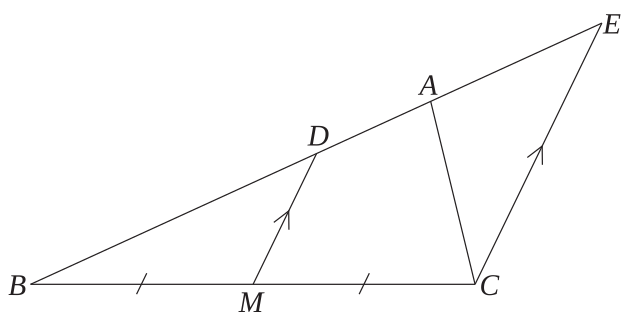
Plane Geometry, 2UA 2017 HSC 16c

In the triangle `ABC`, the point `M` is the mid-point of `BC`. The point `D` lies on `AB` and

`BD = DA + AC`.

The line that passes through the point `C` and is parallel to `MD` meets `BA` produced at `E`.

Copy or trace this diagram into your writing booklet.

  1. Prove that `Delta ACE` is isosceles.  (3 marks)
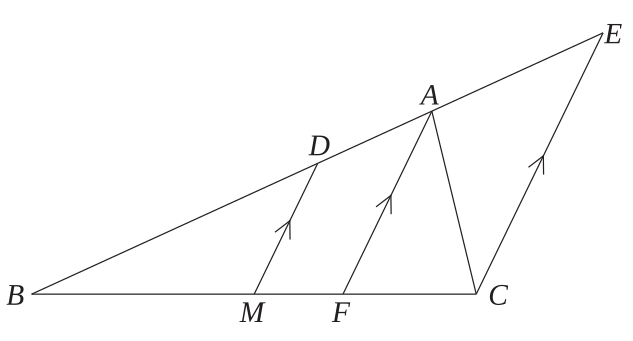
  2. The point `F` is chosen on `BC` so that `AF` is parallel to `DM`.
    `qquad` 
    Show that `AF` bisects `/_ BAC`.  (2 marks)


Show Answers Only
  1. `text(Proof)\ \ text{(See Worked Solutions)}`
  2. `text(Proof)\ \ text{(See Worked Solutions)}`
Show Worked Solution
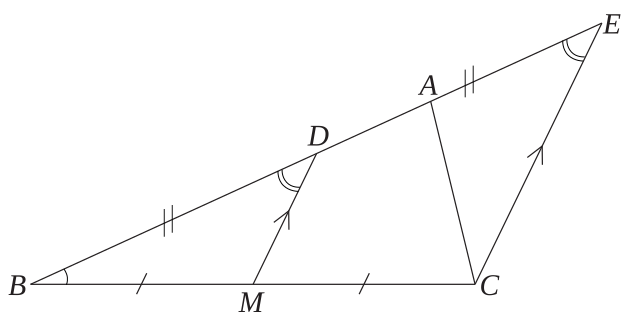
(i)  

`text(Prove)\ Delta ACE\ text(is isosceles)`

♦♦♦ Mean mark 21%.

`text(S) text(ince)\ DM text(||) EC,`

`∠BDM = ∠BEC\ \ text{(corresponding angles)}`

`∠DBM\ \ text(is common)`

`:. Delta BDM\ text(|||)\ Delta BEC\ \ text{(AAA)}`

`text(Using ratios of similar)\ Delta text(s):`

`(BM)/(BD)` `= (BC)/(BE)`
`(BM)/(BC)` `= (BD)/(BE) = 1/2\ \ text{(}M\ text(is midpoint of)\ BC text{)}`


`=> D\ text(is the midpoint of)\ BE.`

`=> BD = DE`

`AE` `= DE – DA`
`AC` `= BD – DA\ text{(given)}`
  `= DE – DA`
`:.  AE` `= AC`

`:. Delta ACE\ text(is isosceles)`


(ii)  

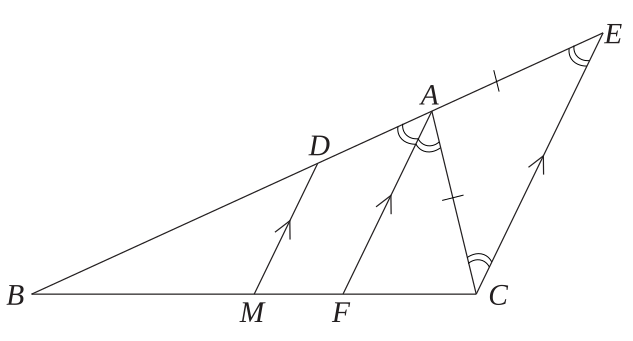
`text(Show)\ AF\ text(bisects)\ /_ BAC`

♦♦ Mean mark 31%.

`/_ BAF = /_ AEC\ \ \ text{(corresponding angles)}`

`text{From part (i)}`

`/_ AEC` `= /_ ECA\ \ \ text{(}Delta AEC\ text{is isosceles)}`
`/_ FAC` `= /_ ECA\ \ \ text{(alternate angles)}`
`:. /_ BAF` `= /_ FAC`

`:. AF\ text(bisects)\  /_ BAC\ \ \ text(… as required)`

Filed Under: 2. Plane Geometry Tagged With: Band 5, Band 6

Financial Maths, 2ADV M1 2017 HSC 16b

A geometric series has first term  `a`  and limiting sum 2.

Find all possible values for  `a`.  (3 marks)

--- 6 WORK AREA LINES (style=lined) ---

Show Answers Only

`0 < a < 4`

Show Worked Solution

`S_oo = a/(1 – r)`

♦ Mean mark 39%.

`text(If)\ \ S_oo = 2:`

`2` `= a/(1 – r)`
`2(1 – r)` `= a`
`1 – r` `= a/2`
`r` `= 1 – a/2`


`text(S)text(ince)\ \ |r| < 1,`

`|1 – a/2| < 1`

`1 – a/2` `< 1` `or qquad -(1 – a/2)` `< 1`
`a/2` `> 0` `a/2` `< 2`
`a` `> 0` `a` `< 4`


`:. 0 < a < 4`

Filed Under: Geometric Series, Geometric Series (Y12) Tagged With: Band 5, smc-1006-40-Limiting Sum

Calculus, 2ADV C3 2017 HSC 16a

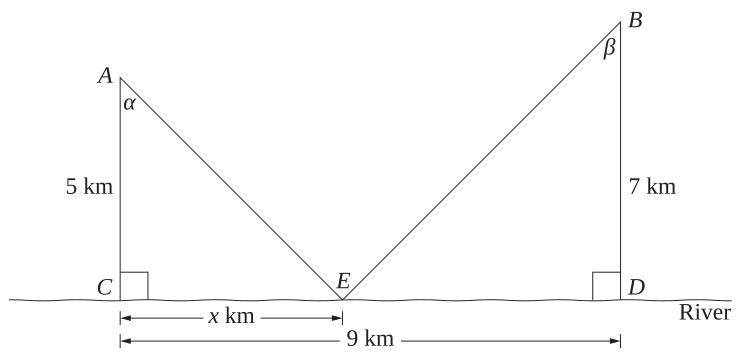
John’s home is at point `A` and his school is at point `B`. A straight river runs nearby.

The point on the river closest to `A` is point `C`, which is 5 km from `A`.

The point on the river closest to `B` is point `D`, which is 7 km from `B`.

The distance from `C` to `D` is 9 km.

To get some exercise, John cycles from home directly to point `E` on the river, `x` km from `C`, before cycling directly to school at `B`, as shown in the diagram.


The total distance John cycles from home to school is `L` km.

  1. Show that  `L = sqrt (x^2 + 25) + sqrt (49 + (9 - x)^2)`.   (1 mark)

    --- 2 WORK AREA LINES (style=lined) ---

  2. Show that if  `(dL)/(dx) = 0`, then  `sin alpha = sin beta`.   (3 marks)

    --- 6 WORK AREA LINES (style=lined) ---

  3. Find the value of `x` that makes  `sin alpha = sin beta`.   (2 marks)

    --- 5 WORK AREA LINES (style=lined) ---

  4. Explain why this value of `x` gives a minimum for `L`.   (1 mark)

    --- 3 WORK AREA LINES (style=lined) ---

Show Answers Only
  1. `text(Proof)\ \ text{(See Worked Solutions)}`
  2. `text(Proof)\ \ text{(See Worked Solutions)}`
  3. `45/12`
  4. `text(See Worked Solutions)`
Show Worked Solution
i.  

`text(Using Pythagoras:)`

`L` `= AE + EB`
  `= sqrt (5^2 + x^2) + sqrt (7^2 + (9 – x)^2)`
  `= sqrt(25 + x^2) + sqrt (49 + (9 – x)^2)\ text(… as required)`


ii.  `text(From diagram):`

♦ Mean mark 41%.

`sin alpha = x/sqrt(25 + x^2) and sin beta = (9 – x)/sqrt(49 + (9 – x)^2)`

`L` `= sqrt(25 + x^2) + sqrt (49 + (9 – x)^2)`
`(dL)/(dx)` `= (2x)/sqrt(25 + x^2) – (2(9 – x))/sqrt(49 + (9 – x)^2)`


`text(If)\ \ (dL)/(dx) = 0,`

`=> (2x)/sqrt(25 + x^2)` `= (2(9 – x))/sqrt(49 + (9 – x)^2)`
`x/sqrt(25 + x^2)` `= (9 – x)/sqrt(49 + (9 – x)^2)`
`sin alpha` `= sin beta\ text(… as required)`


iii.  `text(If)\ sin alpha = sin beta,\ text(then)\ alpha = beta and`

♦♦ Mean mark 29%.

`Delta ACE\ text(|||)\ Delta BDE`

`text(Using corresponding sides of similar triangles:)`

`x/5` `= (9 – x)/7`
`7x` `= 45 – 5x`
`12x` `= 45`
`:. x` `= 45/12\ text(km)`
♦♦♦ Mean mark 9%.


iv.  

`text(If point)\ B\ text(is reflected across the)`

`text(river),\ AEB\ text(will be a straight line.)`

`text(If any other point is chosen,)\ AEB`

`text(would not be straight and the distance)`

`text(would be longer.)`

Filed Under: Maxima and Minima, Maxima and Minima (Y12) Tagged With: Band 4, Band 5, Band 6, smc-970-50-Distance

Calculus, EXT1* C1 2017 HSC 15c

Two particles move along the `x`-axis.

When  `t = 0`, particle `P_1` is at the origin and moving with velocity 3.

For  `t >= 0`, particle `P_1` has acceleration given by  `a_1 = 6t + e^(-t)`.

  1. Show that the velocity of particle `P_1` is given by  `v_1 = 3t^2 + 4-e^(-t)`  (2 marks)

    --- 4 WORK AREA LINES (style=lined) ---

When  `t = 0`, particle `P_2` is also at the origin.

For  `t >= 0`, particle `P_2` has velocity given by  `v_2 = 6t + 1-e^(-t)`.

  1. When do the two particles have the same velocity?  (2 marks)

    --- 5 WORK AREA LINES (style=lined) ---

  2. Show that the two particles do not meet for  `t > 0`.  (3 marks)

    --- 12 WORK AREA LINES (style=lined) ---

Show Answers Only
  1. `text(Proof)\ \ text{(See Worked Solutions)}`
  2. `t = 1`
  3. `text(Proof)\ \ text{(See Worked Solutions)}`
Show Worked Solution
i.   `a_1` `= 6t + e^(-t)`
  `v_1` `= int a_1\ dt`
    `= int 6t + e^(-t)\ dt`
    `= 3t^2-e^(-t) + c`


`text(When)\ t = 0,\ v_1 = 3`

`3` `= 0-1 + c`
`c` `= 4`
`:. v_1` `= 3t^2 + 4-e^(-t) …\ text(as required)`


ii.  `v_2 = 6t + 1-e^(-t)`

`text(Find)\ \ t\ \ text(when)\ \ v_1 = v_2`

`3t^2 + 4-e^(-t)` `= 6t + 1-e^(-t)`
`3t^2-6t + 3` `= 0`
`t^2-2t + 1` `= 0`
`(t-1)^2` `= 0`
`:. t` `=1`


iii.   `x_1` `= int v_1\ dt`
    `= int 3t^2 + 4-e^(-t)\ dt`
    `= t^3 + 4t + e^(-t) + c`


`text(When)\ \ t = 0,\ \ x_1 = 0`

♦ Mean mark (iii) 39%.
`0` `= 0 + 0 + 1 + c`
`c` `= -1`
`:. x_1` `= t^3 + 4t + e^(-t)-1`


`x_2` `= int 6t + 1-e^(-t)\ dt`
  `= 3t^2 + t + e^(-t) + c`

 
`text(When)\ \ t = 0,\ \ x_2 = 0`

`0` `= 0 + 0 + 1 + c`
`c` `= -1`
`:. x_2` `= 3t^2 + t + e^(-t)-1`


`text(Find)\ \ t\ \ text(when)\ \ x_1 = x_2`

`t^3 + 4t + e^(-t)-1` `= 3t^2 + t + e^(-t)-1`
`t^3-3t^2 + 3t` `= 0`
`t(t^2-3t + 3)` `= 0`


`text(S)text(ince)\ \ Delta < 0\ \ text(for)\ \ t^2-3t + 3`

`=>\ text(No real solution)`


`:.\ text(The particles do not meet)`

`(x_1 != x_2)\ \ text(for)\ \ t > 0.`

Filed Under: Motion, Rates of Change with respect to time (Ext1) Tagged With: Band 3, Band 4, Band 5, smc-1077-10-Motion, smc-1077-40-Exponential Equation

Financial Maths, 2ADV M1 2017 HSC 15b

Anita opens a savings account. At the start of each month she deposits `$X` into the savings account. At the end of each month, after interest is added into the savings account, the bank withdraws $2500 from the savings account as a loan repayment. Let `M_n` be the amount in the savings account after the `n`th  withdrawal.

The savings account pays interest of 4.2% per annum compounded monthly.

  1. Show that after the second withdrawal the amount in the savings account is given by
    `qquad qquad M_2 = X(1.0035^2 + 1.0035) - 2500 (1.0035 + 1)`.  (2 marks)

    --- 5 WORK AREA LINES (style=lined) ---

  2. Find the value of  `X`  so that the amount in the savings account is $80 000 after the last withdrawal of the fourth year.  (3 marks)

    --- 6 WORK AREA LINES (style=lined) ---

Show Answers Only
  1. `text(Proof)\ \ text{(See Worked Solutions)}`
  2. `$ 4019.42\ text{(nearest cent)}`
Show Worked Solution
i.   `M_1` `= X (1 + 4.2/(12 xx 100)) – 2500`
    `= X (1.0035) – 2500`
  `M_2` `= X (1.0035) + M_1 (1.0035) – 2500`
    `=X(1.0035)+(1.0035)[X(1.0035)-2500]-2500`
    `= X (1.0035) + X (1.0035^2) – 2500 (1.0035) – 2500`
    `= X (1.0035^2 + 1.0035) – 2500 (1.0035 + 1)`
♦ Mean mark part (ii) 48%.


ii.  

`M_3 = X (1.0035^3 + … + 1.0035) – 2500 (1.0035^2 + 1.0035 + 1)`

`vdots`

`M_n = X (1.0035^n + … + 1.0035) – 2500 (1.0035^(n – 1) + … + 1)`

`text(Find)\ X\ text(such that)\ \ M_n = 80\ 000\ \ text(when)\ n = 48`

`80\ 000 = X (1.0035^48 + …\ 1.0035) – 2500 (1.0035^47 + … + 1)`

`text(Using)\ S_n = (a(r^n – 1))/(r – 1)`

`80\ 000` `= X [(1.0035(1.0035^48 – 1))/(1.0035 – 1)] – 2500 [(1(1.0035^48 – 1))/(1.0035 – 1)]`
`80\ 000` `= X (52.351…) – 130\ 421.20…`
   
`:. X` `= (80\ 000 + 130\ 421.20…)/(52.351…)`
  `= $4019.42\ text{(nearest cent)}`

Filed Under: Compound interest, loan repayments and annuities, Financial Applications of Series (Y12) Tagged With: Band 4, Band 5, smc-1007-40-Annuity with concurrent withdrawals

Calculus, 2ADV C4 2017 HSC 14b

  1. Find the exact value of
     
  2. `qquad int_0^(pi/3) cos x\ dx`.  (1 mark)

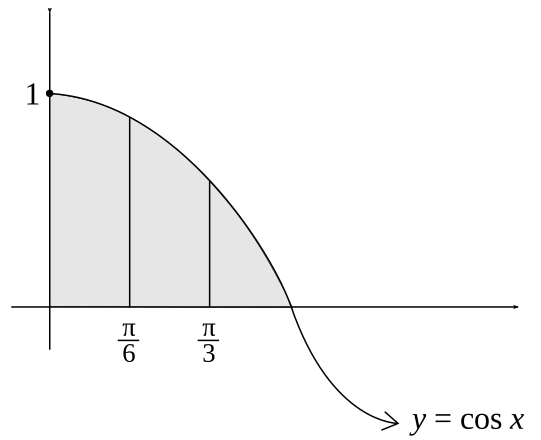
  3. Using Simpson’s rule with one application, find an approximation to the integral
  4.  
    `qquad int_0^(pi/3) cos x\ dx,`
     
  5. leaving your answer in terms of `pi` and `sqrt 3`.  (2 marks)
     

  6. Using parts (i) and (ii), show that
     
  7. `qquad pi ~~ (18 sqrt 3)/(3 + 4 sqrt 3)`.  (1 mark)


Show Answers Only
(i)   `sqrt 3/2`
(ii)   `((4 sqrt 3 + 3)pi)/36`
(iii)   `text{Proof (See Worked Solutions)}`
Show Worked Solution
(i)   `int_0^(pi/3) cos x\ dx` `= [sin x]_0^(pi/3)`
    `= sin\ pi/3 – 0`
    `= sqrt 3/2`


(ii)  
    `x`     `0`    `overset(pi) underset(6) _`     `overset(pi) underset(3) _`  
    `y`     `1`     `overset(sqrt 3) underset(2) _`     `overset(1) underset(2) _`  
      `y_0`     `y_1`     `y_2`  
`int_0^(pi/3) cos x\ dx` `~~ h/3 [y_0 + 4y_1 + y_2]`
  `~~ pi/6 ⋅ 1/3 [1 + 4 ⋅ sqrt 3/2 + 1/2]`
  `~~ pi/18 ((4 sqrt 3 + 3)/2)`
  `~~ ((4 sqrt 3 + 3) pi)/36`


(iii)  `text{Using parts (i) and (ii)}`

♦ Mean mark 49%.
`((4 sqrt 3 + 3) pi)/36` `~~ sqrt 3/2`
`:. pi` `~~ (36 sqrt 3)/(2(3 + 4 sqrt 3))`
  `~~ (18 sqrt 3)/(3 + 4 sqrt 3) … text( as required)`

Filed Under: Integrals, Trapezoidal and Simpson's Rule Tagged With: Band 3, Band 4, Band 5

Calculus, 2ADV C3 2017 HSC 9 MC

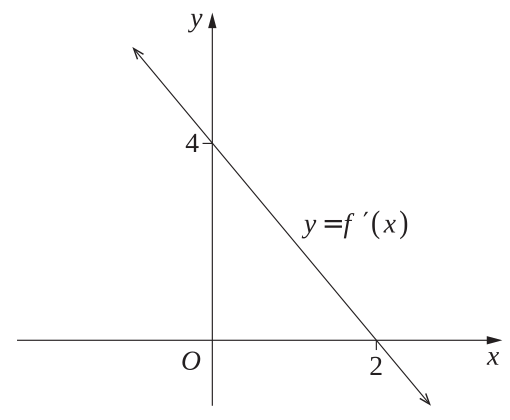
The graph of  `y = f^{′}(x)`  is shown.
 

The curve  `y = f (x)`  has a maximum value of 12.

What is the equation of the curve  `y = f (x)`?

  1. `y = x^2-4x + 12`
  2. `y = 4 + 4x-x^2`
  3. `y = 8 + 4x-x^2`
  4. `y = x^2-4x + 16`
Show Answers Only

`C`

Show Worked Solution

`text(Find the equation of)\ \ f^{′}(x):`

`m = -2,\ \ y text(-int) = 4`

`y = -2x + 4`

`f(x)` `= int -2x + 4\ dx`
  `= -x^2 + 4x + c`


`text(Maximum)\ \ f(x) = 12\ \ text(when)\ \ f^{′}(x) = 0:`

`-2x + 4` `= 0`
`x` `= 2`

 
`text(Substitute)\ \ x=2\ \ text(into)\ \ f(x):`

`:. 12` `= -2^2 + 4 ⋅ 2 + c`
`c` `= 8`


`:. f(x) = 8 + 4x-x^2`

`=>  C`

Filed Under: Other Integration Applications (Y12) Tagged With: Band 5, smc-1213-25-Tangents/Primitive function

Algebra, 2UG 2017 HSC 30d

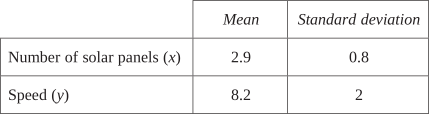
In an investigation, students used different numbers of identical small solar panels to power model cars. The cars were then tested and their speed measured in km/h. The results are summarised in the table.


The equation of the least-squares line of best fit, relating the speed and the number of solar panels, has been calculated to be
 

`y = 2.125x + 2.0375`
 

  1. What would be the speed of a car powered by 5 solar panels, based on this equation?  (1 mark)
  2. Calculate the correlation coefficient, `r`, between the number of solar panels and the speed of a car.  (2 marks)


Show Answers Only
  1. `12.6625\ text(km/h)`
  2. `0.85`
Show Worked Solution
(i)    `text(Speed)(y)` `= 2.125(5) + 2.0375`
    `= 12.6625\ text(km/h)`


(ii)   `text(Using the formula sheet:)`

♦♦ Mean mark 23%.
`text(gradient)` `= r xx (text(std dev)(y))/(text(std dev)(x))`
`2.125` `= r xx 2/0.8`
`:. r` `= (2.125 xx 0.8)/2`
  `= 0.85`

Filed Under: Correlation / Body Measurements, Other Linear Modelling Tagged With: Band 4, Band 5

Measurement, STD2 M6 2017 HSC 30c

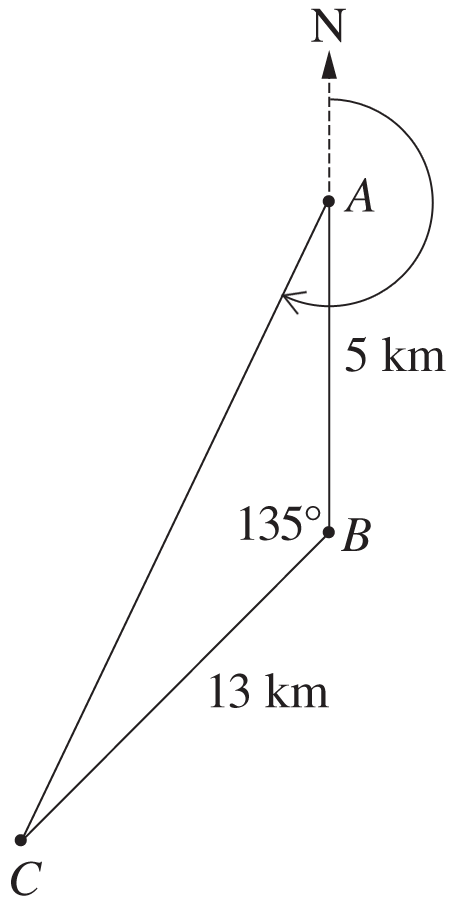
The diagram shows the location of three schools. School `A` is 5 km due north of school `B`, school `C` is 13 km from school `B` and `angleABC` is 135°.


  1. Calculate the shortest distance from school `A` to school `C`, to the nearest kilometre.  (2 marks)

    --- 4 WORK AREA LINES (style=lined) ---

  2. Determine the bearing of school `C` from school `A`, to the nearest degree.  (3 marks)

    --- 6 WORK AREA LINES (style=lined) ---

Show Answers Only
  1. `17\ text{km  (nearest km)}`
  2. `213^@`
Show Worked Solution

i.   `text(Using cosine rule:)`

`AC^2` `= AB^2 + BC^2 – 2 xx AB xx BC xx cos135^@`
  `= 5^2 + 13^2 – 2 xx 5 xx 13 xx cos135^@`
  `= 285.923…`
`:. AC` `= 16.909…`
  `= 17\ text{km  (nearest km)}`


ii.   

`text(Using sine rule, find)\ angleBAC:`

♦♦ Mean mark 31%.
`(sin angleBAC)/13` `= (sin 135^@)/17`
`sin angleBAC` `= (13 xx sin 135^@)/17`
  `= 0.5407…`
`angleBAC` `= 32.7^@`


`:. text(Bearing of)\ C\ text(from)\ A`

`= 180 + 32.7`

`= 212.7^@`

`= 213^@`

Filed Under: Bearings & Field Surveys, Bearings and Radial Surveys (Std2) Tagged With: Band 5, common-content, smc-803-10-Bearings

Statistics, STD2 S1 2017 HSC 30a

A set of data has a lower quartile (`Q_L`) of 10 and an upper quartile (`Q_U`) of 16.

What is the maximum possible range for this set of data if there are no outliers?  (2 marks)

--- 4 WORK AREA LINES (style=lined) ---

Show Answers Only

`24`

Show Worked Solution

`IQR = 16 – 10 = 6`

♦♦ Mean mark 34%.

`text(If no outliers,)`

`text(Upper limit)` `= Q_U + 1.5 xx IQR`
  `= 16 + 1.5 xx 6`
  `= 25`
`text(Lower limit)` `= Q_L – 1.5 xx IQR`
  `= 10 – 1.5 xx 6`
  `= 1`


`:.\ text(Maximum range)` `= 25 – 1`
  `= 24`

Filed Under: Measures of Centre and Spread (Std2-2027), Summary Statistics - No Graph (Std 2), Summary Statistics - No graph (Y12), Summary Statistics (no graph), Summary Statistics (Std 1) Tagged With: Band 5, common-content, smc-1131-30-IQR and Outliers, smc-6312-30-IQR and Outliers, smc-824-30-IQR and Outliers, smc-999-30-IQR and Outliers

  • « Previous Page
  • 1
  • …
  • 58
  • 59
  • 60
  • 61
  • 62
  • …
  • 81
  • Next Page »

Copyright © 2014–2025 SmarterEd.com.au · Log in