SmarterEd

Aussie Maths & Science Teachers: Save your time with SmarterEd

  • Login
  • Get Help
  • About

Mechanics, EXT2 M1 2013 HSC 15d

A ball of mass `m` is projected vertically into the air from the ground with initial velocity  `u`. After reaching the maximum height `H` it falls back to the ground. While in the air, the ball experiences a resistive force `kv^2`, where `v` is the velocity of the ball and `k` is a constant.

The equation of motion when the ball falls can be written as

`m dot v = mg-kv^2.`      (Do NOT prove this.)

  1. Show that the terminal velocity  `v_T` of the ball when it falls is
  2.    `sqrt ((mg)/k).`  (1 mark)

    --- 4 WORK AREA LINES (style=lined) ---

  3. Show that when the ball goes up, the maximum height  `H`  is
  4.    `H = (v_T^2)/(2g) ln (1 + u^2/(v_T^2)).`  (3 marks)

    --- 8 WORK AREA LINES (style=lined) ---

  5. When the ball falls from height  `H`  it hits the ground with velocity  `w`.
  6. Show that  `1/w^2 = 1/u^2 + 1/(v_T^2).`  (2 marks)

    --- 6 WORK AREA LINES (style=lined) ---

Show Answers Only
  1. `text(Proof)\ \ text{(See Worked Solutions)}`
  2. `text(Proof)\ \ text{(See Worked Solutions)}`
  3. `text(Proof)\ \ text{(See Worked Solutions)}`
Show Worked Solution

i.  `m dot v = mg-kv^2`

`t = 0,\ \ \ v = 0,\ \ \ x = 0\ \ \ text(Ball falling)`

`text{For terminal velocity}\ \(v_T),\ \ \  dot v = 0`

`v_T^2` `= (mg)/k`
`:.v_T` `= sqrt ((mg)/k)`


ii.  `text(When the ball rises),\ \ m dot v = -mg-kv^2`

♦ Mean mark 43%.


MARKER’S COMMENT: More than half of students incorrectly wrote the equation to solve as `m dot v=mg-kv^2!`
`text(Using)\ \ dot v` `= v (dv)/(dx)`
`mv (dv)/(dx)` `= -mg-kv^2`
`dx` `=(-mv)/(mg + kv^2) dv` 
`int_0^H dx` `= -int_u^0 (mv)/(mg + kv^2) dv`
`[x]_0^H` `= -m/(2k) [log_e (mg + kv^2)]_u^0`
`H` `= -m/(2k) (log_e (mg)-log_e (mg + ku^2))`
  `= m/(2k) log_e ((mg + ku^2)/(mg))`
  `= m/(2k) log_e (1 + (ku^2)/(mg))\ \ \ \ text{(using}\ \ k = (mg)/v_T^2 text{)}`
`:.H` `=(v_T^2)/(2g) log_e (1 + u^2/(v_T^2))`


iii.  `text(When the ball falls),\ \ m dot v = mg-kv^2`

♦♦ Mean mark 14%.
`mv (dv)/(dx)` `= mg-kv^2`
`dx` `=(mv)/(mg-kv^2) dv` 


`int_0^H dx` `= int_0^w (mv)/(mg-kv^2)dv`
`[x]_0^H` ` =-m/(2k)[log_e (mg-kv^2)]_0^w`
`H` `= -m/(2k) (log_e (mg-kw^2)-log_e (mg))`
  `= -m/(2k) log_e ((mg-kw^2)/(mg))`
  `= -m/(2k) log_e (1-(kw^2)/(mg))\ \ \ \ text{(using}\ \ k = (mg)/v_T^2 text{)}`
`H` `=-(v_T^2)/(2g) log_e (1-w^2/(v_T^2))`
  `=-(v_T^2)/(2g) log_e ((v_T^2-w^2)/(v_T^2))`
  `=(v_T^2)/(2g) log_e ((v_T^2)/(v_T^2-w^2))`


`text{Using part (ii):}`

`(v_T^2)/(2g) log_e ((v_T^2)/(v_T^2-w^2))` `=(v_T^2)/(2g) log_e (1 + u^2/(v_T^2))`
`(v_T^2)/(v_T^2-w^2)` `=(v_T^2 + u^2)/(v_T^2)`
`(v_T^2 + u^2)(v_T^2-w^2)` `=v_T^4`
`v_T^4-v_T^2 w^2+v_T^2 u^2-w^2 u^2` `=v_T^4`
`v_T^2 w^2+w^2 u^2` `=v_T^2 u^2`
`(v_T^2 w^2)/(v_T^2w^2u^2)+(w^2 u^2)/(v_T^2w^2u^2)` `=(v_T^2 u^2)/(v_T^2w^2u^2)`
`:.1/u^2 + 1/(v_T^2)` `=1/w^2`

Filed Under: Resisted Motion, Resisted Motion Tagged With: Band 3, Band 5, Band 6, smc-1061-05-Projectile Motion, smc-1061-20-R ~ v^2, smc-1061-50-Max Height, smc-1061-70-Newton's Law

Harder Ext1 Topics, EXT2 2013 HSC 15c

Eight cars participate in a competition that lasts for four days. The probability that a car completes a day is `0.7`. Cars that do not complete a day are eliminated.

  1. Find the probability that a car completes all four days of the competition.  (1 mark)
  2. Find an expression for the probability that at least three cars complete all four days of the competition.  (2 marks)
Show Answers Only
  1. `0.2401`
  2. `1-(0.76^8 + \ ^8C_1 * 0.76^7 * 0.24 + \ ^8C_2 * 0.76^6 * 0.24^2)`
Show Worked Solution

(i)    `P text{(Completes 1 day)} = 0.7`

`:.P text{(Completes 4 days)}` `= 0.7^4`
  `~~ 0.2401`


(ii)  `P text{(Does not complete all 4 days)` `= 1 – 0.7^4`
  `= 0.7599`
  `~~ 0.76`
♦♦ Mean mark 26%.

STRATEGY: The use of complementary events reduced the required calculations and subsequent errors in this part.


`text(Let)\ \ C =\ text(number of cars that complete 4 days)`

`:. P text{(At least 3 cars complete all 4 days)}`

`= 1 – [P (C=0) + P (C = 1) + P (C = 2)]`

`= 1 – (\ ^8C_0 *0.76^8 + \ ^8C_1 * 0.76^7 * 0.24 + \ ^8C_2 * 0.76^6 * 0.24^2)`

`=1-(0.76^8 + \ ^8C_1 * 0.76^7 * 0.24 + \ ^8C_2 * 0.76^6 * 0.24^2)`

Filed Under: Probability and The Binomial Tagged With: Band 3, Band 5

Complex Numbers, EXT2 N2 2013 HSC 15a

The Argand diagram shows complex numbers  `w`  and  `z`  with arguments  `phi`  and  `theta`  respectively, where  `phi < theta`. The area of the triangle formed by  `0, w`  and  `z` is  `A`.


Show that  `z bar w - w bar z = 4iA.`  (3 marks)

--- 8 WORK AREA LINES (style=lined) ---

Show Answers Only

`text{(See Worked Solutions)}`

Show Worked Solution
♦♦ Mean mark 29%.

STRATEGY: The angles shown in the graphic should alert students that the mod-arg approach is likely to be easier than the `x + iy` form.
`A` `=1/2 ab sin C`
  `= 1/2 |z| |w|\ sin (theta – phi)`


`z bar w – w bar z` `= |z| text(cis)\ theta* |w| text(cis)(-phi) – |w| text(cis)\ phi *|z| text(cis)(-theta)`
  `= |z| |w| (text(cis)\ theta\ text(cis)(-phi) – text(cis)\ phi\ text(cis) (-theta))`
  `= |z| |w| (text(cis)(theta – phi) – text(cis)(phi – theta))`


`text(S)text(ince)\ \ cos(phi – theta)` `= cos(theta – phi),\ \ \ text(and)`
`sin(phi – theta)` `= -sin(theta – phi)`
`=>text(cis)(theta – phi) – text(cis)(phi – theta)` `= 2i sin(theta – phi)`


`:.z bar w – w bar z`  `= 2i |z| |w| sin(theta – phi)`
  `=4i(1/2 |z| |w|\ sin (theta – phi))`
  `=4iA\ \ \ \ text(… as required)`

Filed Under: Geometrical Implications of Complex Numbers, Geometry and Complex Numbers (vectors) Tagged With: Band 5, smc-1052-20-Triangles

Harder Ext1 Topics, EXT2 2013 HSC 14d

A triangle has vertices `A, B` and `C`. The point `D` lies on the interval `AB` such that `AD = 3` and `DB = 5`. The point `E` lies on the interval `AC` such that `AE = 4`, `DE = 3` and `EC = 2`.

  1. Prove that `Delta ABC` and `Delta AED` are similar.  (1 mark)
  2. Prove that `BCED` is a cyclic quadrilateral.  (1 mark)
  3. Show that `CD = sqrt 21`.  (2 marks)
  4. Find the exact value of the radius of the circle passing through the points `B, C, E and D`.  (2 marks)


Show Answers Only
  1. `text(Proof)\ \ text{(See Worked Solutions)}`
  2. `text(Proof)\ \ text{(See Worked Solutions)}`
  3. `text(Proof)\ \ text{(See Worked Solutions)}`
  4. `(3 sqrt 105)/10`
Show Worked Solution

(i)  `text(In)\ \ Delta ABC and Delta AED`

`/_ BAC = /_ EAD\ \ \ \ text{(common angle)}`

`(AB)/(AE)` `= 8/4 = 2/1`
`(AC)/(AD)` `= 6/3 = 2/1`
`(AB)/(AE)` `= (AC)/(AD) = 2/1`


`:.\ Delta ABC\ \ text(|||)\ \ Delta AED` `\ \ \ \ \ text{(sides about equal angles}`
  `\ \ \ \ \ text{are in the same ratio)}`


(ii)   `/_ ABC = /_ AED\ \ \ \ \ text{(corresponding angles of similar triangles)}`

`/_ AED\ \ text(is an exterior angle of quadrilateral)\ \ BCED`

`:.\ BCED\ \ text(is a cyclic quadrilateral as an exterior)`

`text(angle equals the interior opposite angle.)`


(iii)  `cos /_ AED = (3^2 + 4^2 – 3^2)/(2 xx 3 xx 4) = 2/3`

♦♦ Mean mark 33%.

`cos /_ CED` `= cos(pi – /_AED)`
  `=-cos/_AED`
  `=-2/3`

`text(In)\ \ Delta CDE`

`CD^2` `= 2^2 + 3^2 – 2 xx 2 xx 3 xx (-2/3)`
  `= 13 + 8`
  `=21`
`:.CD` `= sqrt 21`


(iv)

`text(Mark the centre)\ \ O,\ \ text(draw the radii)\ \ OC, OD`

`text(Let)\ \ /_ CBD` `= alpha`  
`:. /_ COD` `= 2 alpha` ` \ \ \ \ text{(angles at circumference and}`
    `\ \ \ \ text{centre on arc}\ \ CD text{)}`
`/_ DEC` `= pi – alpha` ` \ \ \ \ text{(opposite angles of cyclic}`
    `\ \ \ \ text{quadrilateral}\ \ BCED text{)}`


♦♦♦ Mean mark 7%.

COMMENT: This part had the lowest mean mark in the entire 2013 exam.

`cos alpha = cos /_ AED = 2/3\ \ \ \ text{(part (iii))}`

`text(Let)\ \ r= text(circle radius)`

`text(In)\ \ Delta DOC`

`CD^2` `=r^2 + r^2 – 2r xx r xx cos 2 alpha`
`21` `=2r^2 – 2r^2 (2 cos^2 alpha – 1)`
  `=2r^2 – 2r^2 (8/9 – 1)`
  `=2r^2 + (2r^2)/9`
  `=(20r^2)/9`
`r^2` `=(9 xx 21)/20`
`:.r` `=(3 sqrt 21)/(2 sqrt 5)`
  `=(3 sqrt 105)/10`

Filed Under: Circle/Plane Geometry Tagged With: Band 4, Band 5, Band 6

Calculus, EXT2 C1 2013 HSC 14c

  1. Given a positve integer `n`, show that
     
         `sec^(2n) theta = sum_(k = 0)^n ((n),(k)) tan^(2k) theta.`  (1 mark)

    --- 4 WORK AREA LINES (style=lined) ---

  2. Hence, by writing  `sec^8 theta`  as  `sec^6 theta\ sec^2 theta` find,
     
         `int sec^8 theta\ d theta.`  (2 marks)

    --- 8 WORK AREA LINES (style=lined) ---

Show Answers Only
  1. `text(Proof)\ \ text{(See Worked Solutions)}`
  2. `tan theta + tan^3 theta + 3/5 tan^5 theta + 1/7 tan^7 theta + C`
Show Worked Solution
i.     `sec^2 theta` `= 1 + tan^2 theta`
`sec^(2n) theta` `= (1 + tan^2 theta)^n`
  `= ((n), (0)) + ((n), (1)) tan^2 theta + … + ((n), (k)) tan^(2k) theta +`
  ` … + ((n), (n)) tan^(2n) theta`
♦♦ Mean mark 30%.

MARKER’S COMMENT: Note that  `sec^(2n) theta“ ≠ 1+tan^(2n) theta`. A very common error!

`:.sec^(2n) theta= sum_(k = 0)^n ((n), (k)) tan^(2k) theta\ \ \ \ text(… as required)`


♦ Mean mark 38%.

ii.  `int sec^8 theta\ d theta` `= int sec^6 theta sec^2 theta\ d theta`
  `= int (1 + tan^2 theta)^3 sec^2 theta\ d theta`
  `= int [1 + ((3), (1)) tan^2 theta + ((3), (2)) tan^4 theta`
  `+ ((3), (3)) tan^6 theta] sec^2 theta\ d theta`
  `=int(1 + 3 tan^2 theta+3 tan^4 theta+tan^6 theta)sec^2 theta\ d theta`
  `= tan theta + tan^3 theta + 3/5 tan^5 theta + 1/7 tan^7 theta + c` 

Filed Under: Harder Integration Examples, Probability and The Binomial, Trig Integrals, Trig Integration Tagged With: Band 5, smc-1193-40-Other trig ratios

Proof, EXT2 P2 2013 HSC 14b

Let  `z_2 = 1 + i`  and, for  `n > 2`, let  `z_n = z_(n - 1) (1 + i/(|\ z_(n - 1)\ |)).`
 

Use mathematical induction to prove that  `|\ z_n\ | = sqrt n`  for all integers  `n >= 2.`  (3 marks)

--- 8 WORK AREA LINES (style=lined) ---

Show Answers Only

`text(Proof)\ \ text{(See Worked Solutions)}`

Show Worked Solution
♦ Mean mark 50%.

MARKER’S COMMENT: Many students did not recognise the need to use `|\ ab\ |=|\ a\ |*|\ b\ |` in their solution.

`text(Prove)\ \ |\ z_n\ | = sqrt n\ \ \ text(for)\ n>=2`

`text(given)\ \ z_n = z_(n – 1) (1 + i/(|\ z_(n – 1)\ |))`

`text(If)\ \ n=2`

` z_2 = 1 + i`

`|\ z_2\ | = sqrt (1 + 1) = sqrt 2`

`:.text(True for)\ \ n = 2`


`text(Assume that)\ \ |\ z_k\ | = sqrt k\ \ text(and prove that)\ \ |\ z_(k + 1)\ | = sqrt (k + 1)`

`z_k` `= z_(k – 1) (1 + i/(|\ z_(k – 1)\ |))`
`=> z_(k + 1) ` `= z_k (1 + i/(|\ z_k\ |))`


`|\ z_(k + 1)\ |` `= |\ z_k (1 + i/(|\ z_k\ |))\ |`
  `=|\ z_k\ |*|\ (1 + i/sqrt k)\ |`
  `= sqrt k * sqrt((1^2+(1/sqrt k)^2))`
  `=sqrt k * sqrt((1+1/k))`
  `= sqrt k * sqrt((k+1)/k)`
  `= sqrt k * sqrt(k+1)/sqrt k`
  `=sqrt(k+1)`


`=>text(True for)\ \ n = k + 1`

`:. text(S)text(ince true for)\ \ n=2,\ \ text(by PMI, true for all integers)\ \ n >= 2.`

Filed Under: Arithmetic and Complex Numbers, Induction, Induction EXT2, P2 Induction (Ext2) Tagged With: Band 5, smc-1044-70-Complex Numbers, smc-5115-70-Complex numbers

Harder Ext1 Topics, EXT2 2013 HSC 13c

The points `A, B, C` and `D` lie on a circle of radius `r`, forming a cyclic quadrilateral. The side `AB` is a diameter of the circle. The point `E` is chosen on the diagonal `AC` so that `DE _|_ AC`. Let `alpha = /_DAC and beta = /_ACD.`

  1. Show that `AC = 2r sin (alpha + beta).`  (2 marks)
  2. By considering `Delta ABD`, or otherwise, show that `AE = 2r cos alpha sin beta.`  (2 marks)
  3. Hence, show that `sin (alpha + beta) = sin alpha cos beta + sin beta cos alpha.`  (1 mark)
Show Answers Only
  1. `text(Proof)\ \ text{(See Worked Solutions)}`
  2. `text(Proof)\ \ text{(See Worked Solutions)}`
  3. `text(Proof)\ \ text{(See Worked Solutions)}`
Show Worked Solution

(i)   `/_ ADC = (180 – (alpha + beta))`

`/_ ABC = alpha + beta\ \ \ \ \ ` `text{(opposite angles of cyclic}`
  `text(quadrilateral)\ \ ABCD)`


`/_ ACB = 90^@\ \ \ text{(angle in a semi-circle)}`

`(AC)/(AB)` `= sin /_ ABC`
`:. AC` `= 2 r sin (alpha + beta)`


(ii)

`text(In)\ \ Delta ABD`

♦ Mean mark 49%.

`/_ ADB = 90^@\ \ \ text{(angle in a semi-circle)}`

`(AD)/(AB)` `= cos /_ DAB`
`AD` `= AB cos /_ DAB`


`text(In)\ \ Delta ABC`

`/_CAB` `= 180^@ – (90^@ +alpha + beta)\ \ \ \ text{(angle sum of}\ Delta ABC text{)}`
  `= 90^@- (alpha + beta)`
`=>/_ DAB` `= alpha + 90^@ – (alpha + beta)`
  `= 90^@ – beta`
`:.AD` `= AB cos ( 90^@ – beta)`
  `=2r sin beta`


`text(In)\ \ Delta ADE`
`(AE)/(AD)` `= cos alpha`
`:.AE` `= 2 r cos alpha sin beta\ \ text(… as required)`


(iii)  `text(In)\ \ Delta ADE`

♦ Mean mark 35%.
`sin alpha` `=(DE)/(2r sin beta)`
`DE` `=2r sin alpha sin beta`


`text(In)\ \ Delta CDE`

`tan beta` `=(DE)/(EC)`
`EC` `=(2r sin alpha sin beta)/tan beta`
  `=2r sin alpha cos beta`


`text(S)text(ince)\ \ AC` `=AE + ED`
`2 r sin (alpha + beta)` `= 2 r sin beta cos alpha + 2 r sin alpha cos beta`
`:.sin (alpha + beta)` `= sin alpha cos beta + sin beta cos alpha`

Filed Under: Circle/Plane Geometry Tagged With: Band 4, Band 5

Calculus, EXT2 C1 2013 HSC 13a

Let  `I_n = int_0^1 (1 - x^2)^(n/2)\ dx`, where  `n >= 0`  is an integer.

  1. Show that
     
            `I_n = n/(n + 1) I_(n-2)`  for every integer  `n>= 2.`  (3 marks)

    --- 8 WORK AREA LINES (style=lined) ---

  2. Evaluate  `I_5.`  (2 marks)

    --- 5 WORK AREA LINES (style=lined) ---

Show Answers Only
  1. `text(Proof)\ \ text{(See Worked Solutions)}`
  2. `(5 pi)/32`
Show Worked Solution

i.  `I_n = int_0^1 (1 – x^2)^(n/2)\ dx`

♦ Mean mark 46%.
STRATEGY TIP: Attempting to prove this relationship using induction proved unsuccessful and time consuming for some students.
`text(Let)\ \ u` `= (1 – x^2)^(n/2)`
`u′` `= n/2 (1 – x^2)^(n/2 – 1) (-2x)`
  `= -nx (1 – x^2)^(n/2 -1)`
`v` `=x`
`v′` `=1`


`I_n` `= [x (1 – x^2)^(n/2)]_0^1 – int_0^1 – nx (1 – x^2)^(n/2 – 1)x\ dx`
  `= 0 + n int_0^1 x^2 (1 – x^2)^(n/2 – 1)\ dx`
  `= n int_0^1 (x^2 – 1 + 1) (1 – x^2)^(n/2 – 1)\ dx`
  `= n int_0^1 1 (1 – x^2)^(n/2 -1)\ dx – n int_0^1 (1 – x^2) (1 – x^2)^(n/2 – 1)\ dx`
  `= n int_0^1 (1 – x^2)^((n-2)/2)\ dx – n int_0^1 (1 – x^2)^(n/2)\ dx`
  `= nI_(n – 2) – nI_n`


`:.(n + 1) I_n` `= nI_(n-2)`
`I_n` `= n/(n + 1) I_(n-2)\ \ \ \ text(where)\ \ n >= 2`
STRATEGY TIP: Realising that the integral `I_1` is equal to the area of a quarter unit circle saved valuable time.


ii.  `I_5 = 5/6 I_3 = 5/6 xx 3/4\ I_1`

`I_1` `= int_0^1 (1 – x^2)^(1/2)\ dx`
  `= 1/4 xx pi xx 1^2\ \ \ \ text{(1st quadrant of a circle, radius 1)}`
  `= pi/4`
`I_5` `= 5/6 xx 3/4 xx pi/4`
  `= (5 pi)/32`

Filed Under: Integration By Parts, Recurrence Relations, Recurrence Relations Tagged With: Band 4, Band 5, smc-1054-50-Other Function

Calculus, EXT2 C1 2014 HSC 16c

Find  `int(ln\ x)/((1 + ln\ x)^2)\ dx`.  (3 marks)

--- 6 WORK AREA LINES (style=lined) ---

Show Answers Only

`x/(1+ln x) +c`

Show Worked Solution

`I=int(ln\ x)/((1 + ln\ x)^2)\ dx`

♦♦ Mean mark 31%.
STRATEGY: This is as challenging as integration gets … a substitution followed by applying integration by parts. Note that simply substituting `u=ln x` gets you a full mark.
`text(Let)\ \ \ u=` `ln x`
`(du)/(dx)=` `1/x=1/e^u`
`du=` `1/e^u\ dx`
`dx=` `e^u\ du`
`I` `=int (u e^u)/(1+u)^2\ du`
  `=int ((1+u) e^u)/(1+u)^2\ du- int e^u/(1+u)^2\ du`
  `=int e^u/(1+u)\ du -int e^u/(1+u)^2\ du`
 

`text{Using integration by parts:}`

`u` `=-e^u`    `u′` `=-e^u`
`v′` `=-(1+u)^-2` `v` `=(1+u)^-1`
 `:.I` `=int e^u/(1+u)\ du – ((-e^u)/(1+u) + int (e^u)/(1+u)\ du)`
  `=e^u/(1+u) +c`
  `=x/(1+ln x) +c`

Filed Under: Harder Integration Examples, Integration By Parts, Integration By Parts, Integration By Parts (SM) Tagged With: Band 5, smc-1055-10-Logs, smc-5134-10-Logs

Proof, EXT2 P1 2014 HSC 16b

Suppose `n` is a positive integer. 

  1. Show that 
     
        `-x^(2n) ≤ 1/(1 + x^2) − (1 − x^2 + x^4 − x^6 + … + (-1)^(n − 1) x^(2n − 2)) ≤ x^(2n)`.  (3 marks)

    --- 6 WORK AREA LINES (style=lined) ---

  2. Use integration to deduce that
     
    `-1/(2n + 1) ≤ pi/4 − (1 − 1/3 + 1/5 − … + (-1)^(n − 1) 1/(2n − 1)) ≤ 1/(2n + 1)`.  (2 marks)

    --- 6 WORK AREA LINES (style=lined) ---

  3. Explain why   `pi/4 = 1 − 1/3 + 1/5 − 1/7 + …`.  (1 mark)

    --- 5 WORK AREA LINES (style=lined) ---

Show Answers Only
  1. `text{Proof (See Worked Solutions)}`
  2. `text{Proof (See Worked Solutions)}`
  3. `text{Proof (See Worked Solutions)}`
Show Worked Solution

i.   `text(Let)\ \ S_n=1 − x^2 + x^4 − x^6 + … + (-1)^(n − 1) x^(2n − 2)`

`=>text(GP where)\ \ a=1, r=-x^2`

♦♦ Mean mark 12%.
STRATEGY: Applying the GP formula and simplifying the middle term is worth 2 full marks in this question.
`:.S_n` `=(1(1-(-x^2)^n))/(1-(-x^2))`
  `= (1 − (-x^2)^n)/(1 + x^2)`


`:.1/(1 + x^2) − (1 − x^2 + x^4 − x^6 + … + (-1)^(n − 1) x^(2n − 2))​`

`=1/(1 + x^2)-(1 − (-x^2)^n)/(1 + x^2)`

`=((-x^2)^n)/(1 + x^2)`

`=((-1)^nx^(2n))/(1 + x^2)`


`text(S)text(ince)\ \ (1 + x^2)>=1,\ \ \ -x^(2n) ≤ ((-1)^nx^(2n))/(1 + x^2) ≤ x^(2n)`

`:.\ text(We can conclude)`

`-x^(2n) ≤ 1/(1 + x^2) − (1 − x^2 + x^4 − x^6 + … + (-1)^(n − 1) x^(2n − 2))\ ≤ x^(2n)` 


ii.   `text{Integrating part (i) between 0 and 1}`

♦ Mean mark 43%.
`int_0^1 -x^(2n)\ dx` `=(-1)/(2n + 1)[x^(2n + 1)]_0^1`
  `=(-1)/(2n + 1)`
`int_0^1 1/(1 + x^2)` `=[tan^(-1) x]_0^1`
  `=pi/4`
`int_0^1 (1 − x^2 + x^4 − x^6 + … + (-1)^(n − 1) x^(2n − 2))\ dx` 
`=[x − (x^3)/3 + (x^5)/5 −… + ((-1)^(n − 1)x^(2n − 1))/(2n − 1)]_0^1`
`=1 − 1/3 + 1/5 − … + ((-1)^(n − 1))/(2n − 1)`
`int_0^1 x^(2n)\ dx` `=1/(2n + 1)[x^(2n + 1)]_0^1`
  `=1/(2n + 1)`

 
`:.\ text(We can conclude)`

`(-1)/(2n + 1) ≤ pi/4 − (1 − 1/3 + 1/5 − … + (-1)^(n − 1) 1/(2n − 1)) ≤ 1/(2n + 1)`


iii.  `(-1)/(2n + 1) ≤ pi/4 − (1 − 1/3 + 1/5 − … + ((-1)^(n − 1))/(2n − 1)) ≤ 1/(2n + 1)`

`text(As)\ n → ∞,`

`=>(-1)/(2n + 1) → 0^-\ \ text(and)\ \ 1/(2n + 1) → 0^+`

`=> pi/4 − (1 − 1/3 + 1/5 − … + 1/(2n − 1)) → 0`

♦♦ Mean mark 28%.

`:. pi/4 = 1 -1/3 + 1/5 − 1/7 + …`

Filed Under: Inequalities EXT2, Proof and Inequalities Tagged With: Band 5, Band 6, smc-1208-70-Calculus, smc-1208-80-Geometric Series

Harder Ext1 Topics, EXT2 2014 HSC 16a

The diagram shows two circles `C_1` and `C_2` . The point `P` is one of their points of intersection. The tangent to `C_2` at `P` meets `C_1` at `Q`, and the tangent to `C_1` at `P` meets `C_2` at `R`.

The points `A` and `D` are chosen on `C_1` so that `AD` is a diameter of `C_1` and parallel to `PQ`. Likewise, points `B` and `C` are chosen on `C_2` so that `BC` is a diameter of `C_2` and parallel to `PR`.


The points `X` and `Y` lie on the tangents `PR` and `PQ`, respectively, as shown in the diagram.

Harder Ext1 Topics, EXT2 2014 HSC 16a 


Copy or trace the diagram into your writing booklet.

  1. Show that `∠APX = ∠DPQ`.  (2 marks)
  2. Show that `A`, `P` and `C` are collinear.  (3 marks)
  3. Show that `ABCD` is a cyclic quadrilateral. (1 mark)
Show Answers Only
  1. `text(See Worked Solutions.)`
  2. `text(See Worked Solutions.)`
  3. `text(See Worked Solutions.)`
Show Worked Solution
(i)

Harder Ext1 Topics, EXT2 2014 HSC 16a  Answer


 `∠APX` `= ∠ADP\ \ \ text{(angle in alternate segment)`βαγ
 `∠ADP` `= ∠DPQ\ \ \ text{(alternate angles,}\ AD\ text(||)\ PQ)`
`:.∠APX` `= ∠DPQ`


(ii)  `text(Join)\ PC\ text(and)\ PB.`

♦♦ Mean mark 31%.
MARKER’S COMMENT: Be vigilant that your reasoning does not implicitly assume `APC` or `DPB` are straight lines.

`text{Let}\ \ ∠APX = ∠DPQ=α\ \ \ text{(from part (i))}`

`text{Similarly,}\ \ ∠YPB = ∠CPR=β`

`∠XPY = ∠RPQ=γ\ \ \ text{(vertically opposite angles.)}`

`∠APD` `= 90^@\ \ \ text{(angle in a semicircle in}\ C_1)`
`∠CPB` `= 90^@\ \ \ text{(angle in a semicircle in}\ C_2)`


`90^@ + 90^@ + 2(α+β+γ)` `= 360^@ \ \ text{(sum of angles at a point}\ Ptext{)}`
`:. (α+β+γ)` `= 90^@`
`∠APC` `=90+(α+β+γ)=180^@`


`:.\ A, P\ text(and)\ C\ text(are collinear.)`


♦ Mean mark 44%.

(iii)  `:.∠APX = ∠CPR\ text{(vertically opposite angles,}\ APC\ text{is a straight line)}`

`:.α=β\ \ =>∠BCA = ∠BDA`

`text(S)text(ince chord)\ AB\ text(subtends a pair of equal angles at)\ C and D`

`=>ABCD\ text(is a cyclic quadrilateral.)`

Filed Under: Circle/Plane Geometry Tagged With: Band 3, Band 5, HSC

Mechanics, EXT2 2014 HSC 15c

A toy aeroplane `P` of mass `m` is attached to a fixed point `O` by a string of length `l`. The string makes an angle  `ø`  with the horizontal. The aeroplane moves in uniform circular motion with velocity `v` in a circle of radius `r` in a horizontal plane.

Mechanics, EXT2 2014 HSC 15c

The forces acting on the aeroplane are the gravitational force  `mg`, the tension force  `T`  in the string and a vertical lifting force  `kv^2`, where `k` is a positive constant.

  1. By resolving the forces on the aeroplane in the horizontal and the vertical directions, show that
    `(sin\ ø)/(cos^2\ ø) = (lk)/m − (lg)/(v^2)`.  (3 marks)

  2. Part (i) implies that
    `(sin\ ø)/(cos^2\ ø) < (lk)/m`.   (Do NOT prove this.)
  3. Use this to show that
    1. `sin\ ø < (sqrt(m^2 + 4l^2k^2) − m)/(2lk).`  (2 marks)

  4. Show that
    `(sin\ ø)/(cos^2\ ø)` is an increasing function of  `ø`  for  `-pi/2 < ø < pi/2`.  (2 marks)

  5. Explain why `ø` increases as `v` increases.  (1 mark)
Show Answers Only
  1. `text{Proof (See Worked Solutions)}`
  2. `text{Proof (See Worked Solutions)}`
  3. `text{Proof (See Worked Solutions)}`
  4. `text{Proof (See Worked Solutions)}`
Show Worked Solution

(i)    `text(Vertically)`

 `kv^2 = mg + T\ sin\ ø\ \ \ \ \ …\ (1)`

`text(Horizontally)`

`T cos\ ø` `=(mv^2)/r`
  `=(mv^2)/(l cos\ ø)\ \ \ \ \ \ (r=lcos\ ø)`
`T` `=(mv^2)/(l cos^2\ ø)\ \ \ \ …\ (2)`


`text{Substitute (2) into (1)}`

`mg + (mv^2)/(l cos^2\ ø)\ sin\ ø` `=kv^2`
`lmg + (mv^2)/(cos^2\ ø)\ sin\ ø` `=lkv^2`
`(mv^2)/(cos^2\ ø)\ sin\ ø` `=lkv^2 – lmg`
`(sin\ ø)/(cos^2\ ø)` `=(lk)/m − (lg)/(v^2)\ \ \ text(… as required)`


♦♦♦ Mean mark 14%.
STRATEGY: The form of the required proof strongly hints that the quadratic formula is relevant – a clue that was ignored by many students. 
(ii)   `(sin\ ø)/(cos^2\ ø)` `< (lk)/m`
   `sin\ ø` `< (lk)/m(1 − sin^2\ ø)`
  `m sin\ ø` `< lk – lksin^2\ ø`
    `lk\ sin^2\ ø + m\ sin\ ø − lk< 0` 


`text(Using the quadratic formula)`

`sin\ ø = (-m ± sqrt(m^2 + 4l^2k^2))/(2lk)`

`text(S)text(ince)\ \ 0<ø<pi/2\ \ \ \ =>\ 0 < sin\ ø < 1`

`:. sin\ ø = (sqrt(m^2 + 4l^2k^2)-m)/(2lk)`


`=> lk\ sin^2\ ø + m\ sin\ ø − lk< 0\ \ text(is true)` 

`text(when)\ \ sin\ ø = 0`

`=>sqrt(m^2 + 4l^2k^2)>m`

`:.sin\ ø < (sqrt(m^2 + 4l^2k^2) − m)/(2lk)\ \ \ \ text(… as required)`


(iii)  `f(x)` `= (sin\ ø)/(cos^2\ ø)`
  `f′(x)` `= (cos\ ø\ cos^2\ ø − sin\ ø xx 2\ cos\ ø(-sin\ ø))/(cos^4\ ø)`
    `= (cos^2\ ø + 2sin^2\ ø)/(cos^3\ ø)`


♦♦ Mean mark 25%.

`text(Consider)\ \ -pi/2 < ø < pi/2`

`cos\ ø>0, \ \ cos^3\ ø > 0, \ \ 2sin^2\ ø>=0`

`=> f′(x) > 0`


`:. f(x)=(sin\ ø)/(cos^2\ ø)\ text(is an increasing function for)\ \ \ -pi/2 < ø < pi/2.`


(iv)  `text(Consider)\ \ (sin\ ø)/(cos^2\ ø) = (lk)/m − (lg)/(v^2)`

♦♦♦ Mean mark 8%.
COMMENT: This question had the lowest mean mark in the entire 2014 exam.
`text(As)\ v\ text(increases)` `=>(lg)/(v^2)\ text(decreases)`
  `=>(lk)/m – (lg)/(v^2)\ text(increases)`
  `=>(sin\ ø)/(cos^2\ ø)\ text(increases.)`


`text{From (iii)},\ (sin\ ø)/(cos^2\ ø)\ text(is an increasing function as)\ ø\ text(increases.)`

`:.ø\  text(increases as)\ \ v\ \ text(increases.)`

Filed Under: Circular Motion Tagged With: Band 4, Band 5, Band 6

Conics, EXT2 2014 HSC 14b

The point `P(a cos theta , b sin theta)` lies on the ellipse  `x^2/a^2 + y^2/b^2 = 1`,  where  `a >b`.

The acute angle between  `OP`  and the normal to the ellipse at  `P` is  `ø`.

Conics, EXT2 2014 HSC 14b

  1. Show that
    `tan\ ø = ((a^2 − b^2)/(ab))\ sin theta cos theta.`  (3 marks)
  2. Find a value of  `theta`  for which  `ø`  is a maximum.  (2 marks)
Show Answers Only
  1. `text{Proof (See Worked Solutions)}`
  2. `pi/4`
Show Worked Solution
♦ Mean mark 49%.
(i) `x^2/a^2 + y^2/b^2` `=1`
  `(2x)/(a^2) + (2y)/(b^2)*(dy)/(dx)` `=0`
  `(2y)/(b^2)*(dy)/(dx)` `=(2x)/(a^2)`
  `(dy)/(dx)` `= -(b^2x)/(a^2y)`

`text(Consider)\ \ P(a cos theta , b sin theta)`

`m_text(tan)` `= -(b^2a cos theta)/(a^2b sin theta)`
  `= -(b cos theta)/(a sin theta)`
`m_text(norm)` `= (a sin theta)/(b cos theta)`
`m_(OP)` `= (b\ sin\ theta)/(a\ cos\ theta)`


`text(S)text(ince)\ \ ø\ \ text(is the acute angle between two lines)`

`tan\  ø` `=|(m_(norm) – m_(OP))/(1+m_(norm) * m_(OP))|`
  `=| ((a sin theta)/(b cos theta) − (b sin theta)/(a cos theta))/(1 + (a sin theta)/(b cos theta) xx (b sin theta)/(a cos theta))|`
  `=| (a^2 sin theta cos theta – b^2 sin theta cos theta)/(ab cos^2 theta + ab sin^2 theta)|`
  `= |((a^2 − b^2) sin theta cos theta)/(ab (cos^2 theta + sin^2 theta))|`
  `= ((a^2 − b^2)/(ab))\ sin theta cos theta\ \ \ \ text(… as required)`


(ii)   `tan\ ø` `= ((a^2 − b^2)/(ab))\ sin theta cos theta`
    `= ((a^2 − b^2)/(2ab))\ 2 sin theta cos theta`
    `= ((a^2 − b^2)/(2ab))\ sin 2 theta`
♦♦ Mean mark 27%.
STRATEGY: The critical thought to solving this is to realise that  `sin theta cos theta`  can be replaced by  `½\ sin 2theta`.

`=>ø\ \ text(is a maximum when)`

`((a^2 − b^2)/(2ab))\ sin 2 theta\ \ text(is a maximum)`

`:.\ text(Maximum occurs when)`

`sin 2 theta` `=1`
`2 theta` `= pi/2`
`theta` `= pi/4`

Filed Under: Ellipse, Other Ext1 Topics Tagged With: Band 5, page-break-before-solution

Calculus, EXT2 C1 2014 HSC 12d

Let  `I_n = int_0^1 (x^(2n))/(x^2 + 1)\ dx`, where  `n`  is an integer and  `n ≥ 0`.

  1. Show that  `I_0 = pi/4`.  (1 mark)

    --- 4 WORK AREA LINES (style=lined) ---

  2. Show that
     
         `I_n + I_(n − 1) = 1/(2n − 1)`.  (2 marks)

    --- 6 WORK AREA LINES (style=lined) ---

  3. Hence, or otherwise, find
     
         `int_0^1 (x^4)/(x^2 + 1)\ dx`.  (2 marks)

    --- 6 WORK AREA LINES (style=lined) ---

Show Answers Only
  1. `text{Proof (See Worked Solutions)}`
  2. `text{Proof (See Worked Solutions)}`
  3. `pi/4 − 2/3`
Show Worked Solution

i.   `I_n = int_0^1 (x^(2n))/(x^2 + 1)\ dx, \ \ n ≥ 0`

  `I_0` `= int_0^1 (x^0)/(x^2 + 1)\ dx`
  `= [tan^(−1) x]_0^1` 
  ` = tan^(−1) 1 − tan^(−1)0`
  `= pi/4`


♦ Mean mark 41%.
STRATEGY: The denominator of the proof, `(2n-1)`, should flag the potential existence of `x^(2n-2)` in the integral.
ii.  `I_(n − 1)` `= int_0^1 x^(2n-2)/(x^2 + 1)\ dx`
  `I_n` `= int_0^1 x^(2n)/(x^2 + 1)\ dx`


`I_n + I_(n − 1)` `= int_0^1(x^(2n))/(x^2 + 1)\ dx + int_0^1(x^(2n − 2))/(x^2 + 1)\ dx`
  `= int_0^1(x^(2n) + x^(2n − 2))/(x^2 + 1)\ dx`
  `= int_0^1(x^(2n − 2)(x^2 + 1))/(x^2 + 1)\ dx`
  `= int_0^1x^(2n − 2)\ dx`
  `= [(x^(2n − 1))/(2n − 1)]_0^1`
  `= 1/(2n − 1)`


iii.  `I_2` `= int_0^1(x^4)/(x^2 + 1)\ dx`
  `I_1` `= int_0^1(x^2)/(x^2 + 1)\ dx`
`I_n + I_(n − 1)` `= 1/(2n − 1)`
`I_2 + I_1` `= 1/(2(2) − 1) = 1/3\ \ …\ (1)`
`I_1 + I_0` `= 1/(2(1)-1)=1`
`I_1+pi/4` `= 1`
`:.I_1` `=1- pi/4`
`text(Substitute into (1))`
`I_2+1- pi/4` `= 1/3`
 `:.I_2` `= pi/4 − 2/3`

Filed Under: Recurrence Relations, Recurrence Relations Tagged With: Band 2, Band 4, Band 5, smc-1054-20-Quotient

Mechanics, EXT2* M1 2004 HSC 7a

The rise and fall of the tide is assumed to be simple harmonic, with the time between successive high tides being 12.5 hours. A ship is to sail from a wharf to the harbour entrance and then out to sea. On the morning the ship is to sail, high tide at the wharf occurs at 2 am. The water depths at the wharf at high tide and low tide are 10 metres and 4 metres respectively.

  1. Show that the water depth, `y` metres, at the wharf is given by
     
         `y = 7 + 3 cos\ ((4pit)/(25))`, where  `t`  is the number of hours after high tide.  (2 marks)  

    --- 5 WORK AREA LINES (style=lined) ---

  2. An overhead power cable obstructs the ship’s exit from the wharf. The ship can only leave if the water depth at the wharf is 8.5 metres or less.


    Show that the earliest possible time that the ship can leave the wharf is 4:05 am.  (2 marks)

    --- 8 WORK AREA LINES (style=lined) ---

  3. At the harbour entrance, the difference between the water level at high tide and low tide is also 6 metres. However, tides at the harbour entrance occur 1 hour earlier than at the wharf. In order for the ship to be able to sail through the shallow harbour entrance, the water level must be at least 2 metres above the low tide level.


    The ship takes 20 minutes to sail from the wharf to the harbour entrance and it must be out to sea by 7 am. What is the latest time the ship can leave the wharf?  (2 marks)

    --- 6 WORK AREA LINES (style=lined) ---

Show Answers Only
  1. `text{Proof (See Worked Solutions)}`
  2. `text{Proof (See Worked Solutions)}`
  3. `4:28\ text(am)`
Show Worked Solution

i.   `text(Period)`

`(2pi)/n =` ` 12.5`
`12.5n =` ` 2pi`
`25n =` ` 4pi`
`n =` ` (4pi)/25`

 
`text(Amplitude)`

`a` `= 1/2(10 − 4)`
  `= 3`

 
`=>\ text(Motion centres around)\ \ x = 7\ \ text(with)`

`y = 10\ \ text(when)\ \ t= 0`


`:.\ text(Water depth is given by)`

`y` `= 7+a cos nt`
  `= 7 + 3 cos\ ((4pit)/(25))\ \ …\ text(as required.)`


ii.  

 Calculus in the Physical, EXT1 2004 HSC 7a Answer

`text(Find)\ \ t\ \ text(when)\ \ y = 8.5:`

`8.5` `= 7 + 3\ cos\ ((4pit)/25)`
`3\ cos\ ((4pit)/25)` `= 1.5`
`cos\ ((4pit)/25)` `= 1/2`
`(4pit)/25` `=pi/3`
`t` `=(25pi)/(3 xx 4pi)`
  `=2 1/12`
  `= 2\ text(hrs 5 mins)`


`:.\ text(The earliest time the ship can leave)`

`text(is 4:05 am  … as required.)`


iii.  `text(2 metres above low tide = 6 m)`

`text(Find)\ t\ text(when)\ y = 6:`

`6 = 7 + 3\ cos\ ((4pit)/(25))`

`3\ cos\ ((4pit)/(25))` `= -1`
`cos\ ((4pit)/(25))` `= -1/3`
`(4pit)/25` `= 1.9106…`
`:.t` `= (25 xx 1.9106…)/(4pi)`
  `= 3.801…`
  `= 3\ text{hr 48 min  (nearest min)}`


`:.\ text(At the harbour entrance, water depth)`

`text(of 6 m occurs when)\ \ t = 2\ text(hr 48 min.)`


`:.\ text(Given 20 mins sailing time, the latest the ship can)`

`text(leave the wharf is at)\ \ t = 2\ text(hr 28 min, or 4:28 am.)`

Filed Under: Simple Harmonic Motion, Simple Harmonic Motion EXT1 Tagged With: Band 4, Band 5, Band 6, smc-1059-20-Prove/Identify SHM, smc-1059-50-Real World examples

Mechanics, EXT2* M1 2007 HSC 7b

A small paintball is fired from the origin with initial velocity `14` metres per second towards an eight-metre high barrier. The origin is at ground level, `10` metres from the base of the barrier.

The equations of motion are

`x = 14t\ cos\ theta`

`y = 14t\ sin\ theta – 4.9t^2`

where  `theta`  is the angle to the horizontal at which the paintball is fired and  `t`  is the time in seconds. (Do NOT prove these equations of motion)
 

  1. Show that the equation of trajectory of the paintball is
     
         `y = mx − ((1 + m^2)/40)x^2`, where  `m = tan\ theta`.  (2 mark)

    --- 6 WORK AREA LINES (style=lined) ---

  2. Show that the paintball hits the barrier at height  `h`  metres when
     
         `m = 2 ± sqrt(3 − 0.4h)`.


    Hence determine the maximum value of  `h`.  (2 marks)

    --- 8 WORK AREA LINES (style=lined) ---

  3. There is a large hole in the barrier. The bottom of the hole is `3.9` metres above the ground and the top of the hole is `5.9` metres above the ground. The paintball passes through the hole if  `m`  is in one of two intervals. One interval is  `2.8 ≤ m ≤ 3.2`.


    Find the other interval.  (2 marks)

    --- 8 WORK AREA LINES (style=lined) ---

  4. Show that, if the paintball passes through the hole, the range is 
     
         `(40m)/(1 + m^2)\ \ text(metres.)`
     
    Hence find the widths of the two intervals in which the paintball can land at ground level on the other side of the barrier.  (3 marks)

    --- 10 WORK AREA LINES (style=lined) ---

Show Answers Only
  1. `text{Proof (See Worked Solutions)}`
  2. `text{Proof (See Worked Solutions)}`
  3. `0.8 ≤ m ≤ 1.2`
  4. `text{1.3 m  (to 1 d.p.)  and  0.5 m  (to 1 d.p.)}`
Show Worked Solution
i.    `x` `= 14t\ cos\ theta` `\ \ …\ (1)`
  `y` `= 14t\ sin\ theta-4.9t^2` `\ \ …\ (2)`


`text(Substitute)\ \ t = x/(14\ cos\ theta)\ \ text{from (1) into (2)}`

`y` `= 14(x/(14\ cos\ theta))\ sin\ theta − 4.9(x/(14\ cos\ theta))^2`
  `= x\ tan\ theta − (4.9/(14^2))((x^2)/(cos^2\ theta))`
  `= x\ tan\ theta − (x^2)/40\ sec^2\ theta`
  `= x\ tan\ theta − (x^2)/40(1 + tan^2\ theta)`
  `= mx − ((1 + m^2)/40)x^2\ \ \ \ \ (text(Given)\ \ m = tan\ theta)`


ii.  `text(Show paintball hits at)\ \ h\ \ text(when)`

`m = 2 ± sqrt(3 − 0.4h)`

`text(i.e.)\ \ y = h\ \ text(when)\ \ x = 10`

`10m − ((1 + m^2)/40) · 10^2` `= h`
`10m − 5/2(1 + m^2)` `= h`
`20m − 5 − 5m^2` `= 2h`
`5m^2 − 20m + 2h + 5` `= 0`


`text(Using the quadratic formula)`

`m` `=(20 ± sqrt((-20)^2 − 4 · 5 · (2h + 5)))/(2 · 5)`
  `= (20 ± sqrt(400 − 40h −100))/10`
  `= (20 ± sqrt(300 − 40h))/10`
  `= (20 ± 10sqrt(3 − 0.4h))/10`
  `= 2 ± sqrt(3 − 0.4h)\ \ \ text(… as required)`


`text(Find maximum)\ \ h`

`sqrt(3 − 0.4h)` `≥ 0`
`3 − 0.4h` `≥ 0`
`0.4h` `≤ 3`
`h` `≤ 7.5`


`:.\ text(Maximum)\ \ h = 7.5\ text(m)`


iii.   EXT1 2007 7bi

`text{Using part (ii)}`

`text(When)\ \ h = 3.9`

`m` `= 2 ± sqrt(3 − 0.4(3.9))`
  `= 2 ± sqrt(1.44)`
  `= 2 ± 1.2`
  `= 3.2\ \ text(or)\ \ 0.8`


`text(When)\ \ h = 5.9`

`m` `= 2 ± sqrt(3 − 0.4(5.9))`
  `= 2 ± sqrt(0.64)`
  `= 2 ± 0.8`
  `= 2.8\ \ text(or)\ \ 1.2`


`:.\ text(The other interval is)\ \ \ 0.8 ≤ m ≤ 1.2`


iv.  `text(Find)\ \ x\ \ text(when)\ \ y = 0`

`mx − ((1 + m^2)/40)x^2` `= 0`
`x[m − ((1 + m^2)/40)x]` `= 0`
`((1 + m^2)/40)x` `= m,\ \  \ \ x ≠ 0`
`:. x` `= (40m)/(1 + m^2)\ \ …\ text(as required)`


`text(Consider the interval)\ \ \ 2.8 ≤ m ≤ 3.2`

`text(When)\ \ m = 2.8`

`=> x = (40(2.8))/(1 + 2.8^2) = 12.669…\ text(m)`

`text(When)\ \ m = 3.2`

`=>x = (40(3.2))/(1 + 3.2^2) = 11.387…\ text(m)`


`:.\ text(Landing width interval)`

`= 12.669… − 11.387…`

`= 1.281…`

`= 1.3\ text(m)\ \ text{to 1 d.p.}`


`text(Consider the interval)\ \ \ 0.8 ≤ m ≤ 1.2`

`text(When)\ \ m = 0.8`

`=>x = (40(0.8))/(1 + 0.8^2) = 19.512…\ text(m)`

`text(When)\ \ m = 1.2`

`=>x = (40(1.2))/(1 + 1.2^2) = 19.672…`


`text(S)text(ince interval includes)\ \ m = 1\ \ text(where the)`

`text(paintball has maximum range.)`

`x_(text(max)) = (40(1))/(1 + 1^2) = 20\ text(m)`


`:.\ text(Landing width interval)`

`= 20 − 19.512…`

`= 0.487…`

`= 0.5\ text(m)\ \ \ text{(to 1 d.p.)}`

Filed Under: Projectile Motion, Projectile Motion EXT1 Tagged With: Band 4, Band 5, Band 6, smc-1062-10-Range/Time of Flight, smc-1062-40-Initial Angle/Speed, smc-1062-80-Cartesian, smc-1062-95-Hit Wall

Functions, EXT1 F1 2007 HSC 6b

Consider the function  `f(x) = e^x − e^(-x)`.

  1. Show that  `f(x)`  is increasing for all values of `x`.  (1 mark)

    --- 3 WORK AREA LINES (style=lined) ---

  2. Show that the inverse function is given by
     
    `qquad qquad f^(-1)(x) = log_e((x + sqrt(x^2 + 4))/2)` (3 marks)

    --- 7 WORK AREA LINES (style=lined) ---

  3. Hence, or otherwise, solve  `e^x - e^(-x) = 5`. Give your answer correct to two decimal places.  (1 mark)

    --- 4 WORK AREA LINES (style=lined) ---

Show Answers Only
  1. `text{Proof (See Worked Solutions.)}`
  2. `text{Proof (See Worked Solutions.)}`
  3. `1.65\ \ text{(to 2 d.p.)}`
Show Worked Solution
i.    `f(x)` `= e^x − e^(-x)`
  `f′(x)` `= e^x + e^(-x)`


`text(S)text(ince)\ \ ` `e^x` `> 0\ \ text(for all)\ x`
  `e^(-x)` `> 0\ \ text(for all)\ x`
  `f′(x)` `> 0\ \ text(for all)\ x`


`:.f(x)\ \ text(is an increasing function for all)\ x.`


ii.  `y = e^x − e^(-x)`

`text(Inverse function)`

`x` `= e^y − 1/(e^y)`
`xe^y` `= e^(2y) − 1`
`e^(2y) − xe^y − 1` `= 0`


`text(Let)\ \ A = e^y`

`:.A^2 − xA − 1 = 0`


`text(Using the quadratic formula)`

`A` `=(x ± sqrt((-x)^2 − 4 · 1 · (-1)))/(2 · 1)`
  `=(x ± sqrt(x^2 + 4))/2`


`text(S)text(ince)\ \ (x – sqrt(x^2 + 4))/2<0\ \ text(and)\ \ e^y>0,`

`:.e^y` `= (x + sqrt(x^2 + 4))/2`
`log_e e^y` ` = log_e((x + sqrt(x^2 + 4))/2)`
`y` `= log_e((x + sqrt(x^2 + 4))/2)`
`:.f^(-1)(x)` `= log_e((x + sqrt(x^2 + 4))/2)\ \  …\ text(as required)`


iii.   `e^x − e^(-x)` `= 5`
  `f(x)` `= 5`
  `f^(-1)(5)` `= x`


`f^(-1)(5)` `= log_e((5 + sqrt(5^2 + 4))/2)`
  `= log_e((5 + sqrt29)/2)`
  `= 1.647…`
  `= 1.65\ \ text{(to 2 d.p.)}`

Filed Under: Inverse Functions (Ext1), Other Inverse Functions EXT1 Tagged With: Band 4, Band 5, Band 6, page-break-before-solution, smc-1034-10-Logs and Exponentials

Mechanics, EXT2* M1 2007 HSC 6a

A particle moves in a straight line. Its displacement, `x` metres, after `t` seconds is given by

`x = sqrt3\ sin\ 2t − cos\ 2t + 3`.

  1. Prove that the particle is moving in simple harmonic motion about  `x = 3`  by showing that   `ddot x = -4(x − 3)`.  (2 marks)

    --- 6 WORK AREA LINES (style=lined) ---

  2. What is the period of the motion?  (1 mark)

    --- 2 WORK AREA LINES (style=lined) ---

  3. Express the velocity of the particle in the form  `dotx = A\ cos\ (2t − α)`, where  `α`  is in radians.  (2 marks)

    --- 6 WORK AREA LINES (style=lined) ---

  4. Hence, or otherwise, find all times within the first  `pi`  seconds when the particle is moving at `2` metres per second in either direction.  (2 marks)

    --- 8 WORK AREA LINES (style=lined) ---

Show Answers Only
  1. `text{Proof (See Worked Solutions.)}`
  2. `pi\ text(seconds)`
  3. `dot x = 4\ cos\ (2t − pi/6)`
  4. `t = pi/4, (5pi)/12, (3pi)/4, (11pi)/12\ text(seconds.)`
Show Worked Solution

i.   `text(Show)\ \ ddot x = -4(x − 3)`

`x` `= sqrt3\ sin\ 2t − cos\ 2t + 3`
`dot x` `= 2sqrt3\ cos\ 2t + 2\ sin\ 2t`
`ddot x` `= -4sqrt3\ sin\2t + 4\ cos\ 2t`
  `= -4(sqrt3\ sin\ 2t − cos\ 2t)`
  `= -4(sqrt3\ sin\ 2t − cos\ 2t + 3 − 3)`
  `= -4(x − 3)\ \ …text(as required)`


ii.  `text(Period)\ = (2pi)/n`

`n^2 = 4 ⇒ n = 2\ \ text{(part (i))}`

`:.\ text(Period)` `= (2pi)/2`
  `= pi\ \ text(seconds)`


iii.  `text(Write)\ \ dot x = 2sqrt3\ cos\ 2t + 2\ sin\ 2t`

`text(in form)\ \ \ A\ cos\ (2t − α)`

`A(cos\ 2t\ cos\ α + sin\ 2t\ sin\ α)` `= 2sqrt3\ cos\ 2t + 2\ sin\ 2t`
`cos\ 2t\ cos\ α + sin\ 2t\ sin\ α` `= (2sqrt3)/A\ cos\ 2t + 2/A\ sin\ 2t`
`⇒ cos\ α` `= (2sqrt3)/A`
`⇒ sin\ α` `= 2/A`
`((2sqrt3)/A)^2 + (2/A)^2` `= 1`
`(2sqrt3)^2 + 2^2` `= A^2`
`:.A` `= sqrt16`
  `= 4`


`:.cos\ α` `= (2sqrt3)/4 = sqrt3/2`
`α` `= pi/6`

`:. dot x = 4\ cos\ (2t − pi/6)`


(iv)  `text(Find)\ \ t\ \ text(when)\ \ dot x = ±2`

`text(If)\ \ dot x = 2`

`4\ cos\ (2t − pi/6)` `= 2`
`cos\ (2t − pi/6)` `= 1/2`
`2t − pi/6` `= pi/3, 2pi − pi/3`
`2t` `= pi/2, (11pi)/6`
`t` `= pi/4, (11pi)/12`


`text(If)\ \ dot x = -2`

`cos\ (2t − pi/6)` `= – 1/2`
`2t − pi/6` `= (2pi)/3, (4pi)/3`
`2t` `= (5pi)/6, (3pi)/2`
`t` `= (5pi)/12, (3pi)/4`


`:.t = pi/4, (5pi)/12, (3pi)/4, (11pi)/12\ \ text(seconds.)`

Filed Under: Simple Harmonic Motion, Simple Harmonic Motion EXT1 Tagged With: Band 4, Band 5, smc-1059-10-Amplitude / Period, smc-1059-20-Prove/Identify SHM, smc-1059-40-Auxiliary Angles

Quadratic, EXT1 2007 HSC 5d

2007 5d

The diagram shows a point  `P(2ap, ap^2)`  on the parabola  `x^2= 4ay`. The normal to the parabola at  `P`  intersects the parabola again at  `Q(2aq,aq^2)`.

The equation of  `PQ`  is  `x + py − 2ap − ap^3 = 0`. (Do NOT prove this.)

  1. Prove that  `p^2+ pq + 2 = 0`.  (1 mark)
  2. If the chords  `OP`  and  `OQ`  are perpendicular, show that  `p^2 = 2`.  (2 marks)
Show Answers Only
  1. `text{Proof (See Worked Solutions)}`
  2. `text{Proof (See Worked Solutions)}`
Show Worked Solution

(i)   `text(Solution 1)`

`text(Prove)\ \ p^2 + pq + 2=0`

`PQ\ \ \ x+py-2ap-ap^3=0`

`=>y=-1/p x +2a+ap^2`

`:. m_(PQ)=-1/p`

`text(Also,)\ \ m_(PQ)` `=(y_2-y_1)/(x_2-x_1)`
  `=(ap^2-aq^2)/(2ap-2aq)`
  `=(a(p+q)(p-q))/(2a(p-q))`
  `=(p+q)/2`
`:. (p+q)/2` `=-1/p`
`p^2+pq` `=-2`
`p^2+pq+2` `=0\ \ \ text(… as required)`


`text(Solution 2)`

`PQ\ \ \ \ x + py − 2ap − ap^3 = 0`

`Q(2aq, aq^2)\ text(lies on)\ PQ`

`:.2aq + p(aq^2) − 2ap − ap^3` `= 0`
`2q − 2p + pq^2 − p^3` `= 0`
`2(q − p) + p(q^2 − p^2)` `= 0`
`2(q − p) + p(q − p)(q + p)` `= 0`
`p(q + p) + 2` `= 0`
`p^2 + pq + 2` `= 0\ \ \ text(… as required)`


(ii)  `text(If)\ OP ⊥ OQ, \ text(show)\ p^2 = 2`

`m_(OP) xx m_(OQ) = -1`

`m_(OP)` `= (ap^2 − 0)/(2ap − 0)`  `= p/2`
`m_(OQ)` `= (aq^2 − 0)/(2aq − 0)` `= q/2`
`:.p/2 * q/2` `= -1`
`pq` `= -4`


`text(Substitute)\ \ pq = -4\ \ text{into part (i)}`

`p^2 − 4 + 2` `= 0`
`:.p^2` `= 2\ \ …\ text(as required)`

Filed Under: 9. Quadratics and the Parabola EXT1 Tagged With: Band 4, Band 5

Trig Calculus, EXT1 2007 HSC 5a

2007 5a

The points  `P`  and  `Q`  lie on the circle with centre  `O`  and radius  `r`. The arc  `PQ`  subtends an angle  `theta`  at  `O`. The tangent at  `P`  and the line  `OQ`  intersect at  `T`, as shown in the diagram.

  1. The arc  `PQ`  divides triangle  `TPO`  into two regions of equal area.

    Show that  `tan\ theta = 2theta`.  (2 marks)

  2. A first approximation to the solution of the equation  `2theta - tan\ theta = 0`  is  `theta = 1.15` radians. Use one application of Newton’s method to find a better approximation. Give your answer correct to four decimal places.  (2 marks)


Show Answers Only
  1. `text(See Worked Solutions.)`
  2. `1.1644\ \ text{(to 4 d.p.)}`
Show Worked Solution

(i)   `text(Show)\ tan\ theta = 2theta`

`text(Area of segment)\ OPQ` `= theta/(2pi) · pir^2`
  `= 1/2thetar^2`
`text(Area of)\ ΔOPQ` `= 1/2bh`
  `= 1/2 · PT · OP`
  `= 1/2r · PT`


`text(S)text(ince the regions are equal,)`

`1/2 xx\ text(Area)\ ΔOPQ ` `= text(Area segment)\ OPQ`
`1/2(1/2r*PT)` `= 1/2thetar^2`
`PT` `= 2thetar`
`:.tan\ theta` `= (PT)/(OP)`
  `= (2thetar)/r`
  `= 2theta\ \ …\ text(as required)`


(ii)  `f(theta)` `= 2theta − tan\ theta`
  `f′(theta)` `= 2 − sec^2\ theta`
`f(1.15)` `= 2(1.15) − tan\ 1.15 = 0.06550…`
`f′(1.15)` `= 2 − sec^2\ 1.15 = -3.9929…`
MARKER’S COMMENT: Calculating `(2-sec^2 1.15)` proved challenging for many students.
`theta_2` `= theta_1 − (f(theta_1))/(f′(theta_1))`
  `= 1.15 − (0.06550…)/((-3.9929…))`
  `= 1.16440…`
  `= 1.1644\ \ text{(to 4 d.p.)}`

Filed Under: 13. Trig Calc, Graphs and Circular Measure EXT1, Newton's Method etc... EXT1 Tagged With: Band 5

Trig Calculus, EXT1 2006 HSC 7

A gutter is to be formed by bending a long rectangular metal strip of width `w` so that the cross-section is an arc of a circle.

Let `r` be the radius of the arc and `2 theta` the angle at the centre, `O`, so that the cross-sectional area, `A`, of the gutter is the area of the shaded region in the diagram on the right.

  1. Show that, when  `0 < theta <= pi/2`, the cross-sectional area is
    1. `A = r^2 (theta - sin theta cos theta).`  (2 marks)

  2. The formula in part (i) for  `A`  is true for  `0 < theta < pi.`      (Do NOT prove this.)
  3. By first expressing  `r`  in terms of  `w`  and  `theta`, and then differentiating, show that
    1. `(dA)/(d theta) = (w^2 cos theta (sin theta - theta cos theta))/(2 theta^3).`
  4. for  `0 < theta < pi.`  (3 marks)

  5. Let  `g(theta) = sin theta - theta cos theta.`
  6. By considering  `g prime(theta)`, show that  `g(theta) > 0`  for   `0 < theta < pi.`  (3 marks)

  7. Show that there is exactly one value of  `theta`  in the interval  `0 < theta < pi` for which
    1. `(dA)/(d theta) = 0.`  (2 marks)

  8. Show that the value of  `theta`  for which  `(dA)/(d theta) = 0`  gives the maximum cross-sectional area. Find this area in terms of `w.`  (2 marks)


Show Answers Only
  1. `text(Proof)\ \ text{(See Worked Solutions)}`
  2. `text(Proof)\ \ text{(See Worked Solutions)}`
  3. `text(Proof)\ \ text{(See Worked Solutions)}`
  4. `text(Proof)\ \ text{(See Worked Solutions)}`
  5. `w^2/(2 pi)\ \ text(u²)`
Show Worked Solution

(i)   `text(Show)\ \ A = r^2(theta – sin theta cos theta)`

`text(Area of segment)\ \ OBC`

`= (2 theta)/(2 pi) xx pi r^2`

`= r^2 theta`

`text(Area of)\ \ Delta OBC` `= 1/2 ab sin C`
  `= 1/2 r * r * sin 2 theta`
  `= 1/2 r^2 * 2 sin theta cos theta`
  `= r^2 sin theta cos theta`


`:.\ text(Shaded Area (A))`

`= text(Area of segment)\ \ OBC – text(Area of)\ \ Delta OBC`

`= r^2 theta – r^2 sin theta cos theta`

`= r^2 (theta – sin theta cos theta)\ \ text(…  as required.)`


(ii)   `text(Consider Arc length)\ \ BC`

`w` `= (2 theta)/(2 pi) xx 2 pi r`
  `= 2 theta r`
`:.\ r` `= w/(2 theta)`


`:. A` `= (w/(2 theta))^2 (theta – sin theta cos theta)`
  `= w^2/(4 theta) – (w^2 sin theta cos theta)/(4 theta^2)`


`:. (dA)/(d theta)` `= (-w^2)/(4 theta^2) – (w^2/4) [((sin theta xx -sin theta + cos theta * cos theta) theta^2 – 2 theta sin theta cos theta)/theta^4]`
  `= (-w^2)/(4 theta^2) – (w^2/(4 theta^4))[(cos^2 theta – sin^2 theta) theta^2 – 2 theta sin theta cos theta]`
  `= (-w^2)/(4 theta^2) – (w^2/(4 theta^3))[(2 cos^2 theta – 1) theta – 2 sin theta cos theta]`
  `= (-w^2)/(4 theta^2) – (w^2/(4 theta^3))[(2 cos^2 theta – 1) theta – 2 sin theta cos theta]`
  `= w^2/(4 theta^3) [-theta – 2 theta cos^2 theta + theta + 2 sin theta cos theta]`
  `= w^2/(4 theta^3) [2 sin theta cos theta – 2 theta cos^2 theta]`
  `= w^2/(2 theta^3) (sin theta cos theta – theta cos^2 theta)`
  `= (w^2 cos theta\ (sin theta – theta cos theta))/(2 theta^3)\ \ text(… as required)`


(iii)   `g(theta)`  `= sin theta- theta cos theta`
  `g prime (theta)` `= cos theta – (theta xx -sin theta + cos theta * 1)`
    `= cos theta + theta sin theta – cos theta`
    `= theta sin theta`


`text(S)text(ince)\ \ 0 < theta < pi,`

`=> sin theta > 0`

`:.\ g prime (theta) > 0`

`g(0) = sin 0 – 0 * cos 0 = 0`


`:.\ text(S)text(ince)\ \ g(0) = 0 and g(theta)\ \ text(is an increasing function)`

`(g prime (theta) > 0)\ \ text(for)\ \ 0 < theta < pi , text(then)\ \ g(theta) > 0.`


(iv)   `text(If)\ \ (dA)/(d theta) = 0\ ,\ \ \ 0 < theta < pi`

`(w^2 cos theta\ (sin theta – theta cos theta))/(2 theta^3) = 0`

`text(Consider)`

`(w^2 cos theta)/(2 theta^3) = 0\ ,\ \ theta != 0`

`=>theta = pi/2`

`text(Consider)`

`sin theta – theta cos theta=` ` 0`
`text(i.e.)\ \ g(theta)=` ` 0`


`=>\ text(No solution for)\ \ 0 < theta < pi\ \ text{(using part (iii))}`

 `:.\ text(There is only one value of)\ \ theta.`


(v)   `(dA)/(d theta)` `= (w^2 cos theta\ (sin theta – theta cos theta))/(2 theta^3)`
  `= (w^2 cos theta * g(theta))/(2 theta^3)`


`text(If)\ \ theta = pi/4\ ,\ \ g(pi/4) > 0\ ,\ \ cos (pi/4) > 0`

`:.\ (dA)/(d theta) > 0`

`text(If)\ \ theta = (3 pi)/4\ ,\ \ g((3 pi)/4) > 0\ ,\ \ cos ((3 pi)/4) < 0`

`:.\ (dA)/(d theta) < 0`

`:.\ text(Maximum when)\ \ theta = pi/2`


`text(When)\ \ theta = pi/2`

`A` `= r^2 (theta – sin theta cos theta)`
  `= (w/(2 theta))^2 (theta – sin theta cos theta)`
  `= w^2/(2^2 xx (pi/2)^2) (pi/2 – sin\ pi/2 cos\ pi/2)`
  `= w^2/pi^2 (pi/2)`
  `= w^2/(2 pi)\ \ text(u²)`

Filed Under: 10. Geometrical Applications of Calculus EXT1, 13. Trig Calc, Graphs and Circular Measure EXT1 Tagged With: Band 4, Band 5, Band 6

Statistics, EXT1 S1 2006 HSC 6b

In an endurance event, the probability that a competitor will complete the course is  `p`  and the probability that a competitor will not complete the course is  `q = 1 - p.` Teams consist of either two or four competitors. A team scores points if at least half its members complete the course.

  1. Show that the probability that a four-member team will have at least three of its members not complete the course is  `4pq^3 + q^4.`  (1 mark)

    --- 2 WORK AREA LINES (style=lined) ---

  2. Hence, or otherwise, find an expression in terms of  `q`  only for the probability that a four-member team will score points.  (2 marks)

    --- 4 WORK AREA LINES (style=lined) ---

  3. Find an expression in terms of  `q`  only for the probability that a two-member team will score points.  (1 mark)
    --- 2 WORK AREA LINES (style=lined) ---

  4. Hence, or otherwise, find the range of values of  `q`  for which a two-member team is more likely than a four-member team to score points.  (2 marks)

    --- 6 WORK AREA LINES (style=lined) ---

Show Answers Only
  1. `text(Proof)\ \ text{(See Worked Solutions)}`
  2. `1  – 4q^3 + 3q^4`
  3. `1 – q^2 `
  4. `1/3 < q < 1`
Show Worked Solution

i.  `P text{(at least 3 don’t complete)}`

`= P\ text{(3 don’t complete)} + P\ text{(4 don’t complete)}`

`= \ ^4C_3 q^3 p + \ ^4C_4 q^4`

`= 4pq^3 + q^4`


ii.  `P text{(4-member team scores)}`

`= 1 – P\ text{(at least 3 don’t complete)}`

`= 1 – 4pq^3 + q^4`

`= 1 – [4 (1 – q) q^3 + q^4]`

`= 1 – (4q^3 – 4q^4 + q^4)`

`= 1  – 4q^3 + 3q^4`


iii.   `P text{(2-member team scores)}`

`= 1 – P\ text{(both don’t complete)}`

`= 1 – q*q`

`= 1 – q^2`


iv.   `text(A 2-member team is more likely to score when)`

`1 – q^2` `> 1 -4q^3 + 3q^4`
`3q^4 – 4q^3 + q^2` `< 0`
`q^2 (3q^2 – 4q + 1)` `< 0`
`q^2 (3q – 1) (q – 1)` `< 0`


`text(Consider)\ \ (3q – 1) (q – 1) < 0`

`:.\ text(S)text(ince)\ \ q\ \ text(is positive and)\ != 1`

`q^2 (3q – 1) (q – 1) < 0\ \ text(when)`

`1/3 < q < 1.`

Filed Under: Binomial Probability (Ext1), Binomial Probability EXT1 Tagged With: Band 4, Band 5, smc-1084-30-Algebraic examples

Mechanics, EXT2* M1 2006 HSC 6a

Two particles are fired simultaneously from the ground at time  `t = 0.`

Particle 1 is projected from the origin at an angle  `theta, \ \ 0 < theta < pi/2`, with an initial velocity  `V.`

Particle 2 is projected vertically upward from the point  `A`, at a distance  `a`  to the right of the origin, also with an initial velocity of  `V.`


It can be shown that while both particles are in flight, Particle 1 has equations of motion:

`x = Vt cos theta`

`y = Vt sin theta -1/2 g t^2,`

and Particle `2` has equations of motion:

`x = a`

`y = Vt -1/2 g t^2.`   Do NOT prove these equations of motion.

Let  `L`  be the distance between the particles at time  `t.`

  1. Show that, while both particles are in flight,
     
         `L^2 = 2V^2t^2 (1 - sin theta) - 2aVt cos theta + a^2.`  (2 marks)

    --- 6 WORK AREA LINES (style=lined) ---

  2. An observer notices that the distance between the particles in flight first decreases, then increases.


    Show that the distance between the particles in flight is smallest when
     
         `t = (a cos theta)/(2V(1 - sin theta))`  and that this smallest distance is  `a sqrt ((1 - sin theta)/2).`  (3 marks)

    --- 12 WORK AREA LINES (style=lined) ---

  3. Show that the smallest distance between the two particles in flight occurs while Particle 1 is ascending if  
     
         `V > sqrt((a g cos theta)/(2 sin theta \ (1 - sin theta))).`  (1 mark)

    --- 6 WORK AREA LINES (style=lined) ---

Show Answers Only
  1. `text(Proof)\ \ text{(See Worked Solutions)}`
  2. `text(Proof)\ \ text{(See Worked Solutions)}`
  3. `text(Proof)\ \ text{(See Worked Solutions)}`
Show Worked Solution
i.   

`text(Show)\ \ L^2 = 2V^2t^2 (1 – sin theta) – 2aVt cos theta + a^2`

`text(Consider)\ \ P_1`

`x_1 = Vt cos theta`

`y_1 = Vt sin theta – 1/2 g t^2`

`text(Consider)\ \ P_2`

`x_2 = a`

`y_2 = Vt -1/2 g t^2`

`text(Let)\ \ d=\ text(Vertical distance between particles)`

`d= Vt -1/2 g t^2 – (Vt sin theta – 1/2 g t^2)`

`d= Vt (1 – sin theta)`


`text(Using Pythagoras:)`

`L^2` `= (a – x_1)^2 + d^2`
  `= (a – Vt cos theta)^2 + V^2t^2 (1 – sin theta)^2`
  `= a^2 – 2aVt cos theta + V^2t^2 cos ^2 theta + V^2t^2 (1 – 2 sin theta + sin^2 theta)`
  `= a^2 – 2aVt cos theta + V^2 t^2 (cos^2 theta + sin^2 theta + 1 – 2 sin theta)`
  `= a^2 – 2aVt cos theta + V^2 t^2 (2 – 2 sin theta)`
  `= 2 V^2 t^2 (1 – sin theta) – 2aVt cos theta + a^2\ \ text(…  as required.)`


ii.   `L^2 = 2V^2 t^2 (1 – sin theta) – 2a Vt cos theta + a^2`

`(d(L^2))/(dt) = 4 V^2 t\ (1 – sin theta) – 2aV cos theta`

`text(Max or min when)\ \ (d(L^2))/(dt) = 0`

`4V^2t\ (1 – sin theta)` `= 2aV cos theta`
 `t` `= (2a V cos theta)/(4V^2 (1 – sin theta))`
  `= (a cos theta)/(2V(1 – sin theta)`


`(d^2(L^2))/(dt^2) = 4V^2(1 – sin theta) > 0\ \ text(for)\ \ V > 0,\ \ 0 < theta < pi/2`

`:.\ L^2\ \ text(is a minimum)`

`:.\ L\ \ text(is a minimum when)\ \ t = (a cos theta)/(2V (1 – sin theta)`


`text(Show minimum distance is)\ \ a sqrt {(1 – sin theta)/2}`

`text(When)\ \ t = (a cos theta)/(2V(1 – sin theta))`

`L^2` `= 2V^2 ((a^2 cos ^2 theta)/(4V^2 (1 – sin theta)^2)) (1 – sin theta)`
  `\ \ – 2aV ((a cos theta)/(2V (1 – sin theta))) cos theta + a^2`
  `= (a^2 cos^2 theta)/(2 (1 – sin theta)) – (a^2 cos^2 theta)/((1 – sin theta)) + a^2`
  `= a^2[(cos^2 theta – 2 cos^2 theta + 2 (1 – sin theta))/(2(1 – sin theta))]`
  `= a^2[(-cos^2 theta + 2 – 2 sin theta)/(2(1 – sin theta))]`
  `= a^2[(-(1 – sin^2 theta) + 2 – 2 sin theta)/(2 (1 – sin theta))]`
  `= a^2 [(sin^2 theta – 2 sin theta + 1)/(2(1 – sin theta))]`
  `= a^2 [(1 – sin theta)^2/(2 (1 – sin theta))]`
  `= a^2 [((1 – sin theta))/2]`
`:.\ L` `= sqrt ((a^2(1 – sin theta))/2)`
  `= a sqrt ((1 – sin theta)/2)\ \ text(…  as required.)`


iii.   `text(Smallest distance occurs when)`

`t = (a cos theta)/(2V (1 – sin theta)`

`text(If)\ \ P_1\ \ text(is ascending,)\ \ dot y_1 > 0`

`y_1 = Vt sin theta – 1/2 g t^2`

`dot y_1 = V sin theta – g t`

`:.\ V sin theta – g ((a cos theta)/(2V (1 – sin theta)))` `> 0`
`2V^2 sin theta\ (1 – sin theta) – a g cos theta` `> 0`
`2V^2 sin theta\ (1 – sin theta)` `> ag cos theta`
`V^2` `> (a g cos theta)/(2 sin theta\ (1 – sin theta))`
`V` `> sqrt ((a g cos theta)/(2 sin theta\ (1 – sin theta)))\ \ text(…  as required.)`

Filed Under: Projectile Motion, Projectile Motion EXT1 Tagged With: Band 4, Band 5, Band 6, page-break-before-solution

Plane Geometry, EXT1 2007 HSC 4c

EXT1 2007 4c

The diagram shows points `A`, `B`, `C` and `D` on a circle. The lines  `AC`  and  `BD`  are perpendicular and intersect at  `X`. The perpendicular to  `AD`  through  `X`  meets  `AD`  at  `P`  and  `BC`  at  `Q`.

Copy or trace this diagram into your writing booklet.

  1. Prove that  `∠QXB =∠QBX`.  (3 marks)
  2. Prove that  `Q`  bisects  `BC`.  (2 marks)
Show Answers Only
  1. `text{Proof (See Worked Solutions)}`
  2. `text{Proof (See Worked Solutions)}`
Show Worked Solution
(i)   

 `text(Prove)\ \ ∠QXB =∠QBX`

MARKER’S COMMENT: Many students did not copy the diagram into their answer! Efficient solutions labelled angles with a symbol.

`∠ADX = ∠ACB = theta`

`text{(angles in the same segment on arc}\ AB)`


`text(In)\ ΔDPX`

`∠DPX` `= 90^@\ \ (PQ ⊥ AD)`
`∠PXD` `= (90 – theta)^@\ \ text{(angle sum of}\ Δ DPX)`
`∠QXB` `= (90 – theta)^@\ \ text{(vertically opposite angle)}`


`text(In)\ Δ BXC`

`∠BXC` `= 90^@\ \ (∠AXC\ text{is a straight angle)}`
`∠QBX` `= (90 – theta)^@\ \ text{(angle sum of}\ ΔBXC)`
`:.∠QXB` `= ∠QBX`


(ii)  `text(Prove)\ \ Q\ \ text(bisects)\ \ BC`

`BQ = QX\ \ ` `text{(sides opposite equal angles}`
  `text{of isosceles}\ Delta BXQ text{)}`
`∠QXC` `= 180 − 90 − (90 − theta)\ \ (∠AXC\ text{is a straight angle)}`
  `= theta`
`∠XCB` `=theta\ \ \ text{(from part (i))}`
`:. ΔXQC\ text(is isosceles)`


`QX = QC\ \ ` `text{(sides opposite base angles}`
  `text{of isosceles}\ ΔQXC)`

`:. BQ = QC`

`:. Q\ text(bisects)\ BC`

Filed Under: 2. Plane Geometry EXT1 Tagged With: Band 4, Band 5, HSC

Statistics, EXT1 S1 2007 HSC 4a

In a large city, 10% of the population has green eyes.

  1. What is the probability that two randomly chosen people both have green eyes?  (1 mark)

    --- 1 WORK AREA LINES (style=lined) ---

  2. What is the probability that exactly two of a group of 20 randomly chosen people have green eyes? Give your answer correct to three decimal places.  (1 mark)

    --- 2 WORK AREA LINES (style=lined) ---

  3. What is the probability that more than two of a group of 20 randomly chosen people have green eyes? Give your answer correct to two decimal places.  (2 marks)

    --- 4 WORK AREA LINES (style=lined) ---

Show Answers Only
  1. `0.01`
  2. `0.285\ \ \ text{(to 3 d.p.)}`
  3. `0.32\ \ \ text{(to 2 d.p.)}`
Show Worked Solution
i.       `P(text(G))` `= 0.1`
  `P(text(GG))` `= 0.1 xx 0.1`
    `= 0.01`


ii.  `P(text(not G)) = 1 − 0.1 = 0.9`

`:. P(text(2 out of 20 have green eyes))`

`= \ ^(20)C_2 · (0.1)^2 · (0.9)^(18)`

`= 0.2851…`

`= 0.285\ \ \ text{(to 3 d.p.)}`


iii. `P(text(more than 2 have green eyes))`

`= 1 − [P(0) + P(1) + P(2)]`

`= 1 − [0.9^20 + \ ^20C_1(0.1)^1(0.9)^19 + \ ^20C_2(0.1)^2(0.9)^(18)]`

`= 1 − [0.1215… + 0.2701… + 0.2851…]`

`= 1 − 0.6769…`

`= 0.3230`

`= 0.32\ \ \ text{(to 2 d.p.)}`

Filed Under: Binomial Probability (Ext1), Binomial Probability EXT1 Tagged With: Band 3, Band 4, Band 5, smc-1084-10-General Case

Mechanics, EXT2* M1 2004 HSC 6b

A fire hose is at ground level on a horizontal plane. Water is projected from the hose. The angle of projection, `theta`, is allowed to vary. The speed of the water as it leaves the hose, `v` metres per second, remains constant. You may assume that if the origin is taken to be the point of projection, the path of the water is given by the parametric equations

`x = vt\ cos\ theta`

`y = vt\ sin\ theta − 1/2 g t^2`

where  `g\ text(ms)^(−2)`  is the acceleration due to gravity.  (Do NOT prove this.)

  1. Show that the water returns to ground level at a distance`(v^2\ sin\ 2theta)/g`  metres from the point of projection.   (2 marks)

    --- 6 WORK AREA LINES (style=lined) ---

This fire hose is now aimed at a 20 metre high thin wall from a point of projection at ground level 40 metres from the base of the wall. It is known that when the angle  `theta`  is 15°, the water just reaches the base of the wall.  
 

Calculus in the Physical World, EXT1 2004 HSC 6b
 

  1. Show that  `v^2 = 80g`.  (1 mark)

    --- 3 WORK AREA LINES (style=lined) ---

  2. Show that the cartesian equation of the path of the water is given by
     
         `y = x\ tan\ theta − (x^2\ sec^2\ theta)/160`.  (2 marks)

    --- 6 WORK AREA LINES (style=lined) ---

  3. Show that the water just clears the top of the wall if
     
         `tan^2\ theta − 4\ tan\ theta + 3 = 0`.  (2 marks)

    --- 6 WORK AREA LINES (style=lined) ---

  4. Find all values of  `theta`  for which the water hits the front of the wall.  (2 marks)

    --- 10 WORK AREA LINES (style=lined) ---

Show Answers Only
  1. `text(See Worked Solutions)`
  2. `text(See Worked Solutions)`
  3. `text(See Worked Solutions)`
  4. `text(See Worked Solutions)`
  5. `15^@ ≤ theta ≤ 45^@ \ \ text(and)\ \ 71.6^@ ≤ theta ≤ 75^@`
Show Worked Solution
i.    `x` `= vt\ cos\ theta`
  `y` `= vt\ sin\ theta − 1/2 g t^2`


`text(Find)\ \ t\ \ text(when)\ \ y = 0`

`vt\ sin\ theta − 1/2 g t^2` `= 0`
`t(v\ sin\ theta − 1/2 g t)` `= 0`
`v\ sin\ theta − 1/2 g t` `= 0, \ \ t ≠ 0`
`1/2 g t` `= v\ sin\ theta`
`t` `= (2v\ sin\ theta)/g`


`text(Find)\ \ x\ \ text(when)\ \ t = (2v\ sin\ theta)/g`

`x` `= v · (2v\ sin\ theta)/g\ cos\ theta`
  `= (v^2 · \ 2\ sin\ theta\ cos\ theta)/g`
  `= (v^2\ sin\ 2theta)/g`


`:.\ text(When)\ \ x = (v^2\ sin\ 2theta)/g,\ \ \text(the water returns)`

`text(to ground level  … as required.)`


ii.   `text(Show)\ \ v^2 = 80\ text(g)`

`text(When)\ \ theta = 15^@, \ x = 40`

`text{From part (i)}`

`40` `= (v^2\ sin\ 30^@)/g`
`v^2 xx 1/2` `= 40g`
`v^2` `= 80g\ \ \ …text(as required)`


iii.  `text(Show)\ \ y = x\ tan\ theta − (x^2\ sec^2\ theta)/160`

`x` `= vt\ cos\ theta`
`:.t` `= x/(v\ cos\ theta)`


`text(Substitute into)`

`y` `= vt\ sin\ theta − 1/2 g t^2`
  `= v · x/(v\ cos\ theta) · sin\ theta −1/2 g  (x/(v\ cos\ theta))^2`
  `= x\ tan\ theta − 1/2  g (x^2/(v^2\ cos^2\ theta))`
  `= x\ tan\ theta − 1/2  g · x^2/(80g\ cos^2\ theta)`
  `= x\ tan\ theta − (x^2\ sec^2\ theta)/160\ \ \ …text(as required.)`


iv.   `text(Water clears the top if)\ \ y = 20\ \ text(when)\ \ x = 40`

`text{Substitute into equation from (iii)}`

`40\ tan\ theta − (40^2\ sec^2\ theta)/160` `= 20`
`40\ tan\ theta − 10\ sec^2\ theta` `= 20`
`40\ tan\ theta − 10(1 + tan^2\ theta)` `= 20`
`40\ tan\ theta − 10 − 10\ tan^2\ theta` `= 20`
`10\ tan^2\ theta − 40\ tan\ theta\ + 30` `= 0`
`tan^2\ theta − 4\ tan\ theta + 3` `= 0\ \ \ text(… as required)`


v.   

Calculus in the Physical World, EXT1 2004 HSC 6b Answer

`text(Water hits the bottom of the wall when)`

`x = 40\ \ text(and)\ \ y = 0`

`40\ tan\ theta − (40^2\ sec^2\ theta)/160` `= 0`
`40\ tan\ theta − 10\ sec^2\ theta` `= 0`
`4\ tan\ theta − (1 + tan^2\ theta)` `= 0`
`tan^2\ theta − 4\ tan\ theta + 1` `= 0`


`text(Using the quadratic formula)`

`tan\ theta` `= (+4 ± sqrt(16 − 4 · 1 · 1))/ (2 xx 1)`
  `= (4 ± sqrt12)/2`
  `= 2 ± sqrt3`
`theta` `= 15^@\ \ text(or)\ \ 75^@`


`text(Water hits the top of the wall when)`

`x = 40\ text(and)\ \ y = 20`

`tan^2\ theta − 4\ tan\ theta + 3` `= 0\ \ \ text{from (iv)}`
`(tan\ theta − 1)(tan\ theta − 3)` `= 0`
`tan\ theta` `= 1` `text(or)` `tan\ theta` `= 3`
`theta` `= 45^@`   `theta` `= tan^(−1)\ 3`
        `= 71.565…`
        `= 71.6^@\ \ \text{(to 1 d.p.)}`


`:.\ text(Following the motion of the water as)\ \ theta\ \ text(increases,)`

`text(water hits the wall when)`

`15^@ ≤ theta ≤ 45^@` `\ text(and)`
`71.6^@ ≤ theta ≤ 75^@`  

Filed Under: Projectile Motion, Projectile Motion EXT1 Tagged With: Band 3, Band 4, Band 5, Band 6, smc-1062-10-Range/Time of Flight, smc-1062-40-Initial Angle/Speed, smc-1062-80-Cartesian, smc-1062-95-Hit Wall

Plane Geometry, EXT1 2004 HSC 6a

Plane Geometry, EXT1 2004 HSC 6a

The points  `A, \ B, \ C`  and  `D`  are placed on a circle of radius  `r`  such that  `AC`  and  `BD`  meet at  `E`. The lines  `AB`  and  `DC`  are produced to meet at  `F`, and  `BECF`  is a cyclic quadrilateral.

Copy or trace this diagram into your writing booklet.

  1. Find the size of  `∠DBF`, giving reasons for your answer.  (2 marks)

  2. Find an expression for the length of  `AD`  in terms of  `r`.  (1 mark)
Show Answers Only
  1. `90^@`
  2. `2r`
Show Worked Solution
(i)   

Plane Geometry, EXT1 2004 HSC 6a Answer

 `∠ACD = ∠ABD = theta\ \ \ text{(angles in the same segment on arc}\ AD)`

`text(Consider cyclic quad)\ \ BECF`

`∠DBF = ∠ECD = theta` `\ \ \ text{(exterior angle of cycle quad}`
  `\ \ \ text{equals its interior opposite)}`
`2theta` `= 180^@\ \ \ (∠ABF\ text{is a straight angle)}`
`theta` `= 90^@`
`:.∠DBF` `= 90^@`


(ii)   `text(S)text(ince)\ AD\ text(subtends right angles)\ \ ∠ABD\ \ text(and)\ \ ∠ACD`

`text{(from part (i))}`

`⇒ AD\ \ text(is a diameter)`

`:.AD = 2r`


Filed Under: 2. Plane Geometry EXT1 Tagged With: Band 4, Band 5

Inverse Functions, EXT1 2004 HSC 5b

The diagram below shows a sketch of the graph of  `y = f(x)`, where  `f(x) = 1/(1 + x^2)`  for  `x ≥ 0`.
 

Inverse Functions, EXT1 2004 HSC 5b
 

  1. Copy or trace this diagram into your writing booklet.
    On the same set of axes, sketch the graph of the inverse function,  `y = f^(−1)(x)`.  (1 mark)
  2.  
  3. State the domain of  `f^(−1)(x)`.  (1 mark)

  4. Find an expression for  `y = f^(−1)(x)`  in terms of  `x`.  (2 marks)

  5. The graphs of  `y = f(x)`  and  `y = f^(−1)(x)`  meet at exactly one point  `P`.
  6. Let  `α`  be the `x`-coordinate of  `P`. Explain why  `α`  is a root of the equation
     

    1. `x^3 + x − 1 = 0`.  (1 mark)
    2.  
  7. Take 0.5 as a first approximation for  `α`. Use one application of Newton’s method to find a second approximation for  `α`.  (2 marks) 


Show Answers Only
  1. `text(See Worked Solutions)`
  2. `0 < x ≤ 1`
  3. `y = sqrt((1 − x)/x), y > 0`
  4.  
  5. `text(See Worked Solutions)`
  6. `0.714\ \ \ text{(to 3 d.p.)}`
Show Worked Solution
(i)   

Inverse Functions, EXT1 2004 HSC 5b Answer

(ii)   `text(Domain of)\ \ f^(−1)(x)\ text(is)`

`0 < x ≤ 1`


(iii)  `f(x) = 1/(1 + x^2)`

 
`text(Inverse: swap)\ \ x↔y`

`x` `= 1/(1 + y^2)`
`x(1 + y^2)` `= 1`
`1 + y^2` `= 1/x`
`y^2` `= 1/x − 1`
  `= (1 − x)/x`
`y` `= ± sqrt((1 − x)/x)`


`:.y = sqrt((1 − x)/x), \ \ y >= 0`


(iv)   `P\ \ text(occurs when)\ \ f(x)\ \ text(cuts)\ \ y = x`

`text(i.e. where)`

`1/(1 + x^2)` `= x`
`1` `= x(1 + x^2)`
`1` `= x + x^3`
`x^3 + x − 1` `= 0`


`=>\ text(S)text(ince)\ α\ text(is the)\ x\ text(-coordinate of)\ P,`

`text(it is a root of)\ \ \ x^3 + x − 1 = 0`


(v)    `f(x)` `= x^3 + x − 1`
  `f′(x)` `= 3x^2 + 1`
  `f(0.5)` `= 0.5^3 + 0.5 − 1`
    `= −0.375`
  `f′(0.5)` `= 3 xx 0.5^2 + 1`
    `= 1.75`


`α_2` `= α_1 − (f(0.5))/(f′(0.5))`
  `= 0.5 − ((−0.375))/1.75`
  `= 0.5 − (−0.2142…)`
  `= 0.7142…`
  `= 0.714\ \ \ text{(to 3 d.p.)}`

Filed Under: Newton's Method etc... EXT1, Other Inverse Functions EXT1 Tagged With: Band 3, Band 4, Band 5

Mechanics, EXT2* M1 2004 HSC 5a

A particle is moving along the `x`-axis, starting from a position  `2`  metres to the right of the origin (that is,  `x = 2`  when  `t = 0`) with an initial velocity of  `5\ text(ms)^(−1)`  and an acceleration given by

`ddot x = 2x^3 + 2x`.

  1. Show that  `dot x = x^2 + 1`.  (2 marks)

    --- 8 WORK AREA LINES (style=lined) ---

  2. Hence find an expression for  `x`  in terms of  `t`.  (3 marks)

    --- 8 WORK AREA LINES (style=lined) ---

Show Answers Only
  1. `text(Show Worked Solutions)`
  2. `tan\ (t + tan^(−1)2)`
Show Worked Solution

i.   `text(Show)\ \ dot x = x^2 + 1`

`ddot x` `= d/(dx)\ (1/2 v^2) = 2x^3 + 2x`
`:.1/2 v^2` `= int2x^3 + 2x \ dx`
  `= 2/4x^4 + x^2 + c`
`v^2` `= x^4 + 2x^2 + c`

 
`text(When)\ \ x = 2, \ v = 5`

`5^2` `= 2^4 + (2 xx 2^2) + c`
`25` `= 16 + 8 + c`
`c` `= 1`
`:.v^2` `= x^4 + 2x^2 + 1`
  `= (x^2 + 1)^2`
`v` `= sqrt((x^2 + 1)^2)`
 `:.dot x` `= x^2 + 1\ \ \ …\ text(as required)`


ii.    `(dx)/(dt)` `= x^2 + 1`
  `(dt)/(dx)` `= 1/(x^2 + 1)`
  `:.t` `= int1/(x^2 + 1)\ dx`
    `= tan^(−1)\ x + c`

 
`text(When)\ \ t = 0, \ x = 2`

`0` `= tan^(−1)\ 2 + c`
`c` `= −tan^(−1)\ 2`
`:.t` `=tan^(−1)\ x − tan^(−1)\ 2`


`tan^(−1)\ x` `= t + tan^(−1)2`
`:.x` `= tan (t + tan^(−1)2)`

Filed Under: Motion Without Resistance, Other Motion EXT1 Tagged With: Band 4, Band 5, smc-1060-02-Motion as f(x), smc-1060-10-Polynomial

Combinatorics, EXT1 A1 2004 HSC 4c

Katie is one of ten members of a social club. Each week one member is selected at random to win a prize.

  1. What is the probability that in the first 7 weeks Katie will win at least 1 prize?  (1 mark)

    --- 2 WORK AREA LINES (style=lined) ---

  2. Show that in the first 20 weeks Katie has a greater chance of winning exactly 2 prizes than of winning exactly 1 prize.  (2 marks)

    --- 5 WORK AREA LINES (style=lined) ---

  3. For how many weeks must Katie participate in the prize drawing so that she has a greater chance of winning exactly 3 prizes than of winning exactly 2 prizes?  (2 marks)

    --- 8 WORK AREA LINES (style=lined) ---

Show Answers Only
  1. `0.52`
  2. `text(See Worked Solutions)`
  3. `text(30 weeks)`
Show Worked Solution

i.  `Ptext{(wins at least 1 prize)}`

`= 1 − Ptext{(wins no prize)}`

`= 1 − (9/10)^7`

`= 0.5217…`

`= 0.52\ \ \ text{(2 d.p.)}`
 

ii.  `text(In 1st 20 weeks,)`

`Ptext{(winning exactly 1 prize)}`

`=\ ^(20)C_1 · (1/10) · (9/10)^19`

`= 0.2701…`
 

`Ptext{(winning exactly 2 prizes)}`

`=\ ^(20)C_2 · (1/10)^2 · (9/10)^18`

`= 0.2851…`
 

`:.\ text(Katie has a greater chance of winning)`

`text(exactly 2 prizes.)`


iii. `Ptext{(winning exactly 3 prizes)}`

`=\ ^nC_3 · (1/10)^3 · (9/10)^(n − 3)`

`Ptext{(winning exactly 2 prizes)}`

`=\ ^nC_2 · (1/10)^2 · (9/10)^(n − 2)`
 

`text(If greater chance of winning exactly 3 than exactly 2:)`

`\ ^nC_3 · (1/10)^3 · (9/10)^(n − 3)` `>\ ^nC_2 · (1/10)^2 · (9/10)^(n − 2)`
`(n!)/(3!(n − 3)) · 1/10` `> (n!)/(2!(n − 2)!) · 9/10`
`(2!(n − 2)!)/(3!(n − 3)!)` `> 9`
`(n − 2)/3` `> 9`
`n − 2` `> 27`
`n` `> 29`

 
`:.\ text(Katie must participate for 30 weeks.)`

Filed Under: Binomial Probability EXT1, Permutations and Combinations (Ext1) Tagged With: Band 4, Band 5, smc-1082-20-Unordered Combinations

Quadratic, EXT1 2004 HSC 4b

The two points  `P(2ap, ap^2)`  and  `Q(2aq, aq^2)`  are on the parabola  `x^2 = 4ay`.

  1. The equation of the tangent to  `x^2 = 4ay`  at an arbitrary point  `(2at, at^2)`  on the parabola is   `y = tx − at^2`.  (Do not prove this.)
  2. Show that the tangents at the points  `P`  and  `Q`  meet at  `R`, where  `R`  is the point  `(a(p + q), apq)`.  (2 marks)
  3. As  `P`  varies, the point  `Q`  is always chosen so that  `∠POQ`  is a right angle, where  `O`  is the origin.
  4. Find the locus of  `R`.  (2 marks)
Show Answers Only
  1. `text{Proof (See Worked Solutions)}`
  2. `y = −4a`
Show Worked Solution
(i)   

Quadratic, EXT1 2004 HSC 4b Answer

`text(Show)\ \ R(a(prq), apq)`

`text(T)text(angent equations)`

`y` `= px − ap^2` `\ \ …\ (1)`
`y` `= qx − aq^2` `\ \ …\ (2)`


`text(Substitute)\ \y = px − ap^2\ \text(into)\ (2)`

`px − ap^2` `= qx − aq^2`
`px − qx` `= ap^2 − aq^2`
`x(p − q)` `= a(p^2 − q^2)`
  `= a(p + q)(p − q)`
`:.x` `= a(p + q)`


`text(Substitute)\ \x = a(p + q)\ \ text(into)\ (1)`

`y` `= p xx a(p + q) − ap^2`
  `= ap^2 + apq − ap^2`
  `= apq`


`:.R(a(p+q), apq)\ \ \ …text(as required.)`


(ii)  `text(If)\ \ ∠POQ\ text(is a right angle)`

`M_(PO) xx M_(OQ) = −1`

 `M_(PO)` `= (ap^2 − 0)/(2ap − 0)`
  `= p/2`
`M_(OQ)` `= (aq^2 − 0)/(2aq − 0)`
  `= q/2`


`:.p/2 xx q/2` `= −1`
`pq` `= −4`


`⇒R\ \ text(has coordinates)\ \ (a(p+q), −4a)`

`:.\ text(Locus of)\ R\ text(is)\ \ y = −4a`

Filed Under: 9. Quadratics and the Parabola EXT1 Tagged With: Band 3, Band 5

Trig Ratios, EXT1 2004 HSC 3d

Trig Ratios, EXT1 2004 HSC 3d
 

The length of each edge of the cube  `ABCDEFGH`  is 2 metres. A circle is drawn on the face  `ABCD`  so that it touches all four edges of the face. The centre of the circle is  `O`  and the diagonal  `AC`  meets the circle at  `X`  and  `Y`.

  1. Explain why  `∠FAC = 60^@`.  (1 mark)
  2. Show that  `FO = sqrt6` metres.  (1 mark)
  3. Calculate the size of  `∠XFY`  to the nearest degree.  (1 mark)
Show Answers Only
  1. `text(See Worked Solution)`
  2. `text(See Worked Solution)`
  3. `44^@\ text{(nearest degree)}`
Show Worked Solution
(i)   

Trig Ratios, EXT1 2004 HSC 3d Answer

`text(S)text(ince)\ \ FA, \ AC\ \ text(and)\ \ FC\ \ text(are all)`

`text(diagonals of sides of a cube,)`

`FA = AC = FC`

`:.ΔFAC\ \ text(is equilateral)`

`:.∠FAC = 60^@`


(ii)   

Trig Ratios, EXT1 2004 HSC 3d Answer2

`text(In)\ \ ΔAEF`

`AF^2` `= EF^2 + EA^2`
  `= 2^2 + 2^2`
  `= 8`
`AF` `= sqrt8`
  `= 2sqrt2`


`text(In)\ \ ΔAFO`

`sin\ 60^@` `= (FO)/(AF)`
`sqrt3/2` `= (FO)/(2sqrt2)`
`FO` `= sqrt3/2 xx 2sqrt2`
  `= sqrt6\ text(metres … as required.)`


(iii)

Trig Ratios, EXT1 2004 HSC 3d Answer3

`XY\ \ text(is the diameter of a circle AND the width)`

`text(of the cube.)`

`:.XY` `= 2`
`:.OX` `= OY = 1`
`tan\ ∠OFX` `=1 /sqrt6`
`∠OFX` `= 22.207…^@`


`:.∠XFY` `= 2 xx 22.407…`
  `= 44.415…`
  `= 44^@\ text{(nearest degree)}`

Filed Under: 5. Trig Ratios EXT1 Tagged With: Band 4, Band 5, page-break-before-solution

Plane Geometry, EXT1 2004 HSC 2c

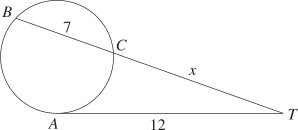
The line  `AT`  is the tangent to the circle at  `A`, and  `BT`  is a secant meeting the circle at  `B`  and  `C`.

Given that  `AT = 12`,  `BC = 7`  and  `CT = x`, find the value of  `x`.  (2 marks)

Show Answers Only

`x = 9,\ \ x\ text(≠ –16)`

Show Worked Solution
♦♦ Poorly done.
MARKER’S COMMENT: A knowledge gap for many students exposed here, not knowing the relationship between the tangent and the secant.
`AT^2` `= CT xx BT`
`12^2` `= x(x + 7)`
`144` `= x^2 + 7x`
`x^2 + 7x − 144` `= 0`
`(x + 16)(x − 9)` `= 0`


`:.x = 9,\ \ x\ text(≠ –16)`

Filed Under: 2. Plane Geometry EXT1 Tagged With: Band 5

Proof, EXT2* P2 2006 HSC 5d

  1. Use the fact that  `tan ( alpha - beta) = (tan alpha - tan beta)/(1 + tan alpha tan beta)`
    to show that
     
        `1 + tan n theta tan (n + 1) theta = cot theta (tan (n + 1) theta - tan n theta).`  (1 mark)

    --- 8 WORK AREA LINES (style=lined) ---

Show Answers Only
  1. `text(Proof)\ \ text{(See Worked Solutions)}`
  2. `text(Proof)\ \ text{(See Worked Solutions)}`
Show Worked Solution

i.   `text(Show)`

`1 + tan n theta tan ( n + 1) theta = cot theta (tan (n+1) theta – tan n theta)`

`text(LHS)` `= underbrace{1 + tan n theta tan ( n + 1) theta}_text{rearrange part (i) identity}`
  `= (tan n theta – tan (n + 1) theta)/(tan (n theta – (n + 1) theta)`
  `= (tan n theta – tan (n + 1) theta)/(tan (-theta))`
  `=1/tan theta * – (tan n theta – tan (n + 1) theta)`
  `= cot theta (tan (n + 1) theta – tan n theta)`
  `=\ text(RHS  …  as required.)`


ii.   `text(Prove)\ \ tan theta tan 2 theta + tan 2 theta tan 3 theta + … + tan n theta tan (n + 1) theta`

`= -(n + 1) + cot theta tan (n + 1) theta`

`text(If)\ \ n = 1`

`text(LHS)` `= tan theta tan 2 theta`
  `= cot theta (tan 2 theta – tan theta) – 1\ \ \ text{(from (i))}`
  `= cot theta tan 2 theta – 1 – 1`
  `= -2 + cot theta tan 2 theta`
`text(RHS)` `= -2 + cot theta tan 2 theta`

`:.\ text(True for)\ \ n = 1`


`text(Assume true for)\ \ n = k`

`text(i.e.)\ \ tan theta tan 2 theta + … + tan k theta tan (k + 1) theta`

`= -(k + 1) + cot theta tan (k + 1) theta`
 

`text(Prove true for)\ \ n = k + 1`

`text(i.e.)\ \ tan theta tan 2 theta + … + tan k theta tan (k + 1) theta + tan (k + 1) theta tan (k + 2) theta`

`= -(k + 2) + cot theta tan (k + 2) theta`

`text(LHS)` `= -(k + 1) + cot theta tan(k + 1) theta + tan (k + 1) theta tan (k + 2) theta`
  `= -(k + 1) + cot theta tan(k + 1) theta + cot theta[tan (k + 2) theta – tan (k + 1) theta] – 1`
  `= -(k + 2) + cot theta tan(k + 1) theta + cot theta tan (k + 2) theta – cot theta tan (k + 1) theta`
  `= -(k + 2) + cot theta tan(k + 2) theta`
  `=\ text(RHS)`

 
`:.\ text(True for)\ \ n = k + 1`

`:.\ text(S)text(ince true for)\ \ n = 1,\ \ text(true for integral)\ \ n >= 1`

Filed Under: Induction, P2 Induction (Ext2) Tagged With: Band 5, smc-1044-30-Trig, smc-5115-30-Trig

Calculus, EXT1 C1 2006 HSC 5c

2006 5c
 

A hemispherical bowl of radius  `r\ text(cm)`  is initially empty. Water is poured into it at a constant rate of  `k\ text(cm³)`  per minute. When the depth of water in the bowl is  `x\ text(cm)`, the volume, `V\ text(cm³)`, of water in the bowl is given by

`V = pi/3 x^2 (3r - x).`    (Do NOT prove this)

  1. Show that  `(dx)/(dt) = k/(pi x (2r - x).`  (2 marks)

    --- 8 WORK AREA LINES (style=lined) ---

  2. Hence, or otherwise, show that it takes 3.5 times as long to fill the bowl to the point where  `x = 2/3r`  as it does to fill the bowl to the point where  `x = 1/3r.`  (2 marks)

    --- 10 WORK AREA LINES (style=lined) ---

Show Answers Only
  1. `text(Proof)\ \ text{(See Worked Solutions)}`
  2. `text(Proof)\ \ text{(See Worked Solutions)}`
Show Worked Solution

i.  `text(Show)\ \ (dx)/(dt) = k/(pi x (2r – x))`

`(dV)/(dt)` `= k`
`V` `= pi/3 x^2 (3r – x)`
  `= r pi x^2 – pi/3 x^3`
`(dV)/(dx)` `= 2 pi r x – pi x^2`
  `= pi x (2r – x)`
   
`(dV)/(dt)` `= (dV)/(dx) * (dx)/(dt)`
`k` `= pi x (2r – x) * (dx)/(dt)`
`:. (dx)/(dt)` `= k/(pi x (2r – x))\ \ text(…  as required)`


ii.  `(dx)/(dt)` `= k/(pi x (2r – x))`
`(dt)/(dx)` `= 1/k pi x (2r – x)`
`t` `= 1/k int 2 pi r x – pi x^2\ dx`
  `= 1/k [pi r x^2 – 1/3 pix^3] + c`

 
`text(When)\ \ t = 0,\ \ \ x = 0`

`:.\ c = 0`

 `:.t = 1/k [pi r x^2 – 1/3 pi x^3]`

 
`text(Find)\ \ t_1,\ \ text(when)\ \ x = 1/3r`

`t_1` `= 1/k [pi r (r/3)^2 – 1/3 pi (r/3)^3]`
  `= 1/k [(pi r^3)/9 – (pi r^3)/81]`
  `= 1/k ((9 pi r^3)/81 – (pi r^3)/81)`
  `= (8 pi r^3)/(81k)`

 
`text(Find)\ \ t_2\ \ text(when)\ \ x = 2/3r`

`t_2` `= 1/k [pi r((2r)/3)^2 – 1/3 pi ((2r)/3)^3]`
  `= 1/k [(4 pi r^3)/9 – (8 pi r^3)/81]`
  `= 1/k ((36 pi r^3)/81 – (8 pi r^3)/81)`
  `= (28 pi r^3)/(81k)`
  `= 3.5 xx (8 pi r^3)/(81k)`
  `= 3.5 xx t_1`

 
`:.\ text(It takes 3.5 times longer to fill the bowl.)`

Filed Under: Rates of Change EXT1, Related Rates of Change (Ext1) Tagged With: Band 3, Band 5, smc-1079-10-Volume

Mechanics, EXT2* M1 2006 HSC 4c

A particle is moving so that  `ddot x = 18x^3 + 27x^2 + 9x.`

Initially  `x = – 2`  and the velocity, `v`, is  `– 6.`

  1. Show that  `v^2 = 9x^2 (1 + x)^2.`  (2 marks)

    --- 8 WORK AREA LINES (style=lined) ---

  2. Hence, or otherwise, show that 
     
         `int 1/(x(1 + x)) \ dx = -3t.`  (2 marks)

    --- 6 WORK AREA LINES (style=lined) ---

  3. It can be shown that for some constant  `c`,
     
         `log_e (1 + 1/x) = 3t + c.`       (Do NOT prove this.)
     
    Using this equation and the initial conditions, find  `x`  as a function of  `t.`  (2 marks)

    --- 8 WORK AREA LINES (style=lined) ---

Show Answers Only
  1. `text(Proof)\ \ text{(See Worked Solutions)}`
  2. `text(Proof)\ \ text{(See Worked Solutions)}`
  3. `x = 2/(e^(3t) – 2)`
Show Worked Solution

i.   `text(Show)\ \ v^2 = 9x^2 (1 + x)^2`

`ddot x` `= d/(dx) (1/2 v^2)`
  `= 18x^3 + 27x^2 + 9x`
`1/2 v^2` `= int 18x^3 + 27x^2 + 9x\ dx`
  `= 18/4 x^4 + 27/3 x^3 + 9/2 x^2 + c`
`v^2` `= 9x^4 + 18x^3 + 9x^2 + c`


`text(When)\ \ t = 0,\ \ x = -2,\ \ v = -6`

`:.\ (-6)^2` `= 9 (-2)^4 + 18 (-2)^3 + 9 (-2)^2 + c`
`36` `= 144 – 144 + 36 + c`
`c` `= 0`


`:.\ v^2` `= 9x^4 + 18x^3 + 9x^2`
  `= 9x^2 (x^2 + 2x + 1)`
  `= 9x^2 (1 + x)^2\ \ text(…  as required)`


ii.   `text(Show)\ \ int 1/(x (1 + x)) \ dx = -3t`

`v^2 = 9x^2 (1 + x)^2`

`v = +- sqrt (9x^2 (1 + x)^2)`
 

`text(When)\ \ x = -2,\ \ v = -6:`

`:.\ v` `= -sqrt (9x^2 (1 + x)^2)`
  `= -3x (1 + x)`


`(dx)/(dt)` `= -3x (1 + x)`
`(dt)/(dx)` `= -1/(3x (1 + x))`
`t` `= -1/3 int 1/(x (1 + x)) \ dx`
`-3t` `= int 1/(x (1 + x)) \ dx\ \ text(…  as required)`


iii.  `text(Given)\ \ log_e (1 + 1/x) = 3t + c`

`text(When)\ \ t = 0,\ \ x = -2:`

`log_e (1 – 1/2)` `= 3(0) + c`
`log_e (1/2)` `= c`
`c` `= log_e 2^-1`
  `= -log_e 2`


`log_e (1 + 1/x)` `= 3t – log_e 2`
`1 + 1/x` `= e^(3t – log_e 2)`
`1/x` `= e^(3t – log_e 2) – 1`
  `= (e^(3t))/(e^(log_e 2)) – 1`
  `= e^(3t)/2 – 1`
  `= (e^(3t) – 2)/2`
`:.\ x` `= 2/(e^(3t) – 2)`

Filed Under: Motion Without Resistance, Other Motion EXT1 Tagged With: Band 4, Band 5, smc-1060-02-Motion as f(x), smc-1060-10-Polynomial

Mechanics, EXT2* M1 2006 HSC 4b

A particle is undergoing simple harmonic motion on the `x`-axis about the origin. It is initially at its extreme positive position. The amplitude of the motion is 18 and the particle returns to its initial position every 5 seconds.

  1. Write down an equation for the position of the particle at time  `t`  seconds.  (2 marks)

    --- 4 WORK AREA LINES (style=lined) ---

  2. How long does the particle take to move from a rest position to the point halfway between that rest position and the equilibrium position?  (3 marks)

    --- 5 WORK AREA LINES (style=lined) ---

Show Answers Only
  1. `x = 18 cos ((2 pi)/5 t)`
  2. `5/6\ \ text(seconds)`
Show Worked Solution

i.   `text{Amplitude (A)} = 18`

♦♦♦ “Very poorly” answered (exact data unavailable).

`text(Period) = (2 pi)/n = 5`

`5n` `= 2 pi`
`n` `= (2 pi)/5`


`text(Using)\ \ x` `= A cos n t`
`x` `= 18 cos ((2 pi)/5 t)`


ii.   `text(When)\ \ t= 0,\ \ \ x = 18`

`text(Find)\ \ t\ \ text(when)\ \ x = 9`

`9` `= 18 cos ((2 pi)/5 t)`
`cos ((2 pi)/5 t)` `= 1/2`
`(2 pi)/5 t` `= pi/3`
`t` `= (5 pi)/(3 xx 2 pi)`
  `= 5/6\ \ text(seconds)`


`:.\ text(It takes the particle)\ \  5/6\ \ text(seconds to move from)`

`text(rest position and half way to equilibrium.)`

Filed Under: Simple Harmonic Motion, Simple Harmonic Motion EXT1 Tagged With: Band 5, Band 6, smc-1059-10-Amplitude / Period

Functions, EXT1 F2 2006 HSC 4a

The cubic polynomial  `P(x) = x^3 + rx^2 + sx + t`. where  `r, \ s`  and  `t`  are real numbers, has three real zeros,  `1, alpha`  and  `-alpha.`

  1. Find the value of  `r.`  (1 mark)

    --- 4 WORK AREA LINES (style=lined) ---

  2. Find the value of  `s + t.`  (2 marks)

    --- 4 WORK AREA LINES (style=lined) ---

Show Answers Only
  1. `-1`
  2. `0`
Show Worked Solution

i.  `P(x) = x^3 + rx^2 + sx + t`

`text(Roots are)\ \ 1, alpha, -alpha`

`1 + alpha + -alpha` `= – b/a`
`1` `= – r/1`
`:.\ r` `= -1`


ii.  `P(x) = x^3 – x^2 + sx + t`

`P(1) = 0`

`0` `= 1 – 1 + (s xx 1) + t`
`0` `= s + t`

 
`:.\ text(Value of)\ \ s + t = 0`

Filed Under: Roots, Remainders and Factors, Sum, Products and Multiplicity of Roots (Ext1) Tagged With: Band 4, Band 5, smc-1205-10-Sum and Product

Plane Geometry, EXT1 2006 HSC 3d

The points  `P, Q`  and  `T`  lie on a circle. The line  `MN`  is tangent to the circle at  `T`  with  `M`  chosen so that  `QM`  is perpendicular to  `MN`. The point  `K`  on  `PQ`  is chosen so that  `TK`  is perpendicular to  `PQ`  as shown in the diagram.

  1. Show that  `QKTM`  is a cyclic quadrilateral.  (1 mark)
  2. Show that  `/_KMT = /_KQT.`  (1 mark)
  3. Hence, or otherwise, show that  `MK`  is parallel to  `TP.`  (2 marks)
Show Answers Only
  1. `text(Proof)\ \ text{(See Worked Solutions)}`
  2. `text(Proof)\ \ text{(See Worked Solutions)}`
  3. `text(Proof)\ \ text{(See Worked Solutions)}`
Show Worked Solution
(i)   

`/_ QMT = 90^@\ \ \ (QM _|_ MN)`

`/_ QKT = 90^@\ \ \ (PQ _|_ TK)`

`:.\ /_ QMT + /_ QKT = 180^@`


`:.\ QKTM\ \ text(is cyclic)\ \ text{(opposite angles are supplementary)}`

`text(…  as required.)`


(ii)  `text(Show)\ \ /_ KMT = /_ KQT`

`/_ KMQ = /_ KTQ = theta`

`text{(angles in the same segment on arc}\ \ KQ text{)}`


`/_ KQT` `= 90 – theta\ \ text{(angle sum of}\ \ Delta KQT text{)}`
`/_ KMT` `= /_ QMT – /_ KMQ`
  `= 90 – theta`


`:.\ /_ KMT = /_ KQT\ \ text(…  as required.)`


(iii)   `text(Show)\ \ MK\ text(||)\ TP`

`/_ NTP` `= /_ KQT\ \ text{(angle in alternate segment)`
  `= 90 – theta`


`:.\ /_ NTP = /_ KMT\ \ text{(from part (ii))}`

`:.\ MK\ text(||)\ TP\ \ text{(corresponding angles are equal)}`

Filed Under: 2. Plane Geometry EXT1 Tagged With: Band 4, Band 5, Band 6, page-break-before-solution

Combinatorics, EXT1 A1 2006 HSC 3c

Sophie has five coloured blocks: one red, one blue, one green, one yellow and one white. She stacks two, three, four or five blocks on top of one another to form a vertical tower.

  1. How many different towers are there that she could form that are three blocks high?  (1 mark)

    --- 1 WORK AREA LINES (style=lined) ---

  2. How many different towers can she form in total?  (2 marks)

    --- 2 WORK AREA LINES (style=lined) ---

Show Answers Only
  1. `60`
  2. `320`
Show Worked Solution
i.   `text(Towers)` `= \ ^5P_3`
  `= 60`

 
ii.
  `text(Number of different towers)`

`= \ ^5P_2 + \ ^5P_3 + \ ^5P_4 + \ ^5P_5`

`= 20 + 60 + 120 + 120`

`= 320`

Filed Under: Permutations and Combinations (Ext1), Permutations and Combinations EXT1 Tagged With: Band 4, Band 5, smc-1082-20-Unordered Combinations

Quadratic, EXT1 2006 HSC 2c

2006 2c

The points  `P(2ap, ap^2), Q(2aq, aq^2)`  and  `R(2ar, ar^2)`  lie on the parabola  `x^2 = 4ay`. The chord  `QR`  is perpendicular to the axis of the parabola. The chord  `PR`  meets the axis of the parabola at  `U`.

The equation of the chord  `PR`  is  `y = 1/2(p + r)x - apr.`     (Do NOT prove this.)

The equation of the tangent at  `P`  is  `y = px - ap^2.`            (Do NOT prove this.) 

  1. Find the coordinates of  `U.`  (1 mark)
  2. The tangents at  `P`  and  `Q`  meet at the point  `T`. Show that the coordinates of  `T`  are  `(a(p + q), apq).`  (2 marks)
  3. Show that  `TU`  is perpendicular to the axis of the parabola.  (1 mark)
Show Answers Only
  1. `(0, –apr)`
  2. `text(Proof)\ \ text{(See Worked Solutions)}`
  3. `text(Proof)\ \ text{(See Worked Solutions)}`
Show Worked Solution

(i)   `U\ \ text(is the)\ \ y\ \ text(intercept of)\ \ PR`

`y = 1/2 (p + r)x – apr`

`text(When)\ \ x = 0`

`y = -apr`

`:.\ U\ \ text(has coordinates)\ \ (0, –apr)`


(ii)   `text(Show)\ \ T\ \ text(is)\ \ (a(p + q), apq)`

`text(T)text(angents at)\ \ P and Q\ \ text(are)`

`y` `= px – ap^2\ \ \ \ text{…  (1)}`
`y` `= qx – aq^2\ \ \ \ text{…  (2)}`


`T\ \ text(occurs when)\ \ \ (1) = (2)`

`px – ap^2` `= qx – aq^2`
`px – qx` `= ap^2 – aq^2`
`x(p – q)` `= a (p^2 – q^2)`
  `= a (p – q) (p + q)`
`:.\ x` `= a (p + q)`


`text(Substitute)\ \ x = a (p + q)\ \ text{into  (1)}`

`y` `= p * a (p + q) – ap^2`
  `= ap^2 + apq – ap^2`
  `= apq`


`:.\ T (a (p + q), apq)\ \ text(…  as required.)`


(iii)  `text(Axis of parabola)\ \ x^2 = 4ay\ \ text(is)\ \ y text(-axis)`

`=>TU\ \ text(will be perpendicular to the)\ \ y text(-axis if it has a)`

`text(gradient of)\ \ 0\ \ text{(i.e.}\ \ T and U\ text{have same} y text{-values)}`

`:.\ text(Need to show)\ \ \ -apr = apq.`


`text(Consider)\ \ QR`

`text(S)text(ince it is perpendicular to)\ \ y text(-axis)`

`text(and the parabola is symmetrical)`

`=>\ \ 2aq` `= -2ar`
`q`  `= -r`
`:.\ apq` `= ap (-r)`
`apq` `= -apr`


`:.\ TU\ \ text(is perpendicular.)`

Filed Under: 9. Quadratics and the Parabola EXT1 Tagged With: Band 3, Band 4, Band 5

Mechanics, EXT2* M1 2005 6b

An experimental rocket is at a height of  5000 m, ascending with a velocity of  ` 200 sqrt 2\ text(m s)^-1`  at an angle of  45°  to the horizontal, when its engine stops.


After this time, the equations of motion of the rocket are:

`x = 200t`

`y = -4.9t^2 + 200t + 5000,`

where `t` is measured in seconds after the engine stops. (Do NOT show this.)

  1. What is the maximum height the rocket will reach, and when will it reach this height?  (2 marks)

    --- 6 WORK AREA LINES (style=lined) ---

  2. The pilot can only operate the ejection seat when the rocket is descending at an angle between 45° and 60° to the horizontal. What are the earliest and latest times that the pilot can operate the ejection seat?  (3 marks)

    --- 10 WORK AREA LINES (style=lined) ---

  3. For the parachute to open safely, the pilot must eject when the speed of the rocket is no more than  `350\ text(m s)^-1`. What is the latest time at which the pilot can eject safely?  (2 marks)

    --- 8 WORK AREA LINES (style=lined) ---

Show Answers Only
  1. `7041\ text(metres)`


    `20.4\ text(seconds.)`

  2. `40.8\ text(seconds)\ ;\ 55.8\ text(seconds)`
  3. `49.7\ text(seconds)`
Show Worked Solution

i.


`y = -4.9t^2 + 200t + 5000`

`dot y = -9.8t + 200`

`text(Max height occurs when)\ \ dot y = 0`

`9.8t` `= 200`
`t` `= 20.408…`
  `= 20.4\ text{seconds  (to 1 d.p.)}`


`text(When)\ t = 20.408…`

`y` `= -4.9 (20.408…)^2 + 200 (20.408…) + 5000`
  `= 7040.816…`
  `= 7041\ text{m  (to nearest metre)}`


`:.\ text(The rocket will reach a maximum height of)`

`text(7041 metres when)\ \ t = 20.4\ text(seconds.)`


ii.  `text(The rocket is descending at 45° at point)\ A\ text(on the graph.)`

`text(The symmetry of the parabolic motion means that)\ \ A`

`text(occurs when)\ \ t = 2 xx text(time to reach max height, or)`

`40.8\ text(seconds.)`


`text(Point)\ B\ text(occurs when the rocket is descending at 60°)`

`text(to the horizontal.)`


`text(At)\ \ B,`


`-tan 60° = (dot y)/(dot x)`

`text{(The gradient of the projectile becomes}`

`text{negative after reaching its max height.)}`

`dot y = -9.8t + 200`

`dot x = d/(dt) (200t) = 200`

`:.\ – sqrt 3` `= (-9.8t + 200)/200`
`-200 sqrt 3` `= -9.8t + 200`
`9.8t` `= 200 + 200 sqrt 3`
`t` `= (200 + 200 sqrt 3)/9.8`
  `= (546.410…)/9.8`
  `= 55.756…`
  `= 55.8\ text{seconds  (nearest second)}`


`:.\ text(The pilot can operate the ejection seat)`

`text(between)\ \ t = 40.8 and t = 55.8\ text(seconds.)`


iii.

`v^2 = (dot x)^2 + (dot y)^2`

`text(When)\ \ v = 350`

`350^2` `= 200^2 + (-9.8t + 200)^2`
`122\ 500` `= 40\ 000 + (-9.8t + 200)^2`
`(-9.8t + 200)^2` `= 82\ 500`
`-9.8t + 200` `= +- sqrt (82\ 500)`
`9.8t` `= 200 +- sqrt (82\ 500)`
`t` `= (200 +- sqrt (82\ 500))/9.8`
  `= 49.717…\ \ \ (t > 0)`
  `= 49.7\ text{seconds  (to 1 d.p.)}`


`:.\ text(The latest time the pilot can eject safely)`

`text(is when)\ \ t = 49.7\ text(seconds.)`

Filed Under: Projectile Motion, Projectile Motion EXT1 Tagged With: Band 4, Band 5, Band 6, page-break-before-solution, smc-1062-20-Max Height, smc-1062-50-Angle of Trajectory/Impact

Statistics, EXT1 S1 2005 HSC 6a

There are five matches on each weekend of a football season. Megan takes part in a competition in which she earns one point if she picks more than half of the winning teams for a weekend, and zero points otherwise. The probability that Megan correctly picks the team that wins any given match is `2/3`.

  1. Show that the probability that Megan earns one point for a given weekend is  0.7901, correct to four decimal places.  (2 marks)

    --- 4 WORK AREA LINES (style=lined) ---

  2. Hence find the probability that Megan earns one point every week of the eighteen-week season. Give your answer correct to two decimal places.  (1 mark)

    --- 2 WORK AREA LINES (style=lined) ---

  3. Find the probability that Megan earns at most 16 points during the eighteen-week season. Give your answer correct to two decimal places.  (2 marks)

    --- 5 WORK AREA LINES (style=lined) ---

Show Answers Only
  1. `text(Proof)\ \ text{(See Worked Solutions)}`
  2. `0.01\ \ text{(to 2 d.p.)}`
  3. `0.92\ \ text{(to 2 d.p.)}`
Show Worked Solution

i.  `P\ text{(earns a point)}`

`= P\ text{(picks 3, 4 or 5 winners)}`

`=\ ^5 C_3  (2/3)^3 * (1/3)^2 + \ ^5 C_4  (2/3)^4 * (1/3)^1`

`+\ ^5 C_5 (2/3)^5*(1/3)^0`

`= 10 * 8/27 * 1/9 + 5 * 16/81 * 1/3 + 1 * 32/243*1`

`= 80/243 + 80/243 + 32/243`

`= 192/243`

`= 0.790123…`

`= 0.7901\ \ text{(to 4 d.p.)  …  as required.}`


ii.  `P\ text{(earns a point 18 weeks in a row)}`

`= (0.7901…)^18`

`= 0.01440…`

`= 0.01\ \ text{(to 2 d.p.)}`


iii.  `P\ text{(earns at most 16 points)}`

`= 1 – P\ text{(earns 17 or 18 points)}`
 

`P\ text{(earns 17)}`

`=\ ^18 C_17 * (0.7901…)^17 xx (1 – 0.7901…)`

`= 0.0688…`

`P\ text{(earns 18)} = 0.01440…\ \ \ \ \ text{(from (ii))}`
 

`:.\ P\ text{(earns at most 16 points)}`

`= 1 – (0.0688… + 0.0144…)`

`= 0.916…`

`= 0.92\ \ \ text{(to 2 d.p.)}`

Filed Under: Binomial Probability (Ext1), Binomial Probability EXT1 Tagged With: Band 4, Band 5, smc-1084-25-Compound Events

Mechanics, EXT2* M1 2005 HSC 5c

A particle moves in a straight line and its position at time  `t`  is given by

`x = 5 + sqrt 3 sin3t - cos 3t.`

  1. Express  `sqrt 3 sin3t − cos 3t`  in the form  `R sin(3t - alpha)`  where  `alpha`  is in radians.  (2 marks)

    --- 6 WORK AREA LINES (style=lined) ---

  2. The particle is undergoing simple harmonic motion. Find the amplitude and the centre of the motion.  (2 marks)

    --- 3 WORK AREA LINES (style=lined) ---

  3. When does the particle first reach its maximum speed after time  `t = 0`?  (1 mark)

    --- 5 WORK AREA LINES (style=lined) ---

Show Answers Only
  1. `2 sin ( 3t – pi/6)`
  2. `text(Amplitude) = 2\ text(units),\ \ \ text(Centre of the motion at)\ \ x = 5`
  3. `pi/18`
Show Worked Solution

i.    `x = 5 + sqrt 3 sin 3t – cos 3t`

`sqrt 3 sin 3t – cos 3t` `= R sin (3t – alpha)`
  `= R sin 3t cos alpha – R cos 3t sin alpha`

 
`=> R cos alpha = sqrt 3\ \ \ \ \ R sin alpha = 1`

`R^2 = sqrt 3^2 + 1^2 = 4`

`R = 2`

`=> 2 cos alpha` `= sqrt3`
`cos alpha` `= (sqrt3)/2`
`alpha` `= pi/6`

 
`:.\ 2 sin ( 3t – pi/6) = sqrt 3 sin 3t – cos 3t`


ii.  `x` `= 5 + sqrt 3 sin 3t – cos 3t`
  `= 5 + 2 sin (3t – pi/6)`

 
`text(Amplitude) = 2\ text(units)`

`text(Centre of motion at)\ \ x = 5`


iii.  `text(Solution 1)`

`x = 5 + 2 sin (3t – pi/6)`

`dot x = 6 cos (3t – pi/6)`

 
`text(Maximum speed occurs when)`

`cos (3t – pi/6)` `= 1`
`3t – pi/6` `= 0`
`3t` `= pi/6`
`t` `= pi/18`

 
`text(Solution 2)`

`text(Maximum speed occurs at the)`

`text(centre of motion,)\ \ x = 5`

`5 + 2 sin (3t – pi/6)` `= 5`
`2 sin (3t – pi/6)` `= 0`
`sin (3t – pi/6)` `= 0`
`3t – pi/6` `= 0`
`t` `= pi/18`

Filed Under: Simple Harmonic Motion, Simple Harmonic Motion EXT1 Tagged With: Band 4, Band 5, smc-1059-10-Amplitude / Period, smc-1059-31-Max Speed, smc-1059-40-Auxiliary Angles

Proof, EXT2* P2 2005 HSC 4d

Use the principle of mathematical induction to show that  `4^n - 1 - 7n > 0`  for all integers  `n >= 2.`  (3 marks)

--- 8 WORK AREA LINES (style=lined) ---

Show Answers Only

`text(Proof)\ \ text{(See Worked Solutions)}`

Show Worked Solution

`text(Prove)\ \ 4^n – 1 – 7n > 0\ \ text(for)\ \ n >= 2`

`text(If)\ \ n = 2`

`text(LHS)` `= 4^2 – 1 – (7 xx 2)`
  `= 16 – 1 – 14`
  `= 1 > 0`

 
`:.\ text(True for)\ \ n = 2`

 
`text(Assume true for)\ \ n = k`

`text(i.e.)\ \ 4^k – 1 – 7k` `> 0`
`4^k` `> 1 + 7k`

 
`text(Prove true for)\ \ n = k + 1`

`text(i.e.)\ \ 4^(k + 1) – 1 – 7 (k + 1) > 0`

`text(LHS)` `= 4 (4^k) – 1 – 7k – 7`
  `> 4 (1 + 7k) – 7k – 8`
  `> 4 + 28k – 7k -8`
  `> 21k – 4`
  `> 0\ \ \ \ (k >= 2)`

 
`=>\ text(True for)\ \ n = k + 1`

 `:.\ text(S)text(ince true for)\ \ n = 2, text(by PMI, true for integral)\ \ n >= 2.`

Filed Under: 7. Induction and Other Series EXT1, Induction, P2 Induction (Ext2) Tagged With: Band 5, smc-1044-10-Inequalities, smc-5115-10-Inequalities

Quadratic, EXT1 2005 HSC 4c

The points  `P (2ap, ap^2)`  and  `Q (2aq, aq^2)`  lie on the parabola  `x^2 = 4ay`.

The equation of the normal to the parabola at  `P`  is  `x + py = 2ap + ap^3`  and the equation of the normal at  `Q`  is similarly given by  `x + qy = 2aq + aq^3.`

  1. Show that the normals at  `P`  and  `Q`  intersect at the point  `R`  whose coordinates are
    1. `(–apq[p + q], a[p^2 + pq + q^2 + 2]).`  (2 marks)

  2. The equation of the chord  `PQ`  is
    1. `y = 1/2 (p + q) x - apq.` (Do NOT show this.)
  3. If the chord  `PQ`  passes through  `(0, a)`, show that  `pq = –1.`  (1 mark)

  4. Find the equation of the locus of  `R`  if the chord  `PQ`  passes through  `(0, a).`  (2 marks)
Show Answers Only
  1. `text(Proof)\ \ text{(See Worked Solutions)}`
  2. `text(Proof)\ \ text{(See Worked Solutions)}`
  3. `y = x^2/a + 3a`
Show Worked Solution

(i)   `text(Show)\ \ R\ \ text(is)\ \ (–apq [p + q], a [p^2 + pq + q^2 + 2])`


ext1 2005 4c

`text(Equations of normals through)\ \  P and Q`

`x + py` `= 2ap + ap^3` `\ \ text{… (1)}`
`x + qy` `= 2aq + aq^3` `\ \ text{… (2)}`


`text{Multiply (1)} xx q\ ,\ \ text{(2)} xx p`

`qx + pqy` `= 2apq + ap^3q` `\ \ text{… (3)}`
`px + pqy` `= 2apq + apq^3` `\ \ text{… (4)}`


`text{Subtract  (4) – (3)}`

`x (p – q)` `= apq^3 – ap^3q`
  `= apq (q^2 – p^2)`
  `= apq (q – p) (q + p)`
  `= -apq (p -q) (p + q)`
`x` `= -apq [p + q]`


`text(Substitute)\ \ x = -apq [p + q]\ \ text{into  (1)}`

`py – apq[p + q]` `= 2ap + ap^3`
`py` `= 2ap + ap^3 + apq (p + q)`
`y` `= 2a + ap^2 + aq (p + q)`
  `= 2a + ap^2 + apq + aq^2`
  `= a[p^2 + pq + q^2 + 2]`


`:.\ R\ \ text(is)\ \ (–apq [p + q], a [p^2 + pq + q^2 + 2])`

`text(…  as required.)`


(ii)  `PQ\ \ text(is)\ \ y = 1/2 (p + q)x – apq`

`text(Passes)\ \ (0, a)`

`a` `= 1/2 (p + q)0 – apq`
`a` `= -apq`
`:. pq` `= -1\ \ text(…  as required)`


(iii)   `R\ \ text(has coordinates)`

`x` `= -apq [p + q]`
`x` `= a(p + q)\ \ \ text{(using part (ii))}`
 `x/a` `=(p + q)`


`y` `= a [p^2 + pq + q^2 + 2]`
  `= a (p^2 – 1 + q^2 + 2)`
  `= a (p^2 + q^2 +1)`
  `= a [(p + q)^2 – 2pq + 1]`
  `= a [(p + q)^2 + 3]`
  `= a [(x/a)^2 + 3]`
  `= x^2/a + 3a`


`:.\ text(Locus of)\ \ R\ \ text(is)\ \ y = x^2/a + 3a`

Filed Under: 9. Quadratics and the Parabola EXT1 Tagged With: Band 4, Band 5, HSC

Trigonometry, EXT1 T3 2005 HSC 4b

By making the substitution  `t = tan\ theta/2`, or otherwise, show that

`text(cosec)\ theta + cot theta = cot\ theta/2.`  (2 marks)

--- 10 WORK AREA LINES (style=lined) ---

Show Answers Only

`text(Proof)\ \ text{(See Worked Solutions)}`

Show Worked Solution

`text(Show cosec)\ theta + cot\ theta = cot\ theta/2`
 

`tan\ theta/2=t`

`=>sin theta` `= 2 sin\ theta/2\ cos\ theta/2= (2t)/(t^2 +1)`
`=>cos theta` `= cos^2\ theta/2 – sin^2\ theta/2= (1 – t^2)/(t^2 + 1)`
`=>tan theta` `= (sin theta)/(cos theta)= (2t)/(1 – t^2)`


`text(LHS)` `= 1/(sin theta) + 1/(tan theta)`
  `= (t^2 + 1)/(2t) + (1 – t^2)/(2t)`
  `= (t^2 + 1 + 1 – t^2)/(2t)`
  `= 1/t`
  `= 1/(tan\ theta/2)`
  `= cot\ theta/2`
  `=\ text(RHS  …  as required.)`

Filed Under: 5. Trig Ratios EXT1, Identities, Equations and 't' formulae (Ext1) Tagged With: Band 5, smc-1076-30-`t` formulae

Plane Geometry, EXT1 2005 HSC 3d

In the circle centred at  `O`  the chord  `AB`  has length  `7`. The point  `E`  lies on  `AB`  and  `AE`  has length  `4`. The chord  `CD`  passes through  `E`.

Let the length of  `CD`  be  `l`  and the length of  `DE`  be  `x`.

  1. Show that  `x^2 - lx + 12 = 0.`  (2 marks)
  2. Find the length of the shortest chord that passes through  `E.`  (2 marks)
Show Answers Only
  1. `text(Proof)\ \ text{(See Worked Solutions)}`
  2. `4 sqrt 3\ text(units.)`
Show Worked Solution

(i)   `text(Show)\ \ x^2 – lx + 12 = 0`

`AB` `= 7`
`:.\ EB` `= 7 – 4 = 3`


`AE xx EB = ED xx CE`

`text{(intercepts of intersecting chords)}`

`4 xx 3` `= x (l – x)`
`12` `= xl – x^2`


`:.\ x^2 – lx + 12 = 0\ \ text(…  as required.)`


(ii)   `x^2 – lx + 12 = 0\ \ text(has a solution)`

MARKER’S COMMENT: A majority of students tried to differentiate this equation, not realising that `l` is a variable, NOT a constant.

`text(When)\ \ Delta >= 0`

`b^2 – 4ac` `>= 0`
`(-l)^2 – 4 * 1 * 12` `>= 0`
`l^2 – 48` `>= 0`
`l^2` `>= 48`
`l` `>= sqrt 48`
  `>= 4 sqrt 3`


`:.\ text(The shortest chord that could pass through)`

`E\ \ text(is)\ \ 4 sqrt 3\ text(units.)`

Filed Under: 2. Plane Geometry EXT1 Tagged With: Band 4, Band 5

Combinatorics, EXT1 A1 2005 HSC 2b

Use the binomial theorem to find the term independent of  `x`  in the expansion of

`(2x - 1/x^2)^12.`  (3 marks)

--- 8 WORK AREA LINES (style=lined) ---

Show Answers Only

`((12), (4)) * 2^8 * (-1)^4 = 126\ 720`

Show Worked Solution

`T_k =\ text(General term of)\ \ (2x – 1/x^2)^12`

`T_k` `= ((12), (k)) (2x)^(12 – k) * (-1)^k * (x^-2)^k`
  `= ((12), (k)) * 2^(12 – k) * x^(12 – k) * (-1)^k * x^(-2k)`
  `= ((12), (k)) * 2^(12 – k) * (-1)^k * x^(12 – 3k)`


`text(Independent term occurs when)`

MARKER’S COMMENT: The general term formula was well known, but many could not apply it to this question.
`x^(12-3k)` `= x^0`
`12 – 3k` `= 0`
`k` `= 4`


`:.\ text(Independent term is)`

`((12), (4)) * 2^8 * (-1)^4 = 126\ 720`

Filed Under: 17. Binomial EXT1, Binomial Expansion (Ext1) Tagged With: Band 5, smc-1088-20-Independent Term

Calculus, 2ADV C3 2007 HSC 10b

The noise level, `N`, at a distance `d` metres from a single sound source of loudness `L` is given by the formula

`N = L/d^2.`

Two sound sources, of loudness `L_1` and `L_2` are placed `m` metres apart.
 

The point `P` lies on the line between the sound sources and is `x` metres from the sound source with loudness `L_1.`

  1. Write down a formula for the sum of the noise levels at `P` in terms of `x`.  (1 mark)

    --- 2 WORK AREA LINES (style=lined) ---

  2. There is a point on the line between the sound sources where the sum of the noise levels is a minimum.


    Find an expression for `x` in terms of `m`, `L_1` and `L_2` if `P` is chosen to be this point.  (4 marks)

    --- 8 WORK AREA LINES (style=lined) ---

Show Answers Only
  1. `N = L_1/x^2 + L_2/(m-x)^2`
  2. `x = (root 3 L_1\ m)/{(root 3 L_2 + root 3 L_1)}`
Show Worked Solution
i.  

`N = L/d^2`

`text(Noise from)\ L_1` `= L_1/x^2`
`text(Noise from)\ L_2` `= L_2/(m-x)^2`
`:. N` `= L_1/x^2 + L_2/(m-x)^2`


ii.  `N = L_1\ x^-2 + L_2 (m – x)^-2`

`(dN)/(dx)` `= -2 L_1 x^-3 + -2 L_2 (m – x)^-3 xx d/(dx) (m – x)`
  `= (-2 L_1)/x^3 + (2 L_2)/(m – x)^3`


`text(Max or min when)\ (dN)/(dx) = 0`

`(2 L_1)/x^3` `= (2 L_2)/(m – x)^3`
`2 L_1 (m – x)^3` `= 2 L_2\ x^3`
`L_1 (m – x)^3` `= L_2\ x^3`
`root 3 L_1 (m – x)` `= root 3 L_2\ x`
`root 3 L_1\ m – root 3 L_1\ x` `= root 3 L_2\ x`
`root 3 L_2\ x + root 3 L_1\ x` `= root 3 L_1\ m`
`x (root 3 L_2 + root 3 L_1)` `= root 3 L_1\ m`
`x` `= (root 3 L_1\ m)/{(root 3 L_2 + root 3 L_1)}`


`(dN)/(dx)` `= -2 L_1\ x^-3 + 2 L_2 (m – x)^-3`
`(d^2N)/(dx^2)` `= 6 L_1\ x^-4 – 6 L_2 (m – x)^-4 xx -1`
  `= (6 L_1)/x^4 + (6 L_2)/(m – x)^4 > 0`


`:.\ text(A minimum occurs when)`

`x = (root 3 L_1\ m)/{(root 3 L_2 + root 3 L_1)}`

Filed Under: Maxima and Minima, Maxima and Minima (Y12) Tagged With: Band 4, Band 5, Band 6, smc-970-60-Other Themes

Calculus in the Physical World, 2UA 2007 HSC 10a

An object is moving on the `x`-axis. The graph shows the velocity, `(dx)/(dt)`, of the object, as a function of time, `t`. The coordinates of the points shown on the graph are  `A (2, 1), B (4, 5), C (5, 0) and D (6, –5)`. The velocity is constant for  `t >= 6`.


  1. Using Simpson’s rule, estimate the distance travelled between  `t = 0`  and  `t = 4`.  (2 marks)
  2. The object is initially at the origin. During which time(s) is the displacement of the object decreasing?  (1 mark)
  3. Estimate the time at which the object returns to the origin. Justify your answer.  (2 marks)
  4. Sketch the displacement, `x`, as a function of time.  (2 marks)
Show Answers Only
  1. `~~ 6\ \ text(units)`
  2. `t > 5\ \ text(seconds)`
  3. `7.2\ \ text(seconds)`


Show Worked Solution

(i)

`text(Distance travelled)`

`= int_0^4 (dx)/(dt)\ dt`

`~~  h/3 [y_0 + 4y_1 + y_2]`

`~~ 2/3 [0 + 4 (1) + 5]`

`~~ 2/3 [9]`

`~~ 6\ \ text(units)`


(ii)  `text(Displacement is reducing when the velocity is negative.)`

`:. t > 5\ \ text(seconds)`


(iii)  `text(At)\ B,\ text(the displacement) = 6\ text(units)`

`text(Considering displacement from)\ B\ text(to)\ D.`

`text(S)text(ince the area below the graph from)`

`B\ text(to)\ C\ text(equals the area above the)`

`text(graph from)\ C\ text(to)\ D,\ text(there is no change)`

`text(in displacement from)\ B\ text(to)\ D.`


`text(Considering)\ t >= 6`

`text(Time required to return to origin)`

`t` `= d/v`
  `= 6/5`
  `= 1.2\ \ text(seconds)`


`:.\ text(The particle returns to the origin after 7.2 seconds.)`

(iv)

2UA HSC 2007 10ai

Filed Under: Motion, Trapezoidal and Simpson's Rule Tagged With: Band 4, Band 5, Band 6, HSC

Financial Maths, 2ADV M1 2007 HSC 9c

Mr and Mrs Caine each decide to invest some money each year to help pay for their son’s university education. The parents choose different investment strategies.

Mr Caine makes 18 yearly contributions of $1000 into an investment fund. He makes his first contribution on the day his son is born, and his final contribution on his son’s seventeenth birthday. His investment earns 6% compound interest per annum.

  1. Find the total value of Mr Caine’s investment on his son’s eighteenth birthday.  (3 marks)

    --- 6 WORK AREA LINES (style=lined) ---

Mrs Caine makes her contributions into another fund. She contributes $1000 on the day of her son’s birth, and increases her annual contribution by 6% each year. Her investment also earns 6% compound interest per annum.

  1. Find the total value of Mrs Caine’s investment on her son’s third birthday (just before she makes her fourth contribution).  (2 marks)

    --- 4 WORK AREA LINES (style=lined) ---

  2. Mrs Caine also makes her final contribution on her son’s seventeenth birthday. Find the total value of Mrs Caine’s investment on her son’s eighteenth birthday.  (1 mark)

    --- 2 WORK AREA LINES (style=lined) ---

Show Answers Only
  1. `$32\ 760\ \ \ text{(nearest dollar)}`
  2. `$3573\ \ \ text{(nearest dollar)}`
  3. `$51\ 378\ \ \ text{(nearest dollar)}`
Show Worked Solution

i.  `text(Let)\ A_n = text(value of the investment after)\ n\ text(years)`

`A_1` `= 1000 (1.06)`
`A_2` `= A_1 (1.06) + 1000 (1.06)`
  `= [1000 (1.06)] (1.06) + 1000 (1.06)`
  `= 1000 (1.06)^2 + 1000 (1.06)`
`A_3` `= A_2 (1.06) + 1000 (1.06)`
  `= 1000 (1.06)^3 + 1000 (1.06)^2 + 1000 (1.06)`
  `= 1000 [1.06 + 1.06^2 + 1.06^3]`

`vdots`

`A_n =` `1000 [1.06 + 1.06^2 + … + 1.06^n]`
  `text(Note that)  (1.06 + 1.06^2 + … + 1.06^n)\ text(is a)`
  `text(GP where)\ a = 1.06 and r = 1.06`
`:. A_n =` `1000 [(a(r^n – 1))/(r – 1)]`


`text(The son’s 18th birthday occurs when)\ n = 18`

`:. A_18` `= 1000 [(1.06 (1.06^18 -1))/(1.06 – 1)]`
  `= 1000 xx 32.7599…`
  `= 32\ 759.991…`
  `= $32\ 760\ \ \ text{(nearest $)}`


`:.\ text(The value of Mr Caine’s investment is $32 760.)`


ii.  `text(Let)\ V_n = text(value of investment after)\ n\ text(years)`

`V_1` `= 1000 (1.06)`
`V_2` `= V_1 (1.06) + 1000 (1.06) (1.06)`
  `= 1000 (1.06)^2 + 1000 (1.06)^2`
  `= 2000 (1.06)^2`
`V_3` `= V_2 (1.06) + 1000 (1.06)^3`
  `= 2000 (1.06)^3 + 1000 (1.06)^3`
  `= 3000 (1.06)^3`
  `= 3573.048…`
  `= $3573\ \ \ text{(nearest dollar)}`


iii.  `text(Continuing the pattern)`

`V_4 = 4000 (1.06)^4`

`vdots`

`V_n = n xx 1000 (1.06)^n`

`:. V_18` `= 18 xx 1000 xx (1.06)^18`
  `= 51\ 378.104…`
  `= $51\ 378\ \ \ text{(nearest dollar)}`


`:.\ text(The value of Mrs Caine’s investment on her)`

`text(son’s 18th birthday will be $51 378.)`

Filed Under: Compound interest, loan repayments and annuities, Financial Applications of Series (Y12) Tagged With: Band 5, Band 6, smc-1007-20-Annuity - Growth phase

Probability, 2ADV S1 2007 HSC 9b

A pack of 52 cards consists of four suits with 13 cards in each suit.

  1. One card is drawn from the pack and kept on the table. A second card is drawn and placed beside it on the table. What is the probability that the second card is from a different suit to the first?  (1 mark)

    --- 3 WORK AREA LINES (style=lined) ---

  2. The two cards are replaced and the pack shuffled. Four cards are chosen from the pack and placed side by side on the table. What is the probability that these four cards are all from different suits?  (2 marks)

    --- 4 WORK AREA LINES (style=lined) ---

Show Answers Only
  1. `13/17`
  2. `0.105\ \ \ text{(to 3 d.p.)}`
Show Worked Solution

i.  `text(After 1st card is drawn)`

`text(# Cards left from another suit) = 39`

`text(# Cards left in pack) = 51`

`:. P\ text{(2nd card from a different suit)}`

`= 39/51`

`= 13/17`


ii.  `P\ text{(all 4 cards from different suits)}`

`= 52/52 xx 39/51 xx 26/50 xx 13/49`

`= 2197/(20\ 825)`

`= 0.1054…`

`= 0.105\ \ \ text{(to 3 d.p.)}`

Filed Under: 3. Probability, Multi-Stage Events (Adv-2027), Multi-Stage Events (Y11) Tagged With: Band 4, Band 5, smc-6469-20-Other Multi-Stage Events, smc-989-20-Other Multi-Stage Events

Plane Geometry, 2UA 2007 HSC 8b

In the diagram, `AE` is parallel to `BD`, `AE = 27`, `CD = 8`, `BD = p`, `BE = q` and `/_ABE`, `/_BCD` and `/_BDE` are equal.

Copy or trace this diagram into your writing booklet.

  1. Prove  that `Delta ABE\ text(|||)\ Delta BCD`.  (2 marks)
  2. Prove  that `Delta EDB\ text(|||)\ Delta BCD`.  (2 marks)
  3. Show that `8`, `p`, `q`, `27` are the first four terms of a geometric series.  (1 mark)
  4. Hence find the values of `p` and `q`.  (2 marks)
Show Answers Only
  1. `text(Proof)\ \ text{(See Worked Solution)}`
  2. `text(Proof)\ \ text{(See Worked Solution)}`
  3. `text(Proof)\ \ text{(See Worked Solution)}`
  4. `p = 12, q = 18`
Show Worked Solution

(i)

`text(Prove)\ Delta ABE\ text(|||)\  Delta BCD`

`/_ ABE = /_ BCD\ \ \ text{(given)}`

`/_ EAB = /_ DBC\ \ \ text{(corresponding angles,}\ AE\ text(||)\ BD text{)}`

`:. Delta ABE\ text(|||)\ Delta BCD\ \ \ text{(equiangular)}`


(ii)  `text(Prove)\ Delta EDB\ text(|||)\ Delta BCD`

`/_ EDB = /_ BCD\ \ \ text{(given)}`

`/_ CDB = 180° – (/_ BCD + /_ DBC)\ \ \ text{(Angle sum of}\ Delta BCD text{)}`

`/_ EBD` `= 180° – (/_ ABE + /_ DBC)\ \ \ text{(}/_ ABC\ text{is a straight angle)}`
  `= 180° – (/_ BCD + /_ DBC)\ \ \ text{(}/_ ABE = /_ BCD,\ text{given)}`
  `= /_ CDB`

`:. Delta EDB\ text(|||)\ Delta BCD\ \ \ text{(equiangular)}`


(iii)  `text(In a GP,)\ \ r = T_n/T_(n-1)`

`text(If)\ \ \ 8, p, q, 27\ \ \ text(are 1st 4 terms of a GP)`

`=> p/8 = q/p = 27/q .`

`text(S)text(ince corresponding sides of similar)`

`text(triangles are in the same ratio)`

`(BD)/(DC) = (EB)/(BD) = (AE)/(EB)`

`p/8 = q/p = 27/q .`


`:. 8, p, q, 27\ \ text(are 1st 4 terms of a GP.)`


(iv)  `8, p, q, 27`

`a = 8`

`text(Using)\ \ T_n = ar^(n-1)`

`T_4=ar^3`

`27` `= 8 xx r^3`
`r^3` `= 27/8`
`r` `= 3/2`


`T_2` `=ar`
`:.p` `= 8 * 3/2`
  `= 12`


`T_3` `=ar^2`
`:.q` `= 8 * (3/2)^2`
  `= 18`

Filed Under: 2. Plane Geometry, Geometric Series Tagged With: Band 4, Band 5, HSC

Calculus, EXT1* C1 2007 HSC 8a

One model for the number of mobile phones in use worldwide is the exponential growth model,

`N = Ae^(kt)`,

where `N` is the estimate for the number of mobile phones in use (in millions), and `t` is the time in years after 1 January 2008.

  1. It is estimated that at the start of 2009, when  `t = 1`, there will be 1600 million mobile phones in use, while at the start of 2010, when  `t = 2`, there will be 2600 million. Find `A` and `k`.  (3 marks)

    --- 8 WORK AREA LINES (style=lined) ---

  2. According to the model, during which month and year will the number of mobile phones in use first exceed 4000 million?  (2 marks)

    --- 6 WORK AREA LINES (style=lined) ---

Show Answers Only
  1. `A = (12\ 800)/13, k = log_e\ 13/8`
  2. `text(November 2010)`
Show Worked Solution

i.  `N = Ae^(kt)`

`text(When)\ t = 1,\ N = 1600`

`:. 1600` `= Ae^k`
`A` `= 1600/e^k`

 
`text(When)\ t = 2, N = 2600`

`:. 2600` `= A e^(2k)`
  `= 1600/e^k xx e^(2k)`
  `= 1600 e^k`
`e^k` `= 2600/1600 = 13/8`
`log_e e^k` `= log_e\ 13/8`
`k` `= log_e\ 13/8`
  `=0.4855…`
  `=0.49\ \ \ text{(to 2 d.p.)}`


`:. A` `= 1600/(e^(log_e\ 13/8)`
  `= 1600/(13/8)`
  `= (12\ 800)/13`


ii.  `text(Find)\ \ t\ \ text(such that)\ N > 4000`

`(12\ 800)/13 xx e^(kt)` `> 4000`
`e^(kt)` `> (13 xx 4000)/(12\800)`
`log_e e^(kt)` `> log_e\ 65/16`
`kt` `> log_e\ 65/16\ \ \ \ (k = log_e\ 13/8)`
`t` `> (log_e\ 65/16)/(log_e\ 13/8`
`t` `> 2.887…\ \ text(years)`
  `>\ text{2 years and 10.6 months (approx)}`


`:.\ text(The number of mobile phones in use will exceed)`

`text(4000 million in November 2010.)`

Filed Under: Exponential growth and decay, Standard Growth and Decay Tagged With: Band 4, Band 5, smc-1081-10-Growth, smc-1081-50-Other Themes

Calculus, EXT1* C1 2007 HSC 5b

A particle is moving on the `x`-axis and is initially at the origin. Its velocity, `v` metres per second, at time `t` seconds is given by

`v = (2t)/(16 + t^2).`

  1. What is the initial velocity of the particle?  (1 mark)

    --- 2 WORK AREA LINES (style=lined) ---

  2. Find an expression for the acceleration of the particle.  (2 marks)

    --- 4 WORK AREA LINES (style=lined) ---

  3. Find the time when the acceleration of the particle is zero.  (1 mark)

    --- 4 WORK AREA LINES (style=lined) ---

  4. Find the position of the particle when `t = 4`.  (3 marks)

    --- 8 WORK AREA LINES (style=lined) ---

Show Answers Only
  1. `0`
  2. `{2(16 – t^2)}/(16 + t^2)^2`
  3. `4\ text(seconds)`
  4. `log_e 2\ \ text(metres)`
Show Worked Solution

i.  `v = (2t)/(16 + t^2)`

`text(When)\ t` `= 0`
`v` `= 0`

`:.\ text(Initial velocity is 0.)`


ii.  `a = d/(dt) ((2t)/(16 + t^2))`
 

`text(Using quotient rule)`

`u` `= 2t` `v` `= 16 + t^2`
`u prime` `= 2` `v prime` `= 2t`
`(dv)/(dt)` `= (u prime v – uv prime)/v^2`
  `= {2(16 + t^2) – 2t * 2t}/(16 + t^2)^2`
  `= (32 + 2t^2 – 4t^2)/(16 + t^2)^2`
  `= {2(16 – t^2)}/(16 + t^2)^2`


iii.  `text(Find)\ t\ text(when)\ (dv)/(dt) = 0`

`{2 (16 – t^2)}/(16 + t^2)^2` `= 0`
`2 (16 – t^2)` `= 0`
`t^2` `= 16`
`t` `= 4\ ,\ t >= 0`


`:.\ text(The acceleration is zero when)`

`t = 4\ text(seconds.)`


iv.  `v = (2t)/(16 + t^2)`

`x` `= int v\ dt`
  `= int (2t)/(16 + t^2)`
  `= log_e (16 + t^2) + c`


`text(When)\ \ t = 0\ ,\ x = 0`

`0 = log_e (16 + 0) + c`

`c = -log_e 16`

`:. x = log_e(16 + t^2) – log_e 16`
 

`text(When)\ t = 4,`

`x` `= log_e (16 + 4^2) – log_e 16`
  `= log_e 32 – log_e 16`
  `= log_e (32/16)`
  `= log_e 2\ \ text(metres)`


`:.\ text(When)\ t = 4\ , \ text(the position of the)`

`text(particle is)\ log_e 2 \ text(metres.)`

Filed Under: Motion, Rates of Change with respect to time (Ext1) Tagged With: Band 3, Band 4, Band 5, smc-1077-10-Motion, smc-1077-50-Log Equation

Trigonometry, 2ADV T1 2007 HSC 4c

 
An advertising logo is formed from two circles, which intersect as shown in the diagram.

The circles intersect at `A` and `B` and have centres at `O` and `C`.

The radius of the circle centred at `O` is 1 metre and the radius of the circle centred at `C` is `sqrt 3` metres. The length of `OC` is 2 metres.

  1. Use Pythagoras’ theorem to show that  `/_OAC = pi/2`.  (1 mark)

    --- 2 WORK AREA LINES (style=lined) ---

  2. Find  `/_ ACO`  and  `/_ AOC`.  (2 marks)

    --- 4 WORK AREA LINES (style=lined) ---

  3. Find the area of the quadrilateral  `AOBC`.  (1 mark)

    --- 2 WORK AREA LINES (style=lined) ---

  4. Find the area of the major sector  `ACB`.  (1 mark)

    --- 2 WORK AREA LINES (style=lined) ---

  5. Find the total area of the logo (the sum of all the shaded areas).  (2 marks)

    --- 4 WORK AREA LINES (style=lined) ---

Show Answers Only
  1. `text(Proof)\ \ text{(See Worked Solutions)}`
  2. `/_ ACO = pi/6\ ,\ /_ AOC = pi/3`
  3. `sqrt 3\ \ text(m²)`
  4. `(5 pi)/2\ text(m²)`
  5. `((19 pi + 6 sqrt 3)/6)\ text(m²)`
Show Worked Solution

i.

`text(In)\ Delta AOC`

`AO^2 + AC^2` `= 1^2 + sqrt 3^2`
  `=1 + 3`
  `= 4`
  `= OC^2`

 
`:. Delta AOC\ \ text(is right-angled and)\ \ /_OAC = pi/2`


ii.  `sin\  /_ACO` `= 1/2`
`:. /_ACO` `= pi/6`
`sin\  /_AOC` `= sqrt 3/2`
`:. /_AOC` `= pi/3`


iii.  `text(Area)\ AOBC`

`= 2 xx text(Area)\ Delta AOC`

`= 2 xx 1/2 xx b xx h`

`= 2 xx 1/2 xx 1 xx sqrt 3`

`= sqrt 3\ \ text(m²)`


iv.  `/_ACB = pi/6 + pi/6 = pi/3`

`:. /_ACB\ text{(reflex)}` `= 2 pi – pi/3`
  `= (5 pi)/3`

 
`text(Area of major sector)\ ACB`

`= theta/(2 pi) xx pi r^2`

`= {(5 pi)/3}/(2 pi) xx pi(sqrt 3)^2`

`= (5 pi)/6 xx 3`

`= (5 pi)/2\ text(m²)`


v.  `/_AOB = pi/3 + pi/3 = (2 pi)/3`

`:. /_AOB\ text{(reflex)}` `= 2 pi – (2 pi)/3`
  `= (4 pi)/3`

`text(Area of major sector)\ AOB`

`= {(4 pi)/3}/(2 pi) xx pi xx 1^2`

`= (2 pi)/3\ text(m²)`


`:.\ text(Total area of the logo)`

`= (5 pi)/2 + (2 pi)/3 + text(Area)\ AOBC`

`= (15 pi + 4 pi)/6 + sqrt 3`

`= ((19 pi + 6 sqrt 3)/6)\ text(m²)`

Filed Under: Circular Measure, Circular Measure (Adv-2027), Circular Measure (Y11), Sine and Cosine Rules, Bearings, Trig Ratios, Sine and Cosine Rules (Adv-2027), Trig Ratios, Sine and Cosine Rules (Y11) Tagged With: Band 3, Band 4, Band 5, page-break-before-solution, smc-6392-10-Pythagoras, smc-6392-20-Trig Ratios, smc-6394-30-Area - Other, smc-978-30-Area - Other, smc-980-10-Pythagoras, smc-980-20-Trig Ratios

Geometry and Calculus, EXT1 2005 HSC 7b

Let  `f(x) = Ax^3 - Ax + 1`,  where  `A > 0`.

  1. Show that  `f(x)`  has stationary points at
    1. `x = +- (sqrt 3)/3.`  (1 mark)

  2. Show that  `f(x)`  has exactly one zero when
    1. `A < (3 sqrt 3)/2.`  (2 marks)

  3. By observing that  `f(-1) = 1`, deduce that  `f(x)`  does not have a zero in the interval  `-1 <= x <= 1`  when
    1. `0 < A < (3 sqrt 3)/2.`  (1 mark)

  4. Let  `g(theta) = 2 cos theta + tan theta`,  where  `-pi/2 < theta < pi/2.`
  5. By calculating  `g prime (theta)`  and applying the result in part (iii), or otherwise, show that  `g(theta)`  does not have any stationary points.  (3 marks)
  6. Hence, or otherwise, deduce that  `g(theta)`  has an inverse function.  (1 mark)
Show Answers Only
  1. `text(Proof)\ \ text{(See Worked Solutions)}`
  2. `text(Proof)\ \ text{(See Worked Solutions)}`
  3. `text(Proof)\ \ text{(See Worked Solutions)}`
  4. `text(Proof)\ \ text{(See Worked Solutions)}`
  5. `text(Proof)\ \ text{(See Worked Solutions)}`
Show Worked Solution

(i)   `f(x) = Ax^3 – Ax + 1\ \ ,\ \ \ A > 0`

`f prime (x) = 3Ax^2 – A`

`text(S.P.’s when)\ \ f prime (x) = 0`

`3Ax^2 – A` `= 0`
`A (3x^2 – 1)` `= 0`
`3x^2` `= 1`
`x^2` `= 1/3`
`x` `= +- 1/sqrt3 xx (sqrt 3)/(sqrt 3)`
  `= +- (sqrt 3)/3\ \ text(…  as required)`


(ii)   `text(Consider)\ \ f(x)\ \ text(with only 1 zero.)`

`f(0) = 1`

`:.\ f(x)\ \ text(passes through)\ \ (0, 1)\ \ text(and has)`

`text(turning points either side at)\ \ x = +- (sqrt 3)/3.`


`text(Given 1 zero)`

`=> f((sqrt 3)/3) > 0`

`A ((sqrt 3)/3)^3 – A ((sqrt 3)/3) + 1` `> 0`
`A((3 sqrt 3)/27) – A ((9 sqrt 3)/27)` `> -1`
`A ((-6 sqrt 3)/27)` `> -1`
`A` `< 27/(6 sqrt 3)`
`A` `< 9/(2 sqrt 3) xx (sqrt 3)/(sqrt 3)`
`A` `< (9 sqrt 3)/6`
 `A` `< (3 sqrt 3)/2\ \ text(…  as required.)`


(iii)  `text(S)text(ince 1 zero occurs when)\ \ A < (3 sqrt 3)/2\ \ text{(part (ii))}`

`=> text(Minimum TP when)\ \ x = (sqrt3)/3`

`=> text(Maximum TP when)\ \ x = -(sqrt 3)/3\ \ text{(see graph)}`


`text(S)text(ince)\ \ f(-1) = 1`

`:. f(x)\ \ text(cannot have a zero for)\ \ \ -1 <= x <= 1`


(iv)   `g(theta) = 2 cos theta + tan theta,\ \ \ \ \ \ -pi/2 < theta < pi/2`

`g prime (theta) = -2 sin theta + sec^2 theta`


`text(S.P.’s when)\ \ g prime (theta) = 0`

`-2 sin theta + sec^2 theta` `= 0`
`-2 sin theta + 1/(cos^2 theta)` `= 0`
`-2 sin theta + 1/((1 – sin^2 theta))` `= 0`
`(-2 sin theta (1 – sin^2 theta) + 1)/((1 – sin^2 theta))` `= 0`
`-2 sin theta (1 – sin^2 theta) + 1` `= 0`
 `-2 sin theta + 2 sin^3 theta + 1` `= 0`
 `2 sin^3 theta – 2 sin theta + 1` `= 0\ \ text(…  (1))`


`text(Let)\ \ x = sin theta and A = 2`

`text{Equation (1) becomes}`

`Ax^3 – 2x + 1 = 0`

`text(S)text(ince)\ \ A = 2`

`0 < A < (3 sqrt 3)/2`

`text(S)text(ince)\ -pi/2` `< \ \ \ theta` `< pi/2`
`-1` `< sin theta` `< 1`
`-1` `< \ \ \ x` `< 1`


`:.\ text{Using Part (iii)} => g prime (theta)\ \ text(has no zeros and)`

`text(therefore)\ \ g (theta)\ \ text(has no S.P.’s for)\ \ -pi/2 < theta < pi/2.`


(v)   `text(Given)\ \ g(theta)\ \ text(has no stationary points, it will be)`

`text(either an increasing or decreasing function in the)`

`text(range)\ \ (-pi)/2 < theta < pi/2\ \ text(and therefore it has an inverse)`

`text(function.)`

Filed Under: 10. Geometrical Applications of Calculus EXT1 Tagged With: Band 4, Band 5, Band 6

Calculus, EXT1 C1 2005 HSC 7a

An oil tanker at  `T`  is leaking oil which forms a circular oil slick. An observer is measuring the oil slick from a position  `P`, 450 metres above sea level and 2 kilometres horizontally from the centre of the oil slick.


  1. At a certain time the observer measures the angle, `alpha`, subtended by the diameter of the oil slick, to be 0.1 radians. What is the radius, `r`, at this time?  (2 marks)

    --- 8 WORK AREA LINES (style=lined) ---

  2. At this time, `(d alpha)/(dt) = 0.02`  radians per hour. Find the rate at which the radius of the oil slick is growing.  (2 marks)

    --- 6 WORK AREA LINES (style=lined) ---

Show Answers Only
  1. `102.6\ text{m  (to 1 d.p.)}`
  2. `20.6\ text{metres  (to 1 d.p.)}`
Show Worked Solution

i.

`text(Let)\ \ Q\ \ text(be the point on the sea such)\ \ /_PQT`

`text(is a right angle.)`

 
`text(Consider)\ \ Delta PQT,`

`text(Using Pythagoras,)`

`PT^2` `= PQ^2 + QT^2`
  `= 450^2 + 2000^2`
`PT` `= sqrt(450^2 + 2000^2)`
  `= 2050\ text(m)`

 
`text(Consider)\ \ Delta PMT`

`tan\  /_ MPT` `= r/(PT)`
`tan 0.05` `= r/2050`
`:. r` `= 2050 xx tan 0.05`
  `= 102.585…`
  `= 102.6\ text{m  (to 1 d.p.)}`


ii.  `text(Find)\ \ (dr)/(dt)\ \ text(when)\ \ alpha = 0.1`

`(dr)/(dt)` `= (dr)/(d alpha) * (d alpha)/(dt)`
   
`r` `= 2050 xx tan\ alpha/2`
`:.\ (dr)/(d alpha)` `= 2050 xx 1/2 xx sec^2\ alpha/2`
  `= 1025 sec^2\ alpha/2`

  
`text(When)\ \ (d alpha)/(dt)= 0.02\ \ text(radians per hour),`

`alpha = 0.1\ \ \ text{(given)}.`

`:. (dr)/(dt)` `= 1025 sec^2 0.05 xx 0.02`
  `= 20.5513…`
  `= 20.6\ text{metres per hour  (to 1 d.p.)}`

Filed Under: 5. Trig Ratios EXT1, Rates of Change EXT1, Related Rates of Change (Ext1) Tagged With: Band 5, Band 6, smc-1079-40-Other Themes

Linear Functions, 2UA 2005 HSC 10b

Xuan and Yvette would like to meet at a cafe on Monday. They each agree to come to the cafe sometime between 12 noon and 1 pm, wait for 15 minutes, and then leave if they have not seen the other person.

Their arrival times can be represented by the point  `(x, y)`  in the Cartesian plane, where  `x`  represents the fraction of an hour after 12 noon that Xuan arrives, and  `y`  represents the fraction of an hour after 12 noon that Yvette arrives.

Thus  `(1/3, 2/5)`  represents Xuan arriving at 12:20 pm and Yvette arriving at 12:24 pm. Note that the point  `(x, y)`  lies somewhere in the unit square  `0 ≤ x ≤ 1`  and   `0 ≤ y ≤ 1`  as shown in the diagram.
 

Probability, 2UA 2005 HSC 10b
 

  1. Explain why Xuan and Yvette will meet if
  2. `x - y ≤ 1/4`  or  `y - x ≤1/4`.  (1 mark)
  3.  
  4. The probability that they will meet is equal to the area of the part of the region given by the inequalities in part (i) that lies within the unit square  `0 ≤ x ≤1`  and  `0≤ y ≤ 1`.
     
  5. Find the probability that they will meet.  (2 marks)
  6.  
  7. Xuan and Yvette agree to try to meet again on Tuesday. They agree to arrive between 12 noon and 1 pm, but on this occasion they agree to wait for `t` minutes before leaving.
  8.  
  9. For what value of `t` do they have a 50% chance of meeting?  (2 marks)


Show Answers Only
  1. `text(See Worked Solutions)`
  2. `7/16`
  3.  
  4. `text(17.6 minutes)`
Show Worked Solution

(i)   `text(Xuan and Yvette must arrive within)\ 1/4\ text(of an hour)`

`text(of each in order to meet.)`

`text(If Xuan arrives first,)\ \ y − x ≤ 1/4.`

`text(If Yvette arrives first,)\ \ x − y ≤ 1/4.`
 

(ii)  `text{From part (i), the inequalities are}`

`y ≤ x + 1/4`

`y ≥ x − 1/4`
 

`text(The shaded area satisfies the inequalities)`

`text(and the conditions)`

`0 ≤ x ≤ 1`

`0 ≤ y≤ 1`
 

Probability, 2UA 2005 HSC 10b Answer
 

`text(Shaded Area)`

`=\ text(Area of square − 2 triangles)`

`= 1^2 −2 xx (1/2 xx b xx h)`

`= 1 − 2 xx (1/2 xx 3/4 xx 3/4)`

`= 1 − 9/16`

`= 7/16\ \ text(u²)`
 

`:.\ text{P(Xuan and Yvette meet)}`

`=\ text(Shaded Area)/text(Area of square)`

`= 7/16`
 

(iii)  `text(We need the shaded area to be)\ 1/2\ text(u²)`

`text(for a 50% chance.)`

`text(If they wait)\ t\ text{minutes, the inequalities from part (i) are:}`

`y ≤ x + t/(60)`

`y ≥ x − t/(60)`

Probability-2UA-2005-HSC-10b-Answer2 

`text(Shaded Area)\ ` `= 1 − 2 xx (1/2 xx b xx h)`
 `1/2` `= 1 − 2 xx [1/2 xx (1 − t/(60))(1 − t/(60))]`
 `1/2` `= 1 − (1 − t/(60))^2`
`(1 − t/(60))^2` `= 1/2`
`1 − t/(60)` `= 1/sqrt2`
`t/(60)` `= 1 − 1/sqrt2`
`t` `= 60(1 − 1/sqrt2)`
  `= 17.593…`
  `= text(17.6 minutes  (to 1 d.p.))`


`:.\ text(They have 50% chance of meeting if they)`

`text(wait 17.6 minutes.)`

Filed Under: 3. Probability, 6. Linear Functions Tagged With: Band 5, Band 6

  • « Previous Page
  • 1
  • …
  • 71
  • 72
  • 73
  • 74
  • 75
  • …
  • 81
  • Next Page »

Copyright © 2014–2025 SmarterEd.com.au · Log in