Find all the values of \(\theta\), where \(-180^{\circ} \leq \theta \leq 180^{\circ}\), such that
\(\tan\,\theta(\tan\,\theta-1)=0\) (3 marks)
--- 6 WORK AREA LINES (style=lined) ---
Aussie Maths & Science Teachers: Save your time with SmarterEd
Find all the values of \(\theta\), where \(-180^{\circ} \leq \theta \leq 180^{\circ}\), such that
\(\tan\,\theta(\tan\,\theta-1)=0\) (3 marks)
--- 6 WORK AREA LINES (style=lined) ---
\(\theta=-180^{\circ}, -135^{\circ}, 0^{\circ}, 45^{\circ}, 180^{\circ}\)
\(\text{If}\ \ \tan\,\theta=0\ \ \Rightarrow\ \ \theta=0^{\circ}, 180^{\circ}, -180^{\circ} \)
\(\text{If}\ \ \tan\,\theta-1=0\ \ \Rightarrow\ \ \tan\,\theta=1\)
\(\text{Reference angle:}\ \ \tan\,\theta=1\ \ \Rightarrow \ \ \theta = 45^{\circ}\)
\(\text{tan is positive in 1st/3rd quadrants.}\)
\(\theta=45^{\circ}, (180+45)^{\circ}=45^{\circ}, 225^{\circ} = 45^{\circ}, -135^{\circ}\ \ (-180^{\circ} \leq \theta \leq 180^{\circ}) \)
\(\therefore \theta=-180^{\circ}, -135^{\circ}, 0^{\circ}, 45^{\circ}, 180^{\circ}\)
Identify all \(\theta\) values between \(0^{\circ} \leq \theta \leq 360^{\circ}\), such that
\(\tan\,\theta +1=0\) (2 marks)
--- 5 WORK AREA LINES (style=lined) ---
\(\theta=135^{\circ}, 315^{\circ}\)
\(\tan\,\theta +1=0\ \ \Rightarrow \ \ \tan\,\theta=-1\)
\(\text{Reference angle:}\ \ \tan\,\theta=1\ \ \Rightarrow \ \ \theta = 45^{\circ}\)
\(\text{tan is negative in 2nd/4th quadrants.}\)
\(\theta=(180-45)^{\circ}, (360-45)^{\circ}=135^{\circ}, 315^{\circ}\)
Identify all \(\theta\) values between \(0^{\circ} \leq \theta \leq 360^{\circ}\), such that
\(\tan^{2}\theta=\dfrac{1}{3} \) (2 marks)
--- 5 WORK AREA LINES (style=lined) ---
\(\theta=30^{\circ}, 150^{\circ}, 210^{\circ}, 330^{\circ}\)
| \(\tan^{2}\theta\) | \(=\dfrac{1}{3} \) | |
| \(\tan\,\theta\) | \(=\pm \dfrac{1}{\sqrt{3}} \) |
\(\text{Reference angle:}\ \ \tan\,\theta=\dfrac{1}{\sqrt{3}}\ \ \Rightarrow \ \ \theta = 30^{\circ}\)
\(\text{Angles exist in all quadrants:}\)
| \(\theta\) | \(=30^{\circ}, (180-30)^{\circ},(180+30)^{\circ},(360-30)^{\circ}\) | |
| \(=30^{\circ}, 150^{\circ}, 210^{\circ}, 330^{\circ}\) |
Find every angle, \(\theta\), between \(0^{\circ} \leq \theta \leq 360^{\circ}\), for which
\(\tan\,\theta=-\sqrt{3}\) (2 marks)
--- 5 WORK AREA LINES (style=lined) ---
\(\theta=120^{\circ}, 300^{\circ}\)
\(\text{Reference angle:}\ \ \tan\,\theta=-\sqrt{3}\ \ \Rightarrow \ \ \theta = 60^{\circ}\)
\(\text{tan is negative in 2nd/4th quadrants.}\)
\(\theta=(180-60)^{\circ}, (360-60)^{\circ}=120^{\circ}, 300^{\circ}\)
Identify all \(\theta\) values between \(0^{\circ} \leq \theta \leq 360^{\circ}\), such that
\(\tan\,\theta=-\dfrac{1}{\sqrt{3}} \) (2 marks)
--- 5 WORK AREA LINES (style=lined) ---
\(\theta=150^{\circ}, 330^{\circ}\)
\(\text{Reference angle:}\ \ \tan\,\theta=\dfrac{1}{\sqrt{3}}\ \ \Rightarrow \ \ \theta = 30^{\circ}\)
\(\text{tan is negative in 2nd/4th quadrants.}\)
\(\theta=(180-30)^{\circ}, (360-30)^{\circ}=150^{\circ}, 330^{\circ}\)
Identify all \(\theta\) values between \(0^{\circ} \leq \theta \leq 360^{\circ}\), such that
\(\tan\,\theta=\sqrt{3} \) (2 marks)
--- 5 WORK AREA LINES (style=lined) ---
\(\theta=60^{\circ}, 240^{\circ}\)
\(\text{Reference angle:}\ \ \tan\,\theta=\sqrt{3}\ \ \Rightarrow \ \ \theta = 60^{\circ}\)
\(\text{tan is positive in 1st/3rd quadrants.}\)
\(\theta=60^{\circ}, (180+60)^{\circ}=60^{\circ}, 240^{\circ}\)
Find every angle, \(\theta\), between \(-180^{\circ} \leq \theta \leq 180^{\circ}\), for which
\(\cos\,\theta=\dfrac{\sqrt{3}}{2}\) (2 marks)
--- 5 WORK AREA LINES (style=lined) ---
\(\theta=30^{\circ}, -30^{\circ}\)
\(\text{Reference angle:}\ \ \cos\,\theta=\dfrac{\sqrt{3}}{2}\ \ \Rightarrow \ \ \theta = 30^{\circ}\)
\(\text{cos is positive in 1st/4th quadrants.}\)
\(\theta=30^{\circ}, (360-30)^{\circ}=30^{\circ}, 330^{\circ}\)
\(\therefore \theta=30^{\circ}, -30^{\circ}\ \ \ (-180^{\circ} \leq \theta \leq 180^{\circ}) \)
Find all the values of \(\theta\), where \(0^{\circ} \leq \theta \leq 360^{\circ}\), such that
\(\cos\,\theta=\dfrac{\sqrt{3}}{2}\) (2 marks)
--- 6 WORK AREA LINES (style=lined) ---
\(\theta=30^{\circ}, 330^{\circ}\)
\(\text{Reference angle:}\ \ \cos\,\theta=\dfrac{\sqrt{3}}{2}\ \ \Rightarrow \ \ \theta = 30^{\circ}\)
\(\text{cos is positive in 1st/4th quadrants.}\)
\(\theta=30^{\circ}, (360-30)^{\circ}=30^{\circ}, 330^{\circ}\)
Solve for all \(\theta\) in the range \(0^{\circ} \leq \theta \leq 360^{\circ}\), that make the following equation correct
\(\cos^{2}\theta-\cos\,\theta=0\) (3 marks)
--- 6 WORK AREA LINES (style=lined) ---
\(\theta=0^{\circ},90^{\circ},270^{\circ},360^{\circ}\)
| \(\cos^{2}\theta-\cos\,\theta\) | \(=0\) | |
| \(\cos\,\theta(\cos\,\theta-1)\) | \(=0\) |
\(\text{If}\ \ \cos\,\theta=0\ \ \Rightarrow\ \ \theta=90^{\circ}, 270^{\circ}\)
\(\text{If}\ \ \cos\,\theta-1=0\ \ \Rightarrow\ \ \cos\,\theta=1\ \ \Rightarrow\ \ \theta=0^{\circ}, 360^{\circ}\)
\(\theta=0^{\circ},90^{\circ},270^{\circ},360^{\circ}\)
Find every angle, \(\theta\), between \(0^{\circ} \leq \theta \leq 360^{\circ}\), for which
\(\cos\,\theta=-\dfrac{1}{\sqrt{2}}\) (2 marks)
--- 5 WORK AREA LINES (style=lined) ---
\(\theta=135^{\circ}, 225^{\circ}\)
\(\text{Reference angle:}\ \ \cos\,\theta=\dfrac{1}{\sqrt{2}}\ \ \Rightarrow \ \ \theta = 45^{\circ}\)
\(\text{cos is negative in 2nd/3rd quadrants.}\)
\(\theta=(180-45)^{\circ}, (180+45)^{\circ}=135^{\circ}, 225^{\circ}\)
Find every angle, \(\theta\), between \(0^{\circ} \leq \theta \leq 360^{\circ}\), for which
\(\cos\,\theta=\dfrac{1}{2}\) (2 marks)
--- 5 WORK AREA LINES (style=lined) ---
\(\theta=60^{\circ}, 300^{\circ}\)
\(\text{Reference angle:}\ \ \cos\,\theta=\dfrac{1}{2}\ \ \Rightarrow \ \ \theta = 60^{\circ}\)
\(\text{cos is positive in 1st/4th quadrants.}\)
\(\theta=60^{\circ}, (360-60)^{\circ}=60^{\circ}, 300^{\circ}\)
Find all the values of \(\theta\), where \(0^{\circ} \leq \theta \leq 360^{\circ}\), such that
\(\sin\,\theta=\dfrac{\sqrt{3}}{2}\) (2 marks)
--- 6 WORK AREA LINES (style=lined) ---
\(\theta=60^{\circ}, 120^{\circ}\)
\(\text{Reference angle:}\ \ \sin\,\theta=\dfrac{\sqrt{3}}{2}\ \ \Rightarrow \ \ \theta = 60^{\circ}\)
\(\text{sin is positive in 1st/2nd quadrants.}\)
\(\theta=60^{\circ}, (180-60)^{\circ}=60^{\circ}, 120^{\circ}\)
Solve for all \(\theta\) in the range \(0^{\circ} \leq \theta \leq 360^{\circ}\), that make the following equation correct
\(\sin\,\theta(\sin\,\theta+1)=0\) (3 marks)
--- 6 WORK AREA LINES (style=lined) ---
\(\theta=0^{\circ},180^{\circ},270^{\circ},360^{\circ}\)
\(\text{If}\ \ \sin\,\theta=0\ \ \Rightarrow\ \ \theta=0^{\circ}, 180^{\circ}, 360^{\circ}\)
\(\text{If}\ \ \sin\,\theta+1=0\ \ \Rightarrow\ \ \sin\,\theta=-1\ \ \Rightarrow\ \ \theta=270^{\circ}\)
\(\theta=0^{\circ},180^{\circ},270^{\circ},360^{\circ}\)
Find all the values of \(\theta\), where \(0^{\circ} \leq \theta \leq 360^{\circ}\), such that
\(\sin\,\theta=-\dfrac{1}{\sqrt{2}}\) (2 marks)
--- 6 WORK AREA LINES (style=lined) ---
\(\theta=225^{\circ}, 315^{\circ}\)
\(\text{Reference angle:}\ \ \sin\,\theta=\dfrac{1}{\sqrt{2}}\ \ \Rightarrow \ \ \theta = 45^{\circ}\)
\(\text{sin is negative in 3rd/4th quadrants.}\)
\(\theta=(180+45)^{\circ}, (360-45)^{\circ}=225^{\circ}, 315^{\circ}\)
Find all the values of \(\theta\), where \(0^{\circ} \leq \theta \leq 360^{\circ}\), such that
\(\sin\,\theta=-\dfrac{\sqrt{3}}{2}\) (2 marks)
--- 6 WORK AREA LINES (style=lined) ---
\(\theta=240^{\circ}, 300^{\circ}\)
\(\text{Reference angle:}\ \ \sin\,\theta=\dfrac{\sqrt{3}}{2}\ \ \Rightarrow \ \ \theta = 60^{\circ}\)
\(\text{sin is negative in 3rd/4th quadrants.}\)
\(\theta=(180+60)^{\circ}, (360-60)^{\circ}=240^{\circ}, 300^{\circ}\)
Find all the values of \(\theta\), where \(0^{\circ} \leq \theta \leq 360^{\circ}\), such that
\(\sin\,\theta=\dfrac{1}{2}\) (2 marks)
--- 6 WORK AREA LINES (style=lined) ---
\(\theta=30^{\circ}, 150^{\circ}\)
\(\text{Reference angle:}\ \ \sin\,\theta=\dfrac{1}{2}\ \ \Rightarrow \ \ \theta = 30^{\circ}\)
\(\text{sin is positive in 1st/2nd quadrants.}\)
\(\theta=30^{\circ}, (180-30)^{\circ}=30^{\circ}, 150^{\circ}\)
Let \((\tan\,\theta-1) (\sin\,\theta-\sqrt{3}\cos\,\theta)(\sin\,\theta + \sqrt{3}\cos\,\theta) = 0\).
--- 4 WORK AREA LINES (style=lined) ---
--- 6 WORK AREA LINES (style=lined) ---
a. \(\tan\,\theta = 1\ \ \text{or}\ \ \tan\,\theta = \pm \sqrt {3}\)
b. \(\theta = 45^{\circ},60^{\circ},120^{\circ}\)
a. \((\tan\,\theta-1) (\sin\,\theta-\sqrt{3}\cos\,\theta)(\sin\,\theta + \sqrt{3}\cos\,\theta) = 0\)
\(\Rightarrow \tan\,\theta = 1\)
| \(\Rightarrow \sin\,\theta-\sqrt{3}\cos\,\theta\) | \(=0\) |
| \(\sin\,\theta\) | \(=\sqrt{3}\cos\,\theta\) |
| \(\tan\,\theta\) | \(=\sqrt{3}\) |
| \(\Rightarrow\sin\,\theta + \sqrt{3}\cos\,\theta\) | \(=0\) |
| \(\sin\,\theta\) | \(=-\sqrt{3}\cos\,\theta\) |
| \(\tan\,\theta\) | \(=-\sqrt{3}\) |
\(\therefore \tan\,\theta = 1\ \ \text{or}\ \ \tan\,\theta = \pm \sqrt{3}\)
b. \((\tan\,\theta-1)(\sin^2\theta-3\cos^2\theta) = 0\)
\(\text{Using part a:}\)
\((\tan\,\theta-1) (\sin\,\theta-\sqrt{3}\cos\,\theta)(\sin\,\theta + \sqrt{3}\cos\,\theta) = 0\)
| \(\Rightarrow \tan\,\theta\) | \(= 1\) | \(\ \ \ \ \ \ \ \ \ \) | \(\tan\,\theta\) | \(= \pm \sqrt{3}\) |
| \(\theta\) | \(= 45^{\circ}\) | \(\theta\) | \(= 60^{\circ}, 120^{\circ}\) |
\(\therefore \theta = 45^{\circ},60^{\circ},120^{\circ}\ \ \ \ (0^{\circ} \leq \theta \leq 180^{\circ})\)
Solve \(2\sin\,\theta\,\cos\,\theta=\sin\,\theta\) for \(0^{\circ} \leq \theta \leq 360^{\circ}\). (3 marks)
\(\theta=0^{\circ}, 60^{\circ}, 180^{\circ}, 300^{\circ}, 360^{\circ}\)
| \(2\sin\,\theta\,\cos\,\theta\) | \(=\sin\,\theta\) |
| \(2\sin\,\theta\,\cos\,\theta-\sin\,\theta\) | \(= 0\) |
| \(\sin\,\theta(2\cos\,\theta-1)\) | \(=0\) |
\(\sin\,\theta=0:\)
\(\Rightarrow \theta=0^{\circ}, 180^{\circ}, 360^{\circ}\)
\(\cos\,\theta=\dfrac{1}{2}:\)
\(\text{Reference angle}\ =60^{\circ}\)
\(\text{cos is positive in 1st/4th quadrants.}\)
\(\Rightarrow \theta=60^{\circ}, (360-60)^{\circ} = 60^{\circ}, 300^{\circ}\)
--- 2 WORK AREA LINES (style=lined) ---
--- 5 WORK AREA LINES (style=lined) ---
a. \(\text{Prove}\ \cos\,\theta\,\tan\,\theta = \sin\,\theta\)
| \(\text{LHS}\) | \(= \cos\,\theta\,\tan\,\theta\) |
| \(=\cos\,\theta \times \dfrac{\sin\,\theta}{\cos\,\theta}\) | |
| \(= \sin\,\theta\) | |
| \(=\ \text{RHS}\) |
| b. | \(8\sin\,\theta\,\cos\,\theta\,\tan\,\theta\) | \(= \dfrac{1}{\sin\,\theta}\) |
| \(8\sin^{2}\theta\) | \(= \dfrac{1}{\sin\,\theta}\) | |
| \(8\sin^{3}\theta\) | \(= 1\) | |
| \(\sin^{3}\theta\) | \(=\dfrac{1}{8}\) | |
| \(\sin\,\theta\) | \(=\dfrac{1}{2}\) |
\(\text{Reference angle:}\ \theta=30^{\circ}\)
\(\text{sin is positive in 1st/2nd quadrants.}\)
\(\therefore \ \theta=30^{\circ}, (180-30)^{\circ}=30^{\circ}, 150^{\circ}\)
Solve the equation \(\sqrt{3}\sin\,\theta = \cos\,\theta\) for \(-180^{\circ} \leq \theta \leq 180^{\circ}\). (2 marks)
--- 5 WORK AREA LINES (style=lined) ---
\(\theta = 30^{\circ}\ \text{or}\ -150^{\circ}\)
\(\text{Divide both sides by}\ \cos\,\theta:\)
| \(\sqrt{3}\sin\,\theta\) | \(=\cos\,\theta\) |
| \(\sqrt{3}\tan\,\theta\) | \(= 1\) |
| \(\tan\,\theta\) | \(= \dfrac {1}{\sqrt{3}}\) |
\(\text{Reference angle:}\ \theta=30^{\circ}\)
\(\therefore\ \theta = 30^{\circ}\ \text{or}\ -150^{\circ}, \ \text{for }-180^{\circ} \leq \theta \leq 180^{\circ}\)
Find all solutions of the equation \(2 \cos\,\theta = \dfrac{\sqrt{3}}{\tan\,\theta}\), for \(0^{\circ} \leq \theta \leq 360^{\circ}\) (3 marks)
--- 6 WORK AREA LINES (style=lined) ---
\(\theta = 60^{\circ}, 90^{\circ}, 120^{\circ}, 270^{\circ}\)
\(2 \cos\,\theta = \dfrac{\sqrt{3}}{\tan\,\theta}\)
| \(2 \cos\,\theta-\dfrac{\sqrt{3}\cos\,\theta}{\sin\,\theta}\) | \(= 0\) | |
| \(\cos\,\theta\left(2-\dfrac{\sqrt{3}}{\sin\,\theta}\right) \) | \(=0\) |
\(\text{If}\ \ \cos\,\theta=0:\)
\(\Rightarrow\ \ \theta=90^{\circ}, 270^{\circ}\)
\(\text{If}\ \ 2-\dfrac{\sqrt{3}}{\sin\,\theta} = 0\ \Rightarrow\ \ \sin\,\theta = \dfrac{\sqrt{3}}{2}:\)
\(\Rightarrow\ \ \theta = 60^{\circ}, 120^{\circ}\)
Solve \(\sin x-\cos x=0 \quad-180^{\circ} \leqslant x \leqslant 180^{\circ}\) (2 marks)
--- 5 WORK AREA LINES (style=lined) ---
\(x=45^{\circ}, -135^{\circ}\)
| \(\sin x-\cos x\) | \(=0\) | |
| \(\dfrac{\sin x}{\cos x}-\dfrac{\cos x}{\cos x}\) | \(=0\) | |
| \(\tan x-1\) | \(=0\) | |
| \(\tan x\) | \(=1\) | |
| \(x\) | \(=\tan ^{-1}(1)\) |
\(\therefore x=45^{\circ}, -135^{\circ}\)
Express \(\dfrac{3}{\sin(180+\theta)}+5 \cos (90-\theta)\) as a single fraction in terms of \(\sin \theta\), given all angles are measured in degrees. (3 marks) --- 8 WORK AREA LINES (style=lined) --- \(\dfrac{-3+5 \sin ^2 \theta}{\sin\,\theta}\) \(\dfrac{3}{\sin(180+\theta)}+5 \cos (90-\theta)\) \(=-\dfrac{3}{\sin\,\theta}+5 \sin\,\theta\) \(=-\dfrac{3}{\sin\,\theta}+\dfrac{5\sin^{2}\theta}{\sin\,\theta}\) \(=\dfrac{-3+5 \sin ^{2}\theta}{\sin\,\theta}\)
How many solutions of the equation `(sin theta-1)(tan theta + 2) = 0` lie between `0°` and `360°`?
`B`
`text(When)\ (sin theta-1)(tan theta + 2) = 0`
`(sin theta-1) = 0\ \ text(or)\ \ tan theta + 2 = 0`
`text(If)\ \ sin theta-1= 0:`
`sin theta= 1\ \ =>\ \ theta= 90°,\ \ \ 0° < theta < 360°`
`text(If)\ \ tan theta + 2= 0:`
`tan theta= -2`
`text{Since}\ tan\ 90°\ text{is undefined, there are only 2 solutions when}`
`tan theta = -2\ \text{(which occurs in the 1st and 4th quadrants).}`
`:.\ 2\ text(solutions)`
`=> B`
Solve \(2\sin^{2}\left( \dfrac{\theta}{3}\right) = 1\) for \(-180^{\circ} \leq \theta \leq 180^{\circ}\). (3 marks)
--- 6 WORK AREA LINES (style=lined) ---
\(\theta=-135^{\circ}, 135^{\circ}\)
| \(2\sin^{2}\left( \dfrac{\theta}{3}\right)\) | \(= 1\) |
| \(\sin^{2}\left( \dfrac{\theta}{3}\right)\) | \(= \dfrac{1}{2}\) |
| \(\sin\left( \dfrac{\theta}{3}\right)\) | \(= \pm \dfrac{1}{\sqrt{2}}\) |
\(\text{When}\ \ \sin\left( \dfrac{\theta}{3}\right)= \dfrac{1}{\sqrt{2}}:\)
| \(\dfrac{\theta}{3}\) | \(= 45, 180-45=45^{\circ}, 135^{\circ}\) |
| \(\theta\) | \(= 135^{\circ}, 405^{\circ}\) |
\(\text{When}\ \ \sin\left( \dfrac{\theta}{3}\right)= -\dfrac{1}{\sqrt{2}}:\)
| \(\dfrac{\theta}{3}\) | \(= -45^{\circ}, -135^{\circ}\) |
| \(\theta\) | \(= -135^{\circ}, -405^{\circ}\) |
\(\therefore \theta=-135^{\circ}, 135^{\circ}\ \ \text{for}\ \ -180^{\circ} \leq \theta \leq 180^{\circ}\)
Find all the values of `theta`, where `0^@ <=theta <= 360^@`, such that
`sin(theta-30^@)=-1/2` (3 marks)
--- 6 WORK AREA LINES (style=lined) ---
`theta=0^@, 240^@ and 360^@`
`sin30^@=1/2\ \ =>\ \ text{Reference angle}\ =30^@`
`=>\ text{sin is negative in 3rd and 4th quadrants}`
| `sin(theta-30^@)` | `=180+30, 360-30` | |
| `=210^@, 330^@` |
`theta-30^@=210^@\ \ =>\ \ theta=240^@`
`theta-30^@=330^@\ \ =>\ \ theta=360^@`
`text{Consider}\ theta = 0^@`
`sin(0-30^@)=sin(-30^@)=-1/2`
`:.theta=0^@, 240^@ and 360^@`
Find all the values of `theta`, where `0^@ <=theta <= 360^@`, such that
`sin(theta-60^@)=-sqrt3/2` (3 marks)
--- 6 WORK AREA LINES (style=lined) ---
`theta=0^@, 300^@ and 360^@`
`sin60^@=sqrt3/2\ \ =>\ \ text{Reference angle}\ =60^@`
`=>\ text{sin is negative in 3rd and 4th quadrants}`
| `sin(theta-60^@)` | `=180+60, 360-60` | |
| `=240^@, 300^@` |
`theta-60^@=240^@\ \ =>\ \ theta=300^@`
`theta-60^@=300^@\ \ =>\ \ theta=360^@`
`text{Consider}\ theta = 0^@`
`sin(0-60^@)=sin(-60^@)=-sqrt3/2`
`:.theta=0^@, 300^@ and 360^@`
Solve \(2\cos(2\theta) = -\sqrt{3}\) for \(\theta\), where \(0^{\circ} \leq \theta \leq 180^{\circ}\). (2 marks)
\(\theta=75^{\circ}, 105^{\circ}\)
| \(2\cos(2\theta)\) | \(= -\sqrt{3}\) | |
| \(\cos(2\theta)\) | \(=-\dfrac{\sqrt{3}}{2}\) |
\(\text{Reference angle:}\ \cos\,30^{\circ}=\dfrac{\sqrt{3}}{2}\)
\(\text{Since cos is negative in 2nd/3rd quadrants:}\)
| \(2\theta\) | \(= 180-30, 180+30, 360+180-30, 360+180+30,\ …\) |
| \(=150^{\circ}, 210^{\circ}, 510^{\circ},\ …\) | |
| \(\therefore \theta\) | \(=75^{\circ}, 105^{\circ}\ \ \ (0^{\circ} \leq \theta \leq 180^{\circ})\) |
Solve the equation \(\cos\left(\dfrac{3\theta}{2}\right) = \dfrac{1}{2}\) for \(-90^{\circ} \leq \theta \leq 90^{\circ}\). (2 marks)
\(\theta = -40^{\circ}, 40^{\circ}\)
\(\cos\left(\dfrac{3\theta}{2}\right) = \dfrac{1}{2}\)
\(\text{Reference angle:}\ \cos\,60^{\circ} = \dfrac{1}{2}\)
\(\text{Since cos is positive in 1st/4th quadrants:}\)
| \(\dfrac{3\theta}{2}\) | \(= -60^{\circ}, 60^{\circ}, 360^{\circ},\ …\) |
| \(\theta\) | \(= -40^{\circ}, 40^{\circ}, 240^{\circ},\ …\) |
| \(= -40^{\circ}, 40^{\circ}\ \ \ (-90^{\circ} \leq \theta\leq 90^{\circ})\) |
--- 2 WORK AREA LINES (style=lined) ---
--- 4 WORK AREA LINES (style=lined) ---
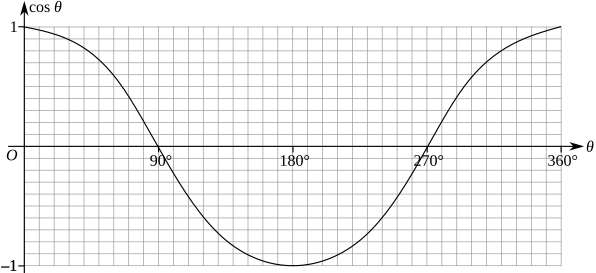
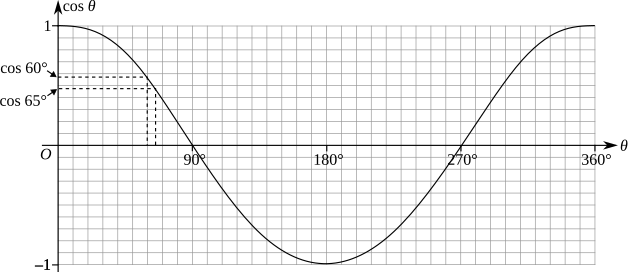
a.
\(\text{Draw a horizontal line on graph from}\ \ \cos\,\theta=0.3:\)
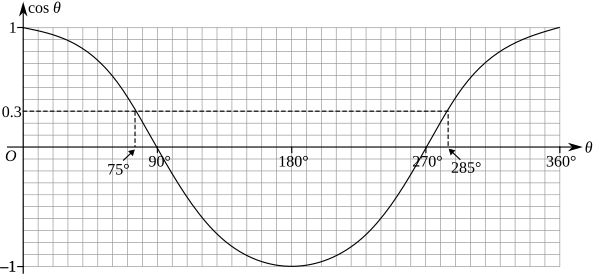
\(\theta \approx 75^{\circ}, 285^{\circ}\)
b. \(\cos\,300^{\circ}\ \text{is in the 4th quadrant.}\)
\(\text{Reference angle:}\ \theta=360-300=60^{\circ}\)
\(\Rightarrow \ \cos\,300^{\circ} = \cos\,60^{\circ} \)
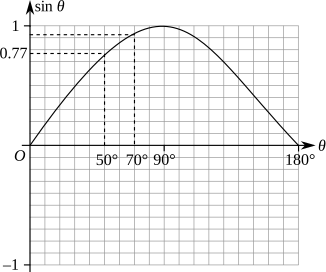
\(\sin\,50^{\circ} = \cos(90-50)^{\circ} = \cos\,40^{\circ}\)
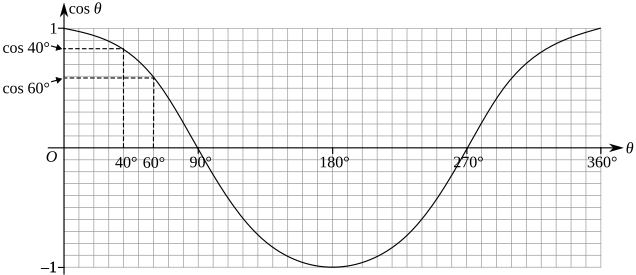
\(\text{Graphically, it can be seen that}\ \ \cos 60^{\circ} \lt \cos\,40^{\circ}\)
\(\Rightarrow\ \cos 300^{\circ} \lt \sin\,50^{\circ}\)
\(\therefore \ \text{Statement is not correct.}\)
a. \(\text{Draw a horizontal line on graph from}\ \ \cos\,\theta=0.3:\)
\(\theta \approx 75^{\circ}, 285^{\circ}\)
b. \(\cos\,300^{\circ}\ \text{is in the 4th quadrant.}\)
\(\text{Reference angle:}\ \theta=360-300=60^{\circ}\)
\(\Rightarrow \ \cos\,300^{\circ} = \cos\,60^{\circ} \)
\(\sin\,50^{\circ} = \cos(90-50)^{\circ} = \cos\,40^{\circ}\)
\(\text{Graphically, it can be seen that}\ \ \cos 60^{\circ} \lt \cos\,40^{\circ}\)
\(\Rightarrow\ \cos 300^{\circ} \lt \sin\,50^{\circ}\)
\(\therefore \ \text{Statement is not correct.}\)
--- 2 WORK AREA LINES (style=lined) ---
--- 4 WORK AREA LINES (style=lined) ---
a. \(\text{Drawing a horizontal line from 0.4 on the \(y\)-axis:}\)
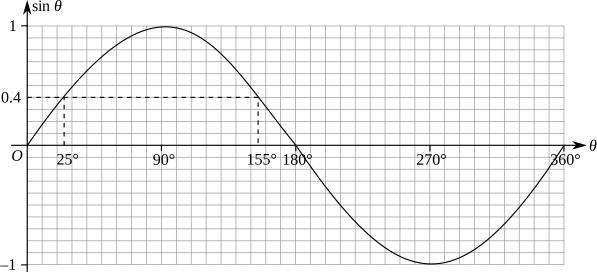
\(\therefore \theta \approx 25^{\circ}, 155^{\circ}\)
b. \(\text{Drawing a horizontal line from –0.6 on the \(y\)-axis:}\)
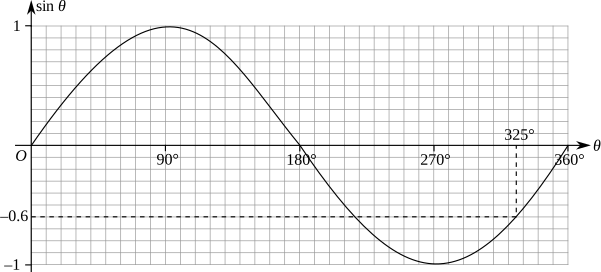
\(\therefore \theta \approx 325^{\circ}\)
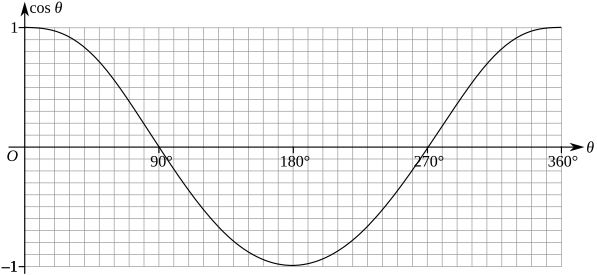
a. \(\text{Drawing a horizontal line from 0.4 on the \(y\)-axis:}\)
\(\therefore \theta \approx 25^{\circ}, 155^{\circ}\)
b. \(\text{Drawing a horizontal line from –0.6 on the \(y\)-axis:}\)
\(\therefore \theta \approx 325^{\circ}\)
--- 2 WORK AREA LINES (style=lined) ---
--- 4 WORK AREA LINES (style=lined) ---
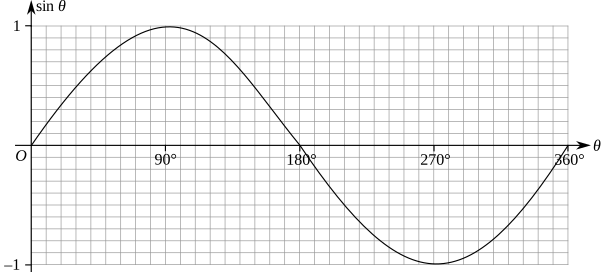
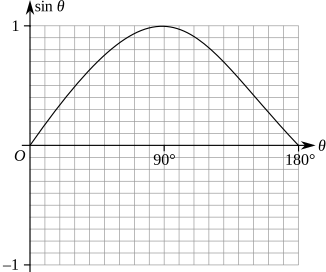
a. \(\theta \approx 125^{\circ}, 235^{\circ}\)
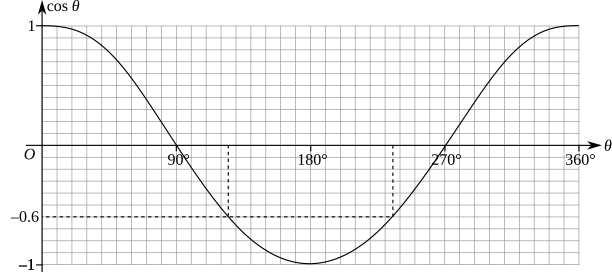
b. \(\sin\,155^{\circ}\ \text{is in the 2nd quadrant.}\)
\(\text{Reference angle:}\ \theta=180-155=25^{\circ}\)
\(\sin\,25^{\circ} =\cos(90-25)^{\circ}=\cos\,65^{\circ}\)
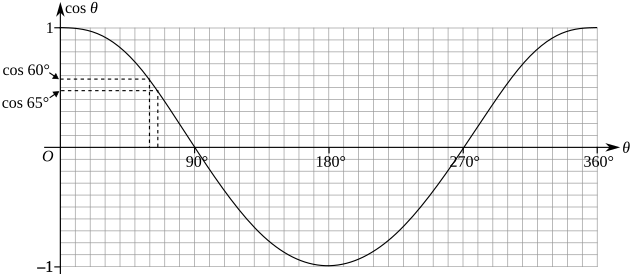
\(\text{Graphically, it is shown}\ \ \cos 60^{\circ} \lt \sin 155^{\circ} (\cos\,65^{\circ})\)
\(\therefore \ \text{Statement is not correct.}\)
a. \(\theta \approx 125^{\circ}, 235^{\circ}\)
b. \(\sin\,155^{\circ}\ \text{is in the 2nd quadrant.}\)
\(\text{Reference angle:}\ \theta=180-155=25^{\circ}\)
\(\sin\,25^{\circ} =\cos(90-25)^{\circ}=\cos\,65^{\circ}\)
\(\text{Graphically, it is shown}\ \ \cos 60^{\circ} \gt \sin 155^{\circ} (\cos\,65^{\circ})\)
\(\therefore \ \text{Statement is correct.}\)
--- 2 WORK AREA LINES (style=lined) ---
--- 4 WORK AREA LINES (style=lined) ---
Solve the equation \(\sin\left(\dfrac{x}{2}\right) = -\dfrac{1}{2}\) for \(360^{\circ} \leq x \leq 720^{\circ}\) (2 marks)
\(x =420^{\circ}, 660^{\circ}\)
\(\sin\left(\dfrac{x}{2}\right) = -\dfrac{1}{2}\)
\(\text{Reference angle:}\ \sin\,30^{\circ}=\dfrac{1}{2}\)
\(\text{Since sin is negative in 3rd/4th quarter:}\)
| \(\dfrac{x}{2}\) | \(=180+30, 360-30, 360+180+30,\ …\) |
| \(=210^{\circ}, 330^{\circ}, 390^{\circ},\ …\) | |
| \(x\) | \(=420^{\circ}, 660^{\circ}, 780^{\circ},\ …\) |
\(\text{Given}\ \ 360^{\circ} \leq x \leq 720^{\circ}:\)
\(\therefore x =420^{\circ}, 660^{\circ}\)
Solve \(\sin\left(\dfrac{x}{2}\right)= \dfrac{1}{2}\) for \(0^{\circ} \leq x \leq 360^{\circ}\). (2 marks)
\(x = 60^{\circ}, 300^{\circ}\)
\(\sin\left(\dfrac{x}{2}\right)= \dfrac{1}{2}\ \ \text{for}\ \ 0^{\circ} \leq x \leq 360^{\circ}\)
\(\Rightarrow\ \text{Reference angle}\ = 30^{\circ}\)
| \(\dfrac{x}{2}\) | \(= 30^{\circ}, 180-30, 360+30, …\) |
| \(=30^{\circ}, 150^{\circ}, 390^{\circ},\ …\) |
\(\therefore x = 60^{\circ}, 300^{\circ}\ \ \text{for}\ \ 0^{\circ} \leq x \leq 360^{\circ}\)
Find the exact values of \(x\) such that \(2\sin\,x =-\sqrt{3}\), where \(0^{\circ} \leq x \leq 360^{\circ}\). (2 marks)
--- 5 WORK AREA LINES (style=lined) ---
\(240^{\circ}, 300^{\circ}\)
| \(2\sin\,x\) | \(=-\sqrt{3}\ \ \text{where}\ \ 0^{\circ} \leq x \leq 360^{\circ}\) |
| \(\sin\,x\) | \(= -\dfrac{\sqrt{3}}{2}\) |
| \(\sin\,60^{\circ}\) | \(= \dfrac{\sqrt{3}}{2}\) |
\(\text{Since}\ \sin\,x\ \text{is negative in 3rd/4th quadrants:}\)
| \(x\) | \(= 180+60,\ 360-60\) |
| \(= 240^{\circ}, 300^{\circ}\) |
Complete the table of exact values. (3 marks)
--- 0 WORK AREA LINES (style=lined) ---
\begin{array}{|c|c|c|c|c|c|}
\hline
\rule{0pt}{2.5ex} \theta \rule[-1ex]{0pt}{0pt}& \ \ 0^{\circ} \ \ & 30^{\circ} & 45^{\circ} & 60^{\circ} & \ 90^{\circ} \ \\
\hline
\rule{0pt}{3.5ex} \sin \theta \rule[-3ex]{0pt}{0pt}& \quad & \dfrac{1}{2} & \dfrac{1}{\sqrt{2}} & \quad & 1 \\
\hline
\rule{0pt}{4ex} \cos \theta \rule[-2.5ex]{0pt}{0pt}& 1 & \dfrac{\sqrt{3}}{2} & \quad & \quad & 0 \\
\hline
\rule{0pt}{3.5ex} \tan \theta \rule[-3ex]{0pt}{0pt}& 0 & \quad & \quad & \dfrac{1}{\sqrt{3}} & \infty \\
\hline
\end{array}
\begin{array}{|c|c|c|c|c|c|}
\hline
\rule{0pt}{2.5ex} \theta \rule[-1ex]{0pt}{0pt}& \ \ 0^{\circ} \ \ & 30^{\circ} & 45^{\circ} & 60^{\circ} & \ 90^{\circ} \ \\
\hline
\rule{0pt}{3.5ex} \sin \theta \rule[-3ex]{0pt}{0pt}& 0 & \dfrac{1}{2} & \dfrac{1}{\sqrt{2}} & \dfrac{\sqrt{3}}{2} & 1 \\
\hline
\rule{0pt}{4ex} \cos \theta \rule[-2.5ex]{0pt}{0pt}& 1 & \dfrac{\sqrt{3}}{2} & \dfrac{1}{\sqrt{2}} & \dfrac{1}{2} & 0 \\
\hline
\rule{0pt}{3.5ex} \tan \theta \rule[-3ex]{0pt}{0pt}& 0 & \dfrac{1}{\sqrt{3}} & 1 & \sqrt{3} & \infty \\
\hline
\end{array}
\begin{array}{|c|c|c|c|c|c|}
\hline
\rule{0pt}{2.5ex} \theta \rule[-1ex]{0pt}{0pt}& \ \ 0^{\circ} \ \ & 30^{\circ} & 45^{\circ} & 60^{\circ} & \ 90^{\circ} \ \\
\hline
\rule{0pt}{3.5ex} \sin \theta \rule[-3ex]{0pt}{0pt}& 0 & \dfrac{1}{2} & \dfrac{1}{\sqrt{2}} & \dfrac{\sqrt{3}}{2} & 1 \\
\hline
\rule{0pt}{4ex} \cos \theta \rule[-2.5ex]{0pt}{0pt}& 1 & \dfrac{\sqrt{3}}{2} & \dfrac{1}{\sqrt{2}} & \dfrac{1}{2} & 0 \\
\hline
\rule{0pt}{3.5ex} \tan \theta \rule[-3ex]{0pt}{0pt}& 0 & \dfrac{1}{\sqrt{3}} & 1 & \sqrt{3} & \infty \\
\hline
\end{array}
Complete the table of exact values. (3 marks)
--- 0 WORK AREA LINES (style=lined) ---
\begin{array}{|c|c|c|c|c|c|}
\hline
\rule{0pt}{2.5ex} \theta \rule[-1ex]{0pt}{0pt}& \ \ 0^{\circ} \ \ & 30^{\circ} & 45^{\circ} & 60^{\circ} & \ 90^{\circ} \ \\
\hline
\rule{0pt}{3.5ex} \sin \theta \rule[-3ex]{0pt}{0pt}& 0 & \quad & \quad & \dfrac{\sqrt{3}}{2} & 1 \\
\hline
\rule{0pt}{4ex} \cos \theta \rule[-2.5ex]{0pt}{0pt}& \quad & \quad & \dfrac{1}{\sqrt{2}} & \dfrac{1}{2} & 0 \\
\hline
\rule{0pt}{3.5ex} \tan \theta \rule[-3ex]{0pt}{0pt}& \quad & \dfrac{1}{\sqrt{3}} & 1 & \quad & \infty \\
\hline
\end{array}
\begin{array}{|c|c|c|c|c|c|}
\hline
\rule{0pt}{2.5ex} \theta \rule[-1ex]{0pt}{0pt}& \ \ 0^{\circ} \ \ & 30^{\circ} & 45^{\circ} & 60^{\circ} & \ 90^{\circ} \ \\
\hline
\rule{0pt}{3.5ex} \sin \theta \rule[-3ex]{0pt}{0pt}& 0 & \dfrac{1}{2} & \dfrac{1}{\sqrt{2}} & \dfrac{\sqrt{3}}{2} & 1 \\
\hline
\rule{0pt}{4ex} \cos \theta \rule[-2.5ex]{0pt}{0pt}& 1 & \dfrac{\sqrt{3}}{2} & \dfrac{1}{\sqrt{2}} & \dfrac{1}{2} & 0 \\
\hline
\rule{0pt}{3.5ex} \tan \theta \rule[-3ex]{0pt}{0pt}& 0 & \dfrac{1}{\sqrt{3}} & 1 & \sqrt{3} & \infty \\
\hline
\end{array}
\begin{array}{|c|c|c|c|c|c|}
\hline
\rule{0pt}{2.5ex} \theta \rule[-1ex]{0pt}{0pt}& \ \ 0^{\circ} \ \ & 30^{\circ} & 45^{\circ} & 60^{\circ} & \ 90^{\circ} \ \\
\hline
\rule{0pt}{3.5ex} \sin \theta \rule[-3ex]{0pt}{0pt}& 0 & \dfrac{1}{2} & \dfrac{1}{\sqrt{2}} & \dfrac{\sqrt{3}}{2} & 1 \\
\hline
\rule{0pt}{4ex} \cos \theta \rule[-2.5ex]{0pt}{0pt}& 1 & \dfrac{\sqrt{3}}{2} & \dfrac{1}{\sqrt{2}} & \dfrac{1}{2} & 0 \\
\hline
\rule{0pt}{3.5ex} \tan \theta \rule[-3ex]{0pt}{0pt}& 0 & \dfrac{1}{\sqrt{3}} & 1 & \sqrt{3} & \infty \\
\hline
\end{array}
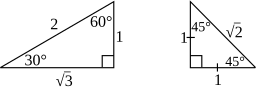
Using the right-angled triangles above, or otherwise, complete the table below. (3 marks)
--- 0 WORK AREA LINES (style=lined) ---
\begin{array}{|c|c|c|c|c|c|}
\hline
\rule{0pt}{2.5ex} \theta \rule[-1ex]{0pt}{0pt}& \ 30^{\circ} \ & \ 45^{\circ} \ & \ 60^{\circ}\ \\
\hline
\rule{0pt}{4.5ex} \sin \theta \rule[-3ex]{0pt}{0pt}& \dfrac{1}{2} & \dfrac{1}{\sqrt{2}} &\quad\\
\hline
\rule{0pt}{4.5ex} \cos \theta \rule[-3ex]{0pt}{0pt}& \dfrac{\sqrt{3}}{2}& \quad & \quad \\
\hline
\rule{0pt}{3.5ex} \tan \theta \rule[-2.5ex]{0pt}{0pt}& \quad & 1 & \sqrt{3} \\
\hline
\end{array}
\begin{array}{|c|c|c|c|c|c|}
\hline
\rule{0pt}{2.5ex} \theta \rule[-1ex]{0pt}{0pt}& \ 30^{\circ} \ & \ 45^{\circ} \ & \ 60^{\circ}\ \\
\hline
\rule{0pt}{4.5ex} \sin \theta \rule[-3ex]{0pt}{0pt}& \dfrac{1}{2} & \dfrac{1}{\sqrt{2}} & \dfrac{\sqrt{3}}{2} \\
\hline
\rule{0pt}{4.5ex} \cos \theta \rule[-3ex]{0pt}{0pt}& \dfrac{\sqrt{3}}{2} & \dfrac{1}{\sqrt{2}} & \dfrac{1}{2} \\
\hline
\rule{0pt}{3.5ex} \tan \theta \rule[-3ex]{0pt}{0pt}& \dfrac{1}{\sqrt{3}} & 1 & \sqrt{3} \\
\hline
\end{array}
\begin{array}{|c|c|c|c|c|c|}
\hline
\rule{0pt}{2.5ex} \theta \rule[-1ex]{0pt}{0pt}& \ 30^{\circ} \ & \ 45^{\circ} \ & \ 60^{\circ}\ \\
\hline
\rule{0pt}{4.5ex} \sin \theta \rule[-3ex]{0pt}{0pt}& \dfrac{1}{2} & \dfrac{1}{\sqrt{2}} & \dfrac{\sqrt{3}}{2} \\
\hline
\rule{0pt}{4.5ex} \cos \theta \rule[-3ex]{0pt}{0pt}& \dfrac{\sqrt{3}}{2} & \dfrac{1}{\sqrt{2}} & \dfrac{1}{2} \\
\hline
\rule{0pt}{3.5ex} \tan \theta \rule[-3ex]{0pt}{0pt}& \dfrac{1}{\sqrt{3}} & 1 & \sqrt{3} \\
\hline
\end{array}
Using the right-angled triangles above, or otherwise, complete the table below. (3 marks) --- 0 WORK AREA LINES (style=lined) ---
\begin{array}{|c|c|c|c|c|c|}
\hline
\rule{0pt}{2.5ex} \theta \rule[-1ex]{0pt}{0pt}& \ 30^{\circ} \ & \ 45^{\circ} \ & \ 60^{\circ}\ \\
\hline
\rule{0pt}{4.5ex} \sin \theta \rule[-3ex]{0pt}{0pt}& \quad & \quad &\quad\\
\hline
\rule{0pt}{4.5ex} \cos \theta \rule[-3ex]{0pt}{0pt}& \quad & \dfrac{1}{\sqrt{2}} & \dfrac{1}{2} \\
\hline
\rule{0pt}{3.5ex} \tan \theta \rule[-3ex]{0pt}{0pt}& \dfrac{1}{\sqrt{3}} & 1 & \quad \\
\hline
\end{array}
\begin{array}{|c|c|c|c|c|c|}
\hline
\rule{0pt}{2.5ex} \theta \rule[-1ex]{0pt}{0pt}& \ 30^{\circ} \ & \ 45^{\circ} \ & \ 60^{\circ}\ \\
\hline
\rule{0pt}{4.5ex} \sin \theta \rule[-3ex]{0pt}{0pt}& \dfrac{1}{2} & \dfrac{1}{\sqrt{2}} & \dfrac{\sqrt{3}}{2} \\
\hline
\rule{0pt}{4.5ex} \cos \theta \rule[-3ex]{0pt}{0pt}& \dfrac{\sqrt{3}}{2} & \dfrac{1}{\sqrt{2}} & \dfrac{1}{2} \\
\hline
\rule{0pt}{3.5ex} \tan \theta \rule[-3ex]{0pt}{0pt}& \dfrac{1}{\sqrt{3}} & 1 & \sqrt{3} \\
\hline
\end{array}
\begin{array}{|c|c|c|c|c|c|}
\hline
\rule{0pt}{2.5ex} \theta \rule[-1ex]{0pt}{0pt}& \ 30^{\circ} \ & \ 45^{\circ} \ & \ 60^{\circ}\ \\
\hline
\rule{0pt}{4.5ex} \sin \theta \rule[-3ex]{0pt}{0pt}& \dfrac{1}{2} & \dfrac{1}{\sqrt{2}} & \dfrac{\sqrt{3}}{2} \\
\hline
\rule{0pt}{4.5ex} \cos \theta \rule[-3ex]{0pt}{0pt}& \dfrac{\sqrt{3}}{2} & \dfrac{1}{\sqrt{2}} & \dfrac{1}{2} \\
\hline
\rule{0pt}{3.5ex} \tan \theta \rule[-3ex]{0pt}{0pt}& \dfrac{1}{\sqrt{3}} & 1 & \sqrt{3} \\
\hline
\end{array}
Find the exact value of
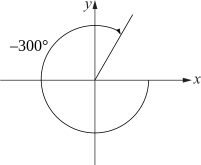
\(\sin(-300^{\circ})\). (2 marks)
--- 5 WORK AREA LINES (style=lined) ---
\(\dfrac{\sqrt{3}}{2}\)
\(\sin(-300^{\circ})= \sin\,60^{\circ}\)
\(\text{Reference angle:}\ 60^{\circ}\)
\(\text{Since sin is positive in 1st quadrant:}\)
\(\sin(-300^{\circ})= \sin\,60^{\circ}=\dfrac{\sqrt{3}}{2}\)
Find the exact value of
\(\sin(-210^{\circ})\). (2 marks)
--- 5 WORK AREA LINES (style=lined) ---
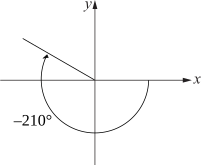
\(\dfrac{1}{2}\)
\(\sin(-210^{\circ})= \sin\,150^{\circ}\)
\(\text{Reference angle:}\ 180-150=30^{\circ}\)
\(\text{Since sin is positive in 2nd quadrant:}\)
\(\sin(-210^{\circ})= \sin\,30^{\circ}=\dfrac{1}{2}\)
Find the exact value of
\(\cos(-240^{\circ})\). (2 marks)
--- 5 WORK AREA LINES (style=lined) ---
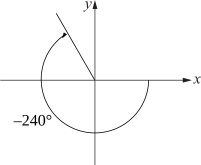
\(-\dfrac{1}{2}\)
\(\cos(-240^{\circ})= \cos\,120^{\circ}\)
\(\text{Reference angle:}\ 180-120=60^{\circ}\)
\(\text{Since cos is negative in 2nd quadrant:}\)
\(\cos(-240^{\circ})= -\cos\,60^{\circ}=-\dfrac{1}{2}\)
Find the exact value of
\(\tan(-150^{\circ})\). (2 marks)
--- 5 WORK AREA LINES (style=lined) ---
\(\dfrac{1}{\sqrt{3}}\)
Find the solutions of \(2\sin\,\theta = 1\) for \(0^{\circ} \leq \theta \leq 360^{\circ}\). (2 marks)
--- 4 WORK AREA LINES (style=lined) ---
\(30^{\circ}, 150^{\circ}\)
\(2\sin\,\theta=1\ \ \Rightarrow\ \ \sin\,\theta=\dfrac{1}{2}\)
\(\text{Reference angle:}\ \sin\,30^{\circ}=\dfrac{1}{2}\)
\(\text{Since sin is positive in the 1st/2nd quadrants:}\)
| \(\therefore\ \theta\) | \(= 30^{\circ}, 180-30^{\circ}\) |
| \(= 30^{\circ}, 150^{\circ}\) |
Find the exact value of \(\theta\) such that \(2\cos\,\theta = 1\), where \(0^{\circ} \leq \theta \leq 90^{\circ}\). (2 marks)
\(\theta = 60^{\circ}\)
| \(2 \cos\,\theta\) | \(= 1\) |
| \(\cos\,\theta\) | \(= \dfrac{1}{2}\) |
| \(\therefore \theta\) | \(= 60^{\circ},\ \ \ \ 0^{\circ} \leq \theta \leq 90^{\circ}\) |
Solve \(\sqrt{2}\,\sin\,x = 1\) for \(0^{\circ} \leq x \leq 360^{\circ}.\) (2 marks)
\(45^{\circ}, 135^{\circ}\)
\(\sqrt{2}\,\sin\,x = 1\ \ \Rightarrow \ \ \sin\,x= \dfrac{1}{\sqrt{2}} \)
\(\text{Reference angle:}\ \sin\,45^{\circ} = \dfrac{1}{\sqrt{2}}\)
\(\text{Since sin is positive in 1st/2nd quadrants:}\)
| \(\therefore x\) | \(= 45^{\circ}, (180-45)^{\circ}\) |
| \(= 45^{\circ}, 135^{\circ}\) |
Solve \(\cos\,\theta = \dfrac{1}{\sqrt{2}}\) for \(0^{\circ} ≤ \theta ≤ 360^{\circ}\). (2 marks)
\(45^{\circ}, 315^{\circ}`
\(\cos\,\theta = \dfrac{1}{\sqrt{2}}\) for \(0^{\circ} ≤ \theta ≤ 360^{\circ}\)
\(\text{Reference angle:}\ \cos\,45^{\circ} = \dfrac{1}{\sqrt{2}}\)
\(\text{Since cos is positive in 1st/4th quadrants:}\)
| \(\theta\) | \(= 45^{\circ}, 360-45` |
| \(= 45^{\circ}, 315^{\circ}\) |
Determine the number of values of \(\theta\) in the range \(0^{\circ} \leqslant \theta \leqslant 360^{\circ}\) that satisfy the equation
\((\tan \theta-\sqrt{3})(\cos^{2}\theta-1)=0 \)
\(C\)
\(\tan \theta = \sqrt{3}\ \rightarrow \text{2 solutions} \)
| \(\cos^{2}\theta\) | \(=1\) | |
| \(\cos\theta\) | \(= \pm 1\) | |
| \(\theta\) | \(=0^{\circ}, 180^{\circ}, 360^{\circ}\ \rightarrow \text{3 solutions} \) |
\(\Rightarrow C\)
What are the solutions of `sqrt3 tanx = -1` for `0^@<=x<=360^@`?
`D`
| `sqrt3 tanx` | `= -1` |
| `tanx` | `= -1/sqrt3` |
`text(When)\ tanx = 1/sqrt3,\ \ x=30^@`
`text(S)text(ince)\ tanx\ text{is negative in 2nd/4th quadrant:}`
| `:. x` | ` = 180-30,360-30` |
| `= 150^@,\ 330^@` |
`=> D`
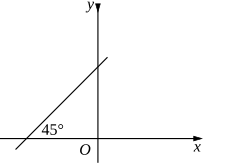
The diagram shows the line \(\ell\).
What is the slope of the line \(\ell\) ?
\(C\)
\(\text{Gradient is positive (slopes from bottom left to top right).}\)
\(\tan\,45^{\circ} = 1\)
\(\therefore\ \text{Gradient is 1}\)
\(\Rightarrow C\)
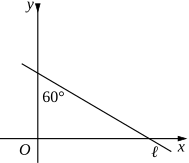
The diagram shows the line \(\ell\).
What is the slope of the line \(\ell\) ?
\(D\)
\(\text{Gradient is negative (slopes from top left to bottom right).}\)
\(\text{The line cuts the \(x\)-axis at an acute angle =}\ 90-60=30^{\circ}\)
\(\tan\,30^{\circ} = \dfrac{1}{\sqrt3}\)
\(\therefore\ \text{Gradient is}\ -\dfrac{1}{\sqrt3}\)
\(\Rightarrow D\)
In which quadrant does \(\theta\) lie, given the following information:
\(\tan \theta \lt 0,\ \ \cos \theta \lt 0\)
\(B\)
\(\tan \theta \lt 0\ \ \Rightarrow\ \ \text{2nd/4th quadrants}\)
\(\cos \theta \lt 0\ \ \Rightarrow\ \ \text{2nd/3rd quadrants}\)
\(\theta\ \text{must be in the 2nd quadrant}\)
\(\Rightarrow B\)
In which quadrant does \(\theta\) lie, given the following information:
\(\sin \theta \lt 0,\ \ \cos \theta \gt 0\)
\(D\)
\(\sin \theta \lt 0\ \ \Rightarrow\ \ \text{3rd/4th quadrants}\)
\(\cos \theta \gt 0\ \ \Rightarrow\ \ \text{1st/4th quadrants}\)
\(\theta\ \text{must be in the 4th quadrant}\)
\(\Rightarrow D\)
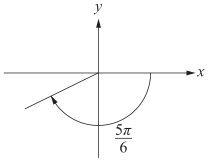
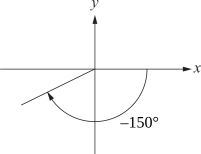
In which quadrant does \(\theta\) lie, given \(\theta = -215^{\circ}\)
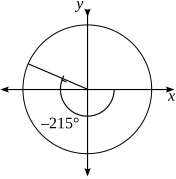
\(B\)
\(\text{2nd quadrant}\)
\(\Rightarrow B\)
In which quadrant does \(\theta\) lie, given \(\theta = -125^{\circ}\)
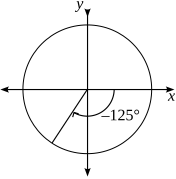
\(C\)
\(\text{3rd quadrant}\)
\(\Rightarrow C\)
Express each of the following in terms of its reference angle \(\theta\), where \(0^{\circ} \leq \theta \leq 90^{\circ}\).
--- 2 WORK AREA LINES (style=lined) ---
a. \(-\tan 5^{\circ}\)
b. \(-\cos 82^{\circ}\)
a. \(175^{\circ}\ \ \Rightarrow\ \ \text{2nd quadrant (sin +ve/cos –ve)} \)
\(\text{Reference angle:}\ 180-175=5^{\circ}\)
\(\tan 175^{\circ} = \dfrac{\sin 5^{\circ}}{-\cos 5^{\circ}} = -\tan 5^{\circ}\)
b. \(262^{\circ}\ \ \Rightarrow\ \ \text{3rd quadrant (cos –ve)} \)
\(\text{Reference angle:}\ \ 180+\theta=262^{\circ}\ \ \Rightarrow\ \ \theta=82^{\circ}\)
\(\cos 262^{\circ} = -\cos 82^{\circ}\)
Express each of the following in terms of its reference angle \(\theta\), where \(0^{\circ} \leq \theta \leq 90^{\circ}\).
--- 2 WORK AREA LINES (style=lined) ---
a. \(-\cos 40^{\circ}\)
b. \(-\tan 15^{\circ}\)
a. \(140^{\circ}\ \ \Rightarrow\ \ \text{2nd quadrant (cos –ve)} \)
\(\text{Reference angle:}\ \ 180-140=40^{\circ}\)
\(\cos 140^{\circ} = -\cos 40^{\circ}\)
b. \(345^{\circ}\ \ \Rightarrow\ \ \text{4th quadrant (sin –ve/cos +ve)} \)
\(\text{Reference angle:}\ 360-345=15^{\circ}\ \ \Rightarrow \ \theta=15^{\circ}\)
\(\tan 345^{\circ} = \dfrac{-\sin 15^{\circ}}{\cos 15^{\circ}} = -\tan 15^{\circ}\)