SmarterEd

Aussie Maths & Science Teachers: Save your time with SmarterEd

  • Login
  • Get Help
  • About

Functions, EXT1 F1 2025 HSC 11a

Find the inverse function, \(f^{-1}(x)\), of the function  \(f(x)=1-\dfrac{1}{x-2}\).   (2 marks)

--- 5 WORK AREA LINES (style=lined) ---

Show Answers Only

\(f^{-1} (x) = 2 + \dfrac{1}{1-x}\)

Show Worked Solution

\(y=1-\dfrac{1}{x-2}\)

\(\text{Inverse: swap}\ x ↔ y\)

\(x\) \(=1-\dfrac{1}{y-2}\)  
\(\dfrac{1}{y-2}\) \(=1-x\)  
\(y-2\) \(=\dfrac{1}{1-x}\)  
\(y\) \(=2+\dfrac{1}{1-x}\)  

Filed Under: Inverse Functions, Inverse Functions Tagged With: Band 3, smc-1034-20-Other Functions, smc-6641-20-Other Functions

Functions, EXT1 F1 EQ-Bank 24

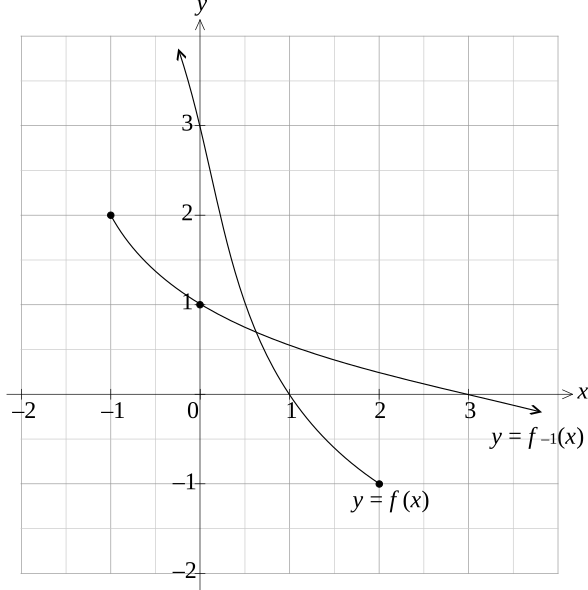
Let  \(f(x)=x^2-4 x+3\)  for  \(x \leqslant 2\).

  1. State the domain of  \(y=f^{-1}(x)\).   (1 mark)

    --- 2 WORK AREA LINES (style=lined) ---

  2. What is the equation of  \(y=f^{-1}(x)\) ?   (3 marks)

    --- 5 WORK AREA LINES (style=lined) ---

  3. For the restricted domain, sketch the function and the inverse function on the same number plane below.
  4. Clearly identify all axis intercepts.   (2 marks)

    --- 0 WORK AREA LINES (style=blank) ---

Show Answers Only

a.   \(f(x)=(x-1)(x-3)\ \Rightarrow \ \text{Axis of symmetry at}\ \ x=2. \)

\(f(2)=-1\)

\(\text{Range}\ f(x): \  y \geqslant -1\ \Rightarrow \ \text{Domain}\ f^{-1}(x): \  x \geqslant -1 \)
 

b.   \(y=2-\sqrt{x+1}\)

c.   \(f(x)\ \text{intercepts:}\ (1,0), (0,3) \)

\(f^{-1}(x)\ \text{intercepts:}\ (3,0), (0,1) \)

Show Worked Solution

a.   \(f(x)=(x-1)(x-3)\ \Rightarrow \ \text{Axis of symmetry at}\ \ x=2. \)

\(f(2)=-1\)

\(\text{Range}\ f(x): \  y \geqslant -1\ \Rightarrow \ \text{Domain}\ f^{-1}(x): \  x \geqslant -1 \)
 

b.   \(\text{Inverse: swap}\ x ↔ y \)

\(x\) \(=y^2-4y+3\)  
\(x\) \(=(y-2)^2-1\)  
\(x+1\) \(=(y-2)^2\)  
\(y-2\) \(=\pm \sqrt{x+1} \)  
\(y\) \(=2 \pm \sqrt{x+1} \)  
\(y\) \(=2-\sqrt{x+1}\ \ \ \ (\text{Range}\ f^{-1}(x): \ y \leqslant 2) \)  

 
c.   \(f(x)\ \text{intercepts:}\ (1,0), (0,3) \)

\(f^{-1}(x)\ \text{intercepts:}\ (3,0), (0,1) \)

Filed Under: Inverse Functions, Inverse Functions Tagged With: Band 4, Band 5, smc-1034-20-Other Functions, smc-6641-20-Other Functions

Functions, EXT1 F1 EQ-Bank 18

If  \(f(x)=\dfrac{4-e^{5 x}}{3}\),  find the inverse function  \(f^{-1}(x)\).   (2 marks)

--- 7 WORK AREA LINES (style=lined) ---

Show Answers Only

\(f^{-1}=\dfrac{1}{5} \ln \abs{4-3x}\)

Show Worked Solution

\(f(x) = \dfrac{4-e^{5x}}{3}\)

\(\text{Inverse: swap}\ \ x↔y\)

\(x\) \(=\dfrac{4-e^{5x}}{3} \)  
\(3x\) \(=4-e^{5y}\)  
\(e^{5y}\) \(=4-3x\)  
\(\ln e^{5y}\) \(=\ln \abs{4-3x}\)  
\(5y\) \(=\ln \abs{4-3x}\)  
\(y\) \(=\dfrac{1}{5} \ln \abs{4-3x}\)  

Filed Under: Inverse Functions, Inverse Functions Tagged With: Band 4, smc-1034-10-Logs and Exponentials, smc-6641-10-Logs and Exponentials

Functions, EXT1 F1 2023 MET1 7

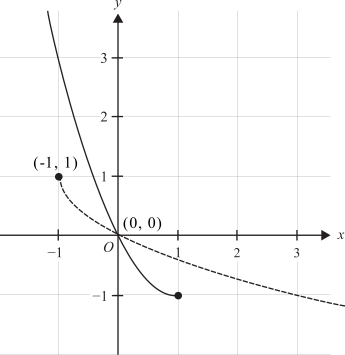
Consider \(f:(-\infty, 1]\rightarrow R, f(x)=x^2-2x\). Part of the graph of  \(y=f(x)\)  is shown below.
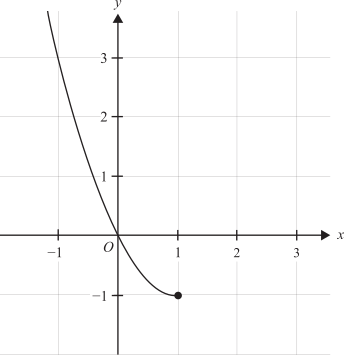
 

  1. State the range of \(f(x)\).   (1 mark)

    --- 2 WORK AREA LINES (style=lined) ---

  2. Sketch the graph of the inverse function  \(y=f^{-1}(x)\) on the axes above. Label any endpoints and axial intercepts with their coordinates.   (2 marks)

    --- 0 WORK AREA LINES (style=lined) ---

  3. Determine the equation of the domain for the inverse function  \(f^{-1}(x)\).   (2 marks)

    --- 3 WORK AREA LINES (style=lined) ---

Show Answers Only

a.    \([-1, \infty)\)

b.   

c.    \(f^{-1}(x)=1-\sqrt{x+1}\)

\(\text{Domain}\ [-1, \infty)\)

Show Worked Solution

a.    \([-1, \infty)\)

b.   

c.    \(\text{When }f(x)\ \text{is written in turning point form}\)

\(y=(x-1)^2-1\)
 

\(\text{Inverse function: swap}\ x \leftrightarrow y\)

\(x\) \(=(y-1)^2-1\)
\(x+1\) \(=(y-1)^2\)
\(-\sqrt{x+1}\) \(=y-1\)
\(f^{-1}(x)\) \(=1-\sqrt{x+1}\)

 
\(\text{Domain:}\ [-1, \infty)\)


♦ Mean mark (c) 48%.
MARKER’S COMMENT: Common error → writing the function as \(f^{-1}(x)=1+\sqrt{x+1}\).

Filed Under: Inverse Functions, Inverse Functions Tagged With: Band 3, Band 4, Band 5, smc-1034-20-Other Functions, smc-6641-20-Other Functions

Functions, EXT1 F1 2023 HSC 9 MC

The graph of a cubic function, \(y=f(x)\), is given below.
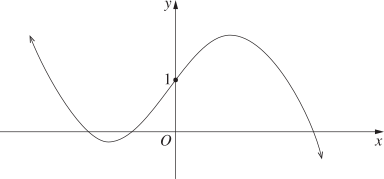
 

Which of the following functions has an inverse relation whose graph has more than 3 points with an \(x\)-coordinate of 1 ?

  1. \(y=\sqrt{f(x)}\)
  2. \(y=\dfrac{1}{f(x)}\)
  3. \(y=f(|x|)\)
  4. \(y=|f(x)|\)
Show Answers Only

\(D\)

Show Worked Solution

\(\text{An inverse function with more than 3 points when}\ \ x=1\ \ \text{is the same}\)

\(\text{as the original function intersecting}\ \ y=1\ \ \text{more than 3 times.}\)

\(\text{Consider}\ \ y=|f(x)| : \)

\( y=1\ \ \text{cuts}\ \ y=f(x)\ \text{three times and}\ \ y=|f(x)|\ \ \text{four times} \)

\(\text{as the graph below the x-axis (bottom right) is reflected in the axis.}\)

\(\Rightarrow D\)

♦ Mean mark 47%.

Filed Under: Inverse Functions, Inverse Functions Tagged With: Band 5, smc-1034-20-Other Functions, smc-6641-20-Other Functions

Functions, EXT1 F1 2021 HSC 12d

A function is defined by  `f(x) = 4-(1-x/2)^2`  for `x` in the domain `(-∞, 2]`.

  1. Sketch the graph of  `y = f(x)`  showing the `x`-  and `y`-intercepts.   (2 marks)

    --- 8 WORK AREA LINES (style=lined) ---
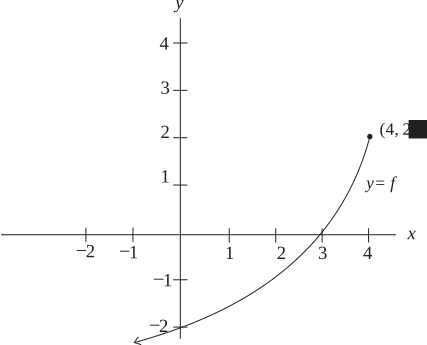
  2. Find the equation of the inverse function, `f^(−1)(x)`, and state its domain.   (3 marks)

    --- 6 WORK AREA LINES (style=lined) ---

  3. Sketch the graph of   `y = f^(-1)(x)`.   (1 mark)

    --- 8 WORK AREA LINES (style=lined) ---

Show Answers Only
  1. `text(See Worked Solutions)`
  2. `f^(-1)(x)=2-2sqrt(4-x)`
  3. `x ∈ (-∞, 4]`
  4.  
     
Show Worked Solution

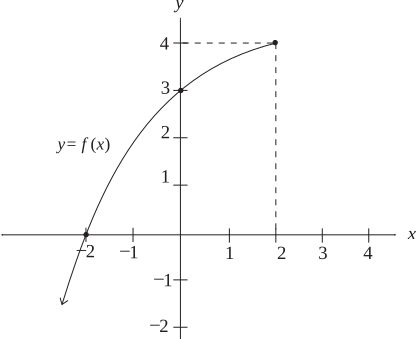
i.   `f(x) = 4-(1-x/2)^2`

`text(At)\ \ x = 2,  f(x) = 4`

`text(At)\ \ x = 0,  f(x) = 3`

`xtext(-intercept:)\ \ 1-x/2 = 2 \ -> \ x = -2`


ii.   `text(Inverse function: swap)\ \ x ↔ y`

`x = 4-(1-y/2)^2`

`(1-y/2)^2` `= 4-x`
`1-y/2` `= ±sqrt(4-x)`
`y/2` `= 1 ± sqrt(4-x)`
`y` `= 2 +- 2sqrt(4-x)`

 
`:. f^(-1)(x)=2-2sqrt(4-x),\ \ \ (y <= 2)`

`text(Domain)\ \ f^(-1)(x)= text(Range)\ f(x)= x ∈ (-∞, 4]`
 

iii.

Filed Under: Inverse Functions, Inverse Functions Tagged With: Band 4, smc-1034-20-Other Functions, smc-6641-20-Other Functions

Functions, EXT1 F1 2020 MET1 6

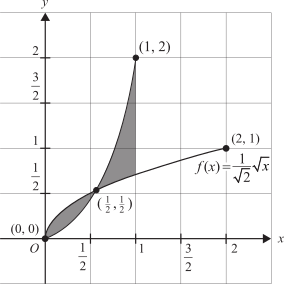
`f(x) = 1/sqrt2 sqrtx`, where `x in [0,2]`

  1. Find `f^(-1)(x)`, and state its domain.   (2 marks)

    --- 4 WORK AREA LINES (style=lined) ---

The graph of  `y = f(x)`, where `x ∈ [0, 2]`, is shown on the axes below.
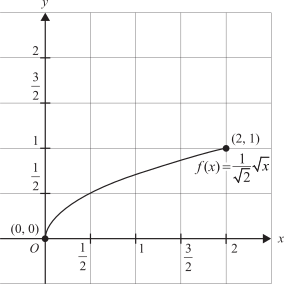


  1. On the axes above, sketch the graph of `f^(-1)(x)` over its domain. Label the endpoints and point(s) of intersection with `f(x)`, giving their coordinates.   (2 marks)

    --- 0 WORK AREA LINES (style=lined) ---

Show Answers Only
  1. `text(Domain) = [0, 1]`


    `f^(-1)(x) = 2x^2`

  2.  
       
Show Worked Solution

a.    `text(Domain)\ \ f^(-1)(x)= text(Range)\ \ f(x)=[0,1]`

`y = 1/sqrt2 x`

`text(Inverse: swap)\ \ x ↔ y`

`x` `= 1/sqrt2 sqrty`  
`sqrty` `= sqrt2 x`  
`y` `= 2x^2`  

 
`:. f^(-1)(x) = 2x^2`


b.     
 

Filed Under: Inverse Functions, Inverse Functions Tagged With: Band 3, Band 4, smc-1034-20-Other Functions, smc-6641-20-Other Functions

Functions, EXT1 F1 2020 HSC 2 MC

Given  `f(x) = 1 + sqrtx`, what are the domain and range of  `f^(−1)(x)`

  1. `x >= 0,\ \ y >= 0`
  2. `x >= 0,\ \ y >= 1`
  3. `x >= 1,\ \ y >= 0`
  4. `x >= 1,\ \ y >= 1`
Show Answers Only

`C`

Show Worked Solution

`text(Domain)\ \ f(x): \ x >= 0`

`text(Range)\ \ f(x): \ y >= 1`

`text(Domain)\ \ f^(−1) = text(Range)\ \ f(x) = x >= 1`

`text(Range)\ \ f^(−1) = text(Range)\ \ f(x) = y >= 0`

`=> C`

Filed Under: Inverse Functions, Inverse Functions Tagged With: Band 4, smc-1034-20-Other Functions, smc-6641-20-Other Functions

Functions, EXT1 F1 2019 MET1-N 5

Let  `h(x) = ( 7)/(x + 2)-3`  for  `x>=0`.

  1.  State the range of `h`.   (1 mark)

    --- 3 WORK AREA LINES (style=lined) ---

  2.  Find the rule for `h^-1`.   (2 marks)

    --- 5 WORK AREA LINES (style=lined) ---

Show Answers Only
  1. `(-3, (1)/(2))`
  2. `(7)/(x + 3)-2`
Show Worked Solution

a.    `y_text(max)\  text(occurs when) \ x = 0`

`y_text(max) = (7)/(2)-3 = (1)/(2)`

`text(As) \ \ x → ∞ , \ (7)/(x + 2) \ → \ 0^+`

`:. \ text(Range) \ \ h(x) = (-3, (1)/(2))`
  

b.    `y = (7)/(x + 2)`

`text(Inverse: swap) \ x ↔ y`

`x` `= (7)/(y + 2)-3`
`x + 3` `= (7)/(y + 2)`
`y + 2` `= (7)/(x + 3)`
`y` `= (7)/(x + 3)-2`

  
`:. \ h^-1 = (7)/(x + 3)-2`

Filed Under: Inverse Functions, Inverse Functions Tagged With: Band 3, smc-1034-20-Other Functions, smc-6641-20-Other Functions

Functions, EXT1 F1 2019 MET2-N 11 MC

The function  `f(x) = 5x^3 + 10x^2 + 1`  will have an inverse function for the domain

  1.  `D = (-2, oo)`
  2.  `D = (-oo , (1)/(2)]`
  3.  `D = (-oo , –1]`
  4.  `D = [0 , oo)`
Show Answers Only

`D`

Show Worked Solution

`y = 5x^3 + 10x^2 + 1`

`y^{′} = 15x^2 + 20x`

`y^{″}=30x+20`

`text(SP’s when)\ \ y^{′}=0\ \ =>\ \ x= – 4/3\ text{(max)}, \ 0\ text{(min)}`

`text(Sketch graph:)`
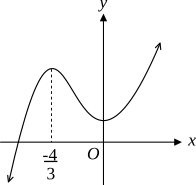
  

`=> \ D`

Filed Under: Inverse Functions, Inverse Functions Tagged With: Band 5, smc-1034-20-Other Functions, smc-1034-40-X-topic Calculus, smc-6641-20-Other Functions, smc-6641-40-X-topic Calculus

Functions, EXT1 F1 2019 MET1 5b

Given the function  `h(x) = sqrt(2x + 3)-2`  for  `h>=-3/2`, find the inverse function  `h^(-1)`  and its domain.   (3 marks)

--- 7 WORK AREA LINES (style=lined) ---

Show Answers Only

`x>=–2  or  [–2, oo)`

Show Worked Solution

 `y = sqrt (2x + 3)-2`

`text(Inverse: swap)\ \ x ↔ y`

`x` `= sqrt(2y + 3)-2`
`sqrt(2y + 3)` `= x + 2`
`2y + 3` `= (x + 2)^2`
`y` `= 1/2(x + 2)^2-3/2`
`:. h^(-1)` `= 1/2(x + 2)^2-3/2`


`text(Domain)\ \ h^(-1)(x)` `= text(Range)\ \ h(x)`
  `= x>=–2  or [–2, oo)`

Filed Under: Inverse Functions, Inverse Functions Tagged With: Band 4, smc-1034-20-Other Functions, smc-6641-20-Other Functions

Functions, EXT1 F1 2019 HSC 10 MC

The function  `f(x) = -sqrt(1 + sqrt(1 + x))`  has inverse `f^(-1) (x)`.

The graph of  `y = f^(-1) (x)`  forms part of the curve  `y = x^4-2x^2`.

The diagram shows the curve  `y = x^4-2x^2`.
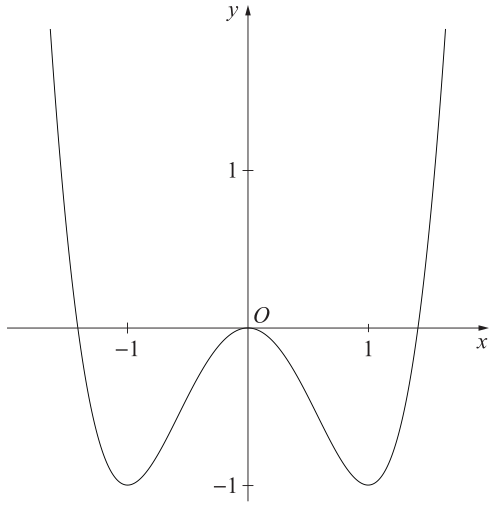
 

How many points do the graphs of  `y = f(x)`  and  `y = f^(-1) (x)`  have in common?

  1. `1`
  2. `2`
  3. `3`
  4. `4`
Show Answers Only

`A`

Show Worked Solution

`f(x) = -sqrt(1 + sqrt(1 + x))`

♦♦♦ Mean mark 29%.

`text(Domain)\ f(x)\ text(is)\ \ x >= -1`

`text(Range)\ f(x)\ text(is)\ \ y <= -1\ \ text(since)\ y\ text(decreases as)\ x\ text(increases.)`

`f(-1) = -sqrt(1 + sqrt 0) = -1`

`:.\ text{One intersection (only) occurs at}\ (-1, -1).`

`=>  A`

Filed Under: Inverse Functions, Inverse Functions Tagged With: Band 6, smc-1034-20-Other Functions, smc-6641-20-Other Functions

Functions, EXT1 F1 2010 HSC 3b*

Let  `f(x) = e^(-x^2)`.  The diagram shows the graph  `y = f(x)`.
 

 Inverse Functions, EXT1 2010 HSC 3b

  1. The graph has two points of inflection.  


    Find the `x` coordinates of these points.   (3 marks)

    --- 6 WORK AREA LINES (style=lined) ---

  2. Explain why the domain of `f(x)` must be restricted if `f(x)` is to have an inverse function.   (1 mark)

    --- 3 WORK AREA LINES (style=lined) ---

  3. Find a formula for `f^(-1) (x)` if the domain of `f(x)` is restricted to  `x ≥ 0`.   (2 marks)

    --- 5 WORK AREA LINES (style=lined) ---
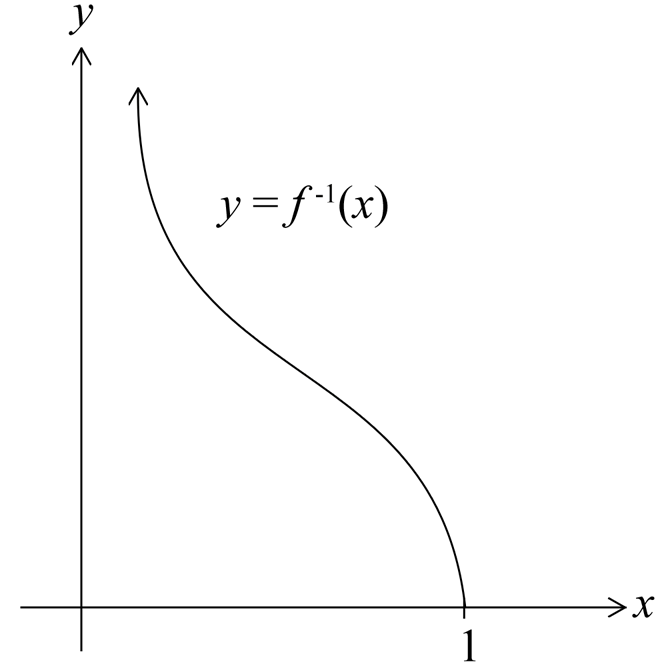
  4. State the domain of `f^(-1) (x)`.   (1 mark)

    --- 2 WORK AREA LINES (style=lined) ---

  5. Sketch the curve  `y = f^(-1) (x)`.   (1 mark)

    --- 5 WORK AREA LINES (style=lined) ---

Show Answers Only
  1. `x = +- 1/sqrt2` 
  2. `text(There can only be 1 value of)\ y\ text(for each value of)\ x.`
  3. `f^(-1)x = sqrt(ln(1/x))`
  4. `0 <= x <= 1`
  5.  
  6. Inverse Functions, EXT1 2010 HSC 3b Answer
Show Worked Solution
i.    `y` `= e^(-x^2)`
  `dy/dx` `= -2x * e^(-x^2)`
  `(d^2y)/(dx^2)` `= -2x (-2x * e^(-x^2)) + e ^(-x^2) (-2)`
    `= 4x^2 e^(-x^2)-2e^(-x^2)`
    `= 2e^(-x^2) (2x^2-1)`


`text(P.I. when)\ \ (d^2y)/(dx^2) = 0:`

`2e^(-x^2) (2x^2-1)` `= 0` 
 `2x^2-1` `= 0` 
 `x^2` `= 1/2`
 `x` `= +- 1/sqrt2` 
COMMENT: It is also valid to show that `f(x)` is an even function and if a P.I. exists at `x=a`, there must be another P.I. at `x=–a`.

 
`text(If)\ x < 1/sqrt2\ =>\ (d^2y)/(dx^2) < 0,\ \ x > 1/sqrt2\ =>\ (d^2y)/(dx^2) > 0`

`=>\ text(Change of concavity)`

`:.\ text(P.I. at)\ \ x = 1/sqrt2`
 

`text(If)\ x < – 1/sqrt2\ =>\ (d^2y)/(dx^2) > 0,\ \ x > – 1/sqrt2\ =>\ (d^2y)/(dx^2) < 0`

`=>\ text(Change of concavity)`

`:.\ text(P.I. at)\ \ x = -1/sqrt2`
 

ii.   `text(In)\ f(x), text(there are 2 values of)\ y\ text(for each value of)\ x.`

`:.\ text(The domain of)\ f(x)\ text(must be restricted for)\ f^(-1) (x)\ text(to exist).`
 

iii.  `y = e^(-x^2)`

`text(Inverse function can be written)` 

`x` `= e^(-y^2),\ \ \ x >= 0`
`lnx` `= ln e^(-y^2)`
`-y^2` `= lnx`
`y^2` `= -lnx`
`y^2` `=ln(1/x)`
`y` `= +- sqrt(ln (1/x))`

 
`text(Restricting)\ \ x>=0\ \ =>\ \ y>=0`

`:.  f^(-1) (x)=sqrt(ln (1/x))`
 

♦ Parts (iv) and (v) were poorly answered with mean marks of 39% and 49% respectively.
iv.   `f(0) = e^0 = 1`

`:.\ text(Range of)\ \ f(x)\ \ text(is)\ \ 0 < y <= 1`

`:.\ text(Domain of)\ \ f^(-1) (x)\ \ text(is)\ \ 0 < x <= 1`
 

v.    
         Inverse Functions, EXT1 2010 HSC 3b Answer

Filed Under: Inverse Functions, Inverse Functions Tagged With: Band 3, Band 4, Band 5, page-break-before-solution, smc-1034-10-Logs and Exponentials, smc-6641-10-Logs and Exponentials

Functions, EXT1 F1 2004 HSC 5b*

The diagram below shows a sketch of the graph of  `y = f(x)`, where  `f(x) = 1/(1 + x^2)`  for  `x ≥ 0`.
 

Inverse Functions, EXT1 2004 HSC 5b

  1. On the same set of axes, sketch the graph of the inverse function,  `y = f^(−1)(x)`.  (1 mark)
  2. State the domain of `f^(−1)(x)`.   (1 mark)

    --- 1 WORK AREA LINES (style=lined) ---

  3. Find an expression for `y = f^(−1)(x)` in terms of `x`.   (2 marks)

    --- 5 WORK AREA LINES (style=lined) ---

  4. The graphs of  `y = f(x)`  and  `y = f^(−1)(x)`  meet at exactly one point `P`.


    Let `alpha` be the `x`-coordinate of `P`. Explain why `alpha` is a root of the equation  `x^3 + x-1 = 0`.   (1 mark)

    --- 4 WORK AREA LINES (style=lined) ---

Show Answers Only
  1. `text(See Worked Solutions)`
  2. `0 < x ≤ 1`
  3. `y = sqrt((1-x)/x), \ y > 0`
  4. `text(See Worked Solutions)`
Show Worked Solution
i.  

Inverse Functions, EXT1 2004 HSC 5b Answer

ii.   `text(Domain of)\ f^(−1)(x)\ text(is)\ \ 0 < x ≤ 1`
 

iii.  `f(x) = 1/(1 + x^2)`

`text(Inverse: swap)\ \ x↔y`

`x` `= 1/(1 + y^2)`
`x(1 + y^2)` `= 1`
`1 + y^2` `= 1/x`
`y^2` `= 1/x-1`
`y^2` `= (1-x)/x`
`y` `= sqrt((1-x)/x), \ \ y >= 0`

 
iv.
   `P\ \ text(occurs when)\ \ f(x)\ \ text(cuts)\ \ y = x`

`text(i.e. where)`

`1/(1 + x^2)` `= x`
`1` `= x(1 + x^2)`
`1` `= x + x^3`
`x^3 + x-1` `= 0`

 
`=>\ text(S)text(ince)\ alpha\ text(is the)\ x\ text(-coordinate of)\ P,`

 `text(it is a root of)\ \ \ x^3 + x-1 = 0`

Filed Under: Inverse Functions, Inverse Functions Tagged With: Band 3, Band 4, Band 5, smc-1034-20-Other Functions, smc-6641-20-Other Functions

Functions, EXT1 F1 2018 HSC 13b

The diagram shows the graph  `y = x/(x^2 + 1)`, for all real `x`.
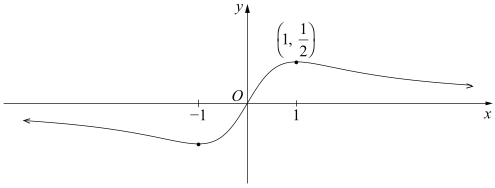
 

Consider the function  `f(x) = x/(x^2 + 1)`, for `x >= 1.`

The function `f(x)` has an inverse. (Do NOT prove this.)

  1.  State the domain and range of `f^(-1) (x).`   (2 marks)

    --- 4 WORK AREA LINES (style=lined) ---

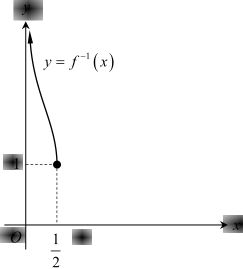
  2.  Sketch the graph  `y = f^(-1)(x).`   (1 mark)

    --- 6 WORK AREA LINES (style=lined) ---

  3.  Find an expression for `f^(-1)(x).`   (3 marks)

    --- 5 WORK AREA LINES (style=lined) ---

Show Answers Only
  1. `text(Domain:)\ 0 < x <= 1/2`
    `text(Range:)\ y >= 1`
  2. `text(See Worked Solutions)`
  3. `y = (1 + sqrt(1-4x^2))/(2x)`
Show Worked Solution

i.   `text(Domain of)\ f(x)\ text(is)\ \ x>=1\ \ text{(given)}`

♦♦ Mean mark part (i) 31%.

`=>\ text(Range of)\ f^(-1)(x)\ text(is)\ \ y >= 1`
 

`text(Range of)\ f(x)\ text(is)\ \ 0<y<1/2`

`=>\ text(Domain of)\ f^-1(x)\ text(is)\ 0 < x <= 1/2.`


♦ Mean mark (ii) 43%.

ii.  

iii.  `y=x/(x^2+1)`

♦ Mean mark (iii) 45%.

`text(Inverse:)\ \ x ↔ y`

`x` `= y/(y^2 + 1)`
`xy^2+ x` `= y`
`xy^2-y+x` `=0`
`y` `= (1 +- sqrt(1-4x^2))/(2x)`

 
`text(S)text(ince range of)\ f^(-1)(x)\ text(is)\ \ y >= 1:`

`f^(-1)(x) = (1 + sqrt(1-4x^2))/(2x)`

Filed Under: Inverse Functions, Inverse Functions, Other Inverse Functions EXT1 Tagged With: Band 5, smc-1034-20-Other Functions, smc-6641-20-Other Functions

Functions, EXT1 F1 2016 HSC 11a

Find the inverse of the function  `y = x^3-2`.  (2 marks)

Show Answers Only

`y = (x + 2)^(1/3)`

Show Worked Solution

`y = x^3-2`

`text(For inverse),\ \ x harr y`

`x` `= y^3-2`
`y^3` `= x + 2`
`:. y` `= (x + 2)^(1/3)`

Filed Under: Inverse Functions, Inverse Functions, Other Inverse Functions EXT1 Tagged With: Band 2, smc-1034-20-Other Functions, smc-6641-20-Other Functions

Functions, EXT1 F1 2007 HSC 6b

Consider the function  `f(x) = e^x-e^(-x)`.

  1. Show that `f(x)` is increasing for all values of `x`.   (1 mark)

    --- 4 WORK AREA LINES (style=lined) ---

  2. Show that the inverse function is given by
  3.    `f^(-1)(x) = log_e((x + sqrt(x^2 + 4))/2)`  (3 marks)

    --- 8 WORK AREA LINES (style=lined) ---

  4. Hence, or otherwise, solve  `e^x-e^(-x) = 5`. Give your answer correct to two decimal places.   (1 mark)

    --- 4 WORK AREA LINES (style=lined) ---

Show Answers Only
  1. `text{Proof (See Worked Solutions.)}`
  2. `text{Proof (See Worked Solutions.)}`
  3. `1.65\ \ text{(to 2 d.p.)}`
Show Worked Solution

i.    `f(x)= e^x-e^(-x)\ \ =>\ \ f^{′}(x)= e^x + e^(-x)`

`text(S)text(ince)\ ` `e^x` `> 0\ \ text(for all)\ x`
  `e^(-x)` `> 0\ \ text(for all)\ x`
  `f^{′}(x)` `> 0\ \ text(for all)\ x`

 
`:.f(x)\ text(is an increasing function for all)\ x.`
 

ii.   `y = e^x-e^(-x)`

`text(Inverse function:)`

`x` `= e^y-1/(e^y)`
`xe^y` `= e^(2y)-1`
`e^(2y)-xe^y-1` `= 0`

 
`text(Let)\ \ A = e^y:`

`A^2-xA-1 = 0`

`text(Using the quadratic formula:)`

`A=(x ± sqrt((-x)^2-4 · 1 · (-1)))/(2 · 1)=(x ± sqrt(x^2 + 4))/2`

`text(S)text(ince)\ \ (x -sqrt(x^2 + 4))/2<0\ \ text(and)\ \ e^y>0:`

`e^y` `= (x + sqrt(x^2 + 4))/2`
`log_e e^y` ` = log_e((x + sqrt(x^2 + 4))/2)`
`y` `= log_e((x + sqrt(x^2 + 4))/2)=f^(-1)(x)`


iii.  `e^x-e^(-x)=5\ \ =>\ \ f(x)=5\ \ =>\ \ f^(-1)(5)= x`

`f^(-1)(5)= log_e((5 + sqrt(5^2 + 4))/2)= 1.647…= 1.65\ \ text{(to 2 d.p.)}`

Filed Under: Inverse Functions, Inverse Functions, Other Inverse Functions EXT1 Tagged With: Band 4, Band 5, Band 6, page-break-before-solution, smc-1034-10-Logs and Exponentials, smc-6641-10-Logs and Exponentials

Functions, EXT1 F1 2006 HSC 5b

Let  `f(x) = log_e (1 + e^x)`  for all `x`.

Show that `f(x)` has an inverse.   (2 marks)

--- 5 WORK AREA LINES (style=lined) ---

Show Answers Only

`text(Proof)\ \ text{(See Worked Solutions)}`

Show Worked Solution
`f(x)` `= log_e (1 + e^x)`
`f^{′}(x)` `= e^x/(1 + e^x)`

 
`e^x > 0\ \ text(for all)\ x\ \ => \ \ e^x/(1 + e^x) > 0\ \ text(for all)\ x`

`f(x)\ text(is a monotonic increasing function for all)\ x.`

`:.\ f(x)\ text(has an inverse for all)\ x.`

Filed Under: Inverse Functions, Inverse Functions, Other Inverse Functions EXT1 Tagged With: Band 4, smc-1034-10-Logs and Exponentials, smc-6641-10-Logs and Exponentials

Functions, EXT1 F1 2008 HSC 5a

Let  `f(x) = x-1/2 x^2`  for  `x <= 1`.  This function has an inverse,  `f^(-1) (x)`. 

  1.  Sketch the graphs of  `y = f(x)`  and  `y = f^(-1) (x)`  on the same set of axes. (Use the same scale on both axes.)  (2 marks)

    --- 8 WORK AREA LINES (style=lined) ---

  2.  Find an expression for  `f^(-1) (x)`.   (3 marks)

    --- 6 WORK AREA LINES (style=lined) ---

  3.  Evaluate  `f^(-1) (3/8)`.   (1 mark)

    --- 3 WORK AREA LINES (style=lined) ---

Show Answers Only
  1.  
    Inverse Functions, EXT1 2008 HSC 5a Answer

  2. `y = 1-sqrt(1-2x)`
  3. `1/2`
Show Worked Solution
i. 

Inverse Functions, EXT1 2008 HSC 5a Answer

ii.    `y = x-1/2 x^2,\ \ \ x <= 1`

 
`text(Inverse function: swap)\ \ x↔y,`

`x` `= y-1/2 y^2,\ \ \ y <= 1`
`2x` `= 2y-y^2`
`y^2-2y + 2x` `= 0`


`y` `= (2 +- sqrt( (-2)^2-4 * 1 * 2x) )/2`
  `= (2 +- sqrt(4-8x))/2`
  `= (2 +- 2 sqrt(1-2x))/2`
  `= 1 +- sqrt (1-2x)`


`:. y = 1-sqrt(1-2x), \ \ (y <= 1)`


iii.    `f^(-1) (3/8)` `= 1-sqrt(1 -2(3/8))`
    `= 1-sqrt(1-6/8)`
    `= 1-sqrt(1/4)`
    `= 1-1/2`
    `= 1/2`

Filed Under: Inverse Functions, Inverse Functions, Other Inverse Functions EXT1 Tagged With: Band 4, smc-1034-20-Other Functions, smc-6641-20-Other Functions

Functions, EXT1 F1 2009 HSC 3a

Let  `f(x) = (3 + e^(2x))/4`. 

  1.  Find the range of `f(x)`.   (1 mark)

    --- 2 WORK AREA LINES (style=lined) ---

  2.  Find the inverse function `f^(-1) (x)`.    (2 marks)

    --- 5 WORK AREA LINES (style=lined) ---

Show Answers Only
  1. `y > 3/4`
  2. `f^(-1) (x) = 1/2 ln(4x-3)`
Show Worked Solution
i.   `f(x) = (3 + e^(2x))/4`

`text(As)\ \ x -> oo, \ e^(2x) ->oo, \ f(x)->oo`

`text(As)\ \ x -> -oo, \ e^(2x) ->0, \ f(x)->3/4`

`:.\ text(Range is)\ \ y > 3/4`
 

ii.   `text(Inverse function: swap)\ \ x↔y` 

`x` `= (3 + e^(2y))/4`
`4x` `= 3 + e^(2y)`
`e^(2y)` `= 4x-3`
`ln e^(2y)` `= ln (4x-3)`
`2y` `= ln (4x-3)`
`y` `= 1/2 ln (4x-3)`


`:.\ f^(-1) (x) = 1/2 ln (4x\ – 3)`

Filed Under: 12. Logs and Exponentials EXT1, Inverse Functions, Inverse Functions, Other Inverse Functions EXT1 Tagged With: Band 4, Band 5, smc-1034-10-Logs and Exponentials, smc-6641-10-Logs and Exponentials

Functions, EXT1 F1 2012 HSC 12b

Let  `f(x) = sqrt(4x-3)` 

  1.  Find the domain of  `f(x)`.   (1 mark)

    --- 2 WORK AREA LINES (style=lined) ---

  2.  Find an expression for the inverse function `f^(-1) (x)`.    (2 marks)

    --- 4 WORK AREA LINES (style=lined) ---

  3.  Find the points where the graphs  `y = f(x)`  and  `y=x`  intersect.   (1 mark)

    --- 4 WORK AREA LINES (style=lined) ---

  4.  On the same set of axes, sketch the graphs  `y = f(x)`  and  `y = f^(-1) (x)`  showing the information found in part (iii).   (2 marks)

    --- 8 WORK AREA LINES (style=lined) ---

Show Answers Only
  1. `x >= 3/4`
  2. `f^(-1) (x) = 1/4 x^2 + 3/4,\ x >= 0`
  3. `(1,1),\ (3,3)`
  4.   
    1. Inverse Functions, EXT1 2012 HSC 12b Answer
Show Worked Solution

i.    `f(x) = sqrt(4x-3)`

`text(Domain exists when:)`

`4x-3>=0\ \ =>\ \ x>= 3/4`
 

ii.  `text(Inverse function when)`

`x` `= sqrt(4y-3)`
`x^2` `= 4y-3`
`4y` `= x^2 + 3`
`y` `= 1/4 x^2 + 3/4`


`text(S)text(ince range of)\ f(x)\ text(is)\ \ y >= 0`

`=> text(Domain of)\ f^(-1)(x)\ text(is)\ \ x >= 0`

`:.\ f^(-1) (x) = 1/4 x^2 + 3/4,\ \ \ \ x >= 0`


iii.  `text(Find intersection:)`

`y` ` = sqrt(4x-3)\ \ …\ text{(1)}`
`y ` `=x\ \ …\ text{(2)}`


`text{Intersection occurs when:}`

`x` `= sqrt(4x-3)`
`x^2` `= 4x-3`
`x^2-4x + 3` `= 0`
`(x-3)(x-1)` `= 0`

 
`x=1\ text(or)\ 3`

`:.\ text(Intersection at)\ (1,1)\ text(and)\ (3,3)`


iv.

`qquad`Inverse Functions, EXT1 2012 HSC 12b Answer

Filed Under: Inverse Functions, Inverse Functions, Other Inverse Functions EXT1 Tagged With: Band 2, Band 3, Band 4, smc-1034-20-Other Functions, smc-6641-20-Other Functions

Copyright © 2014–2026 SmarterEd.com.au · Log in