SmarterEd

Aussie Maths & Science Teachers: Save your time with SmarterEd

  • Login
  • Get Help
  • About

Algebra, STD1 A2 2022 HSC 12

The cost of hiring a campervan is $210 per day. There is also a charge of $0.35 per km travelled.

A family hired a campervan for 9 days and travelled 2700 km.

How much did the family pay in total?  (2 marks)

Show Answers Only

Cost = $2835

Show Worked Solution
`text{Cost}`  `= 210 xx 9 + 2700 xx 0.35`  
  `= $2835`  

Filed Under: Applications: Currency, Fuel and Other Problems (Std 1) Tagged With: Band 2, smc-1119-30-Other Linear Applications

Algebra, STD1 A2 2022 HSC 6 MC

A water tank holds 6000 litres when full.

The tank is full when water starts to flow out of it at a constant rate of 3 litres per minute until the tank is empty.

Which expression represents the volume (`V` litres) of water in the tank after `t` minutes?

  1. `V=6000-3t`
  2. `V=6000 t-3`
  3. `V=3-6000 t`
  4. `V=3t-6000`
Show Answers Only

`A`

Show Worked Solution

`text{When}\ \ t=0,  \ V=6000-0 xx 3 =6000`
 
`text{When}\ \ t=1,  \ V=6000-1 xx 3 =5997`

`vdots`

`text{After}\ t\ text{minutes}, \ V=6000-t xx 3 =6000-3t`

`=> A`

Filed Under: Applications: Currency, Fuel and Other Problems (Std 1) Tagged With: Band 3, smc-1119-30-Other Linear Applications

Algebra, STD1 A2 2021 HSC 8 MC

A student is thinking of a number. Let the number be `x`.

When the student subtracts 8 from this number and multiplies the result by 3, the answer is 2 more than `x`.

Which equation can be used to find `x`?

  1. `3(x-8)=2x`
  2. `3x-8=2x`
  3. `3(x-8)=x+2`
  4. `3x-8=x+2`
Show Answers Only

`C`

Show Worked Solution

`text(The description defines the following equation:)`

`(x-8) xx 3` `= x + 2`
`3(x-8)` `=x+2`

 
`=>C`

Filed Under: Applications: Currency, Fuel and Other Problems (Std 1) Tagged With: Band 4, smc-1119-30-Other Linear Applications

Algebra, STD1 A2 2020 HSC 10 MC

A plumber charges a call-out fee of $90 as well as $2 per minute while working.

Suppose the plumber works for  `t`  hours.

Which equation expresses the amount the plumber charges ($`C`) as a function of time (`t`  hours)?

  1.  `C = 2 + 90t`
  2.  `C = 90 + 2t`
  3.  `C = 120 + 90t`
  4.  `C = 90 + 120t`
Show Answers Only

`D`

Show Worked Solution

♦♦♦ Mean mark 21%.
`text(Hourly rate)` `= 60 xx 2`
  `= $120`

 
`therefore  C = 90 + 120t`

Filed Under: Applications: Currency, Fuel and Other Problems (Std 1) Tagged With: Band 6, smc-1119-30-Other Linear Applications

Algebra, STD2 A2 2007 HSC 27b*

A clubhouse uses four long-life light globes for five hours every night of the year. The purchase price of each light globe is $6.00 and they each cost  `$d`  per hour to run.

  1. Write an equation for the total cost (`$c`) of purchasing and running these four light globes for one year in terms of  `d`.    (2 marks)

    --- 4 WORK AREA LINES (style=lined) ---

  2. Find the value of  `d`  (correct to three decimal places) if the total cost of running these four light globes for one year is $250.   (1 mark)

    --- 2 WORK AREA LINES (style=lined) ---

  3. If the use of the light globes increases to ten hours per night every night of the year, does the total cost double? Justify your answer with appropriate calculations.   (1 mark)

    --- 2 WORK AREA LINES (style=lined) ---

Show Answers Only
  1. `$c = 24 + 7300d`
  2. `0.031\ $ text(/hr)\ text{(3 d.p.)}`
  3. `text(Proof)\ \ text{(See Worked Solutions)}`
Show Worked Solution

i.  `text(Purchase price) = 4 xx 6 = $24`

`text(Running cost)` `= text(# Hours) xx text(Cost per hour)`
  `= 4 xx 5 xx 365 xx d`
  `= 7300d`
 
`:.\ $c = 24 + 7300d`


ii.  `text(Given)\ $c = $250`

`=>250` `= 24 + 7300d`
`7300d` `= 226`
`d` `= 226/7300`
  `= 0.03095…`
  `= 0.031\ $ text(/hr)\ text{(3 d.p.)}`


iii.  `text(If)\ d\ text(doubles to 0.062)\ \ $text(/hr)`

`$c` `= 24 + 7300 xx 0.062`
  `= $476.60`
   
`text(S) text(ince $476.60 is less than)\ 2 xx $250\ ($500),`
`text(the total cost increases to less than double)`
`text(the original cost.)`


Filed Under: Applications: Currency, Fuel and Other Problems (Std 1) Tagged With: Band 4, Band 5, smc-1119-30-Other Linear Applications

Algebra, STD2 A2 SM-Bank 3

The average height, `C`, in centimetres, of a girl between the ages of 6 years and 11 years can be represented by a line with equation

`C = 6A + 79`

where `A` is the age in years. For this line, the gradient is 6.

  1. What does this indicate about the heights of girls aged 6 to 11?   (1 mark)

    --- 2 WORK AREA LINES (style=lined) ---

  2. Give ONE reason why this equation is not suitable for predicting heights of girls older than 12.   (1 mark)

    --- 2 WORK AREA LINES (style=lined) ---

Show Answers Only
  1. `text(It indicates that 6-11 year old girls, on average, grow 6 cm per year.)`
  2. `text(Girls eventually stop growing, and the equation doesn’t factor this in.)`
Show Worked Solution

i.  `text(It indicates that 6-11 year old girls, on average, grow)`

`text(6 cm per year.)`
 

ii. `text(Girls eventually stop growing, and the equation doesn’t)`

`text(factor this in.)`

Filed Under: Applications: Currency, Fuel and Other Problems (Std 1), Applications: Currency, Fuel and Other Problems (Std 2), Applications: Currency, Fuel and Other Problems (Std2-2027) Tagged With: Band 4, Band 5, smc-1119-30-Other Linear Applications, smc-1119-40-Limitations, smc-6256-30-Other Linear Applications, smc-793-30-Other Linear Applications, smc-793-40-Limitations

Algebra, STD2 A2 SM-Bank 2

The weight of a steel beam, `w`, varies directly with its length, `ℓ`.

A 1200 mm steel beam weighs 144 kg.

Calculate the weight of a 750 mm steel beam.  (2 marks)

--- 4 WORK AREA LINES (style=lined) ---

Show Answers Only

`90\ text(kg)`

Show Worked Solution

`w propto ℓ`

`w = kℓ`

`text(When)\ \ w = 144\ text(kg),\ \ ℓ = 1200\ text(mm)`

`144` `= k xx 1200`
`k` `= 144/1200`
  `= 3/25`


`text(When)\ \ ℓ = 750\ text(mm),`

`w` `= 3/25 xx 750`
  `= 90\ text(kg)`

Filed Under: Applications: Currency, Fuel and Other Problems (Std 1), Applications: Currency, Fuel and Other Problems (Std 2), Direct Variation (Std2-2027) Tagged With: Band 5, smc-1119-30-Other Linear Applications, smc-1119-50-Proportional, smc-6249-30-Algebraic Solutions, smc-793-30-Other Linear Applications, smc-793-50-Proportional

Algebra, STD2 A2 2017 HSC 3 MC

The graph shows the relationship between infant mortality rate (deaths per 1000 live births) and life expectancy at birth (in years) for different countries.
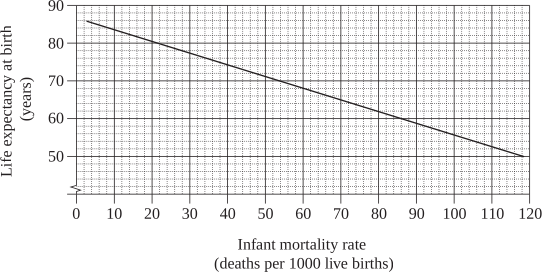
 

What is the life expectancy at birth in a country which has an infant mortality rate of 60?

  1. 68 years
  2. 69 years
  3. 86 years
  4. 88 years
Show Answers Only

\(A\)

Show Worked Solution

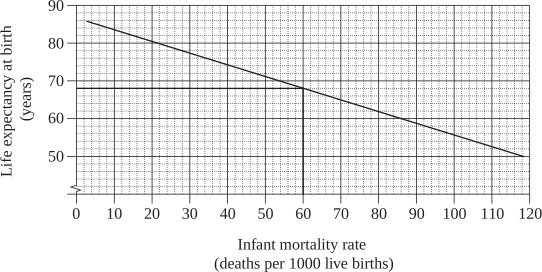
\(\text{When infant mortality rate is 60, life expectancy}\)

\(\text{at birth is 68 years (see below).}\)
 

\(\Rightarrow A\)

Filed Under: Applications: Currency, Fuel and Other Problems (Std 1), Applications: Currency, Fuel and Other Problems (Std 2), Applications: Currency, Fuel and Other Problems (Std2-2027), Bivariate Data, Life Expectancy, Linear Applications, S3 Further Statistical Analysis (Y12), S4 Bivariate Data Analysis (Y12) Tagged With: Band 3, common-content, num-title-ct-coreb, num-title-qs-hsc, smc-1001-10-Line of Best Fit, smc-1113-10-Line of Best Fit, smc-1119-30-Other Linear Applications, smc-5022-10-Line of best fit graphs, smc-6256-30-Other Linear Applications, smc-785-10-Line of Best Fit, smc-793-30-Other Linear Applications

Algebra, STD2 A2 2016 HSC 29e

The graph shows the life expectancy of people born between 1900 and 2000.
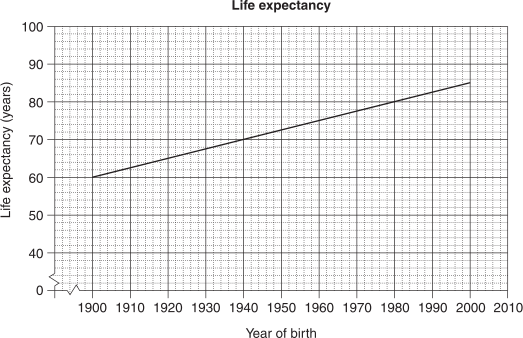


  1. According to the graph, what is the life expectancy of a person born in 1932?  (1 mark)

    --- 1 WORK AREA LINES (style=lined) ---

  2. With reference to the value of the gradient, explain the meaning of the gradient in this context.  (2 marks)

    --- 4 WORK AREA LINES (style=lined) ---

Show Answers Only
  1. `text(68 years)`
  2. `text(After 1900, life expectancy increases 0.25 years for each later year someone is born.)`
Show Worked Solution

i.    \(\text{68 years}\)

ii.    \(\text{Using (1900,60), (1980,80):}\)

\(\text{Gradient}\) \(= \dfrac{y_2-y_1}{x_2-x_1}\)
  \(= \dfrac{80-60}{1980-1900}\)
  \(= 0.25\)

 
\(\text{After 1900, life expectancy increases by 0.25 years for}\)

\(\text{each year later that someone is born.}\)

♦♦ Mean mark (ii) 33%.

Filed Under: Applications: Currency, Fuel and Other Problems (Std 1), Applications: Currency, Fuel and Other Problems (Std 2), Applications: Currency, Fuel and Other Problems (Std2-2027), Bivariate Data Analysis (Y12), Life Expectancy, Other Linear Modelling, S3 Further Statistical Analysis (Y12), S4 Bivariate Data Analysis (Y12) Tagged With: Band 3, Band 5, common-content, smc-1001-10-Line of Best Fit, smc-1001-50-Gradient Interpretation, smc-1113-10-Line of Best Fit, smc-1113-50-Gradient, smc-1119-30-Other Linear Applications, smc-6256-30-Other Linear Applications, smc-785-10-Line of Best Fit, smc-785-50-Gradient Interpretation, smc-793-30-Other Linear Applications

Algebra, STD2 A2 2014 HSC 26f

The weight of an object on the moon varies directly with its weight on Earth.  An astronaut who weighs 84 kg on Earth weighs only 14 kg on the moon.

A lunar landing craft weighs 2449 kg when on the moon. Calculate the weight of this landing craft when on Earth.   (2 marks)

--- 4 WORK AREA LINES (style=lined) ---

Show Answers Only

 `14\ 694\ text(kg)`

Show Worked Solution

`W_text(moon) prop W_text(earth)`

`=> W_text(m) = k xx W_text(e)`

`text(Find)\ k\ text{given}\  W_text(e) = 84\ text{when}\ W_text(m) = 14`

`14` `= k xx 84`
`k` `= 14/84 = 1/6`


`text(If)\ W_text(m) = 2449\ text(kg),\ text(find)\ W_text(e):`

`2449` `= 1/6  xx W_text(e)`
`W_text(e)` `= 14\ 694\ text(kg)`


`:.\ text(Landing craft weighs)\ 14\ 694\ text(kg on earth)`

Filed Under: Applications: Currency, Fuel and Other Problems (Std 1), Applications: Currency, Fuel and Other Problems (Std 2), Direct Variation (Std2-2027), Other Linear Modelling, Variation and Rates of Change Tagged With: Band 4, num-title-ct-patha, num-title-qs-hsc, smc-1119-30-Other Linear Applications, smc-1119-50-Proportional, smc-4239-10-a prop b, smc-6249-30-Algebraic Solutions, smc-793-30-Other Linear Applications, smc-793-50-Proportional

Algebra, STD2 A2 2009 HSC 24d

A factory makes boots and sandals. In any week

• the total number of pairs of boots and sandals that are made is 200
• the maximum number of pairs of boots made is 120
• the maximum number of pairs of sandals made is 150.

The factory manager has drawn a graph to show the numbers of pairs of boots (`x`) and sandals (`y`) that can be made.
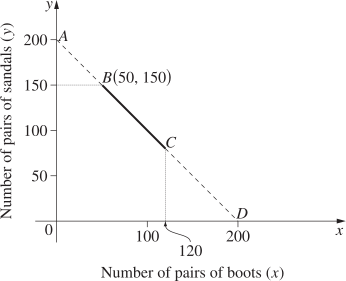


  1. Find the equation of the line `AD`.   (1 mark)

    --- 2 WORK AREA LINES (style=lined) ---

  2. Explain why this line is only relevant between `B` and `C` for this factory.     (1 mark)

    --- 3 WORK AREA LINES (style=lined) ---

  3. The profit per week, `$P`, can be found by using the equation  `P = 24x + 15y`.


    Compare the profits at `B` and `C`.     (2 marks)

    --- 5 WORK AREA LINES (style=lined) ---

Show Answers Only
  1. `x + y = 200`
  2. `text(S)text(ince the max amount of boots = 120)`


    `=> x\ text(cannot)\ >120`


    `text(S)text(ince the max amount of sandals = 150`


    `=> y\ text(cannot)\ >150`


    `:.\ text(The line)\ AD\ text(is only possible between)\ B\ text(and)\ C.`

  3. `text(The profits at)\ C\ text(are $630 more than at)\ B.`
Show Worked Solution

i.   `text{We are told the number of boots}\ (x),` 

♦♦♦ Mean mark part (i) 14%. 
Using `y=mx+b` is a less efficient but equally valid method, using  `m=–1`  and  `b=200` (`y`-intercept).

`text{and shoes}\  (y),\ text(made in any week = 200)`

`=>text(Equation of)\ AD\ text(is)\ \ x + y = 200`


ii.  `text(S)text(ince the max amount of boots = 120)`

♦ Mean mark 49%

`=> x\ text(cannot)\ >120`

`text(S)text(ince the max amount of sandals = 150`

`=> y\ text(cannot)\ >150`

`:.\ text(The line)\ AD\ text(is only possible between)\ B\ text(and)\ C.`


iii.  `text(At)\ B,\ \ x = 50,\ y = 150`

♦ Mean mark 40%.
`=>$P  (text(at)\ B)` `= 24 xx 50 + 15 xx 150`
  `= 1200 + 2250`
  ` = $3450`

`text(At)\ C,\ \  x = 120 text(,)\ y = 80`

`=> $P  (text(at)\ C)` `= 24 xx 120 + 15 xx 80`
  `= 2880 + 1200`
  `= $4080`


`:.\ text(The profits at)\ C\ text(are $630 more than at)\ B.`

Filed Under: Applications: Currency, Fuel and Other Problems (Std 1), Applications: Currency, Fuel and Other Problems (Std 2), Applications: Currency, Fuel and Other Problems (Std2-2027), Breakeven and Financial modelling, Linear Applications, Linear Functions (Adv-2027), Linear Functions (Y11) Tagged With: Band 5, Band 6, common-content, num-title-ct-coreb, num-title-qs-hsc, smc-1119-30-Other Linear Applications, smc-4421-70-Other, smc-6214-20-Other Real World Applications, smc-6256-30-Other Linear Applications, smc-793-30-Other Linear Applications, smc-793-40-Limitations, smc-985-20-Other Linear Applications

Algebra, STD2 A2 2009 HSC 13 MC

The volume of water in a tank changes over six months, as shown in the graph.
 

 2UG-2010-13MC

 
Consider the overall decrease in the volume of water.

What is the average percentage decrease in the volume of water per month over this time, to the nearest percent?

  1.  6%
  2. 11%
  3. 32%
  4. 64%
Show Answers Only

`B`

Show Worked Solution
♦ Mean mark 48%
COMMENT: Remember that % decrease requires the decrease in volume to be divided by the original volume (50,000L).
`text(Initial Volume)` `= 50\ 000\ text(L)`
`text(Final volume)` `= 18\ 000\ text(L)`
`text(Decrease)` `= 50\ 000-18\ 000`
  `= 32\ 000\ text{L   (over 6 months)}`


`text(Loss per month)` `= (32\ 000)/6`
  `= 5333.33…\ text(L per month)`
`text(% loss per month)` `= (5333.33…)/(50\ 000)`
  `=10.666… %`

 
`=>  B`

Filed Under: AM2 - Linear Relationships (Prelim), Applications: Currency, Fuel and Other Problems (Std 1), Applications: Currency, Fuel and Other Problems (Std 2), Applications: Currency, Fuel and Other Problems (Std2-2027), MM1 - Units of Measurement, Non-Linear: Inverse and Other Problems (Std 2) Tagged With: Band 5, smc-1119-30-Other Linear Applications, smc-6256-30-Other Linear Applications, smc-793-30-Other Linear Applications, smc-795-20-Other Relationship

Copyright © 2014–2025 SmarterEd.com.au · Log in