SmarterEd

Aussie Maths & Science Teachers: Save your time with SmarterEd

  • Login
  • Get Help
  • About

Vectors, EXT2 V1 2025 HSC 13b

Let  \(\underset{\sim}{c}=x \underset{\sim}{i}+y \underset{\sim}{j}+z \underset{\sim}{k}\)  be a unit vector that is perpendicular to both  \(\underset{\sim}{a}=2 \underset{\sim}{i}+4 \underset{\sim}{j}-3 \underset{\sim}{k}\)  and  \(\underset{\sim}{b}=-4 \underset{\sim}{i}-5 \underset{\sim}{j}+3 \underset{\sim}{k}\).

Find all possible vectors \(\underset{\sim}{c}\).   (4 marks)

--- 10 WORK AREA LINES (style=lined) ---
Show Answers Only

\(\underset{\sim}{c}= \pm \dfrac{1}{3}(\underset{\sim}{i}-2\underset{\sim}{j}-2 \underset{\sim}{k})\)

Show Worked Solution

\(\underset{\sim}{c} \cdot \underset{\sim}{a}=\left(\begin{array}{l}x \\ y \\ z\end{array}\right)\left(\begin{array}{c}2 \\ 4 \\ -3\end{array}\right)=2 x+4 y-3 z=0\ \ldots\ (1)\)

\(\underset{\sim}{c} \cdot \underset{\sim}{b}=\left(\begin{array}{l}x \\ y \\ z\end{array}\right)\left(\begin{array}{c}-4 \\ -5 \\ 3\end{array}\right)=-4 x-5 y+3 z=0\ \ldots\ (2)\)

\(\text{Given} \ \ \abs{\underset{\sim}{c}}=1:\)

\(x^2+y^2+z^2=1\ \ldots\ (3)\)
 

\(\text{Add}\ \ (1)+(2):\)

\(-2 x-y=0 \ \ \Rightarrow\ \ y=-2 x\)
 

\(\text{Substitute}\ \ y=-2 x \ \ \text{into (1):}\)

\(-6 x-3 z=0 \ \ \Rightarrow\ \ z=-2 x\)
 

\(\text{Substituting into (3):}\)

\(x^2+4 x^2+4 x^2=1\ \ \Rightarrow\ \ x^2=\dfrac{1}{9}\ \ \Rightarrow\ \ x= \pm \dfrac{1}{3}\)

\(\underset{\sim}{c}\) \(=\left(\begin{array}{l}x \\ y \\ z\end{array}\right)=x \underset{\sim}{i}+y \underset{\sim}{j}+z \underset{\sim}{k}\)
  \(= \pm \dfrac{1}{3}(\underset{\sim}{i}-2\underset{\sim}{j}-2 \underset{\sim}{k})\)

Filed Under: Basic Concepts and Arithmetic Tagged With: Band 4, smc-1195-30-Perpendicular Vectors, smc-1195-40-Unit Vectors and Projections

Vectors, EXT2 V1 2025 HSC 11d

  1. Force \({\underset{\sim}{F}}_1\) has magnitude 12 newtons in the direction of vector  \(2 \underset{\sim}{i}-2 \underset{\sim}{j}+\underset{\sim}{k}\).   
  2. Show that  \({\underset{\sim}{F}}_1=8 \underset{\sim}{i}-8 \underset{\sim}{j}+4 \underset{\sim}{k}\).   (1 mark)

    --- 4 WORK AREA LINES (style=lined) ---

  3. Force \({\underset{\sim}{F}}_1\) from part (i) and a second force,  \({\underset{\sim}{F}}_2=-6 \underset{\sim}{i}+12 \underset{\sim}{j}+4 \underset{\sim}{k}\), both act upon a particle.
  4. Show that the resultant force acting on the particle is given by:
  5.      \({\underset{\sim}{F}}_3=2 \underset{\sim}{i}+4 \underset{\sim}{j}+8 \underset{\sim}{k}.\)   (1 mark)

    --- 3 WORK AREA LINES (style=lined) ---

  6. Calculate  \({\underset{\sim}{F}}_3 \cdot \underset{\sim}{d}\), where \({\underset{\sim}{F}}_3\) is the resultant force from part (ii) and  \(\underset{\sim}{d}=\underset{\sim}{i}+\underset{\sim}{j}+2 \underset{\sim}{k}\).   (1 mark)

    --- 3 WORK AREA LINES (style=lined) ---

Show Answers Only

i.    \(\abs{2 \underset{\sim}{i}-2 \underset{\sim}{j}+\underset{\sim}{k}}=\sqrt{2^2+(-2)^2+1^2}=3\)

\({\underset{\sim}{F}}_1=\dfrac{12}{3}\left(\begin{array}{c}2 \\ -2 \\ 1\end{array}\right)=\left(\begin{array}{c}8 \\ -8 \\ 4\end{array}\right)\)

\({\underset{\sim}{F}}_1=8\underset{\sim}{i}-8 \underset{\sim}{j}+4 \underset{\sim}{k}\)
 

ii.    \({\underset{\sim}{F}}_3={\underset{\sim}{F}}_1+{\underset{\sim}{F}}_2=\left(\begin{array}{c}8 \\ -8 \\ 4\end{array}\right)+\left(\begin{array}{c}-6 \\ 12 \\ 4\end{array}\right)=\left(\begin{array}{l}2 \\ 4 \\ 8\end{array}\right)\)

\({\underset{\sim}{F}}_3=2 \underset{\sim}{i}+4 \underset{\sim}{j}+8 \underset{\sim}{k}\)
 

iii.  \({\underset{\sim}{F}}_3 \cdot d=\left(\begin{array}{l}2 \\ 4 \\ 8\end{array}\right)\left(\begin{array}{l}1 \\ 1 \\ 2\end{array}\right)=2+4+16=22\)

Show Worked Solution

i.    \(\abs{2 \underset{\sim}{i}-2 \underset{\sim}{j}+\underset{\sim}{k}}=\sqrt{2^2+(-2)^2+1^2}=3\)

\({\underset{\sim}{F}}_1=\dfrac{12}{3}\left(\begin{array}{c}2 \\ -2 \\ 1\end{array}\right)=\left(\begin{array}{c}8 \\ -8 \\ 4\end{array}\right)\)

\({\underset{\sim}{F}}_1=8\underset{\sim}{i}-8 \underset{\sim}{j}+4 \underset{\sim}{k}\)
 

ii.    \({\underset{\sim}{F}}_3={\underset{\sim}{F}}_1+{\underset{\sim}{F}}_2=\left(\begin{array}{c}8 \\ -8 \\ 4\end{array}\right)+\left(\begin{array}{c}-6 \\ 12 \\ 4\end{array}\right)=\left(\begin{array}{l}2 \\ 4 \\ 8\end{array}\right)\)

\({\underset{\sim}{F}}_3=2 \underset{\sim}{i}+4 \underset{\sim}{j}+8 \underset{\sim}{k}\)
 

iii.  \({\underset{\sim}{F}}_3 \cdot d=\left(\begin{array}{l}2 \\ 4 \\ 8\end{array}\right)\left(\begin{array}{l}1 \\ 1 \\ 2\end{array}\right)=2+4+16=22\)

Filed Under: Basic Concepts and Arithmetic Tagged With: Band 3, Band 4, smc-1195-10-Basic Calculations, smc-1195-40-Unit Vectors and Projections

Vectors, EXT2 V1 2024 HSC 12a

The vector \(\underset{\sim}{a}\) is \(\left(\begin{array}{l}1 \\ 2 \\ 3\end{array}\right)\) and the vector \(\underset{\sim}{b}\) is \(\left(\begin{array}{c}2 \\ 0 \\ -4\end{array}\right)\).

  1. Find \(\dfrac{\underset{\sim}{a} \cdot \underset{\sim}{b}}{\underset{\sim}{b} \cdot \underset{\sim}{b}}\, \underset{\sim}{b}\).   (1 mark)

    --- 4 WORK AREA LINES (style=lined) ---

  2. Show that  \(\underset{\sim}{a}-\dfrac{\underset{\sim}{a} \cdot \underset{\sim}{b}}{\underset{\sim}{b} \cdot \underset{\sim}{b}}\, \underset{\sim}{b}\)  is perpendicular to \(\underset{\sim}{b}\).  (2 marks)

    --- 6 WORK AREA LINES (style=lined) ---

Show Answers Only

1.     \(\left(\begin{array}{c}-1 \\ 0 \\ 2\end{array}\right)\)

ii.    \(\underset{\sim}{a}-\dfrac{\underset{\sim}{a} \cdot \underset{\sim}{b}}{\underset{\sim}{b} \cdot \underset{\sim}{b}}\, \underset{\sim}{b}=\left(\begin{array}{l}1 \\ 2 \\ 3\end{array}\right)-\left(\begin{array}{c}-1 \\ 0 \\ 2\end{array}\right)=\left(\begin{array}{l}2 \\ 2 \\ 1\end{array}\right)\)

\( \left(\underset{\sim}{a}-\dfrac{\underset{\sim}{a} \cdot \underset{\sim}{b}}{\underset{\sim}{b} \cdot \underset{\sim}{b}}\underset{\sim}{b}\right)\left(\begin{array}{c}-1 \\ 0 \\ 2\end{array}\right)=\left(\begin{array}{l}2 \\ 2 \\ 1\end{array}\right)\left(\begin{array}{c}-1 \\ 0 \\ 2\end{array}\right) = -2+0+2=0\)

\(\therefore\ \text {Vectors are perpendicular.}\)

Show Worked Solution

i.    \(\underset{\sim}{a}=\left(\begin{array}{l}1 \\ 2 \\ 3\end{array}\right), \quad \underset{\sim}{b}=\left(\begin{array}{c}2 \\ 0 \\ -4\end{array}\right)\)
 

\(\dfrac{\underset{\sim}{a} \cdot \underset{\sim}{b}}{\underset{\sim}{b} \cdot \underset{\sim}{b}}\, \underset{\sim}{b}=\dfrac{2+0-12}{4+0+16}\left(\begin{array}{c}2 \\ 0 \\ -4\end{array}\right)=-\dfrac{1}{2}\left(\begin{array}{c}2 \\ 0 \\ -4\end{array}\right)=\left(\begin{array}{c}-1 \\ 0 \\ 2\end{array}\right)\)

 
ii.
    \(\underset{\sim}{a}-\dfrac{\underset{\sim}{a} \cdot \underset{\sim}{b}}{\underset{\sim}{b} \cdot \underset{\sim}{b}}\, \underset{\sim}{b}=\left(\begin{array}{l}1 \\ 2 \\ 3\end{array}\right)-\left(\begin{array}{c}-1 \\ 0 \\ 2\end{array}\right)=\left(\begin{array}{l}2 \\ 2 \\ 1\end{array}\right)\)
 

\( \left(\underset{\sim}{a}-\dfrac{\underset{\sim}{a} \cdot \underset{\sim}{b}}{\underset{\sim}{b} \cdot \underset{\sim}{b}}\,\underset{\sim}{b}\right)\left(\begin{array}{c}-1 \\ 0 \\ 2\end{array}\right)=\left(\begin{array}{l}2 \\ 2 \\ 1\end{array}\right)\left(\begin{array}{c}-1 \\ 0 \\ 2\end{array}\right) = -2+0+2=0\)

 
\(\therefore\ \text{Vectors are perpendicular.}\)

Filed Under: Basic Concepts and Arithmetic Tagged With: Band 2, Band 3, smc-1195-30-Perpendicular Vectors, smc-1195-40-Unit Vectors and Projections

Vectors, EXT2 V1 2023 HSC 10 MC

Consider any three-dimensional vectors  \(\underset{\sim}{a}=\overrightarrow{O A}, \underset{\sim}{b}=\overrightarrow{O B}\)  and  \(\underset{\sim}{c}=\overrightarrow{O C}\)  that satisfy these three conditions

\(\underset{\sim}{a} \cdot \underset{\sim}{b}=1\)

\(\underset{\sim}{b} \cdot \underset{\sim}{c}=2\)

\(\underset{\sim}{c} \cdot \underset{\sim}{a}=3\).

Which of the following statements about the vectors is true?

  1. Two of \(\underset{\sim}{a}, \underset{\sim}{b}\) and \(\underset{\sim}{c}\) could be unit vectors.
  2. The points \(A, B\) and \(C\) could lie on a sphere centred at \(O\).
  3. For any three-dimensional vector \(\underset{\sim}{a}\), vectors \(\underset{\sim}{b}\) and \(\underset{\sim}{c}\) can be found so that \(\underset{\sim}{a}, \underset{\sim}{b}\) and \(\underset{\sim}{c}\) satisfy these three conditions.
  4. \(\forall \ \underset{\sim}{a}, \underset{\sim}{b}\) and \(\underset{\sim}{c}\) satisfying the conditions, \(\exists \ r, s\) and \(t\) such that \(r, s\) and \(t\) are positive real numbers and  \(r\underset{\sim}{a}+s \underset{\sim}{b}+t \underset{\sim}{c}=\underset{\sim}{0}\).
Show Answers Only

\(B\)

Show Worked Solution

\(\text{By elimination}\)

\(\text{Option}\ A:\)

\(\text{If}\ \underset{\sim}{a}\ \text{and}\ \underset{\sim}{b}\ \text{are the two unit vectors,}\ \ \underset{\sim}{a} \cdot \underset{\sim}{b} = \abs{\underset{\sim}{a}} \abs{\underset{\sim}{b}} \cos\,\theta = \cos\,\theta\)

\(-1 \leq \cos\,\theta \leq1\ \ \Rightarrow \ \ -1 \leq \underset{\sim}{a} \cdot \underset{\sim}{b} \leq1 \)

\(\text{Given}\ \ \underset{\sim}{a} \cdot \underset{\sim}{b}=1\ \Rightarrow\ \underset{\sim}{a} = \underset{\sim}{b}\ \Rightarrow\ \underset{\sim}{b} \cdot \underset{\sim}{c} = \underset{\sim}{c} \cdot \underset{\sim}{a}\)

\(\text{Contradicts}\ \ \underset{\sim}{b} \cdot \underset{\sim}{c} = 2\ \ \text{and}\ \ \underset{\sim}{c} \cdot \underset{\sim}{a} = 3\)

\(\text{Similar reasoning rules out any pair satisfying all conditions (eliminate}\ A). \)
 

\(\text{Option}\ C:\ \text{If}\ \ \underset{\sim}{a} = \underset{\sim}{0}, \  \underset{\sim}{a} \cdot \underset{\sim}{b} = 0 \neq 1\ \text{(eliminate}\ C). \)

\(\text{Option}\ D:\)

\(\text{Consider the vectors below that satisfy the conditions,}\)

\[\underset{\sim}{a}=\left(\begin{array}{c} 1 \\ 1 \\ 1 \end{array}\right),\ \  \underset{\sim}{b}=\left(\begin{array}{c} 1 \\ 0 \\ 0 \end{array}\right), \ \  \underset{\sim}{c}=\left(\begin{array}{c} 2 \\ 0 \\ 1 \end{array}\right) \]

\(\text{However,}\ r\underset{\sim}{a}+s \underset{\sim}{b}+t \underset{\sim}{c}=\underset{\sim}{0}\ \text{requires}\ \ r=s=t=0\ \ \text{which are not}\)

\(\text{positive constants (eliminate}\ D).\)

\(\Rightarrow B\)

♦♦♦ Mean mark 15%.

Filed Under: Basic Concepts and Arithmetic, Vectors and Geometry Tagged With: Band 6, smc-1195-40-Unit Vectors and Projections, smc-1210-50-Circle/Sphere

Vectors, EXT2 V1 EQ-Bank 3

If  `underset ~a = 3 underset ~i-underset ~j`  and  `underset ~b = −2 underset ~i + 6 underset ~j + 2underset ~k`

  1. Calculate  `underset ~a-1/2underset ~b`   (2 marks)

    --- 3 WORK AREA LINES (style=lined) ---

  2. Find  `hat underset ~b`   (2 marks)

    --- 4 WORK AREA LINES (style=lined) ---

Show Answers Only
  1. `((4),(-4),(-1))`
  2.  `hat underset~b=((-sqrt11)/11, (3sqrt11)/11, sqrt11/11)`
Show Worked Solution
i.    `underset~a-1/2underset~b` `=((3),(-1),(0))-1/2((-2),(6),(2))`
    `=((3),(-1),(0))-((-1),(3),(1))`
    `=((4),(-4),(-1))`


ii.    `hat underset~b = underset~b/{abs(underset~b)}`

`abs(underset~b)=sqrt((-2)^2+6^2+2^2)=sqrt44=2sqrt11`

`hat underset~b` `=1/(2sqrt11)(-2,6,2)`  
  `=((-1)/sqrt11, 3/sqrt11, 1/sqrt11)`  
  `=((-sqrt11)/11, (3sqrt11)/11, sqrt11/11)`  

Filed Under: Basic Concepts and Arithmetic Tagged With: Band 2, Band 3, smc-1195-40-Unit Vectors and Projections

Complex Numbers, EXT2 N2 2021 HSC 10 MC

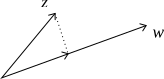
Consider the two non-zero complex numbers  `z`  and  `w`  as vectors.

Which of the following expressions is the projection of  `z`  onto  `w` ? 

  1.  `{text{Re} (zw)}/{|w|} w`
  2.  `|z/w| w`
  3.  `text{Re} (z/w) w`
  4. `{text{Re}(z)}/{|w|} w`
Show Answers Only

`C`

Show Worked Solution

`text{Let} \ \ z = a + i b \ \ =>\ underset~z = ((a),(b))`

♦♦♦ Mean mark 30%.

`text{Let} \ \ w = c + i d \ \ =>\ underset~w = ((c),(d))`

`underset~z * underset~w = ac + bd`

`|underset~w|^2 = c^2 + d^2`

`text{proj}_(underset~w) underset~z = (underset~z*underset~w)/|underset~w|^2 *underset~w= (ac+bd)/(c^2+d^2)*underset~w`

`z/w` `=(a+ib)/(c+id) xx (c-id)/(c-id)`  
  `=(ac+bd + i(bc-ad))/(c^2+d^2)`  

 
`text{Re}(z/w) =(ac+bd)/(c^2+d^2)`

`:.\ text{proj}_(underset~w) underset~z = text{Re} (z/w) w`
 

`=> C`

Filed Under: Basic Concepts and Arithmetic, Geometrical Implications of Complex Numbers Tagged With: Band 6, smc-1052-60-Other problems, smc-1195-40-Unit Vectors and Projections, smc-1195-50-Complex numbers

Vectors, EXT2 V1 2020 SPEC1 5

Let  `underset ~ a = 2 underset ~i - 3 underset ~j + underset ~k`  and  `underset ~b = underset ~i + m underset ~j - underset ~k`, where `m` is an integer.

The projection of  `underset ~a`  onto  `underset ~b`  is  `-11/18 (underset ~i + m underset ~j - underset ~k)`.

  1. Find the value of `m`.  (3 marks)

    --- 6 WORK AREA LINES (style=lined) ---

  2. Find the component of  `underset ~a`  that is perpendicular to  `underset ~b`.  (1 mark)

    --- 3 WORK AREA LINES (style=lined) ---

Show Answers Only
  1. `m = 4`
  2. `47/18 underset ~i – 5/9 underset ~j + 7/18 underset ~k`
Show Worked Solution
a.    `underset ~b ⋅ underset ~a` `= ((1), (m), (-1))((2), (-3), (1)) = 2 – 3m – 1 = 1 – 3m`
  `|underset ~b|^2` `= 1^2 + m^2 + (-1)^2 = m^2 + 2`
`(underset ~b ⋅ underset ~a)/|underset ~b|^2 ⋅ underset ~b` `= -11/18 underset ~b`
`(1 -3m)/(m^2 + 2)` `= -11/18`
`18 – 54m` `= -11m^2 – 22`
`11m^2 – 54m + 40` `=0`  
`(11m – 10)(m – 4)` `=0`  

 
`:. m= 4\ \ (m != 10/11, \ m ∈ Z)`
 

b.    `underset ~a_(⊥ underset ~b)` `= underset ~a + 11/18 (underset ~i + 4 underset ~j – underset ~k)`
    `= 2 underset ~i + 11/18 underset ~i – 3 underset ~j + 44/18 underset ~j + underset ~k – 11/18 underset ~k`
    `= 47/18 underset ~i – 5/9 underset ~j + 7/18 underset ~k`

Filed Under: Basic Concepts and Arithmetic Tagged With: Band 4, Band 5, smc-1195-40-Unit Vectors and Projections

Vectors, EXT2 V1 2014 SPEC1 1

Consider the vector  `underset ~a = sqrt 3 underset ~i - underset ~j - sqrt 2 underset ~k`, where  `underset ~i, underset ~j`  and  `underset ~k`  are unit vectors in the positive directions of the `x, y` and `z` axes respectively.

  1.  Find the unit vector in the direction of  `underset ~a`.  (1 mark)

    --- 2 WORK AREA LINES (style=lined) ---

  2.  Find the acute angle that  `underset ~a`  makes with the positive direction of the `x`-axis.  (2 marks)

    --- 4 WORK AREA LINES (style=lined) ---

  3.  The vector  `underset ~b = 2 sqrt 3 underset ~i + m underset ~j - 5 underset ~k`.


     Given that  `underset ~b`  is perpendicular to  `underset ~a,` find the value of `m`.  (2 marks)

    --- 2 WORK AREA LINES (style=lined) ---

Show Answers Only
  1. `1/sqrt 6 (sqrt 3 underset ~i – underset ~j – sqrt 2 underset ~k)`
  2. `theta = 45^@`
  3. `m = 6 + 5 sqrt 2`
Show Worked Solution
i.    `|underset ~a|` `= sqrt((sqrt 3)^2 + (-1)^2 + (-sqrt 2)^2)`
    `= sqrt 6`
`:. hat underset ~a` `= underset ~a/|underset ~a|`
  `= 1/sqrt 6 (sqrt 3 underset ~i – underset ~j – sqrt 2 underset ~k)`


Mean mark part (b) 51%.

ii.    `underset ~a ⋅ underset ~i` `= sqrt 3 xx 1 = sqrt 3`
  `underset ~a ⋅ underset ~i` `= |underset ~a||underset ~i| cos theta`
    `= sqrt 6 cos theta`
  `sqrt 3` `= sqrt 6 cos theta`
`cos theta` `= 1/sqrt 2`
`:. theta` `= pi/4 = 45^@`


iii.   `underset ~a ⋅ underset ~b = sqrt 3 (2 sqrt 3) + (-1)(m) + (-sqrt 2)(-5) = 0`

`6 – m + 5 sqrt 2` `=0`  
`:. m` `=6 + 5 sqrt 2`  

Filed Under: Basic Concepts and Arithmetic Tagged With: Band 3, Band 4, smc-1195-20-Angles Between Vectors, smc-1195-30-Perpendicular Vectors, smc-1195-40-Unit Vectors and Projections

Copyright © 2014–2025 SmarterEd.com.au · Log in