SmarterEd

Aussie Maths & Science Teachers: Save your time with SmarterEd

  • Login
  • Get Help
  • About

Calculus, MET1 SM-Bank 21

The rule for function  `f` is  `f(x) = e^(-x^2)`.  The diagram shows the graph  `y = f(x)`.

 Inverse Functions, EXT1 2010 HSC 3b

The graph has two points of inflection. 

  1. Find the `x` coordinates of these points.   (2 marks)

    --- 10 WORK AREA LINES (style=lined) ---

  2. Explain why the domain of `f(x)` must be restricted if `f(x)` is to have an inverse function.    (1 mark)

    --- 4 WORK AREA LINES (style=lined) ---

  3. Find the rule for the inverse function `f^(-1)` if the domain of `f(x)` is restricted to  `x ≥ 0.`   (2 marks)

    --- 6 WORK AREA LINES (style=lined) ---

  4. Find the domain for `f^(-1)`.    (1 mark)

    --- 2 WORK AREA LINES (style=lined) ---

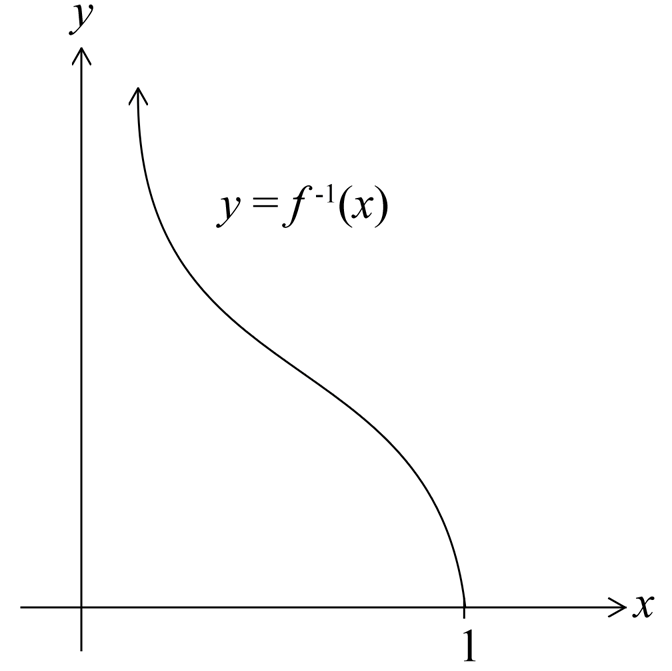
  5. Sketch the curve  `y = f^(-1) (x)`.   (1 mark)

    --- 6 WORK AREA LINES (style=blank) ---

Show Answers Only
  1. `x = +- 1/sqrt2`
  2. `text(There can only be 1 value of)\ y\ text(for each value of)\ x.`
  3. `f^(-1)x = sqrt(ln(1/x))`
  4. `0 <= x <= 1`
  5. Inverse Functions, EXT1 2010 HSC 3b Answer

Show Worked Solution
a.    `y` `= e^(-x^2)`
  `dy/dx` `= -2x * e^(-x^2)`
  `(d^2y)/(dx^2)` `= -2x (-2x * e^(-x^2)) + e ^(-x^2) (-2)`
    `= 4x^2 e^(-x^2)-2e^(-x^2)`
    `= 2e^(-x^2) (2x^2-1)`

 
`text(P.I. when)\ \ (d^2y)/(dx^2) = 0`

`2e^(-x^2) (2x^2-1)` `= 0` 
 `2x^2-1` `= 0` 
 `x^2` `= 1/2`
 `x` `= +- 1/sqrt2` 
COMMENT: It is also valid to show that `f(x)` is an even function and if a P.I. exists at `x=a`, there must be another P.I. at `x=–a`.
`text(When)\ \ ` `x < 1/sqrt2,` `\ (d^2y)/(dx^2) < 0`
  `x > 1/sqrt2,` `\ (d^2y)/(dx^2) > 0`

 
`=>\ text(Change of concavity)`

`:.\ text(P.I. at)\ \ x = 1/sqrt2`
 

`text(When)\ \ ` `x <-1/sqrt2,` `\ (d^2y)/(dx^2) > 0`
  `x >-1/sqrt2,` `\ (d^2y)/(dx^2) < 0`

 
`=>\ text(Change of concavity)`

`:.\ text(P.I. at)\ \ x =-1/sqrt2`


b.   `text(In)\ f(x), text(there are 2 values of)\ y\ text(for)`
  `text(each value of)\ x.`
  `:.\ text(The domain of)\ f(x)\ text(must be restricted)`
  `text(for)\ \ f^(-1) (x)\ text(to exist).`


c.  `y = e^(-x^2)`

`text(Inverse: swap)\  x harr y` 

`x` `= e^(-y^2),\ \ \ x >= 0`
`lnx` `= ln e^(-y^2)`
`-y^2` `= lnx`
`y^2` `= -lnx`
  `=ln(1/x)`
`y` `= +- sqrt(ln (1/x))`


`text(Restricting)\ \ x>=0,\ \ =>y>=0`

`:.  f^(-1) (x)=sqrt(ln (1/x))`


d.   `f(0) = e^0 = 1`

`:.\ text(Range of)\ \ f(x)\ \ text(is)\ \ 0 < y <= 1`

`:.\ text(Domain of)\ \ f^(-1) (x)\ \ text(is)\ \ 0 < x <= 1`


e. 

Inverse Functions, EXT1 2010 HSC 3b Answer

Filed Under: Curve Sketching, Logs and Exponential Functions Tagged With: Band 4, Band 5, smc-5204-70-Sketch graph, smc-724-30-Log/Exponential, smc-724-40-Inverse functions

Functions, MET1 2008 VCAA 10

Let  `f: R -> R,\ \ f(x) = e^(2x)-1`.

  1. Find the rule and domain of the inverse function  `f^(-1)`.   (2 marks)

    --- 5 WORK AREA LINES (style=lined) ---

  2. On the axes provided, sketch the graph of  `y = f(f^(-1)(x))`  for its maximal domain.   (1 mark)

    --- 0 WORK AREA LINES (style=lined) ---


    met1-2008-vcaa-q2
     

  3. Find  `f(-f^(-1)(2x))`  in the form  `(ax)/(bx + c)`  where `a`, `b` and `c` are real constants.   (2 marks)

    --- 5 WORK AREA LINES (style=lined) ---

Show Answers Only
  1. `f^(-1)(x) = 1/2log_e(x + 1), x ∈ (-1,∞)`
  2.  
    met1-2008-vcaa-q10-answer
  3. `f(-f^(-1)(2x)) = (-2x)/(2x + 1)`
Show Worked Solution

a.   `text(Let)\ \ y = f(x)`

`text(For Inverse, swap)\ x ↔ y`

`x` `= e^(2y)-1`
`x + 1` `= e^(2y)`
`2y` `= log_e(x + 1)`
`y` `= 1/2 log_e(x + 1)`
`text(Domain)(f^(-1))` `=\ text(Range)\ (f)`
  `= (-1,∞)`


`:. f^(-1)(x) = 1/2log_e(x + 1),quadx ∈ (-1,∞)`
  

b.   `f(f^(-1)(x)) = x`

♦ Mean mark part (b) 19%.
MARKER’S COMMENT: Few students were aware that a function of its own inverse function is the line  `y=x`  over the appropriate domain.

`text(Domain is)\ \ (-1, oo)`

met1-2008-vcaa-q10-answer


♦ Mean mark 34%.
c.    `-f^(-1)(2x)` `= -1/2 ln(2x + 1)`
  `:. f(-f^(-1)(2x))` `= e^(-log_e(2x + 1))-1`
    `=(2x+1)^-1-1`
    `= 1/(2x + 1)-1`
    `= (-2x)/(2x + 1)`

Filed Under: Functional Equations, Logs and Exponential Functions Tagged With: Band 4, Band 5, Band 6, smc-5204-70-Sketch graph, smc-642-10-(f o g)(x)

Calculus, MET2 2010 VCAA 1

  1. Part of the graph of the function  `g: (-4, oo) -> R,\ g(x) = 2 log_e (x + 4) + 1`  is shown on the axes below


    1. Find the rule and domain of  `g^-1`, the inverse function of  `g`.   (3 marks)

      --- 4 WORK AREA LINES (style=lined) ---

    2. On the set of axes above sketch the graph of  `g^-1`. Label the axes intercepts with their exact values.   (3 marks)

      --- 0 WORK AREA LINES (style=lined) ---

    3. Find the values of `x`, correct to three decimal places, for which  `g^-1(x) = g(x)`.   (2 marks)

      --- 3 WORK AREA LINES (style=lined) ---

    4. Calculate the area enclosed by the graphs of  `g`  and  `g^-1`. Give your answer correct to two decimal places.   (2 marks)

      --- 3 WORK AREA LINES (style=lined) ---

  2. The diagram below shows part of the graph of the function with rule
  3.         `f (x) = k log_e (x + a) + c`, where `k`, `a` and `c` are real constants.
     

    • The graph has a vertical asymptote with equation  `x =-1`.
    • The graph has a y-axis intercept at 1.
    • The point `P` on the graph has coordinates  `(p, 10)`, where `p` is another real constant.
       

      VCAA 2010 1b

    1. State the value of `a`.   (1 mark)

      --- 1 WORK AREA LINES (style=lined) ---

    2. Find the value of `c`.   (1 mark)

      --- 1 WORK AREA LINES (style=lined) ---

    3. Show that  `k = 9/(log_e (p + 1)`.   (2 marks)

      --- 4 WORK AREA LINES (style=lined) ---

    4. Show that the gradient of the tangent to the graph of `f` at the point `P` is  `9/((p + 1) log_e (p + 1))`.   (1 mark)

      --- 3 WORK AREA LINES (style=lined) ---

    5. If the point  `(-1, 0)`  lies on the tangent referred to in part b.iv., find the exact value of `p`.   (2 marks)

      --- 4 WORK AREA LINES (style=lined) ---

Show Answers Only
  1.   i. `g^-1(x) = e^((x-1)/2)-4,\ \ x in R`
  2.  ii. 
     
  3. iii. `3.914 or 5.503`
  4. iv. `52.63\ text(units²)`
  5.   i. `1`
  6.  ii. `1`
  7. iii. `text(Proof)\ \ text{(See Worked Solutions)}`
  8.  iv. `text(Proof)\ \ text{(See Worked Solutions)}`
  9.   v. `e^(9/10)-1`
Show Worked Solution

a.i.   `text(Let)\ \ y = g(x)`

`text(Inverse:  swap)\ \ x harr y,\ \ text(Domain)\ (g^-1) = text(Range)\ (g)`

`x = 2 log_e (y + 4) + 1`

`:. g^{-1} (x) = e^((x-1)/2)-4,\ \ x in R`


ii.  


 iii.  `text(Intercepts of a function and its inverse occur)`

  `text(on the line)\ \ y=x.`

`text(Solve:)\ \ g(x) = g^{-1} (x)\ \ text(for)\ \ x`

`:. x dot = -3.914 or x = 5.503\ \ text{(3 d.p.)}`


  iv.   `text(Area)` `= int_(-3.91432…)^(5.50327…) (g(x)-g^-1 (x))\ dx`
    `= 52.63\ text{u²   (2 d.p.)}`


b.i.   `text(Vertical Asymptote:)`

`x =-1`

`:. a = 1`


  ii.   `text(Solve)\ \ f(0) = 1\ \ text(for)\ \ c,`

`c = 1`


iii.  `f(x)= k log_e (x + 1) + 1`

`text(S)text(ince)\ \ f(p)=10,`

`k log_e (p + 1) + 1` `= 10`
`k log_e (p + 1)` `= 9`
`:. k` `= 9/(log_e (p + 1))\ text(… as required)`


  iv.   `f^{′}(x)` `= k/(x + 1)`
  `f^{′}(p)` `= k/(p + 1)`
    `= (9/(log_e(p + 1))) xx 1/(p + 1)\ \ \ text{(using part (iii))}`
    `= 9/((p + 1)log_e(p + 1))\ text(… as required)`


  v.   `text(Two points on tangent line:)`

♦♦ Mean mark 33%.
MARKER’S COMMENT: Many students worked out the equation of the tangent which was unnecessary and time consuming.

`(p, 10),\ \ (-1, 0)`

`f^{′} (p)` `= (10-0)/(p-(-1))`
  `=10/(p+1)`

`text(Solve:)\ \ 9/((p + 1)log_e(p + 1))=10/(p+1)\ \ \ text(for)\ p,`

`:.p= e^(9/10)-1`

Filed Under: Area Under Curves, Graphs and Applications, Logs and Exponential Functions Tagged With: Band 3, Band 4, Band 5, smc-2745-40-Log graphs, smc-2745-50-Find Domain/Range, smc-5204-70-Sketch graph, smc-5204-80-Area between curves, smc-723-50-Log/Exponential, smc-723-80-Area between graphs

Copyright © 2014–2025 SmarterEd.com.au · Log in