SmarterEd

Aussie Maths & Science Teachers: Save your time with SmarterEd

  • Login
  • Get Help
  • About

HMS, TIP 2025 HSC 30aii

How does fluid intake support evaporation to regulate the body's temperature?   (5 marks)

--- 15 WORK AREA LINES (style=lined) ---

Show Answers Only
  • Adequate fluid intake maintains blood plasma volume for sweat production. This occurs because the body requires sufficient water stores to transport heat from core to skin surface.
  • When athletes consume fluids regularly, sweat glands produce moisture continuously on skin. This allows evaporation to occur, which removes heat energy from the body surface.
  • For example, a cyclist drinking 200ml every 15 minutes during summer training sustains perspiration rates. As a result, evaporative cooling prevents dangerous core temperature elevation during prolonged effort.
  • Insufficient hydration reduces sweat production capacity. Consequently, the body loses its primary cooling mechanism, leading to heat exhaustion or heatstroke risk during physical activity.
  • The reason for this is that without adequate fluid replacement, blood volume decreases, limiting the body’s ability to deliver water to sweat glands for effective thermoregulation.
Show Worked Solution
  • Adequate fluid intake maintains blood plasma volume for sweat production. This occurs because the body requires sufficient water stores to transport heat from core to skin surface.
  • When athletes consume fluids regularly, sweat glands produce moisture continuously on skin. This allows evaporation to occur, which removes heat energy from the body surface.
  • For example, a cyclist drinking 200ml every 15 minutes during summer training sustains perspiration rates. As a result, evaporative cooling prevents dangerous core temperature elevation during prolonged effort.
  • Insufficient hydration reduces sweat production capacity. Consequently, the body loses its primary cooling mechanism, leading to heat exhaustion or heatstroke risk during physical activity.
  • The reason for this is that without adequate fluid replacement, blood volume decreases, limiting the body’s ability to deliver water to sweat glands for effective thermoregulation.

Filed Under: Dietary requirements and fluid intake Tagged With: Band 4, smc-5466-20-Fluid intake

HMS, TIP EQ-Bank 269

Justify why sports drinks are more effective than water alone for endurance athletes competing in events lasting longer than one hour in hot conditions.   (6 marks)

--- 20 WORK AREA LINES (style=lined) ---

Show Answers Only

Position Statement

  • Sports drinks prove more effective than water alone for endurance athletes in prolonged hot conditions due to their carbohydrate and electrolyte content addressing multiple physiological needs.

Sports Drinks Advantages

  • Sports drinks provide carbohydrate replacement essential for maintaining blood glucose levels during extended exercise beyond one hour duration.
  • Evidence demonstrates that endurance events in hot and humid conditions significantly impact the body’s fuel and fluid supplies simultaneously.
  • Research shows sports drinks containing carbohydrates and electrolytes support both energy maintenance and hydration replacement needs effectively.
  • Studies indicate that electrolyte replacement becomes critical during prolonged sweating to maintain proper muscle function and prevent cramping.
  • The carbohydrate content helps replenish glycogen stores while the fluid component addresses dehydration risks in hot environments.

Water Limitations

  • Water alone fails to replace lost electrolytes during extensive sweating, potentially leading to hyponatraemia in extreme cases.
  • Plain water provides no carbohydrate fuel replacement, limiting sustained energy availability during prolonged endurance events.
  • Evidence shows water consumption without electrolyte replacement can compromise muscle contraction efficiency during extended exercise.

Reinforcement

  • While water meets basic hydration needs, sports drinks address the complex physiological demands of endurance exercise in challenging environmental conditions.
  • Therefore sports drinks provide superior support for maintaining both hydration and energy levels during prolonged hot weather competition.
Show Worked Solution

Position Statement

  • Sports drinks prove more effective than water alone for endurance athletes in prolonged hot conditions due to their carbohydrate and electrolyte content addressing multiple physiological needs.

Sports Drinks Advantages

  • Sports drinks provide carbohydrate replacement essential for maintaining blood glucose levels during extended exercise beyond one hour duration.
  • Evidence demonstrates that endurance events in hot and humid conditions significantly impact the body’s fuel and fluid supplies simultaneously.
  • Research shows sports drinks containing carbohydrates and electrolytes support both energy maintenance and hydration replacement needs effectively.
  • Studies indicate that electrolyte replacement becomes critical during prolonged sweating to maintain proper muscle function and prevent cramping.
  • The carbohydrate content helps replenish glycogen stores while the fluid component addresses dehydration risks in hot environments.

Water Limitations

  • Water alone fails to replace lost electrolytes during extensive sweating, potentially leading to hyponatraemia in extreme cases.
  • Plain water provides no carbohydrate fuel replacement, limiting sustained energy availability during prolonged endurance events.
  • Evidence shows water consumption without electrolyte replacement can compromise muscle contraction efficiency during extended exercise.

Reinforcement

  • While water meets basic hydration needs, sports drinks address the complex physiological demands of endurance exercise in challenging environmental conditions.
  • Therefore sports drinks provide superior support for maintaining both hydration and energy levels during prolonged hot weather competition.

Filed Under: Dietary requirements and fluid intake Tagged With: Band 4, smc-5466-10-Pre and during, smc-5466-20-Fluid intake

HMS, TIP EQ-Bank 268

Explain how environmental conditions and individual factors influence an athlete's fluid replacement needs during training and competition.   (4 marks)

--- 12 WORK AREA LINES (style=lined) ---

Show Answers Only
  • Environmental conditions impact fluid requirements as hotter temperatures increase sweat rate and fluid loss during exercise.
  • Humidity levels influence the body’s ability to cool through evaporation, requiring higher fluid intake in humid conditions.
  • Individual sweat rates vary between athletes, meaning personalised hydration strategies are essential for optimal performance.
  • Clothing type affects heat retention and sweat production, influencing total fluid replacement needs during activity.
  • Exercise intensity and duration determine the extent of fluid loss through increased metabolic heat production.
  • Therefore athletes must tailor fluid intake to individual needs and environmental factors rather than following generic recommendations.
Show Worked Solution
  • Environmental conditions impact fluid requirements as hotter temperatures increase sweat rate and fluid loss during exercise.
  • Humidity levels influence the body’s ability to cool through evaporation, requiring higher fluid intake in humid conditions.
  • Individual sweat rates vary between athletes, meaning personalised hydration strategies are essential for optimal performance.
  • Clothing type affects heat retention and sweat production, influencing total fluid replacement needs during activity.
  • Exercise intensity and duration determine the extent of fluid loss through increased metabolic heat production.
  • Therefore athletes must tailor fluid intake to individual needs and environmental factors rather than following generic recommendations.

Filed Under: Dietary requirements and fluid intake Tagged With: Band 3, smc-5466-20-Fluid intake

HMS, TIP EQ-Bank 267

Describe the general daily fluid intake recommendations for athletes and the indicators used to monitor hydration status.   (3 marks)

--- 9 WORK AREA LINES (style=lined) ---

Show Answers Only
  • The general baseline recommendation for athletes is 3.7 litres per day for men and 2.7 litres per day for women.
  • However, fluid intake varies significantly with training intensity and climate conditions requiring individual adjustments.
  • Athletes should aim for pale yellow urine as a sign of good hydration status.
  • Urine colour monitoring helps assess hydration levels, with lighter colours indicating better hydration.
  • Darker urine colour indicates dehydration and the need for increased fluid intake.
Show Worked Solution
  • The general baseline recommendation for athletes is 3.7 litres per day for men and 2.7 litres per day for women.
  • However, fluid intake varies significantly with training intensity and climate conditions requiring individual adjustments.
  • Athletes should aim for pale yellow urine as a sign of good hydration status.
  • Urine colour monitoring helps assess hydration levels, with lighter colours indicating better hydration.
  • Darker urine colour indicates dehydration and the need for increased fluid intake.

Filed Under: Dietary requirements and fluid intake Tagged With: Band 3, smc-5466-20-Fluid intake

HMS, TIP 2014 HSC 25

Outline the post-performance dietary considerations of an endurance athlete.   (3 marks)

--- 7 WORK AREA LINES (style=lined) ---

Show Answers Only

Carbohydrate replenishment:

  • High glycaemic index foods consumed within 30 minutes post-exercise
    • Restores depleted muscle and liver glycogen stores effectively
    • Sports drinks or bananas facilitate rapid glycogen synthesis

Protein intake:

  • Consume 20-25 grams of quality protein for muscle repair
    • Lean meat, dairy or protein supplements provide essential amino acids
    • Supports muscle adaptation and reduces tissue breakdown

Rehydration:

  • Replace 2-3 litres of fluid losses from sweating
    • Water and electrolyte solutions restore cellular function
    • Proper hydration facilitates nutrient transport and waste removal
Show Worked Solution

Carbohydrate replenishment:

  • High glycaemic index foods consumed within 30 minutes post-exercise
    • Restores depleted muscle and liver glycogen stores effectively
    • Sports drinks or bananas facilitate rapid glycogen synthesis

Protein intake:

  • Consume 20-25 grams of quality protein for muscle repair
    • Lean meat, dairy or protein supplements provide essential amino acids
    • Supports muscle adaptation and reduces tissue breakdown

Rehydration:

  • Replace 2-3 litres of fluid losses from sweating
    • Water and electrolyte solutions restore cellular function
    • Proper hydration facilitates nutrient transport and waste removal

Filed Under: Dietary requirements and fluid intake Tagged With: Band 3, smc-5466-15-Post-performance, smc-5466-20-Fluid intake

HMS, TIP 2016 HSC 14 MC

Athletes dehydrate while competing in sporting events.

Which strategy would best address dehydration?

  1. Drinking 250 mL of water for every 30 minutes of competition
  2. Drinking 300 mL to 500 mL of water prior to commencing the event
  3. Drinking 600 mL of an energy sports drink at the completion of the event
  4. Drinking  100 mL of water for every 100 grams of body weight lost during the event
Show Answers Only

\(D\)

Show Worked Solution
  • D is correct: Replacing fluid based on actual weight loss ensures proper rehydration.

Other Options:

  • A is incorrect: Fixed amounts don’t account for individual sweat rates.
  • B is incorrect: Pre-event hydration doesn’t address dehydration during competition.
  • C is incorrect: Post-event only doesn’t prevent dehydration during competition.

♦♦♦ Mean mark 34%.

Filed Under: Dietary requirements and fluid intake Tagged With: Band 5, smc-5466-20-Fluid intake

HMS, TIP 2021 HSC 20 MC

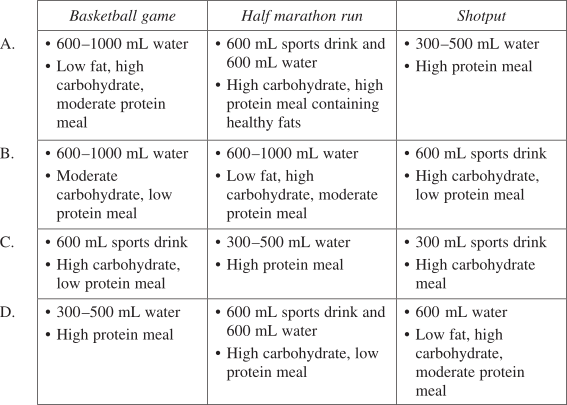
Which row in the table provides the most effective post-performance dietary intake within 60 minutes of athletes competing in the identified events?


Show Answers Only

\(A\)

Show Worked Solution
  • A is correct: Matches energy system demands and recovery needs for each sport.

Other Options:

  • B is incorrect: Inadequate carbohydrate replacement for endurance and team sports.
  • C is incorrect: Poor fluid replacement and inappropriate macronutrient ratios.
  • D is incorrect: Shotput needs protein focus not high carbohydrate intake.

Filed Under: Dietary requirements and fluid intake Tagged With: Band 4, smc-5466-05-Sport-specific needs, smc-5466-15-Post-performance, smc-5466-20-Fluid intake

Copyright © 2014–2026 SmarterEd.com.au · Log in