SmarterEd

Aussie Maths & Science Teachers: Save your time with SmarterEd

  • Login
  • Get Help
  • About

HMS, TIP NSE-Bank 2 MC

Which of the following athletes requires the highest amount of carbohydrate post-performance?

  1. Weightlifter
  2. Discus thrower
  3. Marathon runner
  4. 100-metre swimmer
Show Answers Only

C

Show Worked Solution
  • C is correct

Other options: 

  • A, B and D are incorrect: These activities are shorter in duration and deplete less muscle glycogen than marathon running.

Filed Under: Dietary requirements and fluid intake Tagged With: Band 3, smc-5466-05-Sport-specific needs, smc-5466-15-Post-performance

HMS, TIP 2025 HSC 17 MC

A basketball player has a competition game in the afternoon.

Which row of the table describes the appropriate dietary considerations of the athlete for this game?

\begin{align*}
\begin{array}{l}
\rule{0pt}{2.5ex} \ \rule[-1ex]{0pt}{0pt}& \\
\rule{0pt}{2.5ex} \textbf{A.}\rule[-1ex]{0pt}{0pt}\\
\textbf{}\\
\textbf{}\\
\textbf{}\\
\rule{0pt}{2.5ex} \textbf{B.}\\
\textbf{}\\
\textbf{}\\
\textbf{}\\
\rule{0pt}{2.5ex} \textbf{C.}\\
\textbf{}\\
\textbf{}\\
\textbf{}\\
\rule{0pt}{2.5ex} \textbf{D.}\\
\textbf{}\\
\textbf{}\\
\textbf{}\\\\
\end{array}
\begin{array}{|l|l|}
\hline
\rule{0pt}{2.5ex}Pre-performance \rule[-1ex]{0pt}{0pt}& During \ performance \rule[-1ex]{0pt}{0pt} & Post-performance \\
\hline
\rule{0pt}{2.5ex} \text{A meal high in} &\text{Water and a sports drink}  & \text{A meal high in} \\
\text{carbohydrates two to} &\text{}  & \text{carbohydrates and} \\
\text{three hours before the} &\text{}  & \text{protein within an hour}\\
\text{game } & {} & \text{of the game } \\
\hline
\rule{0pt}{2.5ex} \text{A meal high in fat and} & \text{Water and oranges }  & \text{A snack with protein} \\
\text{protein one hour before} & \text{} & \text{and fat immediately} \\
\text{the game } & \text{} & \text{after the game } \\
\hline
\rule{0pt}{2.5ex} \text{A light snack 30 minutes} & \text{Water and electrolyte}  & \text{A meal that contains} \\
\text{before the game} & \text{gel} & \text{protein and fat} \\
\text{} & \text{} & \text{immediately after the } \\
\text{} & \text{} & \text{game} \\
\hline
\rule{0pt}{2.5ex} \text{A large meal that is} & \text{Water and a protein bar}  & \text{A snack high in} \\
\text{high in protein one hour} & \text{} & \text{pcarbohydrates and} \\
\text{high in protein one hour} & \text{} & \text{protein within an hour} \\
\text{} & \text{} & \text{of the game} \\
\hline
\end{array}
\end{align*}

Show Answers Only

\(A\)

Show Worked Solution
  • A is correct: Carbohydrate-loading 2-3 hours before allows digestion; hydration during game; carbs and protein aid recovery

Other Options:

  • B is incorrect: High fat/protein pre-game slows digestion; oranges provide insufficient hydration; immediate fat delays recovery
  • C is incorrect: Light snack 30 minutes before provides inadequate energy; immediate protein/fat post-game delays glycogen restoration
  • D is incorrect: Large protein meal 1 hour before causes digestive discomfort; protein bar during game unnecessary

Filed Under: Dietary requirements and fluid intake Tagged With: Band 3, smc-5466-10-Pre and during, smc-5466-15-Post-performance

HMS, TIP EQ-Bank 264

Outline the general principles of nutrient timing for endurance athletes before, during and after performance.   (3 marks)

--- 9 WORK AREA LINES (style=lined) ---

Show Answers Only
  • Pre-performance nutrition should focus on carbohydrate intake several hours before activity to optimise glycogen stores for sustained exercise.
  • Food consumed prior to activity is useful only if digested and its energy made available to working muscles.
  • During longer endurance events, athletes need carbohydrate replacement to maintain blood glucose levels and delay fatigue.
  • Post-performance nutrition aims to quickly restore glycogen stores and return the body to its pre-event state.
  • Proper timing maximises energy availability while avoiding digestive issues during prolonged competition.
Show Worked Solution
  • Pre-performance nutrition should focus on carbohydrate intake several hours before activity to optimise glycogen stores for sustained exercise.
  • Food consumed prior to activity is useful only if digested and its energy made available to working muscles.
  • During longer endurance events, athletes need carbohydrate replacement to maintain blood glucose levels and delay fatigue.
  • Post-performance nutrition aims to quickly restore glycogen stores and return the body to its pre-event state.
  • Proper timing maximises energy availability while avoiding digestive issues during prolonged competition.

Filed Under: Dietary requirements and fluid intake Tagged With: Band 3, smc-5466-10-Pre and during, smc-5466-15-Post-performance

HMS, TIP EQ-Bank 260

Justify why post-performance nutrition is more critical for endurance athletes compared to power athletes in terms of recovery and preparation for subsequent training sessions.   (6 marks)

--- 18 WORK AREA LINES (style=lined) ---

Show Answers Only

Position Statement

  • Post-performance nutrition proves more critical for endurance athletes than power athletes.
  • This is due to greater glycogen depletion and extended recovery requirements following prolonged exercise.

Endurance Athletes’ Greater Needs

  • Endurance events significantly deplete muscle and liver glycogen stores through sustained aerobic energy system demands over extended periods.
  • Evidence demonstrates that endurance athletes experience substantial fluid losses through prolonged sweating, requiring immediate replacement of 125-150 percent of fluids lost.
  • Research shows endurance performance relies heavily on carbohydrate availability, making rapid glycogen restoration essential for subsequent training capacity.
  • Post-performance nutrition aims to return the body to its pre-event state as quickly as possible, enabling full training to resume.
  • Studies indicate that delayed carbohydrate intake following endurance events compromises glycogen resynthesis and prolongs recovery periods.

Power Athletes’ Lesser Requirements

  • Power athletes typically complete shorter duration activities that rely primarily on ATP/PCr energy systems with minimal glycogen depletion.
  • These events generally produce less fluid loss and metabolic disruption compared to prolonged endurance activities.
  • Recovery demands focus more on neural system restoration rather than extensive fuel and fluid replacement.

Reinforcement

  • While all athletes benefit from post-exercise nutrition, endurance athletes face greater physiological demands requiring more immediate and comprehensive nutritional intervention.
  • Therefore post-performance nutrition strategies must be prioritised for endurance athletes to maintain training quality and competitive performance.
Show Worked Solution

Position Statement

  • Post-performance nutrition proves more critical for endurance athletes than power athletes.
  • This is due to greater glycogen depletion and extended recovery requirements following prolonged exercise.

Endurance Athletes’ Greater Needs

  • Endurance events significantly deplete muscle and liver glycogen stores through sustained aerobic energy system demands over extended periods.
  • Evidence demonstrates that endurance athletes experience substantial fluid losses through prolonged sweating, requiring immediate replacement of 125-150 percent of fluids lost.
  • Research shows endurance performance relies heavily on carbohydrate availability, making rapid glycogen restoration essential for subsequent training capacity.
  • Post-performance nutrition aims to return the body to its pre-event state as quickly as possible, enabling full training to resume.
  • Studies indicate that delayed carbohydrate intake following endurance events compromises glycogen resynthesis and prolongs recovery periods.

Power Athletes’ Lesser Requirements

  • Power athletes typically complete shorter duration activities that rely primarily on ATP/PCr energy systems with minimal glycogen depletion.
  • These events generally produce less fluid loss and metabolic disruption compared to prolonged endurance activities.
  • Recovery demands focus more on neural system restoration rather than extensive fuel and fluid replacement.

Reinforcement

  • While all athletes benefit from post-exercise nutrition, endurance athletes face greater physiological demands requiring more immediate and comprehensive nutritional intervention.
  • Therefore post-performance nutrition strategies must be prioritised for endurance athletes to maintain training quality and competitive performance.

Filed Under: Dietary requirements and fluid intake Tagged With: Band 5, smc-5466-05-Sport-specific needs, smc-5466-15-Post-performance

HMS, TIP 2012 HSC 13 MC

When should athletes consume greater quantities of high glycaemic index (GI) foods?

  1. During performance
  2. Immediately post-performance
  3. Up to two hours pre-performance
  4. During the first two days of carbohydrate loading
Show Answers Only

\(B\)

Show Worked Solution
  • B is correct: High GI foods immediately post-performance rapidly replenish glycogen stores.

Other Options:

  • A is incorrect: High GI foods during performance may cause blood sugar spikes.
  • C is incorrect: Low GI foods preferred pre-performance for sustained energy release.
  • D is incorrect: Carb loading uses moderate GI foods over extended period.

♦♦ Mean mark 30%.

Filed Under: Dietary requirements and fluid intake Tagged With: Band 6, smc-5466-10-Pre and during, smc-5466-15-Post-performance

HMS, TIP 2014 HSC 25

Outline the post-performance dietary considerations of an endurance athlete.   (3 marks)

--- 7 WORK AREA LINES (style=lined) ---

Show Answers Only

Carbohydrate replenishment:

  • High glycaemic index foods consumed within 30 minutes post-exercise
    • Restores depleted muscle and liver glycogen stores effectively
    • Sports drinks or bananas facilitate rapid glycogen synthesis

Protein intake:

  • Consume 20-25 grams of quality protein for muscle repair
    • Lean meat, dairy or protein supplements provide essential amino acids
    • Supports muscle adaptation and reduces tissue breakdown

Rehydration:

  • Replace 2-3 litres of fluid losses from sweating
    • Water and electrolyte solutions restore cellular function
    • Proper hydration facilitates nutrient transport and waste removal
Show Worked Solution

Carbohydrate replenishment:

  • High glycaemic index foods consumed within 30 minutes post-exercise
    • Restores depleted muscle and liver glycogen stores effectively
    • Sports drinks or bananas facilitate rapid glycogen synthesis

Protein intake:

  • Consume 20-25 grams of quality protein for muscle repair
    • Lean meat, dairy or protein supplements provide essential amino acids
    • Supports muscle adaptation and reduces tissue breakdown

Rehydration:

  • Replace 2-3 litres of fluid losses from sweating
    • Water and electrolyte solutions restore cellular function
    • Proper hydration facilitates nutrient transport and waste removal

Filed Under: Dietary requirements and fluid intake Tagged With: Band 3, smc-5466-15-Post-performance, smc-5466-20-Fluid intake

HMS, TIP 2021 HSC 20 MC

Which row in the table provides the most effective post-performance dietary intake within 60 minutes of athletes competing in the identified events?
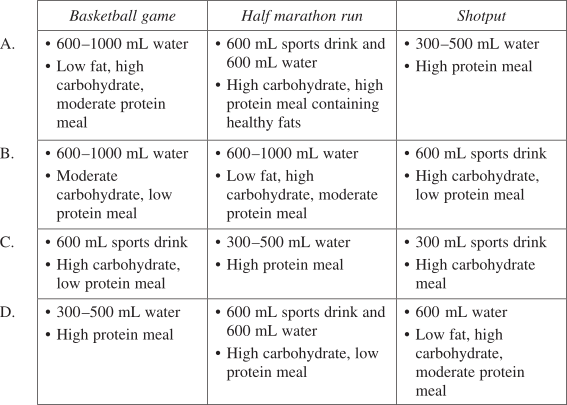
 

Show Answers Only

\(A\)

Show Worked Solution
  • A is correct: Matches energy system demands and recovery needs for each sport.

Other Options:

  • B is incorrect: Inadequate carbohydrate replacement for endurance and team sports.
  • C is incorrect: Poor fluid replacement and inappropriate macronutrient ratios.
  • D is incorrect: Shotput needs protein focus not high carbohydrate intake.

Filed Under: Dietary requirements and fluid intake Tagged With: Band 4, smc-5466-05-Sport-specific needs, smc-5466-15-Post-performance, smc-5466-20-Fluid intake

HMS, TIP 2024 HSC 8 MC

Which nutritional consideration should be prioritised for a cyclist during a 7-day, multi-stage road event?

  1. Protein loading
  2. High calorie intake
  3. Caffeine supplementation
  4. Carbohydrate replenishment
Show Answers Only

\(D\)

Show Worked Solution
  • D is correct: Multi-day cycling requires daily carbohydrate replenishment to restore depleted glycogen stores.

Other Options:

  • A is incorrect: Protein supports recovery not immediate energy needs.
  • B is incorrect: Carbohydrate type more critical than total calories.
  • C is incorrect: Caffeine beneficial but not primary nutritional priority.

Filed Under: Dietary requirements and fluid intake Tagged With: Band 3, smc-5466-05-Sport-specific needs, smc-5466-15-Post-performance

Copyright © 2014–2026 SmarterEd.com.au · Log in