SmarterEd

Aussie Maths & Science Teachers: Save your time with SmarterEd

  • Login
  • Get Help
  • About

HMS, TIP NSE-Bank 2 MC

Which of the following athletes requires the highest amount of carbohydrate post-performance?

  1. Weightlifter
  2. Discus thrower
  3. Marathon runner
  4. 100-metre swimmer
Show Answers Only

C

Show Worked Solution
  • C is correct

Other options: 

  • A, B and D are incorrect: These activities are shorter in duration and deplete less muscle glycogen than marathon running.

Filed Under: Dietary requirements and fluid intake Tagged With: Band 3, smc-5466-05-Sport-specific needs, smc-5466-15-Post-performance

HMS, TIP EQ-Bank 261

Describe the main functions of the three macronutrients and how requirements for each differ between endurance and power athletes.   (3 marks)

--- 9 WORK AREA LINES (style=lined) ---

Show Answers Only

Answers could include three of the following:

  • Carbohydrates are stored as glycogen and are the main fuel source for the aerobic and glycolytic energy systems. Endurance athletes need a much higher daily intake to sustain prolonged activity.
  • Power athletes rely mainly on the ATP-PCr system for short, explosive efforts. Their carbohydrate needs are lower, but intake still supports training volume and recovery.
  • Fats are stored as triglycerides and supply energy during prolonged, lower-intensity exercise. They make a greater contribution for endurance athletes than for power athletes.
  • Protein repairs and rebuilds muscle tissue. Power athletes such as weightlifters have higher requirements to support muscle growth and strength adaptation, while endurance athletes need protein mainly for tissue repair.
Show Worked Solution

Answers could include three of the following:

  • Carbohydrates are stored as glycogen and are the main fuel source for the aerobic and glycolytic energy systems. Endurance athletes need a much higher daily intake to sustain prolonged activity.
  • Power athletes rely mainly on the ATP-PCr system for short, explosive efforts. Their carbohydrate needs are lower, but intake still supports training volume and recovery.
  • Fats are stored as triglycerides and supply energy during prolonged, lower-intensity exercise. They make a greater contribution for endurance athletes than for power athletes.
  • Protein repairs and rebuilds muscle tissue. Power athletes such as weightlifters have higher requirements to support muscle growth and strength adaptation, while endurance athletes need protein mainly for tissue repair.

Filed Under: Dietary requirements and fluid intake Tagged With: Band 3, smc-5466-05-Sport-specific needs

HMS, TIP EQ-Bank 260

Justify why post-performance nutrition is more critical for endurance athletes compared to power athletes in terms of recovery and preparation for subsequent training sessions.   (6 marks)

--- 18 WORK AREA LINES (style=lined) ---

Show Answers Only

Position Statement

  • Post-performance nutrition proves more critical for endurance athletes than power athletes.
  • This is due to greater glycogen depletion and extended recovery requirements following prolonged exercise.

Endurance Athletes’ Greater Needs

  • Endurance events significantly deplete muscle and liver glycogen stores through sustained aerobic energy system demands over extended periods.
  • Evidence demonstrates that endurance athletes experience substantial fluid losses through prolonged sweating, requiring immediate replacement of 125-150 percent of fluids lost.
  • Research shows endurance performance relies heavily on carbohydrate availability, making rapid glycogen restoration essential for subsequent training capacity.
  • Post-performance nutrition aims to return the body to its pre-event state as quickly as possible, enabling full training to resume.
  • Studies indicate that delayed carbohydrate intake following endurance events compromises glycogen resynthesis and prolongs recovery periods.

Power Athletes’ Lesser Requirements

  • Power athletes typically complete shorter duration activities that rely primarily on ATP/PCr energy systems with minimal glycogen depletion.
  • These events generally produce less fluid loss and metabolic disruption compared to prolonged endurance activities.
  • Recovery demands focus more on neural system restoration rather than extensive fuel and fluid replacement.

Reinforcement

  • While all athletes benefit from post-exercise nutrition, endurance athletes face greater physiological demands requiring more immediate and comprehensive nutritional intervention.
  • Therefore post-performance nutrition strategies must be prioritised for endurance athletes to maintain training quality and competitive performance.
Show Worked Solution

Position Statement

  • Post-performance nutrition proves more critical for endurance athletes than power athletes.
  • This is due to greater glycogen depletion and extended recovery requirements following prolonged exercise.

Endurance Athletes’ Greater Needs

  • Endurance events significantly deplete muscle and liver glycogen stores through sustained aerobic energy system demands over extended periods.
  • Evidence demonstrates that endurance athletes experience substantial fluid losses through prolonged sweating, requiring immediate replacement of 125-150 percent of fluids lost.
  • Research shows endurance performance relies heavily on carbohydrate availability, making rapid glycogen restoration essential for subsequent training capacity.
  • Post-performance nutrition aims to return the body to its pre-event state as quickly as possible, enabling full training to resume.
  • Studies indicate that delayed carbohydrate intake following endurance events compromises glycogen resynthesis and prolongs recovery periods.

Power Athletes’ Lesser Requirements

  • Power athletes typically complete shorter duration activities that rely primarily on ATP/PCr energy systems with minimal glycogen depletion.
  • These events generally produce less fluid loss and metabolic disruption compared to prolonged endurance activities.
  • Recovery demands focus more on neural system restoration rather than extensive fuel and fluid replacement.

Reinforcement

  • While all athletes benefit from post-exercise nutrition, endurance athletes face greater physiological demands requiring more immediate and comprehensive nutritional intervention.
  • Therefore post-performance nutrition strategies must be prioritised for endurance athletes to maintain training quality and competitive performance.

Filed Under: Dietary requirements and fluid intake Tagged With: Band 5, smc-5466-05-Sport-specific needs, smc-5466-15-Post-performance

HMS, TIP EQ-Bank 259

Explain how the dietary requirements for AFL players differ from triathlon athletes in terms of pre-performance and during-performance nutrition needs.   (4 marks)

--- 12 WORK AREA LINES (style=lined) ---

Show Answers Only
  • AFL players require a small increase in carbohydrates in the 24 hours prior to competition with their last meal 3-4 hours before competition.
  • This enables optimal glycogen storage for the intermittent high-intensity demands of Australian football.
  • AFL players can top up glucose levels during the game via sports drinks, gels, fruit or crackers during longer breaks.
  • Triathlon athletes need pre-event meals 1-2 hours prior to competition focusing on low GI carbohydrates like cereal and porridge.
  • During events lasting 40-75 minutes, triathletes only require small amounts of carbohydrate at 20-30 grams per hour.
  • For longer triathlons, athletes should consume 30-60 grams of carbohydrate per hour through sports gels, drinks and bananas.
Show Worked Solution
  • AFL players require a small increase in carbohydrates in the 24 hours prior to competition with their last meal 3-4 hours before competition.
  • This enables optimal glycogen storage for the intermittent high-intensity demands of Australian football.
  • AFL players can top up glucose levels during the game via sports drinks, gels, fruit or crackers during longer breaks.
  • Triathlon athletes need pre-event meals 1-2 hours prior to competition focusing on low GI carbohydrates like cereal and porridge.
  • During events lasting 40-75 minutes, triathletes only require small amounts of carbohydrate at 20-30 grams per hour.
  • For longer triathlons, athletes should consume 30-60 grams of carbohydrate per hour through sports gels, drinks and bananas.

Filed Under: Dietary requirements and fluid intake Tagged With: Band 3, smc-5466-05-Sport-specific needs, smc-5466-10-Pre and during

HMS, TIP EQ-Bank 258

Outline why athletes need to follow dietary guidelines specific to their sport to improve performance.   (3 marks)

--- 9 WORK AREA LINES (style=lined) ---

Show Answers Only
  • Athletes need sport-specific dietary requirements because different sports require different energy intakes depending on their predominant energy system.
  • Marathon runners rely on the aerobic energy system requiring carbohydrates as the main fuel source for sustained performance.
  • Sprinters depend on the ATP/PCr energy system, requiring different nutritional support compared to endurance athletes.
  • Athletes must eat enough macronutrients and micronutrients suitable for their specific sport and training requirements.
  • Without proper nutrition, athletes will lack the energy needed to train effectively and sustain competition performance.
Show Worked Solution
  • Athletes need sport-specific dietary requirements because different sports require different energy intakes depending on their predominant energy system.
  • Marathon runners rely on the aerobic energy system requiring carbohydrates as the main fuel source for sustained performance.
  • Sprinters depend on the ATP/PCr energy system, requiring different nutritional support compared to endurance athletes.
  • Athletes must eat enough macronutrients and micronutrients suitable for their specific sport and training requirements.
  • Without proper nutrition, athletes will lack the energy needed to train effectively and sustain competition performance.

Filed Under: Dietary requirements and fluid intake Tagged With: Band 2, smc-5466-05-Sport-specific needs

HMS, TIP 2018 HSC 1 MC

Which athlete would most benefit from consuming a pre-event meal that is high in complex carbohydrates?

  1. A triathlete
  2. A shot-putter
  3. A high jumper
  4. A soccer goalkeeper
Show Answers Only

\(A\)

Show Worked Solution

  • A is correct: Triathletes need sustained energy from complex carbohydrates for endurance events.

Other Options:

  • B is incorrect: Shot-putters require explosive power, not sustained carbohydrate energy.
  • C is incorrect: High jumpers need power and technique, not endurance fuel.
  • D is incorrect: Goalkeepers need quick reactions, not sustained carbohydrate energy.

Filed Under: Dietary requirements and fluid intake Tagged With: Band 2, smc-5466-05-Sport-specific needs, smc-5466-10-Pre and during

HMS, TIP 2021 HSC 20 MC

Which row in the table provides the most effective post-performance dietary intake within 60 minutes of athletes competing in the identified events?
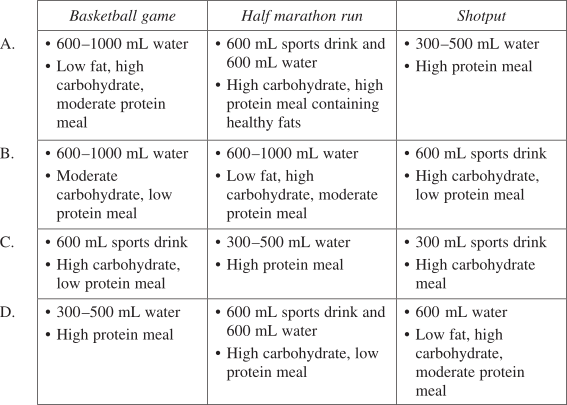
 

Show Answers Only

\(A\)

Show Worked Solution
  • A is correct: Matches energy system demands and recovery needs for each sport.

Other Options:

  • B is incorrect: Inadequate carbohydrate replacement for endurance and team sports.
  • C is incorrect: Poor fluid replacement and inappropriate macronutrient ratios.
  • D is incorrect: Shotput needs protein focus not high carbohydrate intake.

Filed Under: Dietary requirements and fluid intake Tagged With: Band 4, smc-5466-05-Sport-specific needs, smc-5466-15-Post-performance, smc-5466-20-Fluid intake

HMS, TIP 2024 HSC 8 MC

Which nutritional consideration should be prioritised for a cyclist during a 7-day, multi-stage road event?

  1. Protein loading
  2. High calorie intake
  3. Caffeine supplementation
  4. Carbohydrate replenishment
Show Answers Only

\(D\)

Show Worked Solution
  • D is correct: Multi-day cycling requires daily carbohydrate replenishment to restore depleted glycogen stores.

Other Options:

  • A is incorrect: Protein supports recovery not immediate energy needs.
  • B is incorrect: Carbohydrate type more critical than total calories.
  • C is incorrect: Caffeine beneficial but not primary nutritional priority.

Filed Under: Dietary requirements and fluid intake Tagged With: Band 3, smc-5466-05-Sport-specific needs, smc-5466-15-Post-performance

Copyright © 2014–2026 SmarterEd.com.au · Log in