SmarterEd

Aussie Maths & Science Teachers: Save your time with SmarterEd

  • Login
  • Get Help
  • About

Matrices, GEN1 2024 NHT 31 MC

A group of meerkats lives in an enclosure at a zoo.

The meerkats sleep during the night in one of two chambers, chamber A or chamber B.

The transition diagram below shows the proportion of meerkats that stay in the same sleeping location or change sleeping location from night to night.
 

Every night there are \(a\) meerkats in chamber A.

Every night there are \(b\) meerkats in chamber B .

Of the meerkats sleeping in chamber A on Friday night, eight had slept in chamber B on the previous night.

How many meerkats live in the enclosure?

  1. 20
  2. 30
  3. 40
  4. 50
  5. 60
Show Answers Only

\(E\)

Show Worked Solution
\(20\% \times b\) \(=8\)  
\(b\) \(=\dfrac{8}{0.2} = 40\)  

 
\(\text{Since \(a\) and \(b\) remain the same:}\)

\(0.4 \times a\) \(=8\)  
\(a\) \(=\dfrac{8}{0.4} = 20\)  

 
\(\therefore\ \text{Total meercats}\ = 40+20=60\)

\(\Rightarrow E\)

Filed Under: Transition Matrices - Regular Tagged With: Band 5, smc-618-25-Interpret Diagram

Matrices, GEN1 2024 NHT 25-26 MC

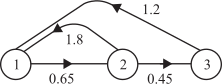
The following life cycle transition diagram shows changes in a female population of mammals with three age groups (1,2 and 3).
 

Question 25

On average, what percentage of the female population from group 2 will survive to group 3 ?

  1. 12%
  2. 18%
  3. 45%
  4. 50%
  5. 65%

 
Question 26

The associated Leslie matrix, \(L\), for the above transition diagram is

  1. \(L=\begin{bmatrix} 0 & 0 & 0 \\ 0 & 1.8 & 1.2 \\ 0 & 0.65 & 0.45\end{bmatrix}\)
     
  2. \(L=\begin{bmatrix}1 & 1.8 & 1.2 \\ 0 & 0.65 & 0 \\ 0 & 0 & 0.45\end{bmatrix}\)
     
  3. \(L=\begin{bmatrix}0 & 1.8 & 1.2 \\ 0.65 & 0 & 0 \\ 0.45 & 0 & 0\end{bmatrix}\)
     
  4. \(L=\begin{bmatrix}1.8 & 1.2 & 0 \\ 0 & 0.65 & 0.45 \\ 0 & 0 & 0\end{bmatrix}\)
     
  5. \(L=\begin{bmatrix}0 & 1.8 & 1.2 \\ 0.65 & 0 & 0 \\ 0 & 0.45 & 0\end{bmatrix}\)
Show Answers Only

\(\text{Question 25:}\ C\)

\(\text{Question 26:}\ E\)

Show Worked Solution

\(\text{Question 25}\)

\(0.45 = 45\%\ \text{of group 2 transition (survive) to group 3.}\)

\(\Rightarrow C\)
 

\(\text{Question 26}\)

\(\text{By elimination:}\)

\(\text{Row 1: Reproduction rate of each group}\ \ \Rightarrow\ \ \text{Eliminate A, B and D}\)

\(e_{3,2}\ \text{shows group 2 to group 3 survival rate} \)

\(\Rightarrow E\)

Filed Under: Transition Matrices - Regular Tagged With: Band 3, Band 4, smc-618-25-Interpret Diagram, smc-618-55-Leslie matrix, smc-618-61-3x3 Matrix

Matrices, GEN2 2024 VCAA 12

When the construction company established the construction site at the beginning of 2023, it employed 390 staff to work on the site.

The staff comprised 330 construction workers \((C)\), 50 foremen \((F)\) and 10 managers \((M)\).

At the beginning of each year, staff can choose to stay in the same job, move to a different job on the site, or leave the site \((L)\) and not return.

The transition diagram below shows the proportion of staff who are expected to change their job at the site each year.
 

This situation can be modelled by the recurrence relation

\(S_{n+1}=T S_n\), where

\(T\) is the transitional matrix, \(S_0=\left[\begin{array}{c}330 \\ 50 \\ 10 \\ 0\end{array}\right] \begin{aligned} & C \\ & F \\ & M \\ & L \end{aligned}\)  and \(n\) is the number of years after 2023.

  1. Calculate the predicted percentage decrease in the number of foremen \((F)\) on the site from 2023 to 2025.   (1 mark)

    --- 4 WORK AREA LINES (style=lined) ---

  2. Determine the total number of staff on the site in the long term.  (1 mark)

    --- 2 WORK AREA LINES (style=lined) ---

To encourage more construction workers \((C)\) to stay, the construction company has given workers an incentive to move into the job of foreman \((F)\).

Matrix \(R\) below shows the ways in which staff are expected to change their jobs from year to year with this new incentive in place.

\begin{aligned}
& \quad \quad \ \ \textit{this year} \\
& \quad  C \quad  \ \ F \quad  \ \  M \quad L\\
R = & \begin{bmatrix}
0.4 & 0.2 & 0 & 0 \\
0.4 & 0.2 & 0.4 & 0 \\
0 & 0.2 & 0.3 & 0 \\
0.2 & 0.4 & 0.3 & 1
\end{bmatrix}\begin{array}{l}
C\\
F\\
M\\
L
\end{array} \quad \textit{next year}
\end{aligned}

The site always requires at least 330 construction workers.

To ensure that this happens, the company hires an additional 190 construction workers \((C)\) at the beginning of 2024 and each year thereafter.

The matrix  \(V_{n+1}\)  will then be given by

\(V_{n+1}=R V_n+Z\), where

\(V_0=\left[\begin{array}{c}330 \\ 50 \\ 10 \\ 0\end{array}\right] \begin{aligned} & C \\ & F \\ & M \\ & L\end{aligned} \quad\quad\quad Z=\left[\begin{array}{c}190 \\ 0 \\ 0 \\ 0\end{array}\right] \begin{aligned} & C \\ & F \\ & M \\ & L\end{aligned} \ \ \) and \(n\) is the number of years after 2023.

  1. How many more staff are there on the site in 2024 than there were in 2023 ?    (1 mark)

    --- 4 WORK AREA LINES (style=lined) ---

  2. Based on this new model, the company has realised that in the long term there will be more than 200 foremen on site.
  3. In which year will the number of foremen first be above 200?   (1 mark)

    --- 4 WORK AREA LINES (style=lined) ---

Show Answers Only

a.    \(14\%\)

b.    \(\text{Zero}\)

c.    \(101\)

d.    \(2027\)

Show Worked Solution

a.    \(\text{Using CAS:}\)

\(\text{Transition matrix}(T):\ \begin{aligned}
& \quad \quad \quad \ \ \ \ \textit{from} \\
& \quad \ \ \ \  C \ \ \ \ \  F \ \ \ \ \ \  M \ \ \ \ \ \  L \ \ \\
\ \ \textit{to}\ \ \ & \begin{array}{l}
C \\
F \\
M \\
L
\end{array}\begin{bmatrix}
0.3 & 0.2 & 0 & 0 \\
0.2 & 0.2 & 0.4 & 0 \\
0 & 0.2 & 0.3 & 0 \\
0.5 & 0.4 & 0.3 & 1
\end{bmatrix}
\end{aligned}\)

♦♦♦ Mean mark (a) 25%.

\(S_{2023}=\begin{bmatrix}
330 \\
50 \\
10 \\
0 \\
\end{bmatrix}\ \ ,\ \  S_{2024}=T\times S_{2023}=\begin{bmatrix}
109 \\
80 \\
13 \\
188 \\
\end{bmatrix}\)

\( S_{2025}=T\times S_{2024}=\begin{bmatrix}
48.7 \\
43 \\
19.9 \\
278.4 \\
\end{bmatrix}\)

 
\(\text{% decrease in foremen}\ (F)=\dfrac{50-43}{50}\times 100\%=14\%\)
 

b.   \(\text{Test for 10 years:}\)

\(\text{Using CAS:}\)

\(S_{2024}=T^{10}\times S_{2023}=\begin{bmatrix}
0.490748 \\
0.734232 \\
0.488858 \\
388.286 \\
\end{bmatrix}\)

 
\(\text{In the long term, there will be zero employees on site.}\)
 

♦♦♦ Mean mark (b) 24%.

c.    \(\text{Using CAS:}\)

\(V_{2024}=R\times V_{2023}+Z=\begin{bmatrix}
332 \\
146 \\
13 \\
89 \\
\end{bmatrix}\)
  

\(\text{Difference in staff from}\ 2023-2024\)

\(=(332+146+13)-390\)

\(=101\ \text{more staff.}\)
 

\(\text{NOTE: 89 not included in calculation as these are the staff}\)

\(\text{who have left the company during the year.}\)
 

♦♦♦ Mean mark (c) 12%.

d.   \(\text{Using CAS:}\)

\(V_{2024}=R\times V_{2023}+Z=\begin{bmatrix}
332 \\
146 \\
13 \\
89 \\
\end{bmatrix}\ \ ,\ \  V_{2025}=R\times V_{2024}+Z=\begin{bmatrix}
352 \\
167.2 \\
33.1 \\
217.7 \\
\end{bmatrix}\ \\\)

♦♦♦ Mean mark (d) 26%.

\(V_{2026}=R\times V_{2025}+Z=\begin{bmatrix}
364.24\\
187.48 \\
43.37 \\
364.91 \\
\end{bmatrix}\ \ ,\ \  V_{2027}=R\times V_{2026}+Z=\begin{bmatrix}
373.192 \\
200.54 \\
50.507 \\
525.761 \\
\end{bmatrix}\ \\\)

 
\(\therefore\ \text{In 2027 the number of foremen will be over 200.}\)

Filed Under: Transition Matrices - Modified Tagged With: Band 5, Band 6, smc-1893-20-State Matrix in discrete period, smc-1893-32-4x4 Matrix, smc-1893-60-Regular Transition Matrices, smc-618-25-Interpret Diagram, smc-618-30-State Matrix in discrete period, smc-618-62-4x4 Matrix

MATRICES, FUR1 2019 VCAA 8 MC

An airline parks all of its planes at Sydney airport or Melbourne airport overnight.

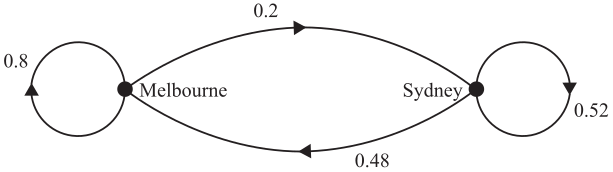
The transition diagram below shows the change in the location of the planes from night to night.


There are always `m` planes parked at Melbourne airport.

There are always `s` planes parked at Sydney airport.

Of the planes parked at Melbourne airport on Tuesday night, 12 had been parked at Sydney airport on Monday night.

How many planes does the airline have?

  1. 25
  2. 37
  3. 62
  4. 65
  5. 85
Show Answers Only

`E`

Show Worked Solution

`text(48% of planes parked in Sydney on Monday are parked)`

`text(in Melbourne on Tuesday.)`

`0.48 s` `= 12`
`s` `= 25`

 
`text(S) text(ince there are always)\ m\ text(planes parked in Melbourne)`

`=>\ text(12 from Melbourne must transfer to Sydney.)`

`0.2 m` `= 12`
`m` `= 60`


`:.\ text(Total planes)` `= 25 + 60`
  `= 85`

 
`=>  E`

Filed Under: Transition Matrices - Regular Tagged With: Band 5, smc-618-25-Interpret Diagram

MATRICES, FUR2 2017 VCAA 2

Junior students at a school must choose one elective activity in each of the four terms in 2018.

Students can choose from the areas of performance (`P`), sport (`S`) and technology (`T`).

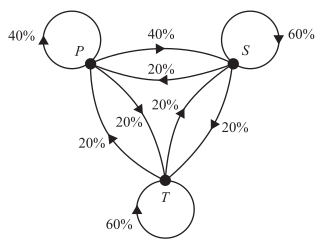
The transition diagram below shows the way in which junior students are expected to change their choice of elective activity from term to term.


  1. Of the junior students who choose performance (`P`) in one term, what percentage are expected to choose sport (`S`) the next term?   (1 mark)

    --- 1 WORK AREA LINES (style=lined) ---

Matrix `J_1` lists the number of junior students who will be in each elective activity in Term 1.
 

`J_1 = [(300),(240),(210)]{:(P),(S),(T):}`
 

  1. 306 junior students are expected to choose sport (`S`) in Term 2.
     
    Complete the calculation below to show this.   (1 mark)

    --- 0 WORK AREA LINES (style=lined) ---


  2. In Term 4, how many junior students in total are expected to participate in performance (`P`) or sport (`S`) or technology (`T`)?   (1 mark)

    --- 3 WORK AREA LINES (style=lined) ---

Show Answers Only
  1. `text(40%)`
  2.  `300 xx 0.4 + 240 xx 0.6 + 210 xx 0.2 = 306`
  3. `750`
Show Worked Solution

a.   `text(40%)`
 

b.  `300 xx 0.4 + 240 xx 0.6 + 210 xx 0.2 = 306`

♦♦ Mean mark part (c) 30%.

MARKER’S COMMENT: No matrix calculations were required here.


c. 
 `text(Each term, every student will do)\ P\ text(or)\ S\ text(or)\ T.`

`:. text(Total students (Term 4))` `=\ text(Total students (Term 1))`
  `= 300 + 240 + 210`
  `= 750`

Filed Under: Transition Matrices - Regular Tagged With: Band 2, Band 4, Band 5, smc-618-25-Interpret Diagram, smc-618-30-State Matrix in discrete period

MATRICES, FUR2 2010 VCAA 2

The 300 players in Oscar’s league are involved in a training program. In week one, 90 players are doing heavy training (`H`), 150 players are doing moderate training (`M`) and 60 players are doing light training (`L`). The state matrix, `S_1`, shows the number of players who are undertaking each type of training in the first week
 

`S_1 = [(90),(150),(60)]{:(H),(M),(L):}`
 

The percentage of players that remain in the same training program, or change their training program from week to week, is shown in the transition diagram below.
 

MATRICES, FUR2 2010 VCAA 2
 

  1. What information does the 20% in the diagram above provide?   (1 mark)

    --- 2 WORK AREA LINES (style=lined) ---

The information in the transition diagram above can also be written as the transition matrix `T`.
 

`{:(qquadqquadqquadquad\ text(this week)),((qquadqquadqquadH,quadM,\ L)),(T = [(0.5,0.1,0.1),(0.2,0.6,0.5),(0.3,0.3,0.4)]{:(H),(M),(L):}qquad{:text(next week):}):}`
 

  1. Determine how many players will be doing heavy training in week two.   (1 mark)

    --- 3 WORK AREA LINES (style=lined) ---

  2. Determine how many fewer players will be doing moderate training in week three than in week one.   (1 mark)

    --- 4 WORK AREA LINES (style=lined) ---

  3. Show that, after seven weeks, the number of players (correct to the nearest whole number) who are involved in each type of training will not change.   (1 mark) 

    --- 4 WORK AREA LINES (style=lined) ---

Show Answers Only
  1. `text(It means that 20% of the players doing heavy training one)`


    `text(week will switch to moderate training the next.)`

  2. `text(66 players)`
  3. `text(6 fewer players)`
  4. `text(See Worked Solutions)`
Show Worked Solution

a.   `text(It means that 20% of the players doing heavy)`

`text(training one week will switch to moderate)`

`text(training the next.)`


b.    `S_2` `= TS_1`
    `= [(0.5,0.1,0.1),(0.2,0.6,0.5),(0.3,0.3,0.4)][(90),(150),(60)]`
    `= [(66),(138),(96)]`


`:. 66\ text(players will be in hard training)`

`text(in week 2.)`


c.   `text(150 in moderate training in week 1.)`

`text(In week 3,)`

`S_3` `= T^2S_1`
  `= [(0.5,0.1,0.1),(0.2,0.6,0.5),(0.3,0.3,0.4)]^2[(90),(150),(60)]`
  `= [(56.4),(144),(99.6)]`


`:.\ text(The reduction in players training moderately)`

`= 150-144`

`= 6`


d.   `text(Need to show steady numbers for consecutive)`

`text(weeks 8 and week 9,)`

`S_8 = T^7S_1 = [(50),(150),(100)]`

`S_9 = T^8S_1 = [(50),(150),(100)]`


`:. S_8 = S_9`

`text{(i.e. player numbers don’t change after week 7.)}`

Filed Under: Transition Matrices - Regular Tagged With: Band 3, Band 4, smc-618-25-Interpret Diagram, smc-618-30-State Matrix in discrete period, smc-618-61-3x3 Matrix

MATRICES, FUR1 2011 VCAA 5-6 MC

Two politicians, Rob and Anna, are the only candidates for a forthcoming election. At the beginning of the election campaign, people were asked for whom they planned to vote. The numbers were as follows.
 

MATRICES, FUR1 2011 VCAA 5-6 MC 1
 

During the election campaign, it is expected that people may change the candidate that they plan to vote for each week according to the following transition diagram.
 

MATRICES, FUR1 2011 VCAA 5-6 MC 2

Part 1

The total number of people who are expected to change the candidate that they plan to vote for one week after the election campaign begins is

A.     `828`

B.   `1423`

C.   `2251`

D.   `4269`

E.   `6891`


Part 2

The election campaign will run for ten weeks.

If people continue to follow this pattern of changing the candidate they plan to vote for, the expected winner after ten weeks will be

A.   Rob by about 50 votes.

B.   Rob by about 100 votes.

C.   Rob by fewer than 10 votes.

D.   Anna by about 100 votes.

E.   Anna by about 200 votes.

Show Answers Only

`text(Part 1:)\ C`

`text(Part 2:)\ E`

Show Worked Solution

`text(Part 1)`

`text(Students expected to change)`

`= 25text(%) xx 5692 + 24text(%) xx 3450`

`= 2251`

`=> C`


`text(Part 2)`

♦ Mean mark 48%.

`text(After 1 week,)`

`[(0.75,0.24),(0.25,0.76)][(5692),(3450)] = [(5097),(4045)]`


`text(After 10 weeks,)`

`[(0.75,0.24),(0.25,0.76)]^10[(5692),(3450)] = [(4479),(4663)]`


`:.\ text(Anna is ahead by)`

`4663 – 4479 = 184\ text(votes)`

`=> E`

Filed Under: Transition Matrices - Regular Tagged With: Band 4, Band 5, smc-618-25-Interpret Diagram, smc-618-30-State Matrix in discrete period, smc-618-60-2x2 Matrix

Copyright © 2014–2025 SmarterEd.com.au · Log in