SmarterEd

Aussie Maths & Science Teachers: Save your time with SmarterEd

  • Login
  • Get Help
  • About

Statistics, STD2 S1 EQ-Bank 21

A survey question is shown.
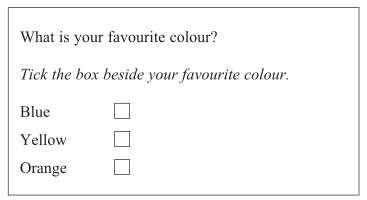
Give TWO reasons why this survey may be considered to be poorly designed.   (2 marks)

--- 3 WORK AREA LINES (style=lined) ---

Show Answers Only

\(\text{Examples of poor design:}\)

\(\text{Only 3 choices of many colours are given.}\)

\(\text{Two colours might be someone’s equal favourite colours.}\)

Show Worked Solution

\(\text{Examples of poor design:}\)

\(\text{Only 3 choices of many colours are given.}\)

\(\text{Two colours might be someone’s equal favourite colours.}\)

Filed Under: Classifying Data, Data Classification, Investigation and Sampling Methods, Data Classification, Investigation and Sampling Methods Tagged With: Band 4, common-content, smc-6309-30-Investigation Process, smc-6529-30-Investigation Process, smc-820-30-Other

Statistics, STD2 S4 EQ-Bank 16

Pedro is planning a statistical investigation.

List the steps that Pedro must follow to execute the statistical investigation correctly.   (2 marks)

--- 5 WORK AREA LINES (style=lined) ---

Show Answers Only

`text(- Identify a problem and pose a statistical question)`

`text(- Collect or obtain data)`

`text(- Represent and analyse the data collected or obtained)`

`text(- Communicate and interpret findings.)`

Show Worked Solution

`text(Steps are:)`

`text(- Identify a problem and pose a statistical question)`

`text(- Collect or obtain data)`

`text(- Represent and analyse the data collected or obtained)`

`text(- Communicate and interpret findings.)`

Filed Under: Bivariate Data Analysis, Data Classification, Investigation and Sampling Methods, Data Classification, Investigation and Sampling Methods, S3 Further Statistical Analysis (Y12), S4 Bivariate Data Analysis (Y12) Tagged With: Band 3, common-content, smc-1001-80-Investigation Process, smc-1113-80-Investigation Process, smc-6309-30-Investigation Process, smc-6529-30-Investigation Process, smc-785-80-Investigation Process

Statistics, STD2 S1 2011 HSC 25a

A study on the mobile phone usage of NSW high school students is to be conducted.

Data is to be gathered using a questionnaire.

The questionnaire begins with the three questions shown.

2UG 2011 25a

  1. Classify the type of data that will be collected in Q2 of the questionnaire.   (1 mark)

    --- 1 WORK AREA LINES (style=lined) ---

  2. Write a suitable question for this questionnaire that would provide discrete ordinal data.   (1 mark)

    --- 2 WORK AREA LINES (style=lined) ---

  3. An initial study is to be conducted using a stratified sample.


    Describe a method that could be used to obtain a representative stratified sample.   (1 mark)

    --- 2 WORK AREA LINES (style=lined) ---

  4. Who should be surveyed if it is decided to use a census for the study?   (1 mark)

    --- 2 WORK AREA LINES (style=lined) ---

Show Answers Only

a.    `text(Categorical)`

b.    `text(See Worked Solutions)`

c.    `text(See Worked Solutions)`

d.    `text(A census would involve all high school students in NSW.)`

Show Worked Solution

a.    `text(Categorical)`
 

b.    `text(How often do you use your mobile phone each day?)`

`text{(Option structure:- Never, Rarely, Sometimes, Often, Always.)}`
 

c.   `text(The method could be to work out how many)`

♦♦♦ Mean mark 7%.
COMMENT: Know random, systematic and stratified sampling definitions.

`text{students are in each year and ask 10% of the}`

`text{students in each year. (Note the sample of}`

`text{students in each year must be  proportional to}`

`text{their percentage in the population).}`


♦♦♦ Mean mark 18%.
MARKER’S COMMENT: A specific population is required here.

d.    `text(A census would involve all high school)`

`text(students in NSW.)`

Filed Under: Classifying Data, Classifying Data, Data Classification, Investigation and Sampling Methods, Data Classification, Investigation and Sampling Methods, DS1 - Stats and society Tagged With: Band 4, Band 5, Band 6, common-content, smc-1127-10-Sampling Methods, smc-1127-20-Classifying Data, smc-1127-30-Other, smc-6309-20-Data Classification, smc-6309-25-Sampling Methods, smc-6309-30-Investigation Process, smc-6529-10-Sampling Methods, smc-6529-20-Data Classification, smc-6529-30-Investigation Process, smc-820-10-Sampling Methods, smc-820-20-Classifying Data, smc-820-30-Other

Statistics, STD2 S3 2009 HSC 5 MC

Jamie wants to know how many songs were downloaded legally from the internet in the last 12 months by people aged 18–25 years. He has decided to conduct a statistical inquiry.

After he collects the data, which of the following shows the best order for the steps he should take with the data to complete his inquiry?

  1. Display, organise, conclude, analyse
  2. Organise, display, conclude, analyse
  3. Display, organise, analyse, conclude
  4. Organise, display, analyse, conclude
Show Answers Only

`D`

Show Worked Solution

`text(Process of statistical enquiry requirements)`

`=>  D`

Filed Under: Classifying Data, Classifying Data, Data Classification, Investigation and Sampling Methods, Data Classification, Investigation and Sampling Methods, DS1 - Stats and society Tagged With: Band 3, common-content, smc-1127-30-Other, smc-6309-30-Investigation Process, smc-6529-30-Investigation Process, smc-820-30-Other

Statistics, STD2 S1 2012 HSC 26d

Greg needs to conduct a statistical inquiry into how much time people aged 18–25 years have spent accessing social media websites in the last two weeks. He has decided to survey a sample of students from his university.

The process of statistical inquiry includes the following steps, which are NOT in order.
 

2012 26d 

  1. Using the letters A, B, C, D, E and F, list the steps in the most appropriate order for Greg to conduct his statistical inquiry.   (2 marks)

    --- 4 WORK AREA LINES (style=lined) ---

  2. Greg conducts his statistical inquiry.


    At which step in the process would he have drawn this graph?   (1 mark) 

2012 26d2

--- 2 WORK AREA LINES (style=lined) ---

Show Answers Only

a.    `text(B, E, C, F, D, A)`

b.    `text(F)`

Show Worked Solution

a.   `text(B, E, C, F, D, A)`

b.   `text(F)`

Filed Under: Classifying Data, Classifying Data, Data Classification, Investigation and Sampling Methods, Data Classification, Investigation and Sampling Methods, DS1 - Stats and society Tagged With: Band 4, common-content, smc-1127-30-Other, smc-6309-30-Investigation Process, smc-6529-30-Investigation Process, smc-820-30-Other

Copyright © 2014–2026 SmarterEd.com.au · Log in