Consider the function \( f: R \rightarrow R, f(x)=(x+1)(x+a)(x-2)(x-2 a) \text { where } a \in R \text {. } \) --- 2 WORK AREA LINES (style=lined) --- --- 4 WORK AREA LINES (style=lined) --- ii. exactly four \(x\)-intercepts. (1 mark) --- 3 WORK AREA LINES (style=lined) --- --- 2 WORK AREA LINES (style=lined) --- ii. Find the coordinates of the local maximum of \(g\). (1 mark) --- 3 WORK AREA LINES (style=lined) --- iii. Find the values of \(x\) for which \(g^{\prime}(x)>0\). (1 mark) --- 3 WORK AREA LINES (style=lined) --- iv. Consider the two tangent lines to the graph of \(y=g(x)\) at the points where --- 5 WORK AREA LINES (style=lined) --- Let \(h\) be the function \(h: R \rightarrow R, h(x)=(x+1)(x-1)(x+2)(x-2)\), which is the function \(f\) where \(a=-1\). --- 4 WORK AREA LINES (style=lined) --- ii. Using a dilation and translations, describe a different sequence of transformations of \(h\), for which its image would have both local minimums at the same coordinates as that of \(g\). (2 marks) --- 6 WORK AREA LINES (style=lined) ---
a. \(x=-1, x=a, x=2, x=2a\) bi. \(a=0, -2, -\dfrac{1}{2}\) bii. \(\text{The solution must be all }R\ \text{except those that give 3 or less solutions.}\) \(\therefore\ R\ \backslash\left\{ -2, -\dfrac{1}{2}, 0, 1\right\}\) \(\text{From graph local maximum occurs when }x=\dfrac{1}{2}\) ciii. \(\text{From graph}\ g^{\prime}(x)>0\ \text{when }x\in\left(-1, \dfrac{1}{2}\right)\cup (2, \infty)\) civ. \(\text{Use CAS to find tangent lines and solve to find intersection.}\) \(\text{Point of intersection of tangent lines}\ \left(\dfrac{1}{2}, \dfrac{27}{4}\right)\) di. \(\text{Local maximum of }g(x)\ \rightarrow\left(\dfrac{1}{2}, \dfrac{81}{16}\right)\) \(\text{From CAS local maximum of }h(x)\ \rightarrow \left(0, 4\right)\) \(\therefore\ \text{Translate }\dfrac{1}{2}\ \text{unit to the right and }\dfrac{81}{16}-4=\dfrac{17}{16}\ \text{units upwards.}\) dii. \(\text{Using CAS to solve }g^{\prime}(x)=0\ \text{and }h^{\prime}(x)=0\) \(\text{Local Minimums for }g(x)\ \text{at }(-1, 0)\ \text{and }(2, 0)\ \text{which are 3 apart.}\) \(\text{Local minimums for at }h(x)\ \text{at }\left(-\sqrt{\dfrac{5}{2}}, -\dfrac{9}{4}\right)\ \text{and }\left(\sqrt{\dfrac{5}{2}}, -\dfrac{9}{4}\right)\) \(\therefore\ \text{Combination is a dilation of }h(x)\ \text{by a factor of}\ \dfrac{3}{\sqrt{10}}\ \text{followed by a }\) \(\text{translation of }\dfrac{1}{2} \ \text{a unit to the right and an upwards translation of}\ \dfrac{9}{4} \ \text{units.}\)
i. exactly three \(x\)-intercepts. (2 marks)
i. Find \(g^{\prime}(x)\) (1 mark)
\(x=\dfrac{-\sqrt{3}+1}{2}\) and \(x=\dfrac{\sqrt{3}+1}{2}\). Determine the coordinates of the point of intersection of these two tangent lines. (2 marks)
i. Using translations only, describe a sequence of transformations of \(h\), for which its image would have a local maximum at the same coordinates as that of \(g\). (1 mark)
ci.
\(g^{\prime}(x)\)
\(=2(2-x)(x+1)^2+(x-2)^22(x+1)\)
\(=2(x-2)(x+1)(x+1+x+2)\)
\(=2(x-2)(x+1)(2x-1)\)
cii. \(\text{When }g^{\prime}(x)=0, x=2, -1, \dfrac{1}{2}\)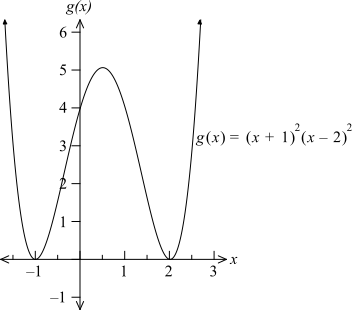
\(g\left(\dfrac{1}{2}\right)\)
\(=\left(\dfrac{1}{2}+1\right)^2\left(\dfrac{1}{2}-2\right)^2\)
\(=\dfrac{9}{4}\times \dfrac{9}{4}=\dfrac{81}{16}\)
\(\therefore\ \text{Local maximum at}\ \left(\dfrac{1}{2} , \dfrac{81}{16}\right)\)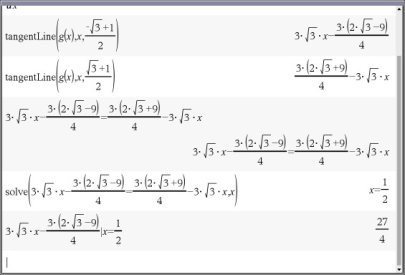
Calculus, MET2 2022 VCAA 1
The diagram below shows part of the graph of `y=f(x)`, where `f(x)=\frac{x^2}{12}`.
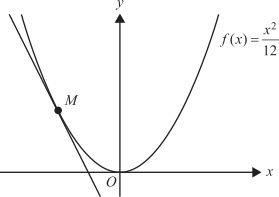
- State the equation of the axis of symmetry of the graph of `f`. (1 mark)
--- 2 WORK AREA LINES (style=lined) ---
- State the derivative of `f` with respect to `x`. (1 mark)
--- 2 WORK AREA LINES (style=lined) ---
The tangent to `f` at point `M` has gradient `-2` .
- Find the equation of the tangent to `f` at point `M`. (2 marks)
--- 6 WORK AREA LINES (style=lined) ---
The diagram below shows part of the graph of `y=f(x)`, the tangent to `f` at point `M` and the line perpendicular to the tangent at point `M`.
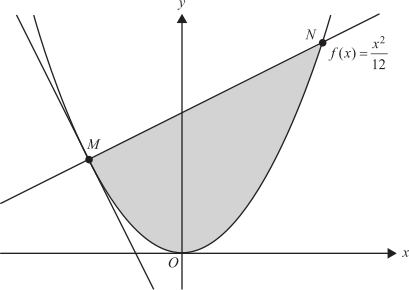
- i. Find the equation of the line perpendicular to the tangent passing through point `M`. (1 mark)
--- 5 WORK AREA LINES (style=lined) ---
- ii. The line perpendicular to the tangent at point `M` also cuts `f` at point `N`, as shown in the diagram above.
- Find the area enclosed by this line and the curve `y=f(x)`. (2 marks)
--- 8 WORK AREA LINES (style=lined) ---
- Another parabola is defined by the rule `g(x)=\frac{x^2}{4 a^2}`, where `a>0`.
- A tangent to `g` and the line perpendicular to the tangent at `x=-b`, where `b>0`, are shown below.
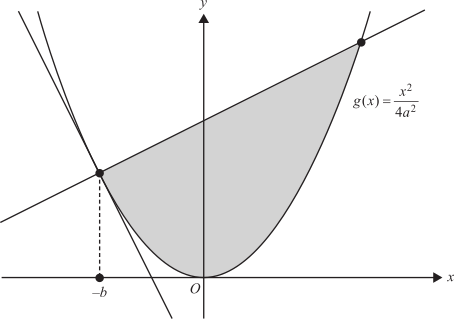
- Find the value of `b`, in terms of `a`, such that the shaded area is a minimum. (4 marks)
--- 8 WORK AREA LINES (style=lined) ---
Calculus, MET2 2023 VCAA 1
Let \(f:R \rightarrow R, f(x)=x(x-2)(x+1)\). Part of the graph of \(f\) is shown below.
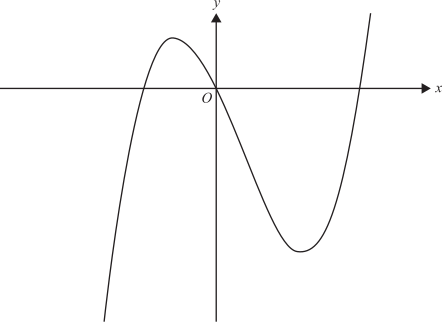
- State the coordinates of all axial intercepts of \(f\). (1 mark)
--- 2 WORK AREA LINES (style=lined) ---
- Find the coordinates of the stationary points of \(f\). (2 marks)
--- 3 WORK AREA LINES (style=lined) ---
-
- Let \(g:R\rightarrow R, g(x)=x-2\).
- Find the values of \(x\) for which \(f(x)=g(x)\). (1 mark)
--- 3 WORK AREA LINES (style=lined) ---
-
- Write down an expression using definite integrals that gives the area of the regions bound by \(f\) and \(g\). (2 marks)
--- 4 WORK AREA LINES (style=lined) ---
- Hence, find the total area of the regions bound by \(f\) and \(g\), correct to two decimal places. (1 mark)
--- 2 WORK AREA LINES (style=lined) ---
- Write down an expression using definite integrals that gives the area of the regions bound by \(f\) and \(g\). (2 marks)
- Let \(h:R\rightarrow R, h(x)=(x-a)(x-b)^2\), where \(h(x)=f(x)+k\) and \(a, b, k \in R\).
- Find the possible values of \(a\) and \(b\). (4 marks)
--- 9 WORK AREA LINES (style=lined) ---
Calculus, MET2 2023 VCAA 14 MC
A polynomial has the equation \(y=x(3x-1)(x+3)(x+1)\).
The number of tangents to this curve that pass through the positive \(x\)-intercept is
- 0
- 1
- 2
- 3
- 4
Calculus, MET2 2020 VCAA 5
Let `f: R to R, \ f(x)=x^{3}-x`.
Let `g_{a}: R to R` be the function representing the tangent to the graph of `f` at `x=a`, where `a in R`.
Let `(b, 0)` be the `x`-intercept of the graph of `g_{a}`.
- Show that `b= {2a^{3}}/{3 a^{2}-1}`. (3 marks)
--- 7 WORK AREA LINES (style=lined) ---
- State the values of `a` for which `b` does not exist. (1 mark)
--- 2 WORK AREA LINES (style=lined) ---
- State the nature of the graph of `g_a` when `b` does not exist. (1 mark)
--- 2 WORK AREA LINES (style=lined) ---
- i. State all values of `a` for which `b=1.1`. Give your answer correct to four decimal places. (1 mark)
--- 2 WORK AREA LINES (style=lined) ---
- ii. The graph of `f` has an `x`-intercept at (1, 0).
- State the values of `a` for which `1 <= b <= 1.1`.
- Give your answers correct to three decimal places. (1 mark)
--- 2 WORK AREA LINES (style=lined) ---
The coordinate `(b, 0)` is the horizontal axis intercept of `g_a`.
Let `g_b` be the function representing the tangent to the graph of `f` at `x=b`, as shown in the graph below.
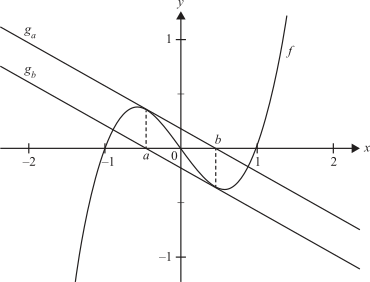
- Find the values of `a` for which the graphs of `g_a` and `g_b`, where `b` exists, are parallel and where `b!=a`. (3 marks)
--- 8 WORK AREA LINES (style=lined) ---
Let `p:R rarr R, \ p(x)=x^(3)+wx`, where `w in R`.
- Show that `p(-x)=-p(x)` for all `w in R`. (1 mark)
--- 3 WORK AREA LINES (style=lined) ---
A property of the graphs of `p` is that two distinct parallel tangents will always occur at `(t, p(t))` and `(-t,p(-t))` for all `t!=0`.
- Find all values of `w` such that a tangent to the graph of `p` at `(t, p(t))`, for some `t > 0`, will have an `x`-intercept at `(-t, 0)`. (1 mark)
--- 6 WORK AREA LINES (style=lined) ---
- Let `T:R^(2)rarrR^(2),T([[x],[y]])=[[m,0],[0,n]][[x],[y]]+[[h],[k]]`, where `m,n in R text(\{0})` and `h,k in R`.
State any restrictions on the values of `m`, `n`, `h`, and `k`, given that the image of `p` under the transformation `T` always has the property that parallel tangents occur at `x = -t` and `x = t` for all `t!=0`. (1 mark)
--- 2 WORK AREA LINES (style=lined) ---
Calculus, MET2 2021 VCAA 7 MC
The tangent to the graph of `y = x^3 - ax^2 + 1` at `x = 1` passes through the origin.
The value of `a` is
- `1/2`
- `1`
- `3/2`
- `2`
- `5/2`
Calculus, MET2 2019 VCAA 5
Let `f: R -> R, \ f(x) = 1-x^3`. The tangent to the graph of `f` at `x = a`, where `0 < a < 1`, intersects the graph of `f` again at `P` and intersects the horizontal axis at `Q`. The shaded regions shown in the diagram below are bounded by the graph of `f`, its tangent at `x = a` and the horizontal axis.
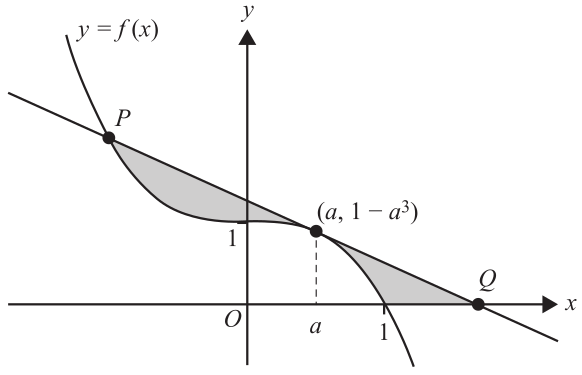
- Find the equation of the tangent to the graph of `f` at `x = a`, in terms of `a`. (1 mark)
--- 3 WORK AREA LINES (style=lined) ---
- Find the `x`-coordinate of `Q`, in terms of `a`. (1 mark)
--- 3 WORK AREA LINES (style=lined) ---
- Find the `x`-coordinate of `P`, in terms of `a`. (2 marks)
--- 4 WORK AREA LINES (style=lined) ---
Let `A` be the function that determines the total area of the shaded regions.
- Find the rule of `A`, in terms of `a`. (3 marks)
--- 5 WORK AREA LINES (style=lined) ---
- Find the value of `a` for which `A` is a minimum. (2 marks)
--- 3 WORK AREA LINES (style=lined) ---
Consider the regions bounded by the graph of `f^(-1)`, the tangent to the graph of `f^(-1)` at `x = b`, where `0 < b < 1`, and the vertical axis.
- Find the value of `b` for which the total area of these regions is a minimum. (2 marks)
--- 4 WORK AREA LINES (style=lined) ---
- Find the value of the acute angle between the tangent to the graph of `f` and the tangent to the graph of `f^(-1)` at `x = 1`. (1 mark)
--- 4 WORK AREA LINES (style=lined) ---
Show Worked Solution
a. `f(x) = 1-x^3,\ \ f^{\prime}(x) = -3x^2`
`m_text(tang) = -3a^2\ \ text(through)\ \ (a, 1-a^3)`
`y = 2a^3-3a^2x + 1`
b. `text(Solve for)\ \x:`
`2a^3-3a^2x + 1 = 0`
`x = (2a^3 + 1)/(3a^2)`
c. `text(Solve for)\ \ x:`
`2a^3-3a^2x + 1 = 1-x^3`
`x=-2a`
`:. x text(-coordinate of)\ P = -2a`
d. `P(-2a, 8a^3 + 1),\ \ Q((2a^3 + 1)/(3a^2), 0)`
| `A` | `= text(Area of triangle)-int_(-2a)^1 f(x)\ dx` |
| `= 1/2((2a^3 + 1)/(3a^2) + 2a)(8a^3 + 1)-int_(-2a)^1 1-x^3\ dx` | |
| `= (80a^6 + 8a^3-9a^2 + 2)/(12a^2)\ \ text{(by CAS)}` |
e. `text(Solve for)\ a: \ (dA)/(da) = 0\ \ text{(by CAS)}`
`a = 10^(-1/3)`
f. `text(Consider)\ f(x):\ \ f(10^(-1/3)) = 9/10`
`A_text(min)\ text(for)\ \ f(x)\ \ text(occurs at)\ \ (10^(-1/3), 9/10)`
`=> A_text(min)\ text(for)\ \ f^(-1)(x)\ \ text(occurs when)\ \ x=9/10`
`:. b = 9/10`
g. `f^{\prime} (1) = -3`
`text(Gradient of)\ \ f^(-1)(x)\ \ text(at)\ \ x = 1\ \ text(is vertical line.)`
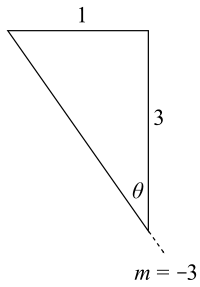
| `tan theta` | `= 1/3` |
| `theta` | `= tan^(-1)(1/3)` |
| `=18.4°\ \ text{(to 1 d.p.)}` |
Calculus, MET2 2016 VCAA 2
Consider the function `f(x) = -1/3 (x + 2) (x-1)^2.`
- i. Given that `g^{′}(x) = f (x) and g (0) = 1`,
- show that `g(x) = -x^4/12 + x^2/2-(2x)/3 + 1`. (1 mark)
--- 3 WORK AREA LINES (style=lined) ---
- ii. Find the values of `x` for which the graph of `y = g(x)` has a stationary point. (1 mark)
--- 3 WORK AREA LINES (style=lined) ---
The diagram below shows part of the graph of `y = g(x)`, the tangent to the graph at `x = 2` and a straight line drawn perpendicular to the tangent to the graph at `x = 2`. The equation of the tangent at the point `A` with coordinates `(2, g(2))` is `y = 3-(4x)/3`.
The tangent cuts the `y`-axis at `B`. The line perpendicular to the tangent cuts the `y`-axis at `C`.

- i. Find the coordinates of `B`. (1 mark)
--- 2 WORK AREA LINES (style=lined) ---
- ii. Find the equation of the line that passes through `A` and `C` and, hence, find the coordinates of `C`. (2 marks)
--- 5 WORK AREA LINES (style=lined) ---
- iii. Find the area of triangle `ABC`. (2 marks)
--- 4 WORK AREA LINES (style=lined) ---
- The tangent at `D` is parallel to the tangent at `A`. It intersects the line passing through `A` and `C` at `E`.
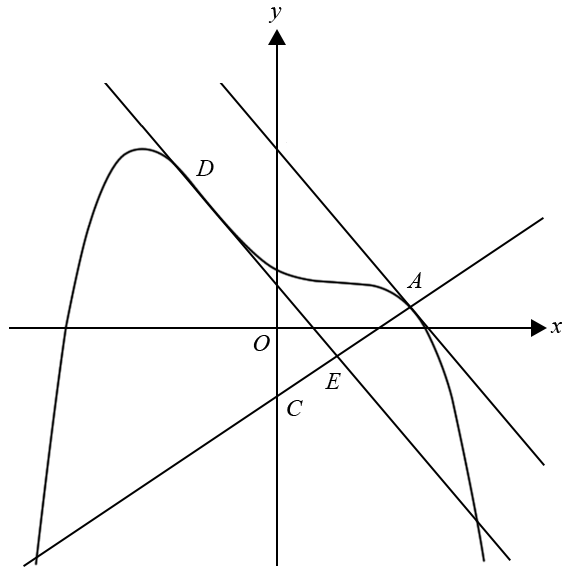
i. Find the coordinates of `D`. (2 marks)
--- 4 WORK AREA LINES (style=lined) ---
- ii. Find the length of `AE`. (3 marks)
--- 6 WORK AREA LINES (style=lined) ---
Show Worked Solution
| a.i. | `g(x)` | `= int f(x)\ dx` |
| `=-1/3 int (x + 2) (x-1)^2\ dx` | ||
| `=-1/3int(x^3-3x+2)\ dx` | ||
| `:.g(x)` | `= -x^4/12 + x^2/2-(2x)/3 + c` |
`text(S)text(ince)\ \ g(0) = 1,`
| `1` | `= 0 + 0-0 + c` |
| `:. c` | `= 1` |
`:. g(x) = -x^4/12 + x^2/2-(2x)/3 + 1\ \ …\ text(as required)`
a.ii. `text(Stationary point when:)`
`g^{′}(x) = f(x) = 0`
`-1/3(x + 2) (x-1)^2=0`
`:. x = -2, 1`
| b.i. |  |
`B\ text(is the)\ y text(-intercept of)\ \ y = 3-4/3 x`
`:. B (0, 3)`
b.ii. `m_text(norm) = 3/4, \ text(passes through)\ \ A(2, 1/3)`
`text(Equation of normal:)`
| `y-1/3` | `=3/4(x-2)` |
| `y` | `=3/4 x-7/6` |
`:. C (0, -7/6)`
| b.iii. | `text(Area)` | `= 1/2 xx text(base) xx text(height)` |
| `= 1/2 xx (3 + 7/6) xx 2` | ||
| `= 25/6\ text(u²)` |
♦ Mean mark part (c)(i) 43%.
MARKER’S COMMENT: Many students gave an incorrect `y`-value here. Be careful!
MARKER’S COMMENT: Many students gave an incorrect `y`-value here. Be careful!
| c.i. | `text(Solve)\ \ \ g^{′}(x)` | `= -4/3\ \ text(for)\ \ x < 0` |
| `=> x` | `= -1` | |
| `g(-1)` | `=-1/12+1/2+2/3+1` | |
| `=25/12` |
`:. D (−1, 25/12)`
c.ii. `text(T) text(angent line at)\ \ D:`
| `y-25/12` | `=-4/3(x+1)` |
| `y` | `=-4/3x + 3/4` |
`DE\ \ text(intersects)\ \ AE\ text(at)\ E:`
♦♦ Mean mark 32%.
| `-4/3 x + 3/4` | `= 3/4 x-7/6` |
| `25/12 x` | `= 23/12` |
| `x` | `=23/25` |
`:. E (23/25, -143/300)`
| `:. AE` | `= sqrt((2-23/25)^2 + (1/3-(-143/300))^2)` |
| `= 27/20\ text(units)` |
Calculus, MET2 2016 VCAA 10 MC
For the curve `y = x^2 - 5`, the tangent to the curve will be parallel to the line connecting the positive x-intercept and the y-intercept when `x` is equal to
A. `sqrt 5`
B. `5`
C. `−5`
D. `sqrt 5/2`
E. `1/sqrt 5`
Calculus, MET2 2015 VCAA 1
Let `f: R -> R,\ \ f(x) = 1/5 (x-2)^2 (5-x)`. The point `P(1, 4/5)` is on the graph of `f`, as shown below.
The tangent at `P` cuts the y-axis at `S` and the x-axis at `Q.`

- Write down the derivative `f^{prime} (x)` of `f (x)`. (1 mark)
--- 3 WORK AREA LINES (style=lined) ---
- i. Find the equation of the tangent to the graph of `f` at the point `P(1, 4/5)`. (1 mark)
--- 5 WORK AREA LINES (style=lined) ---
ii. Find the coordinates of points `Q` and `S`. (2 marks)
--- 6 WORK AREA LINES (style=lined) ---
- Find the distance `PS` and express it in the form `sqrt b/c`, where `b` and `c` are positive integers. (2 marks)
--- 4 WORK AREA LINES (style=lined) ---

- Find the area of the shaded region in the graph above. (3 marks)
--- 4 WORK AREA LINES (style=lined) ---
Calculus, MET2 2013 VCAA 4
Part of the graph of a function `g: R -> R, \ g (x) = (16-x^2)/4` is shown below.

- Points `B` and `C` are the positive `x`-intercept and `y`-intercept of the graph `g`, respectively, as shown in the diagram above. The tangent to the graph of `g` at the point `A` is parallel to the line segment `BC.`
- Find the equation of the tangent to the graph of `g` at the point `A.` (2 marks)
--- 5 WORK AREA LINES (style=lined) ---
-
The shaded region shown in the diagram above is bounded by the graph of `g`, the tangent at the point `A`, and the `x`-axis and `y`-axis.
- Evaluate the area of this shaded region. (3 marks)
--- 6 WORK AREA LINES (style=lined) ---
- Find the equation of the tangent to the graph of `g` at the point `A.` (2 marks)
- Let `Q` be a point on the graph of `y = g(x)`.
- Find the positive value of the `x`-coordinate of `Q`, for which the distance `OQ` is a minimum and find the minimum distance. (3 marks)
--- 6 WORK AREA LINES (style=lined) ---
The tangent to the graph of `g` at a point `P` has a negative gradient and intersects the `y`-axis at point `D(0, k)`, where `5 <= k <= 8.`

- Find the gradient of the tangent in terms of `k.` (2 marks)
--- 8 WORK AREA LINES (style=lined) ---
- i. Find the rule `A(k)` for the function of `k` that gives the area of the shaded region. (2 marks)
--- 5 WORK AREA LINES (style=lined) ---
- ii. Find the maximum area of the shaded region and the value of `k` for which this occurs. (2 marks)
--- 5 WORK AREA LINES (style=lined) ---
- iii. Find the minimum area of the shaded region and the value of `k` for which this occurs. (2 marks)
--- 3 WORK AREA LINES (style=lined) ---
Show Worked Solution
a.i. `B(4,0), C(0,4), A(a,(16-a^2)/4)`
`m_(BC) = m_text(tan) = (4-0)/(0-4) = -1`
| `g(x)` | `= (16-x^2)/4` |
| `g^{prime}(x)` | `=-x/2` |
`text(S)text(ince)\ \ g^{prime}(a) = -1,`
`=>a = 2`
`text(T)text(angent passes through)\ \ (2,3),`
| `y-3` | `=-(x-2)` |
| `y` | `=-x + 5` |
`text(Alternatively, using technology:)`
`[text(CAS: tangent Line)]\ (g(x),x,2)`
a.ii. `text(Solution 1)`
♦ Mean mark 37%.
MARKER’S COMMENT: A common incorrect answer:
`int_0^5((-x+5)-g(x))dx=35/12`. Know why it’s wrong!
MARKER’S COMMENT: A common incorrect answer:
`int_0^5((-x+5)-g(x))dx=35/12`. Know why it’s wrong!
`D(5,0), E(0,5)`
| `text(Area)` | `= DeltaEOD-int_0^4 g(x)\ dx` |
| `= 1/2 xx 5 xx 5-32/3` | |
| `= 11/6\ text(u²)` |
`text(Solution 2)`
| `text(Area)` | `= int_0^5 (-x+5)\ dx-int_0^4 g(x)\ dx` |
| `= 11/6\ text(u²)` |
b. `Q(x, (16-x^2)/4), O(0,0)`
♦♦♦ Mean mark 20%.
| `z` | `= OQ` |
| `= sqrt(x^2 + ((16-x^2)/4)^2), x > 0` |
`text(Max or min when)\ \ (dz)/(dx)=0,`
`text(Solve:)\ (dz)/dx = 0quadtext(for)quadx > 0`
`=> x = 2sqrt2`
`=>z(2sqrt2) = 2sqrt3`
`:. text(Min distance of)\ \ 2sqrt3\ \ text(units when)\ \ x = 2sqrt2`
c. `text(Let)\ \ P(p, (16-p^2)/4)`
♦♦♦ Mean mark 8%.
`m_text(tan)\ text(at)\ P =-p/2`
`m_(PD) = ((16-p^2)/4-k)/(p-0)`
`text(Equating gradients,)`
`text(Solve:)\ \ ((16-p^2)/4-k)/p=-p/2\ \ text(for)\ p,`
`=> p=2sqrt(k-4)`
`:.\ text(Gradient of tangent:)`
`g^{prime}(2sqrt(k-4)) =-sqrt(k-4)`
d.i. `text(Equation of tangent:)`
♦♦♦ Mean mark 8%.
`y = -sqrt(k-4)x + k`
`text(CAS: tangent Line)\ (g(x),x,2sqrt(k-4))`
`xtext(-int of tangent:)\ x = k/(sqrt(k-4))`
| `:. A(k)` | `= 1/2 xx (k/(sqrt(k-4))) xx k-int_0^4 g(x)\ dx` |
| `= (k^2)/(2sqrt(k-4))-32/3, \ \ k ∈ [5,8]` |
d.ii. `text(Solve:)\ \ A(k)=0quadtext(for)quadk ∈ [5,8]`
♦♦♦ Mean mark 5%.
`=> k=16/3`
`text(Sketch the graph of)\ \ A(k)\ \ text(for)\ \ 5<=k<=8`

`:. A_text(max) = 16/3quadtext(when)quadk = 8`
d.iii. `A_text(min)\ text(occurs at the turning point)\ (k=16/3).`
♦♦♦ Mean mark 3%.
| `A_text(min)` | `=A(16/3)` |
| `=(64sqrt3)/9-32/3` |
Calculus, MET2 2015 VCAA 4 MC
Consider the tangent to the graph of `y = x^2` at the point `(2, 4).`
Which of the following points lies on this tangent?
A. `text{(1, −4)}`
B. `(3, 8)`
C. `text{(−2, 6)}`
D. `(1, 8)`
E. `text{(4, −4)}`