SmarterEd

Aussie Maths & Science Teachers: Save your time with SmarterEd

  • Login
  • Get Help
  • About

Calculus, MET1 2018 VCAA 9

Consider a part of the graph of  `y = xsin(x)`, as shown below.
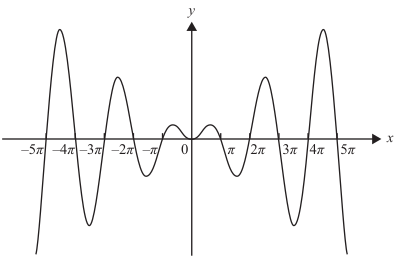
  1.  i. Given that  `int(xsin(x))\ dx = sin(x)-xcos(x) + c`, evaluate  `int_(npi)^((n + 1)pi)(xsin(x))\ dx`  when `n` is a positive even integer or 0.
      
    Give your answer in simplest form.   (2 marks)

    --- 5 WORK AREA LINES (style=lined) ---

    ii. Given that  `int(xsin(x))\ dx = sin(x)-xcos(x) + c`, evaluate  `int_(npi)^((n + 1)pi)(xsin(x))\ dx`  when `n` is a positive odd integer.
    Give your answer in simplest form.   (1 mark)

    --- 4 WORK AREA LINES (style=lined) ---

  2.  
  3. Find the equation of the tangent to  `y = xsin(x)`  at the point  `(−(5pi)/2,(5pi)/2)`.   (2 marks)

    --- 5 WORK AREA LINES (style=lined) ---

  4. The translation `T` maps the graph of  `y = xsin(x)`  onto the graph of  `y = (3pi-x)sin(x)`, where
  5. `qquad T: R^2 -> R^2, T([(x),(y)]) = [(x),(y)] + [(a),(0)]`
  6. and `a` is a real constant.
  7. State the value of `a`.   (1 mark)

    --- 2 WORK AREA LINES (style=lined) ---

  8. Let  `f:[0,3pi] -> R, f(x) = (3pi-x)sin(x)`  and  `g:[0,3pi] -> R, g(x) = (x-3pi)sin(x)`.
    The line `l_1` is the tangent to the graph of `f` at the point `(pi/2,(5pi)/2)` and the line `l_2` is the tangent to the graph of `g` at `(pi/2,-(5pi)/2)`, as shown in the diagram below.
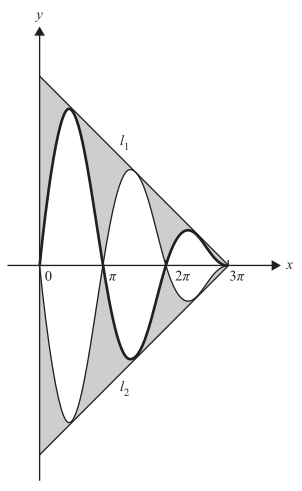


    Find the total area of the shaded regions shown in the diagram above.   (2 marks)

    --- 8 WORK AREA LINES (style=lined) ---

Show Answers Only
  1.  i. `(2n + 1)pi`
    ii. `-(2n + 1)pi`
  2. `:. y =-x`
  3. `-3pi`
  4. `9pi(pi-2)`
Show Worked Solution

a.i.  `text(Given)\ \ n\ \ text(is a positive even integer:)`

♦♦ Mean mark 31%.

`int_(npi)^((n + 1)pi)(xsin(x))dx`

`= [sin(x)-xcos(x)]_(npi)^((n + 1)pi)`

`= [sin((n + 1)pi)-(n + 1)pi · cos((n + 1)pi)]-[sin(npi)-npi · cos(npi)]`

`= [0-(n + 1)pi (−1)]-[0-npi]`

`= (n + 1)pi + npi`

`= (2n + 1)pi`


a.ii. `text(Given)\ \ n\ \ text(is a positive odd integer:)`

♦♦♦ Mean mark 19%.

`int_(npi)^((n + 1)pi)(xsin(x))dx`

`= [sin((n + 1)pi)-(n + 1)pi · cos((n + 1)pi)]-[sin(npi)-npi · cos(npi)]`

`= [0-(n + 1)pi(1)]-[0-npi(−1)]`

`= -(n + 1)pi-npi`

`= -(2n + 1)pi`


b.    `y` `= xsin(x)`
  `(dy)/(dx)` `= x · cos(x) + sin(x)`


♦ Mean mark part (b) 49%.

`(dy)/(dx)` `= -(5pi)/2 · cos(-(5pi)/2) + sin(-(5pi)/2)`
  `= -(5pi)/2 · (0) + (-1)`
  `= -1`

 
`text(T)text(angent has equation)\ \ y =-x + c\ \ text(and passes through)\ \ (-(5pi)/2, (5pi)/2):`

`(5pi)/2` `= +(5pi)/2 + c`
`c` `= 0`

 
`:. y = -x`


♦♦ Mean mark part (c) 34%.

c.    `y` `= (3pi-x)sin(x)`
    `=-(x-3pi)sin(x)`

 
`:. a = 3pi`
 

d.   `f(x) = (3pi-x)sin(x)`

♦♦♦ Mean mark 7%.

  `-> l_1\ text(is the tangent)\ \ y =-x\ \ (text{using part (b)})`

`-> g(x)\ text(is)\ \ y=xsin(x)\ \ text(translated 3π to the right.)`

`-> f(x)\ text(is)\ \ g(x)\ \ text(reflected in the)\ \ x text(-axis.)`

 
`text(Area between)\ f(x)\ text(and)\ xtext(-axis)`

`= int_0^pi xsin(x)\ dx + | int_pi^(2pi) xsin(x)\ dx | + int_(2pi)^(3pi) xsin(x)\ dx`

`= (2 xx 0 + 1)pi + |-1(2 xx 1 + 1)pi | + (2 xx 2 + 1)pi\ \ (text{using part (a)})`

`= pi + 3pi + 5pi`

`= 9pi`
 

`:.\ text(Shaded Area)`

`= 2 xx (1/2 xx 3pi xx 3pi)-2 xx 9pi`

`= 9pi^2-18pi`

`= 9pi(pi-2)`

Filed Under: Area Under Curves, Tangents and Normals Tagged With: Band 5, Band 6, smc-634-30-Trig Function, smc-634-50-Find tangent given curve, smc-723-60-Trig, smc-723-80-Area between graphs

Calculus, MET1 SM-Bank 21

Find the equation of the tangent to the curve  `y = cos 2x`  at the point whose `x`-coordinate is  `pi/6.`   (3 marks)

--- 7 WORK AREA LINES (style=lined) ---

Show Answers Only

`y =-sqrt 3 x + ((sqrt 3 pi)/6 + 1/2)`

Show Worked Solution

`y = cos 2x`

`dy/dx =-2 sin 2x`

`text(When)\ \ x = pi/6,`

`y` `= cos (2 xx pi/6)`
  `= cos (pi/3)`
  `= 1/2`


`dy/dx` `= -2 sin (pi/3)`
  `= -2 xx sqrt 3 / 2`
  `= -sqrt 3`


`:. text(Equation of tangent,)\ \ m =-sqrt 3, text(through)\ \ (pi/6, 1/2) :`

`y-y_1` `= m(x-x_1)`
`y-1/2` `= -sqrt 3 ( x-pi/6)`
`y-1/2` `= -sqrt 3 x + (sqrt 3 pi)/6`
`y` `= -sqrt 3 x + ((sqrt 3 pi)/6 + 1/2)`

Filed Under: Tangents and Normals Tagged With: Band 4, smc-634-30-Trig Function, smc-634-50-Find tangent given curve

Calculus, MET2 2016 VCAA 1

Let  `f: [0, 8 pi] -> R, \ f(x) = 2 cos (x/2) + pi`.

  1. Find the period and range of `f`.   (2 marks)

    --- 4 WORK AREA LINES (style=lined) ---

  2. State the rule for the derivative function `f^{′}`.   (1 mark)

    --- 1 WORK AREA LINES (style=lined) ---

  3. Find the equation of the tangent to the graph of `f` at  `x = pi`.   (1 mark)

    --- 2 WORK AREA LINES (style=lined) ---

  4. Find the equations of the tangents to the graph of  `f: [0, 8 pi] -> R,\ \ f(x) = 2 cos (x/2) + pi`  that have a gradient of 1.   (2 marks)

    --- 4 WORK AREA LINES (style=lined) ---

  5. The rule of  `f^{′}` can be obtained from the rule of `f` under a transformation `T`, such that
      
    `qquad T: R^2 -> R^2,\ T([(x), (y)]) = [(1, 0), (0, a)] [(x), (y)] + [(−pi), (b)]`


    Find the value of `a` and the value of `b`.   (3 marks)

    --- 8 WORK AREA LINES (style=lined) ---

  6. Find the values of  `x, \ 0 <= x <= 8 pi`, such that  `f(x) = 2 f^{′} (x) + pi`.   (2 marks)

    --- 5 WORK AREA LINES (style=lined) ---

Show Answers Only
  1. `text(Period:)\ 4 pi; qquad text(Range:)\ [pi-2, pi + 2]`
  2. `f^{′} (x) =-sin (x/2)`
  3. `y =-x + 2 pi`
  4. `y = x-2 pi and y = x-6 pi`
  5. `a = 1/2 and b =-pi/2`
  6. `x = (3 pi)/2, (7 pi)/2, (11 pi)/2, (15 pi)/2`
Show Worked Solution

a.   `text(Period)= (2pi)/n = (2 pi)/(1/2) = 4pi`

MARKER’S COMMENT: Including round brackets rather than square ones was a common mistake.

`text(Range:)\ [pi-2, pi + 2]`
  

b.   `f^{′} (x) = text(−sin) (x/2)`
 

c.   `[text(CAS: tangentLine)\ (f(x), x, pi)]`

`y = -x + 2 pi`
 

d.   `text(Solve)\ \ f^{′} (x) = 1\ \ text(for)\ x in [0, 8 pi]`

♦ Mean mark part (d) 50%.

`-> x = 3 pi or 7 pi`

`:. y = x-2 pi and y = x-6 pi\ \ [text(CAS)]`


e.   `text(Using the transition matrix,)`

♦♦ Mean mark part (e) 27%.
`x_T` `=x-pi`
`x` `=x_T+pi`
`y_T` `=ay+b`
`y` `=(y_T-b)/a`
   

`f(x)= cos (x/2) + pi/2\ \ ->\ \ f{′}(x) = -sin(x/2)`

`(y_T-b)/a` `=2cos((x_T+pi)/2)+pi`
`y_T` `=2a cos((x_T+pi)/2)+a pi +b`
  `=-2a sin(x_T/2)+a pi + bqquad [text(Complementary Angles)]`
   
`-2a` `=-1`
`:. a` `=1/2`
`1/2 pi +b` `=0`
`:.b` `=-pi/2`


f.   `text(Solve)\ \ f(x) = 2 f^{′} (x) + pi\ \ text(for)\ \ x in [0, 8 pi]`

♦ Mean mark part (f) 50%.
`2 cos (x/2) + pi` `= -2 sin(x/2)+pi`
`tan(x/2)` `=-1`
`x/2` `=(3pi)/4, (7pi)/4, (11pi)/4, (15pi)/4`
`:.x` `= (3 pi)/2, (7 pi)/2, (11 pi)/2, (15 pi)/2`

Filed Under: Tangents and Normals, Transformations Tagged With: Band 3, Band 4, Band 5, smc-634-30-Trig Function, smc-634-50-Find tangent given curve, smc-753-60-Matrix, smc-753-75-Trig functions

Calculus, MET1 2015 VCAA 10

The diagram below shows a point, `T`, on a circle. The circle has radius 2 and centre at the point `C` with coordinates `(2, 0)`. The angle `ECT` is `theta`, where  `0 < theta <= pi/2`.
  

met1-2015-vcaa-q10
  

The diagram also shows the tangent to the circle at `T`. This tangent is perpendicular to `CT` and intersects the `x`-axis at point `X` and the `y`-axis at point `Y`.

  1. Find the coordinates of `T` in terms of `theta`.   (1 mark)

    --- 5 WORK AREA LINES (style=lined) ---

  2. Find the gradient of the tangent to the circle at `T` in terms of `theta`.   (1 mark)

    --- 4 WORK AREA LINES (style=lined) ---

  3. The equation of the tangent to the circle at `T` can be expressed as
  4. `qquad cos(theta)x + sin(theta)y = 2 + 2cos(theta)`
  5.  i. Point `B`, with coordinates `(2, b)`, is on the line segment `XY`.
  6.     Find `b` in terms of `theta`.   (1 mark)

    --- 3 WORK AREA LINES (style=lined) ---

  7. ii. Point `D`, with coordinates `(4, d)`, is on the line segment `XY`.
  8.     Find `d` in terms of `theta`.   (1 mark)

    --- 4 WORK AREA LINES (style=lined) ---

  9. Consider the trapezium `CEDB` with parallel sides of length `b` and `d`.
  10. Find the value of `theta` for which the area of the trapezium `CEDB` is a minimum. Also find the minimum value of the area.   (3 marks)

    --- 10 WORK AREA LINES (style=lined) ---

Show Answers Only
  1. `T(2 + 2costheta, 2 sintheta)`
  2. `(-1)/(tan(theta))`
  3.  i. `2/(sintheta)`
  4. ii. `(2-2 costheta)/(sintheta)`
  5. `theta = pi/3`
  6. `A_text(min) = 2sqrt3\ text(u²)`
Show Worked Solution
a.    `cos theta` `= (CM)/(CT)`
    `=(CM)/2`
  `CM` `= 2costheta`
♦♦♦ Part (a) mean mark 20%.
MARKER’S COMMENT: Many students did not include the “+2” in the `x`-coordinate.
`sintheta` `= (TM)/2`
`TM` `= 2sintheta`


`:. T\ text(has coordinates)\ \ (2 + 2costheta, 2 sintheta)`


♦♦♦ Part (b) mean mark 16%.
b.    `m_(CT)` `=(TM)/(CM)`
    `=(2 sin theta)/(2 cos theta)`
    `=tan theta`
     
  `:.m_(XY)` `=-1/tan theta,\ \ \ (CT ⊥ XY)`


c.i.   `text(Substitute)\ \ (2,b)\ \ text(into equation:)`

`2costheta + bsintheta` `= 2 + 2costheta`
`:. b` `= 2/(sintheta)`


c.ii.   `text(Substitute)\ \ (4,d)\ \ text(into equation:)`

♦ Part (c)(ii) mean mark 47%.
`4costheta + dsintheta` `= 2 + 2costheta`
`d sin theta` `=2-cos theta`
`:.d`  `= (2-2 costheta)/(sintheta)`


♦♦♦ Part (d) mean mark 19%.
d.    `text(A)_text(trap)` `= 1/2 xx 2 xx (b + d)`
    `= 2/(sintheta) + (2-2costheta)/(sintheta)`
    `= (4-2costheta)/(sintheta)`


`text(Stationary point when)\ \ (dA)/(d theta)=0`

`(2sin^2theta-costheta(4-2costheta))/(sin^2theta)` `= 0`
`2sin^2theta-4costheta + 2cos^2theta` `= 0`
`2[sin^2theta + cos^2theta]-4costheta` `= 0`
`2-4costheta` `= 0`
`costheta` `= 1/2`
`theta` `= pi/3,\ \ \ \ theta ∈ (0, pi/2)`


`A(pi/3)` `= (4-2(1/2))/(sqrt3/2)`
  `=3 xx 2/sqrt3`
  `= 2sqrt3`


`:. A_text(min) = 2sqrt3\ text(u²)`

Filed Under: Maxima and Minima, Tangents and Normals Tagged With: Band 4, Band 5, Band 6, smc-634-30-Trig Function, smc-634-70-Find point of tangency, smc-641-10-Area

Graphs, MET2 2013 VCAA 1

Trigg the gardener is working in a temperature-controlled greenhouse. During a particular 24-hour time interval, the temperature  `(Ttext{°C})` is given by  `T(t) = 25 + 2 cos ((pi t)/8), \ 0 <= t <= 24`, where `t` is the time in hours from the beginning of the 24-hour time interval.

  1. State the maximum temperature in the greenhouse and the values of `t` when this occurs.   (2 marks)

    --- 3 WORK AREA LINES (style=lined) ---

  2. State the period of the function `T.`   (1 mark)

    --- 2 WORK AREA LINES (style=lined) ---

  3. Find the smallest value of `t` for which  `T = 26.`   (2 marks)

    --- 3 WORK AREA LINES (style=lined) ---

  4. For how many hours during the 24-hour time interval is  `T >= 26?`   (2 marks)

    --- 3 WORK AREA LINES (style=lined) ---

Trigg is designing a garden that is to be built on flat ground. In his initial plans, he draws the graph of  `y = sin(x)`  for  `0 <= x <= 2 pi`  and decides that the garden beds will have the shape of the shaded regions shown in the diagram below. He includes a garden path, which is shown as line segment `PC.`

  1. The line through points  `P((2 pi)/3, sqrt 3/2)`  and  `C (c, 0)`  is a tangent to the graph of  `y = sin (x)`  at point `P.`

    1. Find  `(dy)/(dx)`  when  `x = (2 pi)/3.`   (1 mark)

      --- 3 WORK AREA LINES (style=lined) ---

    2. Show that the value of `c` is  `sqrt 3 + (2 pi)/3.`   (1 mark)

      --- 6 WORK AREA LINES (style=lined) ---

In further planning for the garden, Trigg uses a transformation of the plane defined as a dilation of factor `k` from the `x`-axis and a dilation of factor `m` from the `y`-axis, where `k` and `m` are positive real numbers.

  1. Let `X^{′}, P^{′}` and `C^{′}` be the image, under this transformation, of the points `X, P` and `C` respectively. 


    1. Find the values of `k` and `m`  if  `X^{′}P^{′} = 10`  and  `X^{′} C^{′} = 30.`   (2 marks)

      --- 8 WORK AREA LINES (style=lined) ---

    2. Find the coordinates of the point `P^{′}.`   (1 mark)

      --- 3 WORK AREA LINES (style=lined) ---

Show Answers Only
  1. `t = 0, or 16\ text(h)`
  2. `16\ text(hours)`
  3. `8/3`
  4. `8\ text(hours)`
  5.  i.  `-1/2`
    ii.  `text(See worked solution)`
  6.  i.  `k=(20sqrt3)/3, m=10sqrt3`
    ii.  `P^{′}((20pisqrt3)/3,10)`
Show Worked Solution

a.   `T_text(max)\ text(occurs when)\ \ cos((pit)/8) = 1,`

`T_text(max)= 25 + 2 = 27^@C`

`text(Max occurs when)\ \ t = 0, or 16\ text(h)`


b.    `text(Period)` `= (2pi)/(pi/8)`
    `= 16\ text(hours)`


c.   `text(Solve:)\ \ 25 + 2 cos ((pi t)/8)=26\ \ text(for)\ t,`

`t`  `= 8/3,40/3,56/3\ \ text(for)\ t ∈ [0,24]`
`t_text(min)` `= 8/3`


d.   `text(Consider the graph:)`

met2-2013-vcaa-sec1-answer1

`text(Time above)\ 26 text(°C)` `= 8/3 + (56/3-40/3)`
  `= 8\ text(hours)`


e.i.   `(dy)/(dx) = cos(x)`

`text(At)\ x = (2pi)/3,`

`(dy)/(dx)` `= cos((2pi)/3)=-1/2`


e.ii.  `text(Solution 1)`

`text(Equation of)\ \ PC,`

`y-sqrt3/2` `=-1/2(x-(2pi)/3)`
`y` `=-1/2 x +pi/3 +sqrt3/2`


`PC\ \ text(passes through)\ \ (c,0),`

`0` `=-1/2 c +pi/3 + sqrt3/2`
`c` `=sqrt3 + (2 pi)/3\ …\ text(as required)`


`text(Solution 2)`

`text(Equating gradients:)`

`- 1/2` `= (sqrt3/2-0)/((2pi)/3-c)`
`-1` `= sqrt3/((2pi-3c)/3)`
`3c-2pi` `= 3sqrt3`
`3c` `= 3 sqrt3 + 2pi`
`:. c` `= sqrt3 + (2pi)/3\ …\ text(as required)`


f.i.   `X^{′} ((2pi)/3 m,0)qquadP^{′}((2pi)/3 m, sqrt3/2 k)qquadC^{′} ((sqrt3 + (2pi)/3)m, 0)`

`X^{′}P^{′}` `= 10`
`sqrt3/2 k` `= 10`
`:. k` `= 20/sqrt3`
  `=(20sqrt3)/3`
♦♦♦ Mean mark part (f)(i) 14%.


`X^{′}C^{′}=30`

`((sqrt3 + (2pi)/3)m)-(2pi)/3 m` `= 30`
`:. m` `= 30/sqrt3`
  `=10sqrt3`
♦♦♦ Mean mark part (f)(ii) 12%.


f.ii.    `P^{′}((2pi)/3 m, sqrt3/2 k)` `= P^{′}((2pi)/3 xx 10sqrt3, sqrt3/2 xx 20/sqrt3)`
    `= P^{′}((20pisqrt3)/3,10)`

Filed Under: Tangents and Normals, Transformations, Trig Graphing Tagged With: Band 3, Band 4, Band 6, smc-2757-15-Cos, smc-2757-30-Find period, smc-2757-80-Applications, smc-2757-85-Max/min (non-calc), smc-634-30-Trig Function, smc-634-50-Find tangent given curve, smc-753-20-Dilation (Only), smc-753-75-Trig functions

Copyright © 2014–2025 SmarterEd.com.au · Log in