The graph of \(y=f(x)\) is shown below.
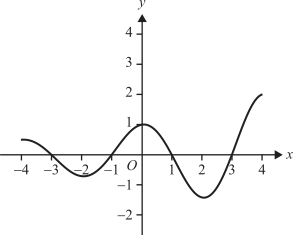
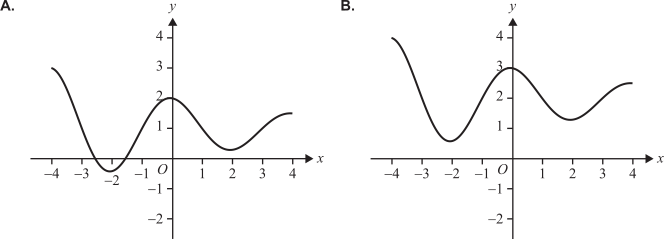
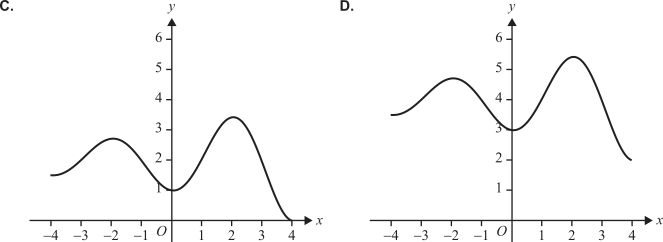
Which one of the following options best represents the graph of \(y=f(-x)+2\) ?
Aussie Maths & Science Teachers: Save your time with SmarterEd
The graph of \(y=f(x)\) is shown below.
Which one of the following options best represents the graph of \(y=f(-x)+2\) ?
Let `f:R→R, \ f(x)=cos(ax)`, where `a in R text(\{0})`, be a function with the property
`f(x)=f(x+h),` for all `h in Z`
Let `g:D rarr R, \ g(x)=log_(2)(f(x))` be a function where the range of `g` is `[-1,0]`.
A possible interval for `D` is
The transformation `T:R^(2)rarrR^(2)` that maps the graph of `y=cos(x)` onto the graph of `y=cos(2x+4)` is
The graph of the function `g` is obtained from the graph of the function `f` with rule `f(x) = cos(x) - (3)/(8)` by a dilation of factor `(4)/(pi)` from the `y`-axis, a dilation of factor `(4)/(3)` from the `x`-axis, a reflection in the `y`-axis and a translation of `(3)/(2)` units in the positive `y` direction, in that order.
The range and period of `g` are respectively
Let `f: [0, pi/2] -> R,\ f(x) = sin(4x) + 1.` The graph of `f` is transformed by a reflection in the `x`-axis followed by a dilation of factor 4 from the `y`-axis.
The resulting graph is defined by
A transformation `T: R^2 -> R^2` that maps the curve with equation `y = sin (x)` onto the curve with equation `y = 1 - 3 sin(2x + pi)` is given by
Let `f: [0, 8 pi] -> R, \ f(x) = 2 cos (x/2) + pi`.
--- 4 WORK AREA LINES (style=lined) ---
--- 1 WORK AREA LINES (style=lined) ---
--- 2 WORK AREA LINES (style=lined) ---
--- 4 WORK AREA LINES (style=lined) ---
Find the value of `a` and the value of `b`. (3 marks)
--- 8 WORK AREA LINES (style=lined) ---
--- 5 WORK AREA LINES (style=lined) ---
Trigg the gardener is working in a temperature-controlled greenhouse. During a particular 24-hour time interval, the temperature `(Ttext{°C})` is given by `T(t) = 25 + 2 cos ((pi t)/8), \ 0 <= t <= 24`, where `t` is the time in hours from the beginning of the 24-hour time interval.
--- 3 WORK AREA LINES (style=lined) ---
--- 2 WORK AREA LINES (style=lined) ---
--- 3 WORK AREA LINES (style=lined) ---
--- 3 WORK AREA LINES (style=lined) ---
Trigg is designing a garden that is to be built on flat ground. In his initial plans, he draws the graph of `y = sin(x)` for `0 <= x <= 2 pi` and decides that the garden beds will have the shape of the shaded regions shown in the diagram below. He includes a garden path, which is shown as line segment `PC.`

--- 3 WORK AREA LINES (style=lined) ---
--- 6 WORK AREA LINES (style=lined) ---
In further planning for the garden, Trigg uses a transformation of the plane defined as a dilation of factor `k` from the `x`-axis and a dilation of factor `m` from the `y`-axis, where `k` and `m` are positive real numbers.
--- 8 WORK AREA LINES (style=lined) ---
--- 3 WORK AREA LINES (style=lined) ---
a. `T_text(max)\ text(occurs when)\ \ cos((pit)/8) = 1,`
`T_text(max)= 25 + 2 = 27^@C`
`text(Max occurs when)\ \ t = 0, or 16\ text(h)`
| b. | `text(Period)` | `= (2pi)/(pi/8)` |
| `= 16\ text(hours)` |
c. `text(Solve:)\ \ 25 + 2 cos ((pi t)/8)=26\ \ text(for)\ t,`
| `t` | `= 8/3,40/3,56/3\ \ text(for)\ t ∈ [0,24]` |
| `t_text(min)` | `= 8/3` |
d. `text(Consider the graph:)`

| `text(Time above)\ 26 text(°C)` | `= 8/3 + (56/3-40/3)` |
| `= 8\ text(hours)` |
e.i. `(dy)/(dx) = cos(x)`
`text(At)\ x = (2pi)/3,`
| `(dy)/(dx)` | `= cos((2pi)/3)=-1/2` |
e.ii. `text(Solution 1)`
`text(Equation of)\ \ PC,`
| `y-sqrt3/2` | `=-1/2(x-(2pi)/3)` |
| `y` | `=-1/2 x +pi/3 +sqrt3/2` |
`PC\ \ text(passes through)\ \ (c,0),`
| `0` | `=-1/2 c +pi/3 + sqrt3/2` |
| `c` | `=sqrt3 + (2 pi)/3\ …\ text(as required)` |
`text(Solution 2)`
`text(Equating gradients:)`
| `- 1/2` | `= (sqrt3/2-0)/((2pi)/3-c)` |
| `-1` | `= sqrt3/((2pi-3c)/3)` |
| `3c-2pi` | `= 3sqrt3` |
| `3c` | `= 3 sqrt3 + 2pi` |
| `:. c` | `= sqrt3 + (2pi)/3\ …\ text(as required)` |
f.i. `X^{′} ((2pi)/3 m,0)qquadP^{′}((2pi)/3 m, sqrt3/2 k)qquadC^{′} ((sqrt3 + (2pi)/3)m, 0)`
| `X^{′}P^{′}` | `= 10` |
| `sqrt3/2 k` | `= 10` |
| `:. k` | `= 20/sqrt3` |
| `=(20sqrt3)/3` |
`X^{′}C^{′}=30`
| `((sqrt3 + (2pi)/3)m)-(2pi)/3 m` | `= 30` |
| `:. m` | `= 30/sqrt3` |
| `=10sqrt3` |
| f.ii. | `P^{′}((2pi)/3 m, sqrt3/2 k)` | `= P^{′}((2pi)/3 xx 10sqrt3, sqrt3/2 xx 20/sqrt3)` |
| `= P^{′}((20pisqrt3)/3,10)` |