A function that has a range of \([6,12]\) is
- \(f: R \rightarrow R, \ f(x)=6+3 \cos (9 x)\)
- \(f: R \rightarrow R, \ f(x)=6+6 \cos (3 x)\)
- \(f: R \rightarrow R, \ f(x)=9-3 \cos (6 x)\)
- \(f: R \rightarrow R, \ f(x)=9-6 \cos (3 x)\)
Aussie Maths & Science Teachers: Save your time with SmarterEd
A function that has a range of \([6,12]\) is
Let \(f:[0,2 \pi] \rightarrow R, f(x)=2 \cos (2 x)+1\).
--- 2 WORK AREA LINES (style=lined) ---
--- 8 WORK AREA LINES (style=lined) ---
--- 0 WORK AREA LINES (style=lined) ---
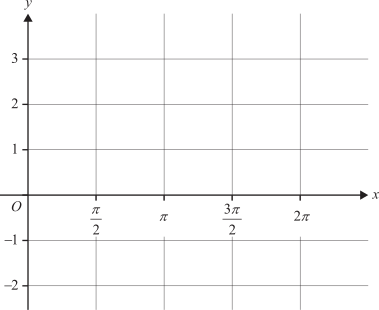
a. \(\text{Range of } f(x):-1 \leqslant y \leqslant 3\)
b. \(x=\dfrac{\pi}{3}, \dfrac{2 \pi}{3}, \dfrac{4 \pi}{3}, \dfrac{5 \pi}{3}\)
c.
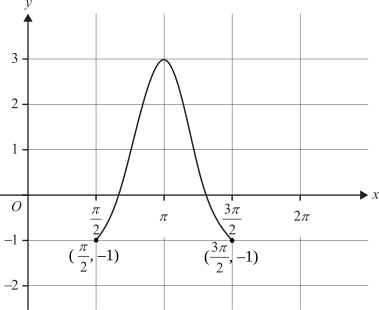
a. \(\text{Amplitude}=2 \ \ \text{about} \ \ y=1.\)
\(\text{Range of } f(x):\ -1 \leqslant y \leqslant 3\)
| b. | \(2 \cos (2 x)+1\) | \(=0\) |
| \(\cos (2 x)\) | \(=-\dfrac{1}{2}\) |
\(\text{Base angle}=\dfrac{\pi}{3}\)
\(2x=\pi-\dfrac{\pi}{3}, \pi+\dfrac{\pi}{3}, \cdots\)
\(2x=\dfrac{2 \pi}{3}, \dfrac{4 \pi}{3}, \dfrac{8 \pi}{3}, \dfrac{10 \pi}{3}\)
\(x=\dfrac{\pi}{3}, \dfrac{2 \pi}{3}, \dfrac{4 \pi}{3}, \dfrac{5 \pi}{3}\)
c.
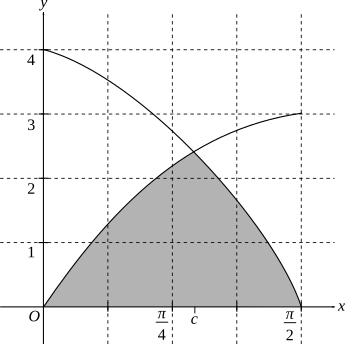
Let `f : [ 0, (pi)/(2)] → R, \ f(x) = 4 cos(x)` and `g : [0, (pi)/(2)] → R, \ g(x) = 3 sin(x)`.
--- 0 WORK AREA LINES (style=lined) ---
`qquad qquad `
Find the value of `sin(c)` and the value of `cos(c)`. (3 marks)
--- 4 WORK AREA LINES (style=lined) ---
--- 0 WORK AREA LINES (style=lined) ---
--- 7 WORK AREA LINES (style=lined) ---
a.
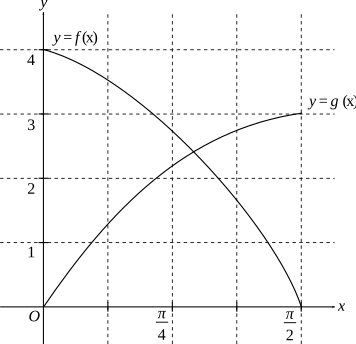
b. `text(At intersection:)`
| `4cos(c)` | `= 3sin(c)` |
| `tan(c)` | `= (4)/(3)` |
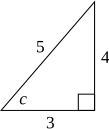
`sin(c) = (4)/(5)`
`cos(c) = (3)/(5)`
c. i.
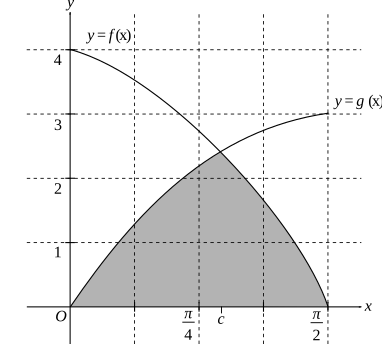
| ii. `A` | `= int_0^c g(x)\ dx + int_c^((pi)/(2)) f(x)\ dx` |
| `= int_0^c 3sin x \ dx + int_c^((pi)/(2)) 4cos \ x \ dx` | |
| `= 3[-cos x]_0^c + 4[sin x]_c^((pi)/(2))` | |
| `= 3(-cos(c) + cos \ 0) + 4(sin \ (pi)/(2)-sin(c))` | |
| `= 3(-(3)/(5) + 1) + 4(1-(4)/(5))` | |
| `= (6)/(5) + (4)/(5)` | |
| `= 2 \ \ text(u²)` |
--- 5 WORK AREA LINES (style=lined) ---
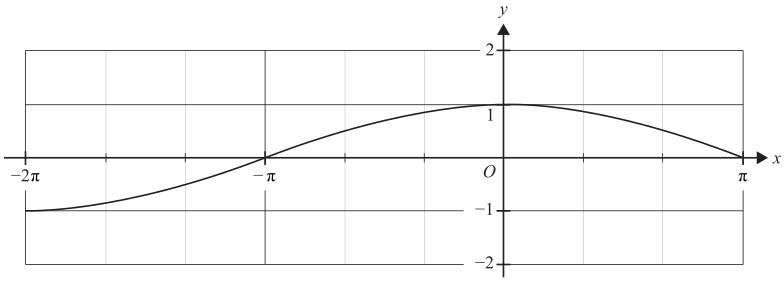
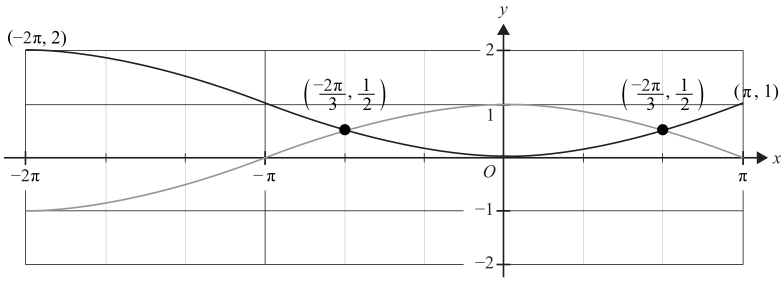
Let `g: [-2pi, pi] -> R,\ \ g(x) = 1-f(x)`.
Sketch the graph of `g` on the axes above. Label all points of intersection of the graphs of `f` and `g`, and the endpoints of `g`, with their coordinates. (2 marks)
--- 2 WORK AREA LINES (style=lined) ---
| a. | `2 cos (x/2)` | `= 1` |
| `cos (x/2)` | `= 1/2` |
`=>\ text(Base angle)\ \ pi/3`
`x/2 = pi/3, -pi/3, (-5 pi)/3`
`x = (2 pi)/3, (-2 pi)/3 qquad (x in [-2pi, pi])`
b. `text(Plot points for)\ \ g(x):`
`text(- reflect)\ f(x)\ text(in)\ x text(-axis, then)`
`text(- translate 1 upwards.)`
Let `f:[0,2pi] -> R, \ f(x) = 2cos(x) + 1`.
--- 5 WORK AREA LINES (style=lined) ---
--- 0 WORK AREA LINES (style=lined) ---
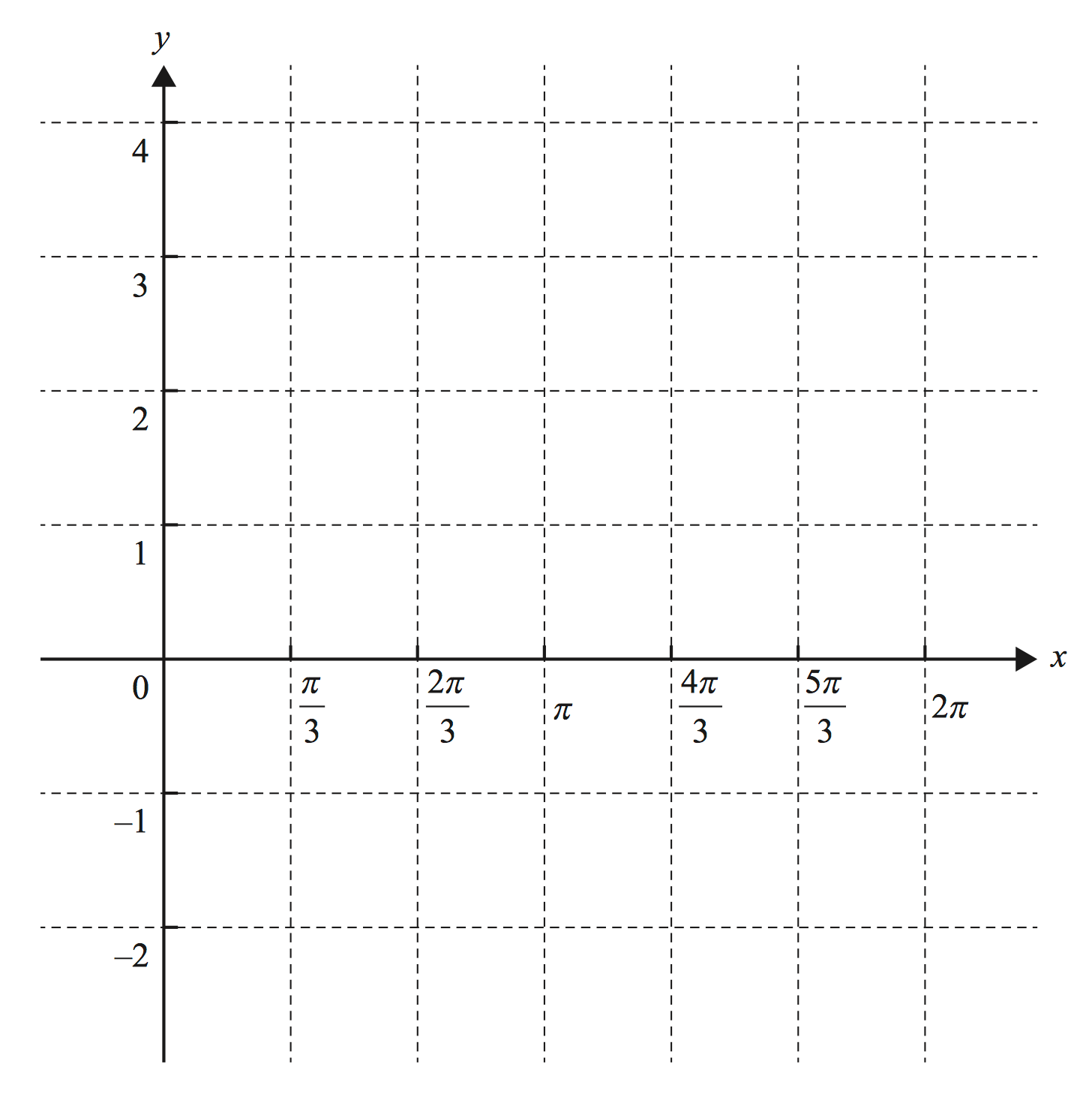
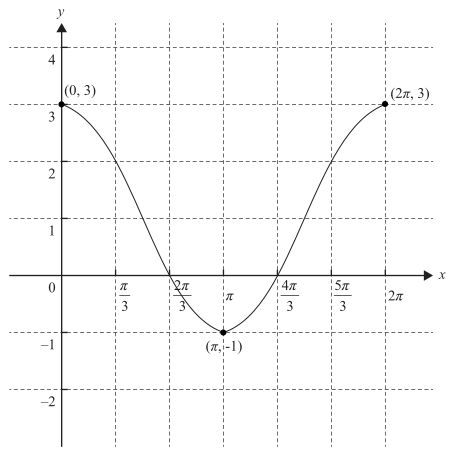
| a. | `2cos(x) + 1` | `= 0` |
| `cos(x)` | `=-1/2` |
`=> cos\ pi/3 = 1/2\ text(and cos is negative)`
`text(in 2nd/3rd quadrant)`
| `:.x` | `= pi-pi/3, pi + pi/3` |
| `= (2pi)/3, (4pi)/3` |
| b. | |
Let `f: R -> R,\ f(x) = 4 cos ((2 pi x)/3) + 1`.
The period of this function is
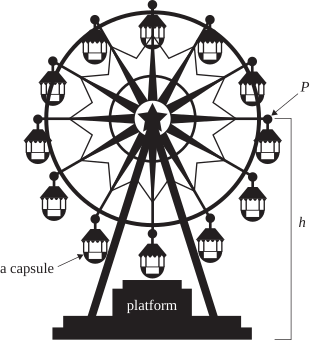
Sammy visits a giant Ferris wheel. Sammy enters a capsule on the Ferris wheel from a platform above the ground. The Ferris wheel is rotating anticlockwise. The capsule is attached to the Ferris wheel at point `P`. The height of `P` above the ground, `h`, is modelled by `h(t) = 65-55cos((pit)/15)`, where `t` is the time in minutes after Sammy enters the capsule and `h` is measured in metres.
Sammy exits the capsule after one complete rotation of the Ferris wheel.
--- 2 WORK AREA LINES (style=lined) ---
--- 2 WORK AREA LINES (style=lined) ---
--- 4 WORK AREA LINES (style=lined) ---
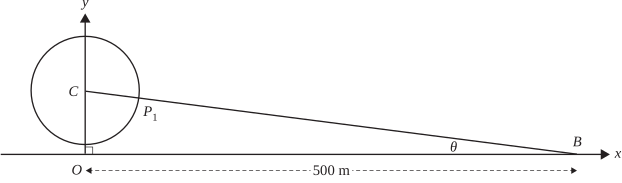
As the Ferris wheel rotates, a stationary boat at `B`, on a nearby river, first becomes visible at point `P_1`. `B` is 500 m horizontally from the vertical axis through the centre `C` of the Ferris wheel and angle `CBO = theta`, as shown below.
--- 3 WORK AREA LINES (style=lined) ---
Part of the path of `P` is given by `y = sqrt(3025-x^2) + 65, x ∈ [-55,55]`, where `x` and `y` are in metres.
--- 2 WORK AREA LINES (style=lined) ---
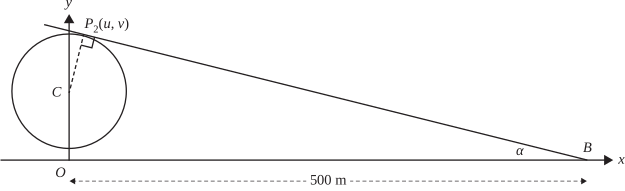
As the Ferris wheel continues to rotate, the boat at `B` is no longer visible from the point `P_2(u, v)` onwards. The line through `B` and `P_2` is tangent to the path of `P`, where angle `OBP_2 = alpha`.
--- 10 WORK AREA LINES (style=lined) ---
--- 4 WORK AREA LINES (style=lined) ---
--- 5 WORK AREA LINES (style=lined) ---
| a. | `h_text(min)` | `= 65-55` | `h_text(max)` | `= 65 + 55` |
| `= 10\ text(m)` | `= 120\ text(m)` |
b. `text(Period) = (2pi)/(pi/15) = 30\ text(min)`
c. `h^{prime}(t) = (11pi)/3\ sin(pi/15 t)`♦ Mean mark 50%.
MARKER’S COMMENT: A number of commons errors here – 2 answers given, calc not in radian mode, etc …
`text(Solve)\ h^{primeprime}(t) = 0, t ∈ (0,30)`
| `t = 15/2\ \ text{(max)}` | `text(or)` | `t = 45/2\ \ text{(min – descending)}` |
`:. t = 7.5`
| d. | 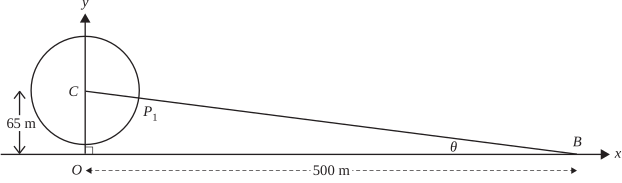 |
♦ Mean mark 36%.
MARKER’S COMMENT: Choosing degrees vs radians in the correct context was critical here.
| `tan(theta)` | `= 65/500` |
| `:. theta` | `=7.406…` |
| `= 7.41^@` |
| e. | `(dy)/(dx)` | `= (-x)/(sqrt(3025-x^2))` |
| f. | 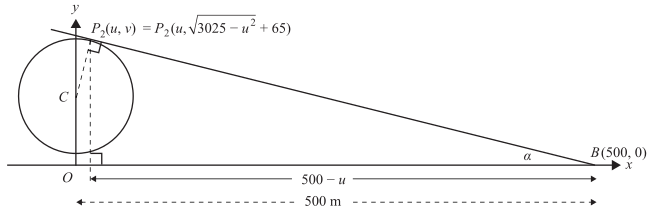 |
`P_2(u,sqrt(3025-u^2) + 65),\ \ B(500,0)`
| `:. m_(P_2B)` | `= (sqrt(3025-u^2) + 65)/(u-500)` |
`text{Using part (e), when}\ \ x=u,`♦♦♦ Mean mark part (f) 18%.
MARKER’S COMMENT: Many students were unable to use the rise over run information to calculate the second gradient.
`dy/dx=(-u)/(sqrt(3025-u^2))`
`text{Solve (by CAS):}`
| `(sqrt(3025-u^2) + 65)/(u-500)` | `= (-u)/(sqrt(3025-u^2))\ \ text(for)\ u` |
`u=12.9975…=13.00\ \ text{(2 d.p.)}`
| `:. v` | `= sqrt(3025-(12.9975…)^2) + 65` |
| `= 118.4421…` | |
| `= 118.44\ \ text{(2 d.p.)}` |
`:.P_2(13.00, 118.44)`
♦♦♦ Mean mark part (g) 7%.
| g. | `tan alpha` | `=v/(500-u)` |
| `= (118.442…)/(500-12.9975…)` | ||
| `:. alpha` | `= 13.67^@\ \ text{(2 d.p.)}` |
| h. | 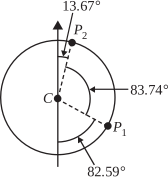 |
♦♦♦ Mean mark 5%.
`text(Find the rotation between)\ P_1 and P_2:`
`text(Rotation to)\ P_1 = 90-7.41=82.59^@`
`text(Rotation to)\ P_2 = 180-13.67=166.33^@`
`text(Rotation)\ \ P_1 → P_2 = 166.33-82.59 = 83.74^@`
| `:.\ text(Time visible)` | `= 83.74/360 xx 30\ text(min)` |
| `=6.978…` | |
| `= 7\ text{min (nearest degree)}` |
The function `f` has the rule `f(x) = 1 + 2 cos x`.
--- 6 WORK AREA LINES (style=lined) ---
--- 0 WORK AREA LINES (style=lined) ---
--- 6 WORK AREA LINES (style=lined) ---
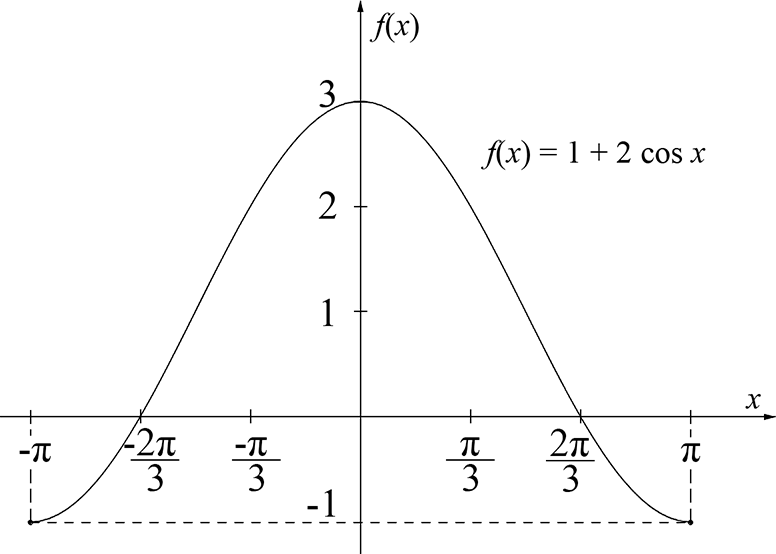
a. `f(x) = 1 + 2 cos x`
`f(x)\ text(cuts the)\ x text(-axis when)\ f(x) = 0`
| `1 + 2 cos x` | `= 0` |
| `2 cos x` | `=-1` |
| `cos x` | `= -1/2` |
`:. x = (2 pi)/3\ …\ text(as required)`
| b. | |
| c. `text(Area)` | `= int_(-pi/2)^((2 pi)/3) 1 + 2 cos x\ \ dx` |
| `= [x + 2 sin x]_(-pi/2)^((2 pi)/3)` | |
| `= [((2 pi)/3 + 2 sin (2 pi)/3)-((-pi)/2 + 2 sin (-pi)/2)]` | |
| `= ((2 pi)/3 + 2 xx sqrt 3/2)-((-pi)/2 +2(- 1))` | |
| `= (2 pi)/3 + sqrt(3) + pi/2 + 2` | |
| `= ((7 pi)/6 + sqrt(3) + 2)\ text(u²)` |
Let `f: R -> R,\ f(x) = 1 - 2 cos ({pi x}/2).`
The period and range of this function are respectively
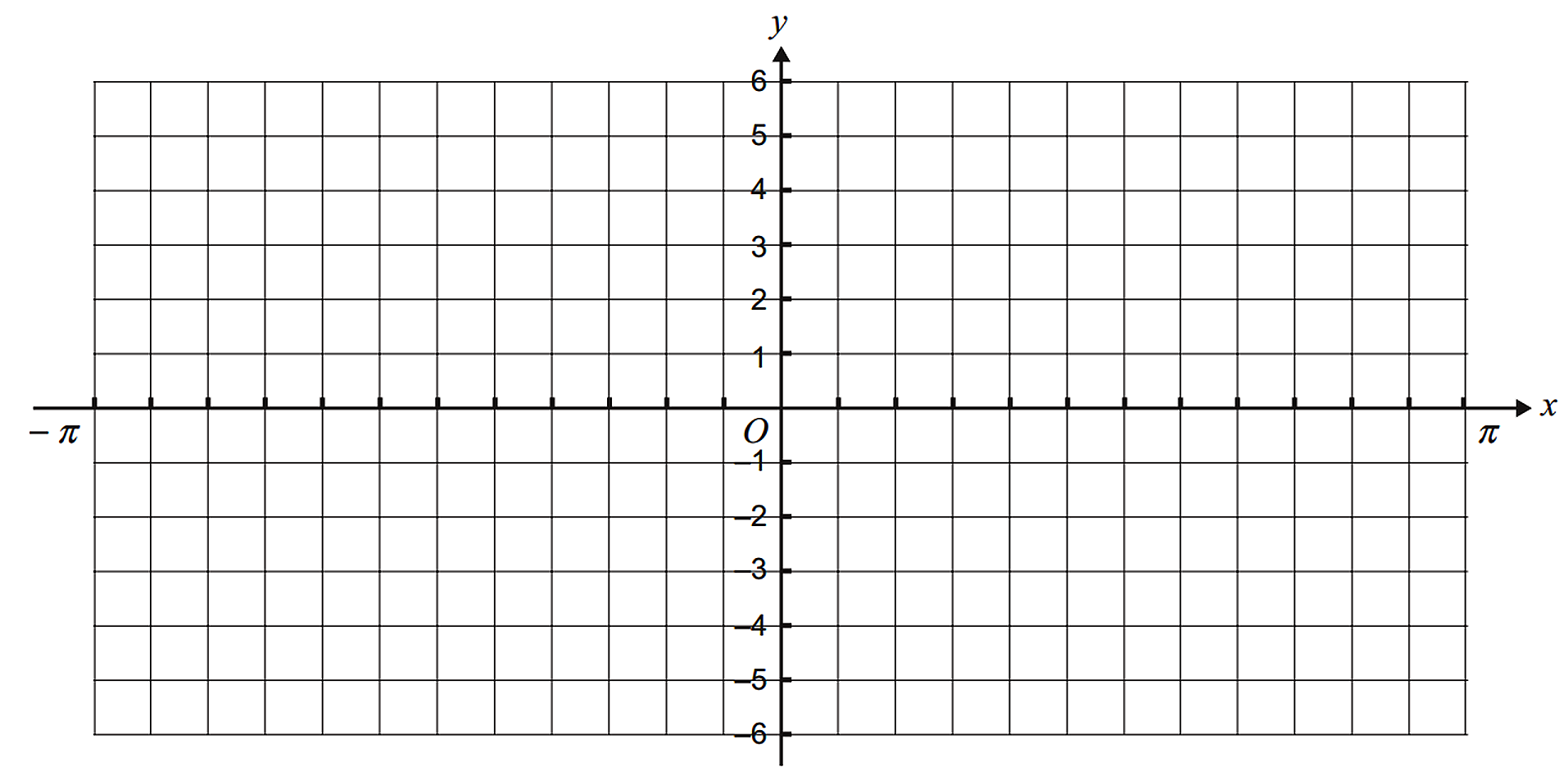
For the function `f: [-pi, pi] -> R, f(x) = 5 cos (2 (x + pi/3))`
--- 2 WORK AREA LINES (style=lined) ---
Label endpoints of the graph with their coordinates. (3 marks)
--- 3 WORK AREA LINES (style=lined) ---
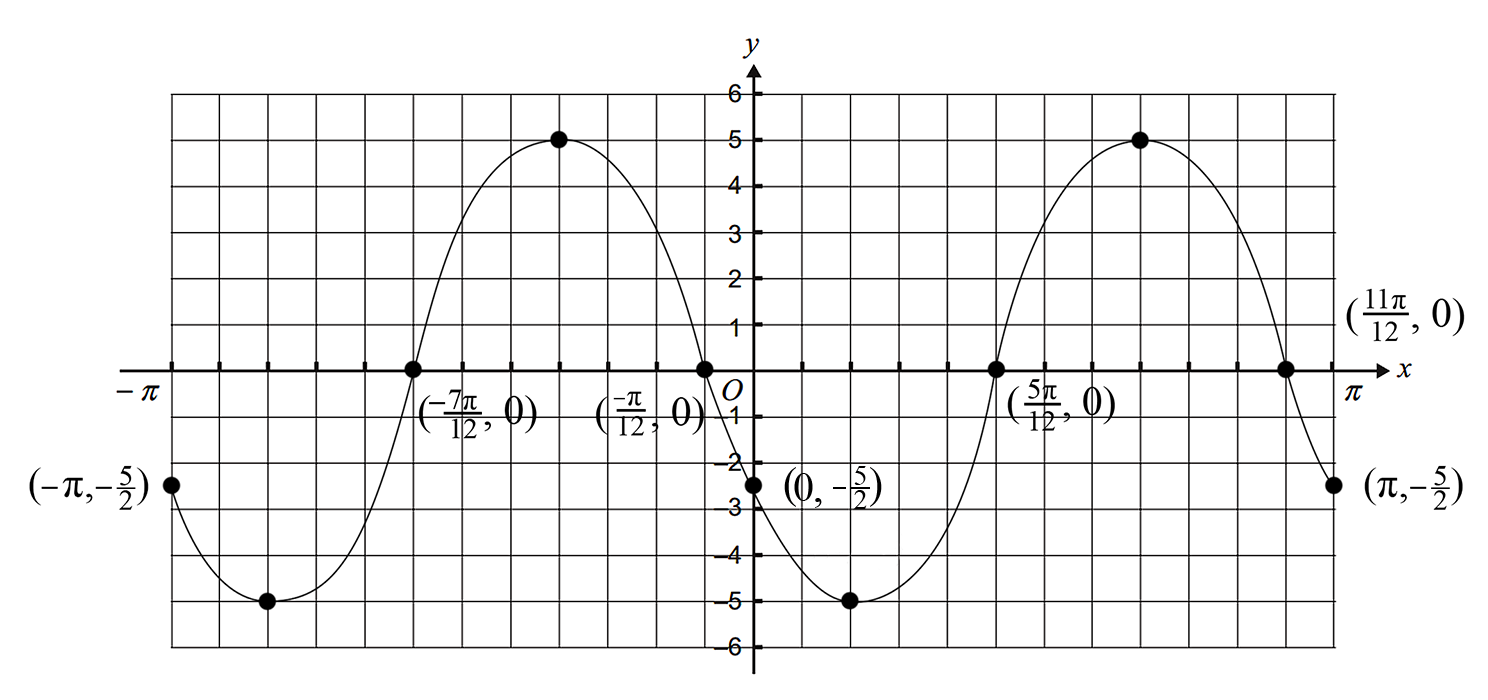
a. `text(Amplitude) = 5`
`text(Period) = (2 pi)/2 = pi`
| b. | |
`text(Shift)\ \ y = 5 cos (2x)\ \ text(left)\ \ pi/3\ \ text(units).`
`text(Period) = pi`
`text(Endpoints are)\ \ (-pi, -5/2) and (pi,-5/2)`
State the range and period of the function
`h: R -> R,\ \ h(x) = 4 + 3 cos ((pi x)/2)`. (2 marks)
--- 5 WORK AREA LINES (style=lined) ---
The graphs of `y = cos (x) and y = a sin (x)`, where `a` is a real constant, have a point of intersection at `x = pi/3.`
--- 5 WORK AREA LINES (style=lined) ---
--- 3 WORK AREA LINES (style=lined) ---
The population of wombats in a particular location varies according to the rule `n(t) = 1200 + 400 cos ((pi t)/3)`, where `n` is the number of wombats and `t` is the number of months after 1 March 2013.
--- 3 WORK AREA LINES (style=lined) ---
--- 2 WORK AREA LINES (style=lined) ---
--- 1 WORK AREA LINES (style=lined) ---
--- 6 WORK AREA LINES (style=lined) ---
Trigg the gardener is working in a temperature-controlled greenhouse. During a particular 24-hour time interval, the temperature `(Ttext{°C})` is given by `T(t) = 25 + 2 cos ((pi t)/8), \ 0 <= t <= 24`, where `t` is the time in hours from the beginning of the 24-hour time interval.
--- 3 WORK AREA LINES (style=lined) ---
--- 2 WORK AREA LINES (style=lined) ---
--- 3 WORK AREA LINES (style=lined) ---
--- 3 WORK AREA LINES (style=lined) ---
Trigg is designing a garden that is to be built on flat ground. In his initial plans, he draws the graph of `y = sin(x)` for `0 <= x <= 2 pi` and decides that the garden beds will have the shape of the shaded regions shown in the diagram below. He includes a garden path, which is shown as line segment `PC.`

--- 3 WORK AREA LINES (style=lined) ---
--- 6 WORK AREA LINES (style=lined) ---
In further planning for the garden, Trigg uses a transformation of the plane defined as a dilation of factor `k` from the `x`-axis and a dilation of factor `m` from the `y`-axis, where `k` and `m` are positive real numbers.
--- 8 WORK AREA LINES (style=lined) ---
--- 3 WORK AREA LINES (style=lined) ---
a. `T_text(max)\ text(occurs when)\ \ cos((pit)/8) = 1,`
`T_text(max)= 25 + 2 = 27^@C`
`text(Max occurs when)\ \ t = 0, or 16\ text(h)`
| b. | `text(Period)` | `= (2pi)/(pi/8)` |
| `= 16\ text(hours)` |
c. `text(Solve:)\ \ 25 + 2 cos ((pi t)/8)=26\ \ text(for)\ t,`
| `t` | `= 8/3,40/3,56/3\ \ text(for)\ t ∈ [0,24]` |
| `t_text(min)` | `= 8/3` |
d. `text(Consider the graph:)`

| `text(Time above)\ 26 text(°C)` | `= 8/3 + (56/3-40/3)` |
| `= 8\ text(hours)` |
e.i. `(dy)/(dx) = cos(x)`
`text(At)\ x = (2pi)/3,`
| `(dy)/(dx)` | `= cos((2pi)/3)=-1/2` |
e.ii. `text(Solution 1)`
`text(Equation of)\ \ PC,`
| `y-sqrt3/2` | `=-1/2(x-(2pi)/3)` |
| `y` | `=-1/2 x +pi/3 +sqrt3/2` |
`PC\ \ text(passes through)\ \ (c,0),`
| `0` | `=-1/2 c +pi/3 + sqrt3/2` |
| `c` | `=sqrt3 + (2 pi)/3\ …\ text(as required)` |
`text(Solution 2)`
`text(Equating gradients:)`
| `- 1/2` | `= (sqrt3/2-0)/((2pi)/3-c)` |
| `-1` | `= sqrt3/((2pi-3c)/3)` |
| `3c-2pi` | `= 3sqrt3` |
| `3c` | `= 3 sqrt3 + 2pi` |
| `:. c` | `= sqrt3 + (2pi)/3\ …\ text(as required)` |
f.i. `X^{′} ((2pi)/3 m,0)qquadP^{′}((2pi)/3 m, sqrt3/2 k)qquadC^{′} ((sqrt3 + (2pi)/3)m, 0)`
| `X^{′}P^{′}` | `= 10` |
| `sqrt3/2 k` | `= 10` |
| `:. k` | `= 20/sqrt3` |
| `=(20sqrt3)/3` |
`X^{′}C^{′}=30`
| `((sqrt3 + (2pi)/3)m)-(2pi)/3 m` | `= 30` |
| `:. m` | `= 30/sqrt3` |
| `=10sqrt3` |
| f.ii. | `P^{′}((2pi)/3 m, sqrt3/2 k)` | `= P^{′}((2pi)/3 xx 10sqrt3, sqrt3/2 xx 20/sqrt3)` |
| `= P^{′}((20pisqrt3)/3,10)` |
The domain of the function `h`, where `h(x) = cos(log_a (x))` and `a` is a real number greater than `1`, is chosen so that `h` is a one-to-one function.
Which one of the following could be the domain?