SmarterEd

Aussie Maths & Science Teachers: Save your time with SmarterEd

  • Login
  • Get Help
  • About

Probability, MET2 2022 VCAA 3

Mika is flipping a coin. The unbiased coin has a probability of \(\dfrac{1}{2}\) of landing on heads and \(\dfrac{1}{2}\) of landing on tails.

Let \(X\) be the binomial random variable representing the number of times that the coin lands on heads.

Mika flips the coin five times.

    1. Find \(\text{Pr}(X=5)\).   (1 mark)

      --- 2 WORK AREA LINES (style=lined) ---

    2. Find \(\text{Pr}(X \geq 2).\) (1 mark)

      --- 2 WORK AREA LINES (style=lined) ---

    3. Find \(\text{Pr}(X \geq 2 | X<5)\), correct to three decimal places.   (2 marks)

      --- 4 WORK AREA LINES (style=lined) ---

    4. Find the expected value and the standard deviation for \(X\).   (2 marks)

      --- 4 WORK AREA LINES (style=lined) ---

The height reached by each of Mika's coin flips is given by a continuous random variable, \(H\), with the probability density function
  

\(f(h)=\begin{cases} ah^2+bh+c         &\ \ 1.5\leq h\leq 3 \\ \\ 0       &\ \ \text{elsewhere} \\ \end{cases}\)
  

where \(h\) is the vertical height reached by the coin flip, in metres, between the coin and the floor, and \(a, b\) and \(c\) are real constants.

    1. State the value of the definite integral \(\displaystyle\int_{1.5}^3 f(h)\,dh\).   (1 mark)

      --- 5 WORK AREA LINES (style=lined) ---

    2. Given that  \(\text{Pr}(H \leq 2)=0.35\)  and  \(\text{Pr}(H \geq 2.5)=0.25\), find the values of \(a, b\) and \(c\).   (3 marks)

      --- 5 WORK AREA LINES (style=lined) ---

    3. The ceiling of Mika's room is 3 m above the floor. The minimum distance between the coin and the ceiling is a continuous random variable, \(D\), with probability density function \(g\).
    4. The function \(g\) is a transformation of the function \(f\) given by \(g(d)=f(rd+s)\), where \(d\) is the minimum distance between the coin and the ceiling, and \(r\) and \(s\) are real constants.
    5. Find the values of \(r\) and \(s\).   (1 mark)

      --- 5 WORK AREA LINES (style=lined) ---

  1. Mika's sister Bella also has a coin. On each flip, Bella's coin has a probability of \(p\) of landing on heads and \((1-p)\) of landing on tails, where \(p\) is a constant value between 0 and 1 .
  2. Bella flips her coin 25 times in order to estimate \(p\).
  3. Let \(\hat{P}\) be the random variable representing the proportion of times that Bella's coin lands on heads in her sample.
    1. Is the random variable \(\hat{P}\) discrete or continuous? Justify your answer.   (1 mark)
      --- 2 WORK AREA LINES (style=lined) ---

    2. If \(\hat{p}=0.4\), find an approximate 95% confidence interval for \(p\), correct to three decimal places.   (1 mark)

      --- 6 WORK AREA LINES (style=lined) ---

    3. Bella knows that she can decrease the width of a 95% confidence interval by using a larger sample of coin flips.
    4. If \(\hat{p}=0.4\), how many coin flips would be required to halve the width of the confidence interval found in part c.ii.?   (1 mark)

      --- 2 WORK AREA LINES (style=lined) ---

Show Answers Only

a. i.    `frac{1}{32}`    ii.    `frac{13}{16}`    iii.    `0.806` (3 d.p.)

a. iv    `text{E}(X)=5/2,  text{sd}(X)=\frac{\sqrt{5}}{2}`

b. i.   `1`   

b. ii.    `a=-frac{4}{5},  b=frac{17}{5},  c=-frac{167}{60}`

b. iii. `r=-1,  s=3`

c. i.   `text{Discrete}`   ii.   `(0.208,  0.592)`   iii.   `n=100`

Show Worked Solution

a.i  `X ~ text{Bi}(5 , frac{1}{2})`

`text{Pr}(X = 5) = (frac{1}{2})^5 = frac{1}{32}`
 

a.ii  By CAS:    `text{binomCdf}(5,0.5,2,5)`     `0.8125`

`text{Pr}(X>= 2) = 0.8125 = frac{13}{16}`

  
a.iii 
`\text{Pr}(X \geq 2 | X<5)`

`=frac{\text{Pr}(2 <= X < 5)}{\text{Pr}(X < 5)} = frac{\text{Pr}(2 <= X <= 4)}{text{Pr}(X <= 4)}`

  
By CAS: `frac{text{binomCdf}(5,0.5,2,4)}{text{binomCdf}(5,0.5,0,4)}`
 

`= 0.806452 ~~ 0.806` (3 decimal places)
  

a.iv `X ~ text{Bi}(5 , frac{1}{2})`

`text{E}(X) = n xx p= 5 xx 1/2 = 5/2`

`text{sd}(X) =\sqrt{n p(1-p)}=\sqrt((5/2)(1 – 0.5)) = \sqrt{5/4} =\frac{\sqrt{5}}{2}`


b.i   `\int_{1.5}^3 f(h) d h = 1`


♦♦ Mean mark (b.i) 40%.
MARKER’S COMMENT: Many students did not evaluate the integral or evaluated incorrectly.

b.ii  By CAS:

`f(h):= a\·\h^2 + b\·\h +c`
 

`text{Solve}( {(\int_{1.5}^2 f(h) d h = 0.35), (\int_{2.5}^3 f(h) d h = 0.25), (\int_{1.5}^3 f(h) d h = 1):})`

`a = -0.8 = frac{-4}{5}, \ b = 3.4 = frac{17}{5},\  c = =-2.78 \dot{3} = frac{-167}{60}`


♦♦ Mean mark (b.ii) 47%.
MARKER’S COMMENT: Many students did not give exact answers.

b.iii  `h + d = 3`

`:.\  f(h) = f(3  –  d) = f(- d + 3)`

`:.\  r = – 1 ` and ` s = 3`


♦♦♦♦ Mean mark (b.iii) 10%.
MARKER’S COMMENT: Many students did not attempt this question.

c.i  `\hat{p}`  is discrete.

The number of coin flips must be zero or a positive integer so  `\hat{p}`  is countable and therefore discrete.
 

c.ii  `\left(\hat{p}-z \sqrt{\frac{\hat{p}(1-\hat{p})}{n}}, \hat{p}+z \sqrt{\frac{\hat{p}(1-\hat{p})}{n}}\right)`

`\left(0.4-1.96 \sqrt{\frac{0.4 \times 0.6}{25}}\ , 0.4-1.96 \sqrt{\frac{0.4 \times 0.6}{25}}\right)`

`\approx(0.208\ ,0.592)`


c.iii To halve the width of the confidence interval, the standard deviation needs to be halved.

`:.\  \frac{1}{2} \sqrt{\frac{0.4 \times 0.6}{25}} = \sqrt{\frac{0.4 \times 0.6}{4 xx 25}} = \sqrt{\frac{0.4 \times 0.6}{100}}`

`:.\  n = 100`

She would need to flip the coin 100 times


♦♦♦ Mean mark (c.iii) 30%.
MARKER’S COMMENT: Common incorrect answers were 0, 10, 11, 50 and 101.

Filed Under: Binomial, Probability density functions Tagged With: Band 2, Band 4, Band 5, Band 6, smc-637-35-Sum probabilities = 1, smc-637-60-Polynomial PDF, smc-638-20-binomCdf (CAS), smc-638-32-Find E(X)/var(X) given n p, smc-638-50-Conditional, smc-719-20-95% confidence intervals, smc-719-40-Find sample size

Probability, MET1 2023 VCAA 8

Suppose that the queuing time, \(T\) (in minutes), at a customer service desk has a probability density function given by
 

\(f(t) = \begin {cases}
kt(16-t^2)         &\ \ 0 \leq t \leq 4 \\
\\
0 &\ \ \text{elsewhere}
\end{cases}\)

 
for some  \(K \in R\).

  1. Show that  \(k=\dfrac{1}{64}\).   (1 mark)

    --- 5 WORK AREA LINES (style=lined) ---

  2. Find  \(\text{E}(T)\).   (2 marks)

    --- 6 WORK AREA LINES (style=lined) ---

  3. What is the probability that a person has to queue for more than two minutes, given that they have already queued for one minute?   (3 marks)

    --- 12 WORK AREA LINES (style=blank) ---

Show Answers Only
a.    \(\displaystyle \int_{0}^{4} (16-t^2)\,dt\) \(=1\)
  \(k\left[8t^2-\dfrac{t^4}{4}\right]_0^4\) \(=1\)
  \(k\Bigg(8\times16-\dfrac{16\times16}{4}\Bigg)\) \(=1\)
  \(64k\) \(=1\)
  \(\therefore\ k\) \(=\dfrac{1}{64}\)

b.    \(E(T)=\dfrac{32}{15}\)

c.    \(\dfrac{16}{25}=0.64\)

Show Worked Solution
a.    \(\displaystyle \int_{0}^{4} kt(16-t^2)\,dt\) \(=1\)
  \(k\left[8t^2-\dfrac{t^4}{4}\right]_0^4\) \(=1\)
  \(k\Bigg(8\times16-\dfrac{16\times16}{4}\Bigg)\) \(=1\)
  \(64k\) \(=1\)
  \(\therefore\ k\) \(=\dfrac{1}{64}\)

♦ Mean mark (a) 43%.
b.    \(E(T)\) \(=\dfrac{1}{64}\displaystyle \int_{0}^{4} (16t^2-t^4)\,dt\)
    \(=\dfrac{1}{64}\left[\dfrac{16t^3}{3}-\dfrac{t^5}{5}\right]_0^4\)
    \(=\dfrac{1}{64}\Bigg(\dfrac{1024}{3}-\dfrac{1024}{5}-0\Bigg)\)
    \(=\dfrac{1}{64}\times\dfrac{2048}{15}\)
    \(=\dfrac{32}{15}\)

♦♦ Mean mark (b) 38%.
c.    \(\text{Pr}(2<T<4|T>1)\) \(=\dfrac{\text{Pr}(2<T<4)}{\text{Pr}(T>1)}\)
    \(=\dfrac{\dfrac{1}{64}\displaystyle \int_{2}^{4} (16t-t^3)\,dt}{\dfrac{1}{64}\displaystyle \int_{1}^{4} (16t-t^3)\,dt}\)
    \(=\dfrac{\left[8t^2-\dfrac{t^4}{4}\right]_2^4}{\left[8t^2-\dfrac{t^4}{4}\right]_1^4}\)
    \(=\dfrac{(64-(32-4))}{\bigg(64-\bigg(8-\dfrac{1}{4}\bigg)\bigg)}\)
    \(=\dfrac{36}{\bigg(\dfrac{225}{4}\bigg)}=\dfrac{144}{225}=\dfrac{16}{25}=0.64\)

♦♦♦ Mean mark (c) 24%.
MARKER’S COMMENT: Simplifying fractions caused problems. Cancelling factors will assist with calculations.

Filed Under: Probability density functions Tagged With: Band 5, Band 6, smc-637-10-E(X), smc-637-35-Sum probabilities = 1, smc-637-60-Polynomial PDF

Probability, MET1 2021 VCAA 7

A random variable  `X`  has the probability density function  `f`  given by

`f(x) = {{:(k/(x^2)),(0):}\ \ \ \ {:(1 <= x <= 2),(text{elsewhere}):}:}`

where  `k`  is a positive real number.

  1. Show that  `k = 2`.  (1 mark)

    --- 5 WORK AREA LINES (style=lined) ---

  2. Find  `E(X)`.  (2 marks)

    --- 5 WORK AREA LINES (style=lined) ---

Show Answers Only

  1. `text(See Worked Solution)`
  2. `2log_e2`

Show Worked Solution

♦ Mean mark part (a) 48%.

a.    `int_1^2 k/x^2\ dx` `=1`
  `k[- 1/x]_1^2` `=1`
  `k(-1/2+1)` `=1`
  `k/2` `=1`
  `:.k` `=2\ \ text{… as required}`


♦ Mean mark part (b) 44%.
MARKER’S COMMENT: Common error not recognising  `log_e1=0`

b.    `E(X)` `=int_1^2 x * 2/x^2\ dx`
    `=int_1^2 2/x\ dx`
    `=[2log_e x]_1^2`
    `=2log_e2-2log_e1`
    `=2log_e2`

Filed Under: Probability density functions Tagged With: Band 5, smc-637-10-E(X), smc-637-35-Sum probabilities = 1, smc-637-60-Polynomial PDF

Probability, MET2-NHT 2019 VCAA 10 MC

Let  `f`  be the probability density function  `f : [ 0, (2)/(3)] → R, \ f(x) = kx(2x + 1)(3x -2)(3x + 2)`.
The value of  `k`  is

  1.     `(308)/(405)`
  2.  `–(308)/(405)`
  3.  `–(405)/(308)`
  4.     `(405)/(308)`
  5.     `(960)/(133)`
Show Answers Only

`C`

Show Worked Solution

`text(Solve for)\ k :`

`k int_0^((2)/(3)) x (2x + 1)(3x – 2)(3x + 2)\ dx = 1`

`k = -(405)/(308)`
 

`=> \ C`

Filed Under: Probability density functions Tagged With: Band 4, smc-637-35-Sum probabilities = 1, smc-637-60-Polynomial PDF

Probability, MET2 2019 VCAA 18 MC

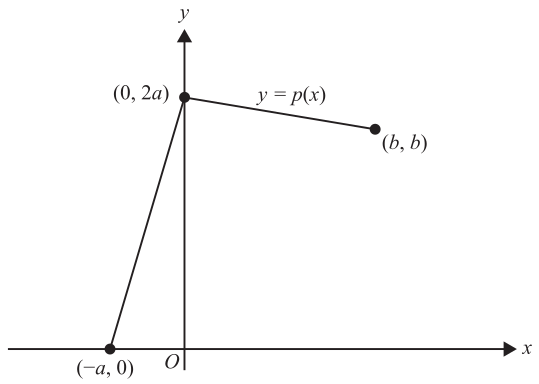
The distribution of a continuous random variable, `X`, is defined by the probability density function  `f`, where
 

`f(x) = {(p(x)), (0):} qquad {:(-a <= x <= b), (text(otherwise)):}`
 

and  `a, b in RR^+`

The graph of the function  `p`  is shown below.


It is known that the average value of  `p`  over the interval  `[-a, b]`  is  `3/4`.

`text(Pr)(X > 0)`  is

A.   `2/3`

B.   `3/4`

C.   `4/5`

D.   `7/9`

E.   `5/6`

Show Answers Only

`D`

Show Worked Solution
`text(Area)` `= 1/2 (a xx 2a) + 1/2 b(2a + b)`
`1` `= a^2 + ab + (b^2)/2\ …\ (1)`


`text(Average value)` `= 1/(b + a) (a^2 + ab + (b^2)/2)`
`3/4` `= 1/(b + a)\ …\ (2)`

 
`text(Solve for) \ \ a\ \ text{(by CAS):}`

`a = – sqrt 2/3`

`text(Pr)(X > 0)` `= 1 – text(Pr)(X < 0)`
  `= 1 – a^2`
  `= 7/9`

 
`=>   D`

Filed Under: Probability density functions Tagged With: Band 5, smc-637-35-Sum probabilities = 1

Probability, MET2 2017 VCAA 19 MC

A probability density function  `f` is given by

`f(x) = {{:(cos(x) + 1),(0):}qquad{:(k < x < (k + 1)),(text(elsewhere)):}:}`

where `0 < k < 2`.

The value of `k` is

  1. `1`
  2. `(3pi - 1)/2`
  3. `pi - 1`
  4. `(pi - 1)/2`
  5. `pi/2`
Show Answers Only

`D`

Show Worked Solution
`int_k^(k+1)(cos(x) + 1)\ dx` `=[sinx +x]_k^(k+1)`
`sin(k+1)+(k+1) -sink – k` `=1`
`sin(k+1)-sink` `=0`
`sin(k+1)-sin(pi-k)` `=0`
   
`k+1` `=pi-k`
`2k` `=pi-1`
`:.k` `=(pi-1)/2`

`=> D`

Filed Under: Probability density functions Tagged With: Band 4, smc-637-35-Sum probabilities = 1, smc-637-80-Trig PDF

Probability, MET1 2008 VCAA 4

The function
 

`f(x) = {{:(k),(0):}{:(sin(pix)qquadtext(if)qquadx ∈ [0,1]),(qquadqquadqquadqquadquadtext(otherwise)):}`
 

is a probability density function for the continuous random variable `X`.

  1. Show that  `k = pi/2`.  (2 marks)

    --- 5 WORK AREA LINES (style=lined) ---

  2. Find  `text(Pr)(X <= 1/4 | X <= 1/2)`.  (3 marks)

    --- 5 WORK AREA LINES (style=lined) ---

Show Answers Only

  1. `text(See Worked Solutions)`
  2. `1 – (sqrt2)/2`

Show Worked Solution

a.   `text(Total Area under curve) = 1\ text(u²)`

`int_0^1 k sin(pix)dx` `= 1`
`- k/pi [cos(pix)]_0^1` `= 1`
`- k/pi[cos(pi) – cos(0)]` `= 1`
`- k/pi[(−1) – (1)]` `= 1`
`2k` `= pi`
`:.k` `= pi/2`


b.   `text(Conditional Probability:)`

♦ Mean mark 47%.
MARKER’S COMMENT: Few students used the symmetry of the probability density function to calculate the denominator.

`text(Pr)(X <= 1/4 | X <= 1/2)`

`= (text(Pr)(X <= 1/4))/(text(Pr)(X <= 1/2))`
`= (pi/2 int_0^(1/4) sin(pix)dx)/(1/2)`
`= -pi/pi [cos(pix)]_0^(1/4)`
`= -1 [cos(pi/4) – cos(0)]`
`= -1 [1/(sqrt2) – 1]`
`= 1 – (sqrt2)/2`

Filed Under: Probability density functions Tagged With: Band 4, Band 5, smc-637-35-Sum probabilities = 1, smc-637-40-Conditional probability, smc-637-80-Trig PDF

Probability, MET1 2010 VCAA 7

The continuous random variable `X` has a distribution with probability density function given by
 

`f(x) = {(ax(5 - x), \ text(if)\ \ 0 <= x <= 5), (0,\ text (if)\ \ x < 0\ \ text(or if)\ \ x > 5):}`
 

where `a` is a positive constant.

  1. Find the value of `a`.  (3 marks)

    --- 5 WORK AREA LINES (style=lined) ---

  2. Express  `text(Pr) (X < 3)`  as a  definite integral. (Do not evaluate the definite integral.)  (1 mark)

    --- 1 WORK AREA LINES (style=lined) ---

Show Answers Only

  1. `6/125`
  2. `int_0^3 f(x)\ dx`

Show Worked Solution

a.   `text(Total Area under curve)` `= 1`
  `a int_0^5 (5x – x^2)\ dx` `= 1`
  `a [5/2 x^2 – 1/3 x^3]_0^5` `= 1`
  `a [(125/2 – 125/3) – (0)]` `= 1`
  `125/6 a` `= 1`
  `:. a` `= 6/125`


b.   `text(Pr) (X < 3) = int_0^3 f(x)\ dx`

Filed Under: Probability density functions Tagged With: Band 4, smc-637-35-Sum probabilities = 1, smc-637-45-Other probability, smc-637-60-Polynomial PDF

Probability, MET2 2015 VCAA 13 MC

The function `f` is a probability density function with rule
 

`f(x) = {(ae^x, 0 <= x <= 1), (ae, 1 < x <= 2), (\ 0, text(otherwise)):}`
 

The value of `a` is

  1. `1`
  2. `e`
  3. `1/e`
  4. `1/(2e)`
  5. `1/(2e - 1)`
Show Answers Only

`E`

Show Worked Solution

`text(Total area) = 1`

`int_0^1 ae^x\ dx + int_1^2 ae\ dx` `= 1`
`[ae^x]_0^1 + [ae*x]_1^2` `=1`
`[ae-a] + [2ae-ae]` `=1`
`a(2e-1)` `=1`
`:. a` `= 1/(2e – 1)`

`=>   E`

Filed Under: Probability density functions Tagged With: Band 4, smc-637-35-Sum probabilities = 1, smc-637-70-Exp/Log PDF

Probability, MET2 2015 VCAA 9 MC

The graph of the probability density function of a continuous random variable, `X`, is shown below.

VCAA 2015 9mc

If  `a > 2`, then `text(E)(X)` is equal to

  1. `8`
  2. `5`
  3. `4`
  4. `3`
  5. `2`
Show Answers Only

`B`

Show Worked Solution
`text(Area under rectangle)` `= 1`
`1/6(a – 2)` `= 1`
`:. a` `= 8`
♦ Mean mark 37%.
MARKER’S COMMENT: Once `a=8` is found, the expected value can also be quickly found halfway between 2 and 8, due to the uniform distribution.


`text(E)(X)` `= int_2^8 x (1/6)\ dx`
  `=[x^2/12]_2^8`
  `=64/12 – 4/12`
  `=5`

 
`=>   B`

Filed Under: Probability density functions Tagged With: Band 5, smc-637-10-E(X), smc-637-35-Sum probabilities = 1

Copyright © 2014–2025 SmarterEd.com.au · Log in