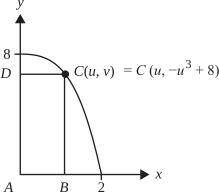
Find the value of \(x\) which maximises the area of the trapezium below.

- \(10\)
- \(5 \sqrt{2}\)
- \(7\)
- \(\sqrt{10}\)
Show Answers Only
\(B\)
Show Worked Solution
| \(A\) | \(=\dfrac{h}{2}(a+b)\) |
| \(=2x\sqrt{100-x^2}\quad\text{(Using Pythagoras)}\) | |
| \(\dfrac{dA}{dx}\) | \(=\dfrac{4(50-x^2)}{\sqrt{100-x^2}}\quad\text{(Using product rule)}\) |
\(\text{For maximum }\ \dfrac{dA}{dx}=0:\)
\(x=5\sqrt{2}\quad (0<x<10)\ \ \text{(by CAS)}\)
\(\text{Alternatively:}\)
| \(\dfrac{4(50-x^2)}{\sqrt{100-x^2}}\) | \(=0\quad(x \neq 10)\) |
| \(50-x^2\) | \(=0\) |
| (\(\sqrt{50}-x)(\sqrt{50}+x)\) | \(=0\) |
| \(\therefore\ x\) | \(=\sqrt{50}=5\sqrt{2}\quad (0<x<10)\) |
\(\text{Check gradient for max using table}\)
| \(x\) | \(7\) | \(\sqrt{50}\) | \(7.2\) |
| \(A^{\prime}\) | \(0.56\) | \(0\) | \(-1.06\) |
| \(\text{Gradient}\) | \(+\) | \(0\) | \(-\) |
\(\therefore\ x=5\sqrt{2}\ \text{maximises the area}\)
\(\Rightarrow B\)