Which of the following sets represents a function that has an inverse function?
- \(\{(1,3),(2,0),(2,1)\}\)
- \(\{(-1,3),(2,2),(3,1)\}\)
- \(\{(-1,3),(0,1),(1,3)\}\)
- \(\{(1,0),(2,3),(1,3)\}\)
Aussie Maths & Science Teachers: Save your time with SmarterEd
Which of the following sets represents a function that has an inverse function?
\(B\)
\(\text{Option A and D are not functions (x-values have two y-values).}\)
\(\text{Consider option B:}\)
\(\{(-1,3),(2,2),(3,1)\} \ \text{is a one-to-one function.}\)
\(\therefore \ \text {Inverse exists}\)
\(\text{Note that option C is not one-to-one because two different inputs (-1 and 1) map to}\)
\(\text{the same output (3), so its inverse would not be a function.}\)
\(\Rightarrow B\)
Some values of the functions \(f: R \rightarrow R\) and \(g: R \rightarrow R\) are shown below.
\begin{array} {|c|c|}
\hline
\rule{0pt}{2.5ex} \quad \ x \quad \rule[-1ex]{0pt}{0pt} & \quad \ 1 \quad \rule[-1ex]{0pt}{0pt} & \quad \ 2 \quad \rule[-1ex]{0pt}{0pt} & \quad \ 3 \quad \\
\hline
\rule{0pt}{2.5ex} \quad f(x) \quad \rule[-1ex]{0pt}{0pt} & \quad \ 0 \quad \rule[-1ex]{0pt}{0pt} & \quad 4 \quad \rule[-1ex]{0pt}{0pt} & \quad 5 \quad \\
\hline
\rule{0pt}{2.5ex} \quad g(x) \quad \rule[-1ex]{0pt}{0pt} & \quad 3 \quad \rule[-1ex]{0pt}{0pt} & \quad 4 \quad \rule[-1ex]{0pt}{0pt} & \quad -5 \quad \\
\hline
\end{array}
The graph of the function \(h(x)=f(x)-g(x)\) must have an \(x\)-intercept at
\(A\)
\begin{array} {|c|c|}
\hline
\rule{0pt}{2.5ex} \quad x \quad \rule[-1ex]{0pt}{0pt} & \quad 1 \quad \rule[-1ex]{0pt}{0pt} & \quad 2 \quad \rule[-1ex]{0pt}{0pt} & \quad 3 \quad \\
\hline
\rule{0pt}{2.5ex} h(x) \rule[-1ex]{0pt}{0pt} & \ \ -3 \ \ \rule[-1ex]{0pt}{0pt} & \ \ 0 \ \ \rule[-1ex]{0pt}{0pt} & \ \ 10 \ \ \\
\hline
\end{array}
\(\therefore\ x\text{-intercept}\ \rightarrow\ (2, 0)\)
\(\Rightarrow A\)
Consider the functions \(f\) and \(g\), where \begin{aligned} --- 2 WORK AREA LINES (style=lined) --- --- 3 WORK AREA LINES (style=lined) --- --- 4 WORK AREA LINES (style=lined) --- a. \([-9, \infty)\) b. \(f\circ g(x)=x-9, \text{Domain}\ [0, \infty)\) c. \((-\infty, -3)\cap (3, \infty)\) a. \(\text{Range}\ \rightarrow\ [-9, \infty)\) \(g(x)=\sqrt{x} \ \rightarrow x\ \text{must be }\geq 0\) \(\therefore\ \text{Domain}\ f\circ g(x) \text{ is }[0, \infty)\) \(\text{For }g\circ h(x)\ \text{to exist}\ h(x)\geq 0\) \(x\text{-intercepts for }h(x)\ \text{are } x=-3, 3\) \(\text{and }h(x)\ \text{is positive for } x\leq -3\ \text{and }x\geq 3\) \(\therefore\ \text{Maximal domain} = (-\infty, -3)\cap (3, \infty)\)
& f: R \rightarrow R, f(x)=x^2-9 \\
& g:[0, \infty) \rightarrow R, g(x)=\sqrt{x}
\end{aligned}
b.
\(f\circ g(x)\)
\(=(g(x))^2-9\)
\(=(\sqrt{x})^2-9\)
\(=x-9\)
c.
\(g\circ h(x)\)
\(=\sqrt{h(x)}\)
\(=\sqrt{x^2-9}\)
Let \(f(x)=e^{x-1}\).
Given that the product function \(f(x)\times g(x)=e^{(x-1)^2}\), the rule for the function \(g\) is
\(B\)
| \(f(x)\times g(x)\) | \(=e^{(x-1)^2}\) |
| \(e^{x-1}\times g(x)\) | \(=e^{(x-1)^2}\) |
| \( g(x)\) | \(=\dfrac{e^{(x-1)^2}}{e^{(x-1)}}\) |
| \(=e^{(x-1)^2}\times e^{(x-1)^-1}\) | |
| \(=e^{x^2-3x+2}\) | |
| \(=e^{(x-2)(x-1)}\) |
\(\Rightarrow B\)
Two function, \(p\) and \(q\), are continuous over their domains, which are \([-2, 3)\) and \((-1, 5]\), respectively.
The domain of the sum function \(p+q\) is
\(E\)
\(\text{Domain of sum function = intersection of two domains.}\)
\([-2, 3)\cap(-1, 5]=(-1, 3)\)
\(\Rightarrow E\)
Consider the functions `f(x) = sqrt{x+2}` and `g(x) = sqrt{1-2x}`, defined over their maximal domains.
The maximal domain of the function `h = f + g` is.
`D`
`f(x) \ = \ sqrt{x + 2} \ => \ text{domain} \ x ≥ -2`
`g(x) \ = \ sqrt{1-2x} \ => \ text{domain} \ x ≤ 1/2`
`text{Intersection of domains = domain} \ h(x)`
`:. \ h(x) ∈ [-2, 1/2]`
`=> D`
The function `f: R -> R, \ f(x)` is a polynomial function of degree 4. Part of the graph of `f` is shown below.
The graph of `f` touches the `x`-axis at the origin.
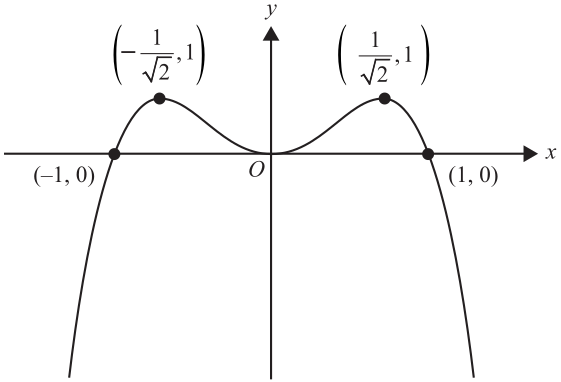
--- 4 WORK AREA LINES (style=lined) ---
Let `g` be a function with the same rule as `f`.
Let `h: D -> R, \ h(x) = log_e (g(x))-log_e (x^3 + x^2)`, where `D` is the maximal domain of `h`.
--- 3 WORK AREA LINES (style=lined) ---
--- 5 WORK AREA LINES (style=lined) ---
| a. | `y` | `= ax^2 (x-1)(x + 1)` |
| `= ax^2 (x^2-1)\ …\ (1)` |
`text(Substitute)\ (1/ sqrt 2, 1)\ text{into (1):}`
`1 = a ⋅ (1/sqrt 2)^2 ((1/sqrt 2)^2-1)`
`1 = a(1/2)(-1/2)`
`a = -4`
`:. f(x) = -4x^2(x^2-1)`
| b. | `g(x) > 0` | `=> -4x^2 (x^2-1) > 0` |
| `=> x in (-1, 1)\ text(\{0})` |
`text(and)`
`x^3 + x^2 > 0 => text(true for)\ \ x in (-1 , 1)\ text(\{0})`
`:. D:\ x in (-1, 1)\ text(\{0})`
| c. | `h(x)` | `= log_e ((-4x^2(x^2-1))/(x^3 + x^2))` |
| `= log_e ((-4x^2(x + 1)(x-1))/(x^2(x + 1)))` | ||
| `= log_e (4(1-x))\ \ text(where)\ \ x in (-1, 1)\ text(\{0})` |
`text(As)\ \ x -> -1,\ \ h(x) -> log_e 8 = 3 log_e 2`
`text(As)\ \ x -> 1,\ \ h(x) -> -oo`
`text(As)\ \ x -> 0,\ \ h(x) -> log_e 4 = 2 log_e 2`
`text{(}h(x)\ text(undefined when)\ \ x = 0 text{)}`
`:.\ text(Range)\ \ h(x) in (-oo, 3 log_e 2)\ text(\{) 2 log_e 2 text(})`
The function `f` has the property `f (x + f (x)) = f (2x)` for all non-zero real numbers `x`.
Which one of the following is a possible rule for the function?
`C`
`text(By trial and error,)`
`text(Consider option C:)`
| `x + f(x)` | `= x + x = 2x` |
| `f(2x)` | `=2x` |
| `:. f(x + f(x))` | `= f(2x)` |
`=> C`
Let `h:(−1,1) -> R`, `h(x) = 1/(x - 1)`.
Which one of the following statements about `h` is not true?
`E`
`text(By trial and error, consider option)\ E:`
`h(x) = 1/(x – 1)`
`(h(x))^2 = 1/(x – 1)^2=1/(x^2-2x+1)`
`h(x^2)=1/(x^2-1) != (h(x))^2`
`=> E`
Let `f: R -> R,\ f(x) = e^x + e^(–x).`
For all `u in R,\ f(2u)` is equal to
`C`
`text(Solution 1)`
`text(Define)\ \ f(x) = e^x + e^-x`
`text(Enter each functional equation)`
`[text(i.e.)\ \ f(2u) = (f(u))^2 – 2]`
`text(until CAS output is “true”)`
`=> C`
`text(Solution 2)`
| `f(2u)` | `=e^(2u) + e^(-2u)` |
| `(f(u))^2` | `=(e^u + e^(-u))^2` |
| `=e^(2u) + 2 + e^(-2u)` | |
`:. f(2u) = (f(u))^2-2`
`=>C`
Let `f: R -> R,\ f (x) = x^2`
Which one of the following is not true?
`D`
`text(Solution 1)`
`text(Consider option)\ D:`
| `f(x-y)` | `=(x-y)^2` |
| `=x^2 -2xy+y^2` | |
| `f(x)-f(y)` | `= x^2-y^2` |
| `:.f(x-y)` | `!=f(x)-f(y)` |
`=>D`
`text(Solution 2)`
`text(Define)\ \ f(x) = x^2`
`text(Enter each functional equation on CAS)`
`text(until output does NOT read “true”.)`
`=> D`
The function `f` has the property `f(x) - f(y) = (y - x)\ f(xy)` for all non-zero real numbers `x` and `y`.
Which one of the following is a possible rule for the function?
`D`
`text(Solution 1)`
`text(Consider option)\ D:`
`text(LHS)\ = 1/x – 1/y`
`text(RHS)\ =(y-x) xx 1/(xy) = 1/x – 1/y =\ text(LHS)`
`=>D`
`text{Solution 2 (using technology)}`
`text(Define each specific function on CAS)`
`[text(i.e.)\ \ f(x) = 1/x]`
`text(Enter functional equation)\ \ f(x) – f(y) = (y – x)\ f(xy)`
`text(unitl CAS output is “TRUE”)`
`=> D`
If the equation `f(2x) - 2f(x) = 0` is true for all real values of `x`, then the rule for `f` could be
`C`
`text(We need)\ \ f(2x)=2\ f(x),`
`text(Consider)\ C,`
| `f(x)` | `=2x,` |
| `f(2x)` | `= 2(2x)` |
| `= 2\ f(x)` |
`text(CAS can be used to quickly prove other answers)`
`text(do not satisfy equation.)`
`=> C`
If `f: text{(−∞, 1)} -> R,\ \ f(x) = 2 log_e (1 - x)\ \ text(and)\ \ g: text{[−1, ∞)} -> R, g(x) = 3 sqrt (x + 1),` then the maximal domain of the function `f + g` is
`A`
`text(Consider)\ \ f(x) = 2 log_e (1 – x):`
| `(1-x)` | `>0` |
| `:. x` | `<1` |
`text(Consider)\ \ g(x) = 3 sqrt (x + 1):`
| `(x+1)` | `>=0` |
| `:. x` | `>= -1` |
`:.\ text(The maximal domain of)\ \ f + g\ \ text{is [−1, 1)}.`
`=> A`