SmarterEd

Aussie Maths & Science Teachers: Save your time with SmarterEd

  • Login
  • Get Help
  • About

Functions, MET2 2025 VCAA 2

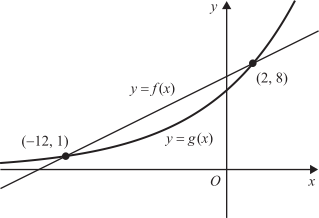
Let  \(f: R \rightarrow R, \ f(x)=\dfrac{x}{2}+7\)  and

\(g: R \rightarrow R, \ g(x)=A e^{k x}\)  where  \(A, k \in R\).

The graphs of  \(y=f(x)\)  and  \(y=g(x)\)  intersect at the points \((-12,1)\) and \((2,8)\), as shown below.


  1. Write down two simultaneous equations in terms of \(A\) and \(k\).
  2. Solve them, using algebra, to show that  \(A=2^{\tfrac{18}{7}}\)  and  \(k=\dfrac{3}{14} \log _e(2)\).   (3 marks)

    --- 12 WORK AREA LINES (style=lined) ---

  3. Find the value of \(b\), where  \(b \in R\), such that \(g(x)\) can be expressed in the form  \(g(x)=A \times 2^{b x}\).   (1 mark)

    --- 3 WORK AREA LINES (style=lined) ---

  4. Use a definite integral to evaluate the area bounded by the graphs of  \(y=f(x)\)  and  \(y=g(x)\), where  \(x \in[-12,2]\).
  5. Give the area correct to two decimal places.   (2 marks)

    --- 5 WORK AREA LINES (style=lined) ---

  6. Let  \(h(x)=f(x)-g(x)\).
    1. Write down an expression for the derivative of \(h(x)\).   (1 mark)

      --- 2 WORK AREA LINES (style=lined) ---

    2. Find the maximum value of \(h(x)\), where  \(x \in[-12,2]\).   (1 mark)
    3. Give your answer correct to two decimal places.

      --- 2 WORK AREA LINES (style=lined) ---

  7. Let \(g^{-1}\) be the inverse of \(g\).
  8. Find the points where the graph of  \(y=g^{-1}(x)\)  intersects with the graph of  \(y=2(x-7)\).   (2 marks)

    --- 5 WORK AREA LINES (style=lined) ---

  9. Let \(F\) be an anti-derivative of \(f\) that passes through \((0, c)\), where \(c \in R\).
    1. Show that it is not possible for the graph of  \(y=F(x)\)  to pass through both \((-12,1)\) and \((2,8)\).   (2 marks)

      --- 9 WORK AREA LINES (style=lined) ---

    2. The graph of  \(y=F(x)\) can be dilated by a factor of \(m\) from the \(x\)-axis such that its image passes through both \((-12,1)\) and \((2,8)\).
    3. Find the values of \(m\) and \(c\).   (2 marks)

      --- 6 WORK AREA LINES (style=lined) ---

Show Answers Only

a.    \(f(x)=\dfrac{x}{2}+7, \ g(x)=A e^{k x}\)

\(\text{Intersection occurs at }(-12,1) \text { and }(2,8):\)

\(A e^{-12 k}\) \(=1\ \ldots\ (1)\)
\(A e^{2 k}\) \(=18\ \ldots\ (2)\)

 
\(\text{Divide:}\ \ (2) ÷ (1)\)

\(e^{2 k-(-12 k)}\) \(=8\)
\(e^{14 k}\) \(=8\)
\(14 k\) \(=\log _e 8\)
\(14 k\) \(=3\log _e 2\)
\(14 k\) \(=\dfrac{3}{14} \log _e 2\)


\(\text{Substitute \(k\) into (1):}\)

\(A e^{-12\left(\tfrac{3}{14} \log _e 2\right)}\) \(=1\)
\(A e^{-\tfrac{18}{7} \log_e2}\) \(=1\)
\(A \times 2^{-\tfrac{18}{7}}\) \(=1\)
\(A\) \(=2^{\tfrac{18}{7}}\)


b.    \(g(x)=2^{\tfrac{18}{7}} \times 2^{\tfrac{3 x}{14}}\)
 

c.    \(\text{Area}=\displaystyle \int_{-12}^2 f(x)-g(x)=15.87 \ \text{u}^2\)
 

d.i.  \(h^{\prime}(x)=\dfrac{1}{2}-\dfrac{6 \log _e 2}{7} \times 2^{\tfrac{3 x}{14}+\tfrac{4}{7}}\)
 

d.ii. \(h(x)_{\text{max}}=1.72\)
 

e.   \(\text{Intersection at}\ (1,-12) \ \text{and} \ (8,2).\)
 

f.i.  \(f(x)=\dfrac{x}{2}+7\)

\(F(x)=\displaystyle \int f(x)\ d x=\dfrac{1}{4} x^2+7 x+c\)
 

\(\text{If} \ F(x) \ \text{passes through} \ (-12,1):\)

\(F(-12)=\dfrac{1}{4}(-12)^2+7(-12)+c=1 \ \ \Rightarrow\ \ c=49\)
 

\(\text{If \(F(x)\) passes through \((2,8)\):}\)

\(F(2)=\dfrac{1}{4}(2)^2+7(2)+c=8 \ \ \Rightarrow \ \ c=-7\)

\(\text{Since \(c\) cannot have 2 values, it cannot pass through both points.}\)
 

f.ii.  \(m=\dfrac{1}{9}, \ c=57\)

Show Worked Solution

a.    \(f(x)=\dfrac{x}{2}+7, \ g(x)=A e^{k x}\)

\(\text{Intersection occurs at }(-12,1) \text { and }(2,8):\)

\(A e^{-12 k}\) \(=1\ \ldots\ (1)\)
\(A e^{2 k}\) \(=18\ \ldots\ (2)\)
Mean mark (a) 51%.

\(\text{Divide:}\ \ (2) ÷ (1)\)

\(e^{2 k-(-12 k)}\) \(=8\)
\(e^{14 k}\) \(=8\)
\(14 k\) \(=\log _e 8\)
\(14 k\) \(=3\log _e 2\)
\(14 k\) \(=\dfrac{3}{14} \log _e 2\)


\(\text{Substitute \(k\) into (1):}\)

\(A e^{-12\left(\tfrac{3}{14} \log _e 2\right)}\) \(=1\)
\(A e^{-\tfrac{18}{7} \log_e2}\) \(=1\)
\(A \times 2^{-\tfrac{18}{7}}\) \(=1\)
\(A\) \(=2^{\tfrac{18}{7}}\)


b.    \(g(x)\) \(=2^{\tfrac{18}{7}} \times e^{\left(\tfrac{3}{14} \log _e 2\right) x}\)
    \(=2^{\tfrac{18}{7}} \times e^{\left(\tfrac{3 x}{14} \log _e 2\right)}\)
    \(=2^{\tfrac{18}{7}} \times e^{\left(\log _e 2^{\tfrac{3x}{14}}\right)}\)
    \(=2^{\tfrac{18}{7}} \times 2^{\tfrac{3 x}{14}}\)

Mean mark (b) 55%.
 

c.    \(\text{Area}=\displaystyle \int_{-12}^2 f(x)-g(x)=15.87 \ \text{u}^2\)
 

d.i.  \(h(x)=f(x)-g(x)\)

\(h(x)=\dfrac{x}{2}+7-2^{\tfrac{18}{7}} \times e^{k x}\)

\(h^{\prime}(x)=\dfrac{1}{2}-\dfrac{6 \log _e 2}{7} \times 2^{\tfrac{3 x}{14}+\tfrac{4}{7}}\)
 

d.ii. \(\text{Solve}\ \ h^{\prime}(x)=0\ \ \text{for}\ x\ \text{(by CAS):}\) 

\(x=-3.829\)

\(\text{Substitute into} \ \ h(x):\)

\(h(x)_{\text{max}}=1.72\)
 

e.   \(\text{Strategy 1}\)

\(\text{By CAS, find} \ \ g^{-1}(x):\)

\(g^{-1}(x)=\dfrac{2\left(7 \log _e x-7 \log _e 8+3 \log _e 2\right)}{3 \log _e 2}\)

\(\text{Solve} \ \ g^{-1}(x)=2(x-7) \ \ \text{for} \ x:\)

\(x=1,8\)

\(\text{Intersection at}\ (1,-12) \ \text{and} \ (8,2).\)
 

\(\text{Strategy 2}\)

\(y=2(x-7) \ \ \text{is the inverse of}\ \  y=\dfrac{x}{2}+7\ \ \text{(i.e.}\ f(x)).\)

\(\text{Two inverse functions will intersect at}\ (1,-12) \ \text{and} \ (8,2).\)
 

f.i.  \(f(x)=\dfrac{x}{2}+7\)

\(F(x)=\displaystyle \int f(x)\ d x=\dfrac{1}{4} x^2+7 x+c\)
 

\(\text{If} \ F(x) \ \text{passes through} \ (-12,1):\)

\(F(-12)=\dfrac{1}{4}(-12)^2+7(-12)+c=1 \ \ \Rightarrow\ \ c=49\)
 

\(\text{If \(F(x)\) passes through \((2,8)\):}\)

\(F(2)=\dfrac{1}{4}(2)^2+7(2)+c=8 \ \ \Rightarrow \ \ c=-7\)

\(\text{Since \(c\) cannot have 2 values, it cannot pass through both points.}\)

♦ Mean mark (f.i) 50%.

f.ii.  \(F(x)=\dfrac{1}{4} x^2+7 x+c\)

\(\text{Dilation of \(m\) from \(x\)-axis passes through \((-12,1)\) and \((2,8)\).}\)

\(\text{Solve simultaneously: }\)

\(m \times F(-12)=36 m-84 m+m c=1\ \ldots\ (1)\)

\(m \times F(2)=m+14 m+m c=8\ \ldots\ (2)\)

\(m=\dfrac{1}{9}, \ c=57\)

♦♦ Mean mark (f.ii) 34%.

Filed Under: Area Under Curves, Graphs and Applications, Log/Index Laws and Equations, Transformations Tagged With: Band 3, Band 4, Band 5, smc-723-50-Log/Exponential, smc-726-50-Exponential Equation, smc-753-20-Dilation (Only)

Algebra, MET2 2023 VCAA 16 MC

Let \(f(x)=e^{x-1}\).

Given that the product function \(f(x)\times g(x)=e^{(x-1)^2}\), the rule for the function \(g\) is

  1. \(g(x)=e^{x-1}\)
  2. \(g(x)=e^{(x-2)(x-1)}\)
  3. \(g(x)=e^{(x+2)(x-1)}\)
  4. \(g(x)=e^{x(x-2)}\)
  5. \(g(x)=e^{x(x-3)}\)
Show Answers Only

\(B\)

Show Worked Solution
\(f(x)\times g(x)\) \(=e^{(x-1)^2}\)
\(e^{x-1}\times g(x)\) \(=e^{(x-1)^2}\)
\( g(x)\) \(=\dfrac{e^{(x-1)^2}}{e^{(x-1)}}\)
  \(=e^{(x-1)^2}\times e^{(x-1)^-1}\)
  \(=e^{x^2-3x+2}\)
  \(=e^{(x-2)(x-1)}\)

 
\(\Rightarrow B\)

Filed Under: Functional Equations, Log/Index Laws and Equations Tagged With: Band 4, smc-642-40-Other functions, smc-726-50-Exponential Equation

Algebra, MET1 2022 VCAA 5a

Solve `10^{3 x-13}=100` for `x`.   (2 marks)

--- 4 WORK AREA LINES (style=lined) ---

Show Answers Only

`x=5`

Show Worked Solution
`10^{(3 x-13)}` `=10^2`  
`3x – 13` `= 2`  
`x` `=5`  

Filed Under: Log/Index Laws and Equations Tagged With: smc-726-50-Exponential Equation

Algebra, MET1 2023 VCAA 2

Solve  \(e^{2x}-12=4e^{x}\)  for  \(x\ \in\ R\).   (3 marks)

--- 6 WORK AREA LINES (style=lined) ---

Show Answers Only

\(x=\log_{e}6\)

Show Worked Solution
\(e^{2x}-12\) \(=4e^{x}\)
\(e^{2x}-4e^{x}-12\) \(=0\)

 
\(\text{Let}\ \ u=e^{x}:\)

\(u^2-4u-12\) \(=0\)
\((u-6)(u+2)\) \(=0\)
 

\(\Rightarrow u=6\ \ \ \text{or}\ -2\)

\(\therefore e^{x}\) \(=6\ \ \ \ \ \ \ \ \ \ \text{or}\ \ \ \ \ \ e^{x}=-2\ \text{(no solution)}\)  
\(x\) \(=\log_{e}6 \)  

Filed Under: Log/Index Laws and Equations Tagged With: Band 4, smc-726-50-Exponential Equation

Algebra, MET1 2015 VCAA 7b

Solve  `3e^t = 5 + 8e^(−t)`  for `t`.  (3 marks)

Show Answers Only

`log_e(8/3)`

Show Worked Solution

`3e^t – 5 – 8e^(−t) = 0`

♦ Part (b) mean mark 44%.
MARKER’S COMMENT: Many students could not create a quadratic, and others who did made mistakes by trying to solve using the quadratic formula rather than simple factorising.

`text(Multiply both sides by)\ e^t:`

`3e^(2t) – 5e^t – 8 = 0`

`text(Let)\ \ y = e^t`

`log_2((6 – x)/(4 – x))` `= 2`
`3y^2 – 5y – 8` `= 0`
`(3y – 8)(y + 1)` `= 0`
`y` `=8/3\ quadquadquadquadquad text(or)\ \ \ \ ` `y` `=-1\ \ text{(No solution)}`
`e^t` `= 8/3`  
`:. t` `= log_e(8/3)\ \ \ `    

Filed Under: Log/Index Laws and Equations Tagged With: Band 5, smc-726-50-Exponential Equation, smc-726-60-Quadratic Equations

Algebra, MET1 2013 VCAA 5b

Solve the equation  `3^(– 4x) = 9^(6 - x)`  for  `x`.  (2 marks)

Show Answers Only

`- 6`

Show Worked Solution
  `3^(-4x)` `= (3^2)^(6 – x)`
  `3^(-4x)` `=3^(12-2x)`
  ` -4x` `= 12 – 2x`
   `2x` `= -12`
   `:. x` `= -6`

Filed Under: Log/Index Laws and Equations Tagged With: Band 3, smc-726-50-Exponential Equation

Algebra, MET2 2017 VCAA 8 MC

If  `y = a^(b - 4x) + 2`, where  `a > 0`, then `x` is equal to

  1. `1/4(b - log_a(y - 2))`
  2. `1/4(b - log_a(y + 2))`
  3. `b - log_a(1/4(y + 2))`
  4. `b/4 - log_a(y - 2)`
  5. `1/4(b + 2 - log_a(y))`
Show Answers Only

`A`

Show Worked Solution

`text(Solving for)\ x:`

`y – 2` `= a^(b – 4x)`
`b – 4x` `= log_a(y – 2)`
`4x` `= b – log_a(y – 2)`
`:. x` `= 1/4(b – log_a(y – 2))`

 
`=> A`

Filed Under: Log/Index Laws and Equations Tagged With: Band 4, smc-726-50-Exponential Equation

Algebra, MET2 2008 VCAA 12 MC

Let  `f: R -> R,\ f(x) = e^x + e^(–x).`

For all  `u in R,\ f(2u)`  is equal to

  1. `f(u) + f(-u)`
  2. `2 f(u)`
  3. `(f(u))^2 - 2`
  4. `(f(u))^2`
  5. `(f(u))^2 + 2`
Show Answers Only

`C`

Show Worked Solution

`text(Solution 1)`

♦ Mean mark 44%.

`text(Define)\ \ f(x) = e^x + e^-x`

`text(Enter each functional equation)`

`[text(i.e.)\ \ f(2u) = (f(u))^2 – 2]`

`text(until CAS output is “true”)`

`=>   C`


`text(Solution 2)`

`f(2u)` `=e^(2u) + e^(-2u)`
`(f(u))^2` `=(e^u + e^(-u))^2`
  `=e^(2u) + 2 + e^(-2u)`
   

`:. f(2u) = (f(u))^2-2`

`=>C`

Filed Under: Functional Equations, Log/Index Laws and Equations Tagged With: Band 5, smc-642-40-Other functions, smc-726-50-Exponential Equation

Algebra, MET1 SM-Bank 9

Solve the following equation for `x`:

`2e^(2x) - e^x = 0`.  (2 marks)

Show Answers Only

`x = ln\ 1/2`

Show Worked Solution

`text(Solution 1)`

`2e^(2x) – e^x = 0`

`text(Let)\ \ X = e^x`

`2X^2 – X` `= 0`
`X (2X – 1)` `= 0`

 
`X = 0 or 1/2`
 

`text(When)\ \ e^x = 0\  =>\ text(no solution)`

`text(When)\ \ e^x = 1/2`

`ln e^x` `= ln\ 1/2`
`:. x` `= ln\ 1/2`


`text(Solution 2)`

`2e^(2x)-e^x` `=0`
`2e^(2x)` `=e^x`
`ln 2e^(2x)` `=ln e^x`
`ln 2 +ln e^(2x)` `=x`
`ln 2 + 2x` `=x`
`x` `=-ln2`
  `=ln\ 1/2`

Filed Under: Log/Index Laws and Equations Tagged With: Band 4, smc-726-50-Exponential Equation, smc-726-60-Quadratic Equations

Algebra, MET1 2011 VCAA 2b

Solve the equation  `4^x - 15 × 2^x = 16`  for `x.`  (3 marks)

Show Answers Only

`x = 4`

Show Worked Solution
`4^x – 15 xx 2^x – 16` `= 0`
`2^(2x) – 15 xx 2^x – 16` `= 0`


♦♦ Mean mark 33%.
MARKER’S COMMENT: “Poorly answered”. Many students incorrectly stated that if  `y=2^x`, then `2y=4^x`.

`text(Let)\ \ y = 2^x`

`y^2 – 15y – 16` `= 0`
`(y – 16) (y + 1)` `= 0`
`y` `= 16` `\ \ \ or\ \ \ ` `y` `= – 1`
`2^x` `= 16`   `2^x` `= – 1`
`:. x` `= 4`   `text(No solution)`

Filed Under: Log/Index Laws and Equations Tagged With: Band 5, smc-726-50-Exponential Equation, smc-726-60-Quadratic Equations

Algebra, MET1 SM-Bank 7

Solve the equation  `2^(2x + 1) = 32`  for `x`.  (2 marks)

Show Answers Only

`2`

Show Worked Solution
`2^(2x + 1)` `= 32`
`2^(2x + 1)` `= 2^5`
`2x + 1` `= 5`
`:. x` `= 2`

Filed Under: Log/Index Laws and Equations Tagged With: Band 3, smc-726-50-Exponential Equation

Algebra, MET1 SM-Bank 2

Solve  `5^x = 4` for `x`.   (2 marks)

Show Answers Only

`(log_e 4)/(log_e 5)`

Show Worked Solution
  `text(Given)\ \ 5^x` `= 4`
  `log_e 5^x` `= log_e 4`
  `x xx log_e 5` `= log_e 4`
  `:. x` `= (log_e 4)/(log_e 5)`

Filed Under: Log/Index Laws and Equations Tagged With: Band 4, smc-726-50-Exponential Equation

Algebra, MET1 2014 VCAA 4

Solve the equation  `2^(3x - 3) = 8^(2 - x)`  for  `x`.  (2 marks)

Show Answers Only

`3/2`

Show Worked Solution
`2^(3x – 3)` `= 2^(3(2 – x))`
`3x – 3` `= 6 – 3x`
`6x` `= 9`
`:. x` `= 3/2`

Filed Under: Log/Index Laws and Equations Tagged With: Band 3, smc-726-50-Exponential Equation

Copyright © 2014–2026 SmarterEd.com.au · Log in