The displacement of a particle is given by \(x=3t^{3}-6t^{2}-15\) . The acceleration is zero at:
- \(t=\dfrac{2}{3}\)
- \(t=\dfrac{4}{3}\)
- \(t=\dfrac{5}{2}\)
- \(\text{never}\)
Aussie Maths & Science Teachers: Save your time with SmarterEd
The displacement of a particle is given by \(x=3t^{3}-6t^{2}-15\) . The acceleration is zero at:
A particle is moving along a straight line. The graph shows the acceleration of the particle.
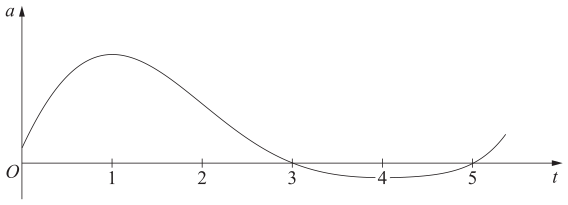
For what value of `t` is the velocity `v` a maximum?
A particle is moving along the `x`-axis. Its velocity `v` at time `t` is given by
`v = sqrt(20t-2t^2)` metres per second
Find the acceleration of the particle when `t = 4`.
Express your answer as an exact value in its simplest form. (3 marks)
--- 6 WORK AREA LINES (style=lined) ---
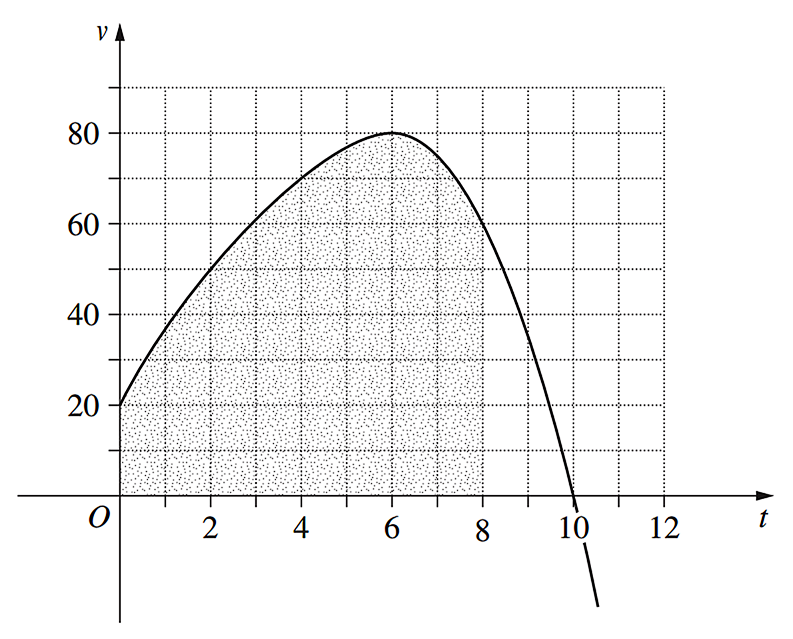
The graph shows the velocity of a particle, `v` metres per second, as a function of time, `t` seconds.
--- 1 WORK AREA LINES (style=lined) ---
--- 1 WORK AREA LINES (style=lined) ---
--- 1 WORK AREA LINES (style=lined) ---
The displacement of a particle moving along the `x`-axis is given by
`x = t^3/3-2t^2 + 3t,`
where `x` is the displacement from the origin in metres and `t` is the time in seconds, for `t >= 0`.
--- 2 WORK AREA LINES (style=lined) ---
--- 3 WORK AREA LINES (style=lined) ---
--- 4 WORK AREA LINES (style=lined) ---
A particle is moving in a straight line. Its displacement, `x` metres, from the origin, `O`, at time `t` seconds, where `t ≥ 0`, is given by `x = 1-7/(t + 4)`.
--- 2 WORK AREA LINES (style=lined) ---
--- 7 WORK AREA LINES (style=lined) ---
--- 4 WORK AREA LINES (style=lined) ---
--- 10 WORK AREA LINES (style=lined) ---
i. `text(–3/4 m)`
ii. `1/7\ text(ms)^-1`
iii. `text(Proof)\ \ text{(See Worked Solutions)}`
iv.

i. `x = 1-7/(t + 4)`
`text(When)\ \ t = 0:`
`x= 1-7/4= -3/4\ \text(m)`
`:.\ text(Initial displacement is)\ 3/4\ text(metres to the left of the origin.)`
ii. `x = 1-7/(t+4) = 1-7(t + 4)^-1`
| `dot x` | `= (-1) -7(t + 4)^-2 xx d/(dt)(t + 4)` |
| `= 7 (t + 4)^-2 xx 1` | |
| `= 7/(t + 4)^2` |
`text(Find)\ t\ text(when)\ x = 0:`
| `0` | `= 1-7/(t + 4)` |
| `7/(t + 4)` | `= 1` |
| `7` | `= (t + 4)` |
| `t` | `= 3` |
`text(When)\ t = 3:`
`dot x= 7/(3 + 4)^2= 1/7\ text(ms)^-1`
`:.\ text(The velocity of the particle through the origin is)\ 1/7\ text(ms)^-1.`
| iii. `dot x` | `= 7(t + 4)^-2` |
| `ddot x` | `= (d dot x)/(dt) = -14 (t +4)^-3` |
`text(Given)\ t >= 0:`
`=> (t + 4)^-3 >= 0`
`=> -14 (t + 4)^-3 <= 0`
`:. ddot x\ text(is always negative.)`
| iv. | |
The displacement of a particle moving along the `x`-axis is given by
`x = t-1/(1 + t)`,
where `x` is the displacement from the origin in metres, `t` is the time in seconds, and `t >= 0`.
--- 5 WORK AREA LINES (style=lined) ---
--- 3 WORK AREA LINES (style=lined) ---
The graph shows the displacement `x` of a particle moving along a straight line as a function of time `t`.
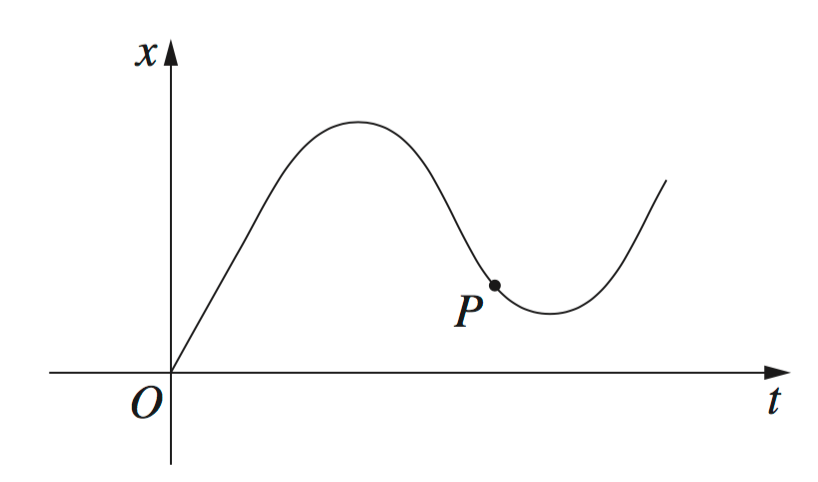
Which statement describes the motion of the particle at the point `P`?