SmarterEd

Aussie Maths & Science Teachers: Save your time with SmarterEd

  • Login
  • Get Help
  • About

Data Analysis, GEN1 2024 NHT 7 MC

Data was collected to investigate the association between two variables:

  • age (in years)
  • uses public transport (yes, no).

Which one of the following is appropriate to use in the statistical display of this data?

  1. a histogram
  2. a least squares line
  3. parallel boxplots
  4. a segmented bar chart
  5. a scatterplot
Show Answers Only

\(C\)

Show Worked Solution

\(\text{Age is a numerical variable and uses public transport is categorical.}\)

\(\text{Parallel boxplots are the appropriate form of display.}\)

\(\Rightarrow C\)

Filed Under: Graphs - Histograms and Other, Graphs - Stem/Leaf and Boxplots Tagged With: Band 5, smc-643-20-Parallel Box-Plots, smc-644-20-Histograms

Data Analysis, GEN1 2024 NHT 1 MC

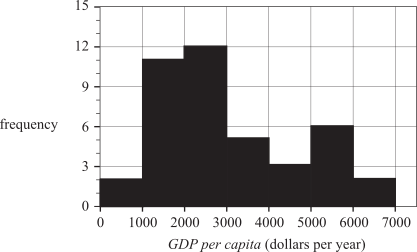
The histogram below shows the distribution of the GDP per capita (gross domestic product per capita), in dollars per year, for a sample of 41 African countries in 2021.
 

The median GDP per capita, in dollars per year, for this sample will be within the range

  1. greater than or equal to 0 but less than 1000
  2. greater than or equal to 1000 but less than 2000
  3. greater than or equal to 2000 but less than 3000
  4. greater than or equal to 3000 but less than 4000
  5. greater than or equal to 4000 but less than 5000
Show Answers Only

\(C\)

Show Worked Solution

\(\text{Median = 21st data point}\)

\(\text{21st data point occurs in the 3rd column.}\)

\(\Rightarrow C\)

Filed Under: Graphs - Histograms and Other Tagged With: Band 3, smc-644-20-Histograms

Data Analysis, GEN1 2022 VCAA 1-3 MC

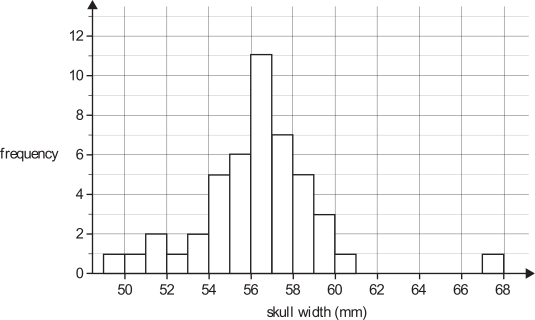
The histogram below displays the distribution of skull width, in millimetres, for 46 female possums.
 

Question 1

The shape of the distribution is best described as

  1. negatively skewed.
  2. approximately symmetric.
  3. negatively skewed with a possible outlier.
  4. positively skewed with a possible outlier.
  5. approximately symmetric with a possible outlier.

 
Question 2

The percentage of the 46 possums with a skull width of less than 55 mm is closest to

  1. 12%
  2. 26%
  3. 39%
  4. 61%
  5. 74%

 
Question 3

The third quartile \((Q_3)\) for this distribution, in millimetres, could be

  1. 55.8
  2. 56.2
  3. 56.9
  4. 57.7
  5. 58.3
Show Answers Only

\(\text{Question 1:} \ C\)

\(\text{Question 2:} \ B\)

\(\text{Question 3:} \ D\)

Show Worked Solution

\(\text{Question 1}\)

The distribution’s centre is in the 56–57 group and if the possible outlier is disregarded, the tail of the distribution is spread more to the left → i.e. negatively skewed with possible outlier.

\(\Rightarrow C\) 


♦♦ Mean mark (Q1) 36%.
COMMENT: 54% of students chose \(E\). The graph distribution however, shows that more than 50% of the data is to the left of the median.

\(\text{Question 2}\)

\(\text{Percentage}\) \(= \dfrac{1+1+2+1+2+5}{46} \times 100\)  
  \(=\dfrac{12}{46} \times 100\)  
  \(=26.086…\)%  

 
\(\Rightarrow B\)
 

\(\text{Question 3}\)

\( Q_3\ =0.75 \times 46 = 34.5 \)

The 34.5th score lies between 57 and 58, therefore, 57.7.

\(\Rightarrow D\)

Filed Under: Graphs - Histograms and Other Tagged With: Band 3, Band 4, Band 5, smc-644-20-Histograms

CORE, FUR1 2020 VCAA 4 MC

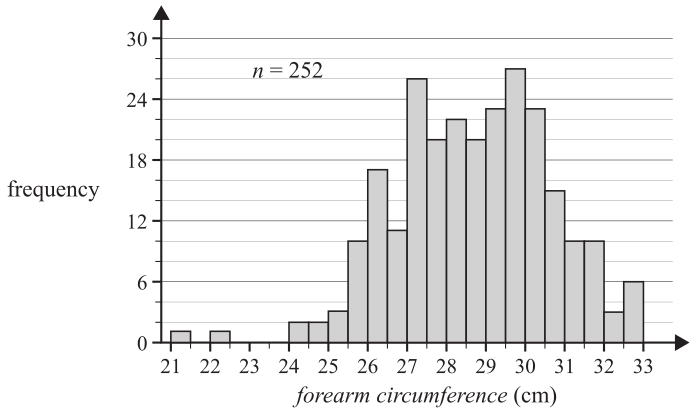
The histogram below shows the distribution of the forearm circumference, in centimetres, of 252 men.

Assume that the forearm circumference values were all rounded to one decimal place.


The third quartile `(Q_3)` for this distribution could be

  1. 29.3
  2. 29.8
  3. 30.3
  4. 30.8
  5. 31.3
Show Answers Only

`C`

Show Worked Solution

`text(S) text(ince)\ \ n = 252,`

♦ Mean mark 50%.

`Q_3\ text(occurs at data point 189.)`

`text(Datapoint 189 falls in the class interval 30 – 30.5)` 

`=>  C`

Filed Under: Graphs - Histograms and Other Tagged With: Band 5, smc-644-20-Histograms

CORE, FUR1 2019 VCAA 1-3 MC

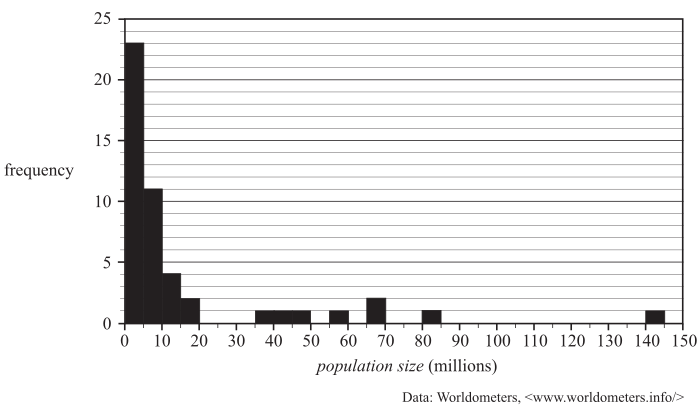
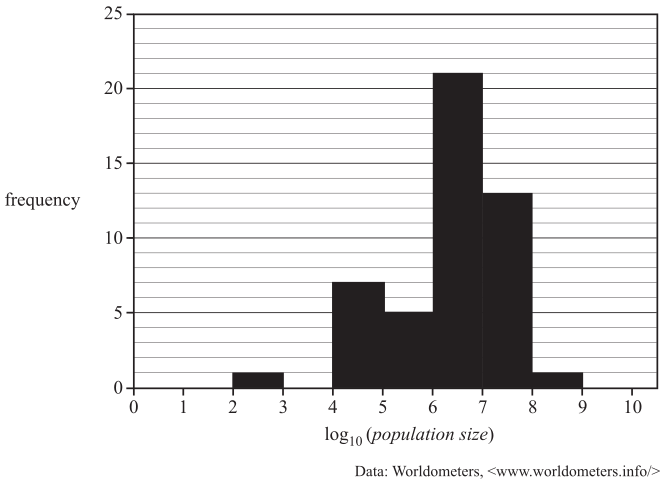
The histogram below shows the distribution of the population size of 48 countries in 2018.

Part 1

The number of these countries with a population size between 5 million and 20 million people is

  1.  11
  2.  17
  3.  23
  4.  34
  5.  35

 
Part 2

The shape of this histogram is best described as

  1. positively skewed with no outliers. 
  2. positively skewed with outliers.
  3. approximately symmetric.
  4. negatively skewed with no outliers.
  5. negatively skewed with outliers.

 
Part 3

The histogram below shows the population size for these 48 countries plotted on a `log_10` scale.

Based on this histogram, the number of countries with a population size that is less than `100\ 000` people is

  1. 1
  2. 5
  3. 7
  4. 8
  5. 48
Show Answers Only

`text(Part 1:)\ B`

`text(Part 2:)\ B`

`text(Part 3:)\ D`

Show Worked Solution

Part 1

`text{Countries (5 – 20 million)}`

`= 11 + 4 + 2`

`= 17`

`=> B`
 

Part 2

`text(Histogram is positively skewed with outliers.)`

`=> B`
 

Part 3

`log_10 100\ 000 = 5`

`text{Countries (population < 100 000)}`

`= 1 + 7`

`= 8`

`=> D`

Filed Under: Graphs - Histograms and Other Tagged With: Band 3, Band 4, smc-644-20-Histograms, smc-644-60-Distribution Description

CORE, FUR1 2016 VCAA 6-7 MC

Part 1

The histogram below shows the distribution of the number of billionaires per million people for 53 countries.
 

Using this histogram, the percentage of these 53 countries with less than two billionaires per million people is closest to

  1. `text(49%)`
  2. `text(53%)`
  3. `text(89%)`
  4. `text(92%)`
  5. `text(98%)`


Part 2

The histogram below shows the distribution of the number of billionaires per million people for the same 53 countries as in Part 1, but this time plotted on a `log_10` scale.
 

Based on this histogram, the number of countries with one or more billionaires per million people is

  1.   `text(1)`
  2.   `text(3)`
  3.   `text(8)`
  4.   `text(9)`
  5. `text(10)`
Show Answers Only

`text(Part 1:)\ D`

`text(Part 1:)\ E`

Show Worked Solution

`text(Part 1)`

`text(Percentage with less than 2)`

`= text(countries with less than 2)/text(total countries)`

`= 49/((49 + 2 + 1 + 1))`

`= 49/53`

`~~ 92.4text(%)`

`=> D`


`text(Part 2)`

`text(Let)\ \ x=\ text(number of billionaires per million,)`

`text(Number of countries where)\ \ x >= 1,`

♦ Mean mark 45%.
MARKER’S COMMENT: On a `log_10` scale, 1 is plotted as 0 because `log_10\ 1 = 0`, or `10^0=1`

`=> log_10 x >= 0`

`:.\ text(Number of countries)`

`= 9 + 1`

`= 10`

`=> E`

Filed Under: Graphs - Histograms and Other Tagged With: Band 4, Band 5, page-break-before-question, smc-644-20-Histograms, smc-644-60-Histogram (log10)

CORE, FUR2 2007 VCAA 1

The histogram below shows the distribution of mean yearly rainfall (in mm) for Australia over 103 years.
 

CORE, FUR2 2007 VCAA 1

  1. Describe the shape of the histogram.   (1 mark)

    --- 1 WORK AREA LINES (style=lined) ---

  2. Use the histogram to determine
  3.  i. the number of years in which the mean yearly rainfall was 500 mm or more.   (1 mark)

    --- 2 WORK AREA LINES (style=lined) ---

  4. ii. the percentage of years in which the mean yearly rainfall was between 500 mm and 600 mm.
  5.     Write your answer correct to one decimal place.  (1 mark)

    --- 3 WORK AREA LINES (style=lined) ---

Show Answers Only
  1. `text(Positively skewed)`
    1. `26`
    2. `text(19.4%)`
Show Worked Solution

a.   `text(Positively skewed.)`
 

b.i.   `text{Years with rainfall over 500 mm}`

`=13+7+3+1+1+1 =26`
 

b.ii.   `text{Years with rainfall between 500 and 600 mm (%)}`

`=20/103 xx 100text(%)`

`= 19.41…`

`=19.4 text{%  (1 d.p.)}`

Filed Under: Graphs - Histograms and Other Tagged With: Band 3, smc-644-20-Histograms, smc-644-60-Distribution Description

CORE, FUR2 2015 VCAA 1

The histogram below shows the distribution of life expectancy of people for 183 countries.
 

CORE, FUR2 2015 VCAA 1 

  1. For this distribution, the modal interval is  ___________  (1 mark)

    --- 0 WORK AREA LINES (style=lined) ---

  2. In how many of these countries is life expectancy less than 55 years?  (1 mark)

    --- 2 WORK AREA LINES (style=lined) ---

  3. In what percentage of these 183 countries is life expectancy between 75 and 80 years?
  4. Write your answer correct to one decimal place.  (1 mark)

    --- 3 WORK AREA LINES (style=lined) ---

Show Answers Only

  1. `text(70 – 75)`
  2. `14`
  3. `text(16.4%)`

Show Worked Solution

a.   `text(70 – 75)`

MARKER’S COMMENT: 40% of students answered this basic question incorrectly.


b.   `text(Adding up the first 2 columns,)`

`5 + 9 = 14\ text(countries)`


c.   `text(% Countries with life expectancy between 75-80)`

MARKER’S COMMENT: Answers of 16% or an unrounded figure received no marks.

`= text(Number of 75-80 countries)/text(Total countries)`

`=30/183 xx 100text(%)`

`=16.39…`

`=16.4text{%  (to 1 d.p.)}`

Filed Under: Graphs - Histograms and Other Tagged With: Band 3, Band 4, smc-644-20-Histograms

CORE, FUR1 2006 VCAA 5-6 MC

The distribution of test marks obtained by a large group of students is displayed in the percentage frequency histogram below.
 

Part 1

The pass mark on the test was 30 marks.

The percentage of students who passed the test is

A.     `7text(%)`

B.   `22text(%)`

C.   `50text(%)`

D.   `78text(%)`

E.   `87text(%)`


Part 2

The median mark lies between

A.   `35 and 40`

B.   `40 and 45`

C.   `45 and 50`

D.   `50 and 55`

E.   `55 and 60`

Show Answers Only

`text (Part 1:)\ D`

`text (Part 2:)\ B`

Show Worked Solution

`text (Part 1)`

`text(Adding up the percentage bars above 30)`

`=7+11+14+16+18+12`

`=78text(%)`

`rArr D`


`text (Part 2)`

`text(Adding up the percentage bars from the left,)`

`text(the 50th and 51st percentile lie in the 40–45)`

`text(mark interval.)`

`rArr B`

Filed Under: Graphs - Histograms and Other, Summary Statistics Tagged With: Band 3, Band 4, smc-468-40-Median Mode and Range, smc-644-20-Histograms

CORE, FUR1 2009 VCAA 4-6 MC

The percentage histogram below shows the distribution of the fertility rates (in average births per woman) for 173 countries in 1975.

Part 1

In 1975, the percentage of these 173 countries with fertility rates of 4.5 or greater was closest to

A.   `12text(%)`  

B.   `35text(%)`  

C.   `47text(%)`  

D.   `53text(%)`  

E.   `65text(%)`  


Part 2

In 1975, for these 173 countries, fertility rates were most frequently

A.   less than 2.5

B.   between 1.5 and 2.5

C.   between 2.5 and 4.5 

D.   between 6.5 and 7.5 

E.   greater than 7.5 


Part 3

Which one of the boxplots below could best be used to represent the same fertility rate data as displayed in the percentage histogram?

Show Answers Only

`text(Part 1:)\ E`

`text(Part 2:)\ D`

`text(Part 3:)\ B`

Show Worked Solution

`text(Part  1)`

`text(Adding up the histogram bars from 4.5.)`

`%` `= 12 + 19  + 28 + 5 + 1`
  `= 65text(%)`

`=>  E`


`text(Part  2)`

`text(Fertility rates between 6.5 and 7.5 were 28%)`

`text(which is greater than any other range given.)`

`=>  D`


`text(Part  3)`

♦ Mean mark 43%.
MARKERS’ COMMENT: A systemic approach where students calculated the median, `Q_1` and `Q_3` was most successful.

`text(The boxplots have the same range, therefore)`

`text(consider the values of)\ Q_1,\ Q_3\ text(and median.)`

`text(By elimination,)`

`Q_1\ text{estimate is slightly below 3.5 (the first 2}`

`text{bars add up to 29%), therefore not A, D or E.}`

`Q_3\ text(estimate is around 7. Eliminate C.)`

`=>  B`

Filed Under: Graphs - Histograms and Other, Graphs - Stem/Leaf and Boxplots Tagged With: Band 2, Band 3, Band 5, smc-643-10-Single Box-Plots, smc-644-20-Histograms

CORE, FUR1 2011 VCAA 1-3 MC

The histogram below displays the distribution of the percentage of Internet users in 160 countries in 2007.
 

Part 1

The shape of the histogram is best described as

A.   approximately symmetric.

B.   bell shaped. 

C.   positively skewed.

D.   negatively skewed.

E.   bi-modal.


Part 2

The number of countries in which less than 10% of people are Internet users is closest to

A.   `10`

B.   `16`

C.   `22`

D.   `32`

E.   `54`


Part 3

From the histogram, the median percentage of Internet users is closest to

A.   `10text(%)`

B.   `15text(%)`

C.   `20text(%)`

D.   `30text(%)`

E.   `40text(%)`

Show Answers Only

`text(Part 1:)\ C`

`text(Part 2:)\ E`

`text(Part 3:)\ C`

Show Worked Solution

`text(Part 1)`

`text(The shape of the histogram has a definite tail)`

`text(on the right side which means it is positively)`

`text(skewed.)`

`=>  C`


`text(Part 2)`

`text(The histogram shows that 32% of countries fall)`

`text(between 0–5%, and 22% fall between 5–10%.)`

`:.\ text(Users below 10%)`

`= 32 + 22`

`= 54 text(%)`

`=>  E`


`text(Part 3)`

♦ Mean mark 45%.

`text(Total countries = 160)`

`text(Adding bars from the left hand side, there are)`

`text{80 countries in the first 4 bars (i.e. half of 160).}`

`:.\ text(Median is closest to 20%)`

`=>  C`

Filed Under: Graphs - Histograms and Other, Summary Statistics Tagged With: Band 3, Band 5, smc-468-40-Median Mode and Range, smc-644-20-Histograms, smc-644-60-Distribution Description

CORE, FUR1 2012 VCAA 5 MC

The temperature of a room is measured at hourly intervals throughout the day.

The most appropriate graph to show how the temperature changes from one hour to the next is a

A.  boxplot.

B.  stem plot.

C.  histogram.

D.  time series plot.

E.  two-way frequency table.

Show Answers Only

`D`

Show Worked Solution

` text (A time series plot is best because the temperature)`

`text(is measured at regular time intervals.)`

`rArr D`

Filed Under: Graphs - Histograms and Other, Graphs - Stem/Leaf and Boxplots Tagged With: Band 4, smc-643-10-Single Box-Plots, smc-643-40-Stem and Leaf, smc-644-20-Histograms

Copyright © 2014–2025 SmarterEd.com.au · Log in