SmarterEd

Aussie Maths & Science Teachers: Save your time with SmarterEd

  • Login
  • Get Help
  • About

Data Analysis, GEN2 2023 VCAA 2a

The following data shows the sizes of a sample of 20 oysters rated as small, medium or large.

\begin{array} {ccccc}
\text{small} & \text{small} & \text{large} & \text{medium} & \text{medium} \\
\text{medium} & \text{large} & \text{small} & \text{medium} & \text{medium}\\
\text{small} & \text{medium} & \text{small} & \text{small} & \text{medium}\\
\text{medium} & \text{medium} & \text{medium} & \text{small} & \text{large}
\end{array}

  1. Use the data above to complete the following frequency table.   (1 mark)

    --- 0 WORK AREA LINES (style=lined) ---
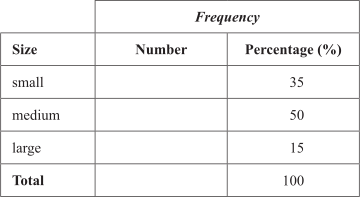
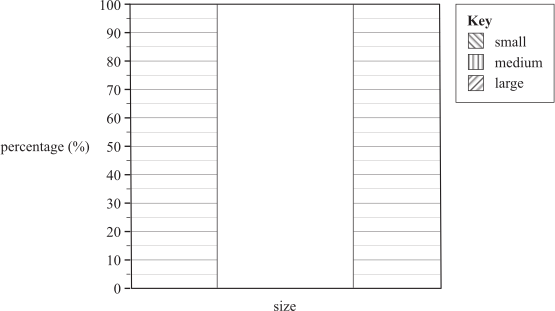
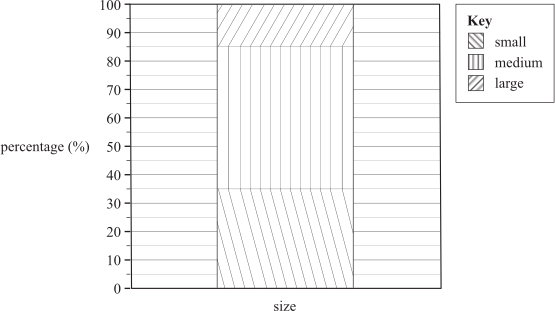
  1. Use the percentages in the table to construct a percentage segmented bar chart below. A key has been provided.   (1 mark)

    --- 0 WORK AREA LINES (style=lined) ---
     

Show Answers Only

i.    

\begin{array} {|l|c|c|}
\hline
\rule{0pt}{2.5ex} \textbf{Size} \rule[-1ex]{0pt}{0pt} & \textbf{Number} & \textbf{Percentage (%) } \\
\hline
\rule{0pt}{2.5ex} \text{small} \rule[-1ex]{0pt}{0pt} & 7 & 35 \\
\hline
\rule{0pt}{2.5ex} \text{medium} \rule[-1ex]{0pt}{0pt} & 10 & 50 \\
\hline
\rule{0pt}{2.5ex} \text{large} \rule[-1ex]{0pt}{0pt} & 3 & 15 \\
\hline
\rule{0pt}{2.5ex} \textbf{Total} \rule[-1ex]{0pt}{0pt} & 20 & 100 \\
\hline
\end{array}

ii.    
     

Show Worked Solution

i.    

\begin{array} {|l|c|c|}
\hline
\rule{0pt}{2.5ex} \textbf{Size} \rule[-1ex]{0pt}{0pt} & \textbf{Number} & \textbf{Percentage (%) } \\
\hline
\rule{0pt}{2.5ex} \text{small} \rule[-1ex]{0pt}{0pt} & 7 & 35 \\
\hline
\rule{0pt}{2.5ex} \text{medium} \rule[-1ex]{0pt}{0pt} & 10 & 50 \\
\hline
\rule{0pt}{2.5ex} \text{large} \rule[-1ex]{0pt}{0pt} & 3 & 15 \\
\hline
\rule{0pt}{2.5ex} \textbf{Total} \rule[-1ex]{0pt}{0pt} & 20 & 100 \\
\hline
\end{array}

 
ii.


Filed Under: Graphs - Histograms and Other Tagged With: Band 2, Band 4, smc-644-40-Segmented Bar Charts, smc-644-50-Frequency Tables

Data Analysis, GEN2 2023 VCAA 2b

An oyster farmer has two farms, \(\text{A}\) and \(\text{B}\).

She takes a random sample of oysters from each of the farms and has the oysters classified as small, medium or large.

The number of oysters of each size is displayed in the two-way table below.

\begin{array} {|l|c|}
\hline
\rule{0pt}{2.5ex} \textbf{Oyster size} \rule[-1ex]{0pt}{0pt} & \textbf{Farm A} & \textbf{Farm B}  \\
\hline
\rule{0pt}{2.5ex} \text{small} \rule[-1ex]{0pt}{0pt} & 42 & 114 \\
\hline
\rule{0pt}{2.5ex} \text{medium} \rule[-1ex]{0pt}{0pt} & 124 & 160 \\
\hline
\rule{0pt}{2.5ex} \text{large} \rule[-1ex]{0pt}{0pt} & 44 & 46 \\
\hline
\rule{0pt}{2.5ex} \textbf{Total} \rule[-1ex]{0pt}{0pt} & 210 & 320 \\
\hline
\end{array}

  1. Calculate the percentage of the total number of oysters graded as 'large' in this investigation. Round the percentage to the nearest whole number.   (1 mark)

    --- 2 WORK AREA LINES (style=lined) ---

  2. The farmer believes that farm \(\text{A}\) has a greater capacity to grow larger oysters than farm \(\text{B}\). Does the information in the table support the farmer's belief? Explain your conclusion by comparing the values of two appropriate percentages.
  3. Round these percentages to the nearest whole number.   (2 marks)

    --- 5 WORK AREA LINES (style=lined) ---

Show Answers Only

i.    \(\text{Large oysters}\ = \dfrac{44}{210} = \dfrac{90}{530} = 0.1698 = 17\% \)

ii.  \(\text{Large oysters (farm A)}\ = \dfrac{44}{210} = 0.2095 = 21\% \)

\(\text{Large oysters (farm B)}\ = \dfrac{46}{320} = 0.1437 = 14\% \)

\(\therefore\ \text{Since farm A produces a much higher percentage of large oysters,}\)

\(\text{the information in the table supports the farmer’s belief.}\)

Show Worked Solution

i.    \(\text{Large oysters}\ = \dfrac{44}{210} = \dfrac{90}{530} = 0.1698 = 17\% \)
 

ii.  \(\text{Large oysters (farm A)}\ = \dfrac{44}{210} = 0.2095 = 21\% \)

\(\text{Large oysters (farm B)}\ = \dfrac{46}{320} = 0.1437 = 14\% \)
 

\(\therefore\ \text{Since farm A produces a much higher percentage of large oysters,}\)

\(\text{the information in the table supports the farmer’s belief.}\)

Filed Under: Graphs - Histograms and Other Tagged With: Band 4, smc-644-50-Frequency Tables

CORE, FUR1 2020 VCAA 10-12 MC

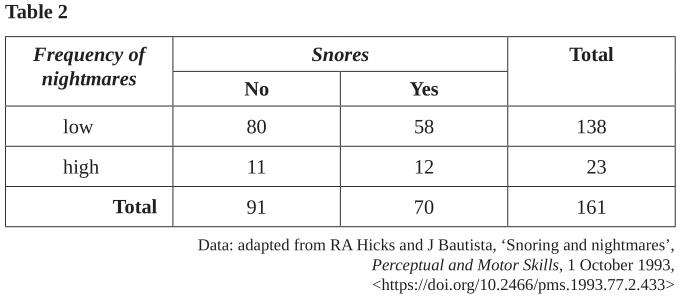
The data in Table 2 was collected in a study of the association between the variables frequency of nightmares (low, high) and snores (no, yes).


Part 1

The variables in this study, frequency of nightmares (low, high) and snores (no, yes), are

  1. ordinal and nominal respectively.
  2. nominal and ordinal respectively.
  3. both numerical.
  4. both ordinal.
  5. both nominal.

 
Part 2

The percentage of participants in the study who did not snore is closest to

  1. 42.0%
  2. 43.5%
  3. 49.7%
  4. 52.2%
  5. 56.5%

 
Part 3

Of those people in the study who did snore, the percentage who have a high frequency of nightmares is closest to

  1.   7.5%
  2. 17.1%
  3. 47.8%
  4. 52.2%
  5. 58.0%
Show Answers Only

`text(Part 1:)\ A`

`text(Part 2:)\ E`

`text(Part 3:)\ B`

Show Worked Solution

Part 1

`text{frequency of nightmares (low, high) is ordinal.}`

`text{snores (no, yes) is nominal.}`

`=> A`
 

Part 2

`text(Percentage)` `= text(not snore)/text(total participants) xx 100`
  `= 91/161 xx 100`
  `= 56.5%`

`=> E`
 

Part 3

`text(Percentage)` `= text(High frequency and snore)/text(total who snore) xx 100`
  `= 12/70 xx 100`
  `= 17.1%`

`=> B`

Filed Under: Graphs - Histograms and Other, Summary Statistics Tagged With: Band 2, Band 4, smc-468-10-Data Classification, smc-644-50-Frequency Tables

Data Analysis, GEN2 2019 NHT 5

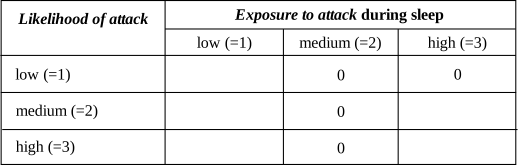
A random sample of 12 mammals drawn from a population of 62 types of mammals was categorized according to two variables.

likelihood of attack (1 = low, 2 = medium, 3 = high)

exposure to attack during sleep (1 = low, 2 = medium, 3 = high)

The data is shown in the following table.


  1. Use this data to complete the two-way frequency table below.   (1 mark)

    --- 0 WORK AREA LINES (style=lined) ---


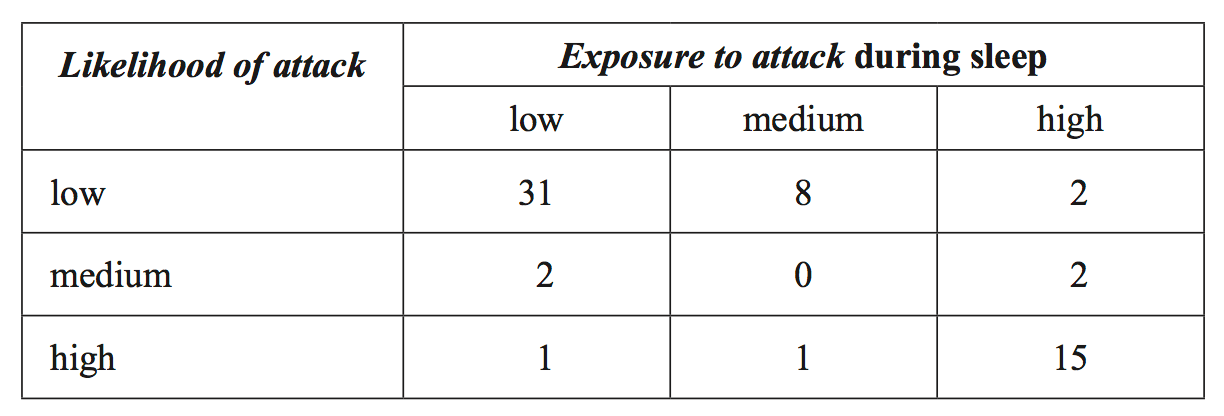
The following two-way frequency table was formed from the data generated when the entire population of 62 types of mammals was similarly categorized.


    1. How many of these 62 mammals had both a high likelihood of attack and a high exposure to attack during sleep?   (1 mark)

      --- 5 WORK AREA LINES (style=lined) ---

    2. Of those mammals that had a medium likelihood of attack, what percentage also had a low exposure to attack during sleep?   (1 mark)

      --- 2 WORK AREA LINES (style=lined) ---

    3. Does the information in the table above support the contention that likelihood of attack is associated with exposure to attack during sleep? justify your answer by quoting appropriate percentages. It is sufficient to consider only one category of likelihood of attack when justifying your answer.   (2 marks)

      --- 4 WORK AREA LINES (style=lined) ---

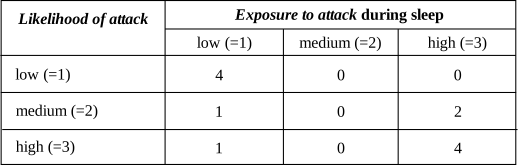
Show Answers Only

  1.  
    1. `15`
    2. `text(Percentage) = (2)/(4) xx 100`
                           `= 50 %`
    3. `text(The data supports the contention that animals with a low likelihood)`
      `text(of attack is associated with low exposure to attack during sleep.)`
       
      `text(- 91%) \ ({31}/{34}) \ text(of animals with low exposure to attack)`
         `text(during sleep, have a low likelihood of attack.)`
       
      `text(- Similarly, 89% of animals with a medium exposure to attack during)`
         `text(sleep have a low likelihood of attack.)`
       
      `text(- 11% of animals with a high exposure to attack during sleep have)`
          `text(a low likelihood of attack)`

Show Worked Solution

a.     


b.    i. `15`

ii.   `text(Percentage)` `= (2)/(4) xx 100`
  `= 50%`


iii. `text(The data supports the contention that animals with a low likelihood)`

`text(of attack is associated with low exposure to attack during sleep.)`

`text(- 91%) \ ({31}/{34}) \ text(of animals with low exposure to attack)`

`text(during sleep, have a low likelihood of attack.)`

`text(- Similarly, 89% of animals with a medium exposure to attack during)`

`text(sleep have a low likelihood of attack.)`

`text(- 11% of animals with a high exposure to attack during sleep have)`

`text(a low likelihood of attack)`

Filed Under: Graphs - Histograms and Other Tagged With: Band 4, Band 5, Band 6, page-break-before-question, smc-644-50-Frequency Tables

CORE, FUR1 2019 VCAA 8 MC

Percy conducted a survey of people in his workplace. He constructed a two-way frequency table involving two variables.

One of the variables was attitude towards shorter working days (for, against).

The other variable could have been

  1. age (in years).
  2. sex (male, female).
  3. height (to the nearest centimetre).
  4. income (to the nearest thousand dollars).
  5. time spent travelling to work (in minutes).
Show Answers Only

`B`

Show Worked Solution

`text(A variable is required here that only has two possibilities.)`

`=>  B`

Filed Under: Graphs - Histograms and Other Tagged With: Band 4, smc-644-50-Frequency Tables

CORE, FUR2 2008 VCAA 1

In a small survey, twenty-five Year 8 girls were asked what they did (walked, sat, stood, ran) for most of the time during a typical school lunch time. 

Their responses are recorded below.
 

`{:(text(sat),text(stood),text(sat),text(ran),text(sat)),(text(walked ),text(walked ),text(sat),text(walked ),text(ran)),(text(sat),text(walked),text(walked ),text(walked),text(ran)),(text(walked),text(ran),text(walked),text(ran),text(walked)),(text(ran),text(sat),text(ran),text(ran),text(walked)):}`


Use the data to

  1. complete the following frequency table  (1 mark)

    --- 0 WORK AREA LINES (style=lined) ---


         Core, FUR2 2008 VCAA 1

  2. determine the percentage of Year 8 girls who ran for most of the time during a typical school lunch time.  (1 mark) 

    --- 3 WORK AREA LINES (style=lined) ---

Show Answers Only
  1.  
    Core, FUR2 2008 VCAA 1 Answer
  2. `text(32%)`
Show Worked Solution
a.    Core, FUR2 2008 VCAA 1 Answer

 
b.
  `text(Percentage who ran)`

`=8/25 xx 100text(%)`

`= 32text(%)`

Filed Under: Graphs - Histograms and Other Tagged With: Band 2, smc-644-50-Frequency Tables

CORE, FUR2 2009 VCAA 1

Table 1 shows the number of rainy days recorded in a high rainfall area for each month during 2008.
 

CORE, FUR2 2009 VCAA 11

The dot plot below displays the distribution of the number of rainy days for the 12 months of 2008.
 

CORE, FUR2 2009 VCAA 12

  1. Circle the dot on the dot plot that represents the number of rainy days in April 2008.   (1 mark)

    --- 0 WORK AREA LINES (style=lined) ---

  2. For the year 2008, determine


  3.  i. the median number of rainy days per month.   (1 mark)

    --- 2 WORK AREA LINES (style=lined) ---

  4. ii. the percentage of months that have more than 10 rainy days. Write your answer correct to the nearest per cent.   (1 mark) 

    --- 3 WORK AREA LINES (style=lined) ---

Show Answers Only
  1.  
    CORE, FUR2 2009 VCAA 12 Answer
    1. `15.5`
    2. `text(92%)`
Show Worked Solution
a.    CORE, FUR2 2009 VCAA 12 Answer


b.i.    `text(Median)` `= text{(6th + 7th)}/2`
    `=(15+16)/2`
    `=15.5`


b.ii.   `text(Months with more than 10 rainy days)`

`=11/12 xx text(100%)`

`=91.66…`

`=92text(%)\ \ text{(nearest %)}`

Filed Under: Graphs - Histograms and Other, Summary Statistics Tagged With: Band 2, Band 3, smc-468-40-Median Mode and Range, smc-644-10-Dot Plots, smc-644-50-Frequency Tables

CORE, FUR1 2012 VCAA 6 MC

The table below shows the percentage of households with and without a computer at home for the years 2007, 2009 and 2011.


In the year 2009, a total of  `5\ 170\ 000` households were surveyed.

The number of households without a computer at home in 2009 was closest to

A.       `801\ 000`
B.    `1\ 153\ 000`
C.    `1\ 737\ 000`
D.    `3\ 433\ 000`
E.    `4\ 017\ 000`
Show Answers Only

`B`

Show Worked Solution

`text (In 2009, the percentage of households without)`

`text(a computer = 22.3%.)`

`:.\ text (# Households without a computer)`

`= 22.3 text (%) xx 5\ 170\ 000`

`= 1\ 152\ 910`

`rArr B`

Filed Under: Graphs - Histograms and Other Tagged With: Band 3, smc-644-50-Frequency Tables

CORE, FUR1 2013 VCAA 3-4 MC

The heights of 82 mothers and their eldest daughters are classified as 'short', 'medium' or 'tall'. The results are displayed in the frequency table below.
 

CORE, FUR1 2013 VCAA 3-4 MC

 
 Part 1

The number of mothers whose height is classified as 'medium' is

 A.   `7` 

B.  `10` 

C.  `14`

D.  `31`

E.  `33`


Part 2

Of the mothers whose height is classified as 'tall', the percentage who have eldest daughters whose height is classified as 'short' is closest to

A.    `text(3%)`

B.    `text(4%)`

C.  `text(14%)`

D.  `text(17%)`

E.  `text(27%)`

Show Answers Only

`text(Part 1:)\ D`

`text(Part 2:)\ C`

Show Worked Solution

       `text(Part 1)`

`text(# Mothers classified as medium)`

`=10+14+7\ \ \ text{(from Table)}`
`=31`

`=>D` 


`text(Part 2)`

♦ Mean mark 45%.
MARKER’S COMMENT: Many students obtained the wrong base of 82 for this percentage calculation.
`text(# Tall Mothers)` `=3+11+8` 
  `=22`

`text{# Tall Mothers with short eldest = 3 (from Table)}`

`:.\ text(Percentage)` `=3/22×100`
  `=13.6363…%`

`=>  C`

Filed Under: Graphs - Histograms and Other Tagged With: Band 3, Band 5, smc-644-50-Frequency Tables

Copyright © 2014–2025 SmarterEd.com.au · Log in