The following data shows the ages of people attending a fitness class:
16, 24, 26, 28, 30, 32, 34, 36, 52, 62
How many outliers are in this dataset?
- 0
- 1
- 2
- 3
Aussie Maths & Science Teachers: Save your time with SmarterEd
The following data shows the ages of people attending a fitness class:
16, 24, 26, 28, 30, 32, 34, 36, 52, 62
How many outliers are in this dataset?
A dataset has a lower quartile (Q1) of 25 and an upper quartile (Q3) of 35.
Which of the following values would be classified as an outlier?
A dataset has the following values arranged in order:
12, 15, 18, 21, 24, 27, 30, 33, 36
What is the interquartile range (IQR) of this dataset?
Consider the following dataset.
\(1, \ 1, \ 2, \ 3, \ 5, \ 7, \ 15\)
--- 2 WORK AREA LINES (style=lined) ---
--- 4 WORK AREA LINES (style=lined) ---
Consider the following dataset.
22, 27, 29, 32, 36, 37, 39, 45, 47, 58
Is 58 an outlier in this dataset? Justify your answer with working. (3 marks)
--- 6 WORK AREA LINES (style=lined) ---
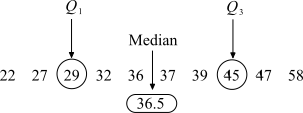
\(\text{Median}=\dfrac{36+37}{2}=36.5\)
\(Q_1=29\ \ \text{and}\ \ Q_3=45\)
\(IQR=Q_3-Q_1=45-29=16\)
\(Q_3+1.5\times IQR=45+1.5\times 16=69\)
\(\therefore\ \text{58 is not an outlier (58 < 69).}\)
\(\text{Median}=\dfrac{36+37}{2}=36.5\)
\(Q_1=29\ \ \text{and}\ \ Q_3=45\)
\(IQR=Q_3-Q_1=45-29=16\)
\(Q_3+1.5\times IQR=45+1.5\times 16=69\)
\(\therefore\ \text{58 is not an outlier (58 < 69).}\)
The ages of the 10 members in a tennis club are
`{:[24,25,27,33,34,34,35,39,47,59.]:}`
Could the age `59` be considered an outlier? Justify your answer with calculations. (3 marks)
--- 6 WORK AREA LINES (style=lined) ---
The five-number summary of a dataset is given.
Lowest score = 1
Lowest quartile (`Q_1`) = 4
Median (`Q_2`) = 7
Upper quartile (`Q_3`) = 10
Highest score = 20
Is 20 an outlier? Justify your answer with calculations. (2 marks)
--- 5 WORK AREA LINES (style=lined) ---
The heights, in centimetres, of 10 players on a basketball team are shown.
170, 180, 185, 188, 192, 193, 193, 194, 196, 202
Is the height of the shortest player on the team considered an outlier? Justify your answer with calculations. (3 marks)
A cumulative frequency table for a data set is shown.
\begin{array} {|c|c|}
\hline
\ \ \ \ \ \ \ \textit{Score}\ \ \ \ \ \ \ & \ \ \ \ \ \textit{Cumulative}\ \ \ \ \ \\ & \textit{frequency} \\
\hline
\rule{0pt}{2.5ex} \text{1} \rule[-1ex]{0pt}{0pt} & 5 \\
\hline
\rule{0pt}{2.5ex} \text{2} \rule[-1ex]{0pt}{0pt} & 9 \\
\hline
\rule{0pt}{2.5ex} \text{3} \rule[-1ex]{0pt}{0pt} & 16 \\
\hline
\rule{0pt}{2.5ex} \text{4} \rule[-1ex]{0pt}{0pt} & 20 \\
\hline
\rule{0pt}{2.5ex} \text{5} \rule[-1ex]{0pt}{0pt} & 34 \\
\hline
\rule{0pt}{2.5ex} \text{6} \rule[-1ex]{0pt}{0pt} & 42 \\
\hline
\end{array}
What is the interquartile range of this data set? (2 marks)
--- 4 WORK AREA LINES (style=lined) ---
A set of data has a lower quartile (`Q_L`) of 10 and an upper quartile (`Q_U`) of 16.
What is the maximum possible range for this set of data if there are no outliers? (2 marks)
--- 4 WORK AREA LINES (style=lined) ---
In a small business, the seven employees earn the following wages per week:
\(\$300, \ \$490, \ \$520, \ \$590, \ \$660, \ \$680, \ \$970\)
--- 6 WORK AREA LINES (style=lined) ---
What effect will this have on the standard deviation? (1 mark)
--- 2 WORK AREA LINES (style=lined) ---
This set of data is arranged in order from smallest to largest.
`5, \ 6, \ 11, \ x, \ 13, \ 18, \ 25`
The range is six less than twice the value of `x`.
Which one of the following is true?