SmarterEd

Aussie Maths & Science Teachers: Save your time with SmarterEd

  • Login
  • Get Help
  • About

Algebra, STD2 A4 2020 HSC 33

The graph shows the number of bacteria, `y`, at time `n` minutes. Initially (when `n = 0`) the number of bacteria is 1000.
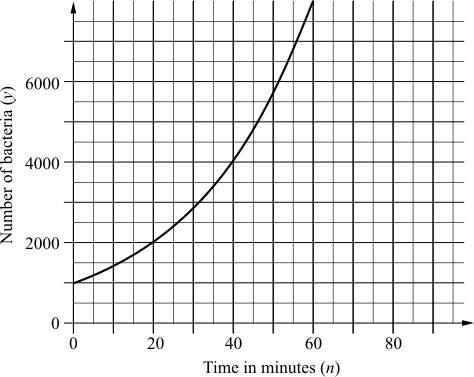


  1. Find the number of bacteria at 40 minutes.   (1 mark)

    --- 1 WORK AREA LINES (style=lined) ---

  2. The number of bacteria can be modelled by the equation  `y = A xx b^n`, where `A` and `b` are constants.
    Use the guess and check method to find, to two decimal places, an upper and lower estimate for the value of `b`. The upper and lower estimates must differ by 0.01.   (2 marks)

    --- 4 WORK AREA LINES (style=lined) ---
Show Answers Only

a.    `4000`

b.    `text{See Worked Solutions}`

Show Worked Solution

a.    `text{When} \ \ n = 40,`

`text{Number of Bacteria} \ (y) = 4000`
 

b.    `A = 1000 \ => \ y = 1000  b^n`

♦♦♦ Mean mark (b) 14%.

`text{By inspection, graph passes through (40, 4000)}`

`=> \ 4000 = 1000  b^40`
 

`text(Guess and check possible values of)\ b:`

`text{If} \ \ b = 1.03 \ , \ \ y = 1000 xx 1.03^40 = 3262 \ text{(too low)}`

`text{If} \ \ b = 1.04 \ , \ \ y = 1000 xx 1.04^40 = 4801 \ text{(too high)}`

`therefore \ 1.03 < b < 1.04`

Filed Under: Exponential Functions, Non-Linear: Exponential/Quadratics Tagged With: Band 2, Band 6, smc-6921-10-\(\large y=ka^{x}\), smc-6921-60-Guess and Check, smc-830-30-Exponential

Algebra, STD2 A4 2011 HSC 26b

Jack needs to find the number of years, `t`, it will take for a population of bats to first exceed `18\ 000`.

He uses a ‘guess-and-check’ method to estimate `t` in the following equation

`5 xx 3^t = 18\ 000.`

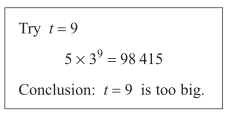
Here is his working:

  1. Jack’s next guess is  `t = 6`. Show Jack’s correct working for this guess, including the calculation and conclusion.   (1 mark)

    --- 2 WORK AREA LINES (style=lined) ---

  2. Continue using the ‘guess-and-check’ method to find the number of years, `t`, it will take for the population to first exceed `18\ 000`, if `t` is a whole number. Include the calculations and conclusions.   (2 marks)

    --- 5 WORK AREA LINES (style=lined) ---

Show Answers Only

a.    `text(See Worked Solutions)`

b.    `8`

Show Worked Solution

a.    `text(When)\ t = 6,`

`5 xx 3^6 = 3645`

`=>\ text(Too small)`


b.    `text(When)\ \ t = 7:`

`5 xx 3^7 = 10\ 935\ \ =>\ text(Too small)`
 

`text(When)\ \ t = 8:`

`5 xx 3^8 = 32\ 805\ \ =>\ text(Exceeds 18 000)`

`:. t = 8`

Filed Under: Exponential Functions, Non-Linear: Exponential/Quadratics Tagged With: Band 4, smc-6921-10-\(\large y=ka^{x}\), smc-6921-60-Guess and Check, smc-830-30-Exponential

Algebra, STD2 A4 2012 HSC 30c

In 2010, the city of Thagoras modelled the predicted population of the city using the equation

`P = A(1.04)^n`.

That year, the city introduced a policy to slow its population growth. The new predicted population was modelled using the equation

`P = A(b)^n`.

In both equations, `P` is the predicted population and `n` is the number of years after 2010.  

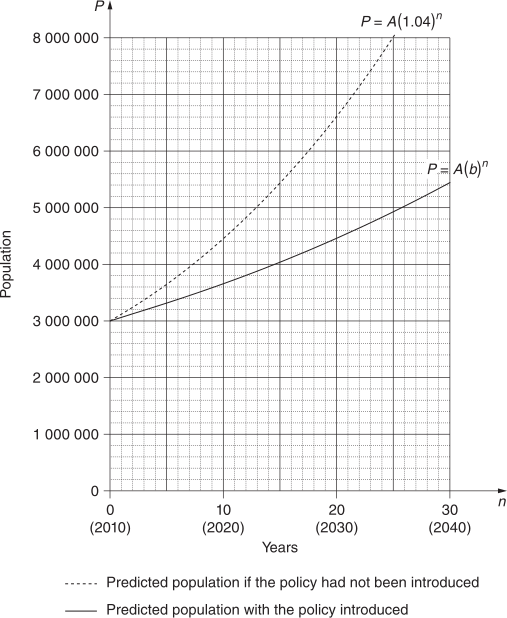
The graph shows the two predicted populations.
 

  1. Use the graph to find the predicted population of Thagoras in 2030 if the population policy had NOT been introduced.   (1 mark)

    --- 1 WORK AREA LINES (style=lined) ---

  2. In each of the two equations given, the value of `A` is 3 000 000.
  3. What does `A` represent?   (1 mark)

    --- 2 WORK AREA LINES (style=lined) ---

  4. The guess-and-check method is to be used to find the value of `b`, in  `P = A(b)^n`.
  5. i.  Explain, with or without calculations, why 1.05 is not a suitable first estimate for `b`.   (1 mark)

    --- 3 WORK AREA LINES (style=lined) ---

  6. ii. With  `n = 20`  and  `P = 4\ 460\ 000`, use the guess-and-check method and the equation  `P = A(b)^n`  to estimate the value of `b` to two decimal places. Show at least TWO estimate values for `b`, including calculations and conclusions.   (2 marks)

    --- 5 WORK AREA LINES (style=lined) ---

  7. The city of Thagoras was aiming to have a population under 7 000 000 in 2050. Does the model indicate that the city will achieve this aim?
  8. Justify your answer with suitable calculations.   (2 marks)

    --- 5 WORK AREA LINES (style=lined) ---

Show Answers Only

a.    `6\ 600\ 000`

b.    `text(The population in 2010.)`

c.i   `\text(See Worked Solution)`

c.ii  `b = 1.03, 1.02`

d.    `text(See Worked Solution)`

Show Worked Solution

a.    `text(2030 occurs at)\ \ n = 20\ \ text(on the)\ x text(-axis.)`

`text(Expected population (no policy) ) = 6\ 600\ 000`
 

b.    `A\ text(represents the population when)\ \ n=0` 

`text(which is the population in 2010.)`
 

c.i   `P = A(1.05)^n\ text(would be steeper and lie above)`

`P = A(1.04)^n\ text(since)\ 1.05 > 1.04`
 

c.ii  `text(Let)\ \ b = 1.03`

`P= 3\ 000\ 000 xx 1.03^20= 5\ 418\ 000`
 

`text(Let)\ \ b = 1.02`

`P= 3\ 000\ 000 xx 1.02^20= 4\ 457\ 800`

`:. b = 1.02`
 

d.    `text(In 2050,)\ n = 40`

`P` `= 3\ 000\ 000 xx 1.02^40`
  `= 6\ 624\ 119\ \ (text(nearest whole))`

 
`text(S)text(ince the population is below 7 million,)`

`text(the model will achieve the aim.)`

Filed Under: Exponential Functions, Exponential/Quadratic (Projectile), Graphs and Applications, Non-Linear: Exponential/Quadratics Tagged With: Band 4, Band 5, Band 6, common-content, smc-6921-10-\(\large y=ka^{x}\), smc-6921-60-Guess and Check, smc-830-30-Exponential, smc-966-10-Exponential graphs, smc-966-20-Population

Copyright © 2014–2026 SmarterEd.com.au · Log in