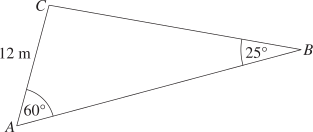
A triangle is shown.
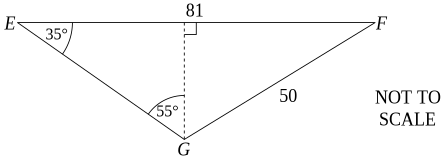
It is given that \(\sin^{-1}\left(\dfrac{81\times\sin35^{\circ}}{50}\right)=68.3^{\circ}\), correct to 1 decimal place.
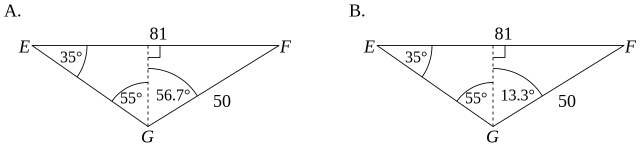
Which diagram shows the correct angle sizes at \(\angle EGF\), given that the angle is obtuse?
Aussie Maths & Science Teachers: Save your time with SmarterEd
A triangle is shown.
It is given that \(\sin^{-1}\left(\dfrac{81\times\sin35^{\circ}}{50}\right)=68.3^{\circ}\), correct to 1 decimal place.
Which diagram shows the correct angle sizes at \(\angle EGF\), given that the angle is obtuse?
\(A\)
\(\text{Using the sine rule in}\ \Delta EFG:\)
| \(\dfrac{\sin \angle EGF}{81}\) | \(=\dfrac{\sin 35^{\circ}}{50}\) | |
| \(\sin \angle EGF\) | \(=\dfrac{81 \times \sin 35^{\circ}}{50} = 68.3^{\circ}\) |
\(\text{Since}\ \angle EGF\ \text{is obtuse:}\)
\(\angle EGF =180^{\circ}-68.3^{\circ}=111.7^{\circ}\)
\(\text{Second angle making up}\ \angle EGF = 111.7-55=56.7^{\circ}\).
\(\Rightarrow A\)
The triangle \(PTA\) is shown. The length of \(PA\) is 75 m and the length of \(PT\) is 51 m.
The angle of depression from \(T\) to \(A\) is 36°, and the angle \(PTA\) is obtuse.
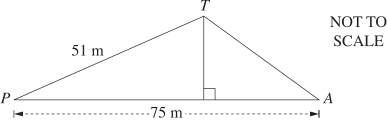
Find the length of \(TA\). Give your answer correct to 2 decimal places. (3 marks)
--- 10 WORK AREA LINES (style=lined) ---
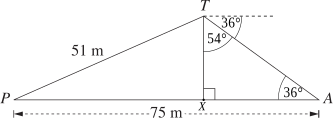
\(TA=35.03 \ \text{m}\)
\(\angle TAP=36^{\circ} \ \text {(alternate)}\)
\(\text{Using sine rule in} \ \triangle TAP:\)
| \(\dfrac{\sin \angle PTA}{75}\) | \(=\dfrac{\sin 36^{\circ}}{51}\) |
| \(\sin \angle PTA\) | \(=75 \times \dfrac{\sin 36^{\circ}}{54}=0.864 \ldots\) |
| \(\angle PTA\) | \(=\sin ^{-1}(0.864 \ldots)=180-59.81=120.19^{\circ}\ \ \text{(obtuse)}\) |
\(\angle PTX=120.19-54=66.19^{\circ}\)
\(\angle TPA=90-66.19=23.81^{\circ}\ \left(180^{\circ}\ \text{in}\ \triangle \right)\)
\(\text{Using sine rule in} \ \triangle TAP:\)
| \(\dfrac{TA}{\sin 23.81^{\circ}}\) | \(=\dfrac{51}{\sin 36^{\circ}}\) |
| \(TA\) | \(=\dfrac{51 \times \sin 23.81^{\circ}}{\sin 36^{\circ}}\) |
| \(=35.03 \ \text{m (2 d.p.)}\) |
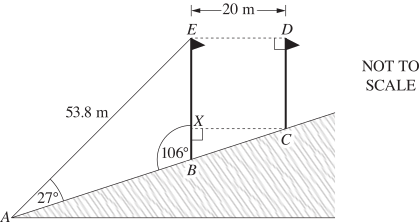
The diagram shows two vertical flagpoles, \(BE\) and \(CD\), set on sloping ground.
--- 6 WORK AREA LINES (style=lined) ---
a. \(BE=25.4\ \text{m}\)
b. \(CD=19.7\ \text{m}\)
a. \(\text{Using the sine rule:}\)
| \(\dfrac{BE}{\sin 27^{\circ}}\) | \(=\dfrac{53.8}{\sin 106^{\circ}}\) |
| \(\therefore BE\) | \(=\dfrac{53.8 \times \sin 27^{\circ}}{\sin 106^{\circ}}\) |
| \(=25.408…\) | |
| \(=25.4\ \text{m (1 d.p.)}\) |
b. \(CD=EB-XB\)
\(\text{Consider}\ \Delta XBC:\)
\(\angle XBC=180-106=74^{\circ}, \ XC=ED=20\)
| \(\tan 74^{\circ}\) | \(=\dfrac{20}{XB}\) |
| \(XB\) | \(=\dfrac{20}{\tan 74^{\circ}}\) |
| \(=5.73\ \text{m}\) |
\(CD=25.4-5.73=19.7\ \text{m (1 d.p.)}\)
The diagram shows triangle `ABC`.
Calculate the area of the triangle, to the nearest square metre. (3 marks)
--- 6 WORK AREA LINES (style=lined) ---
`147\ text{m}^2`
`text{Using the sine rule:}`
| `(CB)/sin60^@` | `=12/sin25^@` |
| `CB` | `=sin60^@ xx 12/sin25^@` |
| `=24.590…` |
`angleACB=180-(60+25)=95^@\ \ text{(180° in Δ)}`
`text{Using the sine area rule:}`
| `A` | `=1/2 xx AC xx CB xx sin angleACB` |
| `=1/2 xx 12 xx 24.59 xx sin95^@` | |
| `=146.98…` | |
| `=147\ text{m}^2` |
The diagram shows two right-angled triangles, `ABC` and `ABD`,
where `AC=35 \ text{cm},BD=93 \ text{cm}, /_ACB=41^(@)` and `/_ADB=theta`.
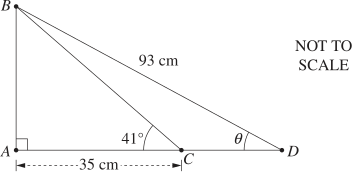
Calculate the size of angle `theta`, to the nearest minute. (4 marks)
--- 8 WORK AREA LINES (style=lined) ---
`19^@6^{′}`
`text{In}\ Delta ABC:`
| `cos 41^@` | `=35/(BC)` | |
| `BC` | `=35/(cos 41^@)` | |
| `=46.375…` |
`angle BCD = 180-41=139^@`
`text{Using sine rule in}\ Delta BCD:`
| `sin theta/(46.375)` | `=sin139^@/93` | |
| `sin theta` | `=(sin 139^@ xx 46.375)/93` | |
| `:.theta` | `=sin^(-1)((sin 139^@ xx 46.375)/93)` | |
| `=19.09…` | ||
| `=19^@6^{′}\ \ text{(nearest minute)}` |
The diagram shows a triangle `ABC` where `AC` = 25 cm, `BC` = 16 cm, `angle BAC` = 28° and angle `ABC` is obtuse.
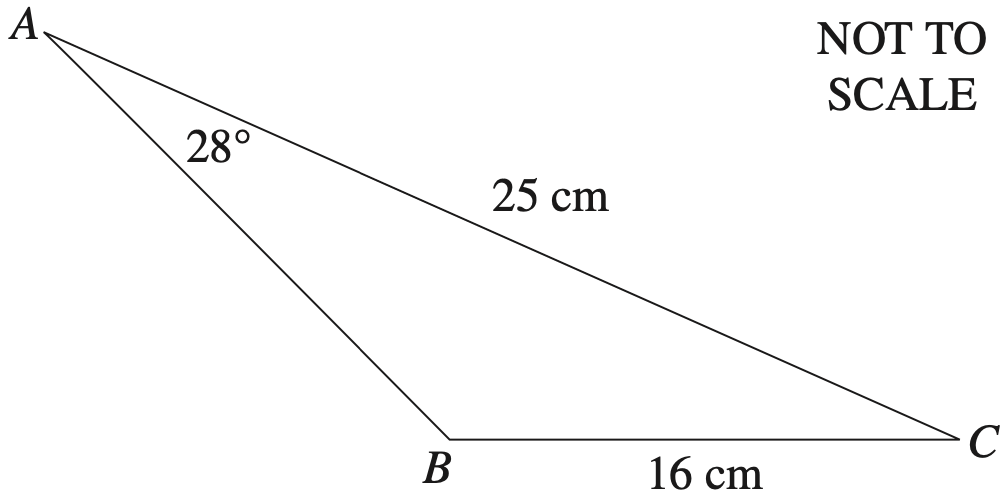
Find the size of the obtuse angle `ABC` correct to the nearest degree. (3 marks)
--- 6 WORK AREA LINES (style=lined) ---
`133°`
`text(Using the sine rule:)`
| `sin theta/25` | `= (sin 28°)/16` |
| `sin theta` | `= (25 xx sin 28°)/16` |
| `sin theta` | `= 0.73355` |
| `theta` | `= 47°` |
| `:. Obtuse angleABC` | `= 180-47` |
| `= 133°` |
The diagram shows a triangle with side lengths 25 cm and 47 cm and angle 30° and `theta`.
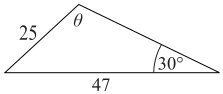
Find `theta` given it is an obtuse angle. Give your answer to the nearest minute. (3 marks)
--- 6 WORK AREA LINES (style=lined) ---
`109°57^{′}`
`text(Using sine rule:)`
| `(sintheta)/47` | `= (sin30°)/25` |
| `sintheta` | `=47 xx (1/2)/25` |
| `sintheta` | `= 47/50` |
| `theta` | `= sin^(−1)\ 47/50` |
| `= 70.05\ text(or)\ 109.94` | |
| `= 109.948…\ \ (theta\ text(is obtuse))` | |
| `= 109°57^{′}` |
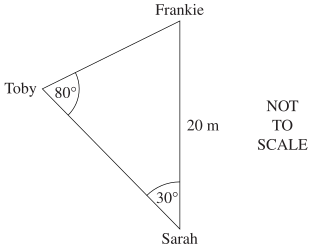
Which formula should be used to calculate the distance between Toby and Frankie?
`A`
`text(The triangle is not a right-angled triangle,)`
`:.\ text(Not)\ B`
`text(Given the information on the diagram provides)`
`text(2 angles and 1 side, the sine rule will work best.)`
`a/sinA = b/sinB`
`=> A`
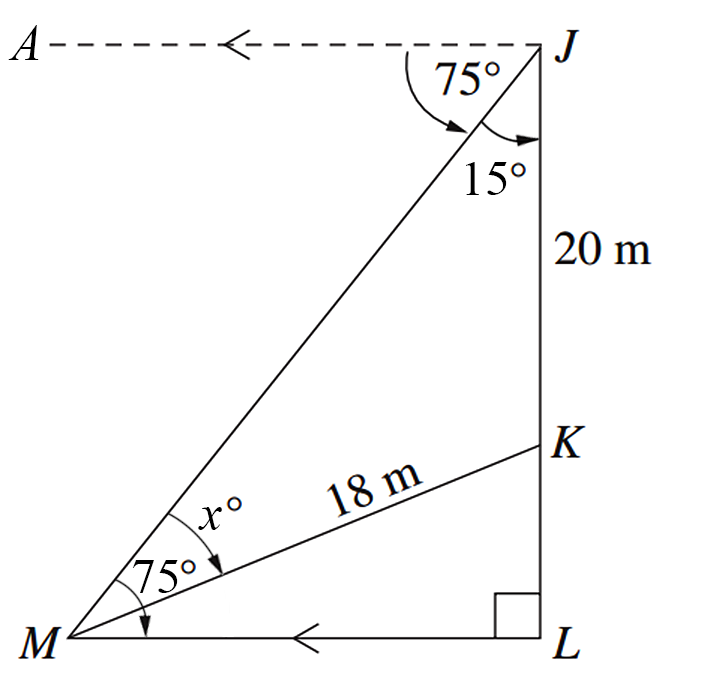
The angle of depression from `J` to `M` is 75°. The length of `JK` is 20 m and the length of `MK` is 18 m.
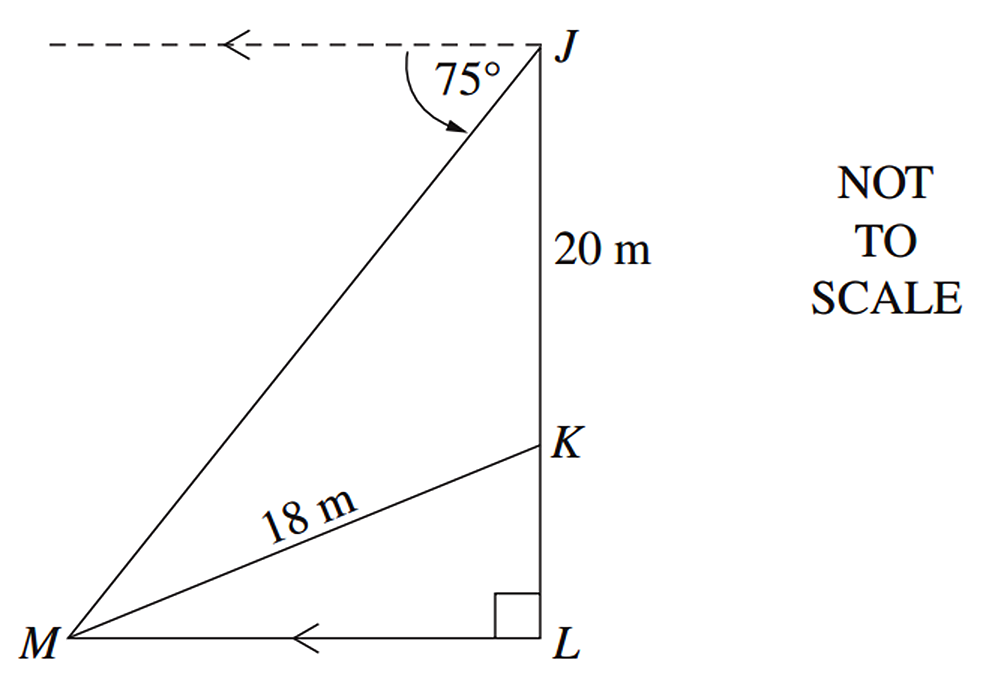
Copy or trace this diagram into your writing booklet and calculate the angle of elevation from `M` to `K`. Give your answer to the nearest degree. (3 marks)
--- 8 WORK AREA LINES (style=lined) ---
`58^@`
`/_AJL = 90^@`
`/_MJL = 90-75 = 15^@`
`text(Using sine rule in)\ Delta MJK`
`text(Let)\ /_JMK = x^@`
| `20/sin x` | `= 18/sin15^@` |
| `18 sin x` | `= 20 xx sin 15^@` |
| `sin x` | `= (20 xx sin 15^@)/18 = 0.2875…` |
| `x` | `= 16.71…^@` |
`/_JML = 75^@\ text{(} text(alternate angles,)\ ML \ text(||) \ AJ text{)}`
| `:.\ /_KML` | `= 75^@-16.71…` |
| `= 58.287…^@` | |
| `= 58^@\ \ \ text{(nearest degree)}` |
`:.\ text(Angle of Elevation from)\ M\ text(to)\ K\ text(is)\ 58^@.`
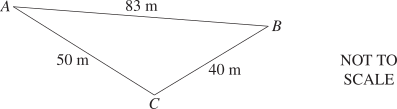
Find the area of triangle `ABC`, correct to the nearest square metre. (3 marks)
--- 6 WORK AREA LINES (style=lined) ---
`717\ text(m²)` `text{(nearest m²)}`
| `cos/_C` | `=(AC^2 + CB^2-AB^2)/(2 xx AC xx CB)` |
| `=(50^2 + 40^2-83^2)/(2 xx 50 xx 40)` | |
| `= -0.69725…` | |
| `/_C` | `=134.2067…^@` |
`text(Using Area) = 1/2 ab\ sinC :`
| `text(Area)\ Delta ABC` | `=1/2 xx 50 xx 40 xx sin134.2067…^@` |
| `=716.828…` | |
| `=717\ text(m²)\ \ \ \ text{(nearest m²)}` |
In the diagram, `AD` and `DC` are equal to 30 cm.
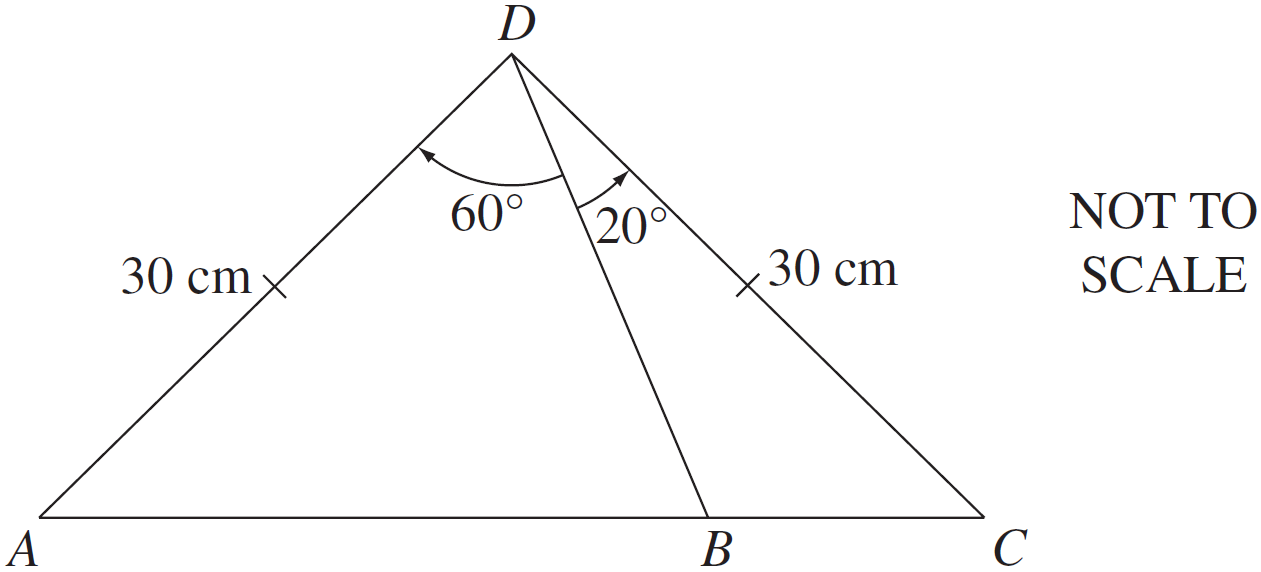
What is the length of `AB` to the nearest centimetre?
`A`
`Delta ADC\ text(is isosceles)`
| `/_DAB = /_DCA` | `= x^@` |
| `2x + 80^@` | `= 180^@\ \ \ (text{Angle sum of}\ DeltaADC)` |
| `2x` | `= 100^@` |
| `x` | `= 50^@` |
| `/_ DBA` | `= 180\-(50 + 60)\ \ \ (text{Angle sum of}\ Delta ADB)` |
| `= 70^@` |
`text(Using sine rule:)`
| `(AB)/sin60` | `= 30/sin70` |
| `AB` | `= (30 xx sin60)/sin70` |
| `= 27.648…\ text(cm)` |
`=> A`
Three towns `P`, `Q` and `R` are marked on the diagram.
The distance from `R` to `P` is 76 km. `angle RQP=26^circ` and `angle RPQ=46^@.`
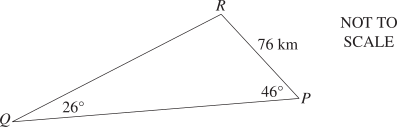
What is the distance from `P` to `Q` to the nearest kilometre?
`C`
| `angle QRP` | `=180-(26+46) (180^circ\ text(in) \ Delta)` |
| `=108^circ` |
`text{Using sine rule}`
| `(PQ)/sin108^circ` | `=76/sin26^circ` |
| `PQ` | `=(76xxsin108^circ)/sin26^circ=164.88\ text(km)` |
`=> C`
Raj cycles around a course. The course starts at `E`, passes through `F`, `G` and `H` and finishes at `E`. The distances `EH` and `GH` are equal.
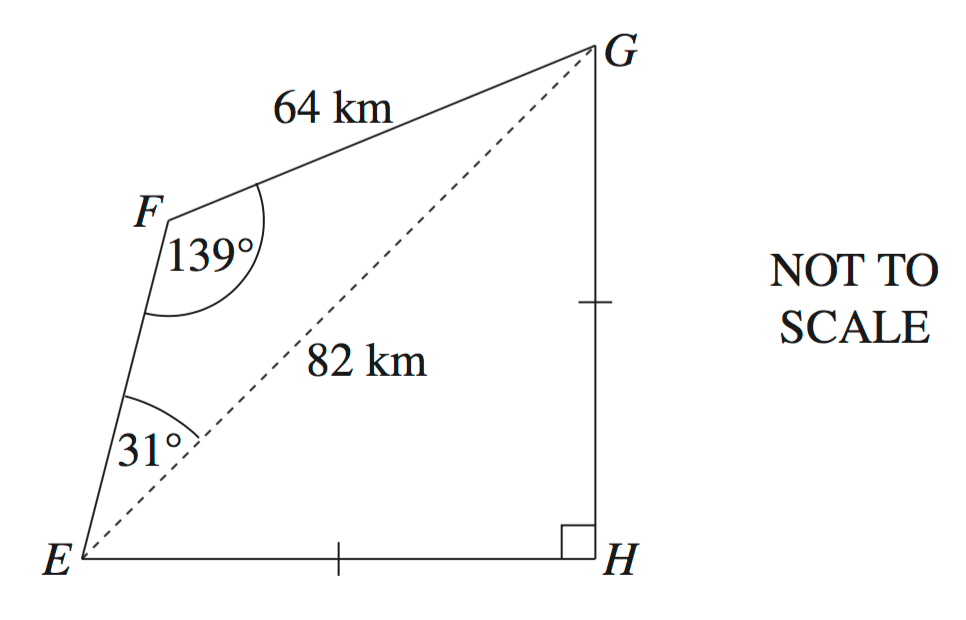
--- 4 WORK AREA LINES (style=lined) ---
--- 6 WORK AREA LINES (style=lined) ---
a. `22\ text{km}`
b. `202\ text{km}`
a. `text(Find)\ EF:`
`/_ FGE= 180\-(139 + 31)= 10^@ \ \ text{(angle sum of}\ Delta EFGtext{)}`
`text(Using Sine rule:)`
| `(EF)/sin10^@` | `= 82/sin139^@` |
| `EF` | `= (82 xx sin10^@)/sin139^@= 21.70406…= 22\ text{km (nearest km)}` |
b. `text(Let)\ \ d = text(total distance cycled)`
`text(Find)\ EH:`
`text(S)text(ince)\ Delta EGH\ text(is isosceles, and)\ /_EHG = 90^@`
`/_GEH = /_HGE = 45^@`
`text{(angles opposite equal sides in}\ Delta EGHtext{)}`
| `sin45^@` | `= (GH)/82` |
| `GH` | `= 82 xx sin45^@= 57.983…` |
| `:. d` | `= EF + FG + GH + EH` |
| `= 21.704… + 64 + 57.983… + 57.983…` | |
| `= 201.66…` | |
| `= 202 \ text{km (nearest km)}` |
`C`
| `a/sinA` | `=b/sinB` |
| `82/sinA` | `=100/sin26` |
| `sin A` | `=(82 xx sin26)/100` |
| `=0.35946…` | |
| `/_A` | `=21^@\ \ \ \ text{(nearest degree)}` |
`text(S)text(ince)\ 180^@\ text(in)\ Delta:`
| `90+26+(theta+21)` | `=180` |
| `theta` | `=43^@` |
`=> C`