SmarterEd

Aussie Maths & Science Teachers: Save your time with SmarterEd

  • Login
  • Get Help
  • About

Financial Maths, 2ADV M1 2024 HSC 30

Suppose the geometric series  \(x+x^2+x^3+\ \cdots\) has a limiting sum.

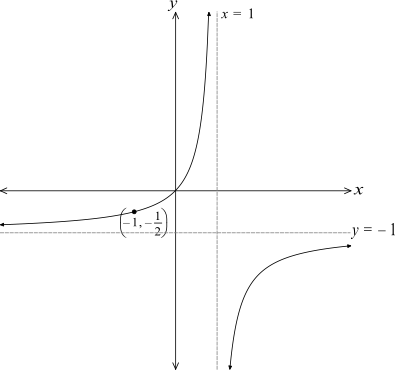
By considering the graph  \(y=-1-\dfrac{1}{x-1}\), or otherwise, find the range of possible values of \(S\).   (3 marks)

--- 12 WORK AREA LINES (style=lined) ---

Show Answers Only

\(S \in \Big( -\dfrac{1}{2}, \infty\Big ) \)

Show Worked Solution

\(x + x^2+x^3\ \cdots \Rightarrow a=x, r=x\)

\(S=\dfrac{a}{1-r} = \dfrac{x}{1-x}=\dfrac{-(1-x)+1}{1-x} = -1+\dfrac{1}{1-x}=-1-\dfrac{1}{x-1}\)

♦♦ Mean mark 31%.

\(\text{If limiting sum}\ \Rightarrow \abs{r} \lt 1\ \Rightarrow \ \abs{x} \lt 1\)

\(\Rightarrow \text{Possible values of}\ S =\ \text{range of}\ \ y=-1-\dfrac{1}{x-1}\ \text{in domain}\ \abs{x} \lt 1\)

\(\text{Consider}\ \ y=-1-\dfrac{1}{x-1}:\)

\(\text{Asymptote at}\ \ x=1.\)

\begin{array} {|c|c|c|c|c|c|}
\hline
\rule{0pt}{2.5ex} x \rule[-1ex]{0pt}{0pt} & -2 & -1 & 0 & 1 & 2 \\
\hline
\rule{0pt}{2.5ex} y \rule[-1ex]{0pt}{0pt} & -\dfrac{2}{3} &  -\dfrac{1}{2} & \ \ 0\ \  & \infty & -2 \\
\hline
\end{array}

\(\text{As}\ x \rightarrow \infty, \ y \rightarrow -1\)

\(\text{As}\ x \rightarrow -\infty, \ y \rightarrow -1\)
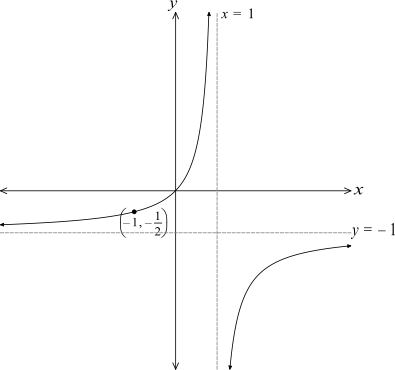
\(\abs{x} \lt 1\ \Rightarrow \  y \in \Big( -\dfrac{1}{2}, \infty\Big ) \)

\(\therefore\ \text{Possible values of}\ S \in \Big( -\dfrac{1}{2}, \infty\Big ) \)

Filed Under: Geometric Series, Geometric Series Tagged With: Band 5, smc-1006-40-Limiting Sum, smc-1006-95-X-topic, smc-7127-50-Limiting Sum, smc-7127-95-X-topic

Trigonometry, 2ADV T2 2004 HSC 9a

Consider the geometric series  `1-tan^2 theta + tan^4 theta- …`

  1. When the limiting sum exists, find its value in simplest form.   (2 marks)

    --- 4 WORK AREA LINES (style=lined) ---

  2. For what values of  `theta`  in the interval
  3. `-pi/2 < theta < pi/2`  does the limiting sum of the series exist?   (2 marks)

    --- 5 WORK AREA LINES (style=lined) ---

Show Answers Only

a.    `cos^2 theta`

b.    `-pi/4 < theta < pi/4`

Show Worked Solution

a.    `1-tan^2 theta + tan^4 theta- …`

`=>\ text(GP where)\ \ a=1,\ \ r=T_2/T_1= − tan^2 theta`

`:. S_∞` `= 1/(1-(-tan^2 theta))`
  `= 1/(1 + tan^2 theta)`
  `= 1/(sec^2 theta)`
  `= cos^2 theta`

  
b.   
`text(Find)\ theta\ text(such that)\ |r |<1:`

`|-tan^2 theta\ |` `< 1`
` tan^2 theta` `< 1`
`-1 < tan theta` `< 1`
`:. -pi/4 < theta` `< pi/4`

Filed Under: Exact Trig Ratios and Other Identities, Geometric Series, Geometric Series, Geometric Series, Trig Identities and Harder Equations, Trig Identities and Harder Equations Tagged With: Band 5, smc-1006-40-Limiting Sum, smc-1006-95-X-topic, smc-1189-10-Solve Equation, smc-1189-50-X-topic Series, smc-6412-10-Solve Equation, smc-7127-50-Limiting Sum, smc-7127-95-X-topic

Trigonometry, 2ADV T1 2005 HSC 9b

Trig Ratios, 2UA 2005 HSC 9b
 

The triangle  `ABC`  has a right angle at `B, \ ∠BAC = theta` and  `AB = 6`. The line `BD` is drawn perpendicular to `AC`. The line `DE` is then drawn perpendicular to `BC`. This process continues indefinitely as shown in the diagram.

  1. Find the length of the interval `BD`, and hence show that the length of the interval `EF` is `6 sin^3 theta`.   (2 marks)

    --- 6 WORK AREA LINES (style=lined) ---

  2. Show that the limiting sum
  3. `qquad BD + EF + GH + ···`
  4. is given by  `6 sec theta tan theta`.   (3 marks)

    --- 8 WORK AREA LINES (style=lined) ---

Show Answers Only

a.    `text(See Worked Solutions)`

b.    `text(See Worked Solutions)`

Show Worked Solution
a.     Trig Ratios, 2UA 2005 HSC 9b Answer

`text(Show)\ EF = 6 sin^3 theta`

`text(In)\ ΔADB:`

`sin theta` `= (DB)/6`
`DB` `= 6 sin theta`
`∠ABD` `= 90-theta\ \ \ text{(angle sum of}\ ΔADB)`
`:.∠DBE` `= theta\ \ \ (∠ABE\ text{is a right angle)}`

  
`text(In)\ ΔBDE:`

`sin theta= (DE)/(DB)= (DE)/(6 sin theta)`

`DE` `= 6 sin^2 theta`
`∠BDE` `= 90-theta\ \ \ text{(angle sum of}\ ΔDBE)`
`∠EDF` `= theta\ \ \ (∠FDB\ text{is a right angle)}`

  
`text(In)\ ΔDEF:`

`sin theta` `= (EF)/(DE)= (EF)/(6 sin^2 theta)`
`:.EF` `= 6 sin^3 theta\ \ …text(as required)`

  
b.   
`text(Show)\ \ BD + EF + GH\ …`

`text(has limiting sum)\ =6 sec theta tan theta`

  
`underbrace{6 sin theta + 6 sin^3 theta +\ …}_{text(GP where)\ \ a = 6 sin theta, \ \ r = sin^2 theta}`

  
`text(S)text(ince)\ \ 0 < theta < 90^@`

`-1` `< sin\ theta` `< 1`
`0` `< sin^2\ theta` `< 1`

 
`:. |\ r\ | < 1`
 

`:.S_∞` `= a/(1-r)`
  `= (6 sin theta)/(1-sin^2 theta)`
  `= (6 sin theta)/(cos^2 theta)`
  `= 6 xx 1/(cos theta) xx (sin theta)/(cos theta)`
  `= 6 sec theta tan theta\ \ …text( as required.)`

Filed Under: Geometric Series, Geometric Series, Geometric Series, Sine and Cosine Rules, Bearings, Trig Ratios, Sine and Cosine Rules, Trig Ratios, Sine and Cosine Rules Tagged With: Band 4, Band 5, Band 6, smc-1006-40-Limiting Sum, smc-1006-80-Applied Context, smc-1006-95-X-topic, smc-6392-20-Trig Ratios, smc-7127-50-Limiting Sum, smc-7127-80-Applied Context, smc-7127-95-X-topic, smc-980-20-Trig Ratios

Probability, 2ADV S1 2013 HSC 15d

Pat and Chandra are playing a game. They take turns throwing two dice. The game is won by the first player to throw a double six. Pat starts the game.

  1. Find the probability that Pat wins the game on the first throw.   (1 mark)

    --- 2 WORK AREA LINES (style=lined) ---

  2. What is the probability that Pat wins the game on the first or on the second throw?   (2 marks)

    --- 5 WORK AREA LINES (style=lined) ---

  3. Find the probability that Pat eventually wins the game.   (2 marks)

    --- 5 WORK AREA LINES (style=lined) ---

Show Answers Only

a.    `1/36`

b.    `(2521)/(46\ 656)\ \ text(or)\ \ 0.054`

c.    `36/71`

Show Worked Solutions

a.    `P\ text{(Pat wins on 1st throw)}=P(W)`

`P(W)` `=P\ text{(Pat throws 2 sixes)}`
  `=1/6 xx 1/6`
  `=1/36`

  
b.   
`text(Let)\ P(L)=P text{(loss for either player on a throw)}=35/36`

`P text{(Pat wins on 1st or 2nd throw)}` 

♦♦ Mean mark (b) 33%
MARKER’S COMMENT: Many students did not account for Chandra having to lose when Pat wins on the 2nd attempt.

`=P(W) + P(LL W)`

`=1/36\ + \ (35/36)xx(35/36)xx(1/36)`

`=(2521)/(46\ 656)`

`=0.054\ \ \ text{(to 3 d.p.)}`

  
c.   
`P\ text{(Pat wins eventually)}`

`=P(W) + P(LL\ W)+P(LL\ LL\ W)+ … `

`=1/36\ +\ (35/36)^2 (1/36)\ +\ (35/36)^2 (35/36)^2 (1/36)\ +…`

 
`=>\ text(GP where)\ \ a=1/36,\ \ r=(35/36)^2=(1225)/(1296)`

♦♦♦ Mean mark (c) 8%!
 COMMENT: Be aware that diminishing probabilities and `S_oo` within the Series and Applications are a natural cross-topic combination.

   
`text(S)text(ince)\ |\ r\ |<\ 1:`

`S_oo` `=a/(1-r)`
  `=(1/36)/(1-(1225/1296))`
  `=1/36 xx 1296/71`
  `=36/71`

  
`:.\ text(Pat’s chances to win eventually are)\  36/71`.

Filed Under: 3. Probability, Geometric Series, Geometric Series, Geometric Series, Multi-Stage Events, Multi-Stage Events Tagged With: Band 3, Band 5, Band 6, smc-1006-40-Limiting Sum, smc-1006-80-Applied Context, smc-1006-95-X-topic, smc-6469-20-Other Multi-Stage Events, smc-6469-50-Probability and Series, smc-7127-50-Limiting Sum, smc-7127-80-Applied Context, smc-7127-95-X-topic, smc-989-20-Other Multi-Stage Events, smc-989-50-Probability and Series

Copyright © 2014–2026 SmarterEd.com.au · Log in