SmarterEd

Aussie Maths & Science Teachers: Save your time with SmarterEd

  • Login
  • Get Help
  • About

Calculus, MET1 SM-Bank 21

The rule for function  `f` is  `f(x) = e^(-x^2)`.  The diagram shows the graph  `y = f(x)`.

 Inverse Functions, EXT1 2010 HSC 3b

The graph has two points of inflection. 

  1. Find the `x` coordinates of these points.   (2 marks)

    --- 10 WORK AREA LINES (style=lined) ---

  2. Explain why the domain of `f(x)` must be restricted if `f(x)` is to have an inverse function.    (1 mark)

    --- 4 WORK AREA LINES (style=lined) ---

  3. Find the rule for the inverse function `f^(-1)` if the domain of `f(x)` is restricted to  `x ≥ 0.`   (2 marks)

    --- 6 WORK AREA LINES (style=lined) ---

  4. Find the domain for `f^(-1)`.    (1 mark)

    --- 2 WORK AREA LINES (style=lined) ---

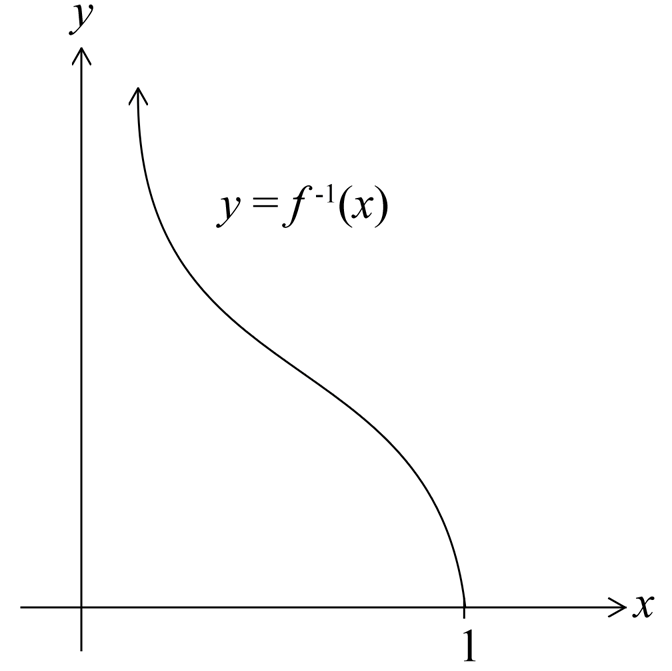
  5. Sketch the curve  `y = f^(-1) (x)`.   (1 mark)

    --- 6 WORK AREA LINES (style=blank) ---

Show Answers Only
  1. `x = +- 1/sqrt2`
  2. `text(There can only be 1 value of)\ y\ text(for each value of)\ x.`
  3. `f^(-1)x = sqrt(ln(1/x))`
  4. `0 <= x <= 1`
  5. Inverse Functions, EXT1 2010 HSC 3b Answer

Show Worked Solution
a.    `y` `= e^(-x^2)`
  `dy/dx` `= -2x * e^(-x^2)`
  `(d^2y)/(dx^2)` `= -2x (-2x * e^(-x^2)) + e ^(-x^2) (-2)`
    `= 4x^2 e^(-x^2)-2e^(-x^2)`
    `= 2e^(-x^2) (2x^2-1)`

 
`text(P.I. when)\ \ (d^2y)/(dx^2) = 0`

`2e^(-x^2) (2x^2-1)` `= 0` 
 `2x^2-1` `= 0` 
 `x^2` `= 1/2`
 `x` `= +- 1/sqrt2` 
COMMENT: It is also valid to show that `f(x)` is an even function and if a P.I. exists at `x=a`, there must be another P.I. at `x=–a`.
`text(When)\ \ ` `x < 1/sqrt2,` `\ (d^2y)/(dx^2) < 0`
  `x > 1/sqrt2,` `\ (d^2y)/(dx^2) > 0`

 
`=>\ text(Change of concavity)`

`:.\ text(P.I. at)\ \ x = 1/sqrt2`
 

`text(When)\ \ ` `x <-1/sqrt2,` `\ (d^2y)/(dx^2) > 0`
  `x >-1/sqrt2,` `\ (d^2y)/(dx^2) < 0`

 
`=>\ text(Change of concavity)`

`:.\ text(P.I. at)\ \ x =-1/sqrt2`


b.   `text(In)\ f(x), text(there are 2 values of)\ y\ text(for)`
  `text(each value of)\ x.`
  `:.\ text(The domain of)\ f(x)\ text(must be restricted)`
  `text(for)\ \ f^(-1) (x)\ text(to exist).`


c.  `y = e^(-x^2)`

`text(Inverse: swap)\  x harr y` 

`x` `= e^(-y^2),\ \ \ x >= 0`
`lnx` `= ln e^(-y^2)`
`-y^2` `= lnx`
`y^2` `= -lnx`
  `=ln(1/x)`
`y` `= +- sqrt(ln (1/x))`


`text(Restricting)\ \ x>=0,\ \ =>y>=0`

`:.  f^(-1) (x)=sqrt(ln (1/x))`


d.   `f(0) = e^0 = 1`

`:.\ text(Range of)\ \ f(x)\ \ text(is)\ \ 0 < y <= 1`

`:.\ text(Domain of)\ \ f^(-1) (x)\ \ text(is)\ \ 0 < x <= 1`


e. 

Inverse Functions, EXT1 2010 HSC 3b Answer

Filed Under: Curve Sketching, Logs and Exponential Functions Tagged With: Band 4, Band 5, smc-5204-70-Sketch graph, smc-724-30-Log/Exponential, smc-724-40-Inverse functions

Calculus, MET2 2011 VCAA 3

  1. Consider the function  `f: R -> R, f(x) = 4x^3 + 5x-9`.


    1. Find  `f^{prime}(x).`   (1 mark)

      --- 1 WORK AREA LINES (style=lined) ---

    2. Explain why  `f^{prime}(x) >= 5` for all `x`.   (1 mark)

      --- 4 WORK AREA LINES (style=lined) ---

  2. The cubic function `p` is defined by  `p: R -> R, p(x) = ax^3 + bx^2 + cx + k`, where `a`, `b`, `c` and `k` are real numbers.


    1. If `p` has `m` stationary points, what possible values can `m` have?   (1 mark)

      --- 2 WORK AREA LINES (style=lined) ---

    2. If `p` has an inverse function, what possible values can `m` have?   (1 mark)

      --- 2 WORK AREA LINES (style=lined) ---

  3. The cubic function `q` is defined by  `q:R -> R, q(x) = 3-2x^3`.


    1. Write down a expression for  `q^(-1)(x)`.   (2 marks)

      --- 4 WORK AREA LINES (style=lined) ---

    2. Determine the coordinates of the point(s) of intersection of the graphs of  `y = q(x)`  and  `y = q^(-1)(x)`.   (2 marks)

      --- 3 WORK AREA LINES (style=lined) ---

  4. The cubic function `g` is defined by  `g: R -> R, g(x) = x^3 + 2x^2 + cx + k`, where `c` and `k` are real numbers.


    1. If `g` has exactly one stationary point, find the value of `c`.   (3 marks)

      --- 4 WORK AREA LINES (style=lined) ---

    2. If this stationary point occurs at a point of intersection of  `y = g(x)`  and  `g^(−1)(x)`, find the value of `k`.   (3 marks)

      --- 8 WORK AREA LINES (style=lined) ---

Show Answers Only
    1. `f^{prime}(x) = 12x^2 + 5`
    2. `text(See Worked Solutions)`
    1. `m = 0, 1, 2`
    2. `m = 0, 1`
    1. `q^(-1)(x) = root(3)((3-x)/2), x ∈ R`
    2. `(1, 1)`
    1. `4/3`
    2. `-10/27`
Show Worked Solution

a.i.   `f^{prime}(x) = 12x^2 + 5`
  

a.ii.  `text(S)text(ince)\ \ x^2>=0\ \ text(for all)\ x,`

♦ Mean mark 47%.
` 12x^2` `>= 0`
`12x^2 + 5` `>=  5`
`f^{prime}(x)` `>=  5\ \ text(for all)\ x`


b.i.   `p(x) = text(is a cubic)`

♦♦♦ Mean mark part (b)(i) 9%, and part (b)(ii) 20%.
MARKER’S COMMENT: Good exam strategy should point students to investigate earlier parts for direction. Here, part (a) clearly sheds light on a solution!

`:. m = 0, 1, 2`

`text{(Note: part a.ii shows that a cubic may have no SP’s.)}`


b.ii.   `text(For)\ p^(−1)(x)\ text(to exist)`

`:. m = 0, 1`


c.i.   `text(Let)\ y = q(x)`

`text(Inverse: swap)\ x ↔ y`

`x` `= 3-2y^3`
`y^3` `= (3-x)/2`

`:. q^(-1)(x) = root(3)((3-x)/2), \ x ∈ R`
  

c.ii.  `text(Any function and its inverse intersect on)`

   `text(the line)\ \ y=x.`

`text(Solve:)\ \ 3-2x^3` `= xqquadtext(for)\ x,`
`x` `= 1`


`:.\ text{Intersection at (1, 1)}`
  

♦ Mean mark part (d)(i) 44%.
d.i.    `g^{prime}(x)` `= 0`
  `3x^2 + 4x + c` `= 0`
  `Delta` `= 0`
  `16-4(3c)` `= 0`
  `:. c` `= 4/3`


d.ii.   `text(Define)\ \ g(x) = x^3 + 2x^2 + 4/3x + k`

♦♦♦ Mean mark part (d)(ii) 14%.

  `text(Stationary point when)\ \ g^{prime}(x)=0`

`g^{prime}(x) = 3x^2+4x+4/3`

`text(Solve:)\ \ g^{prime}(x)=0\ \ text(for)\ x,`

`x = -2/3`

`text(Intersection of)\ g(x)\ text(and)\ g^(-1)(x)\ text(occurs on)\ \ y = x`

`text(Point of intersection is)\  (-2/3, -2/3)`

`text(Find)\ k:`

`g(-2/3)` `= -2/3\ text(for)\ k`
`:. k` ` = -10/27`

Filed Under: Curve Sketching, Polynomial and Other Functions Tagged With: Band 2, Band 3, Band 4, Band 5, Band 6, smc-5205-10-Polynomials, smc-5205-50-Find intersection, smc-724-10-Cubic, smc-724-40-Inverse functions

Algebra, MET2 2010 VCAA 9 MC

The function  `f:\ (–oo, a] -> R`  with rule  `f(x) = x^3 - 3x^2 + 3`  will have an inverse function provided

  1. `a <= 0`
  2. `a >= 2`
  3. `a >= 0`
  4. `a <= 2`
  5. `a <= 1`
Show Answers Only

`A`

Show Worked Solution
`f(x)` `= x^3-3x^2 + 3`
`f′(x)` `=3x^2-6x`
  `=3x(x-2)`


`text(Stationary points at)\ \ x=0 and 2.`

`text{Local max at (0,3) and local min at (2,-1).}`

`text(Sketch the graph:)`

`text(Inverse exists if)\ \ f(x)\ \ text(is)\ \ 1-1.`

`:. x <= 0`

`=>   A`

Filed Under: Curve Sketching, Polynomial and Other Functions Tagged With: Band 4, smc-5205-10-Polynomials, smc-633-10-Polynomial, smc-724-40-Inverse functions

Copyright © 2014–2025 SmarterEd.com.au · Log in