Find the equation of the tangent to the curve \(y=\tan ^{-1}\left(x^2\right)\) at the point on the curve where \(x=1\). (3 marks)
--- 8 WORK AREA LINES (style=lined) ---
Aussie Maths & Science Teachers: Save your time with SmarterEd
Find the equation of the tangent to the curve \(y=\tan ^{-1}\left(x^2\right)\) at the point on the curve where \(x=1\). (3 marks)
--- 8 WORK AREA LINES (style=lined) ---
For what values of the constant \(k\) would the function \(f(x)=\dfrac{k x}{1+x^2}+\arctan x\) have an inverse? (3 marks) --- 5 WORK AREA LINES (style=lined) ---
Find the equation of the tangent to the curve `y=x text{arctan}(x)` at the point with coordinates `(1,(pi)/(4))`. Give your answer in the form `y=mx+c` (3 marks)
--- 6 WORK AREA LINES (style=lined) ---
Let `f(x) = tan^(-1) (3x - -6) + pi`.
--- 2 WORK AREA LINES (style=lined) ---
--- 6 WORK AREA LINES (style=lined) ---
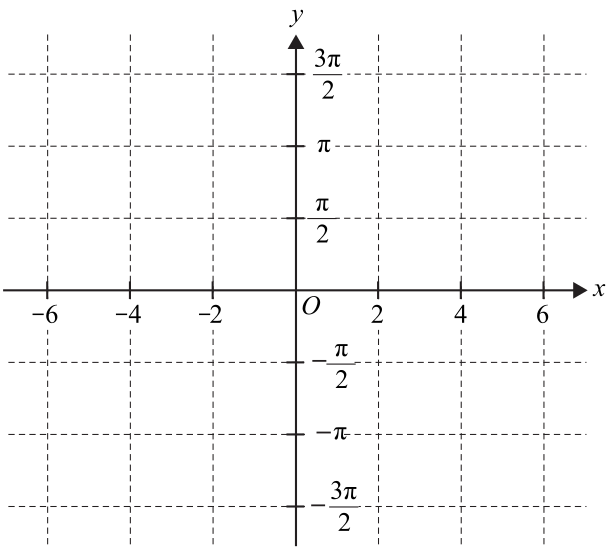
--- 0 WORK AREA LINES (style=lined) ---
| a. | `f^{\prime}(x)` | `= (d/(dx) (3x-6))/(1 + (3x-6)^2)` |
| `= 3/(9x^2-36x + 37)` |
b. `f^{\prime\prime}(x) = (-3(18x-36))/(9x^2-36x + 37)^2`
`f^{\prime\prime}(x) = 0\ \ text(when)\ \ 18x-36 = 0 \ => \ x = 2`
`text(If)\ \ x < 2, 18x-36 < 0 \ => \ f^{\prime\prime}(x) < 0`
`text(If)\ \ x > 2, 18x-36 > 0 \ => \ f^{\prime\prime}(x) > 0`
`text(S) text(ince)\ \ f^{\prime\prime}(x)\ \ text(changes sign about)\ \ x = 2,`
`text(a POI exists at)\ \ x = 2`
| c. | 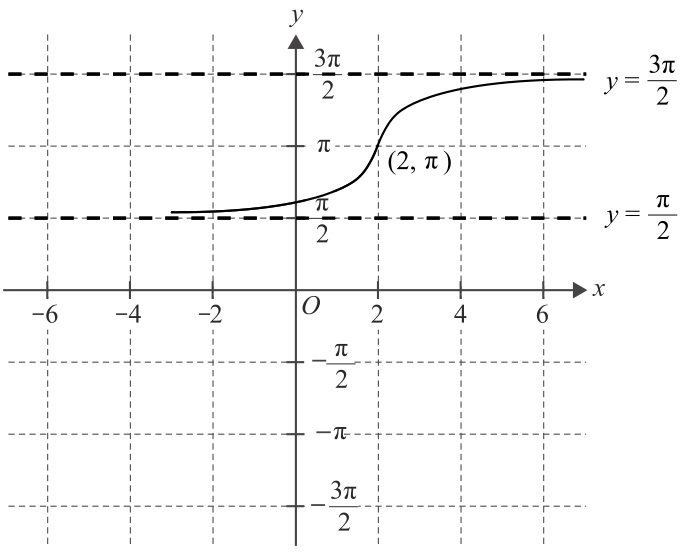 |
Suppose `f(x) = tan(cos^(-1)(x))` and `g(x) = (sqrt(1-x^2))/x`.
The graph of `y = g(x)` is given.
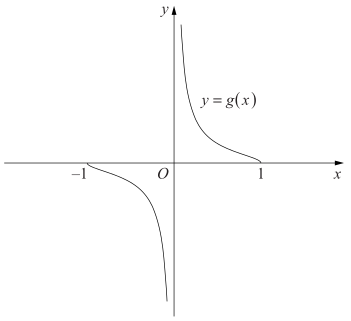
--- 8 WORK AREA LINES (style=lined) ---
--- 6 WORK AREA LINES (style=lined) ---
What is the derivative of `tan^(-1)\ x/2`?
A. `1/(2(4 + x^2))`
B. `1/(4 + x^2)`
C. `2/(4 + x^2)`
D. `4/(4 + x^2)`
Differentiate `3tan^(-1)(2x)`. (2 marks)
--- WORK AREA LINES (style=lined) ---
Differentiate `tan^(-1)(x^4)` with respect to `x`. (2 marks)
--- 4 WORK AREA LINES (style=lined) ---
Let `f(x) = tan^(-1)(x) + tan^(-1)(1/x)` for `x != 0`.
--- 6 WORK AREA LINES (style=lined) ---
--- 6 WORK AREA LINES (style=lined) ---
a. `text(Proof)\ \ text{(See Worked Solutions)}`

b.
| a. | `f(x)` | `= tan^(-1) (x) + tan^(-1) (1/x)\ text(for)\ x != 0` |
| `f prime (x)` | `= 1/(1 + x^2) + 1/(1 + (1/x)^2) xx d/(dx) (1/x)` | |
| `= 1/(1 + x^2) + 1/(1 + 1/(x^2)) xx-1/(x^2)` | ||
| `= 1/(1 + x^2)-1/(x^2 + 1)` | ||
| `= 0` |
`text(S)text(ince)\ \ f prime (x) = 0`
`=> f(x)\ text(is a constant)`
`text(Substitute)\ \ x = 1\ \ text(into)\ \ f(x)`
| `f(1)` | `= tan^(-1) 1 + tan^(-1) (1/1)` |
| `= pi/4 + pi/4` | |
| `= pi/2` |
`:.\ f(x) = pi/2\ \ text(for)\ \ x > 0\ \ \ …\ text(as required)`
| b. | `text(Given)\ \ f(x)\ \ text(is odd)` |
| `f(-x) = -f(x)` |