Evaluate \(\displaystyle\int_{\small{\dfrac{\pi}{6}}}^{\small{\dfrac{\pi}{3}}} \cos ^2(3 x) d x\). (3 marks)
--- 6 WORK AREA LINES (style=lined) ---
Aussie Maths & Science Teachers: Save your time with SmarterEd
Evaluate \(\displaystyle\int_{\small{\dfrac{\pi}{6}}}^{\small{\dfrac{\pi}{3}}} \cos ^2(3 x) d x\). (3 marks)
--- 6 WORK AREA LINES (style=lined) ---
\(\dfrac{\pi}{12}\)
| \(\displaystyle\int_{\small{\dfrac{\pi}{6}}}^{\small{\dfrac{\pi}{3}}} \cos ^2(3x) dx\) | \(=\displaystyle \dfrac{1}{2} \int_{\small{\dfrac{\pi}{6}}}^{\small{\dfrac{\pi}{3}}} (\cos6x+1) dx \) |
| \(=\dfrac{1}{2}\left[\dfrac{1}{6} \sin 6 x+x\right]_{\small{\dfrac{\pi}{6}}}^{\small{\dfrac{\pi}{3}}}\) | |
| \(=\dfrac{1}{2}\left[\left(\dfrac{1}{6} \sin 2 \pi+\dfrac{\pi}{3}\right)-\left(\dfrac{1}{6} \sin \pi+\dfrac{\pi}{6}\right)\right]\) | |
| \(=\dfrac{1}{2}\left(\dfrac{\pi}{3}-\dfrac{\pi}{6}\right)\) | |
| \(=\dfrac{\pi}{12}\) |
Find \(\displaystyle \int \sin 3x \, \cos x \, dx\). (2 marks)
--- 5 WORK AREA LINES (style=lined) ---
\(-\dfrac{1}{8} \cos 4 x-\dfrac{1}{4} \cos 2 x+c\)
| \(\displaystyle\int \sin3x \, \cos x \, dx\) | \(=\displaystyle\frac{1}{2} \int \sin 4 x+\sin2x \,dx\) |
| \(=-\dfrac{1}{8} \cos 4 x-\dfrac{1}{4} \cos 2 x+c\) |
--- 6 WORK AREA LINES (style=lined) --- --- 7 WORK AREA LINES (style=lined) ---
i.
\(\text{LHS}\)
\(=\left[\dfrac{1}{2}(1+\cos (2 x)\right]^2+\left[\dfrac{1}{2}(1-\cos (2 x)\right]^2\)
\(=\dfrac{1}{4}\left(1+2 \cos (2 x)+\cos ^2(2 x)+1-2 \cos (2 x)+\cos ^2(2 x)\right)\)
\(=\dfrac{1}{4}\left(2+2 \cos ^{2}(2 x)\right)\)
\(=\dfrac{1+\cos ^2(2 x)}{2}\)
ii. \(\dfrac{3 \pi}{16}\)
i.
\(\text{LHS}\)
\(=\left[\dfrac{1}{2}(1+\cos (2 x)\right]^2+\left[\dfrac{1}{2}(1-\cos (2 x)\right]^2\)
\(=\dfrac{1}{4}\left(1+2 \cos (2 x)+\cos ^2(2 x)+1-2 \cos (2 x)+\cos ^2(2 x)\right)\)
\(=\dfrac{1}{4}\left(2+2 \cos ^{2}(2 x)\right)\)
\(=\dfrac{1+\cos ^2(2 x)}{2}\)
ii.
\(\displaystyle{\int}_0^{\frac{\pi}{4}}\left(\cos ^4 x+\sin ^4 x\right) d x\)
\(=\dfrac{1}{2} \displaystyle{\int}_0^{\frac{\pi}{4}} 1+\cos ^2(2 x) d x\)
\(=\dfrac{1}{2} \displaystyle{\int}_0^{\frac{\pi}{4}} 1+\dfrac{1}{2}(1+\cos (4 x)) d x\)
\(=\dfrac{1}{2}\left[\dfrac{3}{2}x +\dfrac{1}{8} \sin (4 x)\right]_0^{\frac{\pi}{4}}\)
\(=\dfrac{1}{2}\left[\dfrac{3}{2} \times \dfrac{\pi}{4}+\dfrac{1}{8} \sin \pi-0\right]\)
\(=\dfrac{3 \pi}{16}\)
Which of the following integrals is equivalent to `int sin^2 3x\ dx`?
`B`
`int sin^2 3x\ dx = 1/2 int (1 – cos6x) dx`
`=>\ B`
Suppose `f(x) = tan(cos^(-1)(x))` and `g(x) = (sqrt(1-x^2))/x`.
The graph of `y = g(x)` is given.
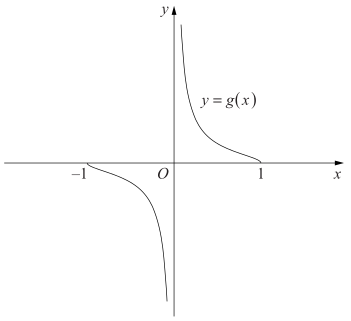
--- 8 WORK AREA LINES (style=lined) ---
--- 6 WORK AREA LINES (style=lined) ---
i. `text(See Worked Solutions)`
ii. `text(See Worked Solutions)`
i. `f(x) = tan(cos^(-1)(x))`
| `f^(′)(x)` | `= -1/sqrt(1-x^2) · sec^2(cos^(-1)(x))` |
| `= -1/sqrt(1-x^2) · 1/(cos^2(cos^(-1)(x)))` | |
| `= -1/(x^2sqrt(1-x^2))` |
`g(x) = (1-x^2)^(1/2) · x^(-1)`
| `g^(′)(x)` | `= 1/2 · -2x(1-x^2)^(-1/2) · x^(-1)-(1-x^2)^(1/2) · x^(-2)` |
| `= (-x)/(x sqrt(1-x^2))-sqrt(1-x^2)/(x^2)` | |
| `= (-x^2-sqrt(1-x^2) sqrt(1-x^2))/(x^2 sqrt(1-x^2))` | |
| `= (-x^2-(1-x^2))/(x^2sqrt(1-x^2))` | |
| `= -1/(x^2sqrt(1-x^2))` | |
| `=f^(′)(x)` |
ii. `f^(′)(x) = g^(′)(x)`
`=> f(x) = g(x) + c`
`text(Find)\ c:`
`f(1)= tan(cos^(-1) 1)= tan 0=0`
`g(1) = sqrt(1-1)/0 = 0`
`f(1) = g(1) + c\ \ =>\ \ c = 0`
`:. f(x) = g(x)`
Find `int_0^(pi/2) cos 5x\ sin 3x\ dx`. (3 marks)
`−1/2`
| `int_0^(pi/2) cos 5x\ sin 3x\ dx` | `= 1/2 int_0^(pi/2) 2cos 5x\ sin 3x\ dx` |
| `= 1/2 int_0^(pi/2) sin 8x-sin 2x\ dx` | |
| `= 1/2[−1/8 cos 8x + 1/2 cos 2x]_0^(pi/2)` | |
| `= 1/2[(−1/8 cos 4pi + 1/2 cospi)-(−1/8 cos0 + 1/2 cos0)]` | |
| `= 1/2(−1/8-1/2 + 1/8-1/2)` | |
| `= −1/2` |
The diagram shows the two curves `y = sin x` and `y = sin(x-alpha) + k`, where `0 < alpha < pi` and `k > 0`. The two curves have a common tangent at `x_0` where `0 < x_0 < pi/2`.
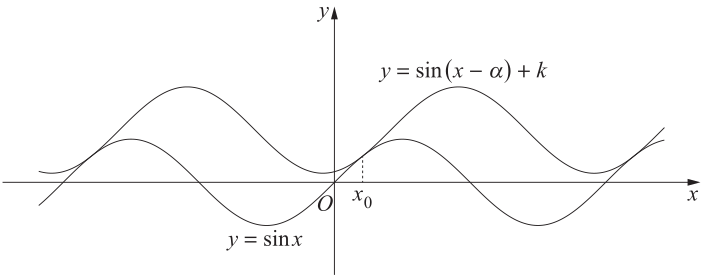
--- 4 WORK AREA LINES (style=lined) ---
--- 5 WORK AREA LINES (style=lined) ---
--- 8 WORK AREA LINES (style=lined) ---
| i. | `y_1` | `= sin x` |
| `(dy_1)/(dx)` | `= cos x` | |
| `y_2` | `= sin(x-alpha) + k` | |
| `(dy_2)/(dx)` | `= cos (x-alpha)` |
`text(At)\ \ x = x_0,\ \ text(tangent is common)`
`:. cos x_0 = cos(x_0-alpha)`
ii. `x_0\ text{is in 1st quadrant (given).}`
`text{Using part (i):}`
`cos\ x_0 = cos(x_0-alpha) >0`
`=> x_0-alpha\ text(is in 4th quadrant)\ (0 < alpha < pi)`
`text(S)text(ince sin is positive in 1st quadrant and)`
`text(negative in 4th quadrant)`
`=> sin x_0 = -sin(x_0-alpha)`
| iii. |
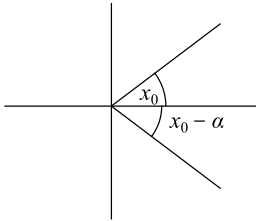
`text(When)\ \ x = x_0:`
| `y_1` | `=sin x_0` | |
| `y_2` | `=sin(x_0-alpha) + k` | |
| `sin x_0` | `=sin (x_0-alpha) + k` | |
| `sin x_0` | `= -sin x_0 + k` | |
| `k` | `== 2\ sin x_0` |
| `text(S)text(ince)\ \ cos x_0` | `= cos(x_0-alpha)` |
| `x_0` | `= -(x_0-alpha)` |
| `2x_0` | `= alpha` |
| `x_0` | `= alpha/2` |
`:. k = 2 sin\ alpha/2`
Find `int 2 sin^2 4x\ dx`. (2 marks)
`x-1/8 sin x + c`
`text(Using)\ \ sin^2theta = 1/2 (1-cos 2theta):`
| `int 2 sin^2 4x\ dx` | `= int 2 xx 1/2 (1-cos 8x)\ dx` |
| `= int 1-cos 8x\ dx` | |
| `= x-1/8 sin 8x + C` |
Which expression is equal to `int sin^2 2x\ dx`?
`A`
`int sin^2 2x\ dx`
`= 1/2 int (1-cos 4x)\ dx`
`= 1/2 (x-1/4 sin 4x) + c`
`=> A`
--- 3 WORK AREA LINES (style=lined) ---
--- 6 WORK AREA LINES (style=lined) ---
a. `text(Proof)\ \ text{(See Worked Solutions)}`
b. `-1/18 cos(9x)-1/2 cos(x) + c`
a. `sin (5x + 4x) + sin (5x-4x) = 2 sin(5x) cos(4x)`
| `text(LHS)` | `= sin (5x) cos (4x)-sin(4x) cos (5x) + sin (5x) cos (4x)+ sin (4x) cos (5x)` |
| `= 2 sin (5x) cos (4x)\ \ text(… as required)` |
b. `int sin (5x) cos (4x)\ dx`
`= 1/2 int 2 sin (5x) cos (4x)\ dx`
`= 1/2 int sin (5x + 4x) + sin (5x-4x)\ dx`
`= 1/2 int sin (9x) + sin (x)\ dx`
`= 1/2 [-1/9 cos(9x)-cos(x)] + c`
`= -1/18 cos(9x)-1/2 cos(x) + c`
The derivative of a function `f(x)` is given by
`f^{′}(x) = sin^2 x`.
Find `f(x)`, given that `f(0) = 2`. (2 marks)
--- 5 WORK AREA LINES (style=lined) ---
`1/2x-1/4 sin 2x + 2`
| `f^{′}(x)` | `= sin^2 x` |
| `f(x)` | `= int sin^2 x\ dx` |
| `= int 1/2(1-cos 2x)\ dx` | |
| `= int 1/2-1/2 cos 2x\ dx` | |
| `= 1/2 x-1/4 sin 2 x + c` |
`text(Given)\ \ f(0) = 2,`
| `2` | `= 1/2 xx 0-1/4 sin 0 + c` |
| `:. c= 2` | |
`:.\ f(x) = 1/2 x-1/4 sin 2x + 2`
Which expression is equal to `int sin^2 3x\ dx`?
`C`
`text(Using:)\ \ sin^2a = 1/2 (1-cos 2a)`
| `int sin^2 3x\ dx` | `= 1/2 int (1-cos 6x)\ dx` |
| `= 1/2 (x-1/6 sin 6x) + C` |
`=> C`