SmarterEd

Aussie Maths & Science Teachers: Save your time with SmarterEd

  • Login
  • Get Help
  • About

Complex Numbers, EXT2 N2 2021 HSC 10 MC

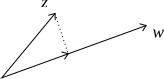
Consider the two non-zero complex numbers `z` and `w` as vectors.

Which of the following expressions is the projection of `z` onto `w` ? 

  1.  `{text{Re} (zw)}/{|w|} w`
  2.  `|z/w| w`
  3.  `text{Re} (z/w) w`
  4. `{text{Re}(z)}/{|w|} w`
Show Answers Only

`C`

Show Worked Solution

`text{Let} \ \ z = a + i b \ \ =>\ underset~z = ((a),(b))`

♦♦♦ Mean mark 30%.

`text{Let} \ \ w = c + i d \ \ =>\ underset~w = ((c),(d))`

`underset~z * underset~w = ac + bd`

`|underset~w|^2 = c^2 + d^2`

`text{proj}_(underset~w) underset~z = (underset~z*underset~w)/|underset~w|^2 *underset~w= (ac+bd)/(c^2+d^2)*underset~w`

`z/w` `=(a+ib)/(c+id) xx (c-id)/(c-id)`  
  `=(ac+bd + i(bc-ad))/(c^2+d^2)`  

 
`text{Re}(z/w) =(ac+bd)/(c^2+d^2)`

`:.\ text{proj}_(underset~w) underset~z = text{Re} (z/w) w`
 

`=> C`
Filed Under: Basic Concepts and Arithmetic, Geometrical Implications of Complex Numbers, Powers and Roots Tagged With: Band 6, smc-1052-60-Other problems, smc-1195-40-Unit Vectors and Projections, smc-1195-50-Complex numbers, smc-7430-70-Vectors

Complex Numbers, EXT2 N2 2017 HSC 13e

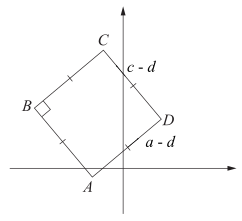
The points `A, B, C` and `D` on the Argand diagram represent the complex numbers `a, b, c` and `d`respectively. The points form a square as shown on the diagram.
 

By using vectors, or otherwise, show that  `c = (1 + i) d-ia`.   (2 marks)

--- 6 WORK AREA LINES (style=lined) ---

Show Answers Only

`text(Proof)\ \ text{(See Worked Solutions)}`

Show Worked Solution

♦ Mean mark 49%.
`c-d` `= i (d-a)\ \ \ text{(rotation of}\ pi/2 text{)}`
`:. c ` `= d + id-ia`
  `= (1 + i) d-ia\ text(… as required.)`

Filed Under: Geometrical Implications of Complex Numbers, Geometry and Complex Numbers (vectors), Powers and Roots Tagged With: Band 5, smc-1052-30-Quadrilaterals, smc-7430-70-Vectors

Complex Numbers, EXT2 N2 2012 HSC 12d

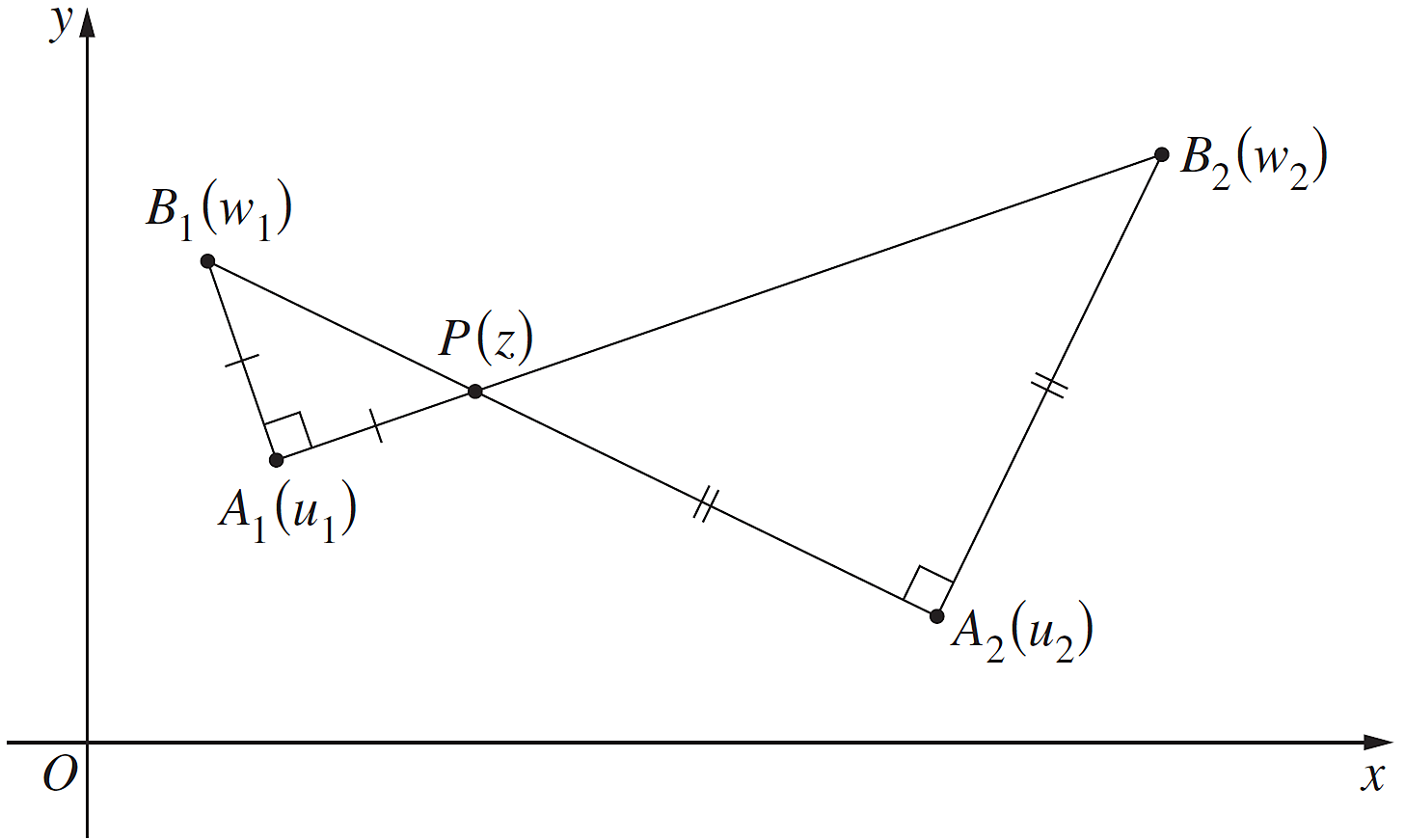
On the Argand diagram the points `A_1` and `A_2` correspond to the distinct complex numbers `u_1` and `u_2` respectively. Let `P` be a point corresponding to a third complex number `z`.

Points `B_1` and `B_2` are positioned so that `ΔA_1PB_1` and `ΔA_2B_2P`, labelled in an anti-clockwise direction, are right-angled and isosceles with right angles at `A_1` and `A_2`, respectively. The complex numbers `w_1` and `w_2` correspond to `B_1` and `B_2`, respectively.
 

Complex Numbers, EXT2 2012 HSC 12d1 

  1. Explain why  `w_1 = u_1 + i(z-u_1)`.   (1 mark)

    --- 5 WORK AREA LINES (style=lined) ---

  2. Find the locus of the midpoint of `B_1B_2` as `P`  varies.   (2 marks)

    --- 6 WORK AREA LINES (style=lined) ---

Show Answers Only

a.    `text(See Worked Solutions.)`

b.    `(u_1 + u_2)/2 + (u_2-u_1)/2 i`

Show Worked Solution
a.     `vec (A_1P)` `= z-u_1`
  `vec (A_1B_1)`  `= w_1-u_1` 

`B_1A_1 ⊥ A_1P\ text(and)\ |vec (A_1P)| = |vec (A_1B_1)|`

`vec (A_1B_1)\ text(is an anticlockwise rotation of)\ vec (A_1P)\ text(through)\ 90^@`

`w_1-u_1 = i(z −u_1)\ \ =>\ \ w_1 = u_1+ i(z −u_1)`


b.       `vec (A_2B_2)` `= w_2-u_2`
  `vec (A_2P)` `= z-u_2`

`A_2B_2 ⊥ A_2P\ text(and)\ |vec (A_2B_2)| = |vec (A_2P)|`

`vec (A_2P)\ text(is an anticlockwise rotation of)\ vec (A_2B_2)\ text(through)\ 90^@`

`z-u_2` `= i(w_2 −u_2)`
`iw_2` `= z-u_2 + iu_2`
`−w_2` `= iz-iu_2-u_2`
`:. w_2` `= u_2 + i(u_2-z)`


`:.\ text(The midpoint of)\ B_1B_2\ text(is)\ (w_1 + w_2)/2`

`= 1/2[u_1 + i(zvu_1) + u_2 + i(u_2-z)]`
`= 1/2[u_1 + u_2 + i(u_2-u_1)]`
`= (u_1 + u_2)/2 + (u_2-u_1)/2 i\ \ \ \ text{(which is a fixed point)}`

Filed Under: Geometrical Implications of Complex Numbers, Geometry and Complex Numbers (vectors), Powers and Roots Tagged With: Band 4, Band 5, smc-1052-20-Triangles, smc-7430-60-Rotation and Shapes, smc-7430-70-Vectors

Copyright © 2014–2026 SmarterEd.com.au · Log in