SmarterEd

Aussie Maths & Science Teachers: Save your time with SmarterEd

  • Login
  • Get Help
  • About

Complex Numbers, EXT2 N2 2025 HSC 9 MC

The points \(U, V, W\) and \(Z\) represent the complex numbers \(u, v, w\) and \(z\) respectively. It is given that  \(v+z=u+w\)  and  \(u+k i z=w+k i v\)  where  \(k \in \mathbb{R} , k>1\).

Which quadrilateral best describes \(UVWZ\) ?

  1. Parallelogram
  2. Rectangle
  3. Rhombus
  4. Square
Show Answers Only

\(C\)

Show Worked Solution

\(\text{Quadrilateral}\ UVWZ\ \ \Rightarrow\ \ \text{Diagonals are \(UW\) and \(VZ\)} \).

\(\text{Given}\ \ v+z=u+w\ \ \Rightarrow\ \ \dfrac{v+z}{2}=\dfrac{u+w}{2}\)

\(\text{Mid-points of diagonals are equal (diagonals bisect).}\)

\(u+kiz\) \(=w+kiv\)  
\(u-w\) \(=ki(v-z)\)  

 
\(\therefore UW\ \text{and}\ VZ\ \text{are perpendicular.}\)

\(\Rightarrow C\)

♦♦ Mean mark 36%.

Filed Under: Geometrical Implications of Complex Numbers, Powers and Roots Tagged With: Band 5, smc-1052-30-Quadrilaterals, smc-1052-55-Rotations, smc-7430-60-Rotation and Shapes

Complex Numbers, EXT2 N2 2025 HSC 11a

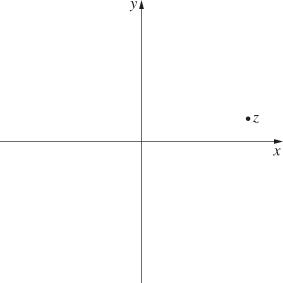
The location of the complex number \(z\) is shown on the diagram below.

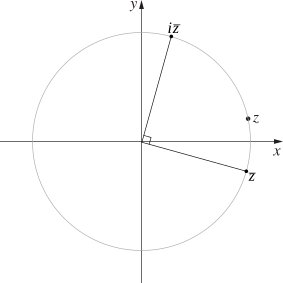
On the diagram, indicate the locations of  \(\bar{z}\)  and  \(i \bar{z}\).   (2 marks)  
 

--- 5 WORK AREA LINES (style=lined) ---

Show Answers Only

Show Worked Solution

Filed Under: Geometrical Implications of Complex Numbers, Powers and Roots Tagged With: Band 3, smc-1052-55-Rotations, smc-7430-60-Rotation and Shapes

Complex Numbers, EXT2 N2 2022 HSC 16a

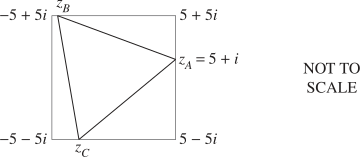
A square in the Argand plane has vertices

        `5+5i,quad5-5i,quad-5-5i`  and  `-5+5i`.

The complex numbers `z_A=5+i, z_B` and `z_C` lie on the square and form the vertices of an equilateral triangle, as shown in the diagram.


Find the exact value of the complex number `z_B`.   (4 marks)

--- 14 WORK AREA LINES (style=lined) ---

Show Answers Only

`(5-16/sqrt3)+5i`

Show Worked Solution

`z_A=5+i, \ \ z_B=b+5i, \ \ z_C=c-5i`

`z_B-z_A=(b-5)+4i`

`z_C-z_A=(c-5)-6i`


♦♦♦ Mean mark 21%.

`text{Internal angles of equilateral triangle} = pi/3:`

`=>\ (z_B-z_A)\ text{is an anti-clockwise rotation of}\ (z_C-z_A)\ text{by}\ pi/3`
 

`e^(i pi/3)(z_B-z_A)=z_C-z_A`

`(1/2+i sqrt3/2)((b-5)+4i)=(c-5)-6i`

`(b-5)/2+2i+((b-5)sqrt3)/2 i-2sqrt3` `=(c-5)-6i`  
`(b-5-4sqrt3)/2 + i((4+(b-5)sqrt3)/2)` `=(c-5)-6i`  

 
`text{Equating imaginary parts:}`

`(4+(b-5)sqrt3)/2` `=-6`  
`(b-5)sqrt3` `=-16`  
`b-5` `=-16/sqrt3`  
`b` `=5-16/sqrt3`  

 
`:.z_B=(5-16/sqrt3)+5i`

Filed Under: Geometrical Implications of Complex Numbers, Powers and Roots Tagged With: Band 6, smc-1052-55-Rotations, smc-7430-60-Rotation and Shapes

Complex Numbers, EXT2 N2 2018 HSC 11d

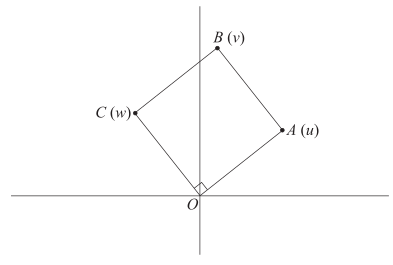
The points `A`, `B` and `C` on the Argand diagram represent the complex numbers `u`, `v` and `w` respectively.

The points `O`, `A`, `B` and `C` form a square as shown on the diagram.
 

It is given that  `u = 5 + 2i`.

  1.  Find  `w`.   (1 mark)

    --- 2 WORK AREA LINES (style=lined) ---

  2.  Find  `v`.   (1 mark)

    --- 2 WORK AREA LINES (style=lined) ---

  3.  Find  `text(arg)(w/v)`.   (1 mark)

    --- 2 WORK AREA LINES (style=lined) ---

Show Answers Only

i.    `−2 + 5i`

ii.   `3 + 7i`

iii.  `pi/4`

Show Worked Solution

i.    `w= iu= i(5 + 2i)= -2 + 5i`
 

ii.    `v` `= u + w`
    `= 5 + 2i + (-2 + 5i)`
    `= 3 + 7i`


iii.    `text(arg)(w/v)` `= text(arg)(w)-text(arg)(v)`
    `= pi/4\ \ (text(diagonal of square bisects corner))`

Filed Under: Geometrical Implications of Complex Numbers, Geometry and Complex Numbers (vectors), Powers and Roots Tagged With: Band 2, Band 3, Band 4, smc-1052-30-Quadrilaterals, smc-7430-60-Rotation and Shapes

Complex Numbers, EXT2 N2 2016 HSC 16b

  1. The complex numbers `0, \ u` and `v` form the vertices of an equilateral triangle in the Argand diagram.
  2. Show that  `u^2 + v^2 = uv.`   (2 marks)

    --- 8 WORK AREA LINES (style=lined) ---

  3. Give an example of non-zero complex numbers `u` and `v`, so that `0, \ u` and `v` form the vertices of an equilateral triangle in the Argand diagram.   (1 mark)

    --- 4 WORK AREA LINES (style=lined) ---

Show Answers Only

a.    `text(Show Worked Solutions)`

b.    `u = 1/2 + sqrt3/2 i`

Show Worked Solution

a.    `0,u,v\ text(are vertices of an equilateral triangle.)`

♦♦ Mean mark (a) 23%.


ext2-2016-hsc-16b-answer

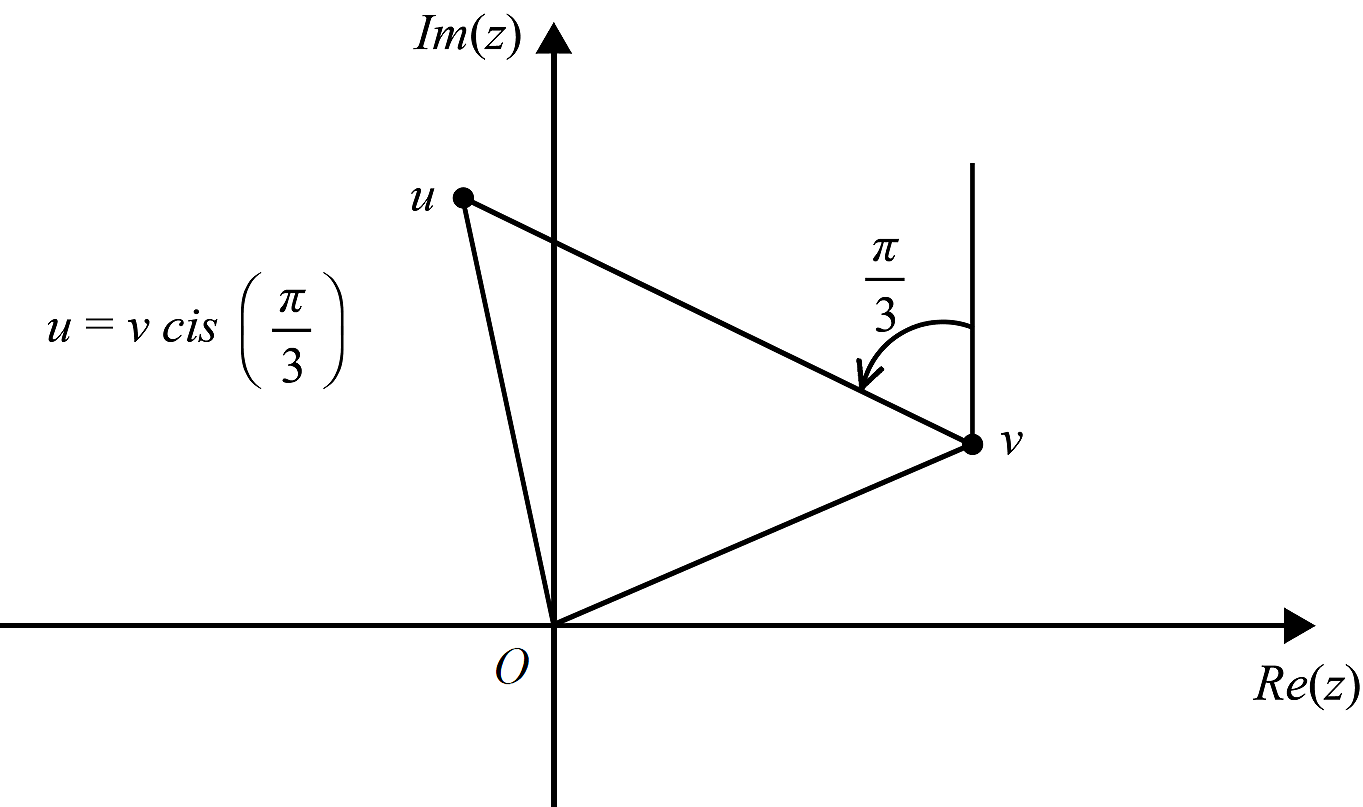
`=> u` `= v text(cis)(±pi/3)`
`u^3` `= v^3text(cis)(±pi)`
`u^3` `= − v^3`
`u^3 + v^3` `= 0`

 
`(u + v)(u^2-uv + v^2) = 0`

`text(S)text(ince)\ u != v:`

`u^2-uv + v^2` `= 0`
`:. u^2 + v^2` `= uv`


b.    `text(Let)\ \ v = 1,`

♦♦ Mean mark (b) 33%.
`:. u` `= text(cis)(pi/3)`
  `= cos\ pi/3 + isin\ pi/3`
  `= 1/2 + sqrt3/2 i`

Filed Under: Geometrical Implications of Complex Numbers, Geometry and Complex Numbers (vectors), Powers and Roots Tagged With: Band 5, Band 6, smc-1052-20-Triangles, smc-7430-60-Rotation and Shapes

Complex Numbers, EXT2 N2 2016 HSC 16a

  1. The complex numbers  `z = cos theta + i sin theta`  and  `w = cos alpha + i sin alpha`, where  `-pi < theta < pi`  and  `-pi < alpha <= pi`, satisfy
  2.    `1 + z + w = 0.`
  3. By considering the real and imaginary parts of  `1 + z + w`, or otherwise, show that `1,  z` and `w` form the vertices of an equilateral triangle in the Argand diagram.   (3 marks)

    --- 12 WORK AREA LINES (style=lined) ---

  4. Hence, or otherwise, show that if the three non-zero complex numbers `2i, z_1` and `z_2` satisfy
  5.    `|\ 2i\ | = |\ z_1\ | = |\ z_2\ |`  AND  `2i + z_1 + z_2 = 0.`
  6. then they form the vertices of an equilateral triangle in the Argand diagram.   (2 marks)

    --- 12 WORK AREA LINES (style=lined) ---

Show Answers Only

i.    `text(See Worked Solutions)`

ii.   `text(See Worked Solutions)`

Show Worked Solution

i.    `z= costheta + isintheta, \ |\ z\ | = 1`

`w= cosalpha + isinalpha, \ |\ w\ | = 1`

`text(S)text(ince)\ 1 + z + w = 0:`

♦♦♦ Mean mark (i) 25%.
STRATEGY: A clear graphical image simplifies both parts of this question significantly.
`text(Im)(1 + z + w)` `= 0`
`sintheta + sinalpha` `= 0`
`sintheta` `= −sinalpha`
`:. theta` `= −alpha\ …\ (1)`


`text(Re)(1 + z + w)` `= 0`
`1 + costheta + cosalpha` `= 0`
`2costheta` `= −1qquad(text(S)text(ince)\ cosalpha  = cos(−theta) = costheta)`
`costheta` `= −1/2`
`:. theta` `= (2pi)/3`
`alpha` `= −(2pi)/3`

 
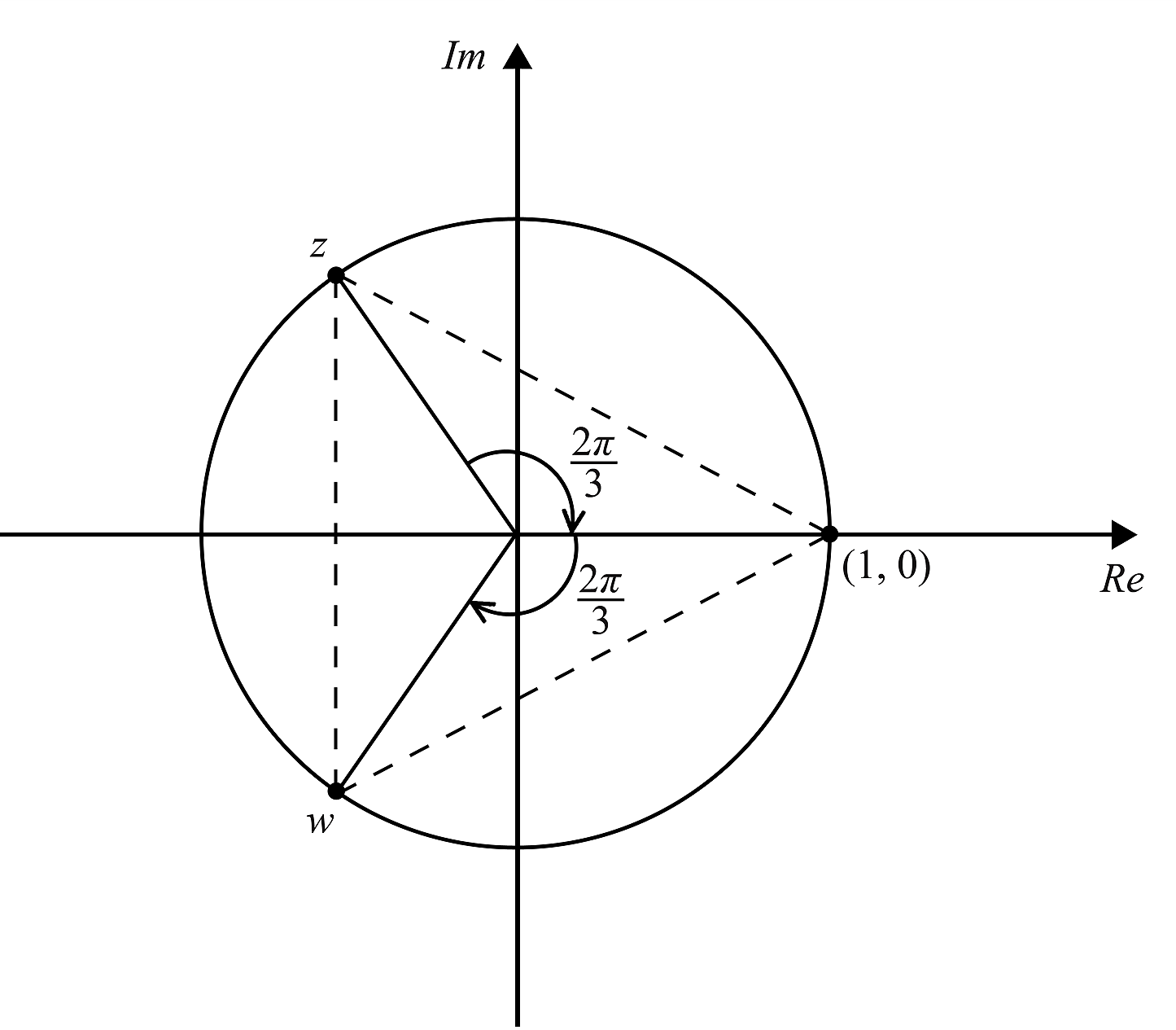
ext2-2016-hsc-16a-answer2 

`=>\ text(All points are on the unit circle separated by)\ (2pi)/3\ text(radians.)`

`:.\ text(They are vertices of an equilateral triangle.)`


ii.   `|\ 2i\ | = 2`

`text(Let)\ \ z_1` `= 2(costheta + isintheta), \  |\ z_1\ | = 2`
`z_2`  `= 2(cosalpha + isinalpha), \  |\ z_2\ | = 2`


♦♦♦ Mean mark (ii) 5%.
`text(Re)(2i + z_1 + z_2)` `= 0`
`2(costheta + cosalpha)` `= 0`
`:. costheta` `= −cosalpha`
`:. theta` `= pi-alpha`


`text(Im)(2i + z_1 + z_2)` `= 0`
`2(1 + sintheta + sinalpha)` `= 0`
`sintheta + sinalpha` `= −1`
`2sintheta` `= −1qquad(text(S)text(ince)\ sinalpha = sin(pi-theta) = sintheta)`
`sintheta` `= −1/2`
`:. theta` `= (7pi)/6`
`:. alpha` `= −pi/6`

 
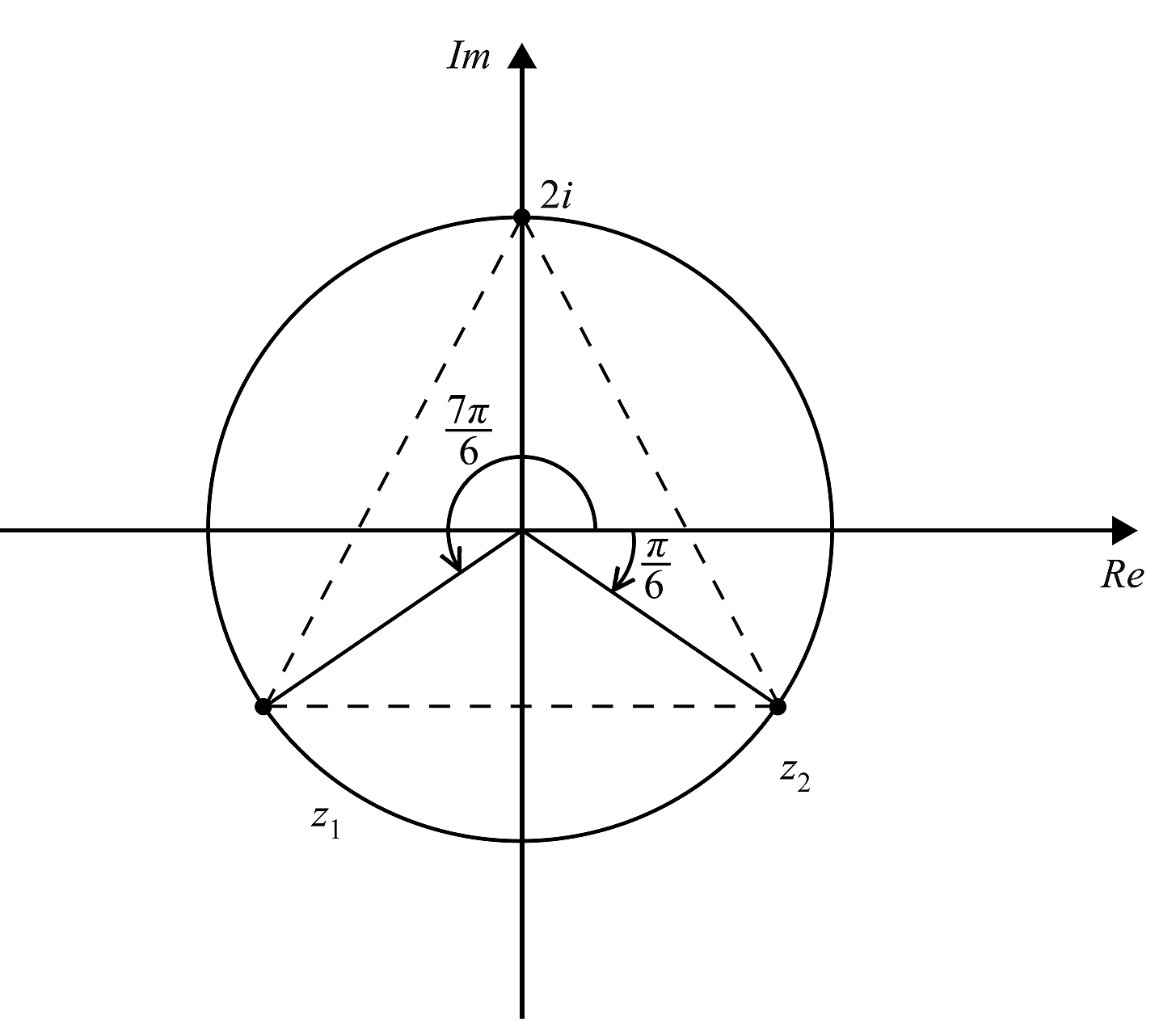
ext2-2016-hsc-16a-answer3 
 

`=>\ text(All points are on the 2 unit circle separated by)\ (2pi)/3\ text(radians.)`

`:. 2i, z_1\ text(and)\ z_2\ text(are vertices of an equilateral triangle.)`

Filed Under: Geometrical Implications of Complex Numbers, Geometry and Complex Numbers (vectors), Powers and Roots Tagged With: Band 6, smc-1052-20-Triangles, smc-7430-60-Rotation and Shapes

Complex Numbers, EXT2 N2 2016 HSC 5 MC

Multiplying a non-zero complex number by  `(1-i)/(1 + i)`  results in a rotation about the origin on an Argand diagram.

What is the rotation?

  1. Clockwise by  `pi/4`
  2. Clockwise by  `pi/2`
  3. Anticlockwise by  `pi/4`
  4. Anticlockwise by  `pi/2`
Show Answers Only

`B`

Show Worked Solution
`(1-i)/(1 + i)` `= ((1-i)^2)/((1 + i)(1-i))`
  `= (−2i)/2`
  `= −i`

 
`:. text(Clockwise rotation by)\ \ pi/2.`

`=> B`

Filed Under: Geometrical Implications of Complex Numbers, Geometry and Complex Numbers (vectors), Powers and Roots Tagged With: Band 4, smc-1052-55-Rotations, smc-7430-60-Rotation and Shapes

Complex Numbers, EXT2 N1 2016 HSC 4 MC

The Argand diagram shows the complex numbers `z` and `w`, where `z` lies in the first quadrant and `w` lies in the second quadrant.
  

ext2-hsc-2016-4mc

Which complex number could lie in the 3rd quadrant?

  1. `-w`
  2. `2 iz`
  3. `bar z`
  4. `w - z`
Show Answers Only

`=> D`

Show Worked Solution

`text(Using the parallelogram method:)`
 

ext2-hsc-2016-4mc-answer1
 

`text(From the graph above,)`

`w-z\ \ text(could lie in 3rd quadrant.)`

`=> D`

Filed Under: Argand Diagrams and Mod/Arg form, Geometric Representations, Geometry and Complex Numbers (vectors), Powers and Roots Tagged With: Band 3, smc-1049-10-Cartesian and Argand diagrams, smc-7428-10-Cartesian and Argand diagrams, smc-7430-60-Rotation and Shapes

Complex Numbers, EXT2 N1 2012 HSC 3 MC

The complex number `z` is shown on the Argand diagram below.
 

Complex Numbers, EXT2 2012 HSC 3 MC
 

Which of the following best represents `i barz`?

Complex Numbers, EXT2 2012 HSC 3 MC ab

Complex Numbers, EXT2 2012 HSC 3 MC cd

Show Answers Only

`A`

Show Worked Solution

`ibarz\ text(is)\ bar z\ text(rotated)\ 90^@\ text(anticlockwise.)`

Complex Numbers, EXT2 2012 HSC 3 MC Answer

`=>A`

Filed Under: Argand Diagrams and Mod/Arg form, Geometry and Complex Numbers (vectors), Powers and Roots Tagged With: Band 4, smc-1049-10-Cartesian and Argand diagrams, smc-7430-60-Rotation and Shapes

Complex Numbers, EXT2 N1 2009 HSC 2c

The points `P` and `Q` on the Argand diagram represent the complex numbers `z` and `w` respectively.


On the diagram, mark the following points:

  1. the point `R` representing `iz.`   (1 mark)

    --- 0 WORK AREA LINES (style=lined) ---

  2. the point `S` representing `bar w.`   (1 mark)

    --- 0 WORK AREA LINES (style=lined) ---

  3. the point `T` representing  `z + w.`   (1 mark)

    --- 0 WORK AREA LINES (style=lined) ---

Show Answers Only

a, b, and c.

Show Worked Solution

a, b, and c.

Filed Under: Argand Diagrams and Mod/Arg form, Geometry and Complex Numbers (vectors), Powers and Roots Tagged With: Band 2, Band 3, smc-1049-10-Cartesian and Argand diagrams, smc-7430-60-Rotation and Shapes

Complex Numbers, EXT2 N2 2011 HSC 2b

On the Argand diagram, the complex numbers  `0, 1 + i sqrt 3 , sqrt 3 + i`  and  `z` form a rhombus.
 

  1. Find `z` in the form  `a + ib`, where `a` and `b` are real numbers.   (1 mark)

    --- 2 WORK AREA LINES (style=lined) ---

  2. An interior angle, `theta`, of the rhombus is marked on the diagram.


    Find the value of `theta.`   (2 marks)

    --- 6 WORK AREA LINES (style=lined) ---

Show Answers Only

a.    `(1 + sqrt 3) + i(1 + sqrt 3)`

b.    `(5 pi)/6`

Show Worked Solution
a.    `z` `= 1 + i sqrt 3 + sqrt 3 + i`
  `= (1 + sqrt 3) + i (1 + sqrt 3)`


b.    `text(arg)\ z = tan^-1 ((1 + sqrt 3)/(1 + sqrt 3)) = pi/4`

`text(arg)\ (sqrt 3 + i) = tan^-1 (1/sqrt 3) = pi/6`

`text(Difference) = pi/4-pi/6 = pi/12`
 

`=>\ text(Opposite angles of a rhombus are equal)`

`=>\ text(The diagonals of a rhombus bisect the angles)`

`:.theta= pi-2 xx pi/12= (5 pi)/6\ \ text{(angle sum of triangle)`

Filed Under: Geometrical Implications of Complex Numbers, Geometry and Complex Numbers (vectors), Powers and Roots Tagged With: Band 2, Band 3, smc-1052-30-Quadrilaterals, smc-7430-60-Rotation and Shapes

Complex Numbers, EXT2 N2 2012 HSC 12d

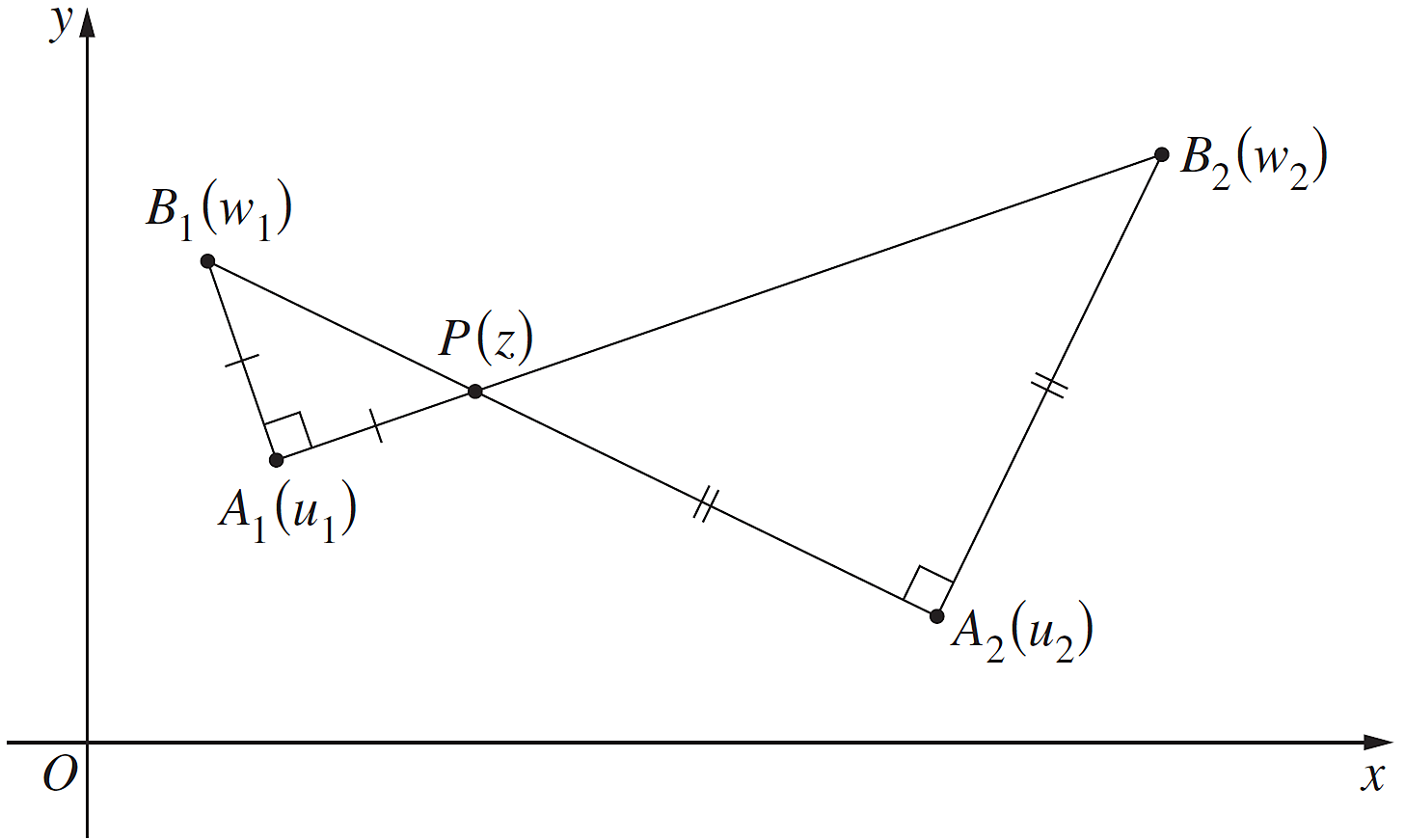
On the Argand diagram the points `A_1` and `A_2` correspond to the distinct complex numbers `u_1` and `u_2` respectively. Let `P` be a point corresponding to a third complex number `z`.

Points `B_1` and `B_2` are positioned so that `ΔA_1PB_1` and `ΔA_2B_2P`, labelled in an anti-clockwise direction, are right-angled and isosceles with right angles at `A_1` and `A_2`, respectively. The complex numbers `w_1` and `w_2` correspond to `B_1` and `B_2`, respectively.
 

Complex Numbers, EXT2 2012 HSC 12d1 

  1. Explain why  `w_1 = u_1 + i(z-u_1)`.   (1 mark)

    --- 5 WORK AREA LINES (style=lined) ---

  2. Find the locus of the midpoint of `B_1B_2` as `P`  varies.   (2 marks)

    --- 6 WORK AREA LINES (style=lined) ---

Show Answers Only

a.    `text(See Worked Solutions.)`

b.    `(u_1 + u_2)/2 + (u_2-u_1)/2 i`

Show Worked Solution
a.     `vec (A_1P)` `= z-u_1`
  `vec (A_1B_1)`  `= w_1-u_1` 

`B_1A_1 ⊥ A_1P\ text(and)\ |vec (A_1P)| = |vec (A_1B_1)|`

`vec (A_1B_1)\ text(is an anticlockwise rotation of)\ vec (A_1P)\ text(through)\ 90^@`

`w_1-u_1 = i(z −u_1)\ \ =>\ \ w_1 = u_1+ i(z −u_1)`


b.       `vec (A_2B_2)` `= w_2-u_2`
  `vec (A_2P)` `= z-u_2`

`A_2B_2 ⊥ A_2P\ text(and)\ |vec (A_2B_2)| = |vec (A_2P)|`

`vec (A_2P)\ text(is an anticlockwise rotation of)\ vec (A_2B_2)\ text(through)\ 90^@`

`z-u_2` `= i(w_2 −u_2)`
`iw_2` `= z-u_2 + iu_2`
`−w_2` `= iz-iu_2-u_2`
`:. w_2` `= u_2 + i(u_2-z)`


`:.\ text(The midpoint of)\ B_1B_2\ text(is)\ (w_1 + w_2)/2`

`= 1/2[u_1 + i(zvu_1) + u_2 + i(u_2-z)]`
`= 1/2[u_1 + u_2 + i(u_2-u_1)]`
`= (u_1 + u_2)/2 + (u_2-u_1)/2 i\ \ \ \ text{(which is a fixed point)}`

Filed Under: Geometrical Implications of Complex Numbers, Geometry and Complex Numbers (vectors), Powers and Roots Tagged With: Band 4, Band 5, smc-1052-20-Triangles, smc-7430-60-Rotation and Shapes, smc-7430-70-Vectors

Copyright © 2014–2026 SmarterEd.com.au · Log in