Sketch the region of the complex plane defined by \(\abs{z+5-i}>\abs{z-3+3 i}\). (3 marks)
--- 14 WORK AREA LINES (style=lined) ---
Aussie Maths & Science Teachers: Save your time with SmarterEd
Sketch the region of the complex plane defined by \(\abs{z+5-i}>\abs{z-3+3 i}\). (3 marks)
--- 14 WORK AREA LINES (style=lined) ---
\(\abs{z+5-i}=\abs{z-(-5+i)}\)
\(\abs{z-3+3 i}=\abs{z-(3-3 i)}\)
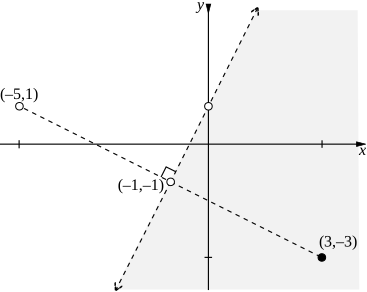
\(\text{Find equation of} \ \perp \ \text{bisector between}\ \ (-5,1) \ \ \text{and}\ \ (3,-3):\)
\(\text{Midpoint} \equiv \left(\dfrac{-5+3}{2}, \dfrac{1-3}{2}\right) \equiv (-1,-1)\)
\(m=\dfrac{-3-1}{3+5}=-\dfrac{1}{2} \ \Rightarrow \ m_{\perp}=2\)
\(\text{Equation of line} \ \ m=2 \ \ \text{through}\ \ (-1,-1):\)
| \(y+1\) | \(=2(x+1)\) |
| \(y\) | \(=2 x+1\) |
\(\text{Sketch:}\ \abs{z+5-i}>\abs{z-3+3 i}\)
Two complex numbers, `u` and `v`, are defined as `u = −2-i` and `v = −4-3i`.
--- 5 WORK AREA LINES (style=lined) ---
--- 2 WORK AREA LINES (style=lined) ---
--- 10 WORK AREA LINES (style=lined) ---
--- 2 WORK AREA LINES (style=lined) ---
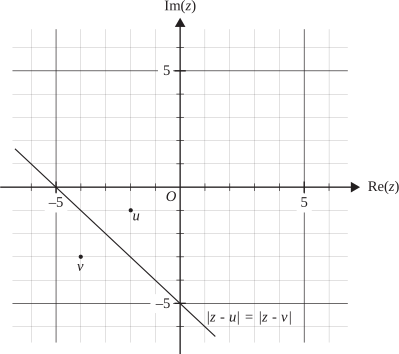
a. `y = −x-5`
b.
c. `|z-u| = |z-v|\ text(is the graph of the perpendicular bisector of the)`
`text(line joining)\ u and v.`
d.
e. `f: (−2, ∞) ->, f(x) = x + 1`
a. `text(Let)\ \ z = x + iy`
`z-u = x + 2 + iy + i`
`z-v = x + 4 + iy + 3i`
`|z-u| = |z-v|`
| `(x + 2)^2 + (y + 1)^2` | `= (x + 4)^2 + (y + 3)^2` |
| `x^2 + 4x + 4 + y^2 + 2y + 1` | `= x^2 + 8x + 16 + y^2 + 6y + 9` |
| `-4y` | `= 4x + 20` |
| `y` | `= −x-5` |
| b. |
|
c. `|z-u| = |z-v|\ text(is the graph of the perpendicular bisector of the)`
`text(line joining)\ u and v.`
| d. |
|
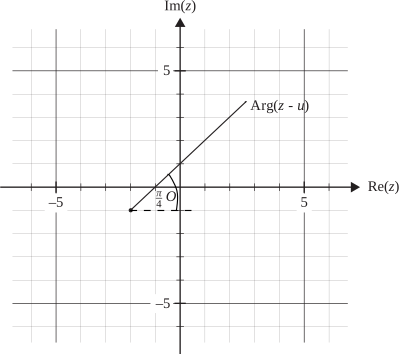
e. `text(Arg)(z-u) = pi/4 =>\ text(gradient) = 1, ytext(-intercept at)\ (0, 1)`
`:. f: (−2, ∞) -> RR, \ f(x) = x + 1`
Sketch the region in the Argand diagram where `|\ z\ | ≤ |\ z-2\ |` and `−pi/4 ≤ text(arg)\ z ≤ pi/4`. (3 marks)
--- 12 WORK AREA LINES (style=lined) ---
`text(See Worked Solutions.)`