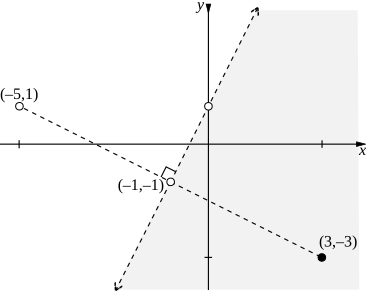
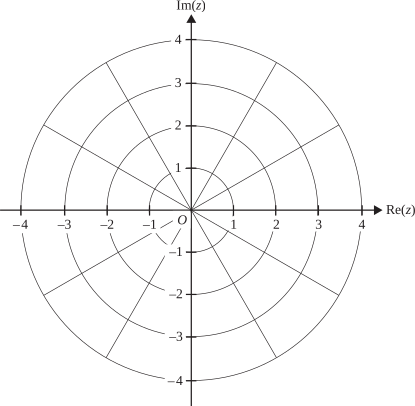
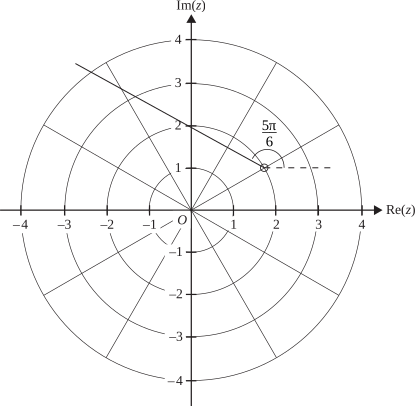
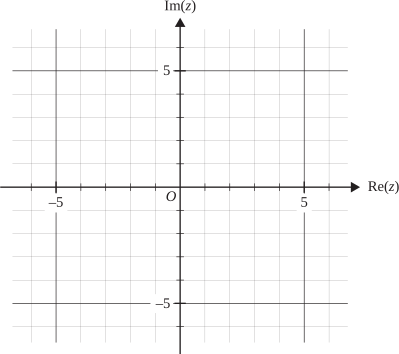
Sketch the region of the complex plane defined by \(\abs{z+5-i}>\abs{z-3+3 i}\). (3 marks)
--- 14 WORK AREA LINES (style=lined) ---
Aussie Maths & Science Teachers: Save your time with SmarterEd
Sketch the region of the complex plane defined by \(\abs{z+5-i}>\abs{z-3+3 i}\). (3 marks)
--- 14 WORK AREA LINES (style=lined) ---
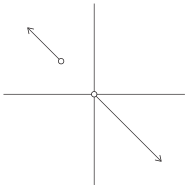
\(\abs{z+5-i}=\abs{z-(-5+i)}\)
\(\abs{z-3+3 i}=\abs{z-(3-3 i)}\)
\(\text{Find equation of} \ \perp \ \text{bisector between}\ \ (-5,1) \ \ \text{and}\ \ (3,-3):\)
\(\text{Midpoint} \equiv \left(\dfrac{-5+3}{2}, \dfrac{1-3}{2}\right) \equiv (-1,-1)\)
\(m=\dfrac{-3-1}{3+5}=-\dfrac{1}{2} \ \Rightarrow \ m_{\perp}=2\)
\(\text{Equation of line} \ \ m=2 \ \ \text{through}\ \ (-1,-1):\)
| \(y+1\) | \(=2(x+1)\) |
| \(y\) | \(=2 x+1\) |
\(\text{Sketch:}\ \abs{z+5-i}>\abs{z-3+3 i}\)
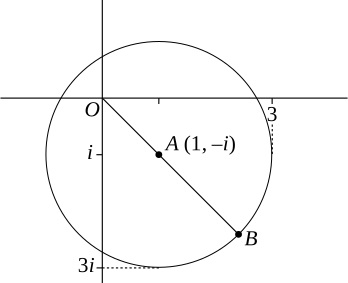
It is given that \(\abs{z-1+i}=2\).
What is the maximum possible value of \(\abs{z}\)?
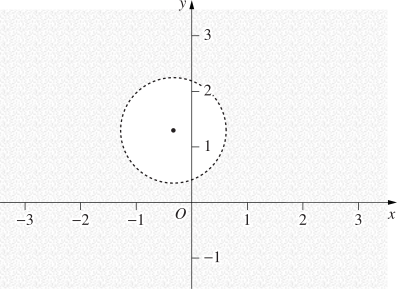
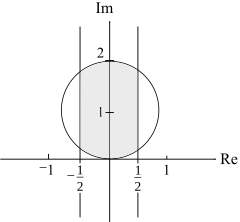
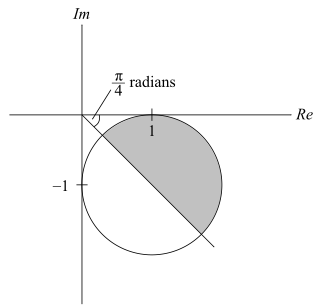
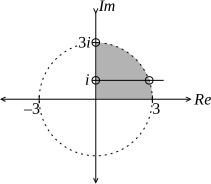
A shaded region on a complex plane is shown.
Which relation best describes the region shaded on the complex plane?
\(D\)
\(\text{By elimination:}\)
\(\text{Let}\ \ z=x+iy \ \ (x,y \in \mathbb{R}) \)
\(\text{Since shaded area is outside the circle, coefficients of}\ x^2\ \text{and} \)
\( y^2\ \text{must be positive (eliminate A and C).}\)
\(\text{Consider option D:}\)
| \(|z-1|\) | \(<2|z-i|\) | |
| \((x-1)^2+y^2\) | \(<4(x^2+(y-1)^2) \) | |
| \(x^2-2x+1+y^2\) | \(<4x^2+4y^2-8y+4\) | |
| \(0\) | \(<3x^2+2x+3y^2-8y+3\) |
\(\text{Circle equation has centre where}\ \ x<0, y>0. \)
\(\Rightarrow D\)
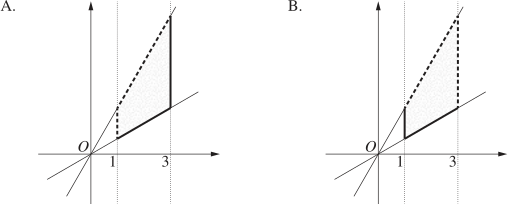
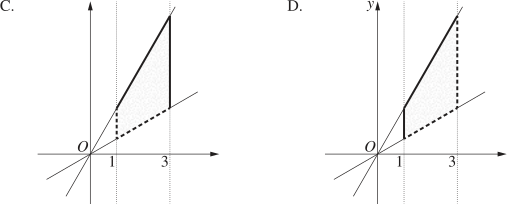
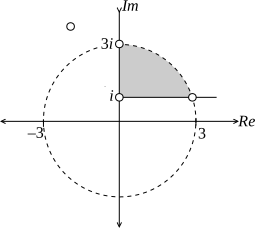
Let `R` be the region in the complex plane defined by `1 < text{Re}(z) <= 3` and `(pi)/(6) <= text{Arg}(z) < (pi)/(3)`.
Which diagram best represents the region `R`?
`A`
`1 < text{Re}(z) <= 3\ \ =>\ \ text{Eliminate}\ B and D`
`(pi)/(6) <= text{Arg}(z) < (pi)/(3)\ \ =>\ \ text{Eliminate}\ C`
`=>A`
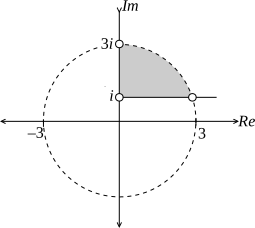
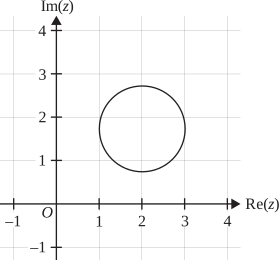
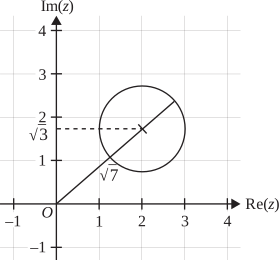
The graph of the circle given by `|z-2-sqrt3i| = 1`, where `z ∈ C`, is shown below.
For points on this circle, find the maximum value of `|z|`. (2 marks)
--- 6 WORK AREA LINES (style=lined) ---
`sqrt7+1`
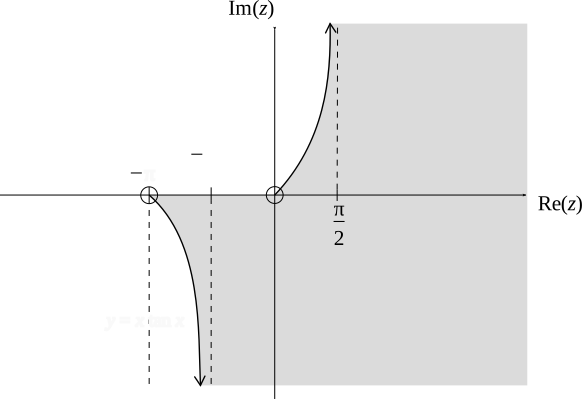
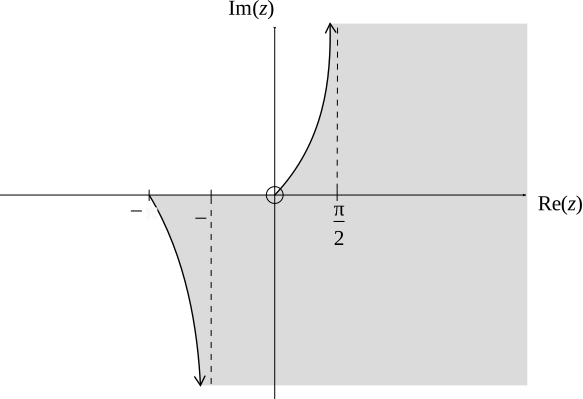
Sketch the region of the complex plane defined by `text{Re}(z) ≥ text{Arg}(z)` where `text{Arg}(z)` is the principal argument of `z`. (3 marks)
--- 12 WORK AREA LINES (style=lined) ---
`text{Find region where} \ \ text{Re}(z) ≥ text{Arg}(z).`
| `x` | `≥ tan^-1 (y/x)` | |
| `x tan (x)` | `≥ y` |
`text(If)\ \ x>=pi/2, \ x>=tan^-1(y/x)\ \ text(as)\ \ tan^-1(y/x)<pi/2`
`text{Arg}(0)\ text(is not defined.)`
`text{In quadrant 2:} \ \ x ≤ 0 \ , \ y ≤ 0 \ , \ pi/2 ≤ text{Arg}(z ) ≤ pi`
`text{Re}(z) < text{Arg}(z ) \ => \ text{no points satisfy}`
`text{In quadrant 3:} \ \ x ≤ 0 \ , \ y ≤ 0 \ , \ -pi ≤ text{Arg}(z) ≤ -pi/2`
| `text{Arg}(z)` | `= -pi + tan^-1 (y/x)` |
| `x` | `≥ -pi + tan^-1 (y/x)` |
| `tan^-1 (y/x)` | `≤ pi + x` |
| `y/x` | `≤ tan (pi + x)` |
| `y` | `≥ xtan (pi + x)` |
`text{In the domain} \ \ -pi/2 <= x <= 0,`
`text{Arg}(z) = -pi+ tan^-1(y/x) < -pi/2\ \ \ (text{s}text{ince}\ \ tan^-1(y/x)<pi/2)`
`=>\ text(all points satisfy for)\ \ \ -pi/2 <= x <= 0`
`text{In quadrant 4:} \ \ x ≥ 0 \ , \ y ≤ 0 \ , \ -pi/2 ≤ text{Arg}(z) ≤ 0`
`text{Re}(z) > text{Arg}(z) \ => \ text{all points satisfy}`
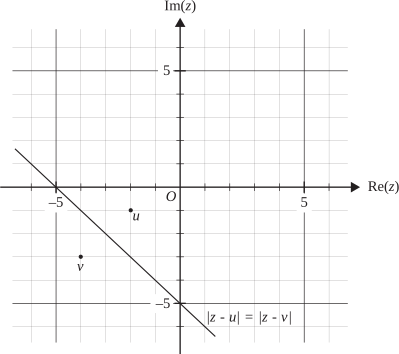
Two complex numbers, `u` and `v`, are defined as `u = −2-i` and `v = −4-3i`.
--- 5 WORK AREA LINES (style=lined) ---
--- 2 WORK AREA LINES (style=lined) ---
--- 10 WORK AREA LINES (style=lined) ---
--- 2 WORK AREA LINES (style=lined) ---
a. `y = −x-5`
b.
c. `|z-u| = |z-v|\ text(is the graph of the perpendicular bisector of the)`
`text(line joining)\ u and v.`
d.
e. `f: (−2, ∞) ->, f(x) = x + 1`
a. `text(Let)\ \ z = x + iy`
`z-u = x + 2 + iy + i`
`z-v = x + 4 + iy + 3i`
`|z-u| = |z-v|`
| `(x + 2)^2 + (y + 1)^2` | `= (x + 4)^2 + (y + 3)^2` |
| `x^2 + 4x + 4 + y^2 + 2y + 1` | `= x^2 + 8x + 16 + y^2 + 6y + 9` |
| `-4y` | `= 4x + 20` |
| `y` | `= −x-5` |
| b. |
|
c. `|z-u| = |z-v|\ text(is the graph of the perpendicular bisector of the)`
`text(line joining)\ u and v.`
| d. |
|
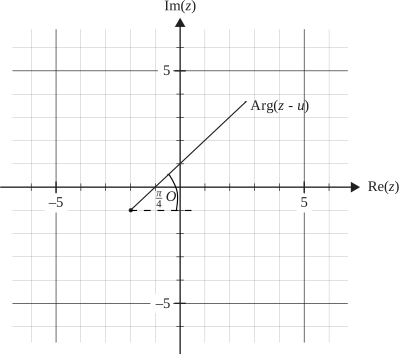
e. `text(Arg)(z-u) = pi/4 =>\ text(gradient) = 1, ytext(-intercept at)\ (0, 1)`
`:. f: (−2, ∞) -> RR, \ f(x) = x + 1`
Sketch the region in the complex plane where the inequalities
`| z + overset_z | ≤ 1` and `| z-i | ≤ 1`
hold simultaneously. (3 marks)
--- 8 WORK AREA LINES (style=lined) ---
Sketch the region on the Argand diagram where the inequalities
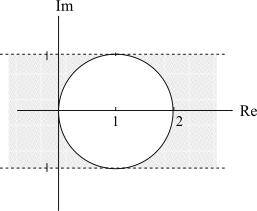
`| z-overset_z | < 2` and `| z-1 | >=1`
hold simultaneously. (3 marks)
--- 12 WORK AREA LINES (style=lined) ---
Which diagram best represents the solutions to the equation `text(arg)(z) = text(arg)(z + 1-i)`?
| A. | B. | ||
| C. | D. |
`D`
| `text(arg)(z)` | `= text(arg)(z + 1-i)` |
| `=text(arg)(z-(−1 + i))` |
`=>\ text(arg)(z-(−1 + i))\ \ text(is the argument of)\ z\ text(from)\ (-1+i).`
`text(Plot)\ (-1 + i)\ text(on the argand diagram and then test different)`
`text(positions of)\ z\ text(along the solutions for each option.)`
`=>D`
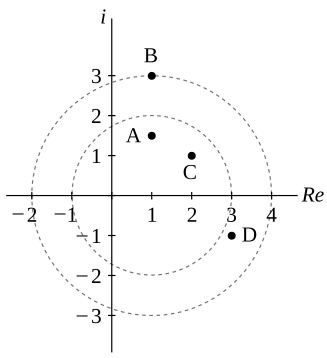
Which complex number lies in the region `2 < |z-1| < 3`?
`D`
The point `P` on the Argand diagram represents the complex number `z`, where `z` satisfies
`1/z + 1/bar z = 1.`
Give a geometrical description of the locus of `P` as `z` varies. (3 marks)
--- 6 WORK AREA LINES (style=lined) ---
`text(Locus is a circle, centre)\ (1, 0), text(radius 1,)`
`text(excluding the point)\ (0, 0).`
| `1/z + 1/bar z` | `=1/(x + iy) +1/(x-iy)` |
| `=(x-iy + x+iy)/(x^2+y^2)` | |
| `=(2x)/(x^2+y^2)` |
| `(2x)/(x^2+y^2)` | `=1` |
| `x^2 + y^2` | `=2x` |
| `x^2-2x + 1 + y^2` | `=1` |
| `(x-1)^2 + y^2` | `=1` |
`:.\ text(Locus is a circle, centre)\ (1, 0), text(radius 1,)`
`text(excluding the point)\ (0, 0).`
The complex number `z` satisfies `| z-1 | = 1.`
What is the greatest distance that `z` can be from the point `i` on the Argand diagram?
`D`
Sketch the region in the complex plane where the inequalities `1 ≤ |\ z\ | ≤ 2` and `0 ≤ z + bar z ≤ 3` hold simultaneously. (2 marks)
--- 10 WORK AREA LINES (style=lined) ---
`text(See Worked Solutions.)`
On an Argand diagram, sketch the region described by the inequality
`|\ 1 + 1/z\ | <= 1.` (2 marks)
--- 10 WORK AREA LINES (style=lined) ---
| `|\ 1 + 1/z\ |<= ` | `1` |
| `|\ (z + 1)/z\ |<= ` | `1` |
| `|\ z + 1\ |/|\ z\ |<= ` | `1` |
| `|\ z + 1\ |<= ` | `|\ z\ |` |
| `sqrt ((x + 1)^2 + y^2) <=` | `sqrt (x^2 + y^2)` |
| `(x + 1)^2 + y^2 <=` | `x^2 + y^2` |
| `x^2 + 2x + 1 <=` | ` x^2` |
| `:.x <=` | `-1/2` |
Let `a` and `b` be real numbers with `a != b`. Let `z = x + iy` be a complex number such that
`|\ z-a\ |^2-|\ z-b\ |^2 = 1.`
--- 6 WORK AREA LINES (style=lined) ---
--- 2 WORK AREA LINES (style=lined) ---
a. `text(Proof)\ \ text{(See Worked Solutions)`
b. `x = (a + b)/2 + 1/(2(b-a))`
| a. | `|\ z-a\ |^2-|\ z-b\ |^2` | `= 1` |
| `|\ (x-a)+iy\ |^2-|\ (x-b)+iy\ |^2` | `=1` | |
| `(x-a)^2 + y^2-((x-b)^2 + y^2)` | `=1` | |
| `(x-a)^2-(x-b)^2` | `=1` | |
| `(x-a-(x-b)) (x-a + x-b)` | `=1` | |
| `(b-a) (2x-a-b)` | `=1` |
| `2x-a-b` | `= 1/(b-a)` |
| `2x` | `= a + b + 1/(b-a)` |
| `:. x` | `= (a + b)/2 + 1/(2(b-a))` |
b. `text(The locus is the vertical line:)`
`x = (a + b)/2 + 1/(2(b-a)).`
Sketch the region in the Argand diagram where `|\ z\ | ≤ |\ z-2\ |` and `−pi/4 ≤ text(arg)\ z ≤ pi/4`. (3 marks)
--- 12 WORK AREA LINES (style=lined) ---
`text(See Worked Solutions.)`