SmarterEd

Aussie Maths & Science Teachers: Save your time with SmarterEd

  • Login
  • Get Help
  • About

Calculus, MET2 2022 VCAA 5

Consider the composite function `g(x)=f(\sin (2 x))`, where the function `f(x)` is an unknown but differentiable function for all values of `x`.

Use the following table of values for `f` and `f^{\prime}`.

`\quad x \quad` `\quad\quad 1/2\quad\quad` `\quad\quad(sqrt{2})/2\quad\quad` `\quad\quad(sqrt{3})/2\quad\quad`
`f(x)` `-2` `5` `3`
`\quad\quad f^{prime}(x)\quad\quad` `7` `0` `1/9`


  1. Find the value of `g\left(\frac{\pi}{6}\right)`.   (1 mark)

    --- 3 WORK AREA LINES (style=lined) ---

The derivative of `g` with respect to `x` is given by `g^{\prime}(x)=2 \cdot \cos (2 x) \cdot f^{\prime}(\sin (2 x))`.

  1. Show that `g^{\prime}\left(\frac{\pi}{6}\right)=\frac{1}{9}`.   (1 mark)

    --- 2 WORK AREA LINES (style=lined) ---

  2. Find the equation of the tangent to `g` at `x=\frac{\pi}{6}`.   (2 marks)

    --- 4 WORK AREA LINES (style=lined) ---

  3. Find the average value of the derivative function `g^{\prime}(x)` between `x=\frac{\pi}{8}` and `x=\frac{\pi}{6}`.   (2 marks)

    --- 5 WORK AREA LINES (style=lined) ---

  4. Find four solutions to the equation `g^{\prime}(x)=0` for the interval `x \in[0, \pi]`.   (3 marks)

    --- 8 WORK AREA LINES (style=lined) ---

Show Answers Only

a.    `3`

b.    `1/9`

c.    `y=1/9x+3-pi/54`

d.    `-48/pi`

e.    ` x = pi/8 , pi/4 , (3pi)/8 ,(3pi)/4`

Show Worked Solution
 

a.  `g(pi/6)`
`= f(sin(pi/3))`  
  `= f(sqrt3/2)`  
  `= 3`  


b.  `g\ ^{prime}(x)` `= 2\cdot\ cos(pi/3)\cdot\ f\ ^{prime}(sin(pi/3))`  
`g\ ^{prime}(pi/6)` `= 2 xx 1/2 xx f\ ^{prime}(sqrt3/2)`  
  `= 1/9`  


c.   `m = 1/9`  and  `g(pi/6) = 3`

`y  –  y_1` `= m(x-x_1)`  
`y  –  3` `= 1/9(x-pi/6)`  
`y` `= 1/9x + 3-pi/54`  

♦♦ Mean mark (c) 45%.
MARKER’S COMMENT: Some students did not produce an equation as required.

  
d.   The average value of `g^{\prime}(x)` between `x=\frac{\pi}{8}` and `x=\frac{\pi}{6}`

Average `= \frac{1}{\frac{\pi}{6}-\frac{\pi}{8}}\cdot\int_{\frac{\pi}{8}}^{\frac{\pi}{6}} g^{\prime}(x) d x`  
  `=24/pi \cdot[g(x)]_{\frac{\pi}{8}}^{\frac{\pi}{\6}}`  
  `= 24/pi \cdot(f(sqrt3/2)-f(sqrt2/2))`  
  `= 24/pi (3-5) = -48/pi`  

♦♦ Mean mark (d) 30%.
MARKER’S COMMENT: Those who used the Average Value formula were generally successful.
Some students substituted `g^{\prime}(x)`, not `g(x)`.

e.   `2 \cos (2 x) f^{\prime}(\sin (2 x)) = 0`

`:.\   2 \cos (2 x) = 0\ ….(1)`  or  ` f^{\prime}(\sin (2 x)) = 0\ ….(2)`

(1):   ` 2 \cos (2 x)`  `= 0`      `x \in[0, \pi]`
`\cos (2 x)` `= 0`      `2 x \in[0,2 \pi]`
`2x` `= pi/2 , (3pi)/2`  
`x` `= pi/4 , (3pi)/4`  
     
(2): ` f^{\prime}(\sin (2 x)) ` `= sqrt2/2`  
`2x` `= pi/4 , (3pi)/4`  
`x` `= pi/8 , (3pi)/8`  

  
`:. \  x = pi/8 , pi/4 , (3pi)/8 ,(3pi)/4`


♦♦ Mean mark (e) 30%.
MARKER’S COMMENT: Some students were able to find `pi/4, (3pi)/4`. Some solved `2 cos(2x)=0` or `f^{\prime}(sin(2x))=0` but not both.

Filed Under: Differentiation (Trig), Integration (Trig), Trig Differentiation, Trig Equations, Trig Integration Tagged With: Band 4, Band 5, Band 6, smc-725-10-Sin, smc-725-20-Cos, smc-736-10-sin, smc-736-20-cos, smc-737-10-sin, smc-737-20-cos, smc-737-50-Average Value, smc-737-60-Find f(x) given f'(x), smc-744-10-sin, smc-744-20-cos, smc-747-10-sin, smc-747-20-cos, smc-747-60-Average Value

Calculus, MET2 2022 VCAA 11 MC

If `\frac{d}{d x}(x \cdot \sin(x))=\sin (x)+x \cdot \cos(x)`, then `\frac{1}{k} \int x \ cos(x)dx` is equal to

  1. `k\left(x \cdot \sin (x)-\int \sin (x) d x\right)+c`
  2. `\frac{1}{k} x \cdot \sin (x)-\int \sin (x) d x+c`
  3. `\frac{1}{k}\left(x \cdot \sin (x)-\int \sin (x) d x\right)+c`
  4. `\frac{1}{k}(x \cdot \sin (x)-\sin (x))+c`
  5. `\frac{1}{k}\left(\int x \cdot \sin (x) d x-\int \sin (x) d x\right)+c`
Show Answers Only

`C`

Show Worked Solution

Given `\frac{d}{d x}(x \cdot \sin(x))=\sin (x)+x \cdot \cos(x)`, then

`x\cdot \cos (x)` `=\frac{d}{d x}(x\cdot \sin (x))-\sin (x)`  
`\frac{1}{k} \int x \cos (x) d x` `= \frac{1}{k}\left(\int \frac{d}{d x}(x \cdot \sin (x)) d x-\int \sin (x) d x\right)`  
  `= \frac{1}{k}\left(x \cdot \sin (x)-\int \sin (x)d x\right)+c`  

 
`=> C`

Filed Under: Integration (Trig), Trig Integration Tagged With: Band 4, smc-737-20-cos, smc-737-40-Integration by recognition, smc-747-20-cos, smc-747-50-Integration by recognition

Functions, MET2 2023 VCAA 2

The following diagram represents an observation wheel, with its centre at point \(P\). Passengers are seated in pods, which are carried around as the wheel turns. The wheel moves anticlockwise with constant speed and completes one full rotation every 30 minutes.When a pod is at the lowest point of the wheel (point \(A\)), it is 15 metres above the ground. The wheel has a radius of 60 metres.
 

Consider the function \(h(t)=-60\ \cos(bt)+c\) for some \(b, c \in R\), which models the height above the ground of a pod originally situated at point \(A\), after time \(t\) minutes.

  1. Show that \(b=\dfrac{\pi}{15}\) and \(c=75\).   (2 marks)

    --- 5 WORK AREA LINES (style=lined) ---

  2. Find the average height of a pod on the wheel as it travels from point \(A\) to point \(B\).
  3. Give your answer in metres, correct to two decimal places.   (2 marks)

    --- 3 WORK AREA LINES (style=lined) ---

  4. Find the average rate of change, in metres per minute, of the height of a pod on the wheel as it travels from point \(A\) to point \(B\).   (1 mark)

    --- 3 WORK AREA LINES (style=lined) ---

After 15 minutes, the wheel stops moving and remains stationary for 5 minutes. After this, it continues moving at double its previous speed for another 7.5 minutes.

The height above the ground of a pod that was initially at point \(A\), after \(t\) minutes, can be modelled by the piecewise function \(w\):
 

\(w(t) = \begin {cases}
h(t)         &\ \ 0 \leq t < 15 \\
k         &\ \ 15 \leq t < 20 \\
h(mt+n) &\ \ 20\leq t\leq 27.5
\end{cases}\)

 
where \(k\geq 0, m\geq 0\) and \(n \in R\).

  1.   i.State the values of \(k\) and \(m\).   (1 mark)

    --- 2 WORK AREA LINES (style=lined) ---

      
     ii. Find all possible values of \(n\).   (2 marks)

    --- 4 WORK AREA LINES (style=lined) ---


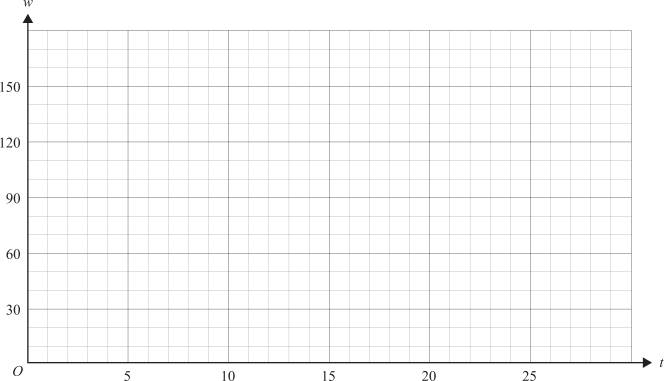
    iii. Sketch the graph of the piecewise function \(w\) on the axes below, showing the coordinates of the endpoints.   (3 marks)

    --- 0 WORK AREA LINES (style=lined) ---


  1.  
Show Answers Only

a.    \(\text{See worked solution}\)

b.    \(\approx 36.80\ \text{m}\)

c.    \(8\)

d.i.  \(k=135, m=2\)

d.ii. \(n=30p+5,\ p\in Z\)

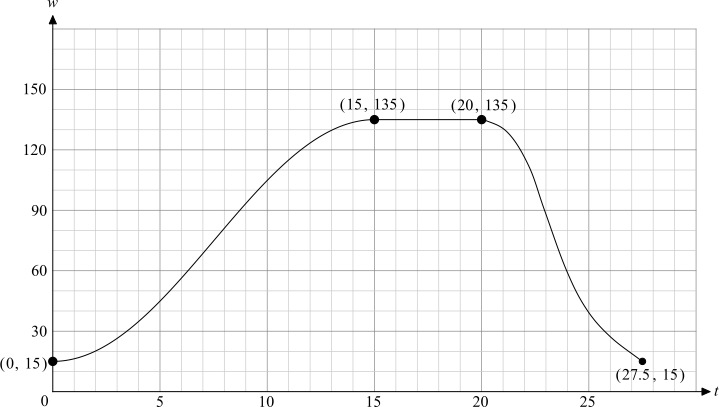
d.iii. 

Show Worked Solution
a.    \(\text{Period:}\) \(\dfrac{2\pi}{b}\) \(=30\)
    \(\therefore\ b\) \(=\dfrac{\pi}{15}\)

  
\(\text{Given }h(t)=-60\cos(bt)+c,\ \text{evaluate when }t=0, h=15\ \text{to find }c.\)

\(-60\ \cos(0)+c\)  \(=15\)
\(c\) \(=75\)

  \(\therefore\ h(t)=-60\cos(\dfrac{\pi t}{15})+75\)

b.     \(\text{Average height}\) \(=\dfrac{1}{\frac{30}{4}-0}\displaystyle\int_0^{\frac{30}{4}}\Bigg(-60\cos\Bigg(\dfrac{\pi}{15}t\Bigg)+75\Bigg)\,dt\)
    \(=\dfrac{2}{15}\left[75t-\dfrac{900\ \sin(\frac{\pi}{15}t)}{\pi}\right]_{0}^{7.5}\)
    \(=\dfrac{2}{15}\Bigg[75\times 7.5-\dfrac{900\ \sin(\frac{\pi}{15}\times 7.5)}{\pi}\Bigg]-\Bigg[0\Bigg]\)
    \(=\dfrac{75\pi-120}{\pi}=\dfrac{15(5\pi-8)}{\pi}\)
    \(=36.802\dots\approx 36.80\ \text{m}\)
 
♦♦ Mean mark (b) 45%.
MARKER’S COMMENT: \(\frac{1}{60}\int_0^{60} h(t)dt\) was a common error.
Others incorrectly found average rate of change instead of average value.

c.   \(\text{Av rate of change of height}\)

  \(=\dfrac{h(7.5)-h(0)}{7.5}\)
  \(=\dfrac{\Bigg(75-60\cos(\dfrac{\pi \times 7.5}{15})\Bigg)-\Bigg(75-60\cos(\dfrac{\pi\times 0}{15})\Bigg)}{7.5}\)
  \(=\dfrac{75-15}{7.5}=8\)
 
♦ Mean mark (c) 50%.
MARKER’S COMMENT: Common incorrect answer was – 8.
di.    \(\text{Period is 30 minutes, so after 15 minutes pod}\)
\(\text{is at the top of the wheel.}\)
  \(\therefore\ k=75-60\ \cos(\frac{\pi}{15}\times 15)=135\)

  
\(\text{Pod is travelling at twice its previous speed}\)
\(\text{so one revolution takes 15 minutes}\)

\(\therefore\ \text{Period}\rightarrow\) \(\dfrac{2\pi}{bm}\) \(=15\)
  \(bm\) \(=\dfrac{2\pi}{15}\)
  \(\dfrac{\pi}{15}\cdot m\) \(=\dfrac{2\pi}{15}\)
  \(m\) \(=\dfrac{2\pi}{15}\times \dfrac{15}{\pi}\)
    \(=2\)
 
♦♦ Mean mark (d)(i) 40%.
MARKER’S COMMENT: Many students could find \(k\) but not \(m\) with \(m=\frac{1}{2}\) a common error.
dii.   \(\text{When }t=20\ \text{the pod is at the top of the wheel and height is 135.}\)
  
\(\text{When }t=27.5\ \text{the pod is back at the start and height is 15.}\)

   
\(\text{Using CAS solve for }t=20:\rightarrow\ h(2(20)+n)=135\ \rightarrow\ n=30p+5\)

\(\text{Using CAS solve for }t=27.5:\rightarrow\ h(2(27.5)+n)=15\ \rightarrow\ n=30p+5\)

\(\therefore\ n=30p+5,\ p\in Z\)

 
♦♦♦ Mean mark (d)(ii) 20%.
MARKER’S COMMENT: Many students set up the correct equations to solve but did not provide the general solution. Some incorrectly stated the variable as an element of R.

diii.   

 
♦♦♦ Mean mark (d)(iii) 40%.
MARKER’S COMMENT: Students are reminded to include all endpoints and be particular about the curvature of graph.

Filed Under: Average Value and Other, Integration (Trig), Trig Equations, Trig Integration Tagged With: Band 4, Band 5, Band 6, smc-2757-70-Sketch graph, smc-725-20-Cos, smc-747-20-cos, smc-747-60-Average Value

Calculus, MET1 2023 VCAA 5

  1. Evaluate  \(\displaystyle \int_{0}^{\frac{\pi}{3}} \sin(x)\,dx\).   (1 mark)

    --- 3 WORK AREA LINES (style=lined) ---

  2. Hence, or otherwise, find all values of \(k\) such that \(\displaystyle \int_{0}^{\frac{\pi}{3}} \sin(x)\,dx=\displaystyle \int_{0}^{\frac{\pi}{2}} \cos(x)\,dx\), where \(-3\pi<k<2\pi\).   (3 marks)

    --- 6 WORK AREA LINES (style=lined) ---

Show Answers Only

a.    \(\dfrac{1}{2}\)

b.    \(k=\dfrac{-11\pi}{6},\ \dfrac{-7\pi}{6},\ \dfrac{\pi}{6},\ \dfrac{5\pi}{6}\)

Show Worked Solution
a.    \(\displaystyle \int_{0}^{\frac{\pi}{3}} \sin(x)\,dx\) \(=\left[-\cos x\right]_0^\frac{\pi}{3}\)
    \(=-\cos\dfrac{\pi}{3}+\cos 0\)
    \(=-\dfrac{1}{2}+1\)
    \(=\dfrac{1}{2}\)


b.    \(\displaystyle \int_{k}^{\frac{\pi}{2}} \cos(x)\,dx\) \(=\left[\sin x\right]_k^\frac{\pi}{2}\)
    \(=\sin\bigg(\dfrac{\pi}{2}\bigg)-\sin (k)\)
    \(=1-\sin (k)\)

 
\(\text{Using part (a):}\)

\(1-\sin (k)\) \(=\dfrac{1}{2}\)
\(\sin (k)\) \(=\dfrac{1}{2}\)
\(\therefore\ k\) \(=\dfrac{-11\pi}{6},\ \dfrac{-7\pi}{6},\ \dfrac{\pi}{6},\ \dfrac{5\pi}{6}\)

Filed Under: Integration (Trig), Trig Integration Tagged With: Band 4, smc-737-10-sin, smc-737-20-cos, smc-747-10-sin, smc-747-20-cos

Calculus, MET2 2019 VCAA 4 MC

`int_0^(pi/6) (a sin (x) + b cos(x))\ dx`  is equal to

  1. `((2 - sqrt 3)a - b)/2`
  2. `(b - (2 - sqrt 3) a)/2`
  3. `((2 - sqrt 3)a + b)/2`
  4. `((2 - sqrt 3) b - a)/2`
  5. `((2 - sqrt 3) b + a)/2`
Show Answers Only

`C`

Show Worked Solution

`int_0^(pi/6) (a sin (x) + b cos(x))\ dx`

`= [-a cos(x) + b sin(x)]_0^(pi/6)`

`= [-a ⋅ sqrt 3/2 + b/2 – (-a + 0)]`

`= (2a – sqrt 3 a + b)/2`

`= ((2 – sqrt 3) a + b)/2`

`=>   C`

Filed Under: Integration (Trig), Trig Integration Tagged With: Band 4, smc-737-10-sin, smc-737-20-cos, smc-747-10-sin, smc-747-20-cos

Calculus, MET1 SM-Bank 5

The function with rule  `f(x)`  has derivative  `f^{prime}(x) =  cos\ 3x`.

If  `f(pi/6) = 1,`  find  `f(x).`  (3 marks)

--- 6 WORK AREA LINES (style=lined) ---

Show Answers Only

`f(x)= 1/3 sin\ 3x + 2/3`

Show Worked Solution
`int f(x)\ dx` `=int cos\ 3x\ dx`
  `= 1/3 sin\ 3x + c`
`f(pi/6)`  `= 1/3\ [sin\ (3 xx pi/6) ]+ c`
`1`  `= 1/3\ sin\ pi/2+c`
`c`  `= 2/3`

 
`:.f(x)= 1/3 sin\ 3x + 2/3`

Filed Under: Integration (Trig), Trig Integration Tagged With: Band 4, smc-737-20-cos, smc-737-60-Find f(x) given f'(x), smc-747-20-cos, smc-747-70-Find f(x) given f'(x)

Calculus, MET1 SM-Bank 25

Evaluate  `int_0^(pi/4) cos 2x\ dx`.   (2 marks)

--- 4 WORK AREA LINES (style=lined) ---

Show Answers Only

`1/2`

Show Worked Solution

`int_0^(pi/4) cos 2x`

`= [1/2 sin\ 2x]_0^(pi/4)`

`= [1/2 sin\ pi/2-1/2 sin\ 0]`

`= 1/2-0`

`= 1/2`

Filed Under: Integration (Trig), Trig Integration Tagged With: Band 4, smc-737-20-cos, smc-747-20-cos

Calculus, MET1 2007 HSC 2bi

Find  an anti-derivative of  `(1 + cos 3x)`  with respect to `x`.   (2 marks)

--- 2 WORK AREA LINES (style=lined) ---

Show Answers Only

`x + 1/3 sin 3x + c`

Show Worked Solution

`int (1 + cos 3x)\ dx`

`= x + 1/3 sin 3x + c`

Filed Under: Integration (Trig), Trig Integration Tagged With: Band 3, smc-737-20-cos, smc-747-20-cos

Calculus, MET1 2010 VCAA 2

Find an antiderivative of  `cos (2x + 1)`  with respect to `x.`   (1 mark)

--- 5 WORK AREA LINES (style=lined) ---

Show Answers Only

`1/2 sin (2x + 1)`

Show Worked Solution

`int cos (2x + 1)\ dx`

`= 1/2 sin (2x + 1)`

Filed Under: Integration (Trig), Trig Integration Tagged With: Band 3, smc-737-20-cos, smc-747-20-cos

Calculus, MET1 2014 VCAA 7

If  `f^{prime}(x) = 2cos(x)-sin(2x)`  and  `f(pi/2) = 1/2`,  find  `f(x)`.   (3 marks)

--- 7 WORK AREA LINES (style=lined) ---

Show Answers Only

`2sinx + 1/2cos(2x)-1`

Show Worked Solution
`f(x)` `= int(2cosx-sin2x)dx`
  `= 2sinx + 1/2cos(2x) + c`

  
`text(Substitute)\ \ f(pi/2) = 1/2:`

`1/2` `= 2sin(pi/2) + 1/2cos(pi) + c`
`1/2` `= 2-1/2 + c`
`c` `=-1`
`:. f(x)` `= 2sinx + 1/2cos(2x)-1`

Filed Under: Integration (Trig), Trig Integration Tagged With: Band 4, smc-737-10-sin, smc-737-20-cos, smc-737-60-Find f(x) given f'(x), smc-747-10-sin, smc-747-20-cos, smc-747-70-Find f(x) given f'(x)

Copyright © 2014–2025 SmarterEd.com.au · Log in