SmarterEd

Aussie Maths & Science Teachers: Save your time with SmarterEd

  • Login
  • Get Help
  • About

v1 Financial Maths, STD2 F4 2021 HSC 26

Mila plans to invest $42 000 for 1.5 years. She is offered two different investment options.

Option A:  Interest is paid at 5% per annum compounded monthly.

Option B:  Interest is paid at `r` % per annum simple interest.

  1. Calculate the future value of Mila's investment after 1.5 years if she chooses Option A. (2 marks)

    --- 4 WORK AREA LINES (style=lined) ---

  2. Find the value of `r` in Option B that would give Mila the same future value after 1.5 years as for Option A. Give your answer correct to two decimal places. (2 marks)

    --- 4 WORK AREA LINES (style=lined) ---
Show Answers Only
  1. `$45\ 264.08`
  2. `5.18text(%)`
Show Worked Solution
a.   `r` `= text(5%)/12 = text(0.4167%) = 0.004167\ \text(per month)`
  `n` `= 12 × 1.5 = 18`
`FV` `= PV(1 + r)^n`
  `= 42\ 000(1 + 0.004167)^{18}`
  `= $45\ 264.08`


b.   `I` `= Prn`
  `3\ 264.08` `= 42\ 000 × r × 1.5`
  `r` `= 3\ 264.08 / (42\ 000 × 1.5)`
    `= 0.0518…`
    `= 5.18\ \text{% (to 2 d.p.)}`

Filed Under: Compound Interest and Shares (Std2-X) Tagged With: Band 4, Band 5, num-title-ct-coreb, num-title-qs-hsc, smc-4334-10-Find FV, smc-4334-40-Find r, smc-4334-50-Compound vs Simple, smc-817-20-FV Formula, smc-817-30-i/r comparisons (incl. graphs)

v1 Financial Maths, STD2 F4 2024 HSC 25

Priya and Leo each invest $2500 for 6 years.

    • Priya's investment earns simple interest at a rate of 5.8% per annum.
    • Leo's investment earns interest at a rate of 4.5% per annum, compounding half-yearly.

By calculating the interest earned over the 6 years, determine who will have the greater amount.   (3 marks)

--- 10 WORK AREA LINES (style=lined) ---

Show Answers Only

\(\text{Priya’s investment:}\)

\(\text{Interest} = Prn = 2500 \times 0.058 \times 6 = \$870\)


\(\text{Leo’s investment:}\)

\(r = \dfrac{4.5\%}{2} = 2.25\% \text{ per half-year}\)

\(\text{Compounding periods} = 6 \times 2 = 12\)

\(FV = PV(1+r)^n = 2500(1+0.0225)^{12} = \$3211.83\)

\(\text{Total interest} = FV-PV = 3211.83-2500 = \$711.83\)


\(\text{Priya’s interest } > \text{ Leo’s interest.}\)

\(\Rightarrow \text{Priya will have a greater amount (since original investment the same)}\)

Show Worked Solution

\(\text{Priya’s investment:}\)

\(\text{Interest} = Prn = 2500 \times 0.058 \times 6 = \$870\)


\(\text{Leo’s investment:}\)

\(r = \dfrac{4.5\%}{2} = 2.25\% \text{ per half-year}\)

\(\text{Compounding periods} = 6 \times 2 = 12\)

\(FV = PV(1+r)^n = 2500(1+0.0225)^{12} = \$3211.83\)

\(\text{Total interest} = FV-PV = 3211.83-2500 = \$711.83\)


\(\text{Priya’s interest } > \text{ Leo’s interest.}\)

\(\Rightarrow \text{Priya will have a greater amount (since original investment the same)}\)

Filed Under: Compound Interest and Shares (Std2-X) Tagged With: Band 4, smc-817-20-FV Formula, smc-817-30-i/r comparisons (incl. graphs)

Financial Maths, STD2 F1 2024 NHT1 24*

Jarryd invested $14 000 into an account earning compound interest at a fixed rate per time period.

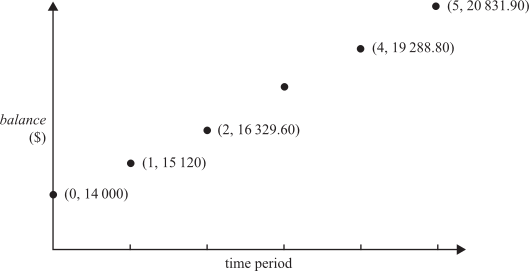
The graph below shows the balance of the account for four of the first five time periods after the initial investment. The information for time period 3 is not shown.


Immediately after the interest was calculated for time period 3, Jarryd added an extra one-off amount into the account.

Determine the value of Jarrod's extra one off amount, giving your answer correct to the nearest cent.   (3 marks)

--- 6 WORK AREA LINES (style=lined) ---

Show Answers Only

\(\$224.03 \)

Show Worked Solution

\(\text{Increase factor between periods}\ = \dfrac{15\,120}{14\,000}=1.08\)

\(\text{At time period 3:}\)

\(\text{Balance (before extra payment)}\ = 14\,000 \times 1.08^{3} = 17\,635.97 \)

\(\text{Let}\ V = 17\,635.97 +\ \text{extra payment}\)

\(V \times 1.08 = 19\,288.80\ \ \Rightarrow\ \ V=17\,860.00\)

\(\therefore \ \text{Extra payment}\ = 17\,860.00-17\,635.97=\$224.03 \)

Filed Under: Compound Interest and Shares (Std2) Tagged With: Band 5, smc-817-20-FV Formula, smc-817-30-i/r comparisons (incl. graphs)

Financial Maths, STD2 F1 2024 GEN1 20*

Dainika invested $2000 for three years at 4.4% per annum, compounding quarterly.

To earn the same amount of interest in three years in a simple interest account, determine the annual simple interest rate. Give your as a percentage, correct to two decimal places.   (3 marks)

--- 5 WORK AREA LINES (style=lined) ---

Show Answers Only

\(4.68\%\)

Show Worked Solution

\(\text{Interest rate (per compounding period)} = \dfrac{4.4}{4} = 1.1 \%\)

\(\text{Compounding periods}\ =3\times4=12\)

\(FV=PV(1+r)^{n} = 2000(1+0.011)^{12}=$2280.57\)

\(\text{Annual interest}\ = \dfrac{280.57}{3}=$93.52\)

\(\text{S.I. rate}\ =\dfrac{93.52}{2000}\times 100\%=4.676\dots=4.68\%\ \text{(2 d.p.)}\)

♦ Mean mark 48%.

Filed Under: Compound Interest and Shares (Std2) Tagged With: Band 5, smc-817-30-i/r comparisons (incl. graphs)

Financial Maths, STD2 F4 2024 HSC 25

Alex and Jun each invest $1800 for 5 years.

    • Alex's investment earns simple interest at a rate of 7.5% per annum.
    • Jun's investment earns interest at a rate of 6.0% per annum, compounding quarterly.

By calculating the interest earned over the 5 years, determine who will have the greater amount.   (3 marks)

--- 10 WORK AREA LINES (style=lined) ---

Show Answers Only

\(\text {Alex’s investment:}\)

\(\text{Interest}=Prn=1800 \times 0.075 \times 5=\$ 675\)
 

\(\text {Jun’s investment:}\)

\(r=\dfrac{6.0\%}{4}=1.5 \% \text { per quarter}\)

\(\text {Compounding periods }=5 \times 4=20\)

\(F V=P V(1+r)^n=1800(1+0.015)^{20}=\$ 2424.34\)

\(\text{Total interest}=F V-P V=2424.34-1800=\$ 624.34\)
 

\(\text {Alex’s interest }>\text { Jun’s interest.}\)

\(\Rightarrow \text{ Alex will have a greater amount (since original investment the same)}\)

Show Worked Solution

\(\text {Alex’s investment:}\)

\(\text{Interest}=Prn=1800 \times 0.075 \times 5=\$ 675\)
 

\(\text {Jun’s investment:}\)

\(r=\dfrac{6.0\%}{4}=1.5 \% \text { per quarter}\)

\(\text {Compounding periods }=5 \times 4=20\)

\(F V=P V(1+r)^n=1800(1+0.015)^{20}=\$ 2424.34\)

\(\text{Total interest}=F V-P V=2424.34-1800=\$ 624.34\)
 

\(\text {Alex’s interest }>\text { Jun’s interest.}\)

\(\Rightarrow \text{ Alex will have a greater amount (since original investment the same)}\)

Filed Under: Compound Interest and Shares (Std2) Tagged With: Band 4, smc-817-20-FV Formula, smc-817-30-i/r comparisons (incl. graphs)

Financial Maths, STD2 F4 2021 HSC 26

Nina plans to invest $35 000 for 1 year. She is offered two different investment options.

Option A:  Interest is paid at 6% per annum compounded monthly.

Option B:  Interest is paid at `r` % per annum simple interest.

  1. Calculate the future value of Nina's investment after 1 year if she chooses Option A.  (2 marks)

    --- 4 WORK AREA LINES (style=lined) ---

  2. Find the value of `r` in Option B that would give Nina the same future value after 1 year as for Option A. Give your answer correct to two decimal places.  (2 marks)

    --- 4 WORK AREA LINES (style=lined) ---

Show Answers Only
  1. `$37\ 158.72`
  2. `6.17text(%)`
Show Worked Solution
a.   `r` `= text(6%)/12= text(0.5%) = 0.005\ text(per month)`
  `n` `=12`


`FV` `= PV(1 + r)^n`
  `= 35\ 000(1 + 0.005)^(12)`
  `= $37\ 158.72`

♦♦ Mean mark part (b) 36%.
b.   `I` `=Prn`
  `2158.72` `=35\ 000 xx r xx 1`
  `r` `=2158.72/(35\ 000)`
    `=0.06167…`
    `=6.17 text{% (to 2 d.p.)}`

Filed Under: Compound Interest, Compound Interest and Shares (Std2) Tagged With: Band 4, Band 5, num-title-ct-coreb, num-title-qs-hsc, smc-4334-10-Find FV, smc-4334-40-Find r, smc-4334-50-Compound vs Simple, smc-817-20-FV Formula, smc-817-30-i/r comparisons (incl. graphs)

Financial Maths, STD2 F4 2019 HSC 13 MC

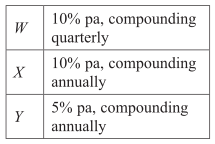
The graph show the future values over time of  `$P`, invested at three different rates of compound interest.


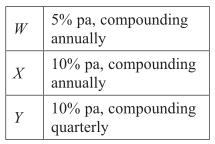
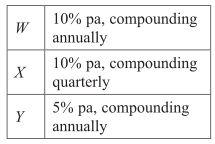
Which of the following correctly identifies each graph?

A. B.
C. D.
Show Answers Only

`C`

Show Worked Solution

`text(Values increase quicker)`

`text(- higher compounding interest rate)`

`text(- same rate but more frequent compounding period)`

`:. W = 10text(% quarterly)`

`X = 10text(% annually)`

`Y = 5text(% annually)`

 
`=> C`

Filed Under: Compound Interest, Compound Interest and Shares (Std2), Modelling Investments and Loans (Y12) Tagged With: Band 4, common-content, num-title-ct-coreb, num-title-qs-hsc, smc-1002-30-Interest Rate Graph Comparison, smc-4334-40-Find r, smc-4334-60-Graphs, smc-817-30-i/r comparisons (incl. graphs)

Financial Maths, STD2 F1 2007 HSC 23a

Lilly and Rose each have money to invest and choose different investment accounts.

The graph shows the values of their investments over time.


  1. How much was Rose’s original investment?  (1 mark)

    --- 1 WORK AREA LINES (style=lined) ---

  2. At the end of  6 years, which investment will be worth the most and by how much?  (2 marks)

    --- 4 WORK AREA LINES (style=lined) ---
  3. Lilly’s investment will reach a value of  $20 000  first.
  4. How much longer will it take Rose’s investment to reach a value of  $20 000?   (1 mark)

    --- 2 WORK AREA LINES (style=lined) ---
Show Answers Only
  1. `$5000`
  2. `text(Rose’s is worth $2000 more.)`
  3. `text(It takes Lilly 14 years to reach $20 000 and it takes)`


    `text{Rose 1 year longer (15 years) to reach the same value}`

Show Worked Solution

i.  `$5000\ text{(} y text(-intercept) text{)}`
 

ii.  `text(After 6 years,)`

`text(Lilly’s investment)` `= $9000`
`text(Rose’s investment)` `= $11\ 000`
`:.\ text(Rose’s is worth $2000 more.)`


iii.  `text(It takes Lilly 14 years to reach $20 000 and it)`

`text{takes Rose 1 year longer (15 years) to reach the}`

`text(same value.)`

Filed Under: Compound Interest and Shares (Std2), F2 Investment (Y12), FM2 - Investing, Simple Interest and S/L Depreciation (Std 1), Simple Interest and S/L Depreciation (Std 2) Tagged With: Band 2, Band 3, Band 4, smc-1108-30-i/r comparisons (incl. graphs), smc-1124-10-Simple Interest, smc-808-10-Simple Interest, smc-817-30-i/r comparisons (incl. graphs)

Copyright © 2014–2025 SmarterEd.com.au · Log in